
Work Readiness Standards and Benchmarks The Key to
Work Readiness Standards and Benchmarks The Key to Differentiating America’s Workforce and Regaining Global Competitiveness 02/07/13
Agenda 1. Overview of Work Readiness Standards and Benchmarks 2. Application of curriculum profiles in developing occupational training programs aligned with employer demand for skills in construction management 3. Application of work readiness standards for skill-based careers in manufacturing 4. Development of a “fast track” program for Nursing Assistants that focuses on both the development of foundational and occupational specific skills 5. Q & A 2
Ready for College and Ready for Work: Same AND Different? • Levels of readiness in reading and math needed to succeed in college-level courses without remediation are comparable to those needed to learn job-specific skills. • These findings do not address “job-specific” skills, above and beyond “foundational” skills. • Individuals need both to be successful in a career pathway and to differentiate themselves in a competitive job market. 3
Definition of Work Readiness A “work ready” individual possesses the foundational skills needed to be minimally qualified for a specific occupation as determined through a job analysis or occupational profile. 4
Work Ready Skills 1) Foundational AND occupation specific 2) Vary in both importance and level for different occupations 3) Depend on the critical tasks identified via a job analysis or occupational profile 5
Work Ready Standards and Benchmarks • Work Ready Standards are precise descriptions of the knowledge and combination of skills that individuals need to be minimally qualified for a target occupation. • While work readiness standards establish the mix of skills and range of levels reported by employers (i. e. , minimum and maximum) for specific occupations, benchmarks are the target skill level (i. e. , median) that an individual should aim for in order to be considered work ready. 6
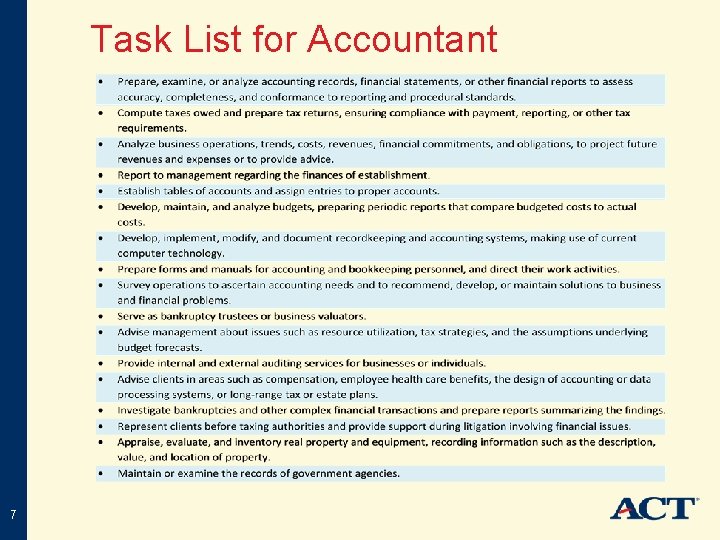
Task List for Accountant 7
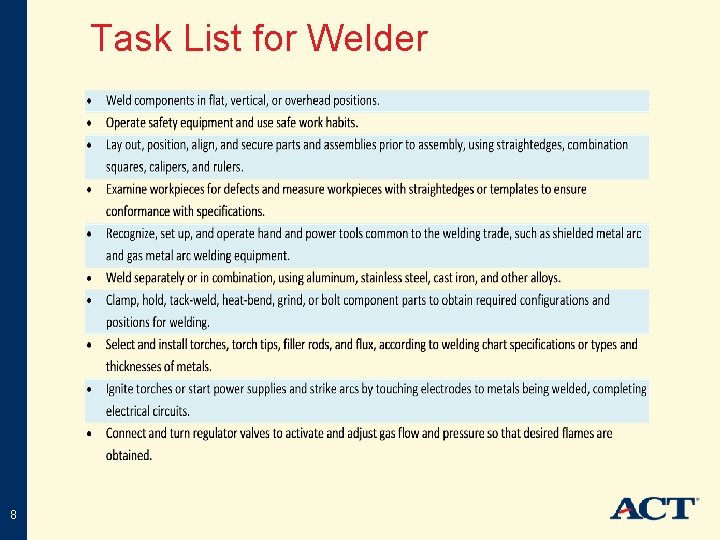
Task List for Welder 8
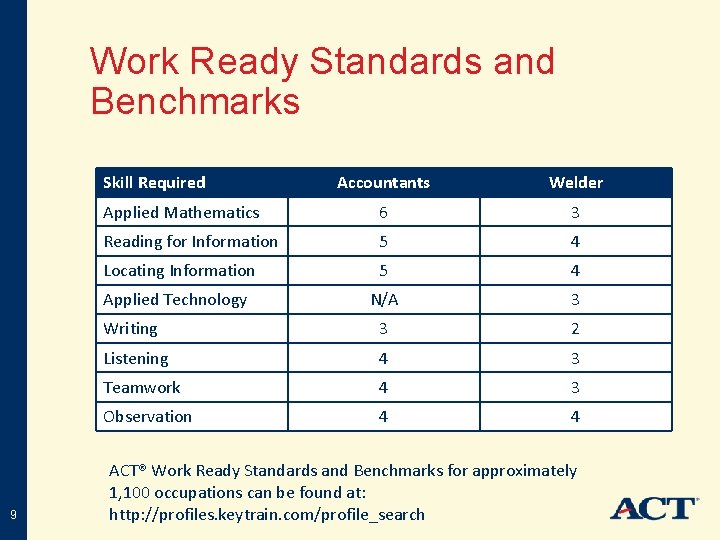
Work Ready Standards and Benchmarks Skill Required 9 Accountants Welder Applied Mathematics 6 3 Reading for Information 5 4 Locating Information 5 4 Applied Technology N/A 3 Writing 3 2 Listening 4 3 Teamwork 4 3 Observation 4 4 ACT® Work Ready Standards and Benchmarks for approximately 1, 100 occupations can be found at: http: //profiles. keytrain. com/profile_search
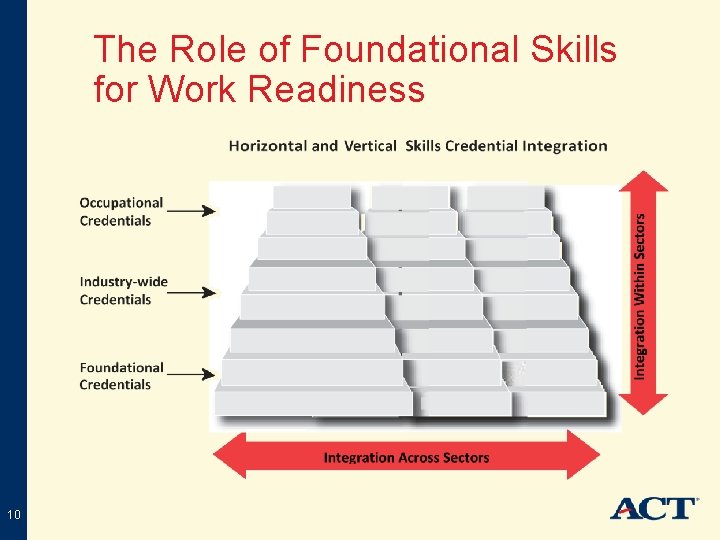
The Role of Foundational Skills for Work Readiness 10
For more information contact: Hope Clark Assistant Vice President, Workforce Research hope. clark@act. org 11

Curriculum Profile Kirkwood Construction Management Program
Construction Management 2 Year Program • provides entry-level skills and knowledge for students who want to pursue one of the many careers available in the construction industry • residential, commercial or highway construction; material suppliers; building inspection; component manufacturing
Why a curriculum profile? • Construction management program had been developed through collaboration with 2 and 4 year institutions across the country • UNI is Kirkwood’s current 4 year partner in development of educational path • Industry partner feedback • Create a consistent pathway from 2 year to 4 year. • Are we addressing the foundation and job ready skills in our curriculum?
The Players…. Work. Keys certified job profiler with profiling experience was key for success Need for in depth analysis for foundational and job ready skills Subject Matter Experts willing to be open and identify gaps
Curriculum Review • Review of current objectives related to 27 technical outcomes • Used SME within the department who consulted with recent graduates, other instructors and Dean • Crosswalk between learning objectives defined by National Center for Construction and Education Careers
Identification of Needed Job Ready Skills • SMEs and Job profiler walked through curriculum of all major classes • SME and job profiler identified objectives from the NCCER curriculum that were not being covered in current curriculum and were also being recommended by industry partners. • Identified objectives were then added to appropriate courses • 83 Learning objectives were identified for the 2 year program, an increase of 20% from pre-curriculum profile – It’s not that these weren’t being taught, but were we being consistent in our teaching and making sure all industry needed skills were addressed at appropriate times in the program.
Examples of Job Ready Skills – Describe the four common construction delivery systems by attending class discussion as a part of Construction Management coursework – Identify the gender and minority issues associated with a changing workforce. This is attained as a part of the Construction Law and Construction Management courses. – Explain the quality control responsibility of managers, superintendents, and crew leaders by reviewing case studies, applying calculation methods and text as part of the Construction Management coursework
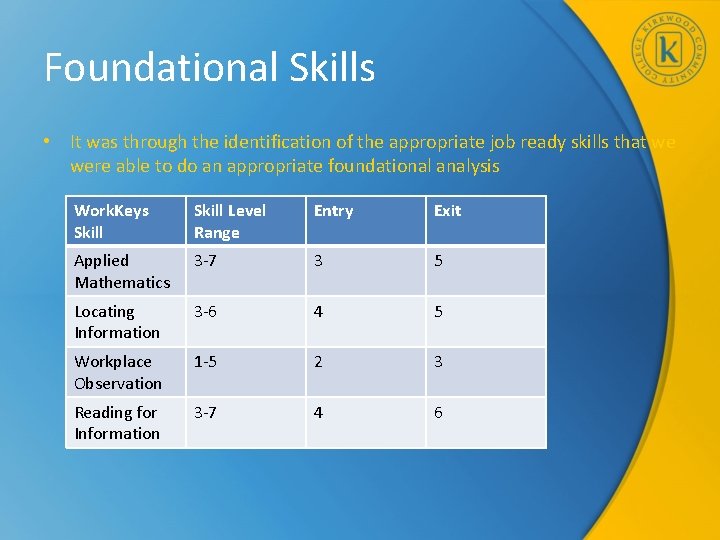
Foundational Skills • It was through the identification of the appropriate job ready skills that we were able to do an appropriate foundational analysis Work. Keys Skill Level Range Entry Exit Applied Mathematics 3 -7 3 5 Locating Information 3 -6 4 5 Workplace Observation 1 -5 2 3 Reading for Information 3 -7 4 6
Amy Lasack Kirkwood Community College amy. lasack@kirkwood. edu 319 -398 -5435
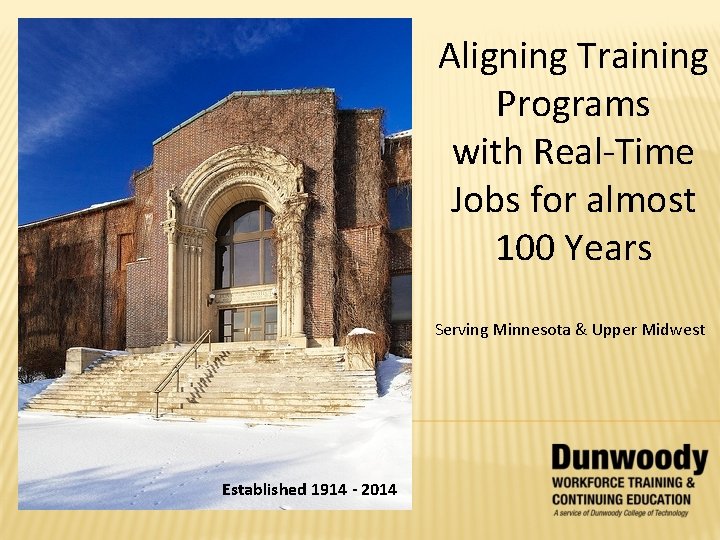
Aligning Training Programs with Real-Time Jobs for almost 100 Years Serving Minnesota & Upper Midwest Established 1914 - 2014
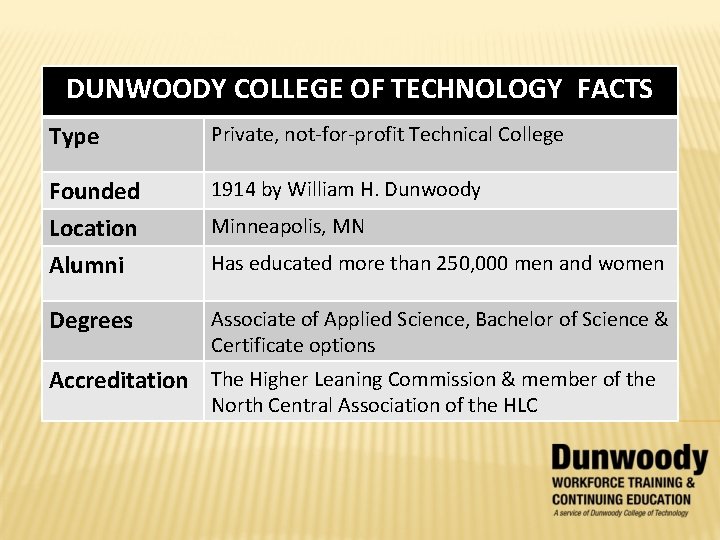
DUNWOODY COLLEGE OF TECHNOLOGY FACTS Type Private, not-for-profit Technical College Founded Location Alumni 1914 by William H. Dunwoody Degrees Associate of Applied Science, Bachelor of Science & Certificate options Minneapolis, MN Has educated more than 250, 000 men and women Accreditation The Higher Leaning Commission & member of the North Central Association of the HLC
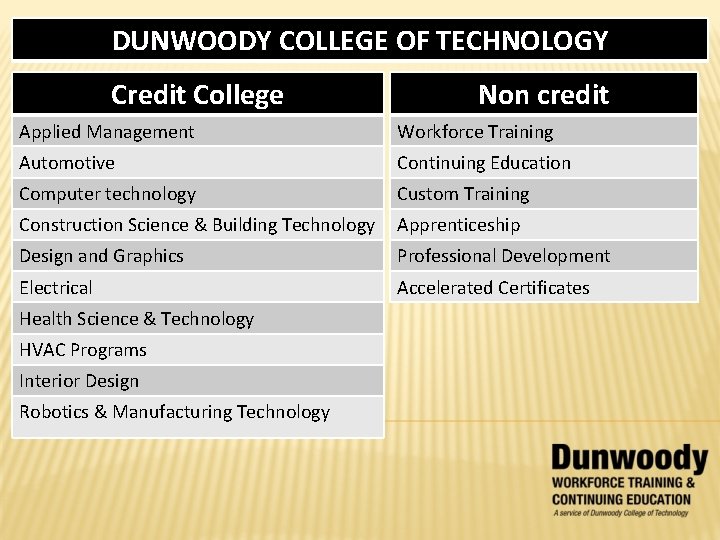
DUNWOODY COLLEGE OF TECHNOLOGY Credit College Non credit Applied Management Workforce Training Automotive Continuing Education Computer technology Custom Training Construction Science & Building Technology Apprenticeship Design and Graphics Professional Development Electrical Accelerated Certificates Health Science & Technology HVAC Programs Interior Design Robotics & Manufacturing Technology
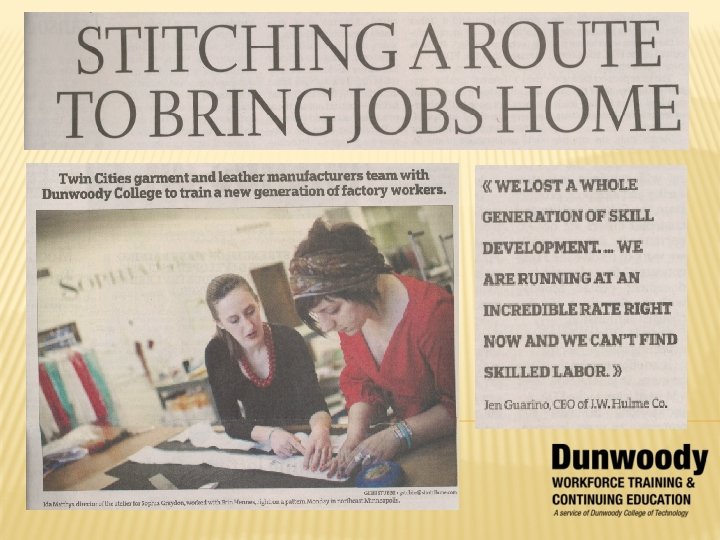
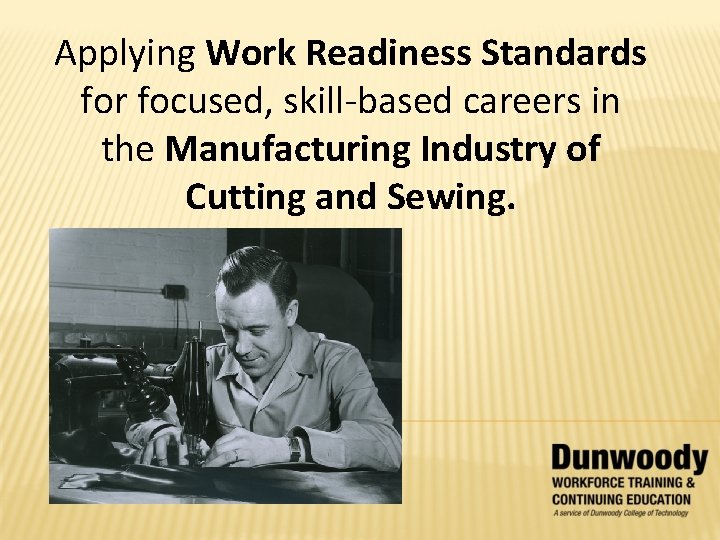
Applying Work Readiness Standards for focused, skill-based careers in the Manufacturing Industry of Cutting and Sewing.
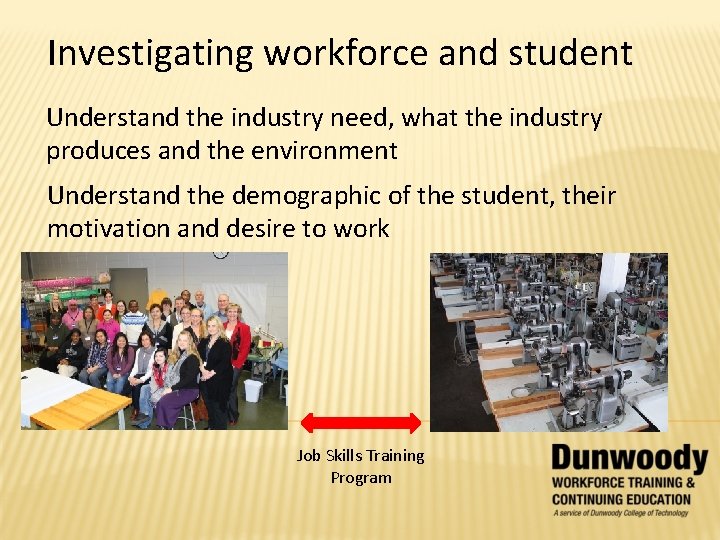
Investigating workforce and student Understand the industry need, what the industry produces and the environment Understand the demographic of the student, their motivation and desire to work Job Skills Training Program
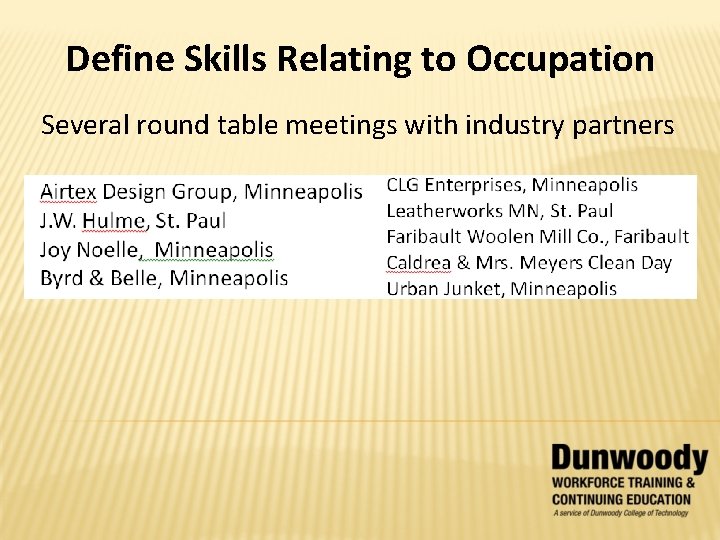
Define Skills Relating to Occupation Several round table meetings with industry partners
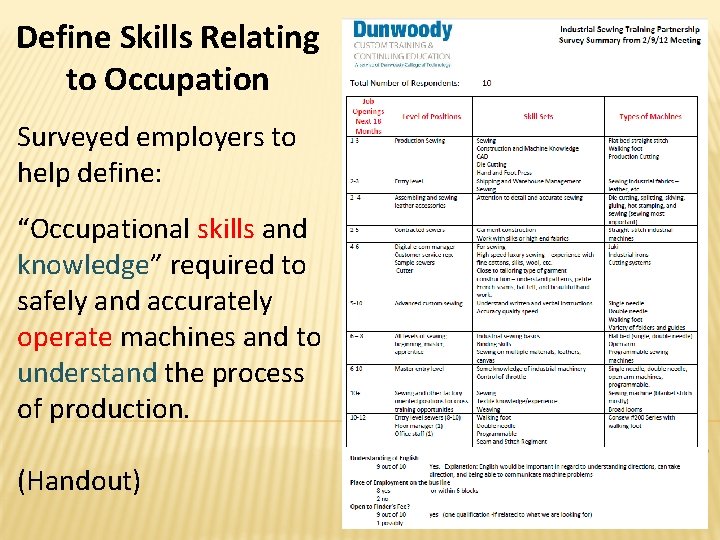
Define Skills Relating to Occupation Surveyed employers to help define: “Occupational skills and knowledge” required to safely and accurately operate machines and to understand the process of production. (Handout)
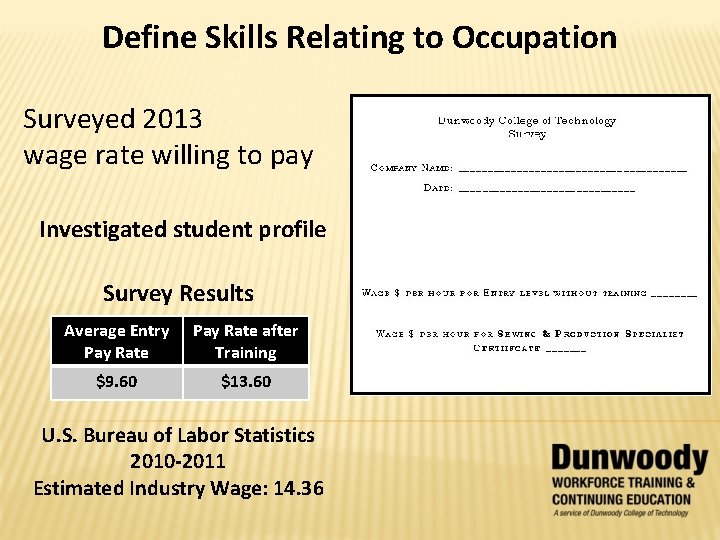
Define Skills Relating to Occupation Surveyed 2013 wage rate willing to pay Investigated student profile Survey Results Average Entry Pay Rate after Training $9. 60 $13. 60 U. S. Bureau of Labor Statistics 2010 -2011 Estimated Industry Wage: 14. 36
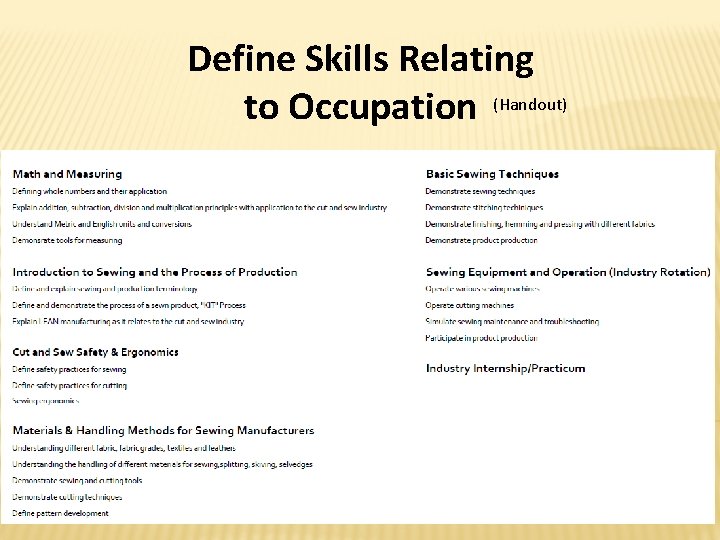
Define Skills Relating to Occupation (Handout)
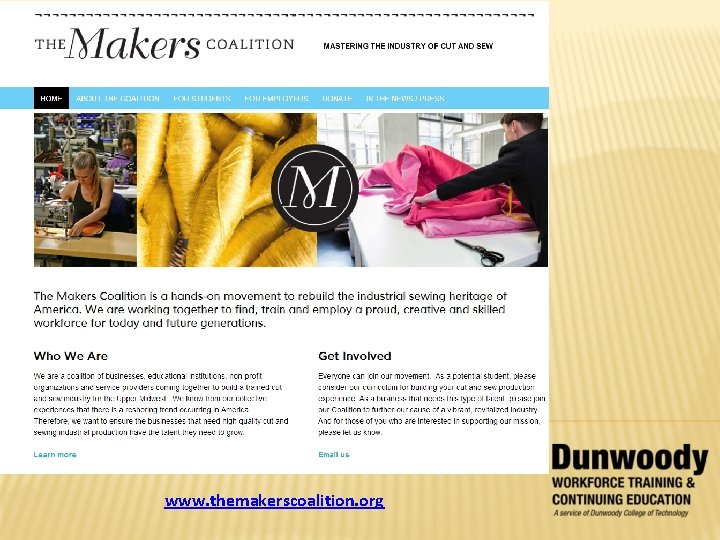
www. themakerscoalition. org
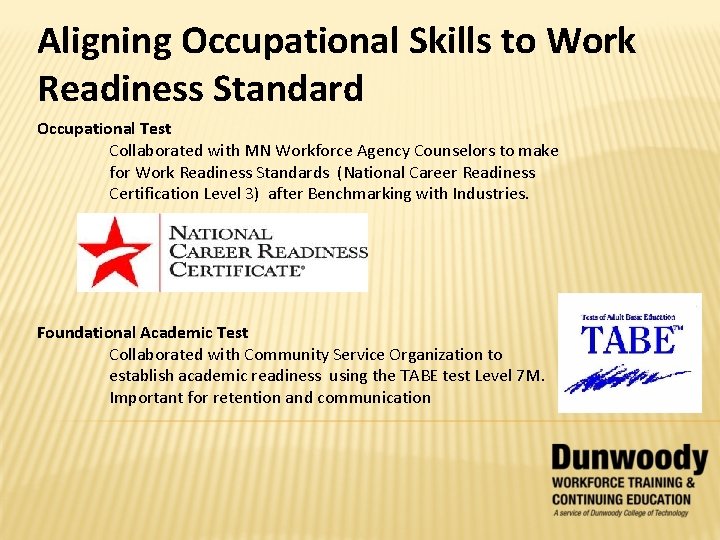
Aligning Occupational Skills to Work Readiness Standard Occupational Test Collaborated with MN Workforce Agency Counselors to make for Work Readiness Standards (National Career Readiness Certification Level 3) after Benchmarking with Industries. Foundational Academic Test Collaborated with Community Service Organization to establish academic readiness using the TABE test Level 7 M. Important for retention and communication
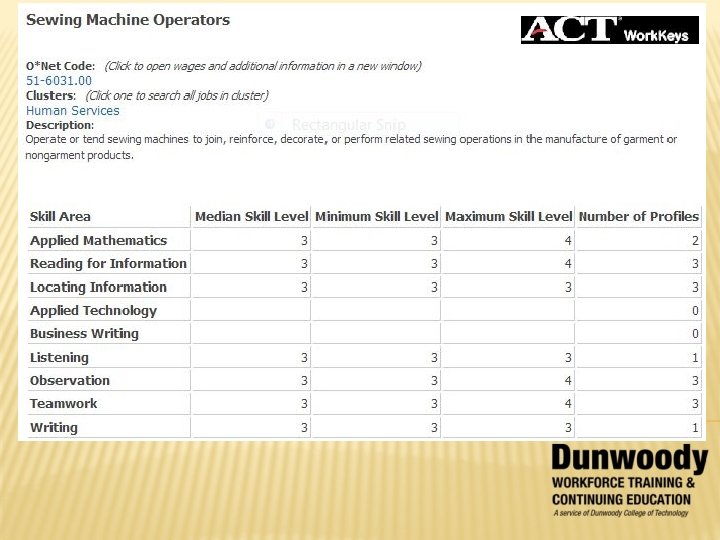
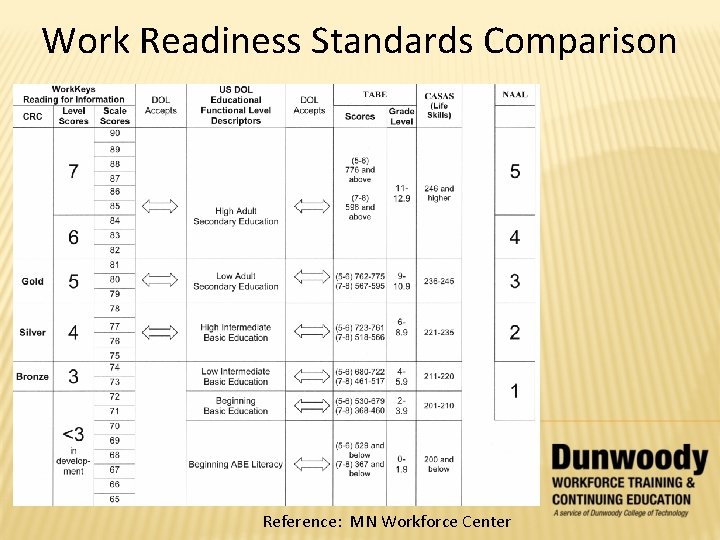
Work Readiness Standards Comparison Reference: MN Workforce Center
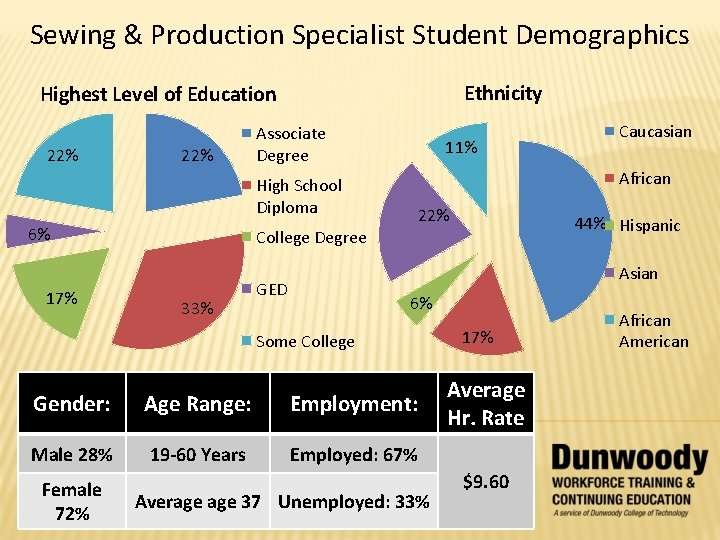
Sewing & Production Specialist Student Demographics Ethnicity Highest Level of Education 22% Associate Degree High School Diploma 6% 17% College Degree 33% 11% African 22% 44% Hispanic Asian GED 6% Some College Gender: Age Range: Employment: Male 28% 19 -60 Years Employed: 67% Female 72% Caucasian Average 37 Unemployed: 33% 17% Average Hr. Rate $9. 60 African American
Questions? Thank You!
RSN at South Central College Dr. Nancy Genelin Vice President of Academic Affairs nancy. genein@southcental. edu
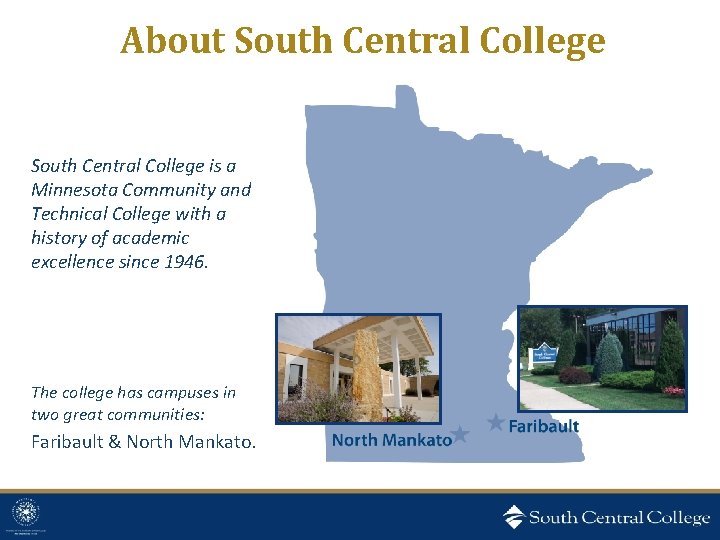
About South Central College is a Minnesota Community and Technical College with a history of academic excellence since 1946. The college has campuses in two great communities: Faribault & North Mankato.
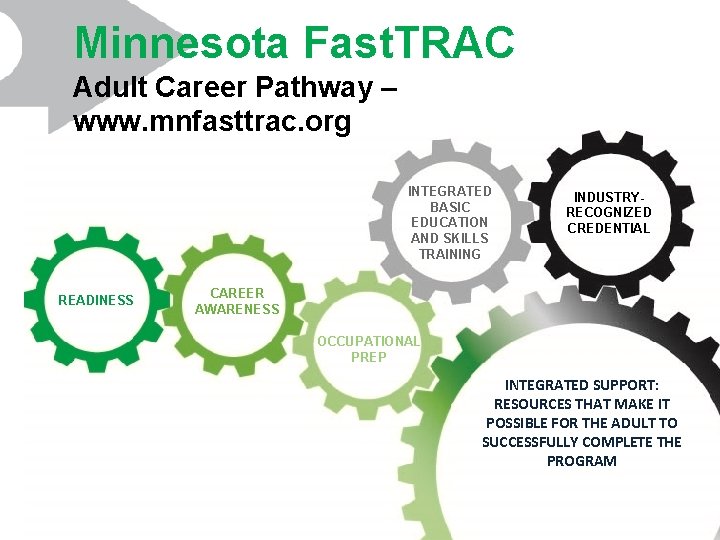
Minnesota Fast. TRAC Adult Career Pathway – www. mnfasttrac. org INTEGRATED BASIC EDUCATION AND SKILLS TRAINING READINESS INDUSTRYRECOGNIZED CREDENTIAL CAREER AWARENESS OCCUPATIONAL PREP INTEGRATED SUPPORT: RESOURCES THAT MAKE IT POSSIBLE FOR THE ADULT TO SUCCESSFULLY COMPLETE THE PROGRAM
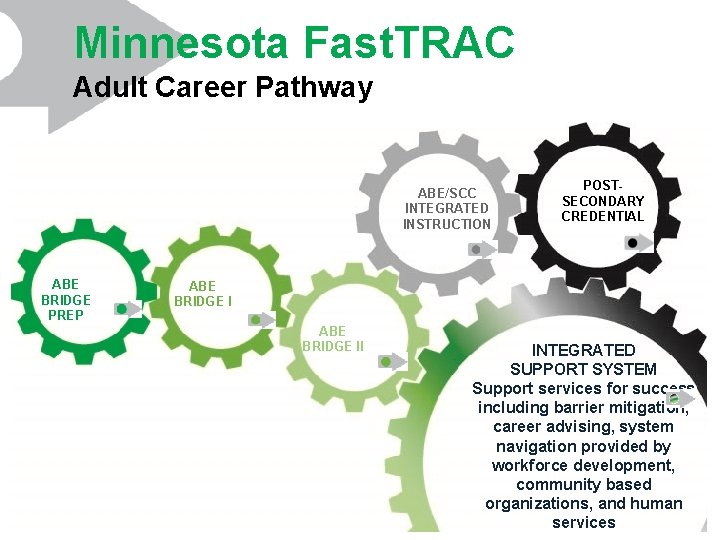
Minnesota Fast. TRAC Adult Career Pathway ABE/SCC INTEGRATED INSTRUCTION ABE BRIDGE PREP POSTSECONDARY CREDENTIAL ABE BRIDGE II INTEGRATED SUPPORT SYSTEM Support services for success including barrier mitigation, career advising, system navigation provided by workforce development, community based organizations, and human services
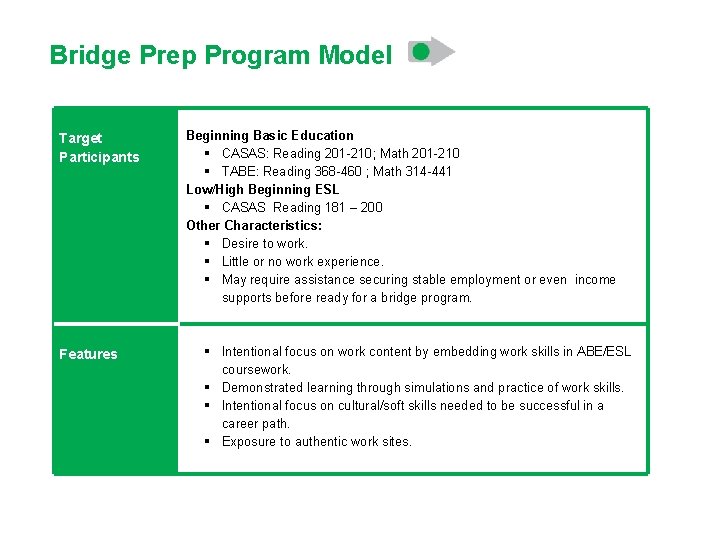
Bridge Prep Program Model Target Participants Features Beginning Basic Education § CASAS: Reading 201 -210; Math 201 -210 § TABE: Reading 368 -460 ; Math 314 -441 Low/High Beginning ESL § CASAS Reading 181 – 200 Other Characteristics: § Desire to work. § Little or no work experience. § May require assistance securing stable employment or even income supports before ready for a bridge program. § Intentional focus on work content by embedding work skills in ABE/ESL coursework. § Demonstrated learning through simulations and practice of work skills. § Intentional focus on cultural/soft skills needed to be successful in a career path. § Exposure to authentic work sites.
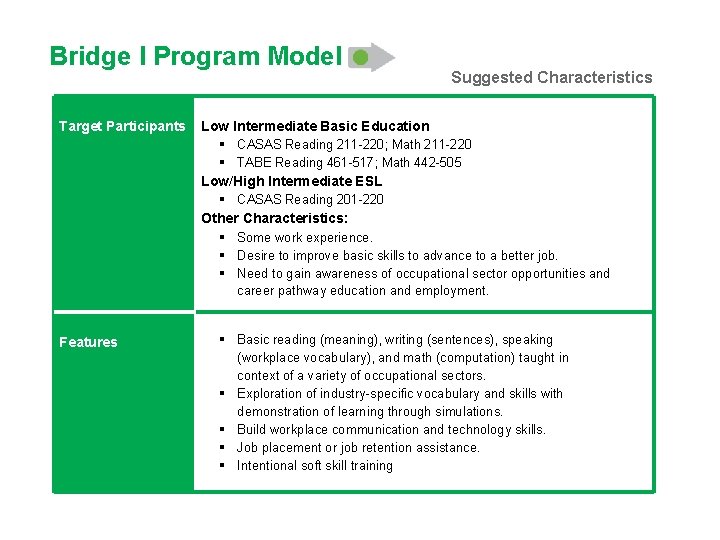
Bridge I Program Model Target Participants Suggested Characteristics Low Intermediate Basic Education § CASAS Reading 211 -220; Math 211 -220 § TABE Reading 461 -517; Math 442 -505 Low/High Intermediate ESL § CASAS Reading 201 -220 Other Characteristics: § Some work experience. § Desire to improve basic skills to advance to a better job. § Need to gain awareness of occupational sector opportunities and career pathway education and employment. Features § Basic reading (meaning), writing (sentences), speaking (workplace vocabulary), and math (computation) taught in context of a variety of occupational sectors. § Exploration of industry-specific vocabulary and skills with demonstration of learning through simulations. § Build workplace communication and technology skills. § Job placement or job retention assistance. § Intentional soft skill training
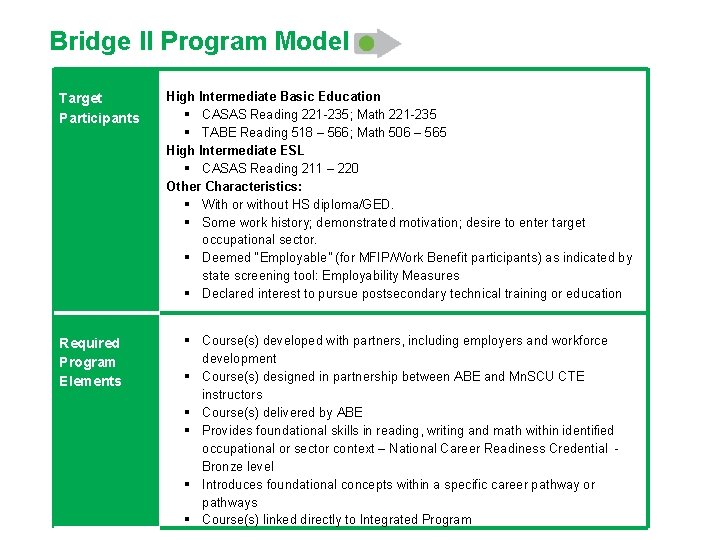
Bridge II Program Model Target Participants Required Program Elements High Intermediate Basic Education § CASAS Reading 221 -235; Math 221 -235 § TABE Reading 518 – 566; Math 506 – 565 High Intermediate ESL § CASAS Reading 211 – 220 Other Characteristics: § With or without HS diploma/GED. § Some work history; demonstrated motivation; desire to enter target occupational sector. § Deemed “Employable” (for MFIP/Work Benefit participants) as indicated by state screening tool: Employability Measures § Declared interest to pursue postsecondary technical training or education § Course(s) developed with partners, including employers and workforce development § Course(s) designed in partnership between ABE and Mn. SCU CTE instructors § Course(s) delivered by ABE § Provides foundational skills in reading, writing and math within identified occupational or sector context – National Career Readiness Credential Bronze level § Introduces foundational concepts within a specific career pathway or pathways § Course(s) linked directly to Integrated Program
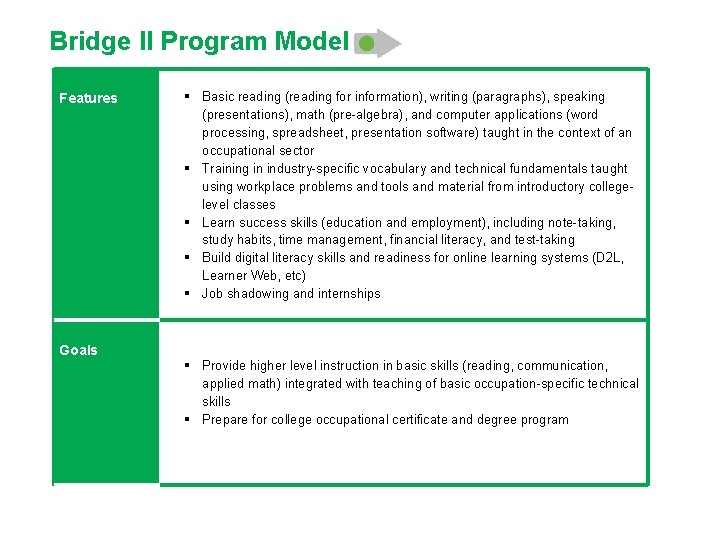
Bridge II Program Model Features § Basic reading (reading for information), writing (paragraphs), speaking (presentations), math (pre-algebra), and computer applications (word processing, spreadsheet, presentation software) taught in the context of an occupational sector § Training in industry-specific vocabulary and technical fundamentals taught using workplace problems and tools and material from introductory collegelevel classes § Learn success skills (education and employment), including note-taking, study habits, time management, financial literacy, and test-taking § Build digital literacy skills and readiness for online learning systems (D 2 L, Learner Web, etc) § Job shadowing and internships Goals § Provide higher level instruction in basic skills (reading, communication, applied math) integrated with teaching of basic occupation-specific technical skills § Prepare for college occupational certificate and degree program
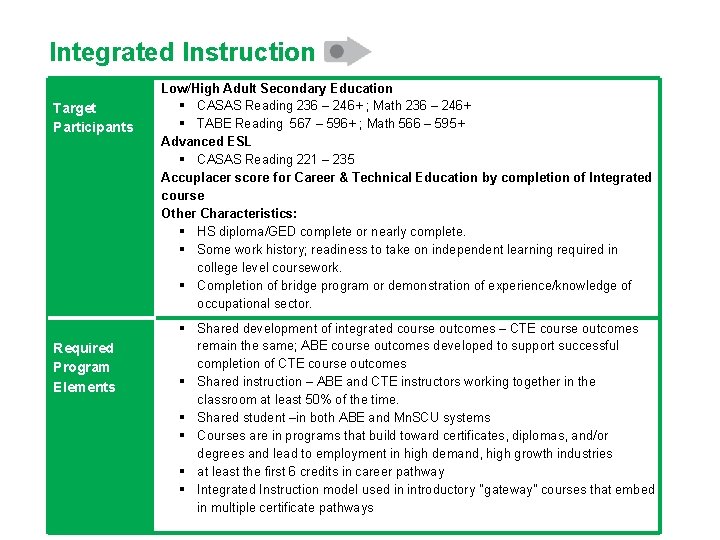
Integrated Instruction Target Participants Required Program Elements Low/High Adult Secondary Education § CASAS Reading 236 – 246+ ; Math 236 – 246+ § TABE Reading 567 – 596+ ; Math 566 – 595+ Advanced ESL § CASAS Reading 221 – 235 Accuplacer score for Career & Technical Education by completion of Integrated course Other Characteristics: § HS diploma/GED complete or nearly complete. § Some work history; readiness to take on independent learning required in college level coursework. § Completion of bridge program or demonstration of experience/knowledge of occupational sector. § Shared development of integrated course outcomes – CTE course outcomes remain the same; ABE course outcomes developed to support successful completion of CTE course outcomes § Shared instruction – ABE and CTE instructors working together in the classroom at least 50% of the time. § Shared student –in both ABE and Mn. SCU systems § Courses are in programs that build toward certificates, diplomas, and/or degrees and lead to employment in high demand, high growth industries § at least the first 6 credits in career pathway § Integrated Instruction model used in introductory “gateway” courses that embed in multiple certificate pathways
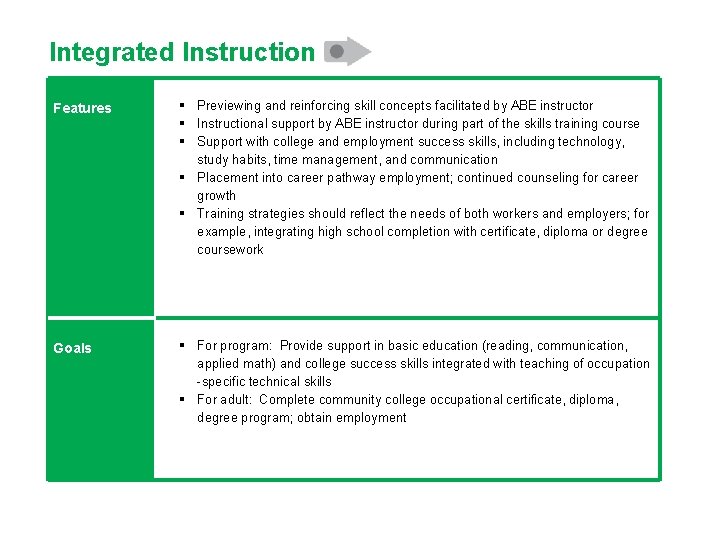
Integrated Instruction Features § Previewing and reinforcing skill concepts facilitated by ABE instructor § Instructional support by ABE instructor during part of the skills training course § Support with college and employment success skills, including technology, study habits, time management, and communication § Placement into career pathway employment; continued counseling for career growth § Training strategies should reflect the needs of both workers and employers; for example, integrating high school completion with certificate, diploma or degree coursework Goals § For program: Provide support in basic education (reading, communication, applied math) and college success skills integrated with teaching of occupation -specific technical skills § For adult: Complete community college occupational certificate, diploma, degree program; obtain employment
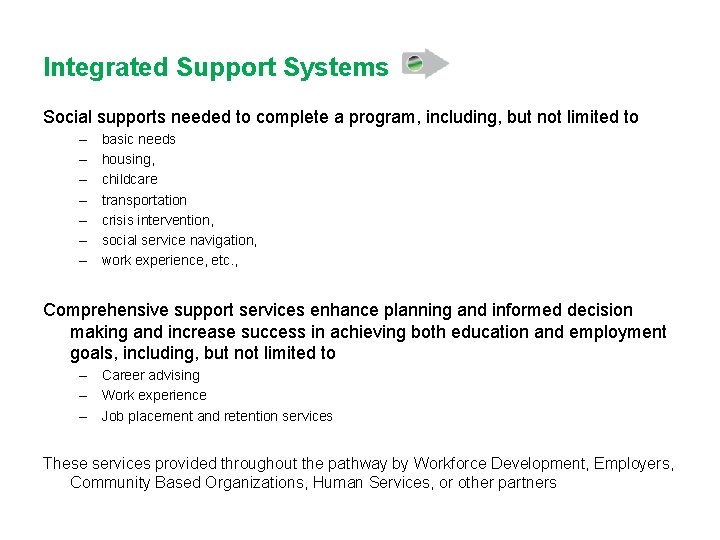
Integrated Support Systems Social supports needed to complete a program, including, but not limited to – – – – basic needs housing, childcare transportation crisis intervention, social service navigation, work experience, etc. , Comprehensive support services enhance planning and informed decision making and increase success in achieving both education and employment goals, including, but not limited to – Career advising – Work experience – Job placement and retention services These services provided throughout the pathway by Workforce Development, Employers, Community Based Organizations, Human Services, or other partners
Fast. TRAC Benefits For Educationally Underprepared Adults § Help for individuals who want to advance to career path job but lack the necessary basic skills. § Exposure to a broad range of jobs, careers, and education opportunities. § Access to postsecondary occupational education. § Counseling to help with career and education planning and overcoming barriers to success. § Facilitated contacts and connections to the labor market, employers, and specific jobs. § Support services to remove barriers to successful career pathway education and employment Adapted from Women employed with Chicago Jobs Council and UIC Great Cities Institute, . “Women Employed. ” Bridges to Careers for Low-Skilled Adults: A Program Development Guide. Women Employed Institute, 2005. Web 2 Apr. 2010.
Fast. TRAC Benefits For Employers § Increased input into certification courses offered in their industry in their region. § Source of workers who are qualified for high-level semi-skilled and entry-level skilled jobs and are prepared to advance. § Improved productivity resulting from a qualified workforce. Adapted from Women employed with Chicago Jobs Council and UIC Great Cities Institute, . “Women Employed. ” Bridges to Careers for Low-Skilled Adults: A Program Development Guide. Women Employed Institute, 2005. Web 2 Apr. 2010.
Fast. TRAC Benefits For Community & Technical Colleges and Other Postsecondary Institutions § “Feeders” of qualified and motivated students to occupational certificate and degree programs; § Preparation of students who come to college with inadequate basic skills to succeed in college-level courses. § Improved retention, graduation rates, and job-placement outcomes, particularly among underrepresented students. § Faculty in credit programs can focus on college-level material rather than developing students’ basic skills. § Clear way to show the connection between a college’s multiple missions. Adapted from Women employed with Chicago Jobs Council and UIC Great Cities Institute, . “Women Employed. ” Bridges to Careers for Low-Skilled Adults: A Program Development Guide. Women Employed Institute, 2005. Web 2 Apr. 2010.
Fast. TRAC Benefits For Community Based Organizations § Help community members advance to college-level occupational education, which has become the gateway to career pathway employment. § Effective response to community need for economic development. § Role as equal partner in development and delivery of adult career pathway program. Adapted from Women employed with Chicago Jobs Council and UIC Great Cities Institute, . “Women Employed. ” Bridges to Careers for Low-Skilled Adults: A Program Development Guide. Women Employed Institute, 2005. Web 2 Apr. 2010.
Fast. TRAC Benefits For Workforce Development • Job connected training and advancement opportunities for one-stop career center clients. • Response to the mismatch between employers demands for motivated workers with strong basic skills and basic skills deficiencies among large segments of the workforce. • Use of existing infrastructure to meet employers’ hiring needs in sectors of importance to regional economies. • Meet High Performance Measure of increasing postsecondary credential attainment with Workforce Investment Act participants. Adapted from Women employed with Chicago Jobs Council and UIC Great Cities Institute, . “Women Employed. ” Bridges to Careers for Low-Skilled Adults: A Program Development Guide. Women Employed Institute, 2005. Web 2 Apr. 2010.
Fast. TRAC Benefits For Adult Basic Education • Motivation and retention of students – increase in number of students completing programs. • Ease in meeting ABE accountability measures while providing contextualized, authentic skill training. • Recognition of key role ABE plays in economic prosperity for a region. Adapted from Women employed with Chicago Jobs Council and UIC Great Cities Institute, . “Women Employed. ” Bridges to Careers for Low-Skilled Adults: A Program Development Guide. Women Employed Institute, 2005. Web 2 Apr. 2010.
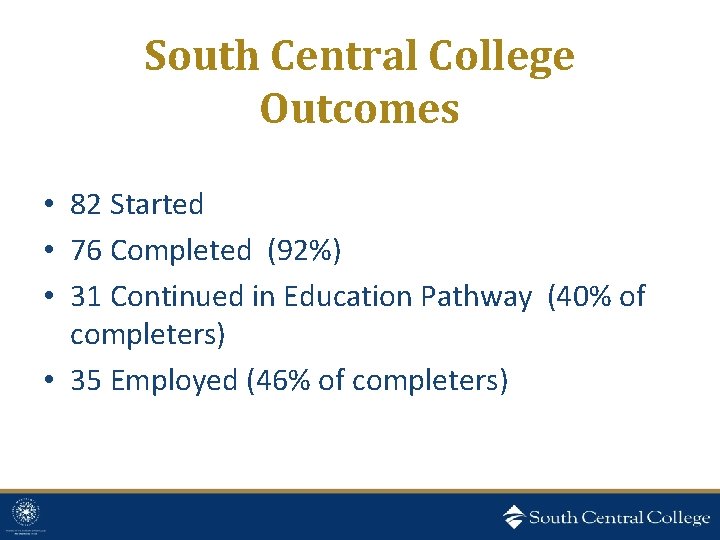
South Central College Outcomes • 82 Started • 76 Completed (92%) • 31 Continued in Education Pathway (40% of completers) • 35 Employed (46% of completers)
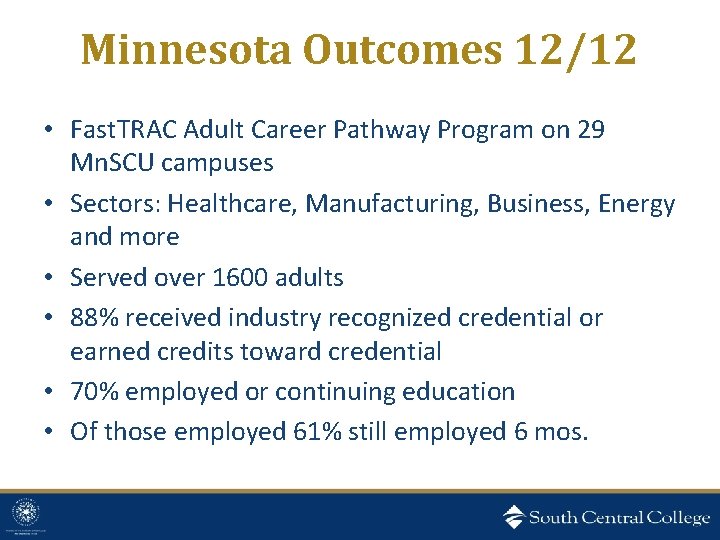
Minnesota Outcomes 12/12 • Fast. TRAC Adult Career Pathway Program on 29 Mn. SCU campuses • Sectors: Healthcare, Manufacturing, Business, Energy and more • Served over 1600 adults • 88% received industry recognized credential or earned credits toward credential • 70% employed or continuing education • Of those employed 61% still employed 6 mos.
Contact Information • nancy. genelin@southcentral. edu • judy. mortrude@state. mn. us • Nola. speiser@state. mn. us • www. mnfasttrac. org
- Slides: 58