
WORK POWER PHYSICAL SCIENCE Work has a special
- Slides: 36
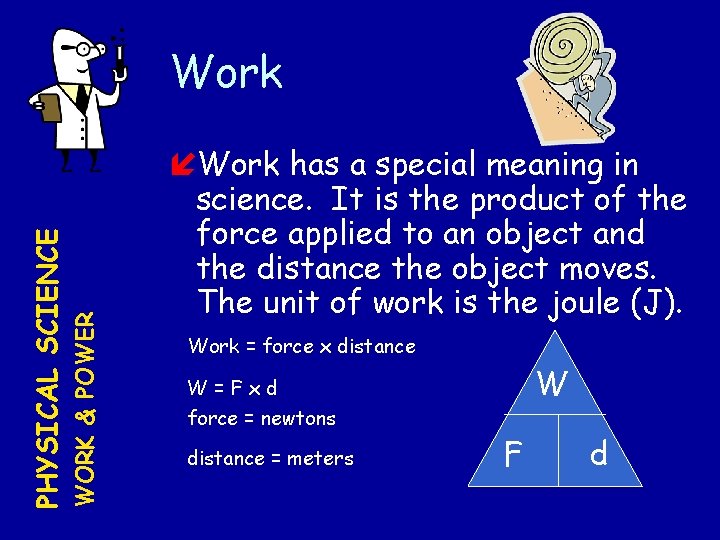
WORK & POWER PHYSICAL SCIENCE Work has a special meaning in science. It is the product of the force applied to an object and the distance the object moves. The unit of work is the joule (J). Work = force x distance W=Fxd force = newtons distance = meters W F d
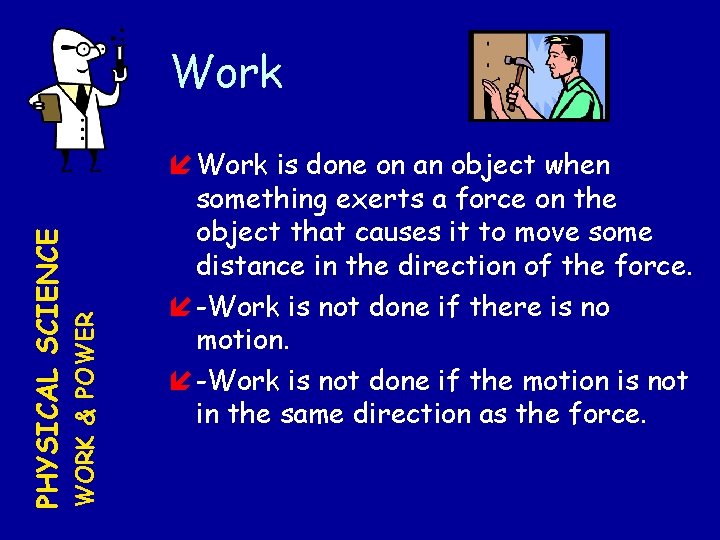
WORK & POWER PHYSICAL SCIENCE Work is done on an object when something exerts a force on the object that causes it to move some distance in the direction of the force. -Work is not done if there is no motion. -Work is not done if the motion is not in the same direction as the force.
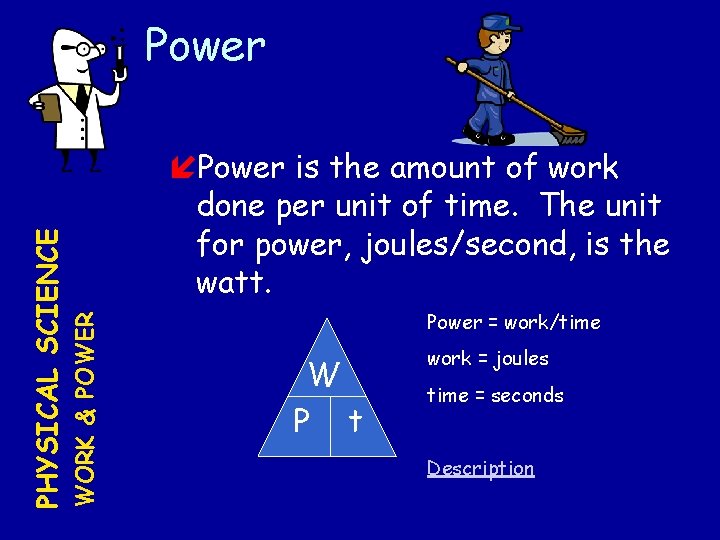
Power is the amount of work done per unit of time. The unit for power, joules/second, is the watt. WORK & POWER PHYSICAL SCIENCE Power = work/time W P t work = joules time = seconds Description
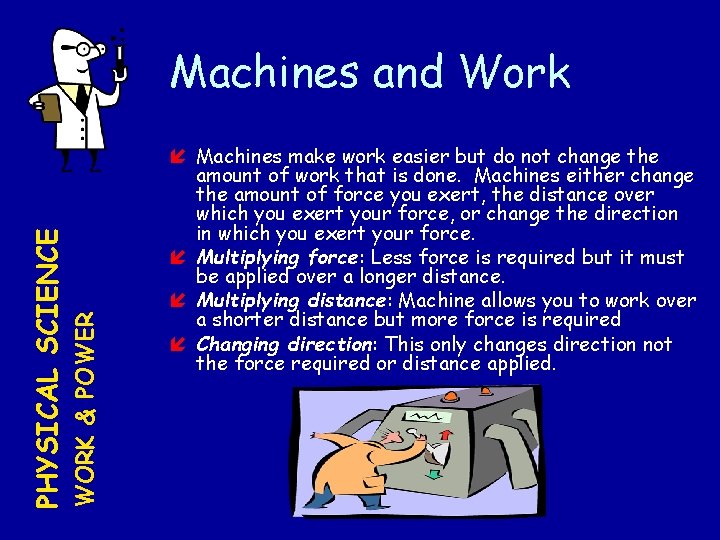
WORK & POWER PHYSICAL SCIENCE Machines and Work Machines make work easier but do not change the amount of work that is done. Machines either change the amount of force you exert, the distance over which you exert your force, or change the direction in which you exert your force. Multiplying force: Less force is required but it must be applied over a longer distance. Multiplying distance: Machine allows you to work over a shorter distance but more force is required Changing direction: This only changes direction not the force required or distance applied.
WORK & POWER PHYSICAL SCIENCE Machines An instrument that makes work easier is called a machine. Machines are not limited to the complicated devices you may be thinking of – car engines, airplanes, and computers.
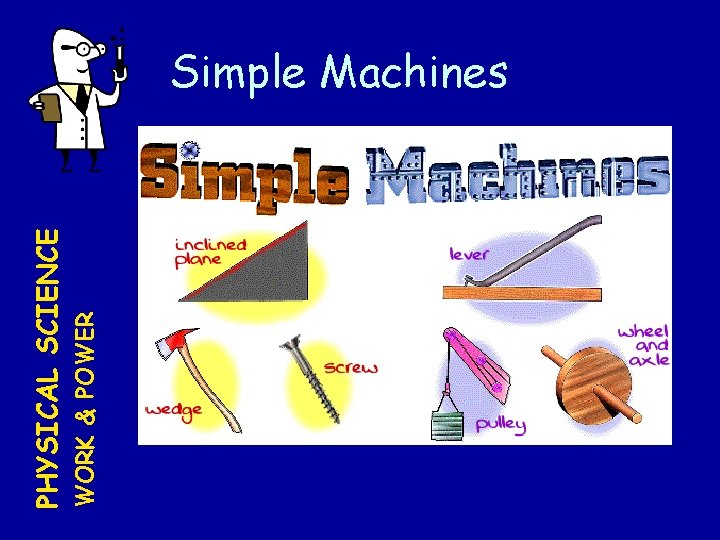
WORK & POWER PHYSICAL SCIENCE Simple Machines
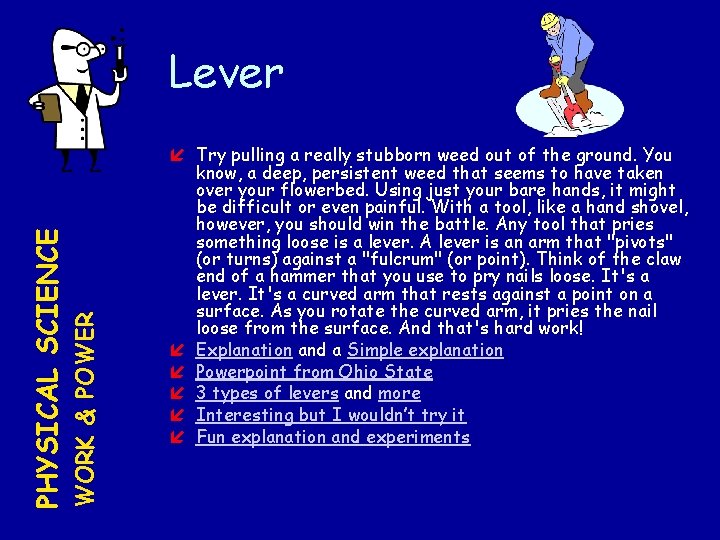
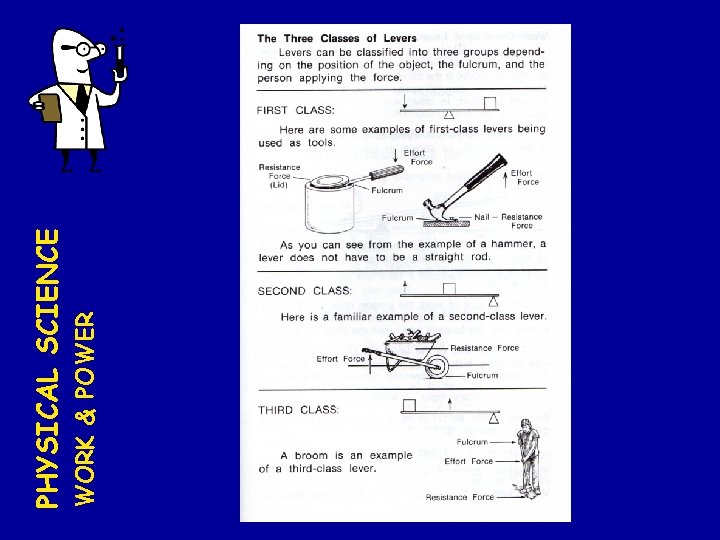
WORK & POWER PHYSICAL SCIENCE Lever Try pulling a really stubborn weed out of the ground. You know, a deep, persistent weed that seems to have taken over your flowerbed. Using just your bare hands, it might be difficult or even painful. With a tool, like a hand shovel, however, you should win the battle. Any tool that pries something loose is a lever. A lever is an arm that "pivots" (or turns) against a "fulcrum" (or point). Think of the claw end of a hammer that you use to pry nails loose. It's a lever. It's a curved arm that rests against a point on a surface. As you rotate the curved arm, it pries the nail loose from the surface. And that's hard work! Explanation and a Simple explanation Powerpoint from Ohio State 3 types of levers and more Interesting but I wouldn’t try it Fun explanation and experiments
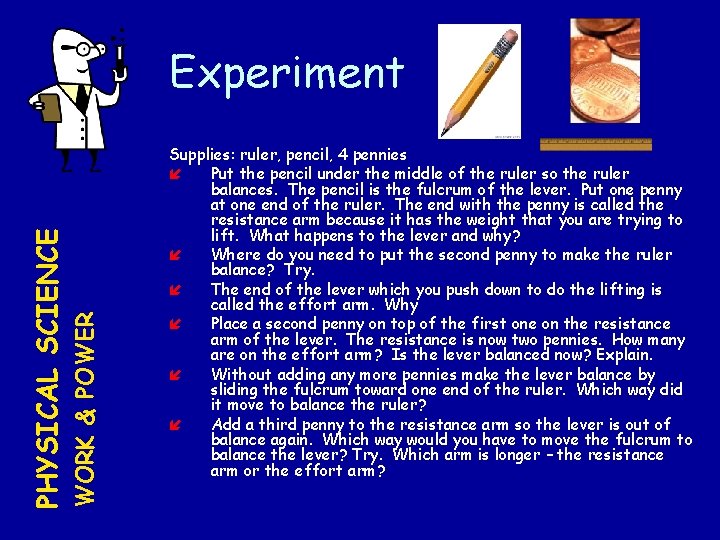
WORK & POWER PHYSICAL SCIENCE Experiment Supplies: ruler, pencil, 4 pennies Put the pencil under the middle of the ruler so the ruler balances. The pencil is the fulcrum of the lever. Put one penny at one end of the ruler. The end with the penny is called the resistance arm because it has the weight that you are trying to lift. What happens to the lever and why? Where do you need to put the second penny to make the ruler balance? Try. The end of the lever which you push down to do the lifting is called the effort arm. Why Place a second penny on top of the first one on the resistance arm of the lever. The resistance is now two pennies. How many are on the effort arm? Is the lever balanced now? Explain. Without adding any more pennies make the lever balance by sliding the fulcrum toward one end of the ruler. Which way did it move to balance the ruler? Add a third penny to the resistance arm so the lever is out of balance again. Which way would you have to move the fulcrum to balance the lever? Try. Which arm is longer – the resistance arm or the effort arm?
WORK & POWER PHYSICAL SCIENCE
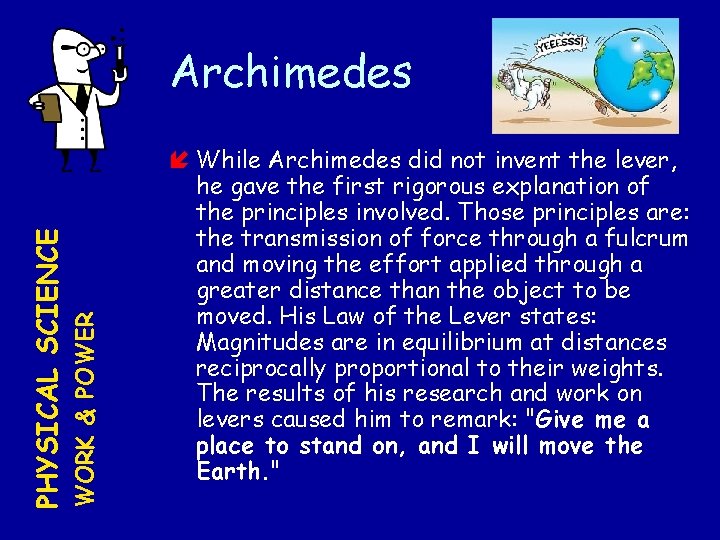
WORK & POWER PHYSICAL SCIENCE Archimedes While Archimedes did not invent the lever, he gave the first rigorous explanation of the principles involved. Those principles are: the transmission of force through a fulcrum and moving the effort applied through a greater distance than the object to be moved. His Law of the Lever states: Magnitudes are in equilibrium at distances reciprocally proportional to their weights. The results of his research and work on levers caused him to remark: "Give me a place to stand on, and I will move the Earth. "
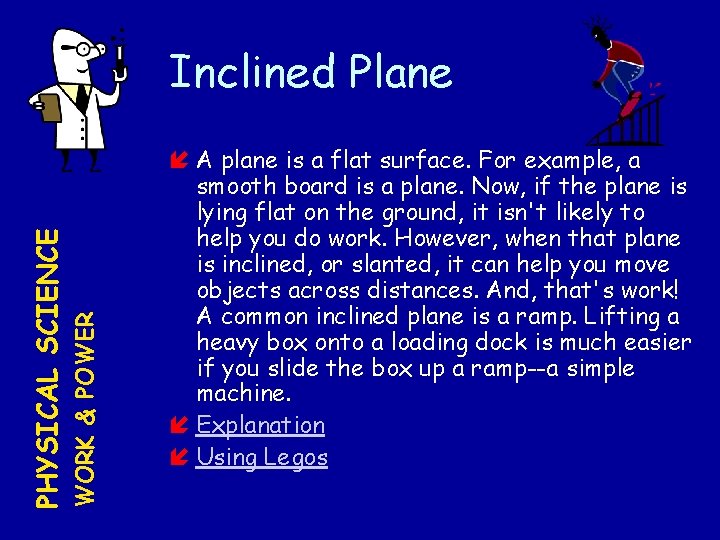
WORK & POWER PHYSICAL SCIENCE Inclined Plane A plane is a flat surface. For example, a smooth board is a plane. Now, if the plane is lying flat on the ground, it isn't likely to help you do work. However, when that plane is inclined, or slanted, it can help you move objects across distances. And, that's work! A common inclined plane is a ramp. Lifting a heavy box onto a loading dock is much easier if you slide the box up a ramp--a simple machine. Explanation Using Legos
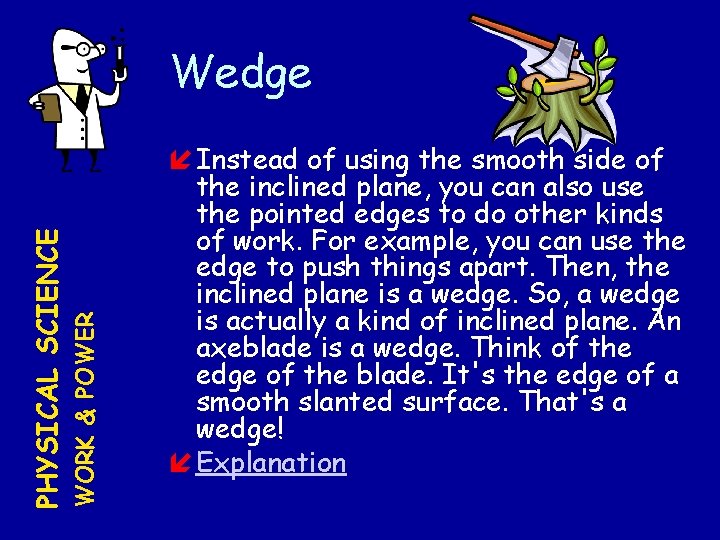
WORK & POWER PHYSICAL SCIENCE Wedge Instead of using the smooth side of the inclined plane, you can also use the pointed edges to do other kinds of work. For example, you can use the edge to push things apart. Then, the inclined plane is a wedge. So, a wedge is actually a kind of inclined plane. An axeblade is a wedge. Think of the edge of the blade. It's the edge of a smooth slanted surface. That's a wedge! Explanation
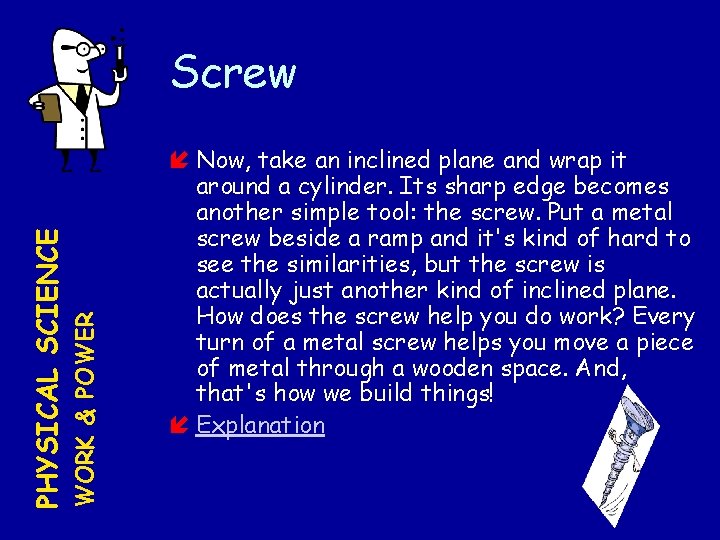
WORK & POWER PHYSICAL SCIENCE Screw Now, take an inclined plane and wrap it around a cylinder. Its sharp edge becomes another simple tool: the screw. Put a metal screw beside a ramp and it's kind of hard to see the similarities, but the screw is actually just another kind of inclined plane. How does the screw help you do work? Every turn of a metal screw helps you move a piece of metal through a wooden space. And, that's how we build things! Explanation
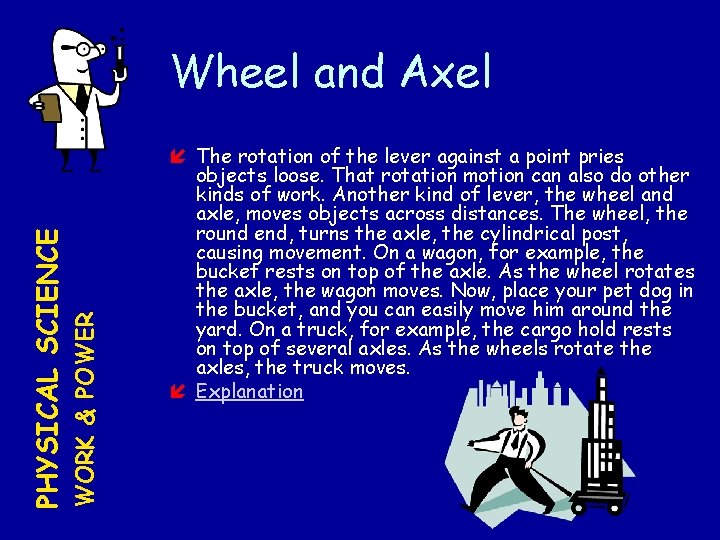
WORK & POWER PHYSICAL SCIENCE Wheel and Axel The rotation of the lever against a point pries objects loose. That rotation motion can also do other kinds of work. Another kind of lever, the wheel and axle, moves objects across distances. The wheel, the round end, turns the axle, the cylindrical post, causing movement. On a wagon, for example, the bucket rests on top of the axle. As the wheel rotates the axle, the wagon moves. Now, place your pet dog in the bucket, and you can easily move him around the yard. On a truck, for example, the cargo hold rests on top of several axles. As the wheels rotate the axles, the truck moves. Explanation
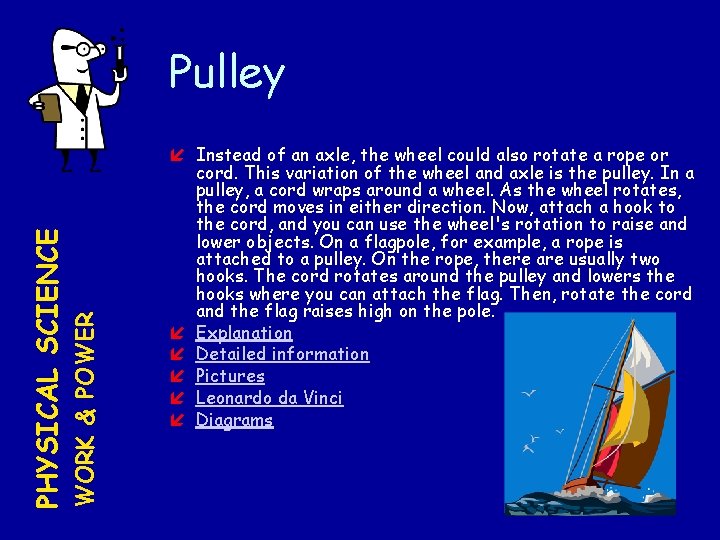
WORK & POWER PHYSICAL SCIENCE Pulley Instead of an axle, the wheel could also rotate a rope or cord. This variation of the wheel and axle is the pulley. In a pulley, a cord wraps around a wheel. As the wheel rotates, the cord moves in either direction. Now, attach a hook to the cord, and you can use the wheel's rotation to raise and lower objects. On a flagpole, for example, a rope is attached to a pulley. On the rope, there are usually two hooks. The cord rotates around the pulley and lowers the hooks where you can attach the flag. Then, rotate the cord and the flag raises high on the pole. Explanation Detailed information Pictures Leonardo da Vinci Diagrams
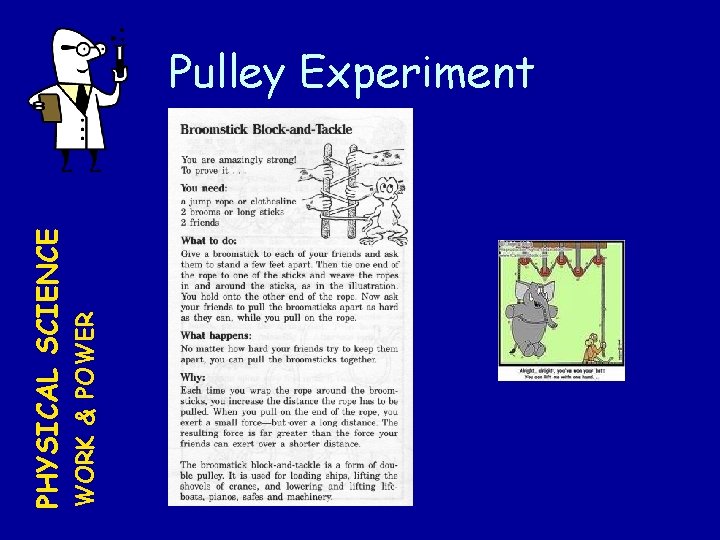
WORK & POWER PHYSICAL SCIENCE Pulley Experiment
WORK & POWER PHYSICAL SCIENCE Simple machines Practice Lots of information Simple explanation (try sketching activity) Review (try the activities and picture review) Univ of Utah review Rube Goldberg Leonardo’s Mysterious Machines
WORK & POWER PHYSICAL SCIENCE Mechanical Advantage The mechanical advantage is the number of times a machine multiplies your effort force or the ratio of force output to force input Calculating Practice problems Finding MA
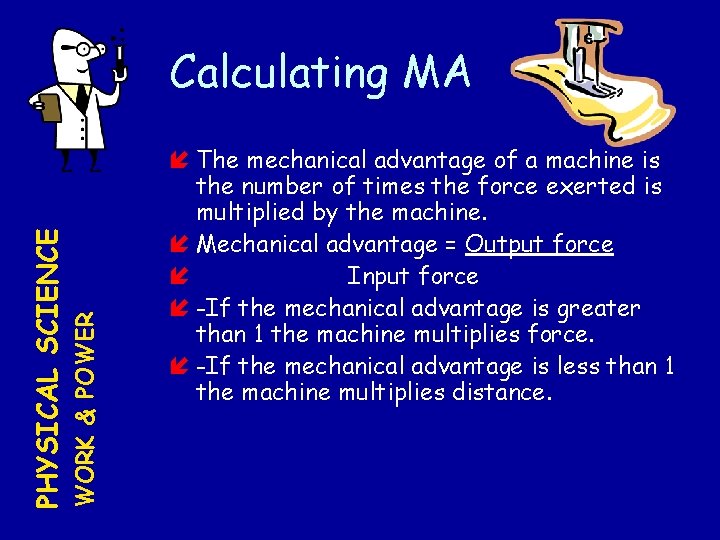
WORK & POWER PHYSICAL SCIENCE Calculating MA The mechanical advantage of a machine is the number of times the force exerted is multiplied by the machine. Mechanical advantage = Output force Input force -If the mechanical advantage is greater than 1 the machine multiplies force. -If the mechanical advantage is less than 1 the machine multiplies distance.
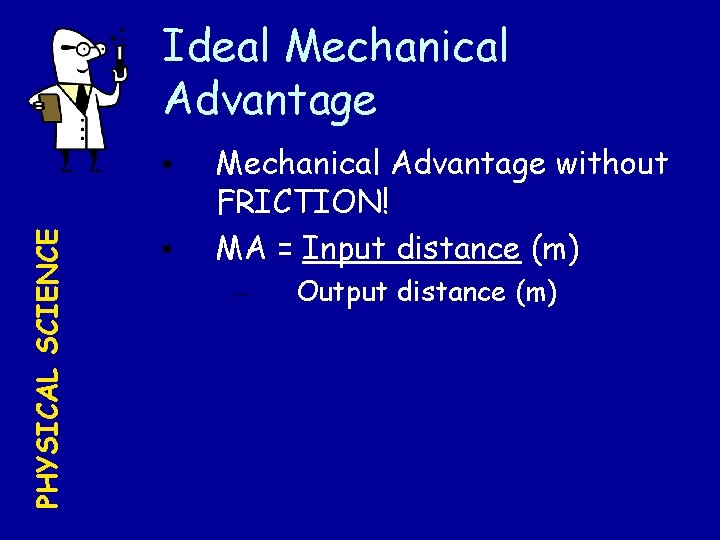
Ideal Mechanical Advantage PHYSICAL SCIENCE • • Mechanical Advantage without FRICTION! MA = Input distance (m) – Output distance (m)
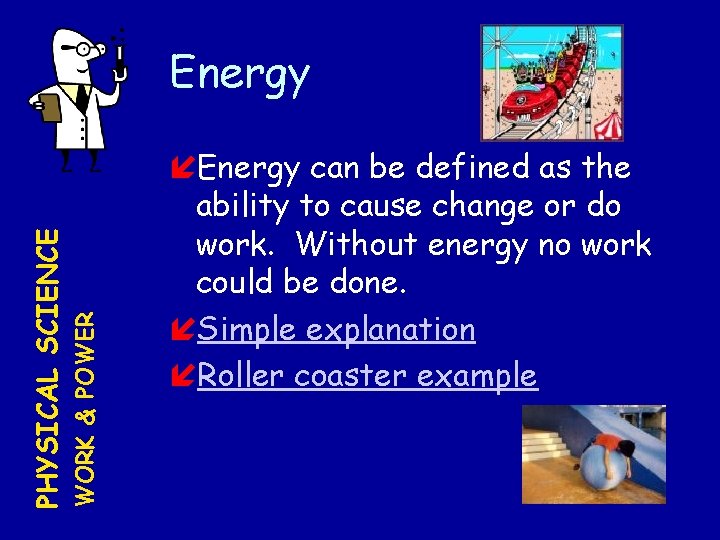
WORK & POWER PHYSICAL SCIENCE Energy can be defined as the ability to cause change or do work. Without energy no work could be done. Simple explanation Roller coaster example
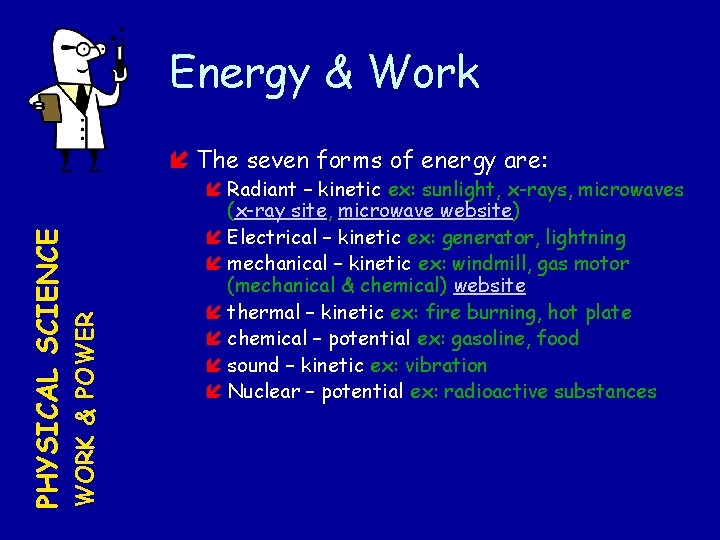
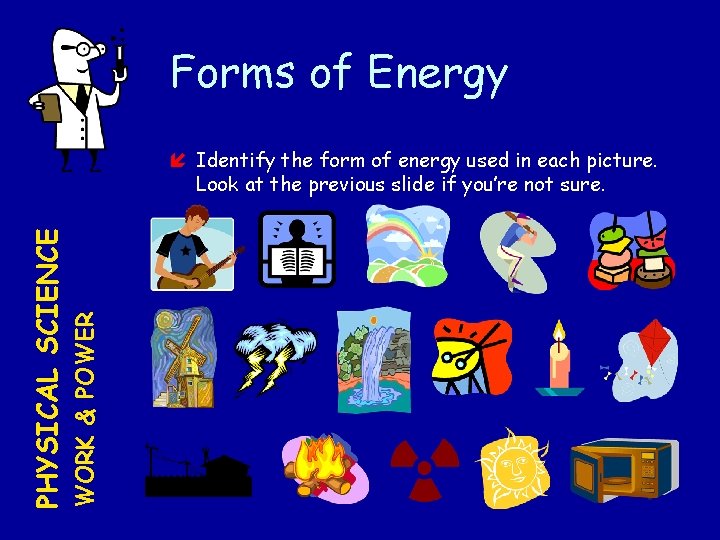
Energy & Work WORK & POWER PHYSICAL SCIENCE The seven forms of energy are: Radiant – kinetic ex: sunlight, x-rays, microwaves (x-ray site, microwave website) Electrical – kinetic ex: generator, lightning mechanical – kinetic ex: windmill, gas motor (mechanical & chemical) website thermal – kinetic ex: fire burning, hot plate chemical – potential ex: gasoline, food sound – kinetic ex: vibration Nuclear – potential ex: radioactive substances
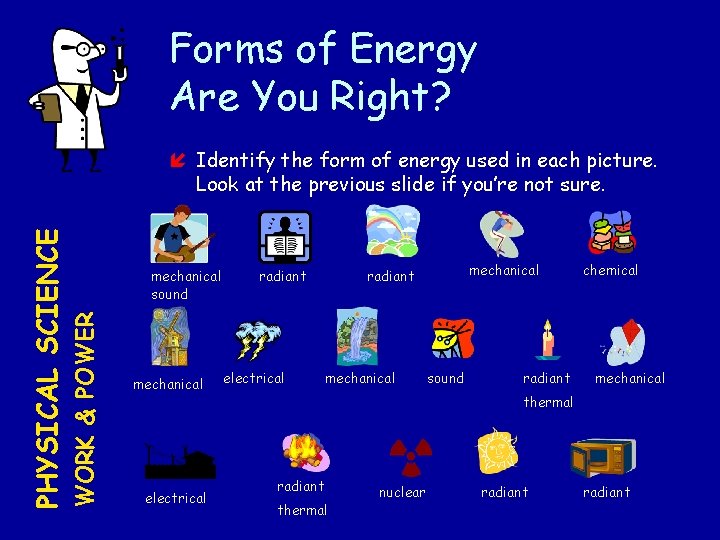
Forms of Energy WORK & POWER PHYSICAL SCIENCE Identify the form of energy used in each picture. Look at the previous slide if you’re not sure.
Forms of Energy Are You Right? mechanical sound WORK & POWER PHYSICAL SCIENCE Identify the form of energy used in each picture. Look at the previous slide if you’re not sure. mechanical electrical radiant electrical mechanical radiant mechanical sound radiant chemical mechanical thermal radiant thermal nuclear radiant
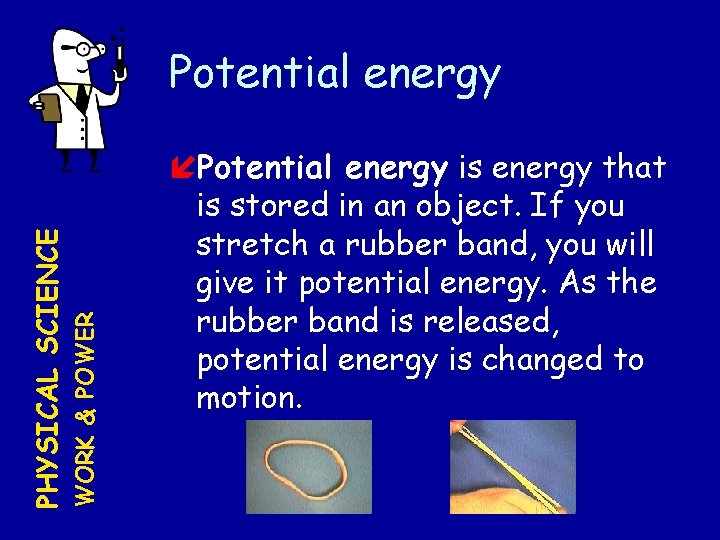
WORK & POWER PHYSICAL SCIENCE Potential energy is energy that is stored in an object. If you stretch a rubber band, you will give it potential energy. As the rubber band is released, potential energy is changed to motion.
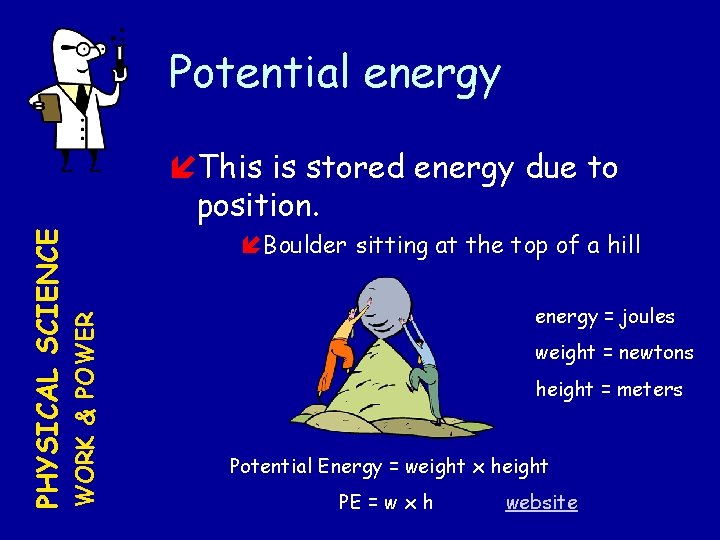
Potential energy Boulder sitting at the top of a hill WORK & POWER PHYSICAL SCIENCE This is stored energy due to position. energy = joules weight = newtons height = meters Potential Energy = weight x height PE = w x h website
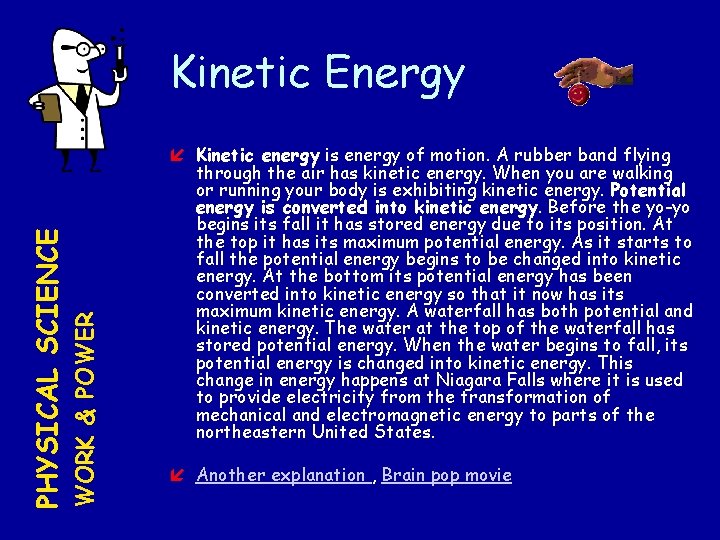
WORK & POWER PHYSICAL SCIENCE Kinetic Energy Kinetic energy is energy of motion. A rubber band flying through the air has kinetic energy. When you are walking or running your body is exhibiting kinetic energy. Potential energy is converted into kinetic energy. Before the yo-yo begins its fall it has stored energy due to its position. At the top it has its maximum potential energy. As it starts to fall the potential energy begins to be changed into kinetic energy. At the bottom its potential energy has been converted into kinetic energy so that it now has its maximum kinetic energy. A waterfall has both potential and kinetic energy. The water at the top of the waterfall has stored potential energy. When the water begins to fall, its potential energy is changed into kinetic energy. This change in energy happens at Niagara Falls where it is used to provide electricity from the transformation of mechanical and electromagnetic energy to parts of the northeastern United States. Another explanation , Brain pop movie
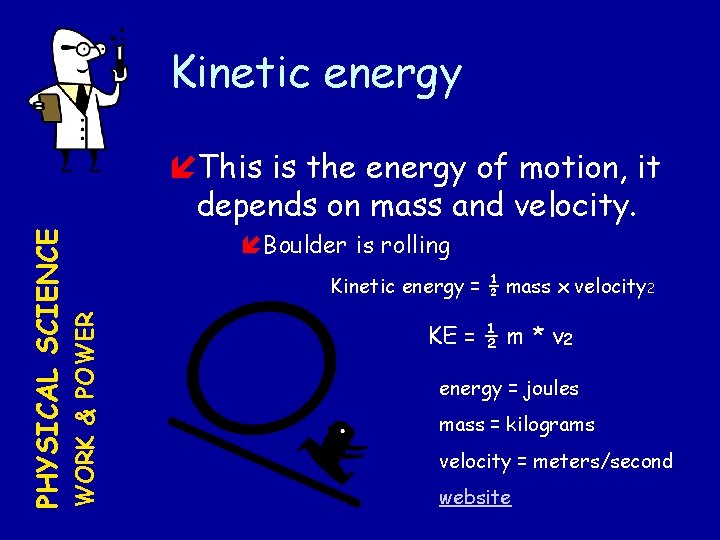
Kinetic energy Boulder is rolling Kinetic energy = ½ mass x velocity 2 WORK & POWER PHYSICAL SCIENCE This is the energy of motion, it depends on mass and velocity. KE = ½ m * v 2 energy = joules mass = kilograms velocity = meters/second website
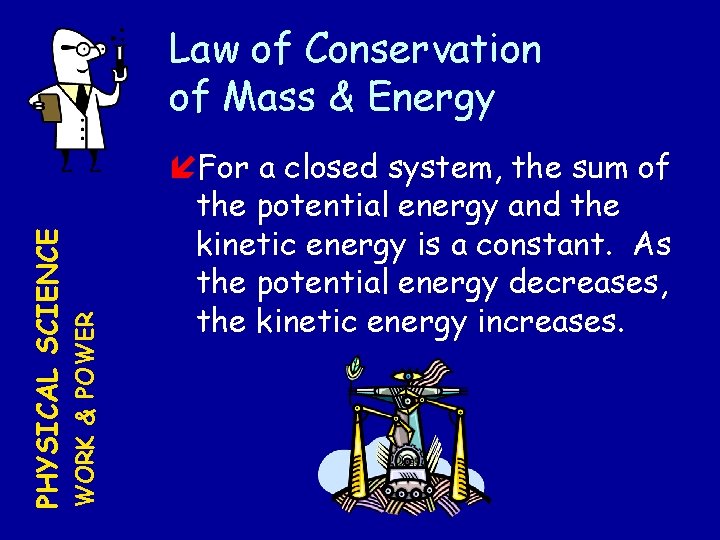
WORK & POWER PHYSICAL SCIENCE Law of Conservation of Mass & Energy For a closed system, the sum of the potential energy and the kinetic energy is a constant. As the potential energy decreases, the kinetic energy increases.
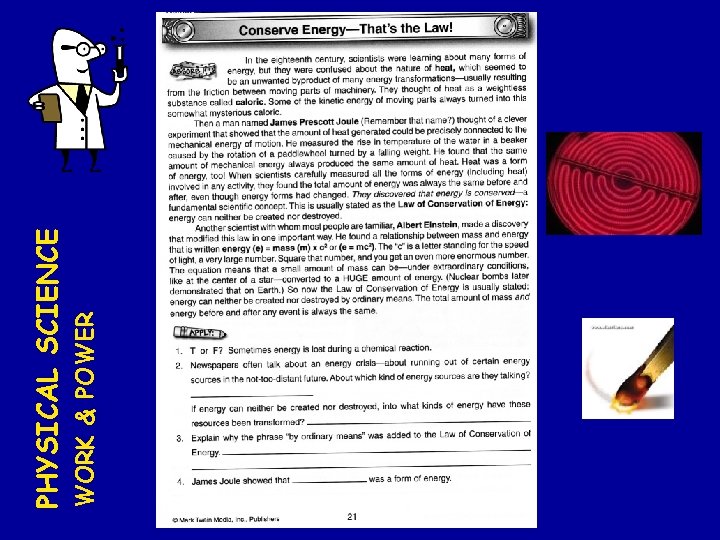
WORK & POWER PHYSICAL SCIENCE
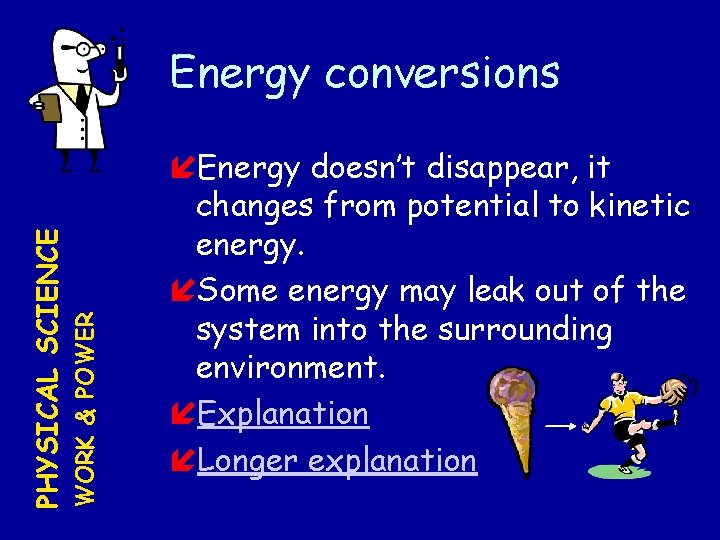
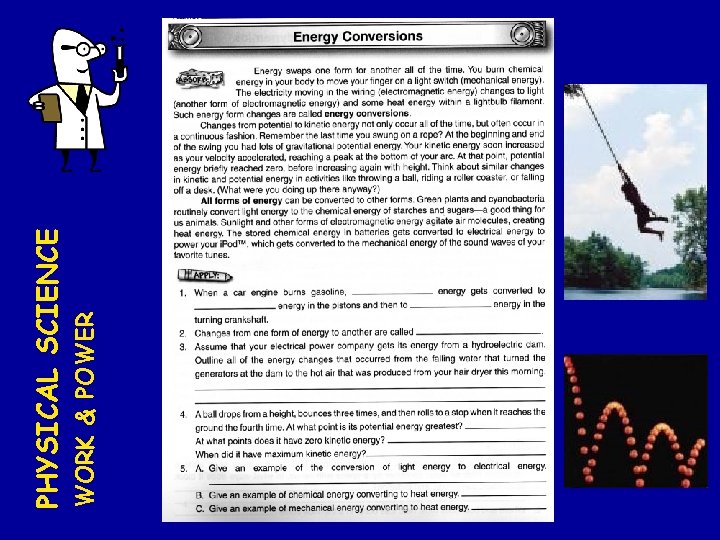
WORK & POWER PHYSICAL SCIENCE Energy conversions Energy doesn’t disappear, it changes from potential to kinetic energy. Some energy may leak out of the system into the surrounding environment. Explanation Longer explanation
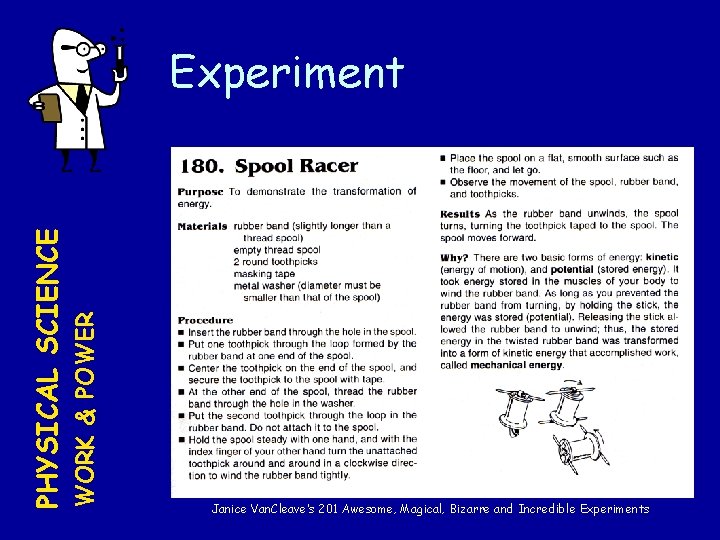
WORK & POWER PHYSICAL SCIENCE Experiment Janice Van. Cleave’s 201 Awesome, Magical, Bizarre and Incredible Experiments
WORK & POWER PHYSICAL SCIENCE
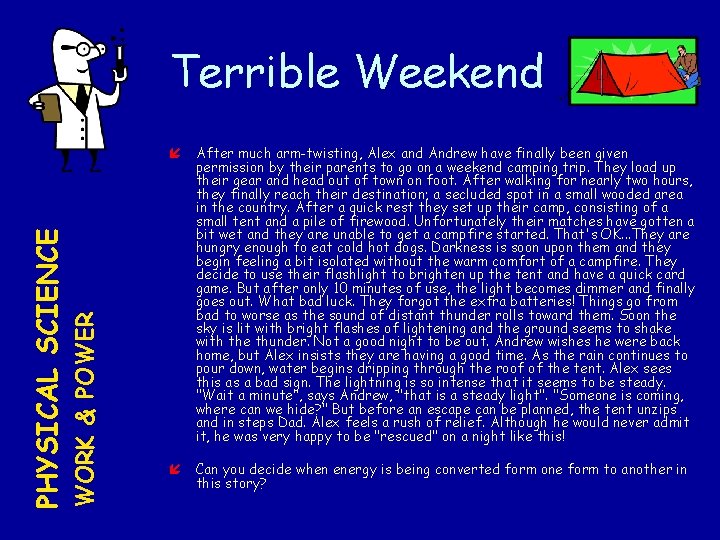
WORK & POWER PHYSICAL SCIENCE Terrible Weekend After much arm-twisting, Alex and Andrew have finally been given permission by their parents to go on a weekend camping trip. They load up their gear and head out of town on foot. After walking for nearly two hours, they finally reach their destination; a secluded spot in a small wooded area in the country. After a quick rest they set up their camp, consisting of a small tent and a pile of firewood. Unfortunately their matches have gotten a bit wet and they are unable to get a campfire started. That's OK. . . They are hungry enough to eat cold hot dogs. Darkness is soon upon them and they begin feeling a bit isolated without the warm comfort of a campfire. They decide to use their flashlight to brighten up the tent and have a quick card game. But after only 10 minutes of use, the light becomes dimmer and finally goes out. What bad luck. They forgot the extra batteries! Things go from bad to worse as the sound of distant thunder rolls toward them. Soon the sky is lit with bright flashes of lightening and the ground seems to shake with the thunder. Not a good night to be out. Andrew wishes he were back home, but Alex insists they are having a good time. As the rain continues to pour down, water begins dripping through the roof of the tent. Alex sees this as a bad sign. The lightning is so intense that it seems to be steady. "Wait a minute", says Andrew, "that is a steady light". "Someone is coming, where can we hide? " But before an escape can be planned, the tent unzips and in steps Dad. Alex feels a rush of relief. Although he would never admit it, he was very happy to be "rescued" on a night like this! Can you decide when energy is being converted form one form to another in this story?
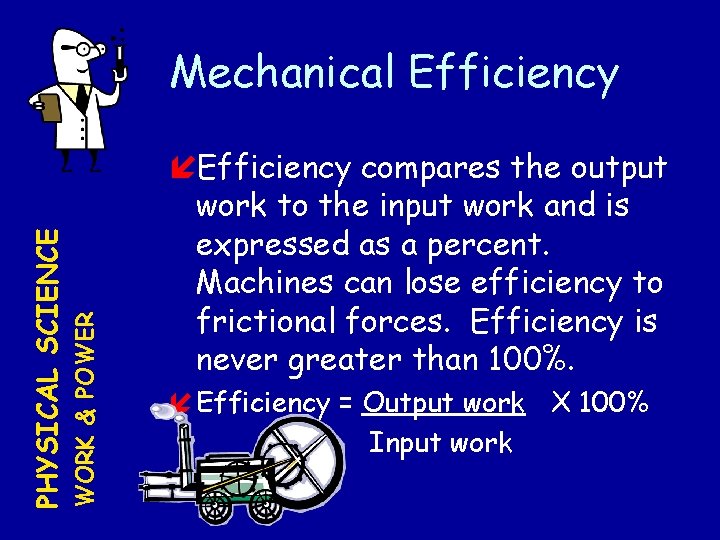
WORK & POWER PHYSICAL SCIENCE Mechanical Efficiency compares the output work to the input work and is expressed as a percent. Machines can lose efficiency to frictional forces. Efficiency is never greater than 100%. Efficiency = Output work X 100% Input work
WORK & POWER PHYSICAL SCIENCE Review Practice problems More practice problems Physics book, explanation and problems Amusement park physics Seatbelt physics Work-energy Review