
Work Plan for Model Development at NCTCOG Arash






- Slides: 41
Work Plan for Model Development at NCTCOG Arash Mirzaei, P. E. AMPO Travel Modeling Work Group St. Louis, MO June 11, 2007
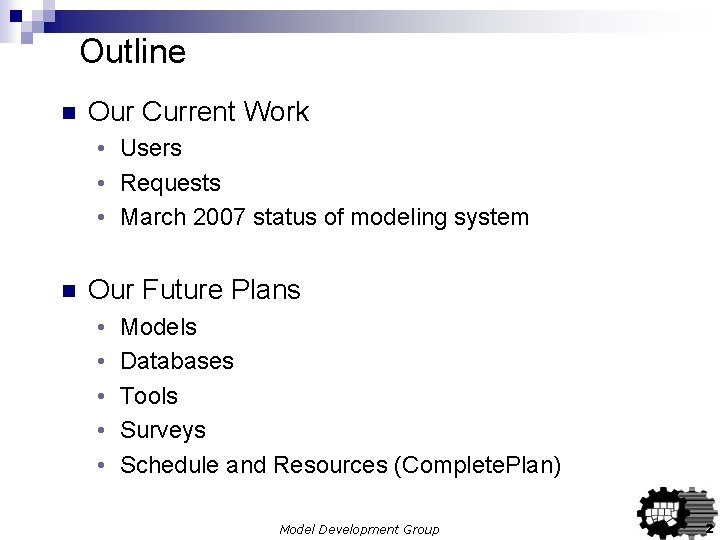
Outline n Our Current Work • Users • Requests • March 2007 status of modeling system n Our Future Plans • • • Models Databases Tools Surveys Schedule and Resources (Complete. Plan) Model Development Group 2
Model Development Group (MDG) Current Work Model Development Group 3
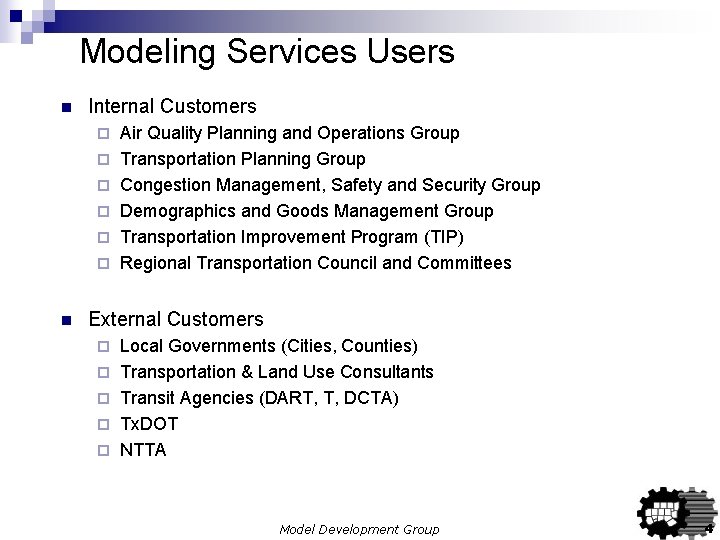
Modeling Services Users n Internal Customers ¨ ¨ ¨ n Air Quality Planning and Operations Group Transportation Planning Group Congestion Management, Safety and Security Group Demographics and Goods Management Group Transportation Improvement Program (TIP) Regional Transportation Council and Committees External Customers ¨ ¨ ¨ Local Governments (Cities, Counties) Transportation & Land Use Consultants Transit Agencies (DART, T, DCTA) Tx. DOT NTTA Model Development Group 4
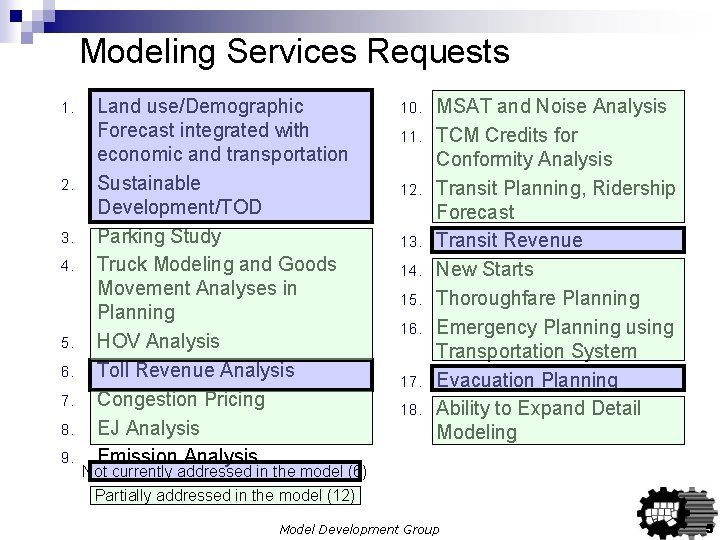
Modeling Services Requests 1. 2. 3. 4. 5. 6. 7. 8. 9. Land use/Demographic Forecast integrated with economic and transportation Sustainable Development/TOD Parking Study Truck Modeling and Goods Movement Analyses in Planning HOV Analysis Toll Revenue Analysis Congestion Pricing EJ Analysis Emission Analysis 10. 11. 12. 13. 14. 15. 16. 17. 18. MSAT and Noise Analysis TCM Credits for Conformity Analysis Transit Planning, Ridership Forecast Transit Revenue New Starts Thoroughfare Planning Emergency Planning using Transportation System Evacuation Planning Ability to Expand Detail Modeling Not currently addressed in the model (6) Partially addressed in the model (12) Model Development Group 5
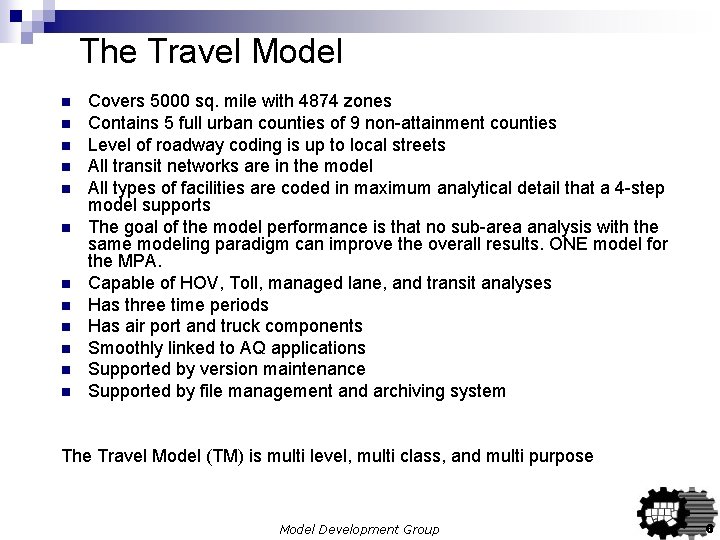
The Travel Model n n n Covers 5000 sq. mile with 4874 zones Contains 5 full urban counties of 9 non-attainment counties Level of roadway coding is up to local streets All transit networks are in the model All types of facilities are coded in maximum analytical detail that a 4 -step model supports The goal of the model performance is that no sub-area analysis with the same modeling paradigm can improve the overall results. ONE model for the MPA. Capable of HOV, Toll, managed lane, and transit analyses Has three time periods Has air port and truck components Smoothly linked to AQ applications Supported by version maintenance Supported by file management and archiving system The Travel Model (TM) is multi level, multi class, and multi purpose Model Development Group 6
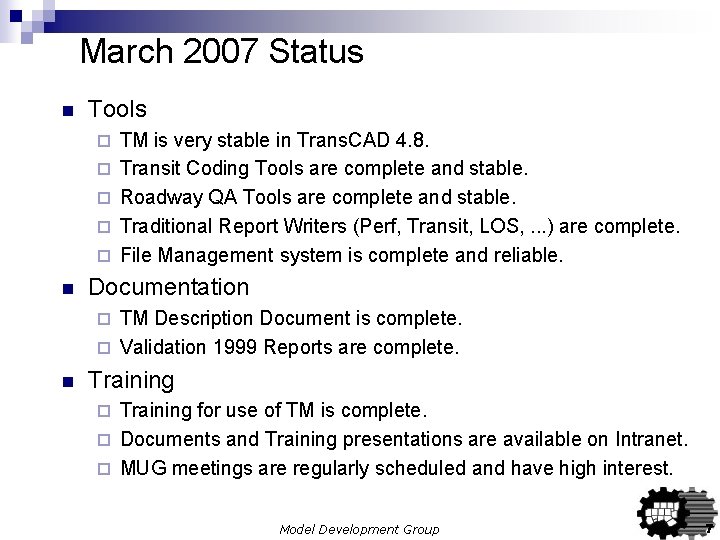
March 2007 Status n Tools ¨ ¨ ¨ n TM is very stable in Trans. CAD 4. 8. Transit Coding Tools are complete and stable. Roadway QA Tools are complete and stable. Traditional Report Writers (Perf, Transit, LOS, . . . ) are complete. File Management system is complete and reliable. Documentation TM Description Document is complete. ¨ Validation 1999 Reports are complete. ¨ n Training for use of TM is complete. ¨ Documents and Training presentations are available on Intranet. ¨ MUG meetings are regularly scheduled and have high interest. ¨ Model Development Group 7
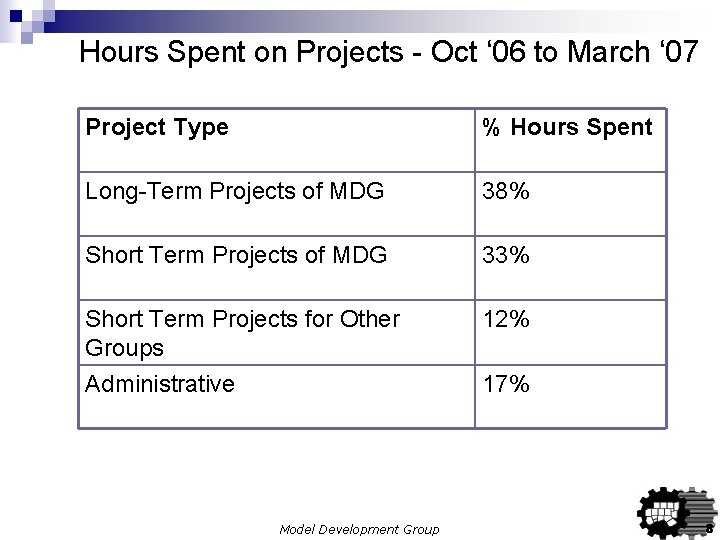
Hours Spent on Projects - Oct ‘ 06 to March ‘ 07 Project Type % Hours Spent Long-Term Projects of MDG 38% Short Term Projects of MDG 33% Short Term Projects for Other Groups Administrative 12% Model Development Group 17% 8
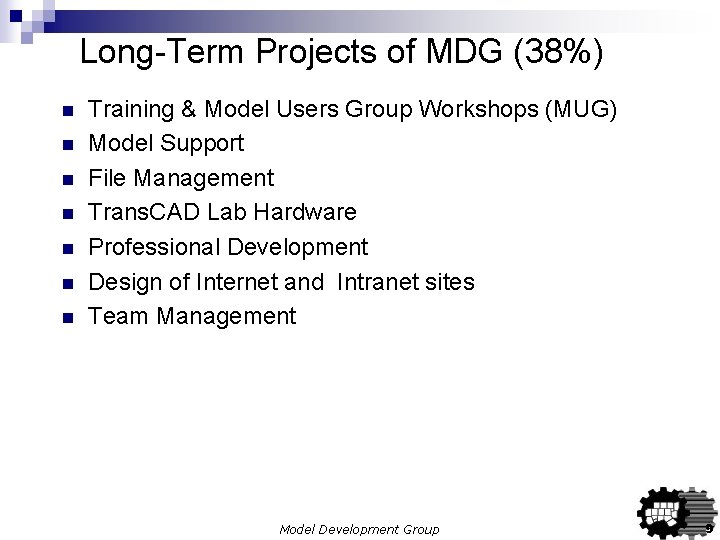
Long-Term Projects of MDG (38%) n n n n Training & Model Users Group Workshops (MUG) Model Support File Management Trans. CAD Lab Hardware Professional Development Design of Internet and Intranet sites Team Management Model Development Group 9
Short Term Projects: MDG (35%) n Model Improvements ¨ ¨ ¨ ¨ Model Diagnostic 2004 Summit Inclusion Comparative Reports Automated Executive Reports Modeling Area Expansion Sensitivity Testing UE Traffic Assignment Stability TOD Transit Model Development n Traffic Simulation n Model Implementation Transition to Trans. CAD 5. 0 ¨ Re-batching the model ¨ Model Development Group 10
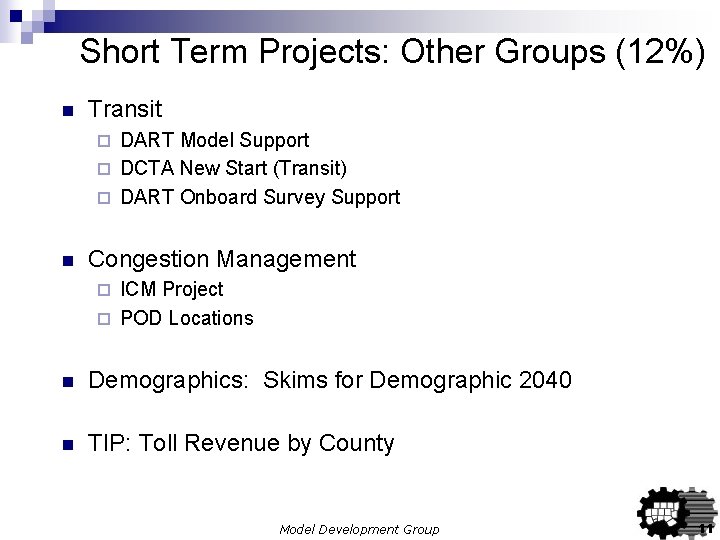
Short Term Projects: Other Groups (12%) n Transit DART Model Support ¨ DCTA New Start (Transit) ¨ DART Onboard Survey Support ¨ n Congestion Management ICM Project ¨ POD Locations ¨ n Demographics: Skims for Demographic 2040 n TIP: Toll Revenue by County Model Development Group 11
Support for Management Activities (17%) n n n Administrative Committees Leave (Holiday/Vacation/Sick) Model Development Group 12
Model Development Group (MDG) Goal: Models Model Development Group 13
Models Needed n Land Use Model n Person Travel Model n Commercial Travel Model n Regional Travel Model to cover 12 counties Model Development Group 14
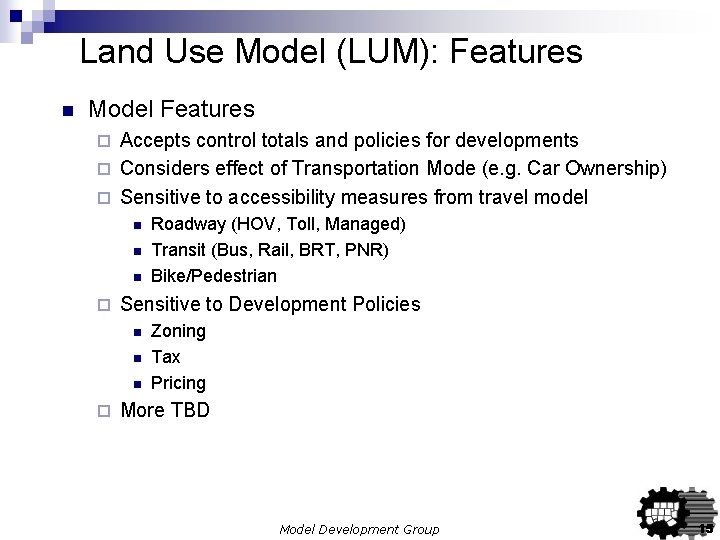
Land Use Model (LUM): Features n Model Features Accepts control totals and policies for developments ¨ Considers effect of Transportation Mode (e. g. Car Ownership) ¨ Sensitive to accessibility measures from travel model ¨ n n n ¨ Sensitive to Development Policies n n n ¨ Roadway (HOV, Toll, Managed) Transit (Bus, Rail, BRT, PNR) Bike/Pedestrian Zoning Tax Pricing More TBD Model Development Group 15
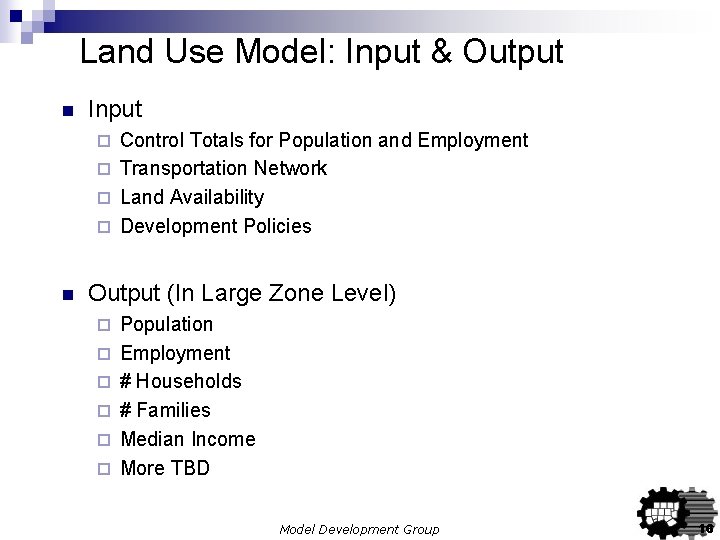
Land Use Model: Input & Output n Input Control Totals for Population and Employment ¨ Transportation Network ¨ Land Availability ¨ Development Policies ¨ n Output (In Large Zone Level) ¨ ¨ ¨ Population Employment # Households # Families Median Income More TBD Model Development Group 16
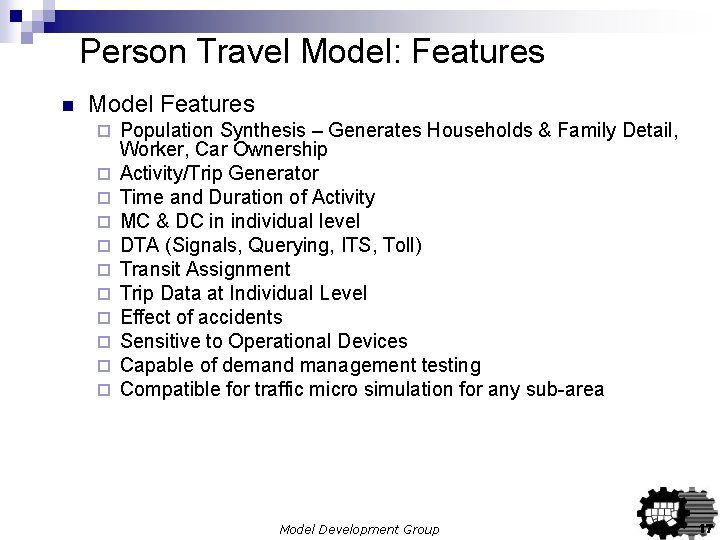
Person Travel Model: Features n Model Features ¨ ¨ ¨ Population Synthesis – Generates Households & Family Detail, Worker, Car Ownership Activity/Trip Generator Time and Duration of Activity MC & DC in individual level DTA (Signals, Querying, ITS, Toll) Transit Assignment Trip Data at Individual Level Effect of accidents Sensitive to Operational Devices Capable of demand management testing Compatible for traffic micro simulation for any sub-area Model Development Group 17
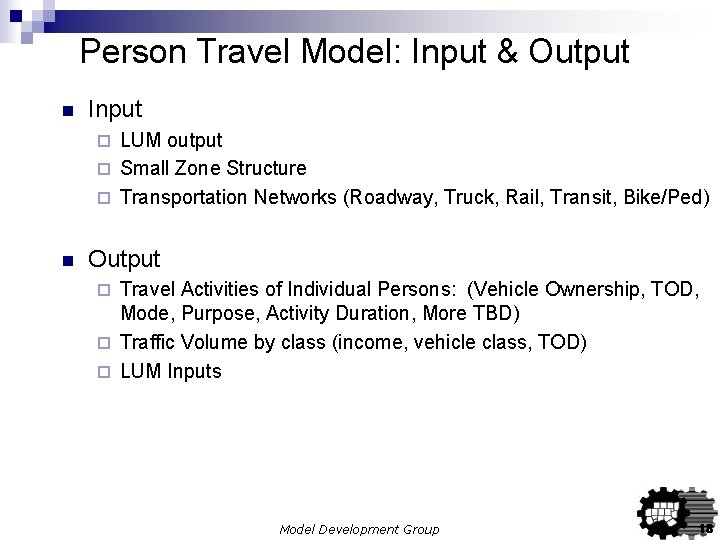
Person Travel Model: Input & Output n Input LUM output ¨ Small Zone Structure ¨ Transportation Networks (Roadway, Truck, Rail, Transit, Bike/Ped) ¨ n Output Travel Activities of Individual Persons: (Vehicle Ownership, TOD, Mode, Purpose, Activity Duration, More TBD) ¨ Traffic Volume by class (income, vehicle class, TOD) ¨ LUM Inputs ¨ Model Development Group 18
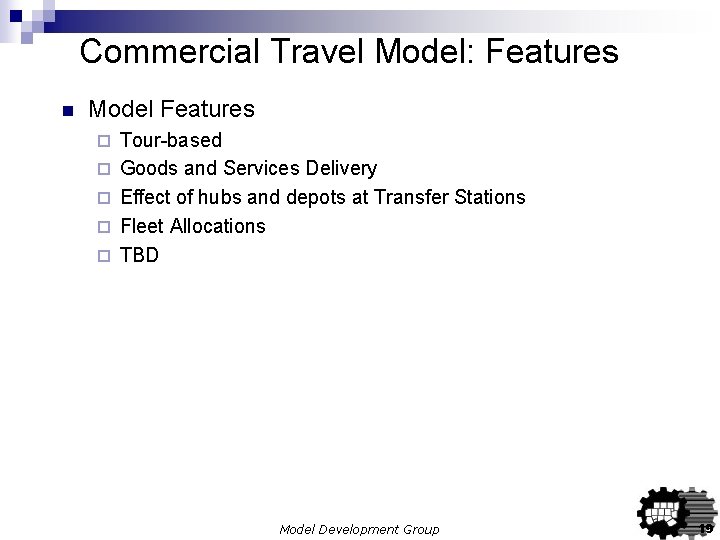
Commercial Travel Model: Features n Model Features ¨ ¨ ¨ Tour-based Goods and Services Delivery Effect of hubs and depots at Transfer Stations Fleet Allocations TBD Model Development Group 19
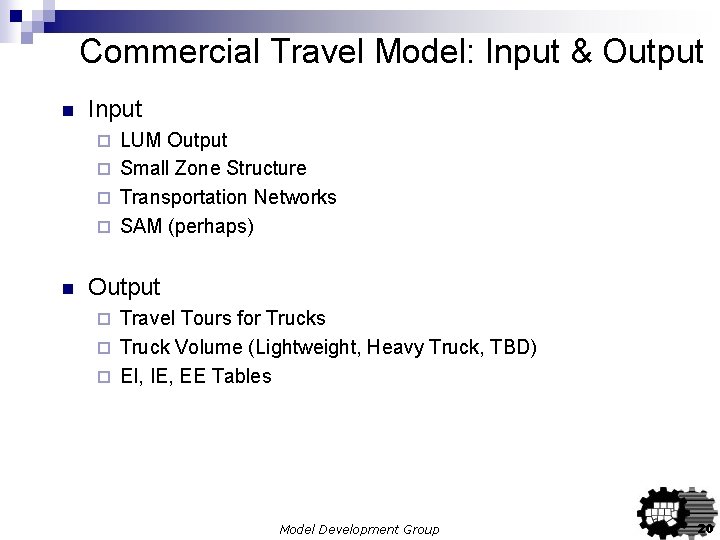
Commercial Travel Model: Input & Output n Input LUM Output ¨ Small Zone Structure ¨ Transportation Networks ¨ SAM (perhaps) ¨ n Output Travel Tours for Trucks ¨ Truck Volume (Lightweight, Heavy Truck, TBD) ¨ EI, IE, EE Tables ¨ Model Development Group 20
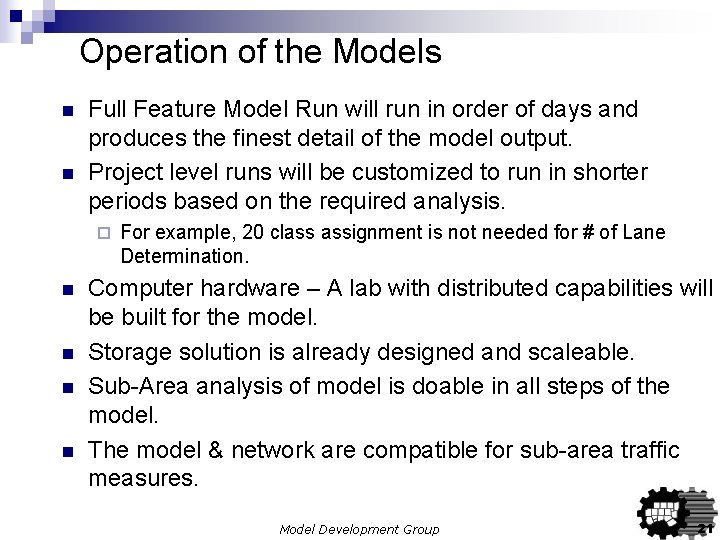
Operation of the Models n n Full Feature Model Run will run in order of days and produces the finest detail of the model output. Project level runs will be customized to run in shorter periods based on the required analysis. ¨ n n For example, 20 class assignment is not needed for # of Lane Determination. Computer hardware – A lab with distributed capabilities will be built for the model. Storage solution is already designed and scaleable. Sub-Area analysis of model is doable in all steps of the model. The model & network are compatible for sub-area traffic measures. Model Development Group 21
Work Plan for New Model Creation n Initial Preparation MDG conducts user and stakeholder meeting to determine the needs. ¨ MDG provides historical perspective of model application for guidance. ¨ MDG converts the needs to model features and structure. ¨ MDG performs investigation and conducts peer reviews to design the model framework. ¨ n Framework: MDG breaks the framework into model components with I/O that can be outsourced for development. ¨ Outsourcing of model components happens sequentially with significant overlap to limit the length of development. ¨ Different contracts for each component. ¨ Model Development Group 22
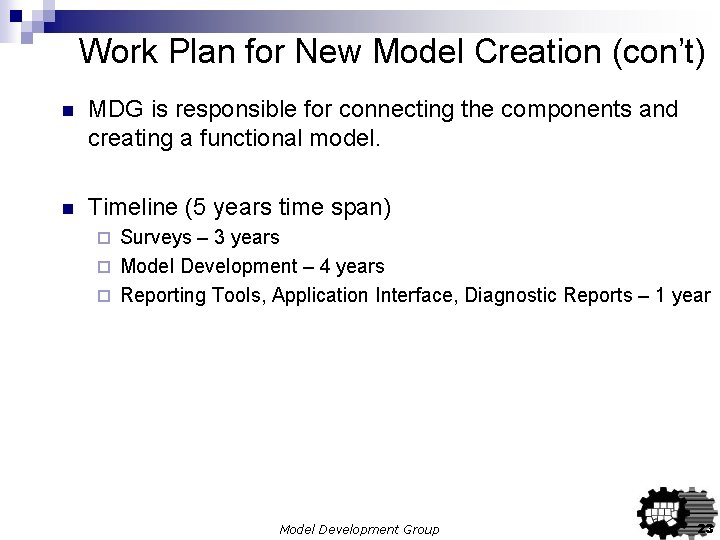
Work Plan for New Model Creation (con’t) n MDG is responsible for connecting the components and creating a functional model. n Timeline (5 years time span) Surveys – 3 years ¨ Model Development – 4 years ¨ Reporting Tools, Application Interface, Diagnostic Reports – 1 year ¨ Model Development Group 23
Model Development Group (MDG) Goal: Databases Model Development Group 24
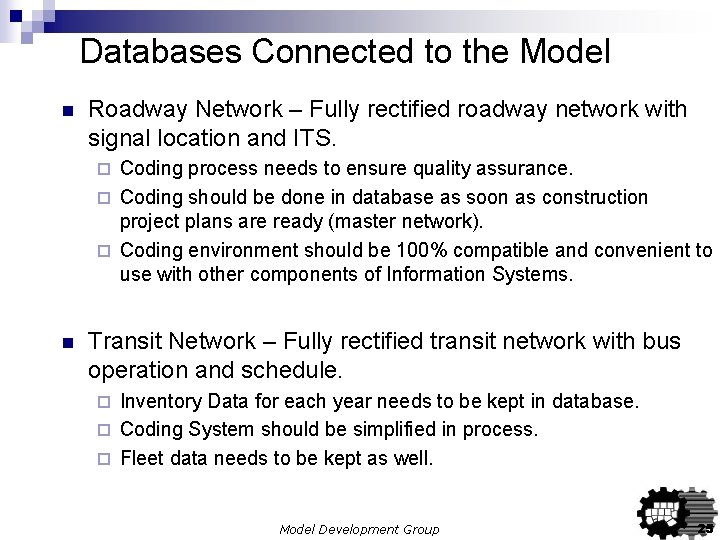
Databases Connected to the Model n Roadway Network – Fully rectified roadway network with signal location and ITS. Coding process needs to ensure quality assurance. ¨ Coding should be done in database as soon as construction project plans are ready (master network). ¨ Coding environment should be 100% compatible and convenient to use with other components of Information Systems. ¨ n Transit Network – Fully rectified transit network with bus operation and schedule. Inventory Data for each year needs to be kept in database. ¨ Coding System should be simplified in process. ¨ Fleet data needs to be kept as well. ¨ Model Development Group 25
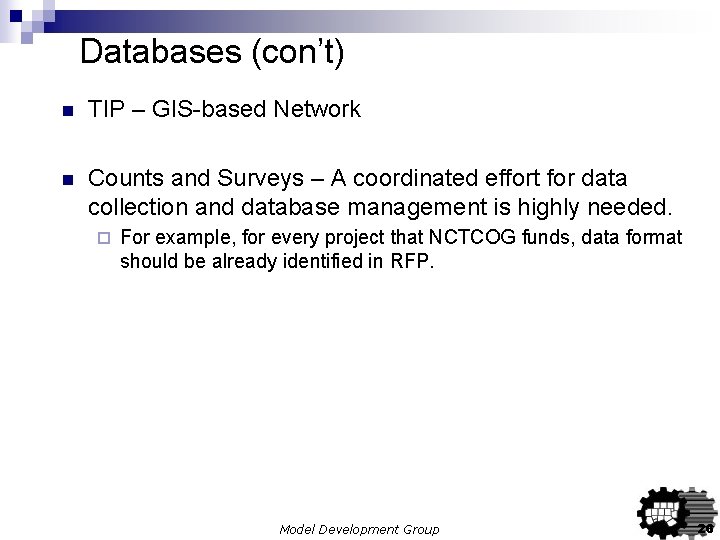
Databases (con’t) n TIP – GIS-based Network n Counts and Surveys – A coordinated effort for data collection and database management is highly needed. ¨ For example, for every project that NCTCOG funds, data format should be already identified in RFP. Model Development Group 26
Model Development Group (MDG) Goal: Tools Model Development Group 27
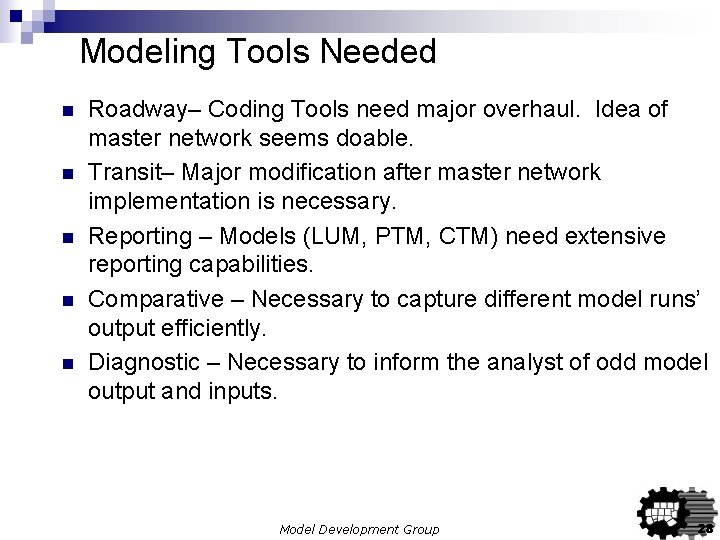
Modeling Tools Needed n n n Roadway– Coding Tools need major overhaul. Idea of master network seems doable. Transit– Major modification after master network implementation is necessary. Reporting – Models (LUM, PTM, CTM) need extensive reporting capabilities. Comparative – Necessary to capture different model runs’ output efficiently. Diagnostic – Necessary to inform the analyst of odd model output and inputs. Model Development Group 28
Model Development Group (MDG) Goal: Surveys Model Development Group 29
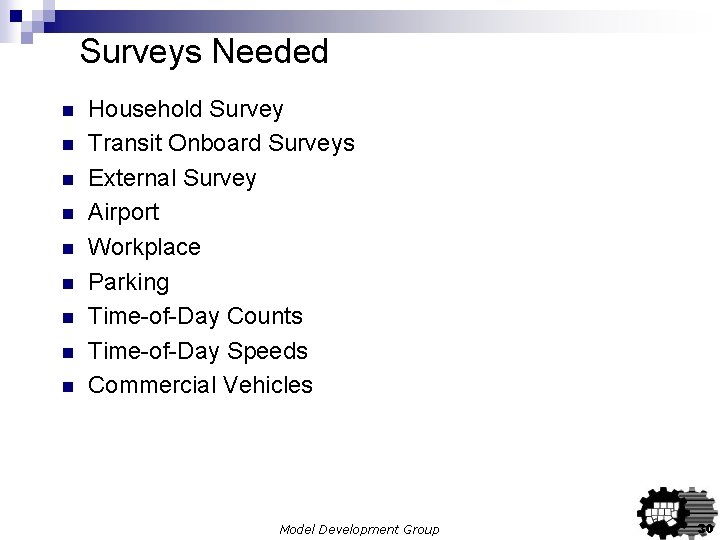
Surveys Needed n n n n n Household Survey Transit Onboard Surveys External Survey Airport Workplace Parking Time-of-Day Counts Time-of-Day Speeds Commercial Vehicles Model Development Group 30
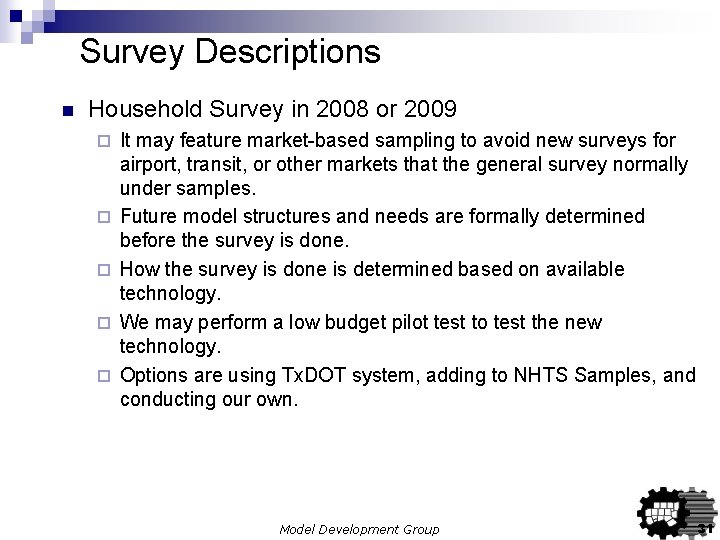
Survey Descriptions n Household Survey in 2008 or 2009 ¨ ¨ ¨ It may feature market-based sampling to avoid new surveys for airport, transit, or other markets that the general survey normally under samples. Future model structures and needs are formally determined before the survey is done. How the survey is done is determined based on available technology. We may perform a low budget pilot test to test the new technology. Options are using Tx. DOT system, adding to NHTS Samples, and conducting our own. Model Development Group 31
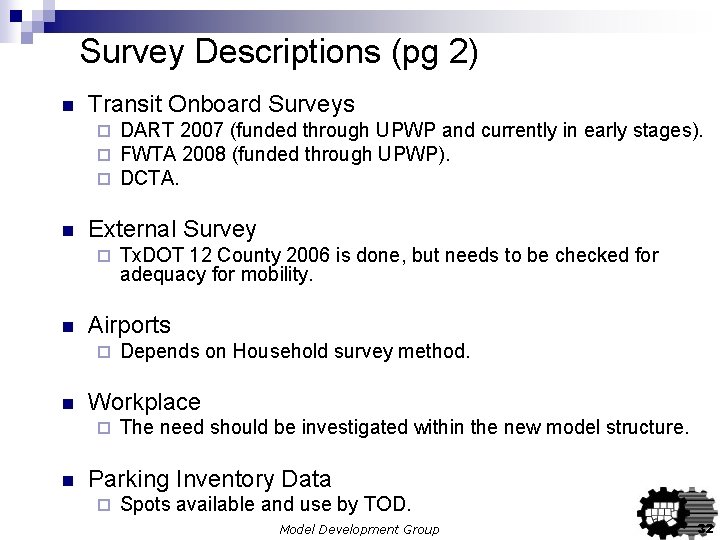
Survey Descriptions (pg 2) n Transit Onboard Surveys ¨ ¨ ¨ n External Survey ¨ n Depends on Household survey method. Workplace ¨ n Tx. DOT 12 County 2006 is done, but needs to be checked for adequacy for mobility. Airports ¨ n DART 2007 (funded through UPWP and currently in early stages). FWTA 2008 (funded through UPWP). DCTA. The need should be investigated within the new model structure. Parking Inventory Data ¨ Spots available and use by TOD. Model Development Group 32
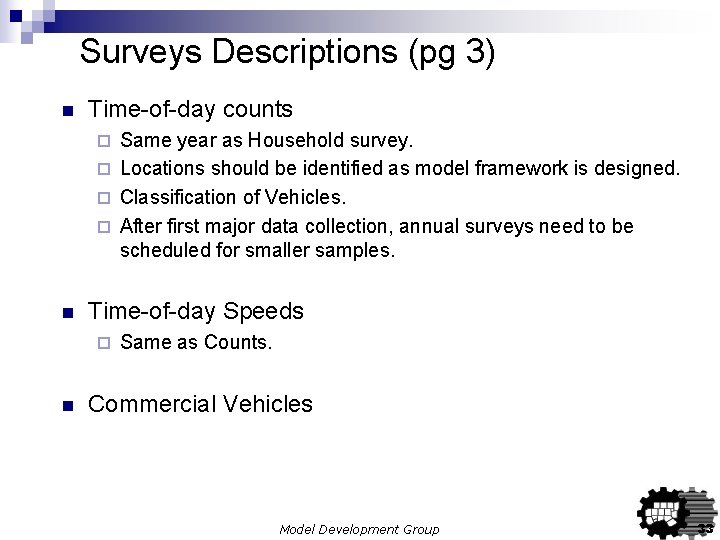
Surveys Descriptions (pg 3) n Time-of-day counts Same year as Household survey. ¨ Locations should be identified as model framework is designed. ¨ Classification of Vehicles. ¨ After first major data collection, annual surveys need to be scheduled for smaller samples. ¨ n Time-of-day Speeds ¨ n Same as Counts. Commercial Vehicles Model Development Group 33
The Future Plan: Complete. Plan Model Development Group 34
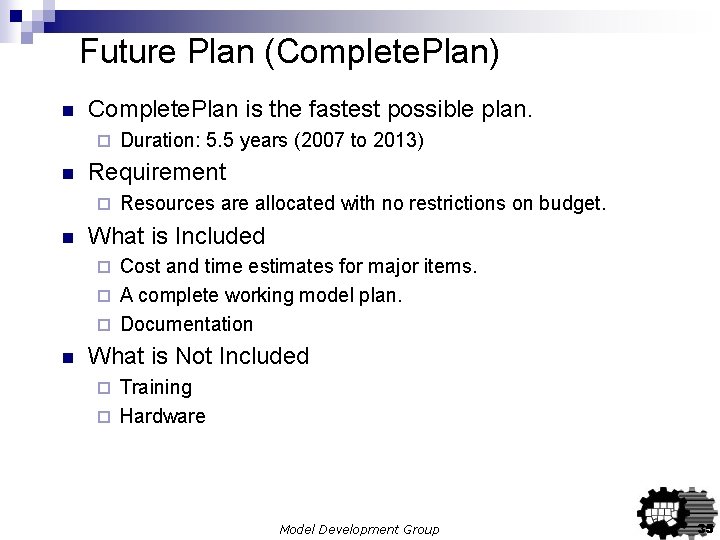
Future Plan (Complete. Plan) n Complete. Plan is the fastest possible plan. ¨ n Requirement ¨ n Duration: 5. 5 years (2007 to 2013) Resources are allocated with no restrictions on budget. What is Included Cost and time estimates for major items. ¨ A complete working model plan. ¨ Documentation ¨ n What is Not Included Training ¨ Hardware ¨ Model Development Group 35
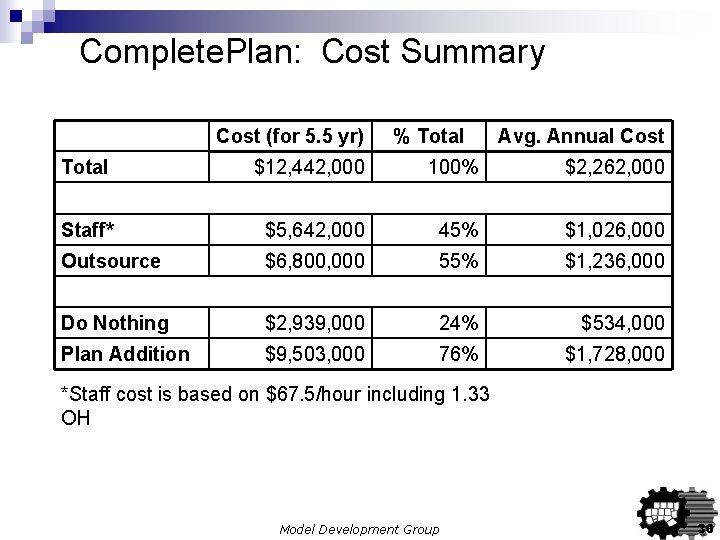
Complete. Plan: Cost Summary Cost (for 5. 5 yr) % Total Avg. Annual Cost Total $12, 442, 000 100% $2, 262, 000 Staff* $5, 642, 000 45% $1, 026, 000 Outsource $6, 800, 000 55% $1, 236, 000 Do Nothing $2, 939, 000 24% $534, 000 Plan Addition $9, 503, 000 76% $1, 728, 000 *Staff cost is based on $67. 5/hour including 1. 33 OH Model Development Group 36
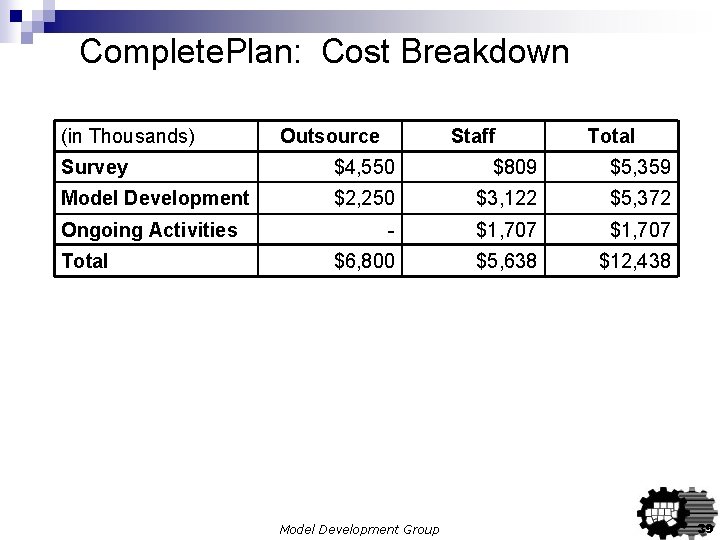
Complete. Plan: Cost Breakdown (in Thousands) Outsource Staff Total Survey $4, 550 $809 $5, 359 Model Development $2, 250 $3, 122 $5, 372 - $1, 707 $6, 800 $5, 638 $12, 438 Ongoing Activities Total Model Development Group 39
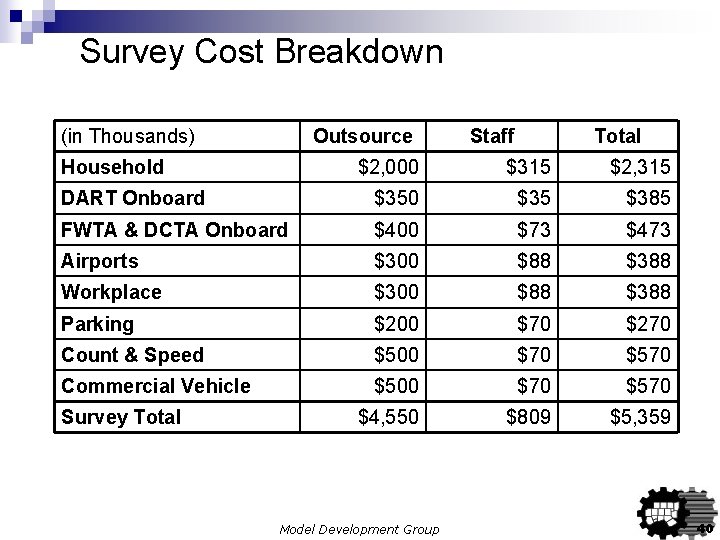
Survey Cost Breakdown (in Thousands) Outsource Household Staff Total $2, 000 $315 $2, 315 DART Onboard $350 $35 $385 FWTA & DCTA Onboard $400 $73 $473 Airports $300 $88 $388 Workplace $300 $88 $388 Parking $200 $70 $270 Count & Speed $500 $70 $570 Commercial Vehicle $500 $70 $570 $4, 550 $809 $5, 359 Survey Total Model Development Group 40
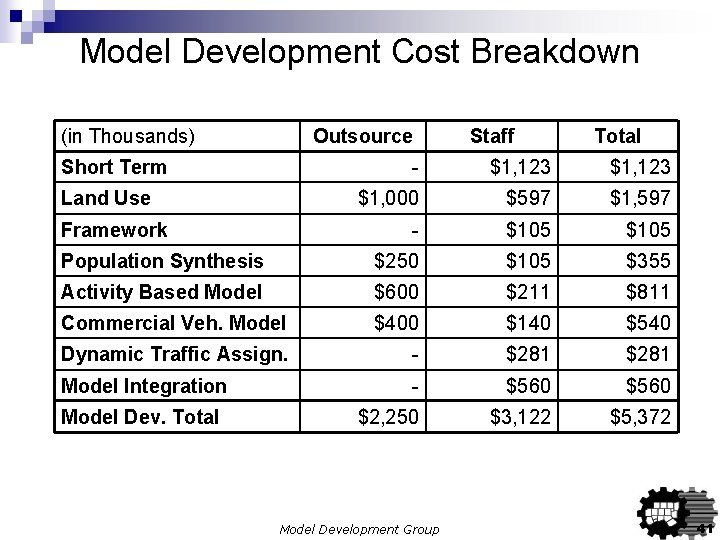
Model Development Cost Breakdown (in Thousands) Outsource Short Term Staff Total - $1, 123 $1, 000 $597 $1, 597 - $105 Population Synthesis $250 $105 $355 Activity Based Model $600 $211 $811 Commercial Veh. Model $400 $140 $540 Dynamic Traffic Assign. - $281 Model Integration - $560 $2, 250 $3, 122 $5, 372 Land Use Framework Model Dev. Total Model Development Group 41
Ongoing Activities Cost Breakdown (in Thousands) Outsource Staff Total Proj. for Other Groups - $290 Support & Mgmt - $1, 417 Ongoing Act. Total - $1, 707 Model Development Group 42
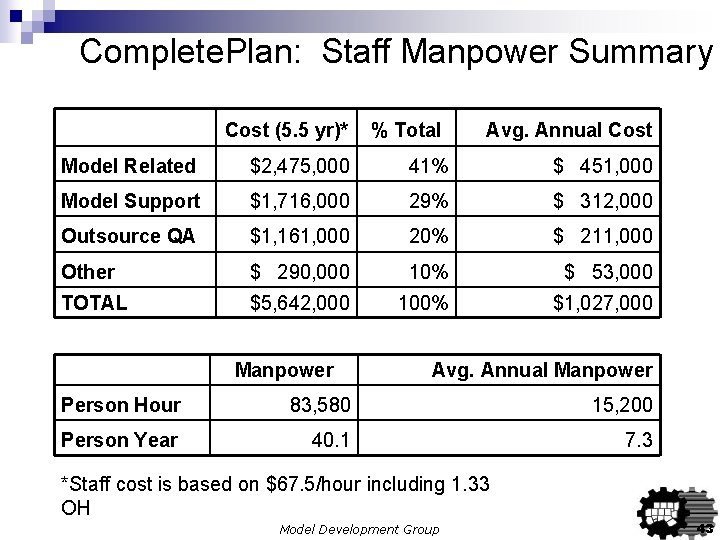
Complete. Plan: Staff Manpower Summary Cost (5. 5 yr)* % Total Avg. Annual Cost Model Related $2, 475, 000 41% $ 451, 000 Model Support $1, 716, 000 29% $ 312, 000 Outsource QA $1, 161, 000 20% $ 211, 000 Other $ 290, 000 10% $ 53, 000 TOTAL $5, 642, 000 100% $1, 027, 000 Manpower Avg. Annual Manpower Person Hour 83, 580 15, 200 Person Year 40. 1 7. 3 *Staff cost is based on $67. 5/hour including 1. 33 OH Model Development Group 43