
Work Physiology Thermal Ergonomics An Introduction to Human
- Slides: 24
Work Physiology – Thermal Ergonomics An Introduction to Human Thermal Environments Ollie Jay Email: Ojay@sfu. ca Laboratory for Exercise and Environmental Physiology
Reading Course Reading: “Exercise Physiology” – G. A. Brooks Chapter 22 Other Recommended Reading if you like: “Life at the extremes – The science of survival” – Frances Ashcroft (2001) “Survival of the fittest” – Mike Stroud (2004)
Outline Human Thermal Environments – How the body interacts with a given thermal environment (hot, moderate or cold) – Human heat balance equation • How does it work? • Avenues of heat exchange • Thermoregulatory responses – Human-Environment Interaction • Six parameters – What happens when the body cannot maintain thermal balance? • Hypothermia, hyperthermia… A matter of survival…. . • Thermal comfort … A matter of productivity….
Thermoregulation Humans are “HOMEOTHERMS” – This means we regulate our deep body (core) temperature around a set-point. . This set-point is 37. 0± 0. 5 C depending upon time of day, metabolism, menstrual cycle for females etc… – It is a DYNAMIC equilibrium, meaning that we fluctuate around this set-point in order to maintain HEAT BALANCE, depending upon the environmental conditions and the way in which we interact with them
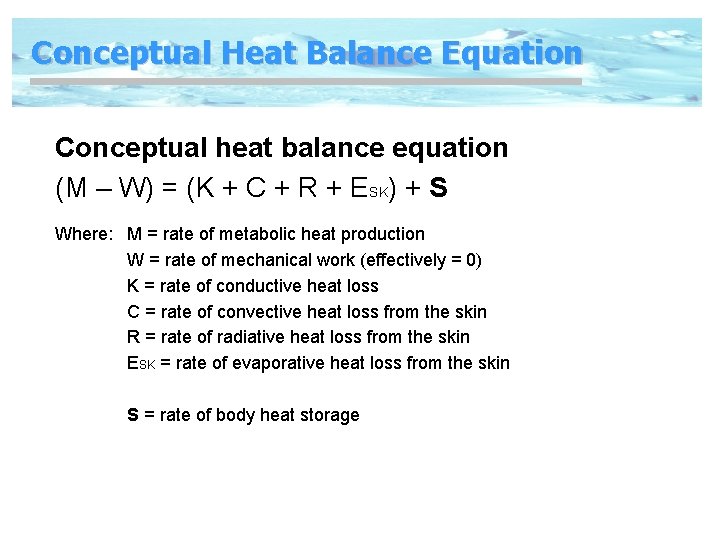
Conceptual Heat Balance Equation Conceptual heat balance equation (M – W) = (K + C + R + ESK) + S Where: M = rate of metabolic heat production W = rate of mechanical work (effectively = 0) K = rate of conductive heat loss C = rate of convective heat loss from the skin R = rate of radiative heat loss from the skin ESK = rate of evaporative heat loss from the skin S = rate of body heat storage
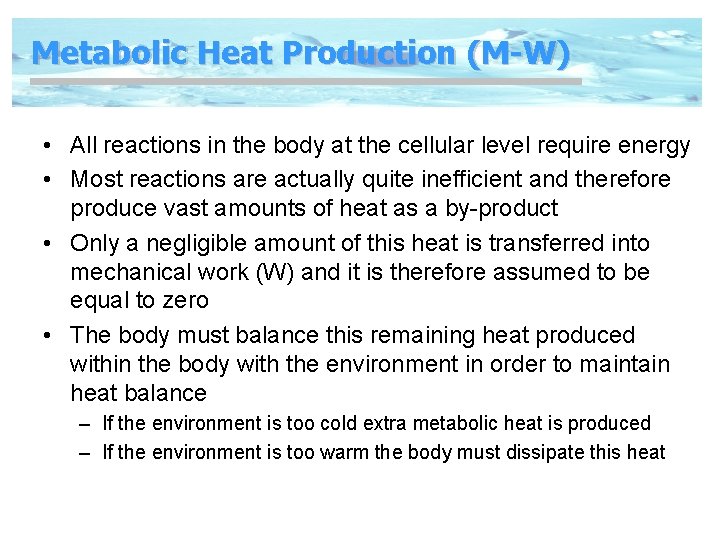
Metabolic Heat Production (M-W) • All reactions in the body at the cellular level require energy • Most reactions are actually quite inefficient and therefore produce vast amounts of heat as a by-product • Only a negligible amount of this heat is transferred into mechanical work (W) and it is therefore assumed to be equal to zero • The body must balance this remaining heat produced within the body with the environment in order to maintain heat balance – If the environment is too cold extra metabolic heat is produced – If the environment is too warm the body must dissipate this heat
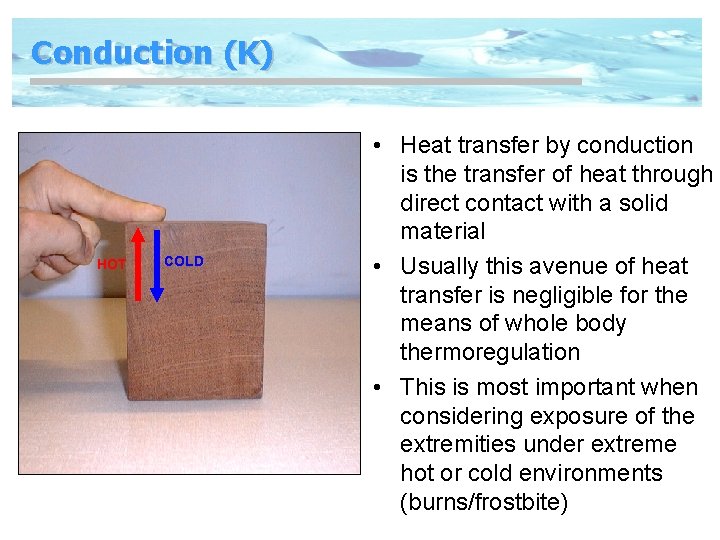
Conduction (K) HOT COLD • Heat transfer by conduction is the transfer of heat through direct contact with a solid material • Usually this avenue of heat transfer is negligible for the means of whole body thermoregulation • This is most important when considering exposure of the extremities under extreme hot or cold environments (burns/frostbite)
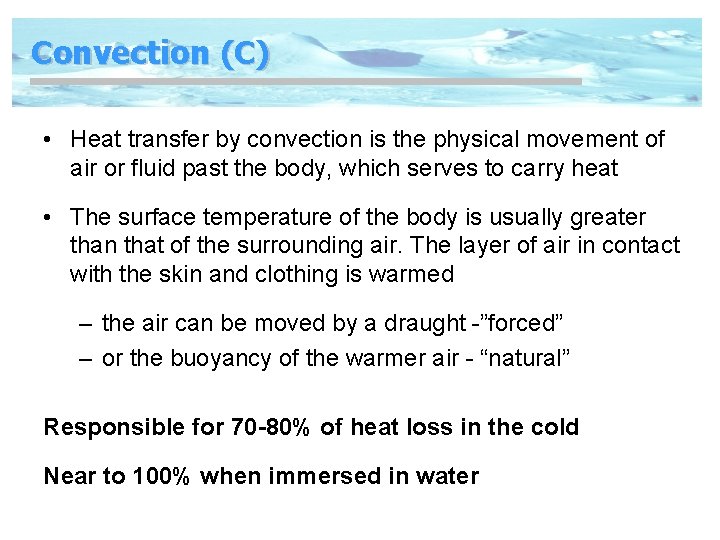
Convection (C) • Heat transfer by convection is the physical movement of air or fluid past the body, which serves to carry heat • The surface temperature of the body is usually greater than that of the surrounding air. The layer of air in contact with the skin and clothing is warmed – the air can be moved by a draught -”forced” – or the buoyancy of the warmer air - “natural” Responsible for 70 -80% of heat loss in the cold Near to 100% when immersed in water
Radiation (R) • Heat transfer by the means of electromagnetic radiation • Largest source of radiant heat is the sun with a surface temperature of 5500ºC and is 93 million miles away
Evaporation (Esk) • Heat transfer due to sweating • Liquid - vapour change produces latent heat, this is lost through evaporation of sweat at the skin surface • It is the evaporation of sweat NOT the production sweat that cools the body Responsible for 70+% of heat loss in the heat
Heat Storage (S) • Heat Storage – Negative = decrease in core temperature • Continued decrease leads to HYPO thermia – Positive = increase in core temperature • Continued increase leads to HYPER thermia • Measuring core temperature – Experimentally the most effective is esophageal – Others include: • Rectal (large time lag) • Tympanic / Aural (not accurate) • Oral (difficult to measure during exercise)
Physiological responses to +ve S • Positive Heat Storage When core temperature increases above set-point (37°C), anterior hypothalmus elicits physiological cooling mechanisms – Sweating • • Increases heat loss via evaporation (Esk) 1 gm sweat = 2411. 3 Joules (0. 58 kcal) Ecrine glands (Forehead, back, palms) - cooling Apocrine glands (axillary and pubic regions) – odours – Vasodilatation • Dilation of the vascular smooth muscle cells allows a greater peripheral blood flow, facilitating greater heat dissipation from body core via convection (C) and radiation (R)
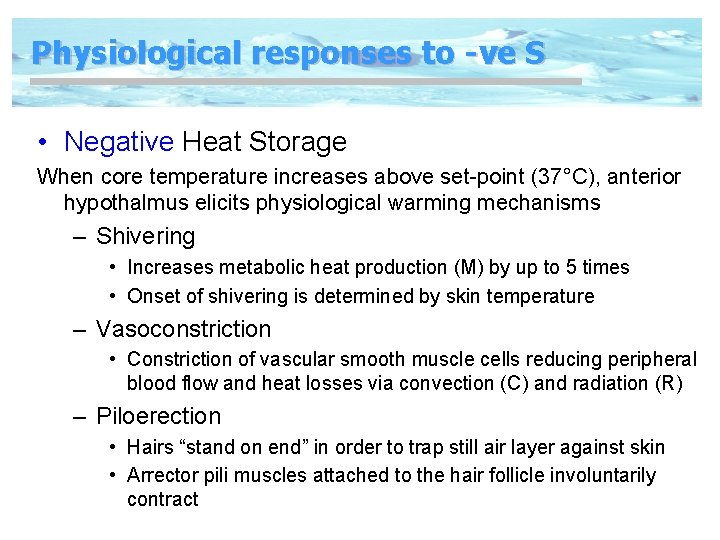
Physiological responses to -ve S • Negative Heat Storage When core temperature increases above set-point (37°C), anterior hypothalmus elicits physiological warming mechanisms – Shivering • Increases metabolic heat production (M) by up to 5 times • Onset of shivering is determined by skin temperature – Vasoconstriction • Constriction of vascular smooth muscle cells reducing peripheral blood flow and heat losses via convection (C) and radiation (R) – Piloerection • Hairs “stand on end” in order to trap still air layer against skin • Arrector pili muscles attached to the hair follicle involuntarily contract
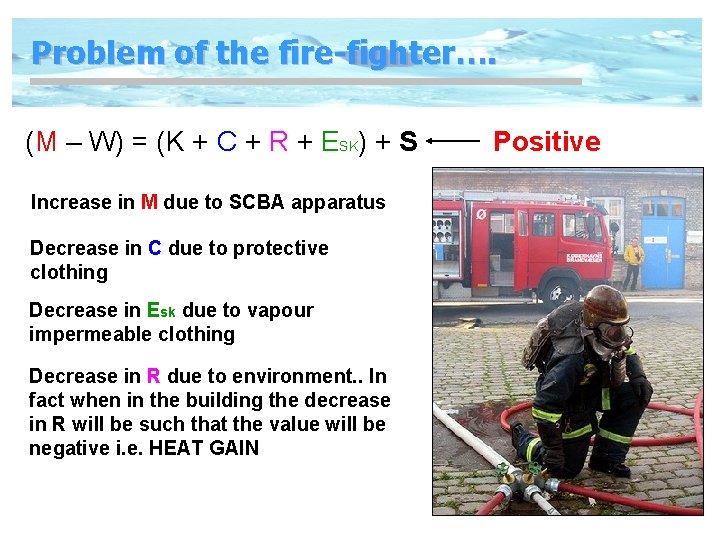
Problem of the fire-fighter…. (M – W) = (K + C + R + ESK) + S Increase in M due to SCBA apparatus Decrease in C due to protective clothing Decrease in Esk due to vapour impermeable clothing Decrease in R due to environment. . In fact when in the building the decrease in R will be such that the value will be negative i. e. HEAT GAIN Positive
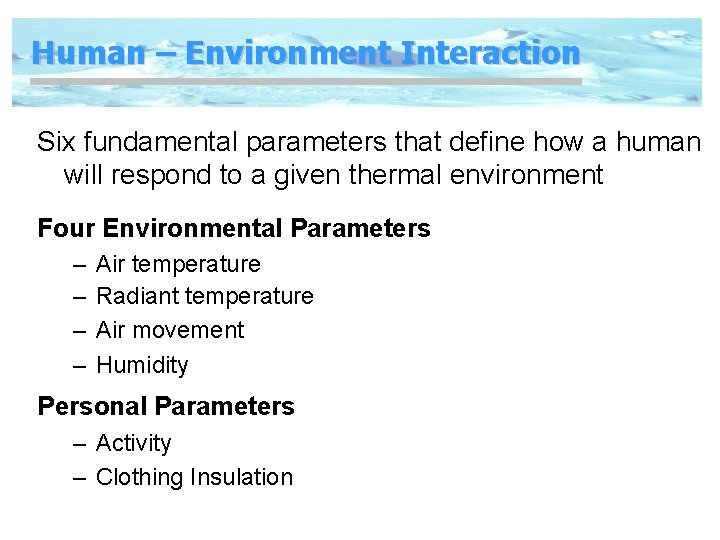
Human – Environment Interaction Six fundamental parameters that define how a human will respond to a given thermal environment Four Environmental Parameters – – Air temperature Radiant temperature Air movement Humidity Personal Parameters – Activity – Clothing Insulation
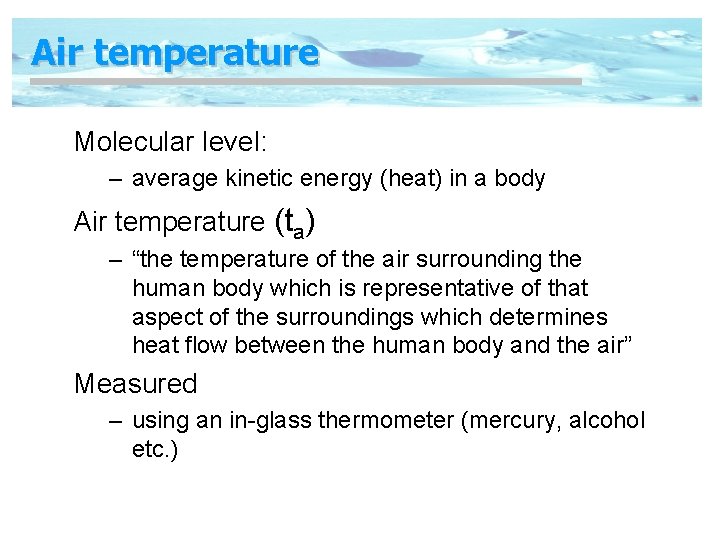
Air temperature Molecular level: – average kinetic energy (heat) in a body Air temperature (ta) – “the temperature of the air surrounding the human body which is representative of that aspect of the surroundings which determines heat flow between the human body and the air” Measured – using an in-glass thermometer (mercury, alcohol etc. )
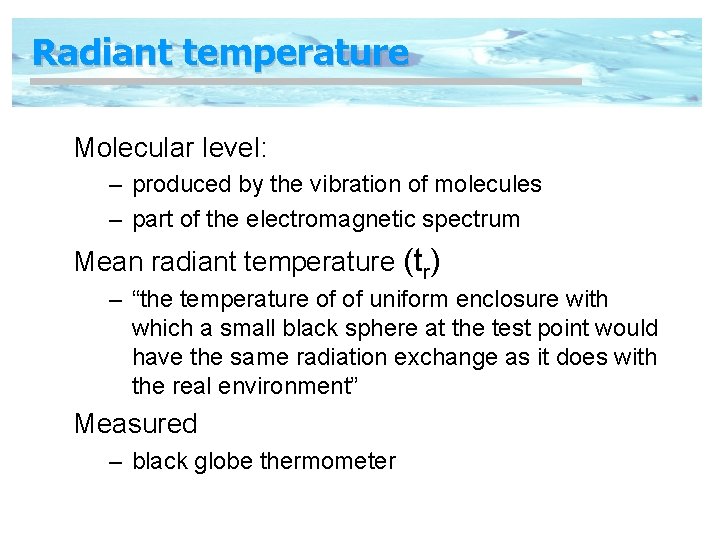
Radiant temperature Molecular level: – produced by the vibration of molecules – part of the electromagnetic spectrum Mean radiant temperature (tr) – “the temperature of of uniform enclosure with which a small black sphere at the test point would have the same radiation exchange as it does with the real environment” Measured – black globe thermometer
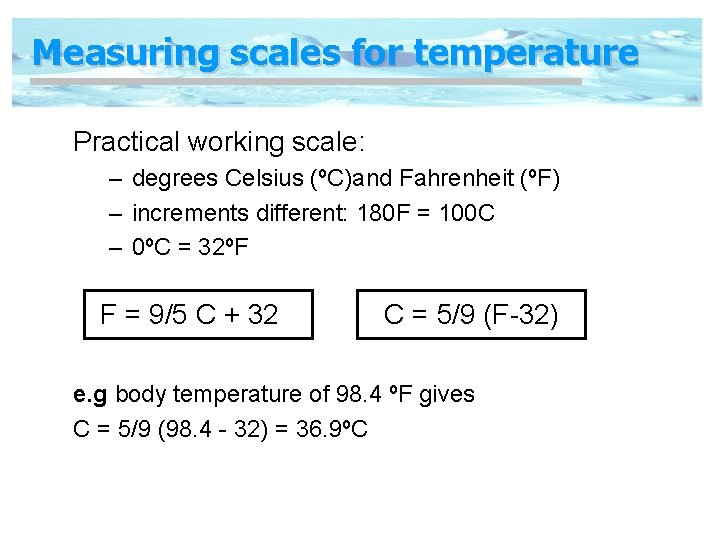
Measuring scales for temperature Practical working scale: – degrees Celsius (ºC)and Fahrenheit (ºF) – increments different: 180 F = 100 C – 0ºC = 32ºF F = 9/5 C + 32 C = 5/9 (F-32) e. g body temperature of 98. 4 ºF gives C = 5/9 (98. 4 - 32) = 36. 9ºC
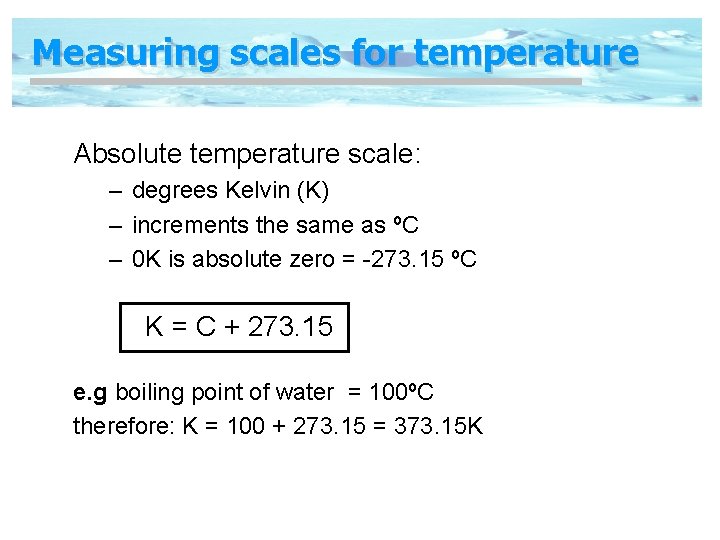
Measuring scales for temperature Absolute temperature scale: – degrees Kelvin (K) – increments the same as ºC – 0 K is absolute zero = -273. 15 ºC K = C + 273. 15 e. g boiling point of water = 100ºC therefore: K = 100 + 273. 15 = 373. 15 K
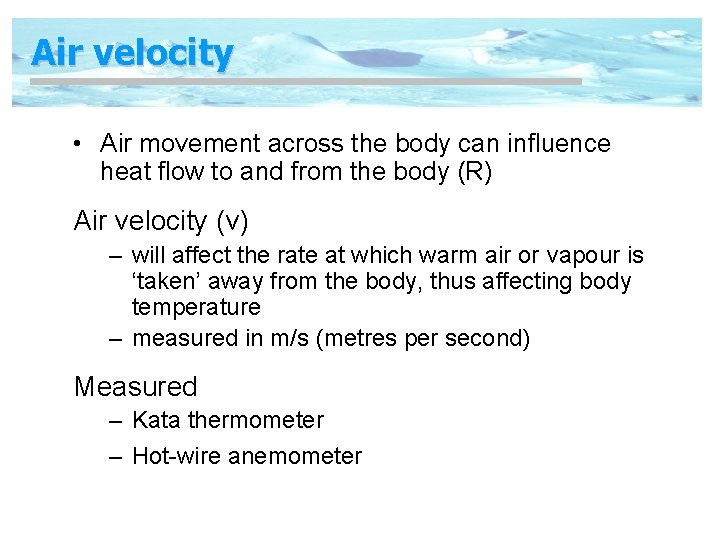
Air velocity • Air movement across the body can influence heat flow to and from the body (R) Air velocity (v) – will affect the rate at which warm air or vapour is ‘taken’ away from the body, thus affecting body temperature – measured in m/s (metres per second) Measured – Kata thermometer – Hot-wire anemometer
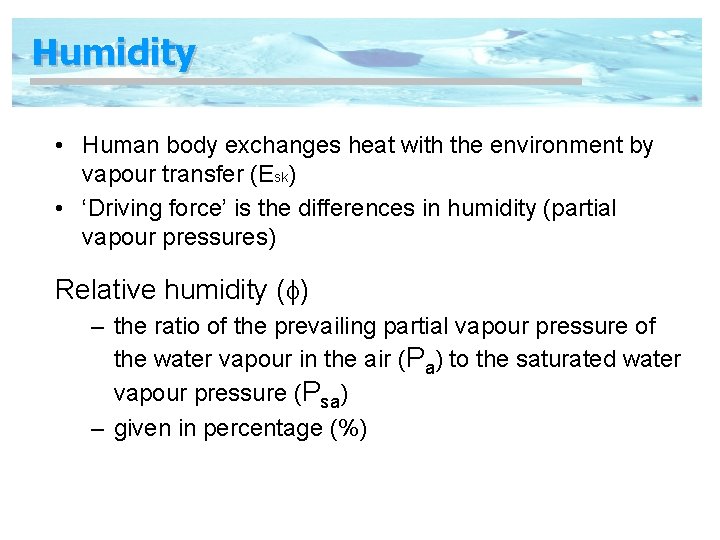
Humidity • Human body exchanges heat with the environment by vapour transfer (Esk) • ‘Driving force’ is the differences in humidity (partial vapour pressures) Relative humidity ( ) – the ratio of the prevailing partial vapour pressure of the water vapour in the air (Pa) to the saturated water vapour pressure (Psa) – given in percentage (%)
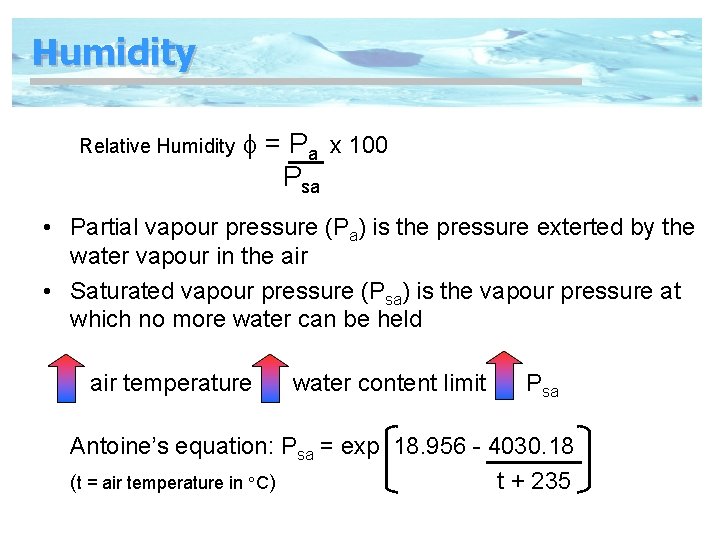
Humidity Relative Humidity = Pa x 100 Psa • Partial vapour pressure (Pa) is the pressure exterted by the water vapour in the air • Saturated vapour pressure (Psa) is the vapour pressure at which no more water can be held air temperature water content limit Psa Antoine’s equation: Psa = exp 18. 956 - 4030. 18 (t = air temperature in C) t + 235
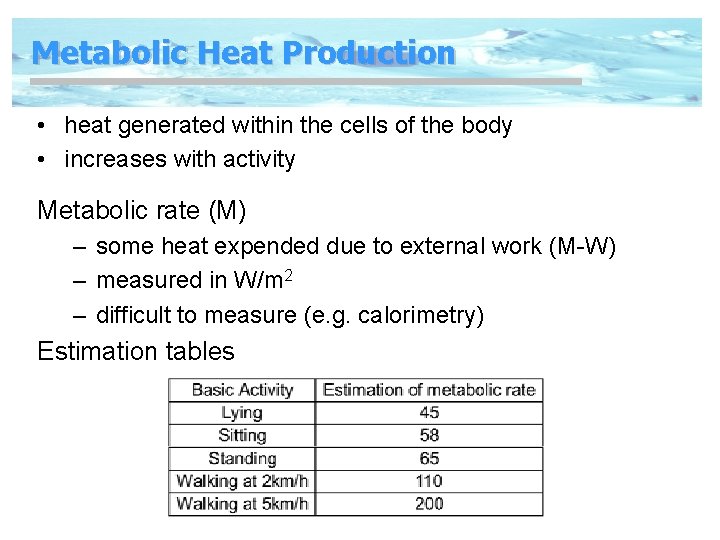
Metabolic Heat Production • heat generated within the cells of the body • increases with activity Metabolic rate (M) – some heat expended due to external work (M-W) – measured in W/m 2 – difficult to measure (e. g. calorimetry) Estimation tables
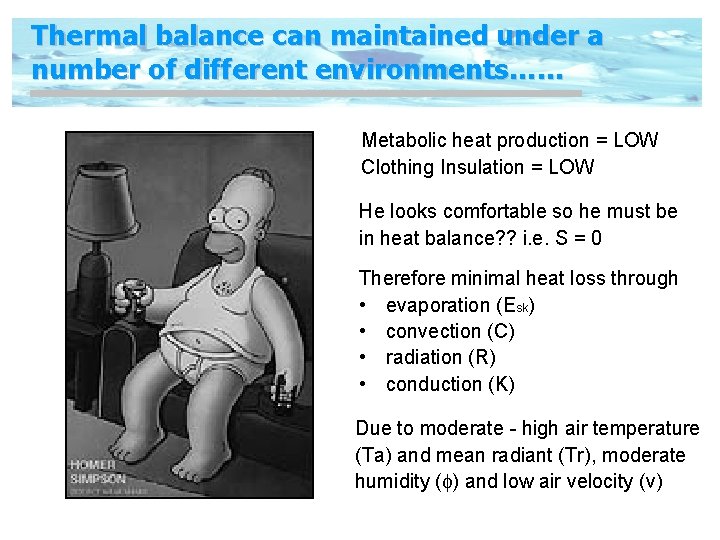
Thermal balance can maintained under a number of different environments…… Metabolic heat production = LOW Clothing Insulation = LOW He looks comfortable so he must be in heat balance? ? i. e. S = 0 Therefore minimal heat loss through • evaporation (Esk) • convection (C) • radiation (R) • conduction (K) Due to moderate - high air temperature (Ta) and mean radiant (Tr), moderate humidity ( ) and low air velocity (v)