
Work pg Objectives Define the joule in terms

Work pg. _____
Objectives • Define the joule in terms of force and distance. • State the connection between work and energy. • Apply the work equation to calculate work, force, or distance. Physics terms • joule (J) • work
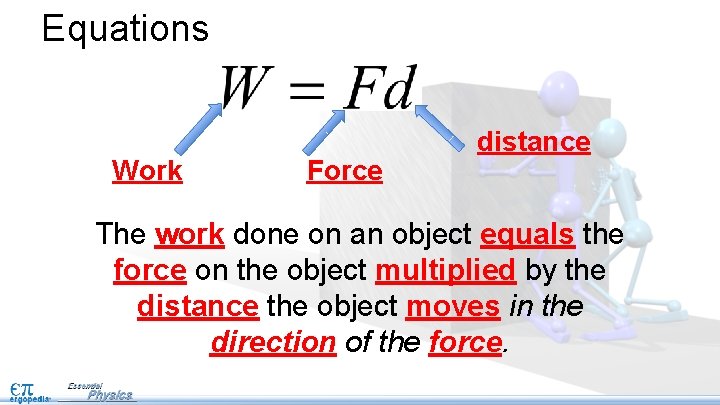
Equations Work Force distance The work done on an object equals the force on the object multiplied by the distance the object moves in the direction of the force.
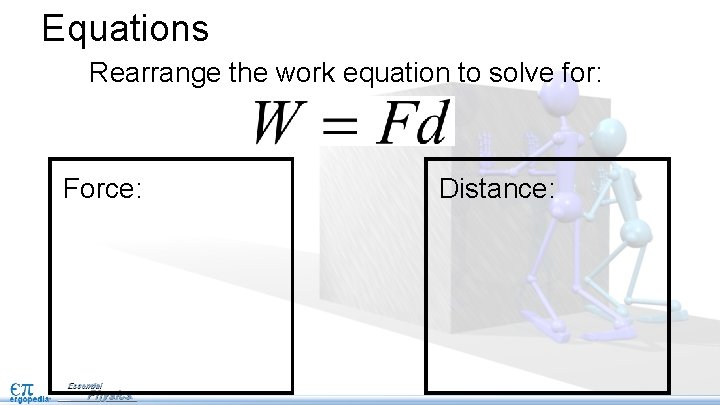
Equations Rearrange the work equation to solve for: Force: Distance:
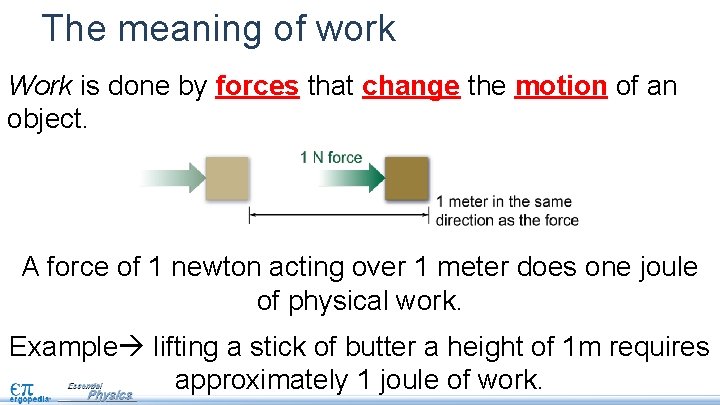
The meaning of work Work is done by forces that change the motion of an object. A force of 1 newton acting over 1 meter does one joule of physical work. Example lifting a stick of butter a height of 1 m requires approximately 1 joule of work.
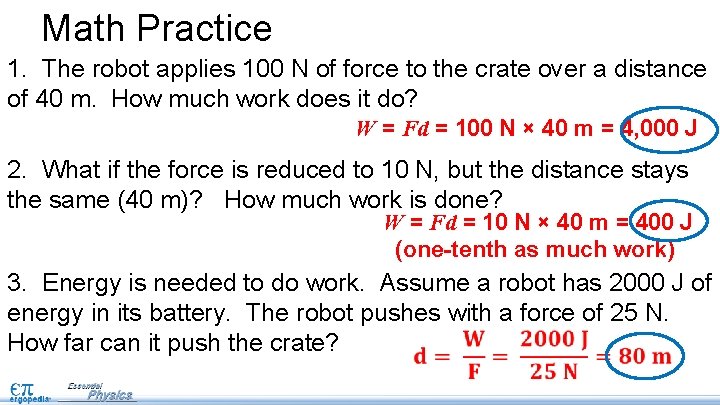
Math Practice 1. The robot applies 100 N of force to the crate over a distance of 40 m. How much work does it do? W = Fd = 100 N × 40 m = 4, 000 J 2. What if the force is reduced to 10 N, but the distance stays the same (40 m)? How much work is done? W = Fd = 10 N × 40 m = 400 J (one-tenth as much work) 3. Energy is needed to do work. Assume a robot has 2000 J of energy in its battery. The robot pushes with a force of 25 N. How far can it push the crate?
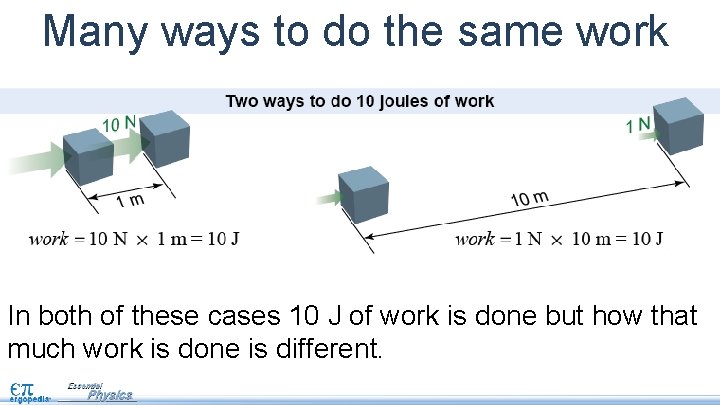
Many ways to do the same work In both of these cases 10 J of work is done but how that much work is done is different.
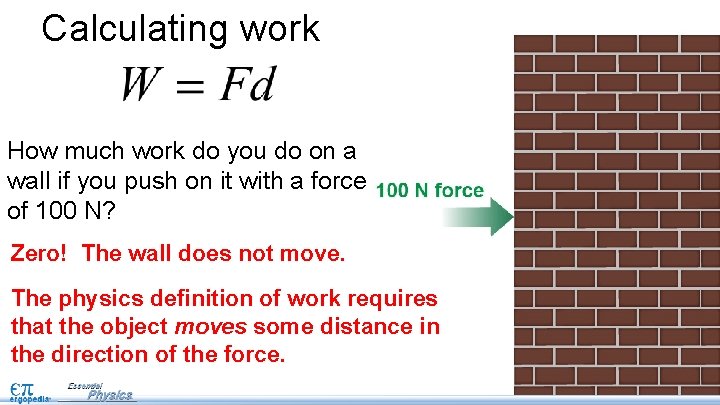
Calculating work How much work do you do on a wall if you push on it with a force of 100 N? Zero! The wall does not move. The physics definition of work requires that the object moves some distance in the direction of the force.
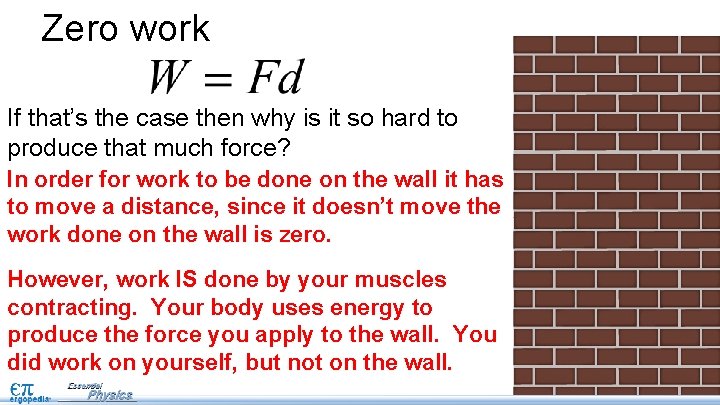
Zero work If that’s the case then why is it so hard to produce that much force? In order for work to be done on the wall it has to move a distance, since it doesn’t move the work done on the wall is zero. However, work IS done by your muscles contracting. Your body uses energy to produce the force you apply to the wall. You did work on yourself, but not on the wall.
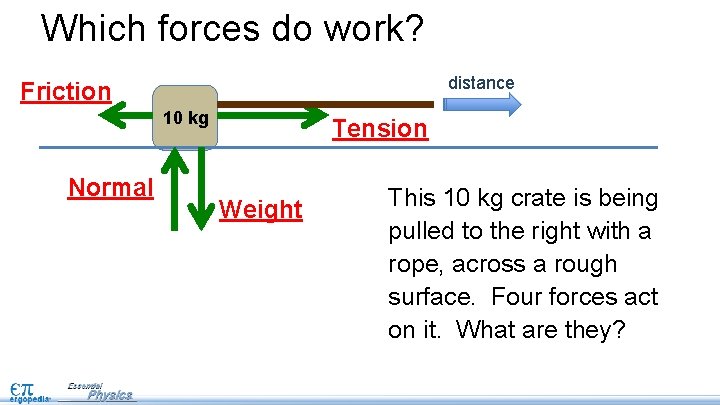
Which forces do work? distance Friction 10 kg Normal Tension Weight This 10 kg crate is being pulled to the right with a rope, across a rough surface. Four forces act on it. What are they?
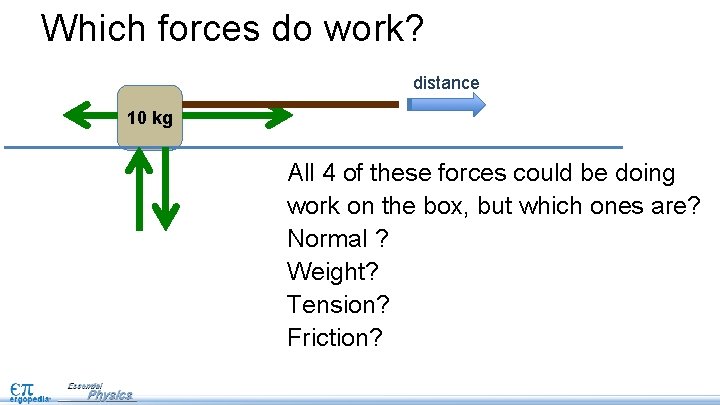
Which forces do work? distance 10 kg All 4 of these forces could be doing work on the box, but which ones are? Normal ? Weight? Tension? Friction?
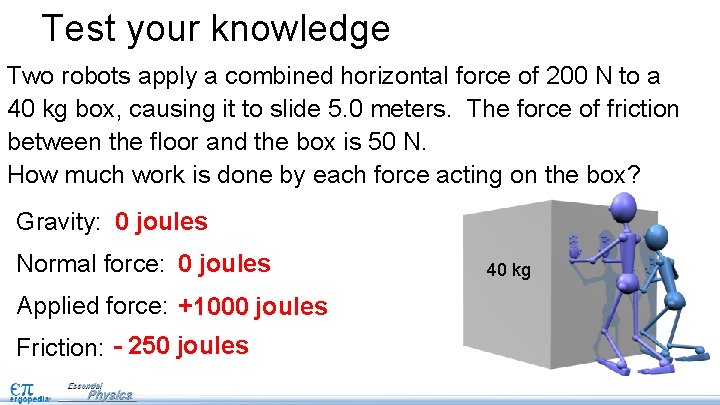
Test your knowledge Two robots apply a combined horizontal force of 200 N to a 40 kg box, causing it to slide 5. 0 meters. The force of friction between the floor and the box is 50 N. How much work is done by each force acting on the box? Gravity: 0 joules Normal force: 0 joules Applied force: +1000 joules Friction: - 250 joules 40 kg
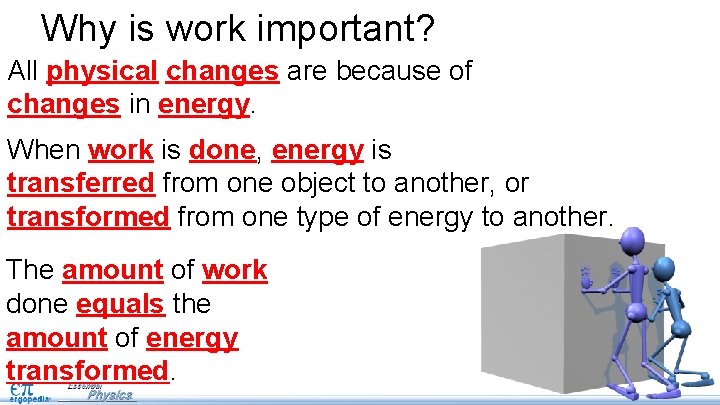
Why is work important? All physical changes are because of changes in energy. When work is done, energy is transferred from one object to another, or transformed from one type of energy to another. The amount of work done equals the amount of energy transformed.
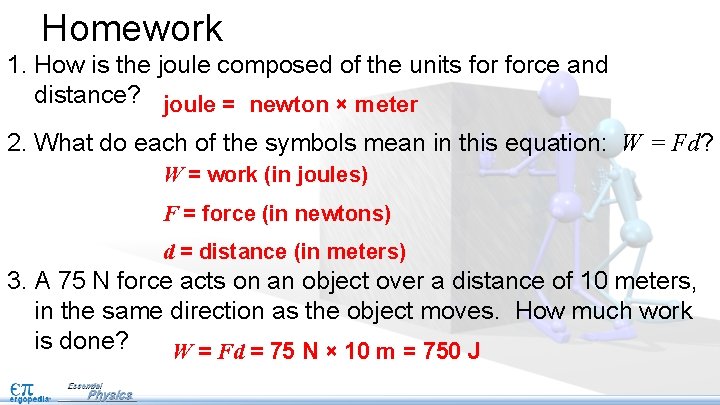
Homework 1. How is the joule composed of the units force and distance? joule = newton × meter 2. What do each of the symbols mean in this equation: W = Fd? W = work (in joules) F = force (in newtons) d = distance (in meters) 3. A 75 N force acts on an object over a distance of 10 meters, in the same direction as the object moves. How much work is done? W = Fd = 75 N × 10 m = 750 J
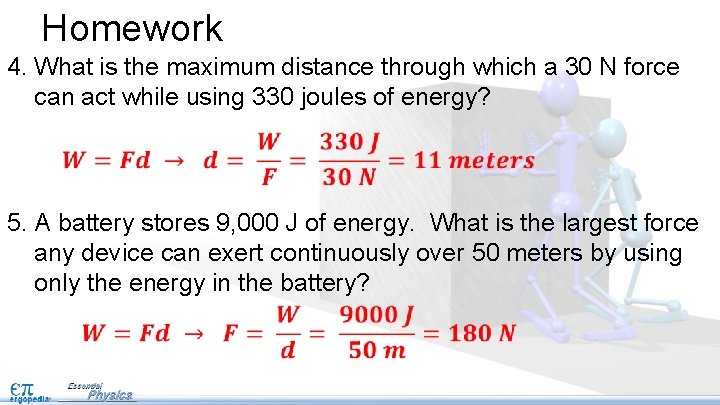
Homework 4. What is the maximum distance through which a 30 N force can act while using 330 joules of energy? 5. A battery stores 9, 000 J of energy. What is the largest force any device can exert continuously over 50 meters by using only the energy in the battery?
Homework 6. Which of these statements correctly describes the relationship between work and energy? A. Energy is the ability to do work. B. Work must be done in order for energy to be transferred between objects. C. Work must be done in order for energy to change from one form to another. D. All of the above.
- Slides: 16