
Work is performed when forces cause Objects to
Work is performed when forces cause • Objects to physically move • Objects to change physical forms (size, shape, chemical reactions, physical states) Types of work • Work (“mechanical” or “linear”) • Work against shape • Work against resistance • Work against gravity Work and Energy = JOULES
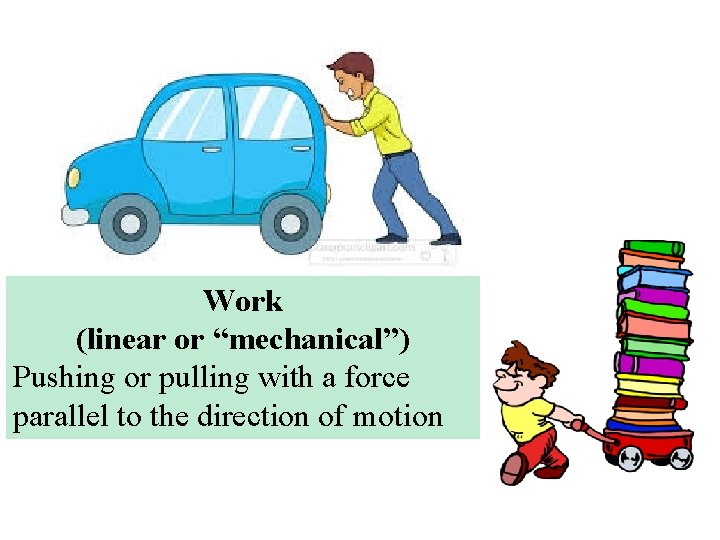
Work (linear or “mechanical”) Pushing or pulling with a force parallel to the direction of motion
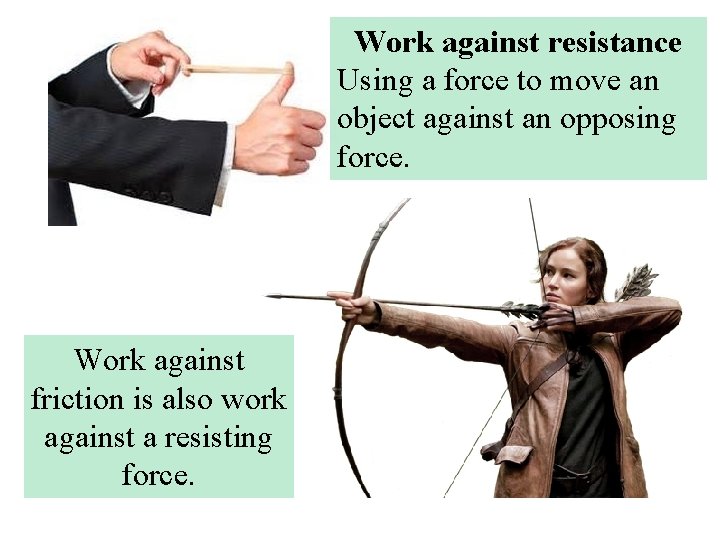
Work against resistance Using a force to move an object against an opposing force. Work against friction is also work against a resisting force.
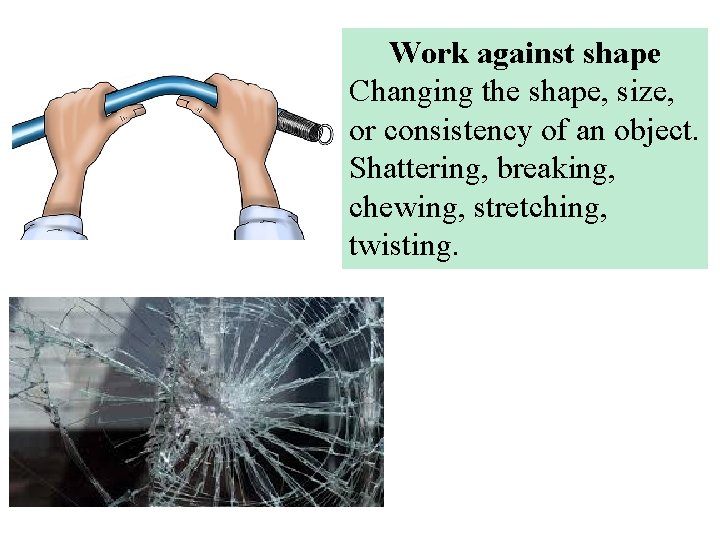
Work against shape Changing the shape, size, or consistency of an object. Shattering, breaking, chewing, stretching, twisting.

Work against gravity Lifting an object upward above a permanent surface to which it may fall.
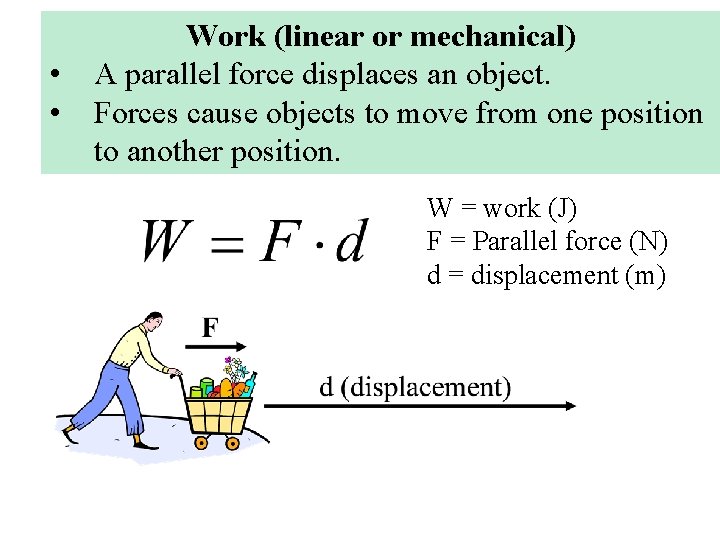
• • Work (linear or mechanical) A parallel force displaces an object. Forces cause objects to move from one position to another position. W = work (J) F = Parallel force (N) d = displacement (m)
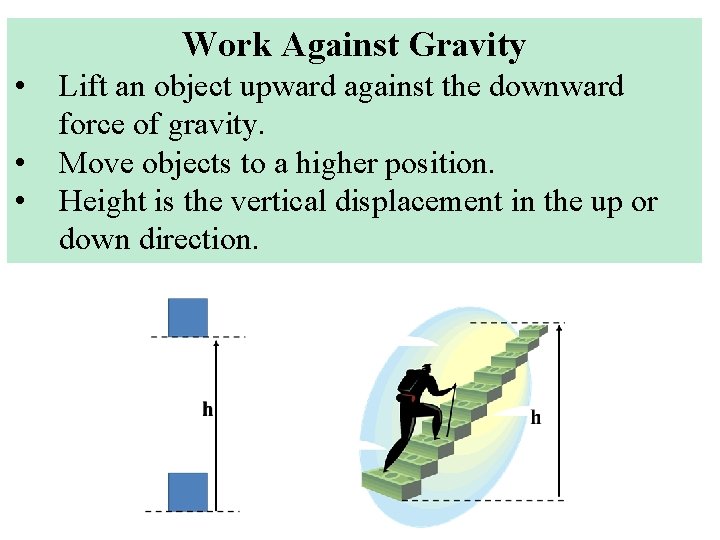
Work Against Gravity • • • Lift an object upward against the downward force of gravity. Move objects to a higher position. Height is the vertical displacement in the up or down direction.
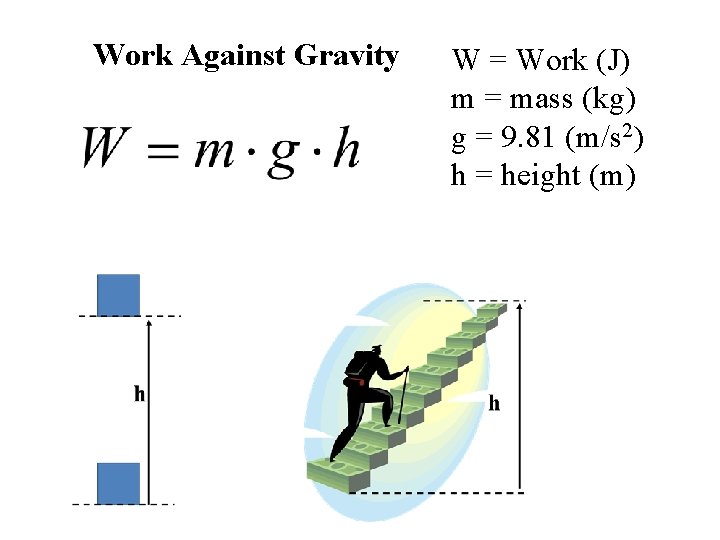
Work Against Gravity W = Work (J) m = mass (kg) g = 9. 81 (m/s 2) h = height (m)
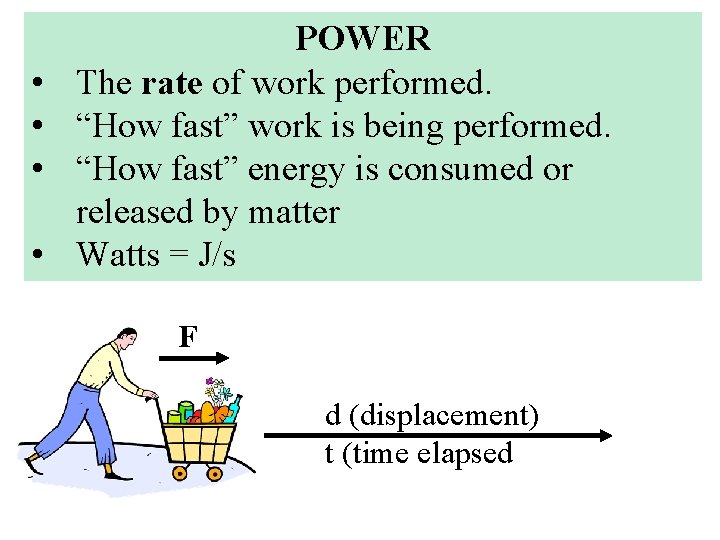
• • POWER The rate of work performed. “How fast” work is being performed. “How fast” energy is consumed or released by matter Watts = J/s F d (displacement) t (time elapsed
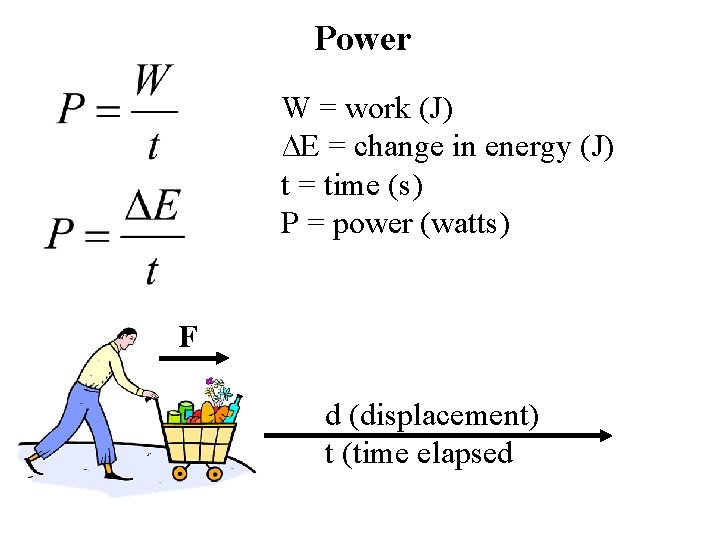
Power W = work (J) ∆E = change in energy (J) t = time (s) P = power (watts) F d (displacement) t (time elapsed
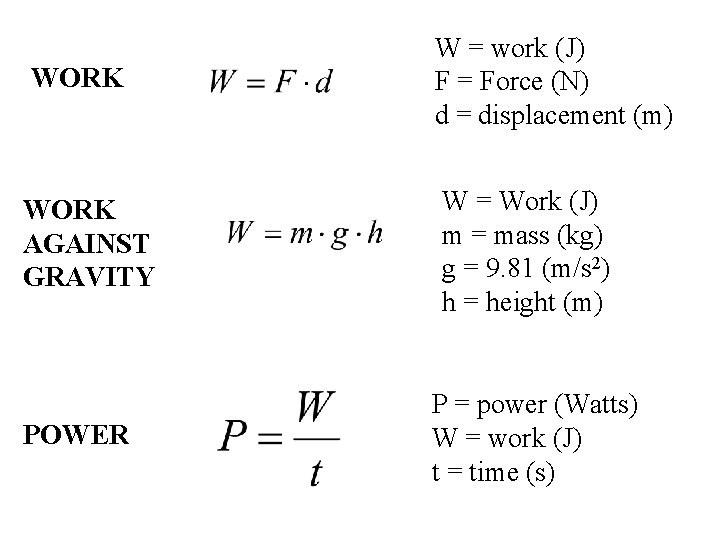
WORK W = work (J) F = Force (N) d = displacement (m) WORK AGAINST GRAVITY W = Work (J) m = mass (kg) g = 9. 81 (m/s 2) h = height (m) POWER P = power (Watts) W = work (J) t = time (s)
• • Review Questions What is the definition of work? (look in notes). What are the four (4) types of work that can be performed on matter? How do you calculate work against gravity? How do you calculate work (mechanical work)?
Calculate Linear Work and Power A man pushes a box 25. 0 meters across the floor in 5. 0 seconds. He pushes with net 30 N of force. (Assume no friction). • Calculate the work performed. • Calculate the power. A man pulls a wagon with a net force of 40 N in a straight-line distance of 30 m for 1 minutes. (Assume no friction). • Calculate the work performed. • Calculate the power.
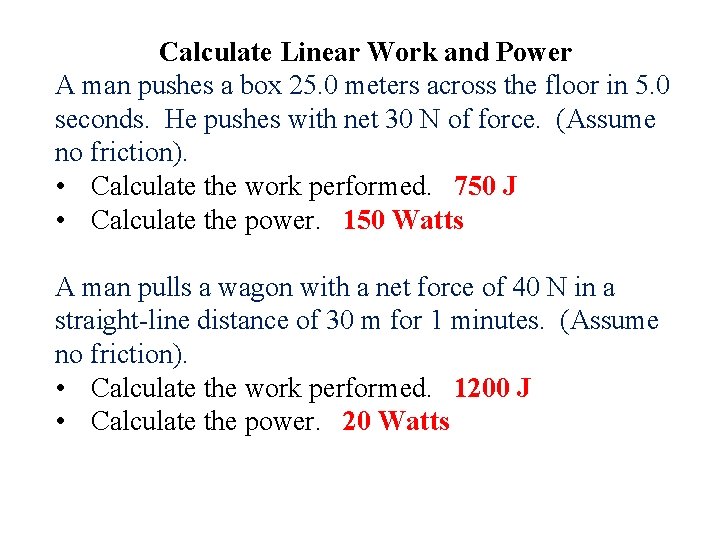
Calculate Linear Work and Power A man pushes a box 25. 0 meters across the floor in 5. 0 seconds. He pushes with net 30 N of force. (Assume no friction). • Calculate the work performed. 750 J • Calculate the power. 150 Watts A man pulls a wagon with a net force of 40 N in a straight-line distance of 30 m for 1 minutes. (Assume no friction). • Calculate the work performed. 1200 J • Calculate the power. 20 Watts
Calculate Work Against Gravity and Power A man with a mass of 60 kg walks up stairs to the second level of this building. The height difference is 4. 0 m. He does this in 14 seconds. • Calculate the work performed. • Calculate the power. A crane raises a crate 40 meters above the ground in 2 minute. The mass of the crate is 500 kg. • Calculate the work performed. • Calculate the power.
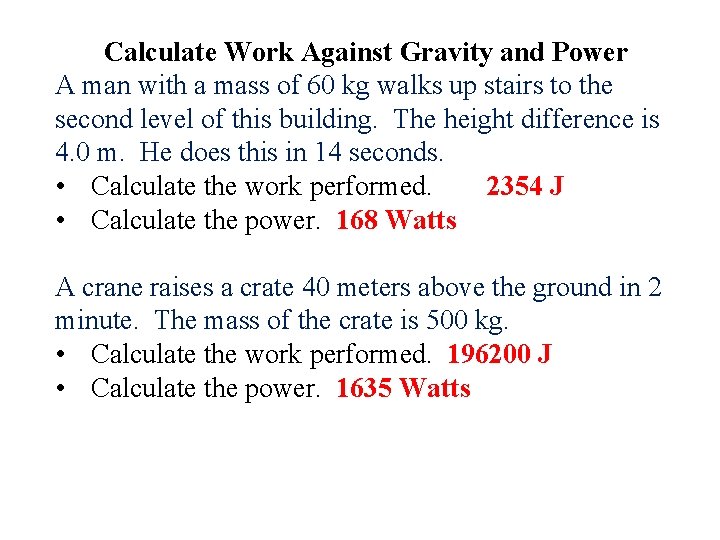
Calculate Work Against Gravity and Power A man with a mass of 60 kg walks up stairs to the second level of this building. The height difference is 4. 0 m. He does this in 14 seconds. • Calculate the work performed. 2354 J • Calculate the power. 168 Watts A crane raises a crate 40 meters above the ground in 2 minute. The mass of the crate is 500 kg. • Calculate the work performed. 196200 J • Calculate the power. 1635 Watts
COMPARE THE WORK AND THE POWER • Marlow pushed a crate with a net force of 50 N for a distance of 30 m in 60 seconds. • Kendrick pushed a crate with a net force of 60 N for a distance of 20 m in 40 seconds. Who performed more work? Who used more power?
COMPARE THE WORK AND THE POWER • Alexa pushed a wagon with a net force of 100 N for a distance of 20 m in 40 seconds. • Renaldo pushed a crate with a net force of 50 N for a distance of 40 m in 40 seconds. Who performed more work? Who used more power?
COMPARE THE WORK AND THE POWER • On Monday, Pedro walked up 50 stair steps to his apartment in 1 minute. • On Tuesday, Pedro walked up 50 stair steps to his apartment in 50 seconds. On which day did he performed more work? On which day did he used more power?
COMPARE THE WORK AND THE POWER • On Monday, Veronica walked up 50 stair steps to her sister’s apartment. She walked for 2 minutes. • On Tuesday, Veronica walked up 100 stair steps to her brother’s apartment. She walked for 4 minutes. On which day did she performed more work? On which day did she used more power?
- Slides: 20