
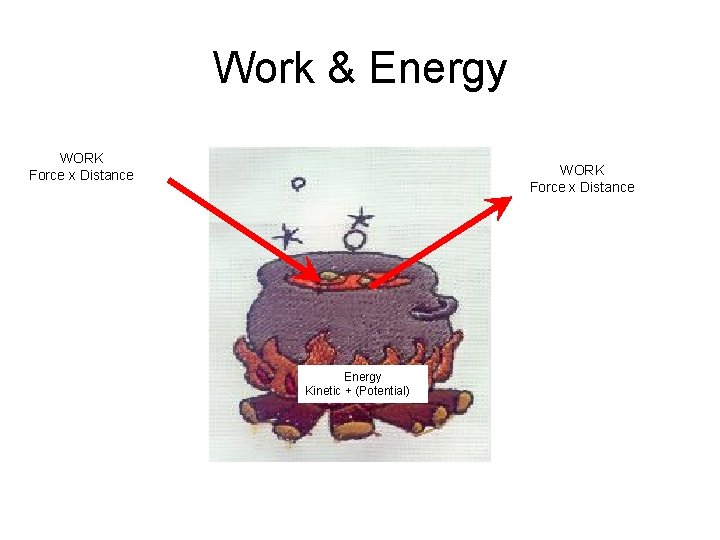
Work Energy WORK Force x Distance Energy Kinetic
- Slides: 22
Work & Energy WORK Force x Distance Energy Kinetic + (Potential)
Work and Energy • • • Intro example Chapter 6 Roadmap Method Differences Work and energy Crate example 2 important points about work
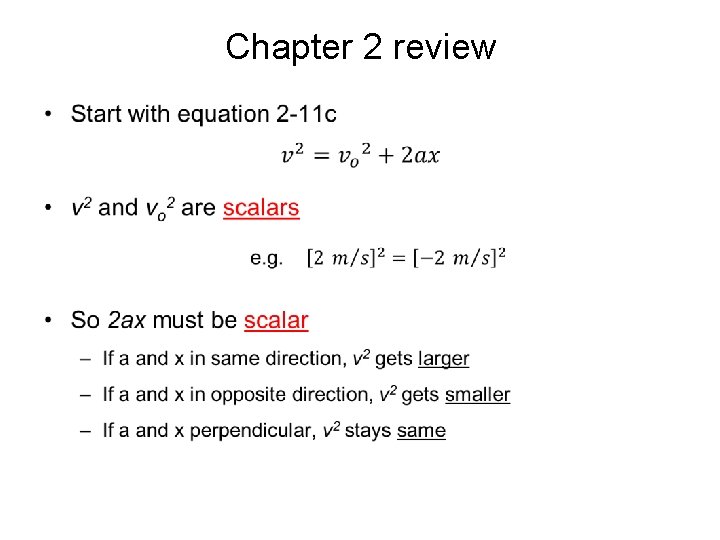
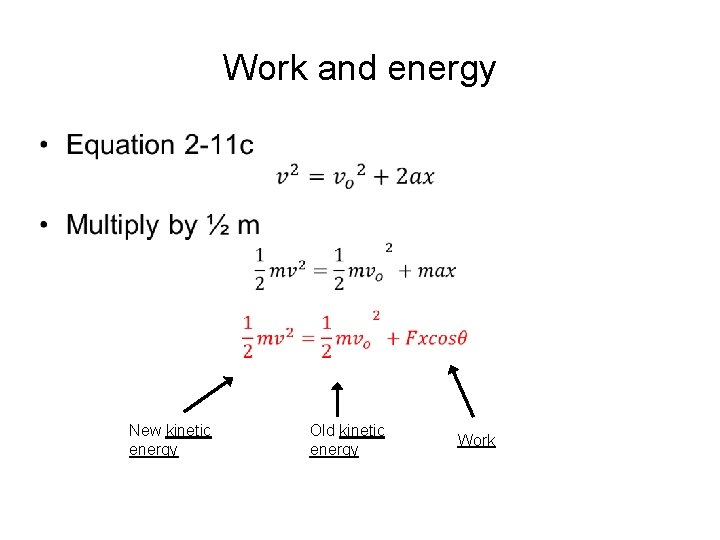
Chapter 2 review •
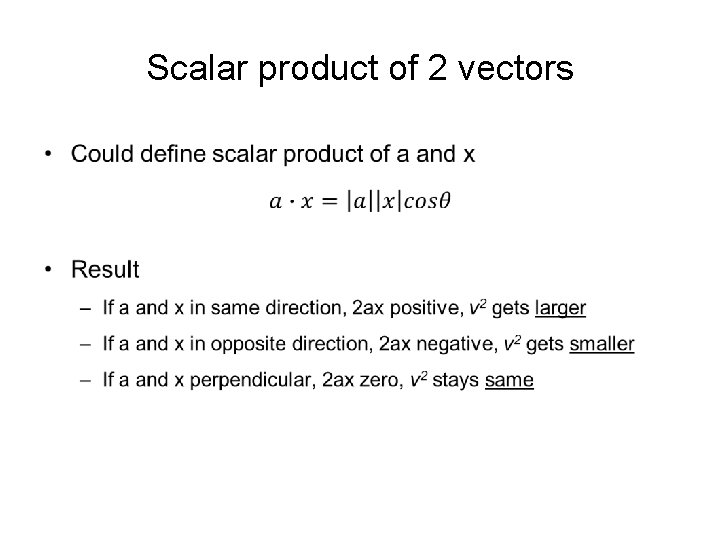
Scalar product of 2 vectors •
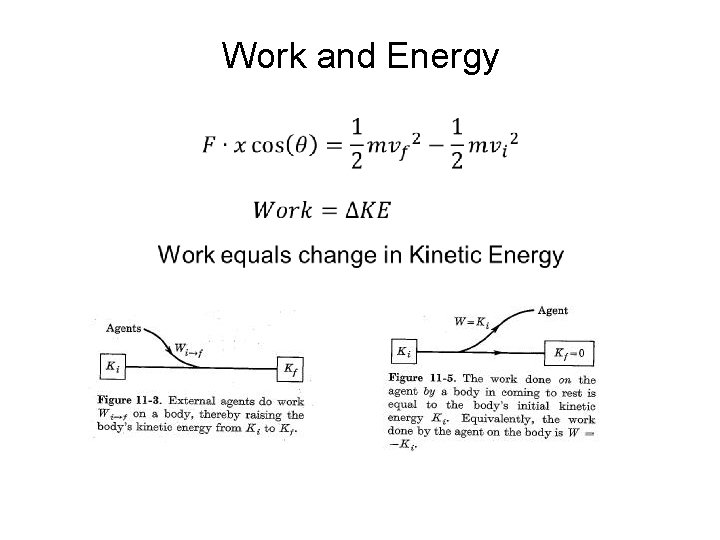
Work and energy • New kinetic energy Old kinetic energy Work
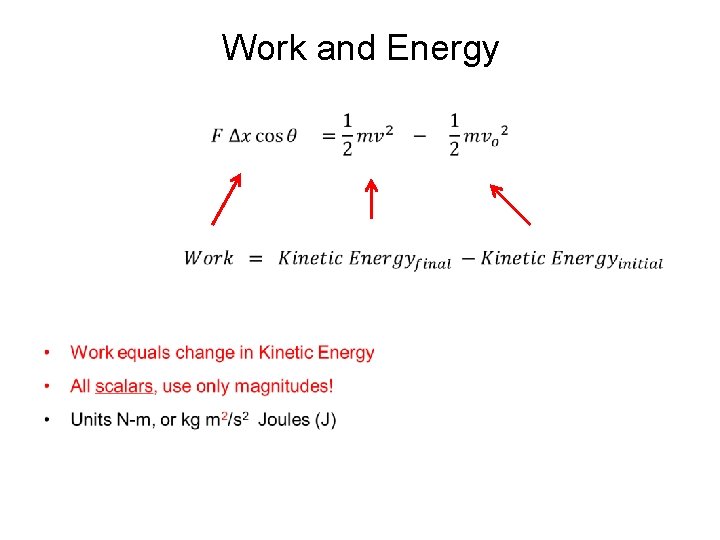
Work and Energy •
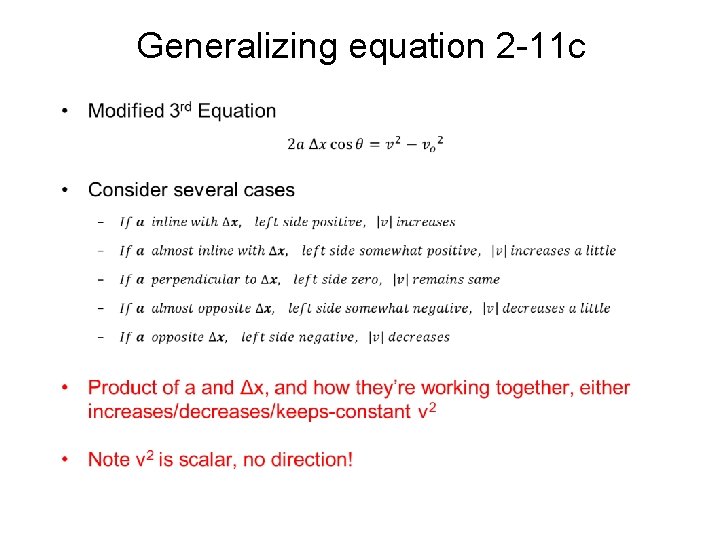
Generalizing equation 2 -11 c •
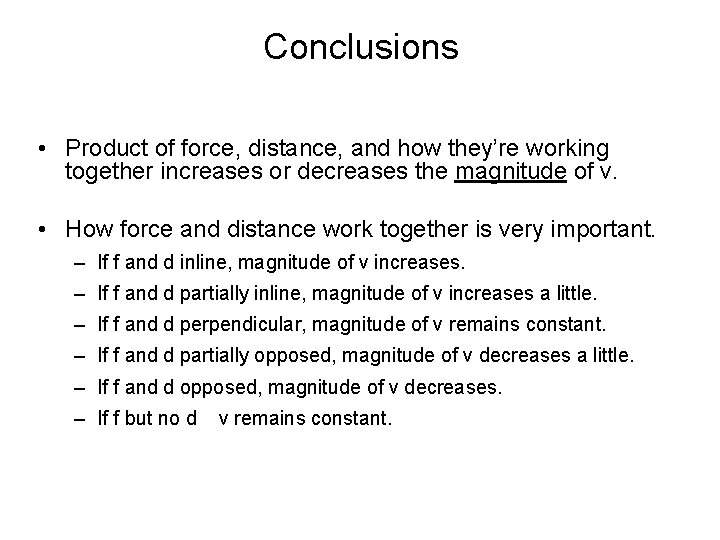
Conclusions • Product of force, distance, and how they’re working together increases or decreases the magnitude of v. • How force and distance work together is very important. – If f and d inline, magnitude of v increases. – If f and d partially inline, magnitude of v increases a little. – If f and d perpendicular, magnitude of v remains constant. – If f and d partially opposed, magnitude of v decreases a little. – If f and d opposed, magnitude of v decreases. – If f but no d v remains constant.
Method Differences • Chapter 3 – Position, velocity, acceleration vectors. – X and y components. • Chapter 4 – Force and acceleration vectors. – ΣF = ma is vector equation. – Solve F=ma in x and y directions. • Chapter 5 – Force and acceleration vectors. – Solve F=ma in radial and other directions. • Chapter 6 – Work and energy scalars. – Forget direction, throw everything in “big mixing pot”.
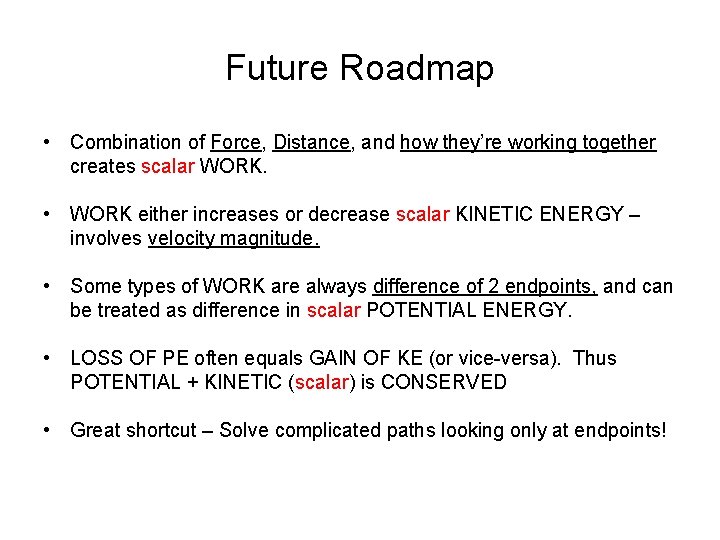
Future Roadmap • Combination of Force, Distance, and how they’re working together creates scalar WORK. • WORK either increases or decrease scalar KINETIC ENERGY – involves velocity magnitude. • Some types of WORK are always difference of 2 endpoints, and can be treated as difference in scalar POTENTIAL ENERGY. • LOSS OF PE often equals GAIN OF KE (or vice-versa). Thus POTENTIAL + KINETIC (scalar) is CONSERVED • Great shortcut – Solve complicated paths looking only at endpoints!
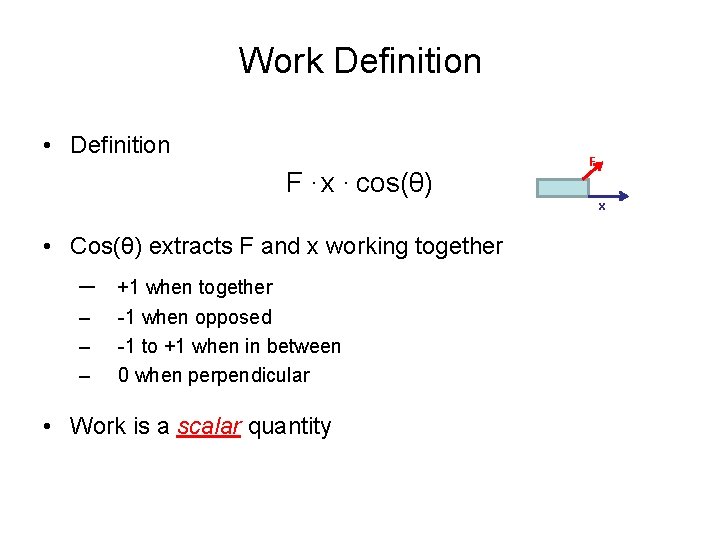
Work Definition • Definition F. x. cos(θ) F x • Cos(θ) extracts F and x working together – +1 when together – -1 when opposed – -1 to +1 when in between – 0 when perpendicular • Work is a scalar quantity
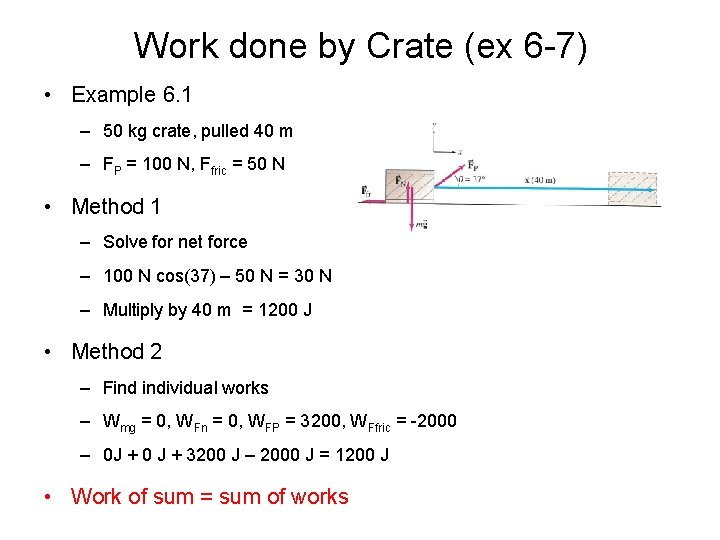
Work done by Crate (ex 6 -7) • Example 6. 1 – 50 kg crate, pulled 40 m – FP = 100 N, Ffric = 50 N • Method 1 – Solve for net force – 100 N cos(37) – 50 N = 30 N – Multiply by 40 m = 1200 J • Method 2 – Find individual works – Wmg = 0, WFn = 0, WFP = 3200, WFfric = -2000 – 0 J + 0 J + 3200 J – 2000 J = 1200 J • Work of sum = sum of works
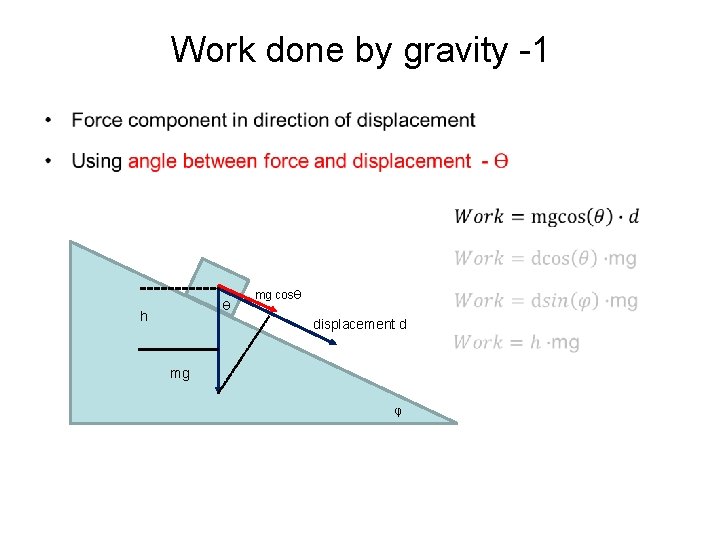
Work done by gravity -1 • ϴ h mg cosϴ displacement d mg φ
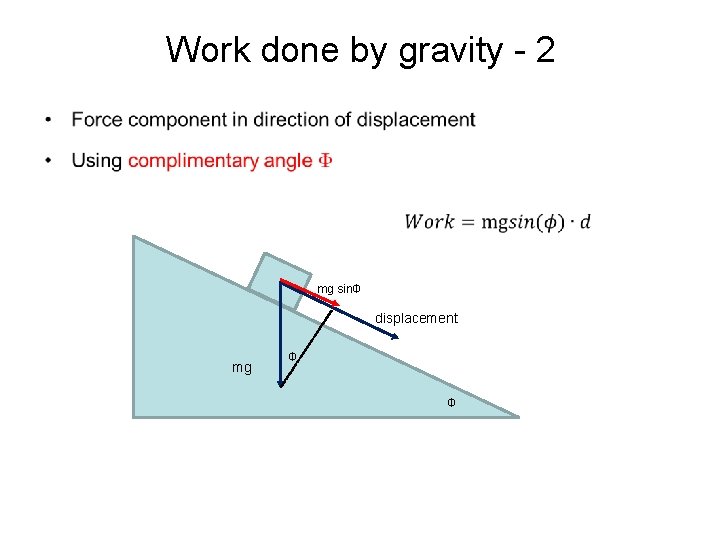
Work done by gravity - 2 • mg sinΦ displacement mg Φ Φ
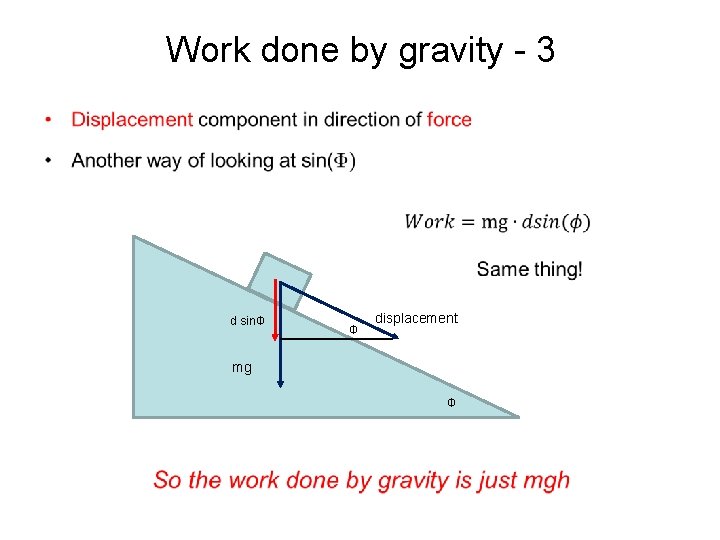
Work done by gravity - 3 • d sinΦ Φ displacement mg Φ
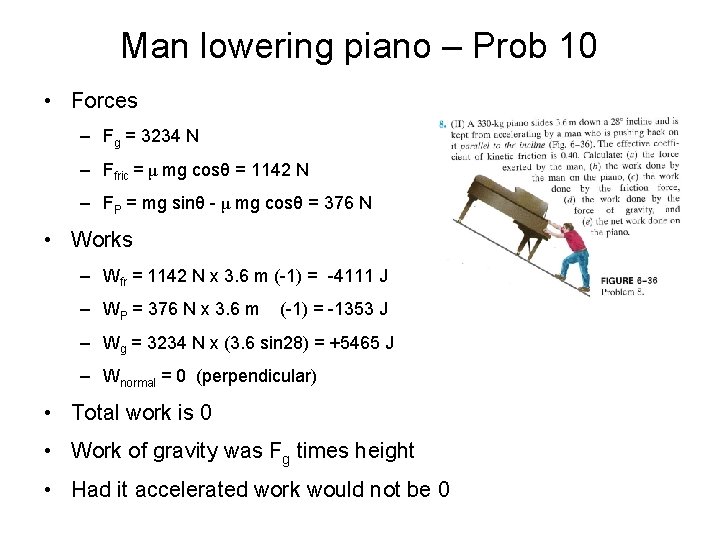
Man lowering piano – Prob 10 • Forces – Fg = 3234 N – Ffric = μ mg cosθ = 1142 N – FP = mg sinθ - μ mg cosθ = 376 N • Works – Wfr = 1142 N x 3. 6 m (-1) = -4111 J – WP = 376 N x 3. 6 m (-1) = -1353 J – Wg = 3234 N x (3. 6 sin 28) = +5465 J – Wnormal = 0 (perpendicular) • Total work is 0 • Work of gravity was Fg times height • Had it accelerated work would not be 0
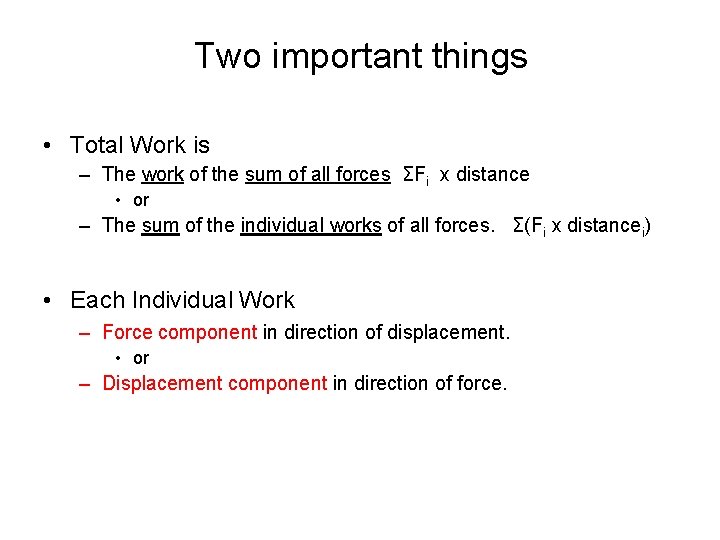
Two important things • Total Work is – The work of the sum of all forces ΣFi x distance • or – The sum of the individual works of all forces. Σ(Fi x distancei) • Each Individual Work – Force component in direction of displacement. • or – Displacement component in direction of force.
Work and Energy •
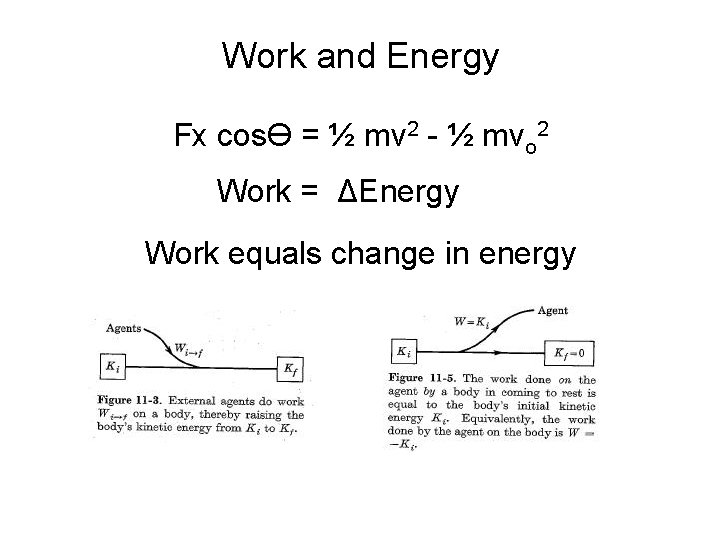
Work and Energy Fx cosϴ = ½ mv 2 - ½ mvo 2 Work = ΔEnergy Work equals change in energy
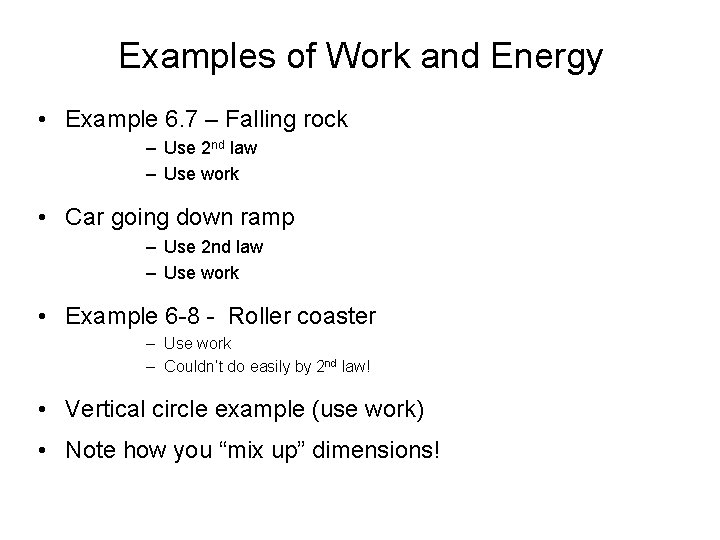
Examples of Work and Energy • Example 6. 7 – Falling rock – Use 2 nd law – Use work • Car going down ramp – Use 2 nd law – Use work • Example 6 -8 - Roller coaster – Use work – Couldn’t do easily by 2 nd law! • Vertical circle example (use work) • Note how you “mix up” dimensions!
More Examples of Work and Energy • Example 6. 6 – Work to increase car speed • Example 6. 5 – Work to stop car • Problem 23 - Air resistance on baseball
Outta here October Potter County hiking / camping