
Work Energy and Power Work symbol W is
Work, Energy, and Power
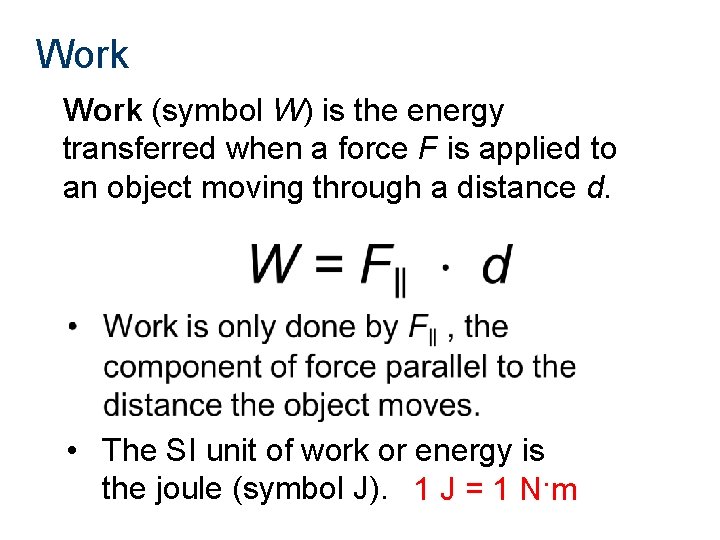
Work (symbol W) is the energy transferred when a force F is applied to an object moving through a distance d. • The SI unit of work or energy is the joule (symbol J). 1 J = 1 N·m
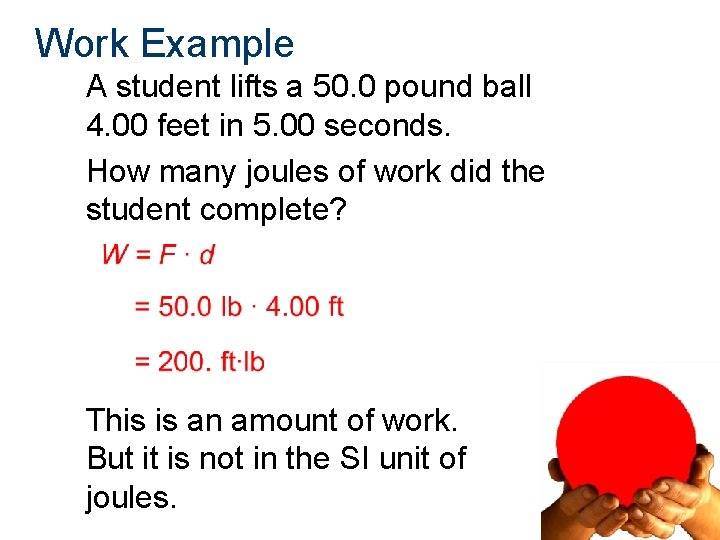
Work Example A student lifts a 50. 0 pound ball 4. 00 feet in 5. 00 seconds. How many joules of work did the student complete? This is an amount of work. But it is not in the SI unit of joules.
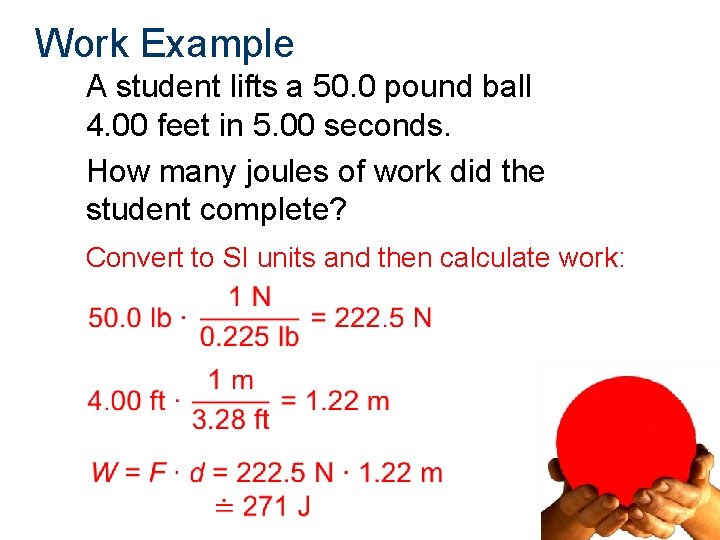
Work Example A student lifts a 50. 0 pound ball 4. 00 feet in 5. 00 seconds. How many joules of work did the student complete? Convert to SI units and then calculate work:
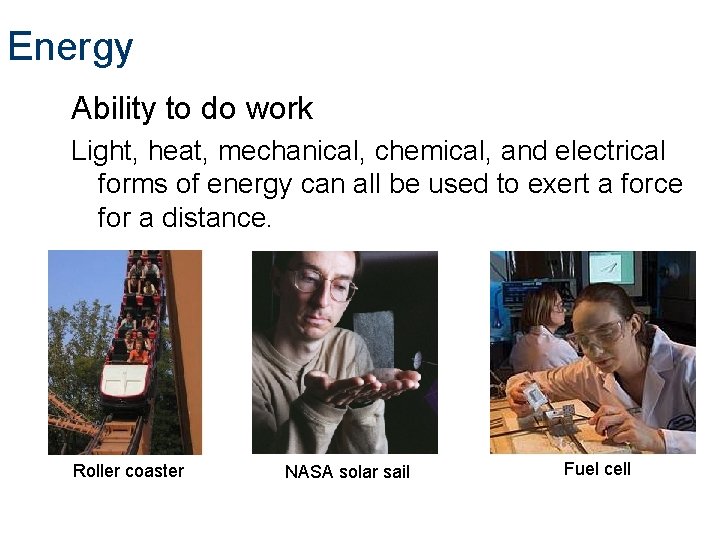
Energy Ability to do work Light, heat, mechanical, chemical, and electrical forms of energy can all be used to exert a force for a distance. Roller coaster NASA solar sail Fuel cell
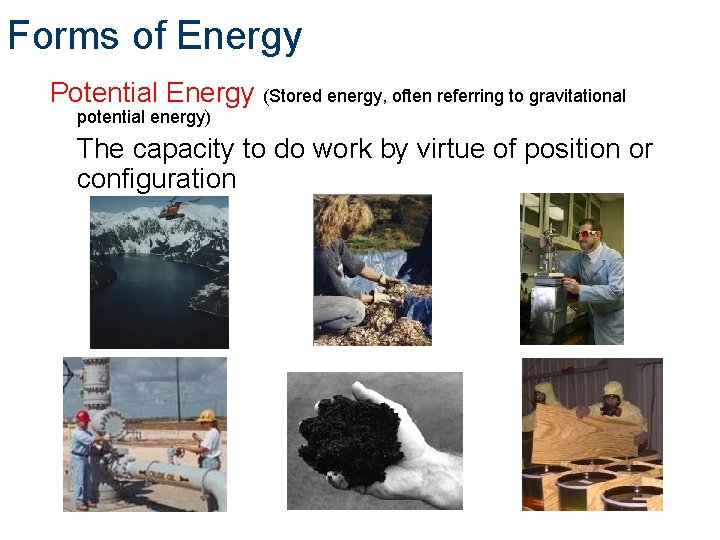
Forms of Energy Potential Energy (Stored energy, often referring to gravitational potential energy) The capacity to do work by virtue of position or configuration
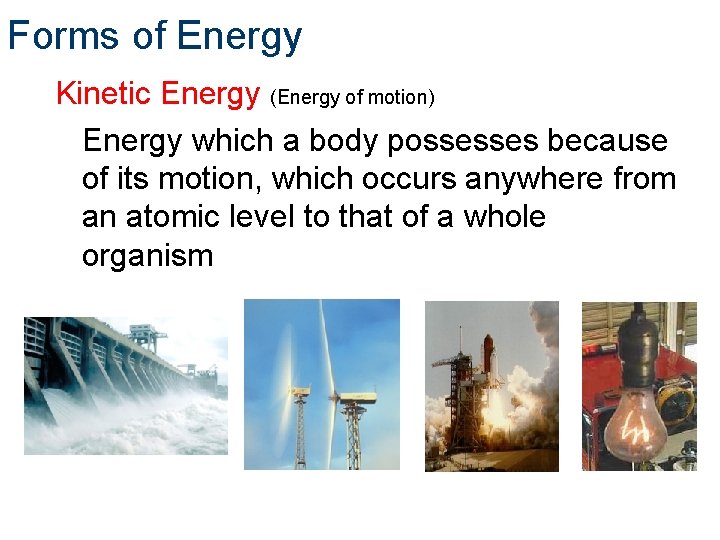
Forms of Energy Kinetic Energy (Energy of motion) Energy which a body possesses because of its motion, which occurs anywhere from an atomic level to that of a whole organism
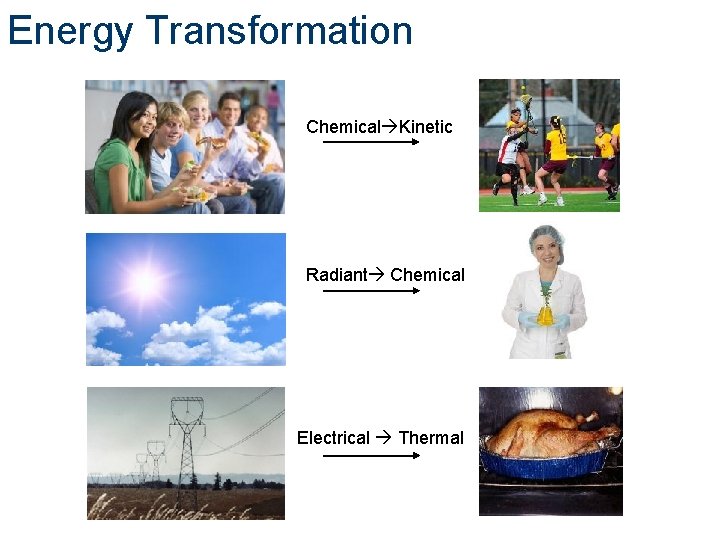
Energy Transformation Chemical Kinetic Radiant Chemical Electrical Thermal
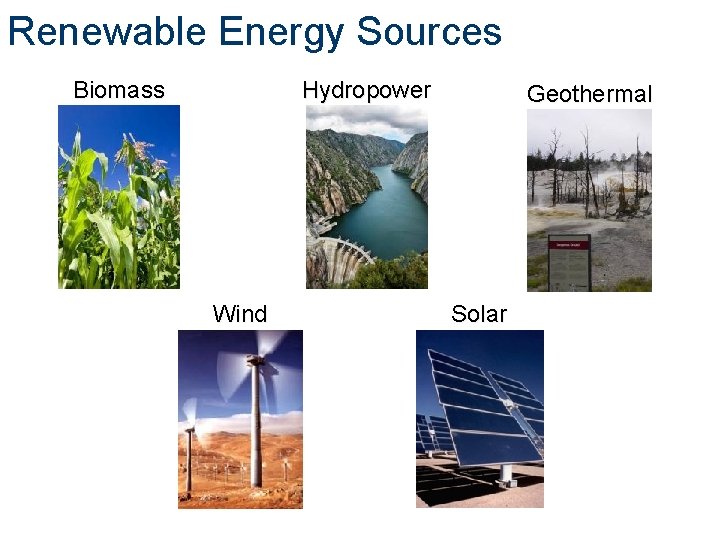
Renewable Energy Sources Biomass Hydropower Hydropowe Wind Geothermal Solar

Nonrenewable Energy Sources Coal Petroleum Natural Gas Uranium
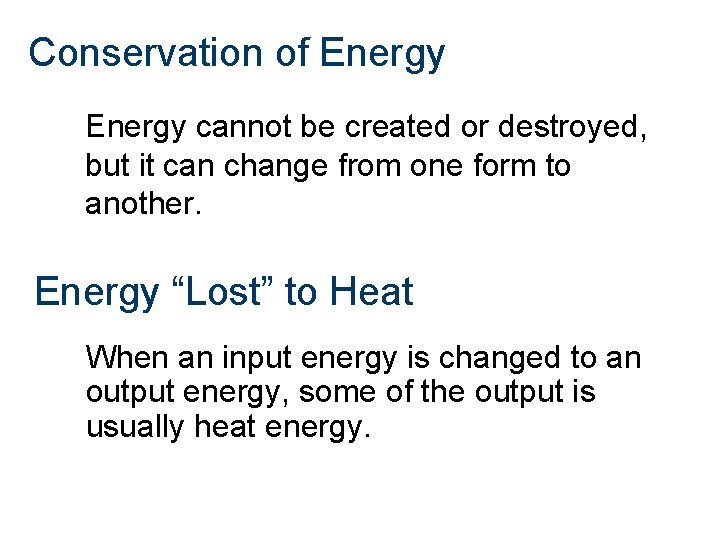
Conservation of Energy cannot be created or destroyed, but it can change from one form to another. Energy “Lost” to Heat When an input energy is changed to an output energy, some of the output is usually heat energy.
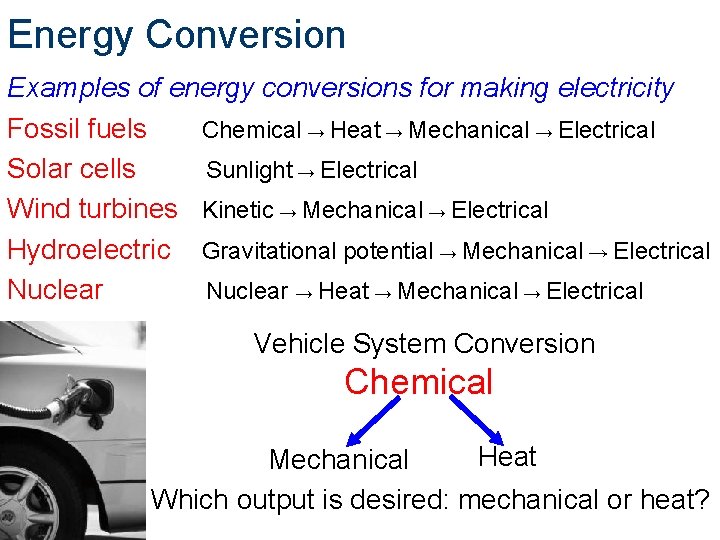
Energy Conversion Examples of energy conversions for making electricity Fossil fuels Chemical → Heat → Mechanical → Electrical Solar cells Sunlight → Electrical Wind turbines Kinetic → Mechanical → Electrical Hydroelectric Gravitational potential → Mechanical → Electrical Nuclear → Heat → Mechanical → Electrical Vehicle System Conversion Chemical Heat Mechanical Which output is desired: mechanical or heat?
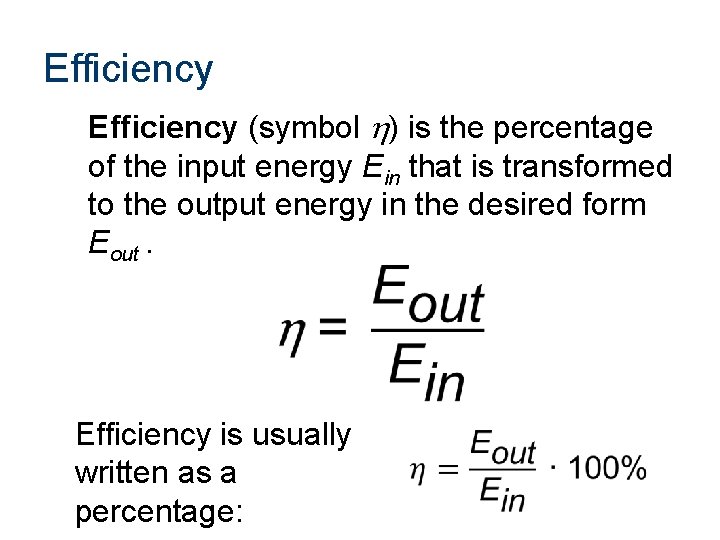
Efficiency (symbol h) is the percentage of the input energy Ein that is transformed to the output energy in the desired form Eout. Efficiency is usually written as a percentage:
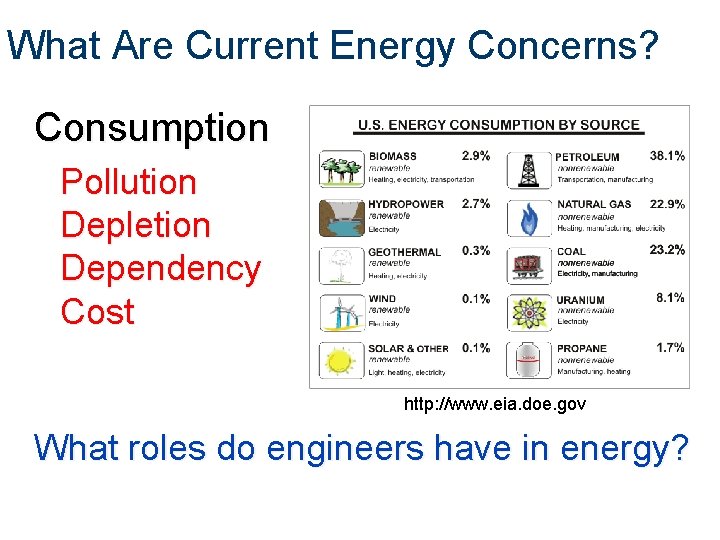
What Are Current Energy Concerns? Consumption Pollution Depletion Dependency Cost http: //www. eia. doe. gov What roles do engineers have in energy?
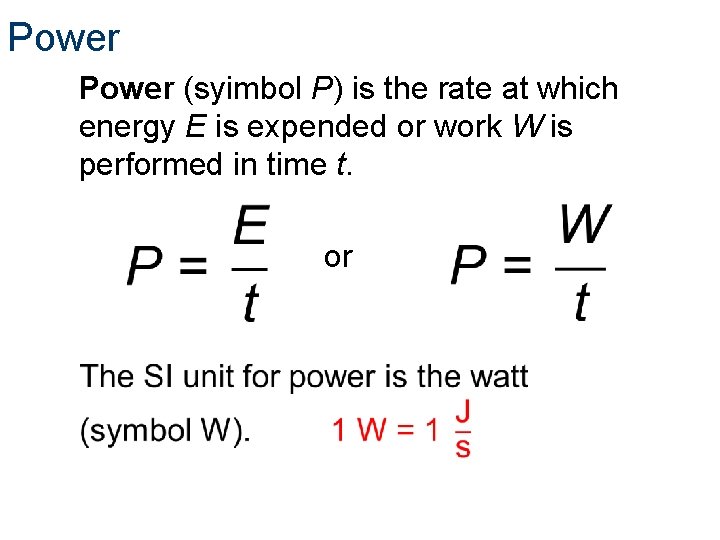
Power (syimbol P) is the rate at which energy E is expended or work W is performed in time t. or

Types of Power Electrical Power Uses electrical energy to do work Mechanical Power Uses mechanical energy to do work (linear, rotary) Fluid Power Uses energy transferred by liquids (hydraulic) and gases (pneumatic)
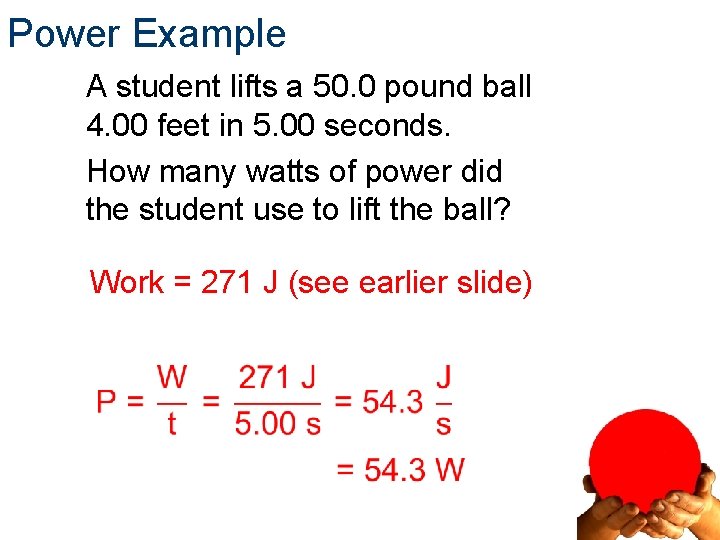
Power Example A student lifts a 50. 0 pound ball 4. 00 feet in 5. 00 seconds. How many watts of power did the student use to lift the ball? Work = 271 J (see earlier slide)
Resources Mc. Graw-Hill dictionary of engineering. (2 nd ed. ). New York, NY: Mc. Graw-Hill. Microsoft, Inc. (2008). Clip art. Retrieved January 10, 2008, from http: //office. microsoft. com/en-us/clipart/default. aspx National Aeronautics and Space Administration (NASA). (1997). Daedalus. Retrieved April 2, 2008, from http: //www. dfrc. nasa. gov/Gallery /Photo/Daedalus/ U. S. Department of Energy. (2008). Scientific forms of energy. Retrieved March 23, 2008, from http: //www. eia. doe. gov/kids/energyfacts/science/formsof energy. html
- Slides: 18