
Work as practical activity resources for autonomous development

- Slides: 21
Work as practical activity: resources for autonomous development Ohjelma Aalto University, ELO, ”Työhyvinvointi” Facilitator: Marja-Liisa Trux Time: 10 th and 12 th December 2019, 9. 30 -12 Place: Otaniemi
Welcome! Programme: 9. 30 Getting aquainted with each other and the workshop idea 10. 00 Tune-in exercise, physical sociometrics 10. 15 A touch of good (work) 10. 30 Internal diversity of work 10. 45 Break 11. 00 Multiple aspects of action from actor’s point of view 11. 05 Cooks, hackers, and I 11. 20 What about your work – individual excercise 12. 00 Bye! See you on Thursday
A touch of good When have you felt that you have done good work – you made it well, it did good to you, and also to others? Perhaps you made a breakthrough, or just experienced a moment of quiet satisfaction … Think of a concrete event or situation. Why, in your view, was this good work? Make a pair with a person previously not well known to you. Share your experiences. You can reflect on what made these moments of good work possible – your own action, or the action of others? How did this exercise feel like? Was it easy? Did you think about the preconditions of good work?
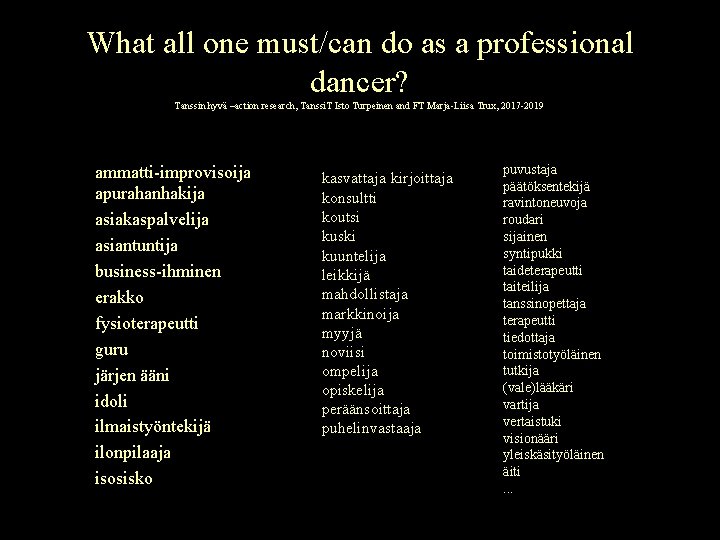
What all one must/can do as a professional dancer? Tanssin hyvä –action research, Tanssi. T Isto Turpeinen and FT Marja-Liisa Trux, 2017 -2019 ammatti-improvisoija apurahanhakija asiakaspalvelija asiantuntija business-ihminen erakko fysioterapeutti guru järjen ääni idoli ilmaistyöntekijä ilonpilaaja isosisko kasvattaja kirjoittaja konsultti koutsi kuski kuuntelija leikkijä mahdollistaja markkinoija myyjä noviisi ompelija opiskelija peräänsoittaja puhelinvastaaja puvustaja päätöksentekijä ravintoneuvoja roudari sijainen syntipukki taideterapeutti taiteilija tanssinopettaja terapeutti tiedottaja toimistotyöläinen tutkija (vale)lääkäri vartija vertaistuki visionääri yleiskäsityöläinen äiti. . .
Styles, takes, holds – the internal diversity of work Reflect on, and write down your own styles, takes or holds – your ”roles” or professional identities. * * Make pairs and compare your lists. Was it difficult? Any work is comprised of a surprisingly rich internal diversity… In practice, one has to stretch over many tasks and cover a lot. Furthermore, all tasks include a multitude of aspects. Different workers underline different aspects – they work in their own style. Styles evolve, and people change them – over the career and during the day.
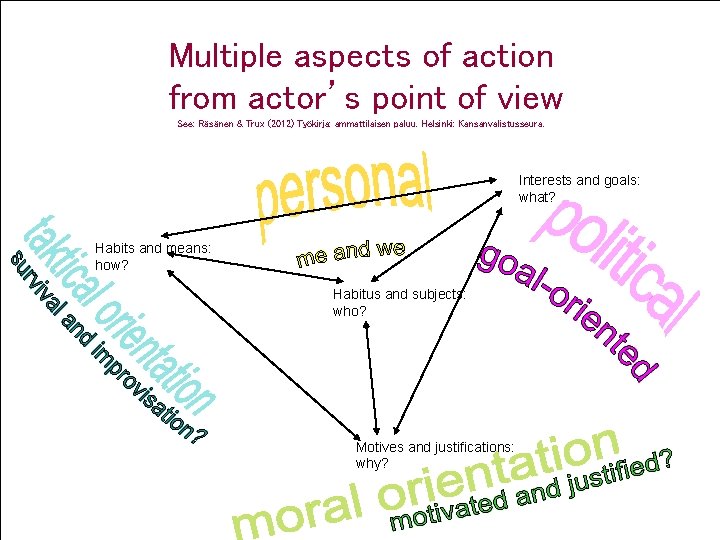
Multiple aspects of action from actor’s point of view See: Räsänen & Trux (2012) Työkirja: ammattilaisen paluu. Helsinki: Kansanvalistusseura. Interests and goals: what? Habits and means: how? Habitus and subjects: who? Motives and justifications: why?
https: //www. youtube. com/watch? v=ltm 4 x. I 2 Hr. FE
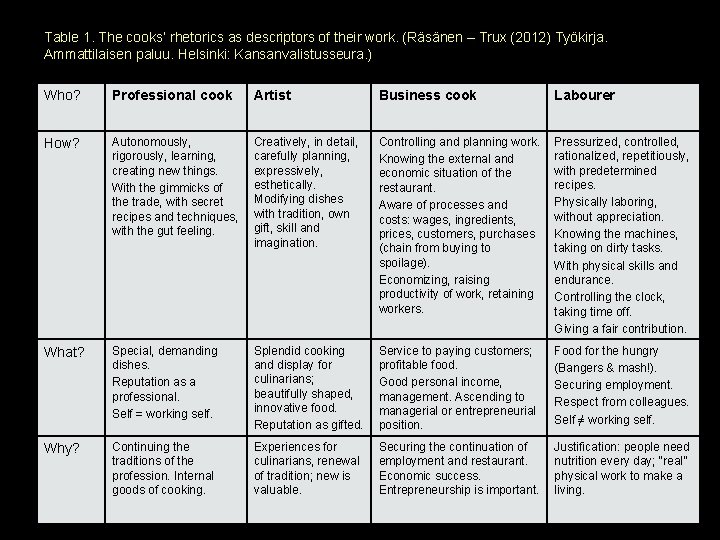
Table 1. The cooks’ rhetorics as descriptors of their work. (Räsänen – Trux (2012) Työkirja. Ammattilaisen paluu. Helsinki: Kansanvalistusseura. ) Who? Professional cook Artist Business cook Labourer How? Autonomously, rigorously, learning, creating new things. With the gimmicks of the trade, with secret recipes and techniques, with the gut feeling. Creatively, in detail, carefully planning, expressively, esthetically. Modifying dishes with tradition, own gift, skill and imagination. Controlling and planning work. Knowing the external and economic situation of the restaurant. Aware of processes and costs: wages, ingredients, prices, customers, purchases (chain from buying to spoilage). Economizing, raising productivity of work, retaining workers. Pressurized, controlled, rationalized, repetitiously, with predetermined recipes. Physically laboring, without appreciation. Knowing the machines, taking on dirty tasks. With physical skills and endurance. Controlling the clock, taking time off. Giving a fair contribution. What? Special, demanding dishes. Reputation as a professional. Self = working self. Splendid cooking and display for culinarians; beautifully shaped, innovative food. Reputation as gifted. Service to paying customers; profitable food. Good personal income, management. Ascending to managerial or entrepreneurial position. Food for the hungry (Bangers & mash!). Securing employment. Respect from colleagues. Self ≠ working self. Why? Continuing the traditions of the profession. Internal goods of cooking. Experiences for culinarians, renewal of tradition; new is valuable. Securing the continuation of employment and restaurant. Economic success. Entrepreneurship is important. Justification: people need nutrition every day; “real” physical work to make a living.
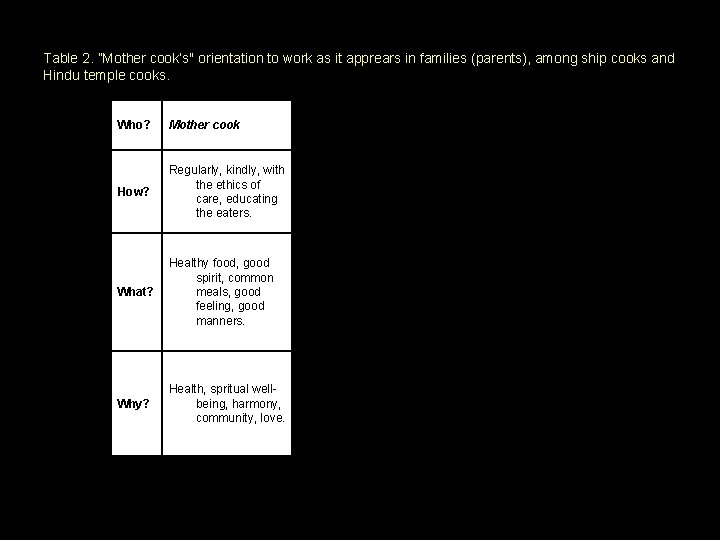
Table 2. ”Mother cook’s" orientation to work as it apprears in families (parents), among ship cooks and Hindu temple cooks. Who? Mother cook How? Regularly, kindly, with the ethics of care, educating the eaters. What? Healthy food, good spirit, common meals, good feeling, good manners. Why? Health, spritual wellbeing, harmony, community, love.
https: //www. youtube. com/watch? v=0 ZNu. Y 1 Dbw. Wk&list=PLUHj. Pcob. Okr. Cg. OAh. VAx 9 H_Cn. Vn 4 GA 1_6 -
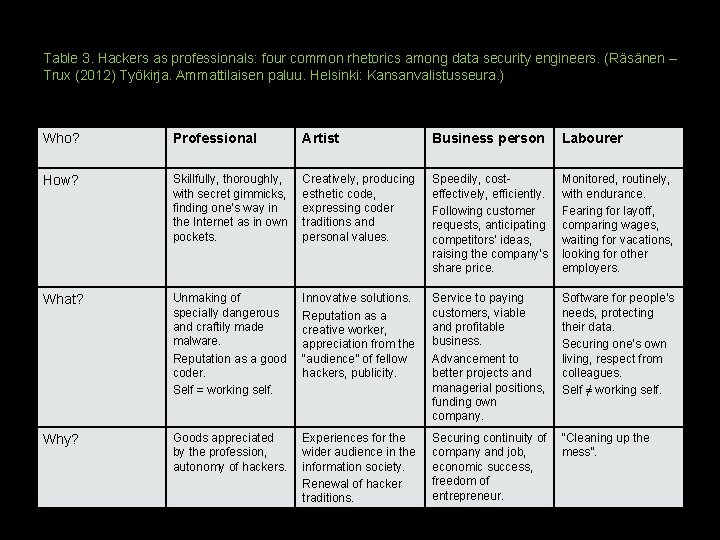
Table 3. Hackers as professionals: four common rhetorics among data security engineers. (Räsänen – Trux (2012) Työkirja. Ammattilaisen paluu. Helsinki: Kansanvalistusseura. ) Who? Professional Artist Business person Labourer How? Skillfully, thoroughly, with secret gimmicks, finding one’s way in the Internet as in own pockets. Creatively, producing esthetic code, expressing coder traditions and personal values. Speedily, costeffectively, efficiently. Following customer requests, anticipating competitors’ ideas, raising the company’s share price. Monitored, routinely, with endurance. Fearing for layoff, comparing wages, waiting for vacations, looking for other employers. What? Unmaking of specially dangerous and craftily made malware. Reputation as a good coder. Self = working self. Innovative solutions. Reputation as a creative worker, appreciation from the “audience” of fellow hackers, publicity. Service to paying customers, viable and profitable business. Advancement to better projects and managerial positions, funding own company. Software for people’s needs, protecting their data. Securing one’s own living, respect from colleagues. Self ≠ working self. Why? Goods appreciated by the profession, autonomy of hackers. Experiences for the wider audience in the information society. Renewal of hacker traditions. Securing continuity of company and job, economic success, freedom of entrepreneur. “Cleaning up the mess”.
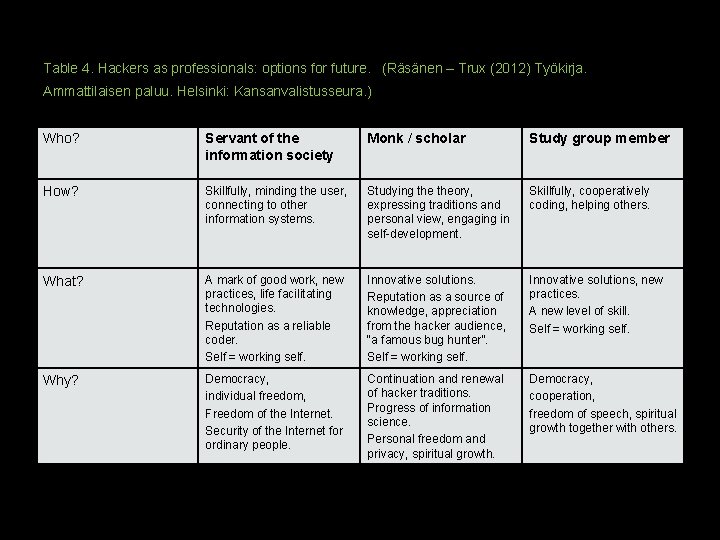
Table 4. Hackers as professionals: options for future. (Räsänen – Trux (2012) Työkirja. Ammattilaisen paluu. Helsinki: Kansanvalistusseura. ) Who? Servant of the information society Monk / scholar Study group member How? Skillfully, minding the user, connecting to other information systems. Studying theory, expressing traditions and personal view, engaging in self-development. Skillfully, cooperatively coding, helping others. What? A mark of good work, new practices, life facilitating technologies. Reputation as a reliable coder. Self = working self. Innovative solutions. Reputation as a source of knowledge, appreciation from the hacker audience, “a famous bug hunter”. Self = working self. Innovative solutions, new practices. A new level of skill. Self = working self. Why? Democracy, individual freedom, Freedom of the Internet. Security of the Internet for ordinary people. Continuation and renewal of hacker traditions. Progress of information science. Personal freedom and privacy, spiritual growth. Democracy, cooperation, freedom of speech, spiritual growth together with others.
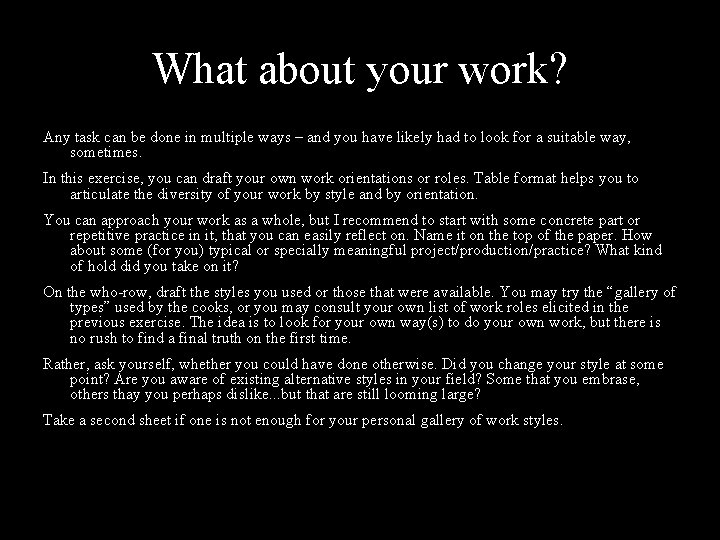
What about your work? Any task can be done in multiple ways – and you have likely had to look for a suitable way, sometimes. In this exercise, you can draft your own work orientations or roles. Table format helps you to articulate the diversity of your work by style and by orientation. You can approach your work as a whole, but I recommend to start with some concrete part or repetitive practice in it, that you can easily reflect on. Name it on the top of the paper. How about some (for you) typical or specially meaningful project/production/practice? What kind of hold did you take on it? On the who-row, draft the styles you used or those that were available. You may try the “gallery of types” used by the cooks, or you may consult your own list of work roles elicited in the previous exercise. The idea is to look for your own way(s) to do your own work, but there is no rush to find a final truth on the first time. Rather, ask yourself, whether you could have done otherwise. Did you change your style at some point? Are you aware of existing alternative styles in your field? Some that you embrase, others thay you perhaps dislike. . . but that are still looming large? Take a second sheet if one is not enough for your personal gallery of work styles.
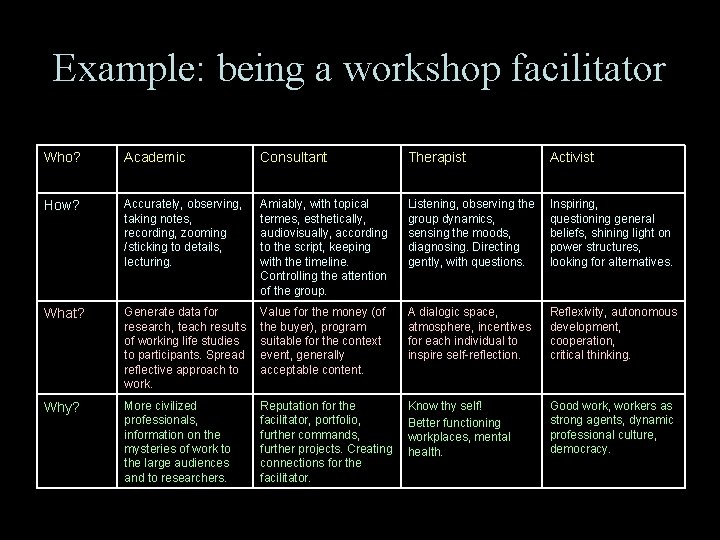
Example: being a workshop facilitator Who? Academic Consultant Therapist Activist How? Accurately, observing, taking notes, recording, zooming /sticking to details, lecturing. Amiably, with topical termes, esthetically, audiovisually, according to the script, keeping with the timeline. Controlling the attention of the group. Listening, observing the group dynamics, sensing the moods, diagnosing. Directing gently, with questions. Inspiring, questioning general beliefs, shining light on power structures, looking for alternatives. What? Generate data for research, teach results of working life studies to participants. Spread reflective approach to work. Value for the money (of the buyer), program suitable for the context event, generally acceptable content. A dialogic space, atmosphere, incentives for each individual to inspire self-reflection. Reflexivity, autonomous development, cooperation, critical thinking. Why? More civilized professionals, information on the mysteries of work to the large audiences and to researchers. Reputation for the facilitator, portfolio, further commands, further projects. Creating connections for the facilitator. Know thy self! Better functioning workplaces, mental health. Good work, workers as strong agents, dynamic professional culture, democracy.
Thank you all! Preserve your draft with care. Bring it along on Thursday.
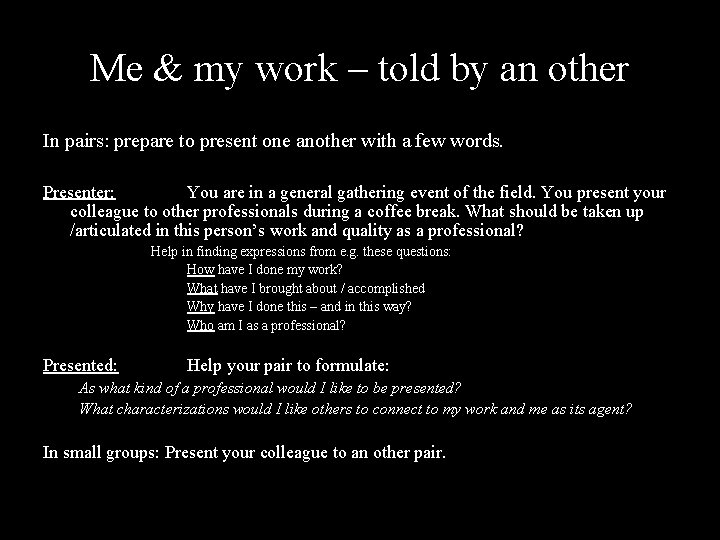
Me & my work – told by an other In pairs: prepare to present one another with a few words. Presenter: You are in a general gathering event of the field. You present your colleague to other professionals during a coffee break. What should be taken up /articulated in this person’s work and quality as a professional? Help in finding expressions from e. g. these questions: How have I done my work? What have I brought about / accomplished Why have I done this – and in this way? Who am I as a professional? Presented: Help your pair to formulate: As what kind of a professional would I like to be presented? What characterizations would I like others to connect to my work and me as its agent? In small groups: Present your colleague to an other pair.
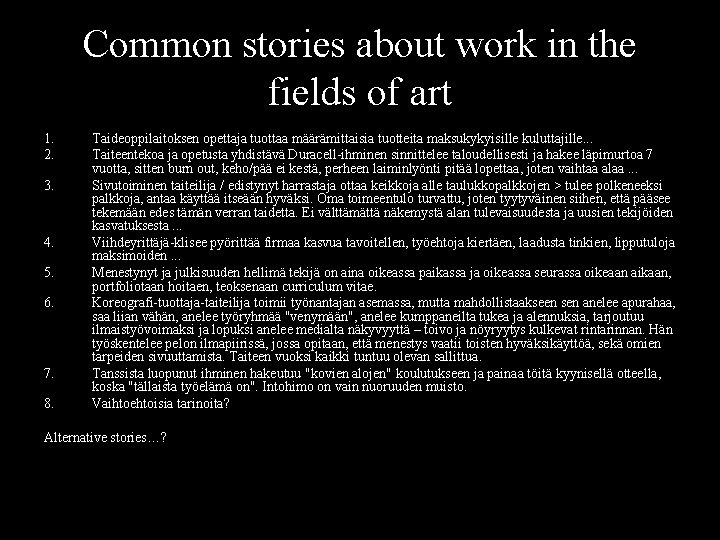
Common stories about work in the fields of art 1. 2. 3. 4. 5. 6. 7. 8. Taideoppilaitoksen opettaja tuottaa määrämittaisia tuotteita maksukykyisille kuluttajille. . . Taiteentekoa ja opetusta yhdistävä Duracell-ihminen sinnittelee taloudellisesti ja hakee läpimurtoa 7 vuotta, sitten burn out, keho/pää ei kestä, perheen laiminlyönti pitää lopettaa, joten vaihtaa alaa. . . Sivutoiminen taiteilija / edistynyt harrastaja ottaa keikkoja alle taulukkopalkkojen > tulee polkeneeksi palkkoja, antaa käyttää itseään hyväksi. Oma toimeentulo turvattu, joten tyytyväinen siihen, että pääsee tekemään edes tämän verran taidetta. Ei välttämättä näkemystä alan tulevaisuudesta ja uusien tekijöiden kasvatuksesta. . . Viihdeyrittäjä-klisee pyörittää firmaa kasvua tavoitellen, työehtoja kiertäen, laadusta tinkien, lipputuloja maksimoiden. . . Menestynyt ja julkisuuden hellimä tekijä on aina oikeassa paikassa ja oikeassa seurassa oikeaan aikaan, portfoliotaan hoitaen, teoksenaan curriculum vitae. Koreografi-tuottaja-taiteilija toimii työnantajan asemassa, mutta mahdollistaakseen sen anelee apurahaa, saa liian vähän, anelee työryhmää "venymään", anelee kumppaneilta tukea ja alennuksia, tarjoutuu ilmaistyövoimaksi ja lopuksi anelee medialta näkyvyyttä – toivo ja nöyryytys kulkevat rintarinnan. Hän työskentelee pelon ilmapiirissä, jossa opitaan, että menestys vaatii toisten hyväksikäyttöä, sekä omien tarpeiden sivuuttamista. Taiteen vuoksi kaikki tuntuu olevan sallittua. Tanssista luopunut ihminen hakeutuu "kovien alojen" koulutukseen ja painaa töitä kyynisellä otteella, koska "tällaista työelämä on". Intohimo on vain nuoruuden muisto. Vaihtoehtoisia tarinoita? Alternative stories…?
Personal summary In pairs: Tell your pair about one (desired) qualifier of your work. Common discussion: Which alternative characters came up? What kind of a story about art / cinema do we want to live and tell? In the future … Where and with whom can I continue to develop my work richly discribing, compassionately and autonomously? Which colleagues, groups or networks might benefit from this type of reflection?
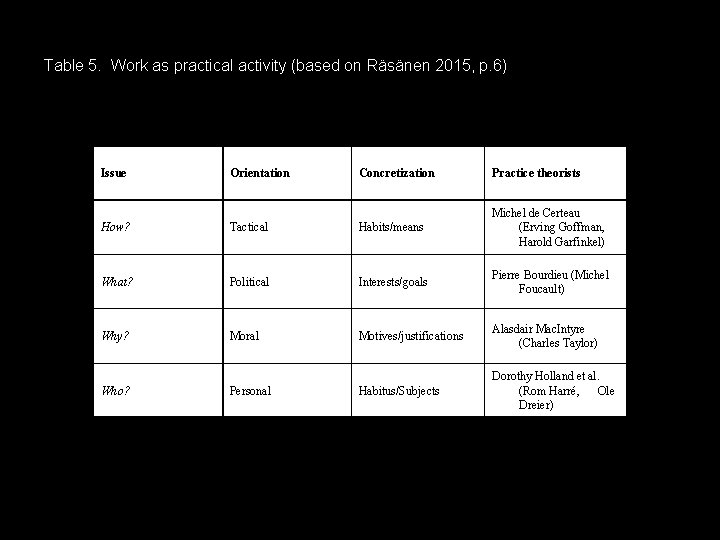
Table 5. Work as practical activity (based on Räsänen 2015, p. 6) Issue Orientation Concretization Practice theorists How? Tactical Habits/means Michel de Certeau (Erving Goffman, Harold Garfinkel) What? Political Interests/goals Pierre Bourdieu (Michel Foucault) Why? Moral Motives/justifications Alasdair Mac. Intyre (Charles Taylor) Who? Personal Habitus/Subjects Dorothy Holland et al. (Rom Harré, Ole Dreier)
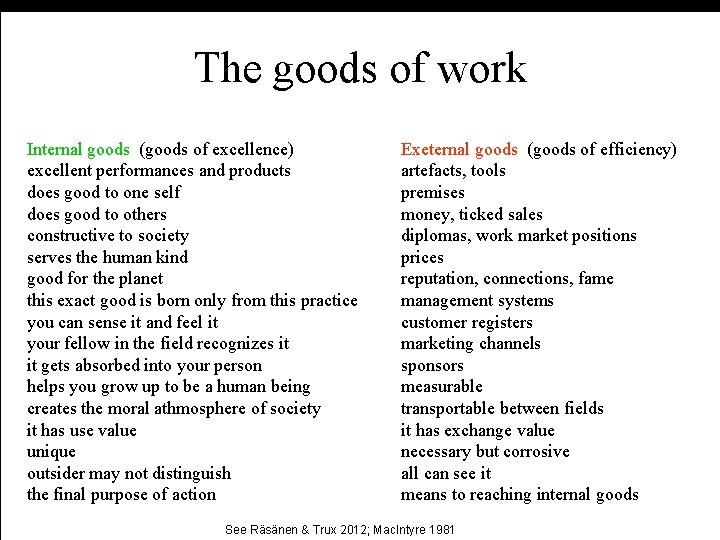
The goods of work Internal goods (goods of excellence) excellent performances and products does good to one self does good to others constructive to society serves the human kind good for the planet this exact good is born only from this practice you can sense it and feel it your fellow in the field recognizes it it gets absorbed into your person helps you grow up to be a human being creates the moral athmosphere of society it has use value unique outsider may not distinguish the final purpose of action Exeternal goods (goods of efficiency) artefacts, tools premises money, ticked sales diplomas, work market positions prices reputation, connections, fame management systems customer registers marketing channels sponsors measurable transportable between fields it has exchange value necessary but corrosive all can see it means to reaching internal goods See Räsänen & Trux 2012; Mac. Intyre 1981