
Work and Kinetic Energy Work a measure of
- Slides: 17
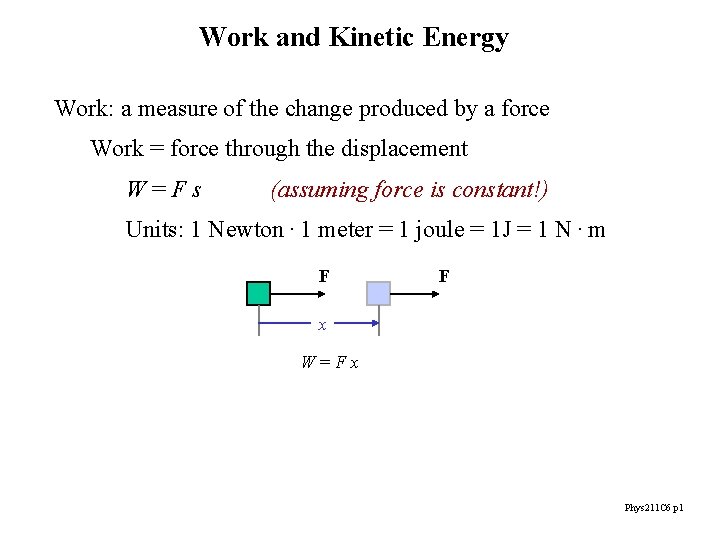
Work and Kinetic Energy Work: a measure of the change produced by a force Work = force through the displacement W=Fs (assuming force is constant!) Units: 1 Newton. 1 meter = 1 joule = 1 J = 1 N. m F F x W=Fx Phys 211 C 6 p 1
Ex: A car is pushed by a constant 200 N force across a level street for a distance of 20 m. How much work is done by the person pushing on the car? Phys 211 C 6 p 2
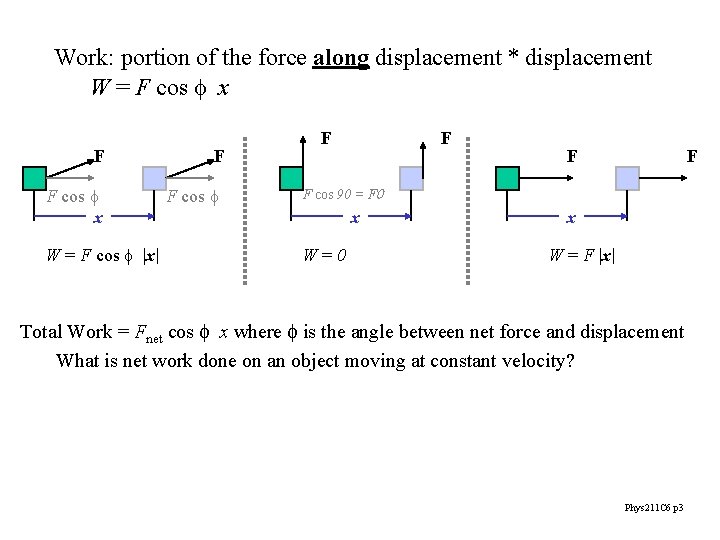
Work: portion of the force along displacement * displacement W = F cos f x F F cos f x W = F cos f |x| F F cos f F F F cos 90 = F 0 x W=0 x W = F |x| Total Work = Fnet cos f x where f is the angle between net force and displacement What is net work done on an object moving at constant velocity? Phys 211 C 6 p 3
Ex: An object with weight 15, 000 N is dragged for a distance of 20. 0 m across level ground. The force is exerted through a cable with a tension of 5, 000 N which makes an angle of 36. 9º above the horizontal. There is a 3, 500 N frictional force opposing the motion. What is the work done by gravity, the force applied by the tension and friction? Phys 211 C 6 p 4
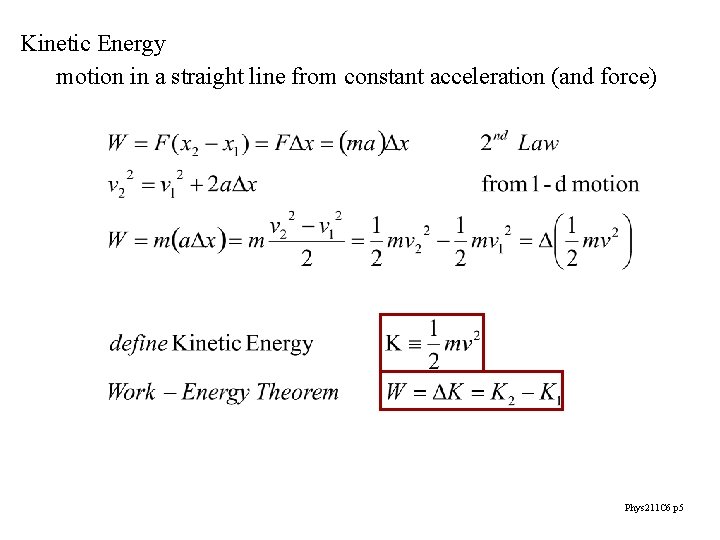
Kinetic Energy motion in a straight line from constant acceleration (and force) Phys 211 C 6 p 5
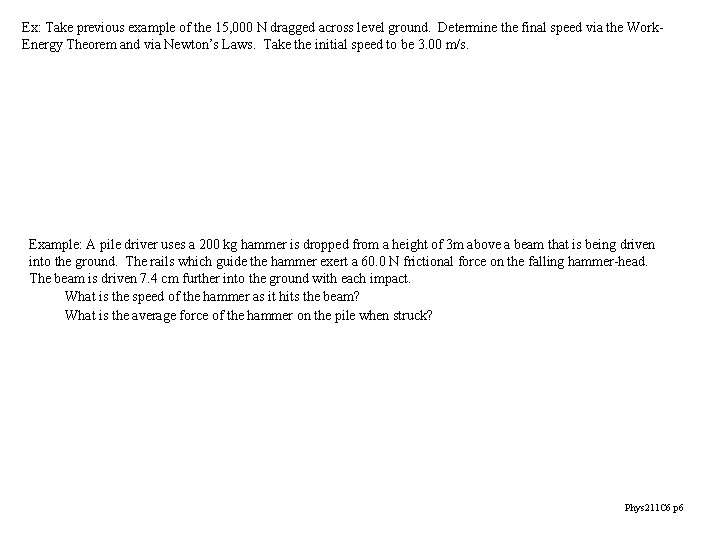
Ex: Take previous example of the 15, 000 N dragged across level ground. Determine the final speed via the Work. Energy Theorem and via Newton’s Laws. Take the initial speed to be 3. 00 m/s. Example: A pile driver uses a 200 kg hammer is dropped from a height of 3 m above a beam that is being driven into the ground. The rails which guide the hammer exert a 60. 0 N frictional force on the falling hammer-head. The beam is driven 7. 4 cm further into the ground with each impact. What is the speed of the hammer as it hits the beam? What is the average force of the hammer on the pile when struck? Phys 211 C 6 p 6
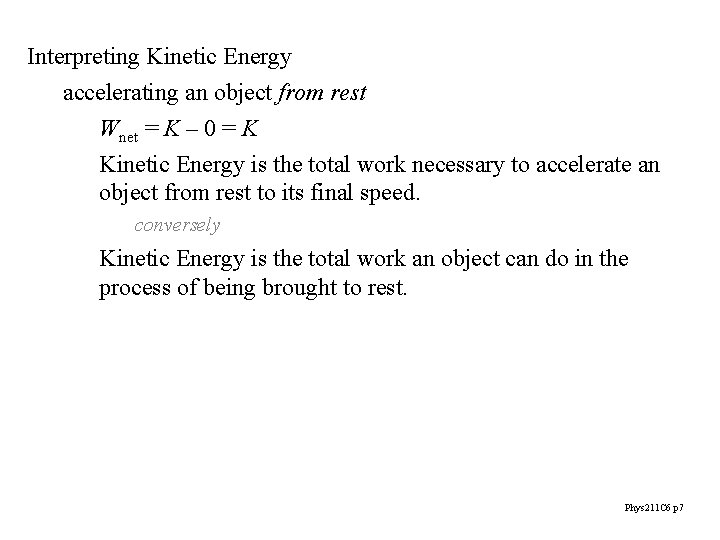
Interpreting Kinetic Energy accelerating an object from rest Wnet = K – 0 = K Kinetic Energy is the total work necessary to accelerate an object from rest to its final speed. conversely Kinetic Energy is the total work an object can do in the process of being brought to rest. Phys 211 C 6 p 7
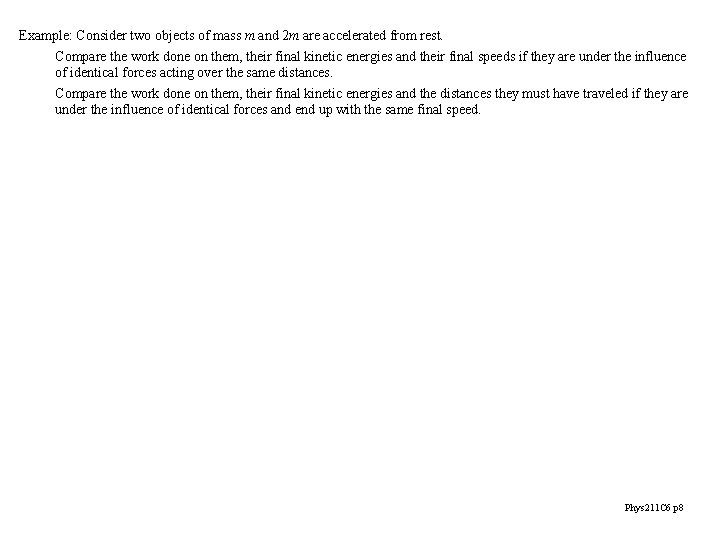
Example: Consider two objects of mass m and 2 m are accelerated from rest. Compare the work done on them, their final kinetic energies and their final speeds if they are under the influence of identical forces acting over the same distances. Compare the work done on them, their final kinetic energies and the distances they must have traveled if they are under the influence of identical forces and end up with the same final speed. Phys 211 C 6 p 8
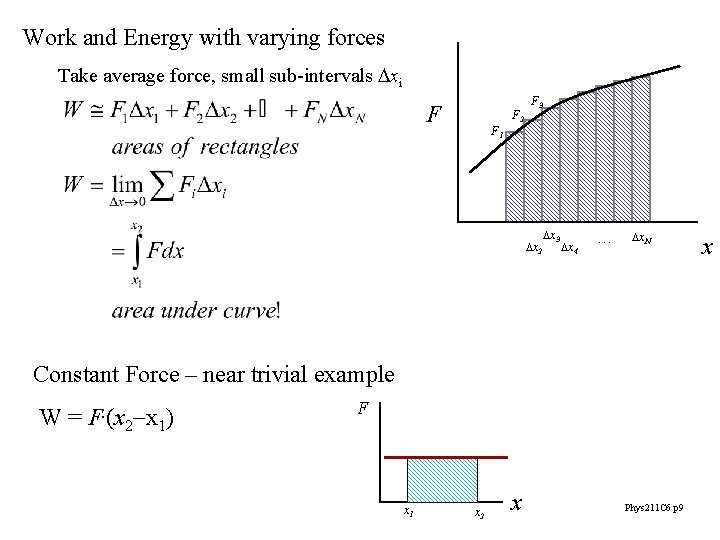
Work and Energy with varying forces Take average force, small sub-intervals Dxi F F 1 F 2 F 3 Dx 2 Dx 3 Dx 4 … Dx. N Constant Force – near trivial example W = F. (x 2 -x 1) F x 1 x 2 x Phys 211 C 6 p 9 x
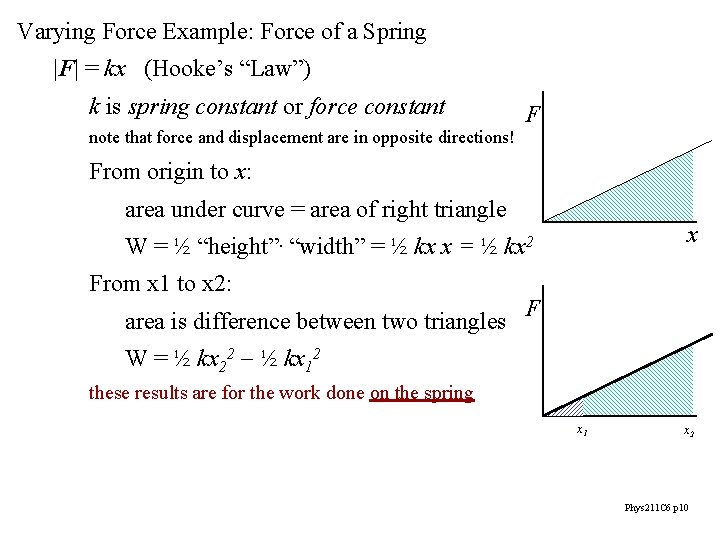
Varying Force Example: Force of a Spring |F| = kx (Hooke’s “Law”) k is spring constant or force constant note that force and displacement are in opposite directions! F From origin to x: area under curve = area of right triangle x W = ½ “height”. “width” = ½ kx x = ½ kx 2 From x 1 to x 2: area is difference between two triangles F W = ½ kx 22 - ½ kx 12 these results are for the work done on the spring x 1 x 2 Phys 211 C 6 p 10
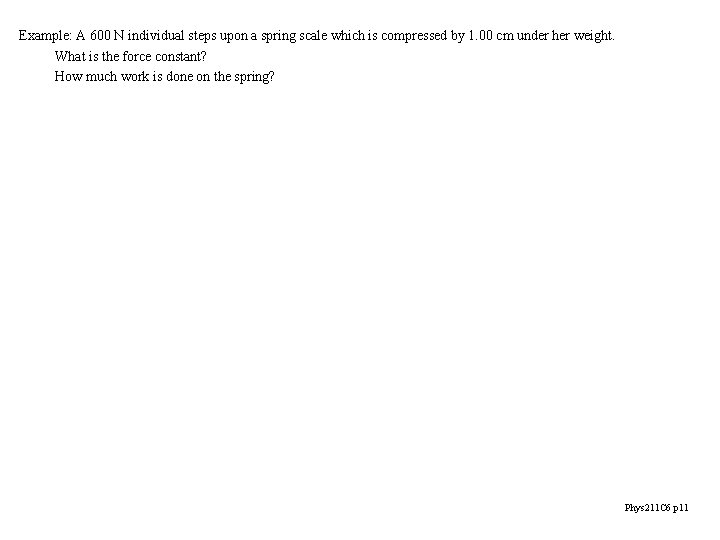
Example: A 600 N individual steps upon a spring scale which is compressed by 1. 00 cm under her weight. What is the force constant? How much work is done on the spring? Phys 211 C 6 p 11
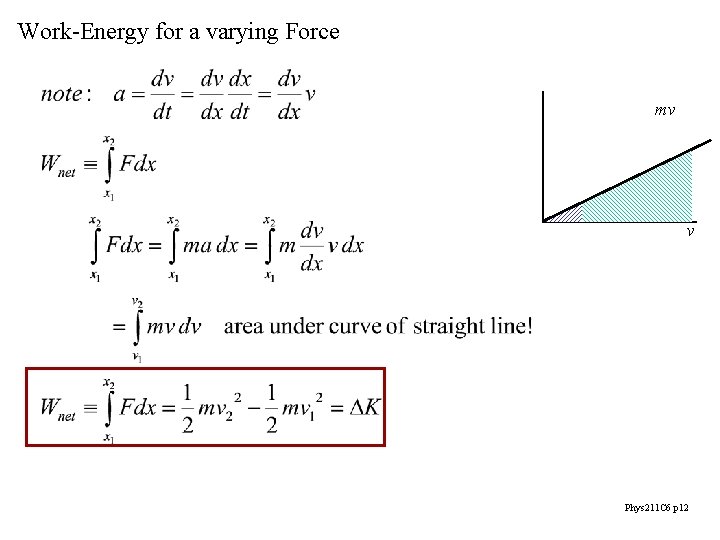
Work-Energy for a varying Force mv v Phys 211 C 6 p 12
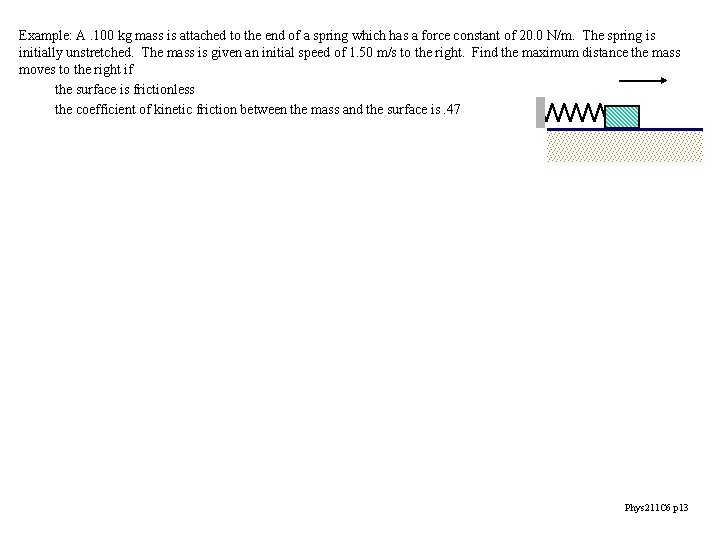
Example: A. 100 kg mass is attached to the end of a spring which has a force constant of 20. 0 N/m. The spring is initially unstretched. The mass is given an initial speed of 1. 50 m/s to the right. Find the maximum distance the mass moves to the right if the surface is frictionless the coefficient of kinetic friction between the mass and the surface is. 47 Phys 211 C 6 p 13
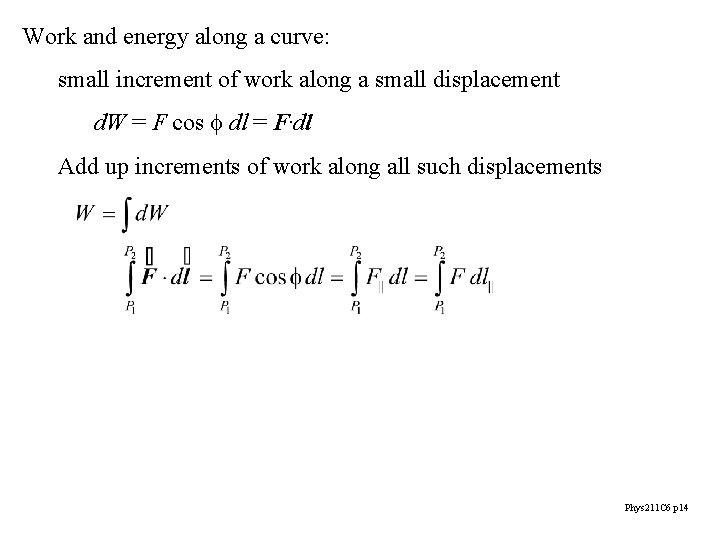
Work and energy along a curve: small increment of work along a small displacement d. W = F cos f dl = F. dl Add up increments of work along all such displacements Phys 211 C 6 p 14
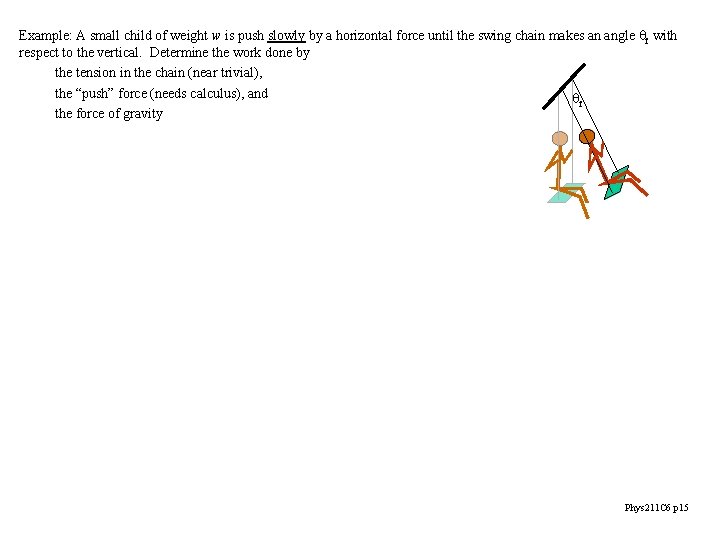
Example: A small child of weight w is push slowly by a horizontal force until the swing chain makes an angle qf with respect to the vertical. Determine the work done by the tension in the chain (near trivial), the “push” force (needs calculus), and qf the force of gravity Phys 211 C 6 p 15
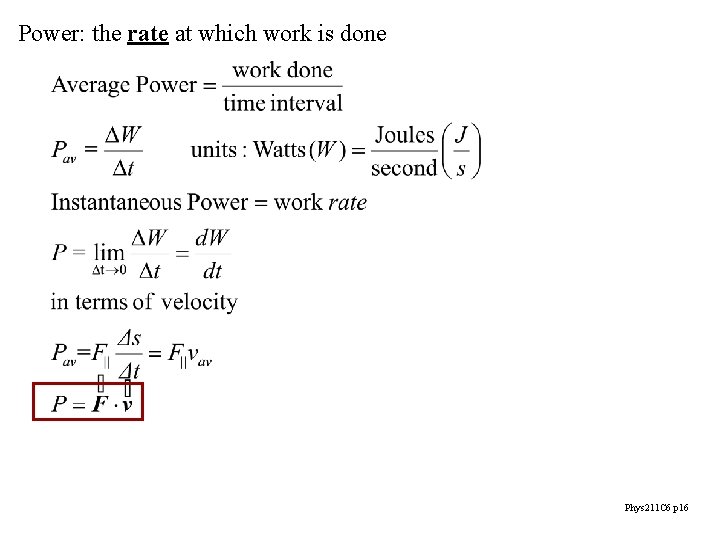
Power: the rate at which work is done Phys 211 C 6 p 16
Example: A 50. 0 kg marathon runner is to run up the stairs of the 443 m tall Sears Tower in Chicago in 15 minutes. What is the runner’s average power exerted in this effort? Phys 211 C 6 p 17