
Work and Energy Unit Energy The ability to
Work and Energy Unit
Energy • The ability to do work or cause change • Can be transferred into other forms (energy flow) • Is conserved (can neither be created nor destroyed) • SI Unit is Joules • Anything with energy can produce a force that is capable acting over a distance
Work • Force times distance the force is applied (W = Fd cos theta) • When work is done, energy is transferred, stored or used (a change occurs) • SI Unit is Joules • Work is done by forces • The object must move for work to be done • Positive work is done in the direction of the displacement.
Power • The rate at which energy is transferred or work is done (work per second) • SI Unit is Watts (Joules/second) • The faster the energy is used, the greater the power • More powerful if – more work is done in same time – same work is done in less time
• Positive work is work done by a force acting in the Work direction of the LT 3 displacement (or motion). I can identify the (example: force applied difference between positive by engine to wheels of a car) and negative • Negative work is work done work. by force acting in the opposite direction of the displacement (or motion) (example: Friction)
Work • Another way of looking at this… • Positive work adds energy to the system • Negative work takes away energy from the system
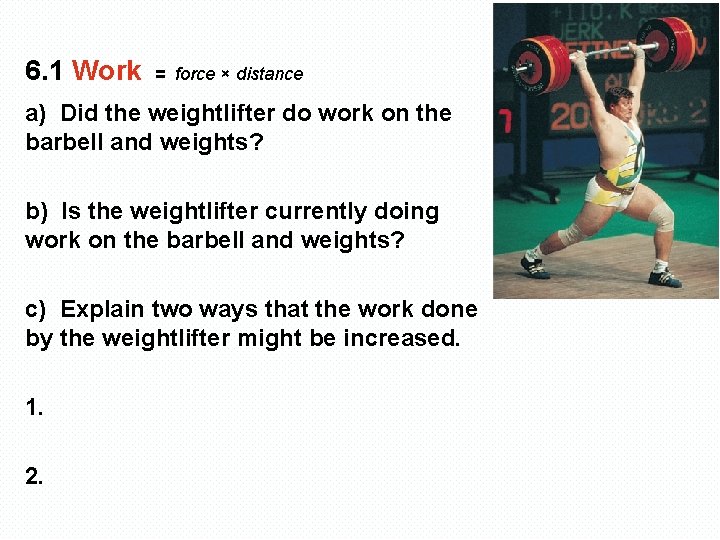
6. 1 Work = force × distance a) Did the weightlifter do work on the barbell and weights? b) Is the weightlifter currently doing work on the barbell and weights? c) Explain two ways that the work done by the weightlifter might be increased. 1. 2.
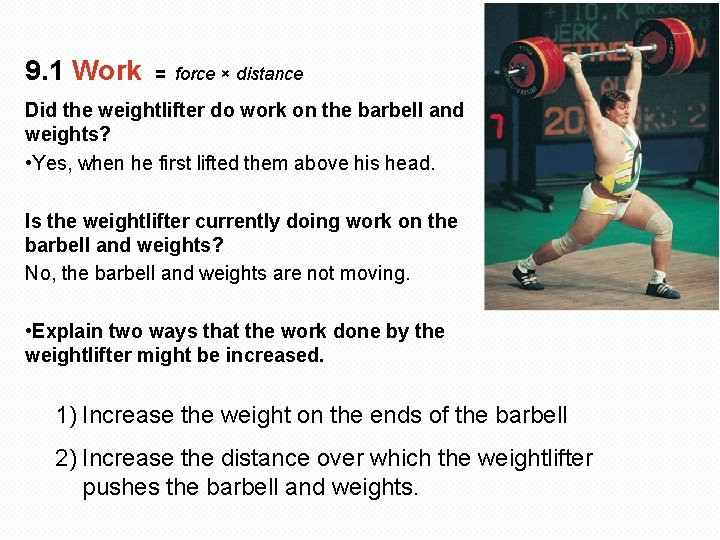
9. 1 Work = force × distance Did the weightlifter do work on the barbell and weights? • Yes, when he first lifted them above his head. Is the weightlifter currently doing work on the barbell and weights? No, the barbell and weights are not moving. • Explain two ways that the work done by the weightlifter might be increased. 1) Increase the weight on the ends of the barbell 2) Increase the distance over which the weightlifter pushes the barbell and weights.
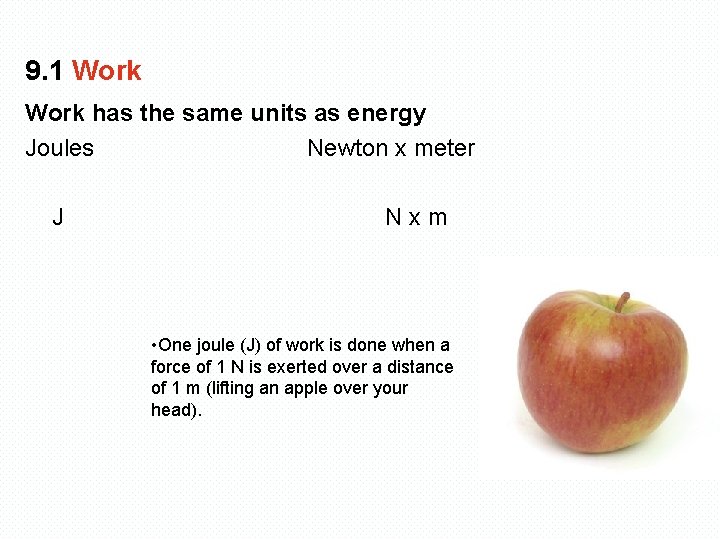
9. 1 Work has the same units as energy Joules Newton x meter J N x m • One joule (J) of work is done when a force of 1 N is exerted over a distance of 1 m (lifting an apple over your head).
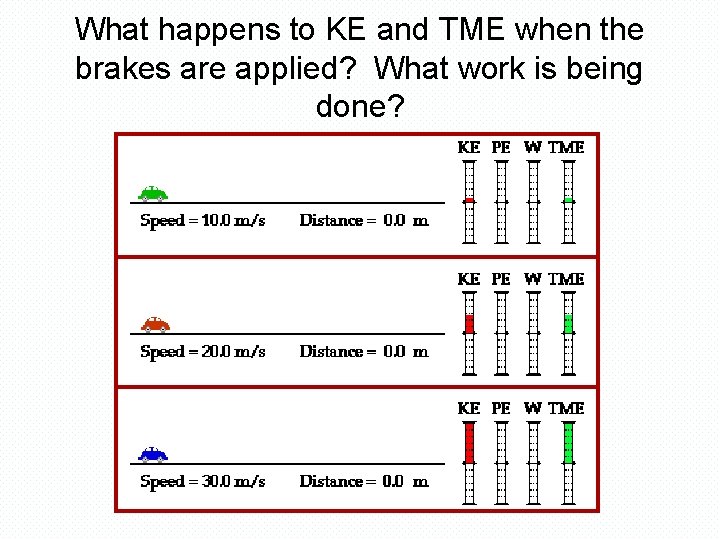
What happens to KE and TME when the brakes are applied? What work is being done?
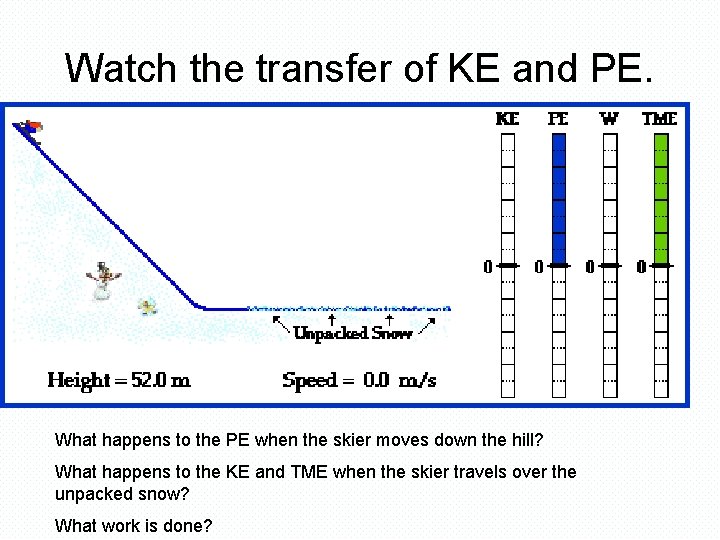
Watch the transfer of KE and PE. What happens to the PE when the skier moves down the hill? What happens to the KE and TME when the skier travels over the unpacked snow? What work is done?
Horsepower
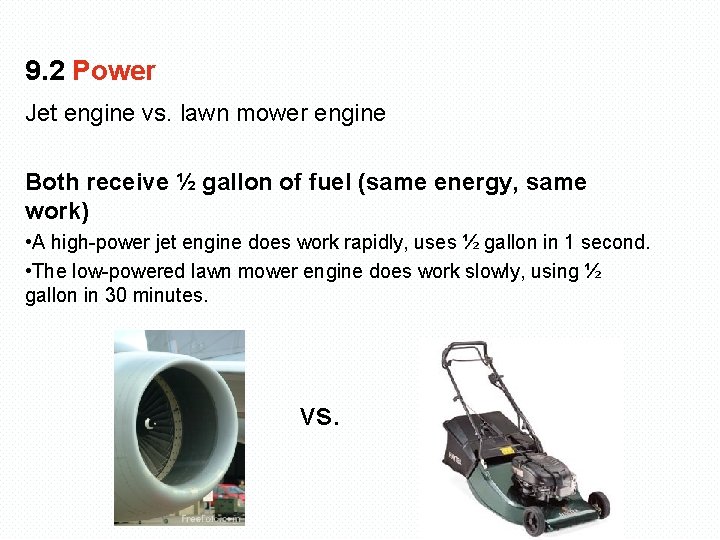
9. 2 Power Jet engine vs. lawn mower engine Both receive ½ gallon of fuel (same energy, same work) • A high-power jet engine does work rapidly, uses ½ gallon in 1 second. • The low-powered lawn mower engine does work slowly, using ½ gallon in 30 minutes. vs.
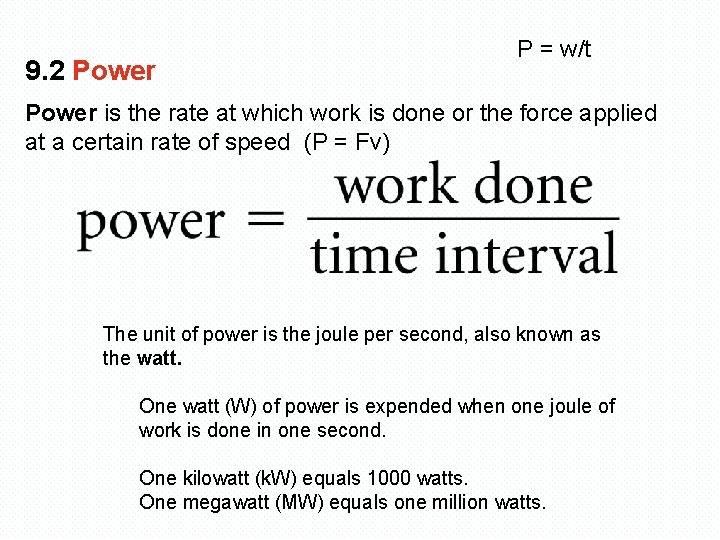
9. 2 Power P = w/t Power is the rate at which work is done or the force applied at a certain rate of speed (P = Fv) The unit of power is the joule per second, also known as the watt. One watt (W) of power is expended when one joule of work is done in one second. One kilowatt (k. W) equals 1000 watts. One megawatt (MW) equals one million watts.
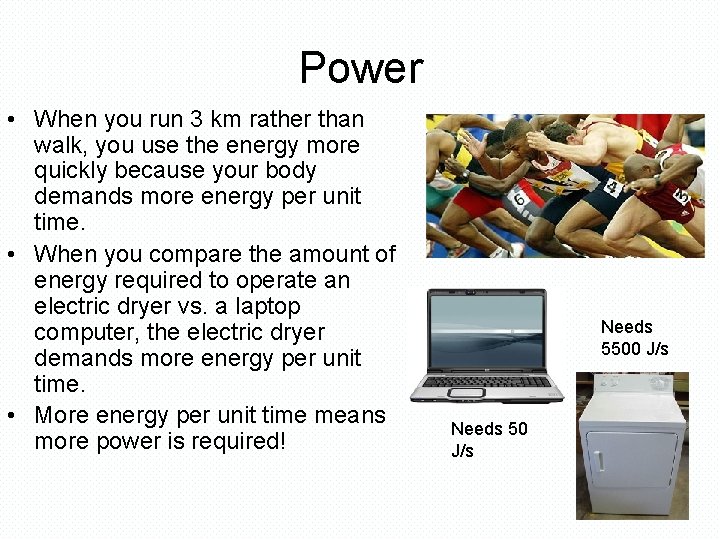
Power • When you run 3 km rather than walk, you use the energy more quickly because your body demands more energy per unit time. • When you compare the amount of energy required to operate an electric dryer vs. a laptop computer, the electric dryer demands more energy per unit time. • More energy per unit time means more power is required! Needs 5500 J/s Needs 50 J/s
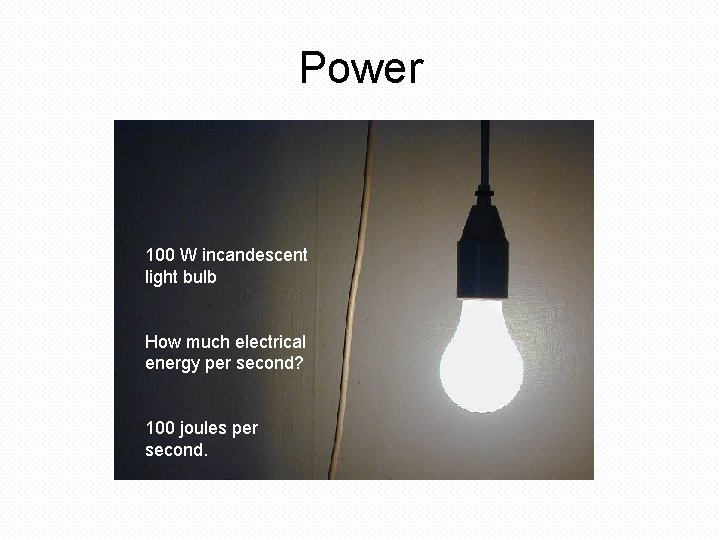
Power 100 W incandescent light bulb How much electrical energy per second? 100 joules per second.
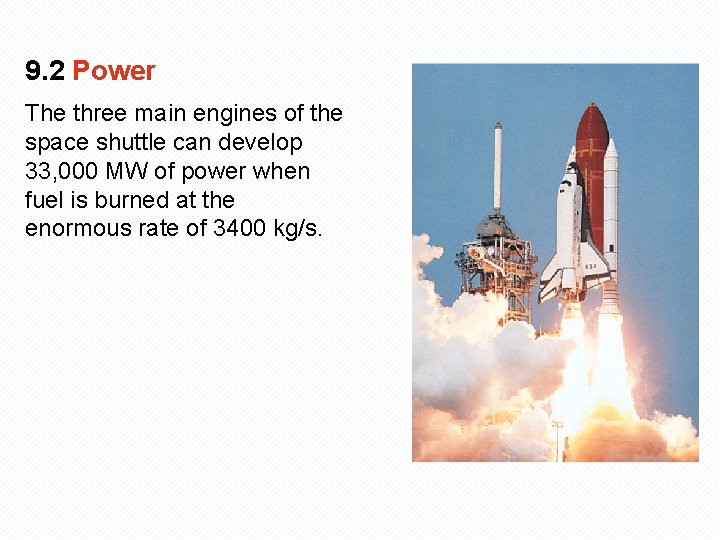
9. 2 Power The three main engines of the space shuttle can develop 33, 000 MW of power when fuel is burned at the enormous rate of 3400 kg/s.
9. 2 Power think! If a forklift is replaced with a new forklift that has twice the power, how much greater a load can it lift in the same amount of time? If it lifts the same load, how much faster can it operate?
9. 2 Power think! If a forklift is replaced with a new forklift that has twice the power, how much greater a load can it lift in the same amount of time? If it lifts the same load, how much faster can it operate? Answer: The forklift that delivers twice the power will lift twice the load in the same time, or the same load in half the time.
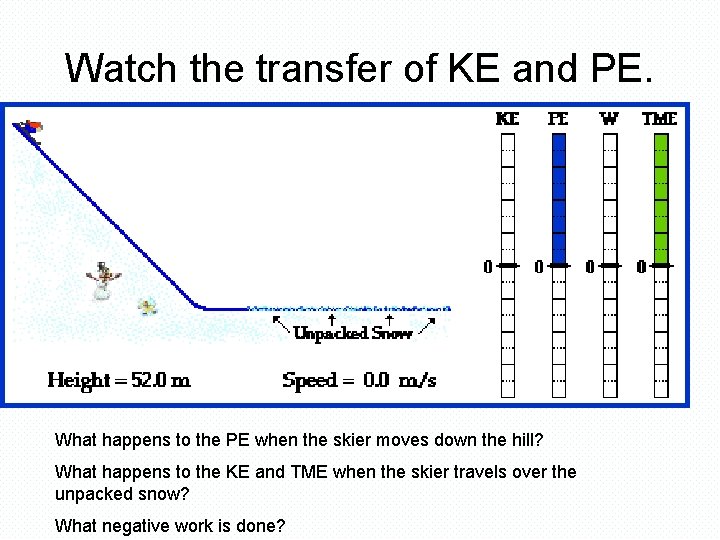
Watch the transfer of KE and PE. What happens to the PE when the skier moves down the hill? What happens to the KE and TME when the skier travels over the unpacked snow? What negative work is done?
9. 1 Work When the object moves. When is work done on an object? When is work not done on an object? When the object does not move.
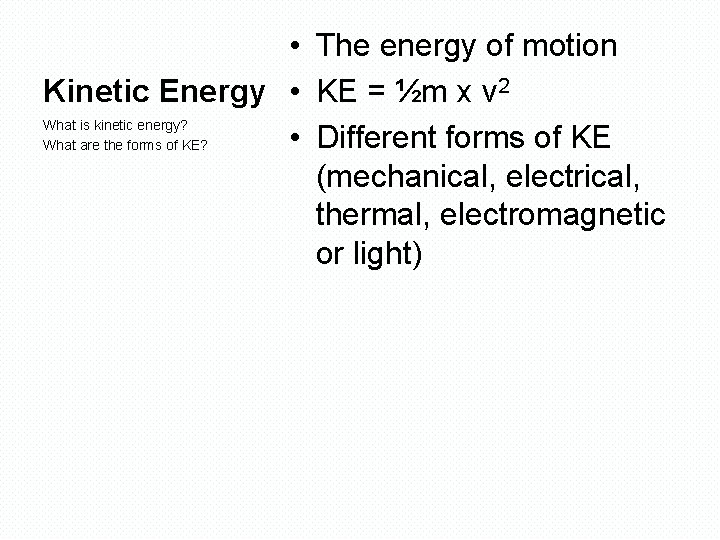
• The energy of motion Kinetic Energy • KE = ½m x v 2 What is kinetic energy? • Different forms of KE What are the forms of KE? (mechanical, electrical, thermal, electromagnetic or light)
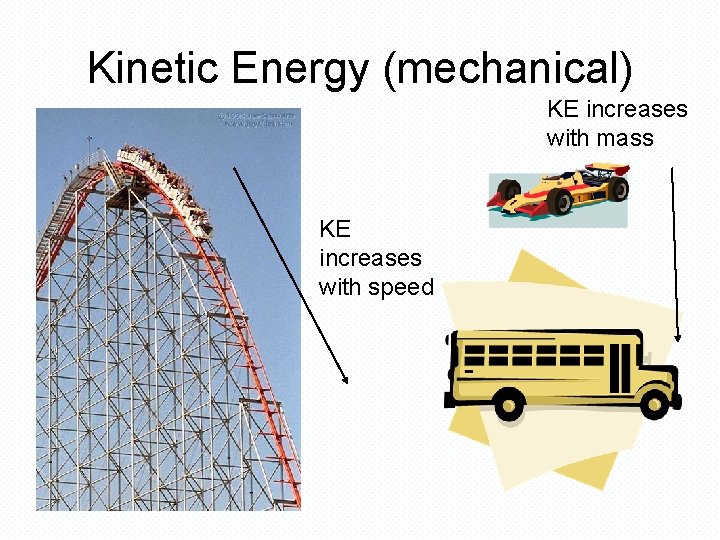
Kinetic Energy (mechanical) KE increases with mass KE increases with speed
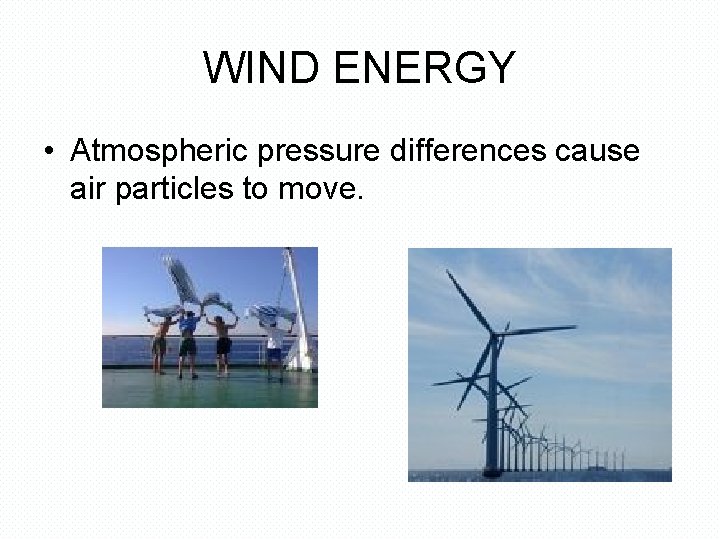
WIND ENERGY • Atmospheric pressure differences cause air particles to move.
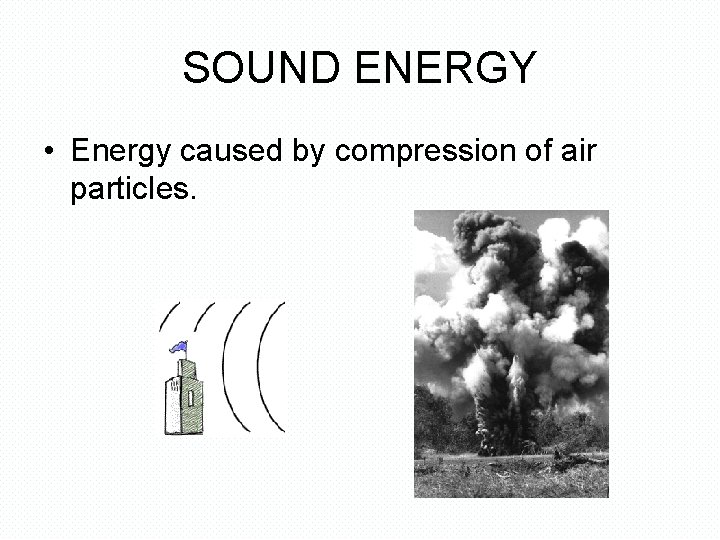
SOUND ENERGY • Energy caused by compression of air particles.
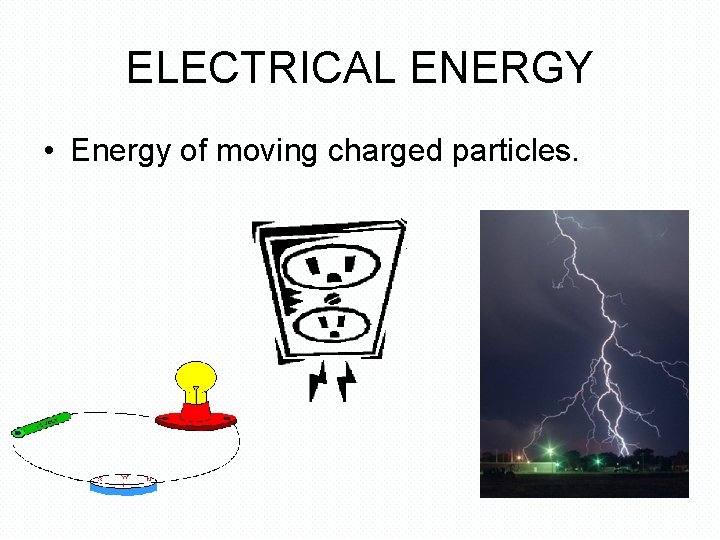
ELECTRICAL ENERGY • Energy of moving charged particles.
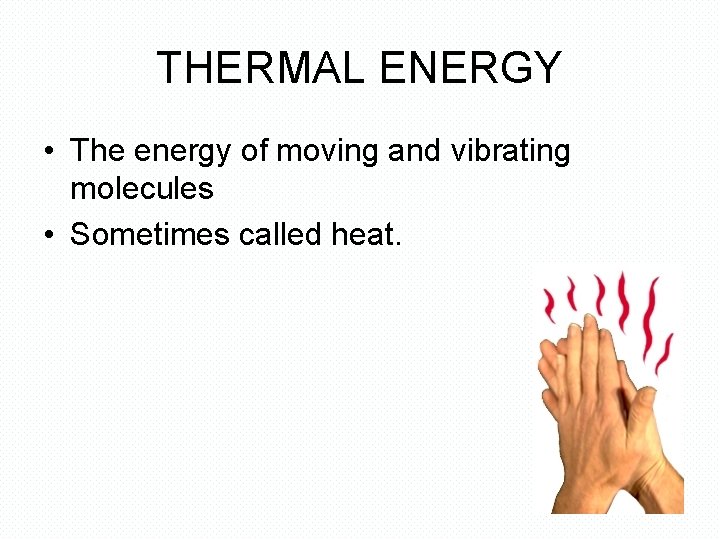
THERMAL ENERGY • The energy of moving and vibrating molecules • Sometimes called heat.
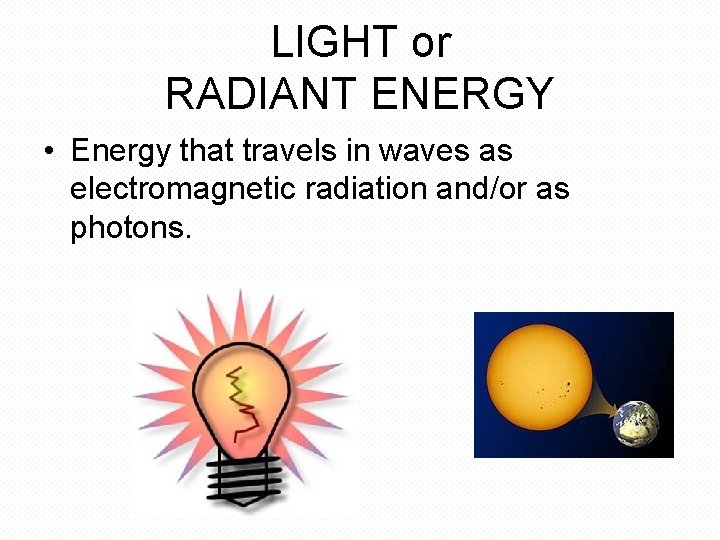
LIGHT or RADIANT ENERGY • Energy that travels in waves as electromagnetic radiation and/or as photons.
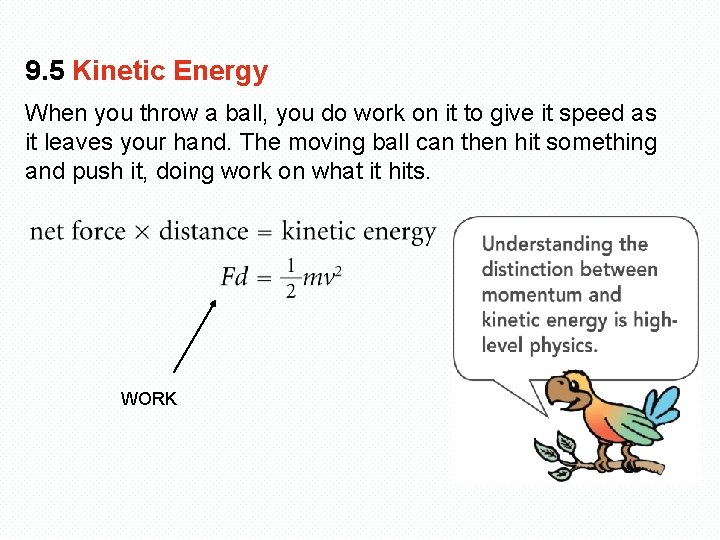
9. 5 Kinetic Energy When you throw a ball, you do work on it to give it speed as it leaves your hand. The moving ball can then hit something and push it, doing work on what it hits. WORK
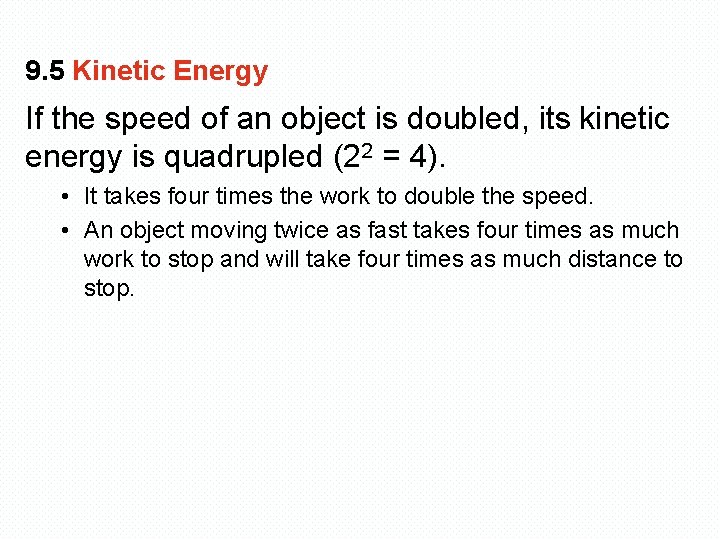
9. 5 Kinetic Energy If the speed of an object is doubled, its kinetic energy is quadrupled (22 = 4). • It takes four times the work to double the speed. • An object moving twice as fast takes four times as much work to stop and will take four times as much distance to stop.
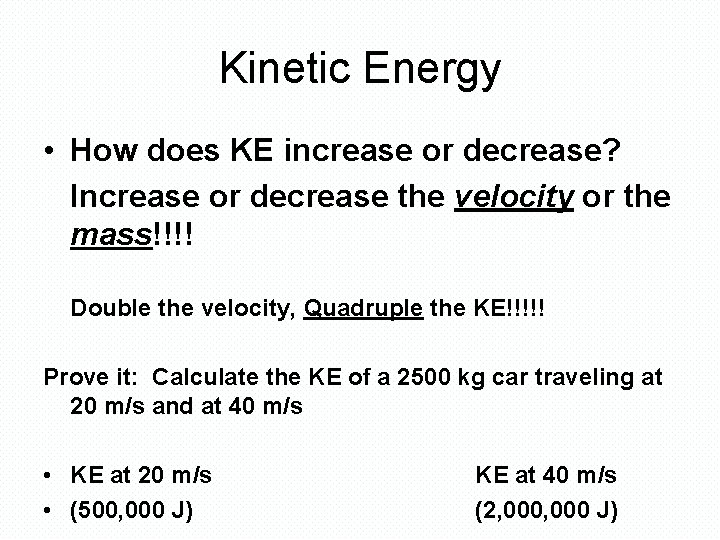
Kinetic Energy • How does KE increase or decrease? Increase or decrease the velocity or the mass!!!! Double the velocity, Quadruple the KE!!!!! Prove it: Calculate the KE of a 2500 kg car traveling at 20 m/s and at 40 m/s • KE at 20 m/s KE at 40 m/s • (500, 000 J) (2, 000 J)
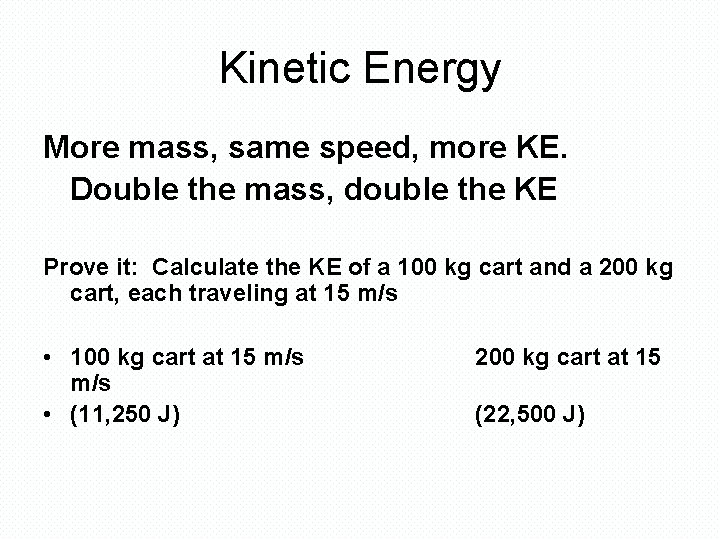
Kinetic Energy More mass, same speed, more KE. Double the mass, double the KE Prove it: Calculate the KE of a 100 kg cart and a 200 kg cart, each traveling at 15 m/s • 100 kg cart at 15 m/s • (11, 250 J) 200 kg cart at 15 (22, 500 J)
• Stored energy or the energy of position Potential Energy What is potential • Gravitational PE is based energy? on height and mass • Gravitational PE is mass How does GPE x gravity x height (GPE change? = mgh) • Increases in height cause increases in stored energy
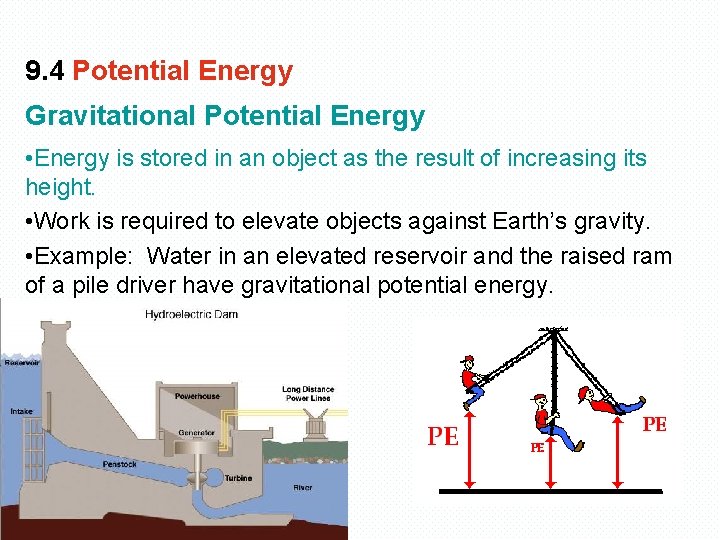
9. 4 Potential Energy Gravitational Potential Energy • Energy is stored in an object as the result of increasing its height. • Work is required to elevate objects against Earth’s gravity. • Example: Water in an elevated reservoir and the raised ram of a pile driver have gravitational potential energy.
9. 4 Potential Energy The amount of gravitational potential energy possessed by an elevated object is equal to the work done against gravity to lift it. PE = mgh What is the gravitational PE of a 10. 0 kg object at 4. 00 m above the ground? mg is weight (in newtons) [mass (kg) x gravity (m/s 2)] 10 kg x 9. 8 m/s 2 x 4 m = 392 J
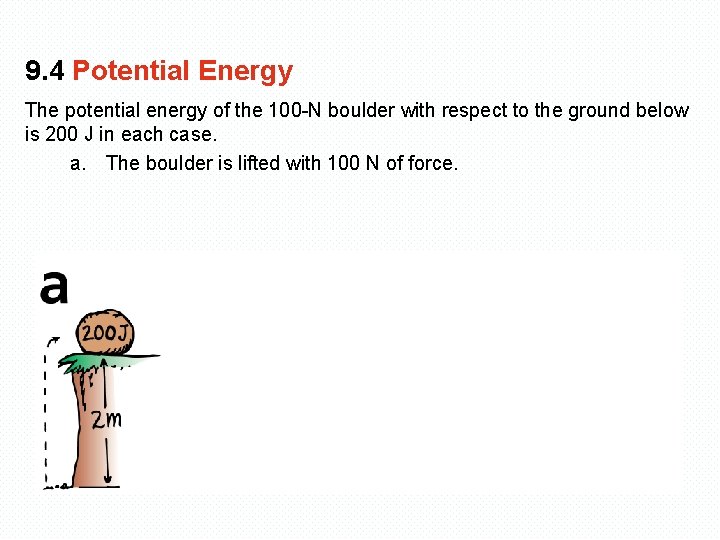
9. 4 Potential Energy The potential energy of the 100 -N boulder with respect to the ground below is 200 J in each case. a. The boulder is lifted with 100 N of force.
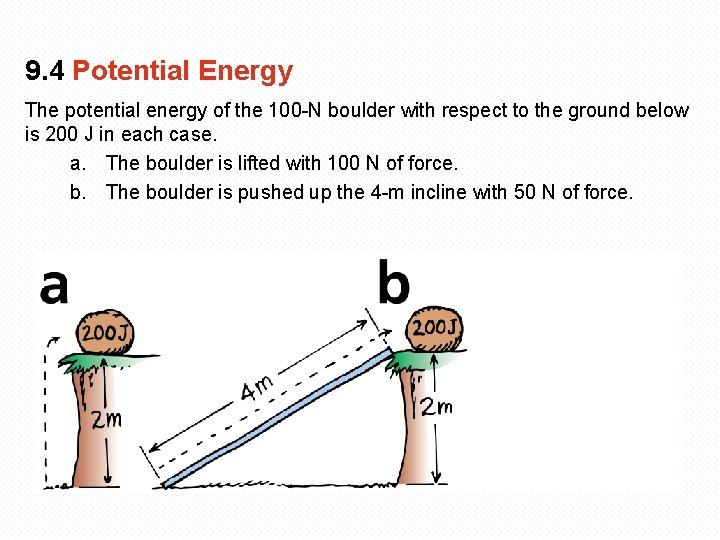
9. 4 Potential Energy The potential energy of the 100 -N boulder with respect to the ground below is 200 J in each case. a. The boulder is lifted with 100 N of force. b. The boulder is pushed up the 4 -m incline with 50 N of force.
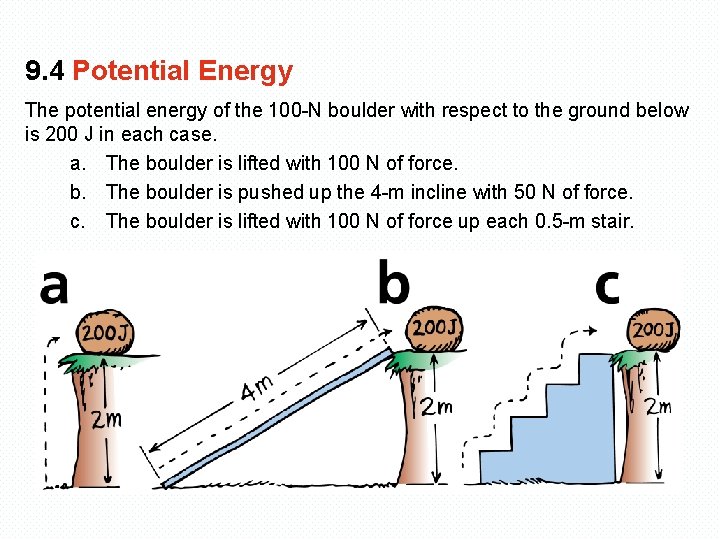
9. 4 Potential Energy The potential energy of the 100 -N boulder with respect to the ground below is 200 J in each case. a. The boulder is lifted with 100 N of force. b. The boulder is pushed up the 4 -m incline with 50 N of force. c. The boulder is lifted with 100 N of force up each 0. 5 -m stair.
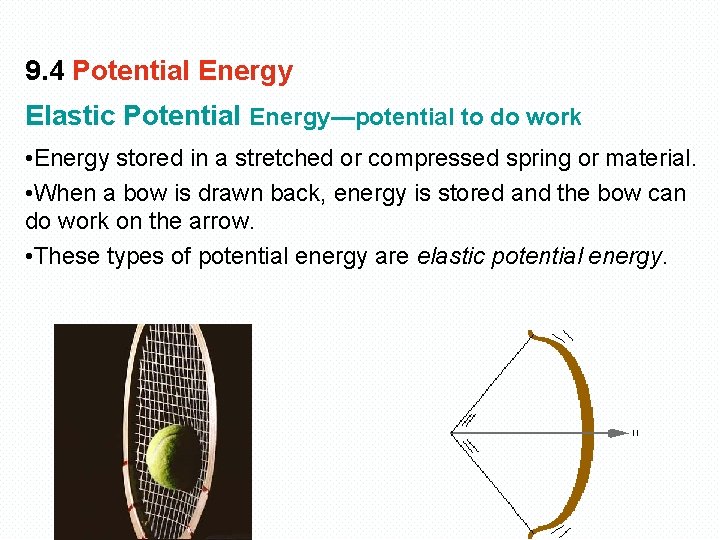
9. 4 Potential Energy Elastic Potential Energy—potential to do work • Energy stored in a stretched or compressed spring or material. • When a bow is drawn back, energy is stored and the bow can do work on the arrow. • These types of potential energy are elastic potential energy.
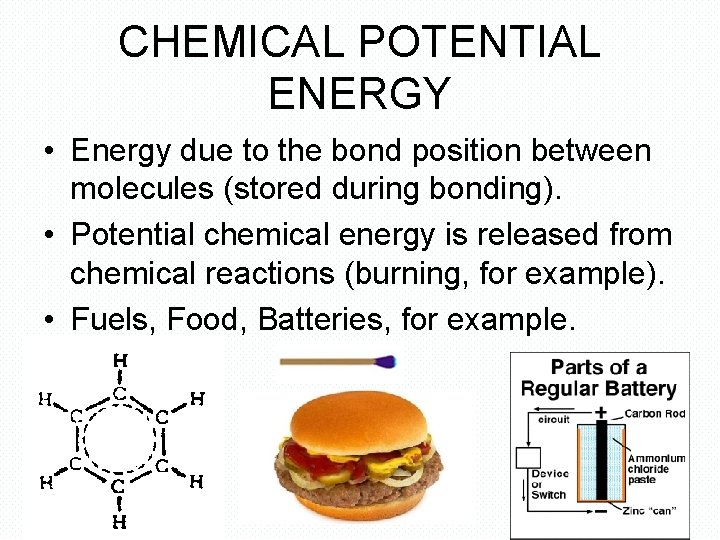
CHEMICAL POTENTIAL ENERGY • Energy due to the bond position between molecules (stored during bonding). • Potential chemical energy is released from chemical reactions (burning, for example). • Fuels, Food, Batteries, for example.
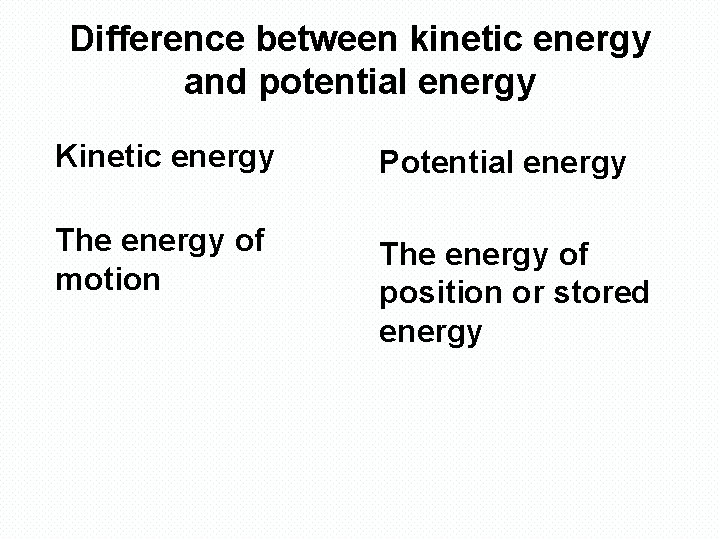
Difference between kinetic energy and potential energy Kinetic energy The energy of motion Potential energy The energy of position or stored energy
Mechanical Energy What is mechanical energy? • The sum of the KE and PE in a system: (total ME = KE + PE) • Describes energy associated with the motion of objects • The KE and GPE are conserved for moving objects (neglecting friction, drag, vibrations and sound)
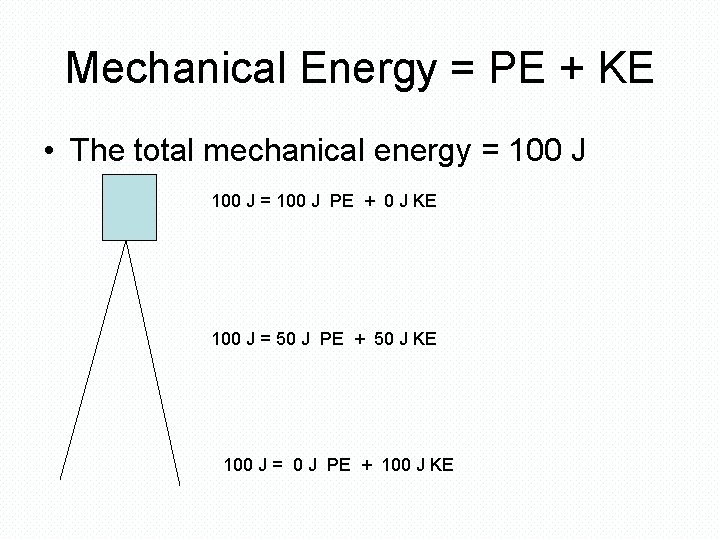
Mechanical Energy = PE + KE • The total mechanical energy = 100 J PE + 0 J KE 100 J = 50 J PE + 50 J KE 100 J = 0 J PE + 100 J KE
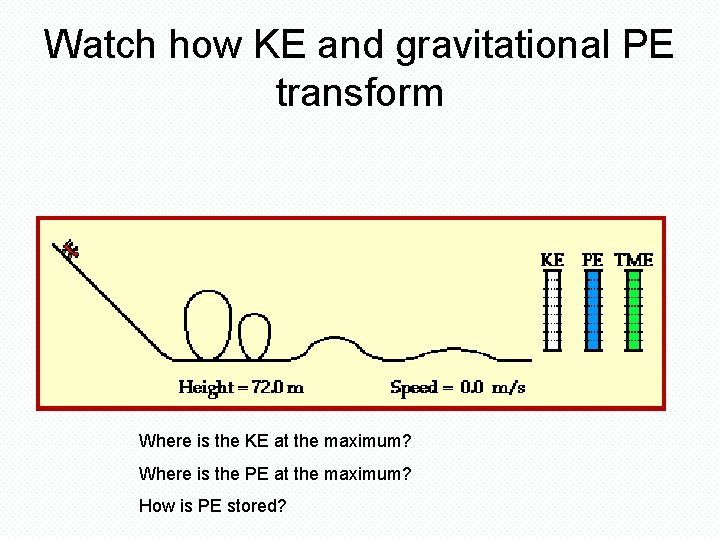
Watch how KE and gravitational PE transform Where is the KE at the maximum? Where is the PE at the maximum? How is PE stored?
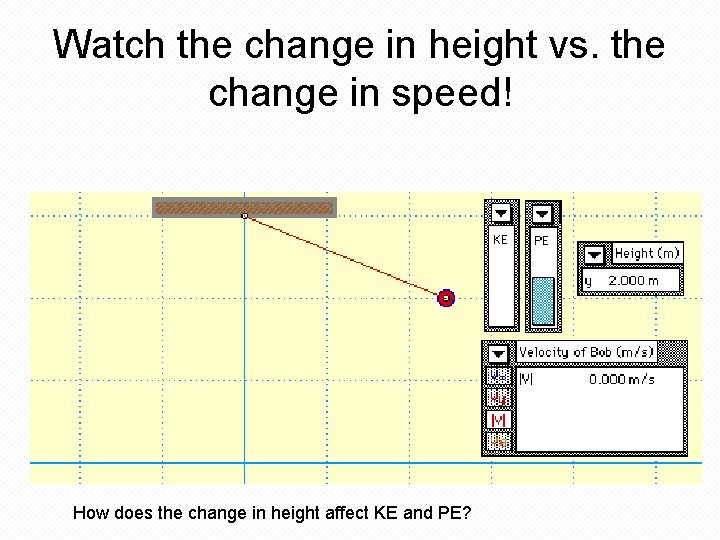
Watch the change in height vs. the change in speed! How does the change in height affect KE and PE?
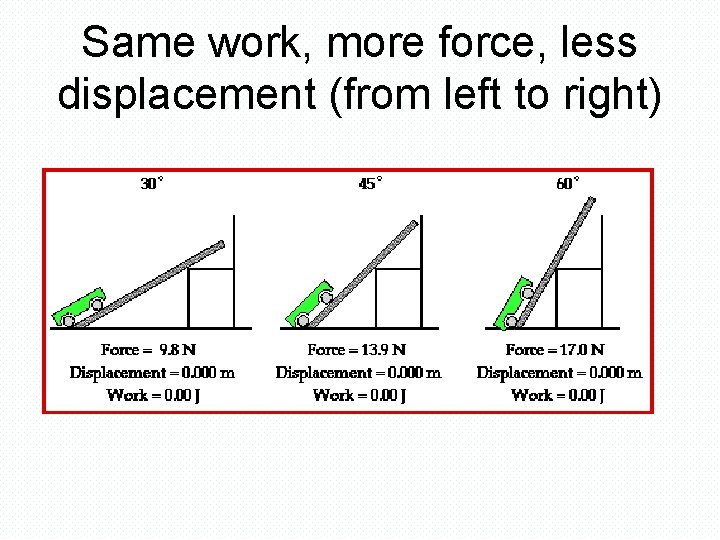
Same work, more force, less displacement (from left to right)
Non-Mechanical • Energy not associated with the motion of objects Energy What is nonmechanical energy? • Typical examples are vibrations, sound and heat • Referred to as dissipated energy or waste energy • Can be “observed” at the molecular level • Path of energy transfer that reduces the KE of the object
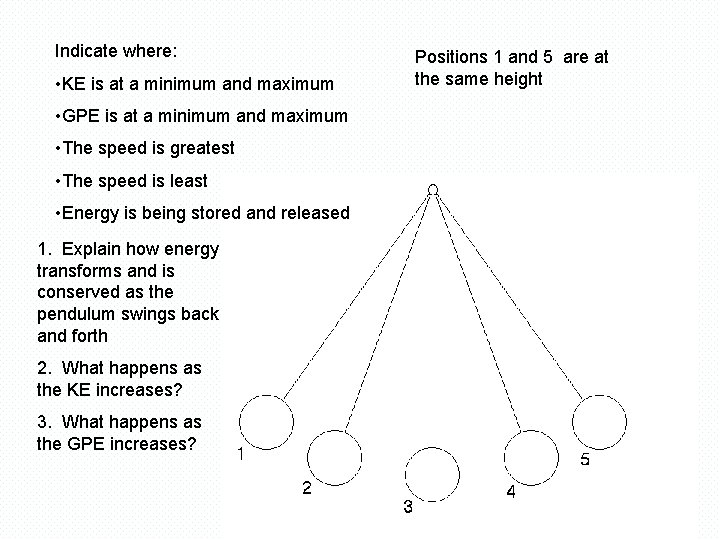
Indicate where: • KE is at a minimum and maximum • GPE is at a minimum and maximum • The speed is greatest • The speed is least • Energy is being stored and released 1. Explain how energy transforms and is conserved as the pendulum swings back and forth 2. What happens as the KE increases? 3. What happens as the GPE increases? Positions 1 and 5 are at the same height
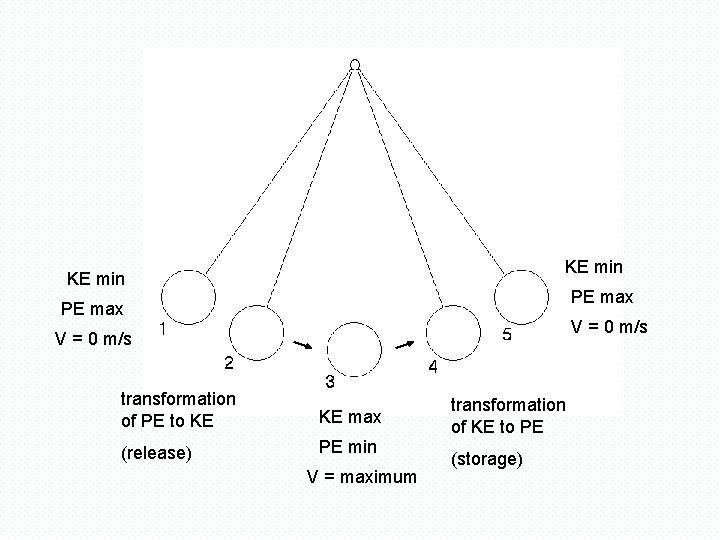
KE min PE max V = 0 m/s transformation of PE to KE KE max (release) PE min V = maximum transformation of KE to PE (storage)
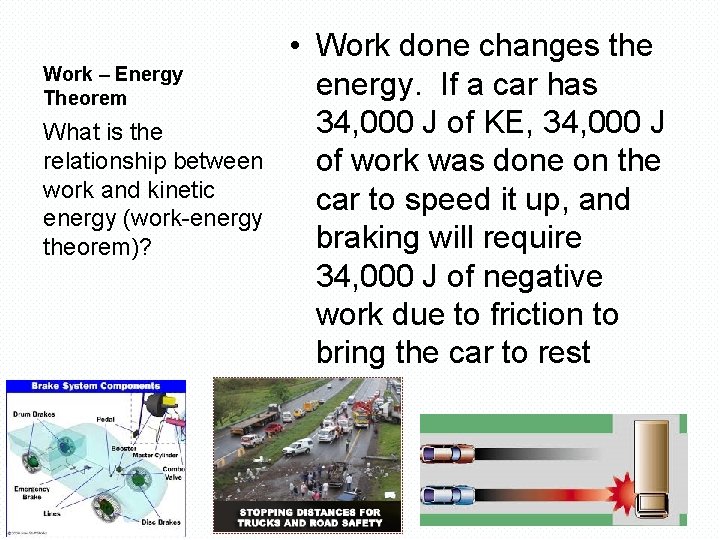
Work – Energy Theorem What is the relationship between work and kinetic energy (work-energy theorem)? • Work done changes the energy. If a car has 34, 000 J of KE, 34, 000 J of work was done on the car to speed it up, and braking will require 34, 000 J of negative work due to friction to bring the car to rest
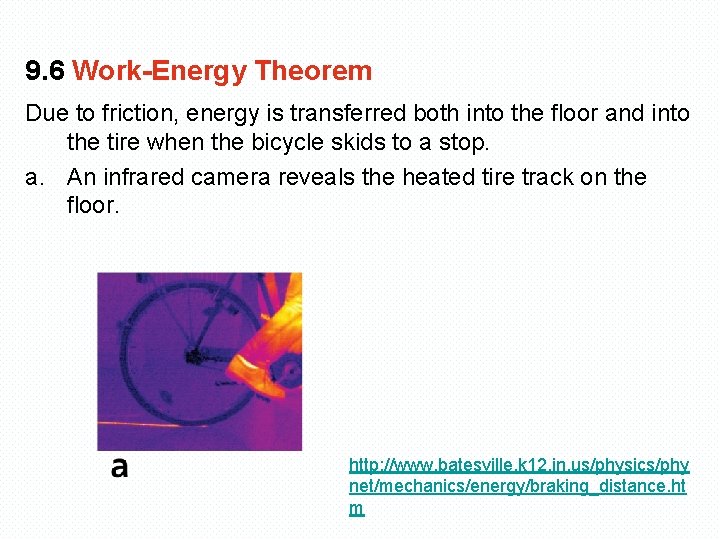
9. 6 Work-Energy Theorem Due to friction, energy is transferred both into the floor and into the tire when the bicycle skids to a stop. a. An infrared camera reveals the heated tire track on the floor. http: //www. batesville. k 12. in. us/physics/phy net/mechanics/energy/braking_distance. ht m
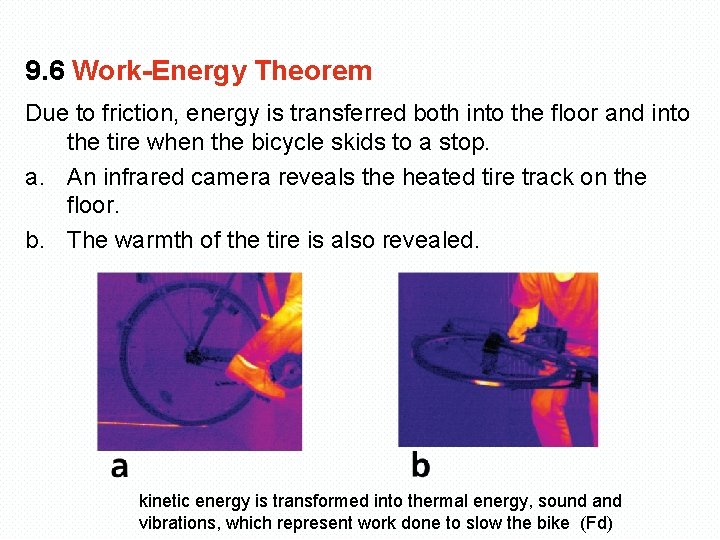
9. 6 Work-Energy Theorem Due to friction, energy is transferred both into the floor and into the tire when the bicycle skids to a stop. a. An infrared camera reveals the heated tire track on the floor. b. The warmth of the tire is also revealed. kinetic energy is transformed into thermal energy, sound and vibrations, which represent work done to slow the bike (Fd)
9. 6 Work-Energy Theorem The work-energy theorem states that whenever work is done, energy changes. Work = ∆KE Work equals the change in kinetic energy.
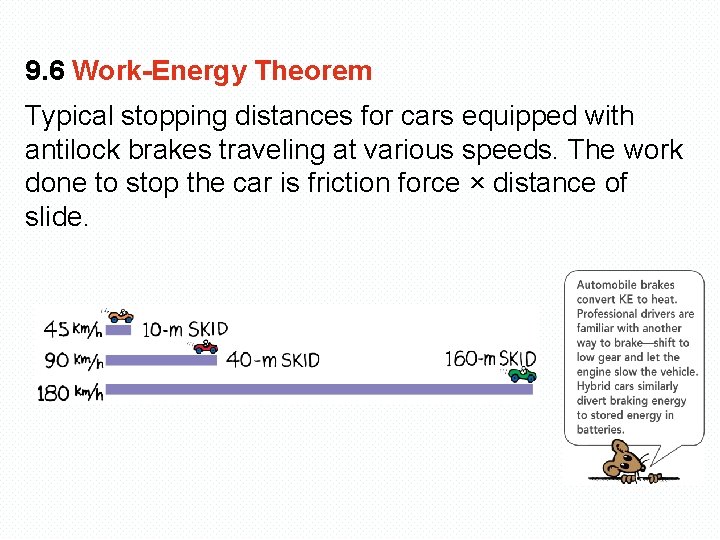
9. 6 Work-Energy Theorem Typical stopping distances for cars equipped with antilock brakes traveling at various speeds. The work done to stop the car is friction force × distance of slide.
9. 6 Work-Energy Theorem think! When the brakes of a car are locked, the car skids to a stop. How much farther will the car skid if it’s moving 3 times as fast?

9. 6 Work-Energy Theorem think! When the brakes of a car are locked, the car skids to a stop. How much farther will the car skid if it’s moving 3 times as fast? Answer: Nine times farther. The car has nine times as much kinetic energy when it travels three times as fast:
9. 7 Conservation of Energy The law of conservation of energy states that energy cannot be created or destroyed. It can be transformed from one form into another, but the total amount of energy never changes. For any system in its entirety—as simple as a swinging pendulum or as complex as an exploding galaxy—there is one quantity that does not change: energy. Energy may change form, but the total energy stays the same.
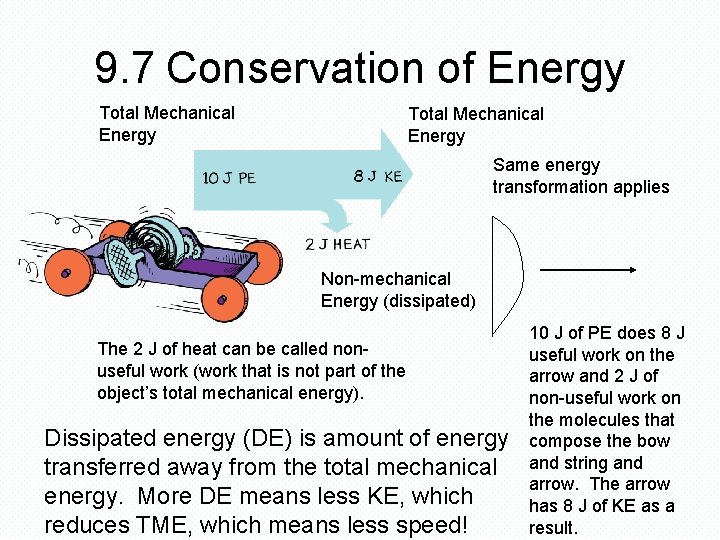
9. 7 Conservation of Energy Total Mechanical Energy Same energy transformation applies Non-mechanical Energy (dissipated) The 2 J of heat can be called nonuseful work (work that is not part of the object’s total mechanical energy). Dissipated energy (DE) is amount of energy transferred away from the total mechanical energy. More DE means less KE, which reduces TME, which means less speed! 10 J of PE does 8 J useful work on the arrow and 2 J of non-useful work on the molecules that compose the bow and string and arrow. The arrow has 8 J of KE as a result.
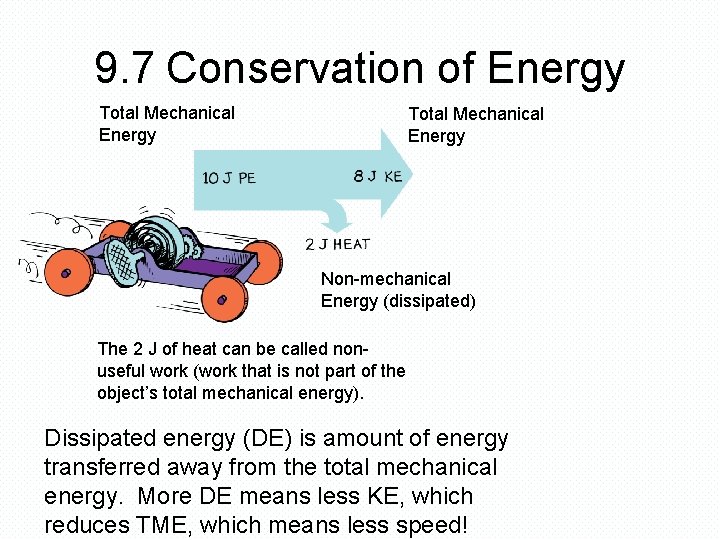
9. 7 Conservation of Energy Total Mechanical Energy Non-mechanical Energy (dissipated) The 2 J of heat can be called nonuseful work (work that is not part of the object’s total mechanical energy). Dissipated energy (DE) is amount of energy transferred away from the total mechanical energy. More DE means less KE, which reduces TME, which means less speed!
9. 7 Conservation of Energy When energy is transformed, it is conserved, meaning that it will change form without losing its original amount of energy.
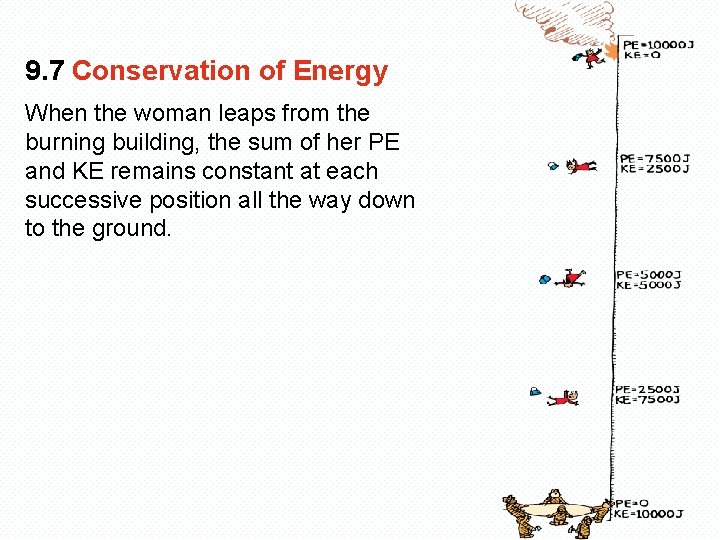
9. 7 Conservation of Energy When the woman leaps from the burning building, the sum of her PE and KE remains constant at each successive position all the way down to the ground.
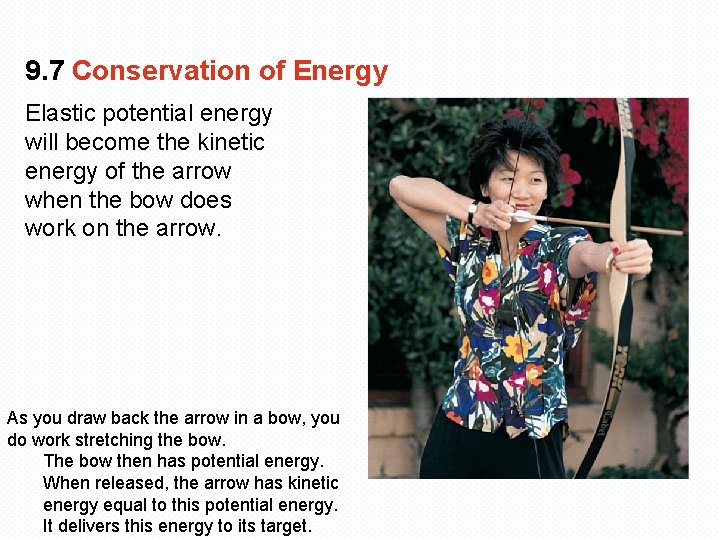
9. 7 Conservation of Energy Elastic potential energy will become the kinetic energy of the arrow when the bow does work on the arrow. As you draw back the arrow in a bow, you do work stretching the bow. The bow then has potential energy. When released, the arrow has kinetic energy equal to this potential energy. It delivers this energy to its target.
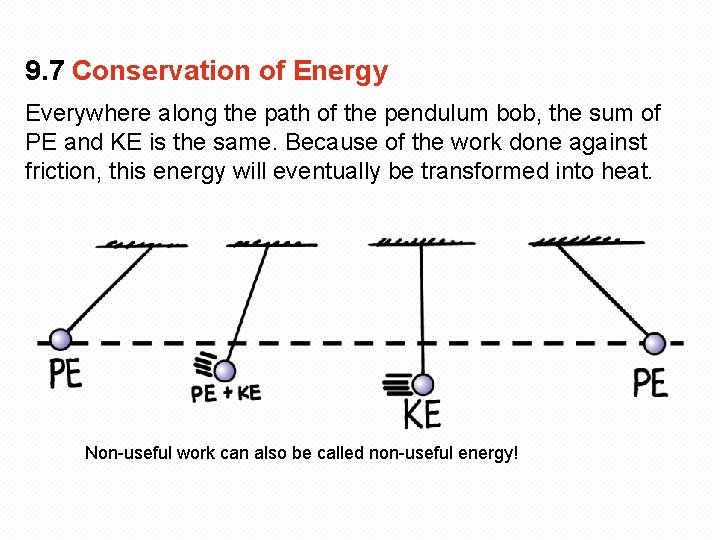
9. 7 Conservation of Energy Everywhere along the path of the pendulum bob, the sum of PE and KE is the same. Because of the work done against friction, this energy will eventually be transformed into heat. Non-useful work can also be called non-useful energy!
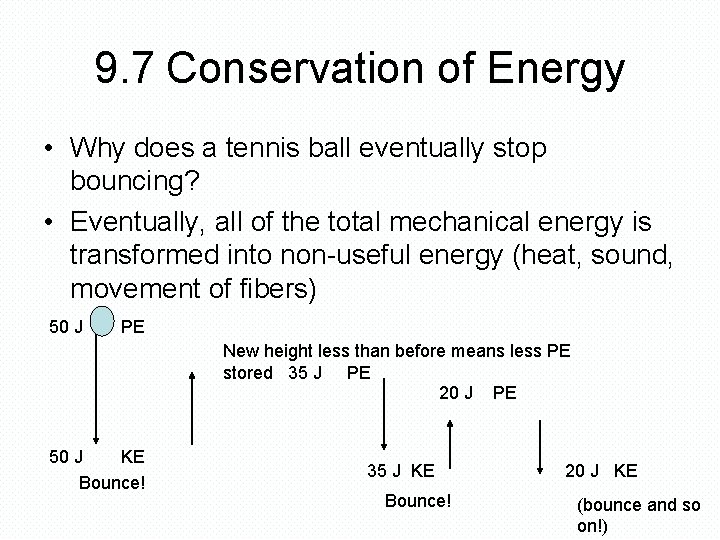
9. 7 Conservation of Energy • Why does a tennis ball eventually stop bouncing? • Eventually, all of the total mechanical energy is transformed into non-useful energy (heat, sound, movement of fibers) 50 J PE New height less than before means less PE stored 35 J PE 20 J PE 50 J KE Bounce! 35 J KE Bounce! 20 J KE (bounce and so on!)
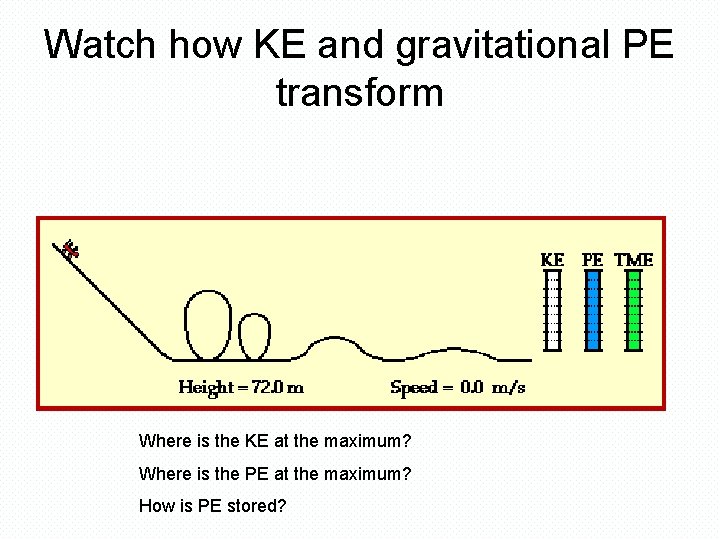
Watch how KE and gravitational PE transform Where is the KE at the maximum? Where is the PE at the maximum? How is PE stored?
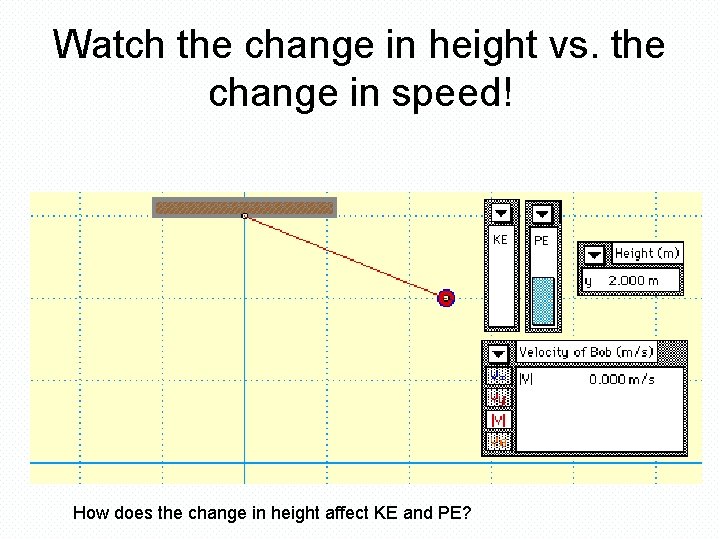
Watch the change in height vs. the change in speed! How does the change in height affect KE and PE?
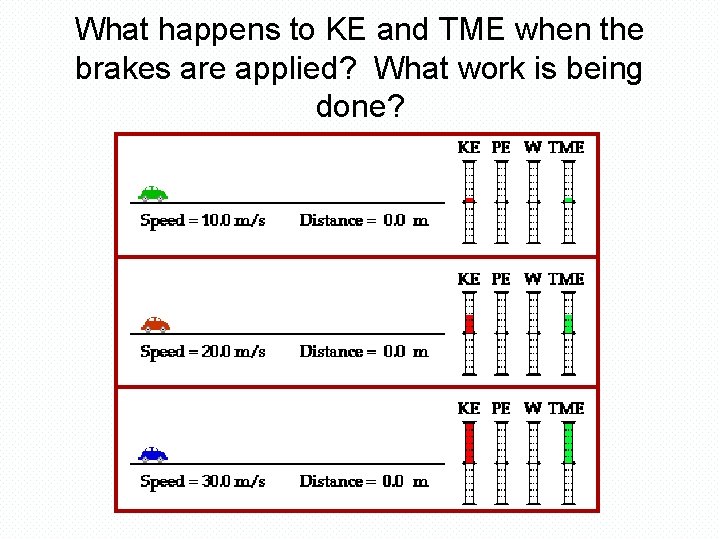
What happens to KE and TME when the brakes are applied? What work is being done?
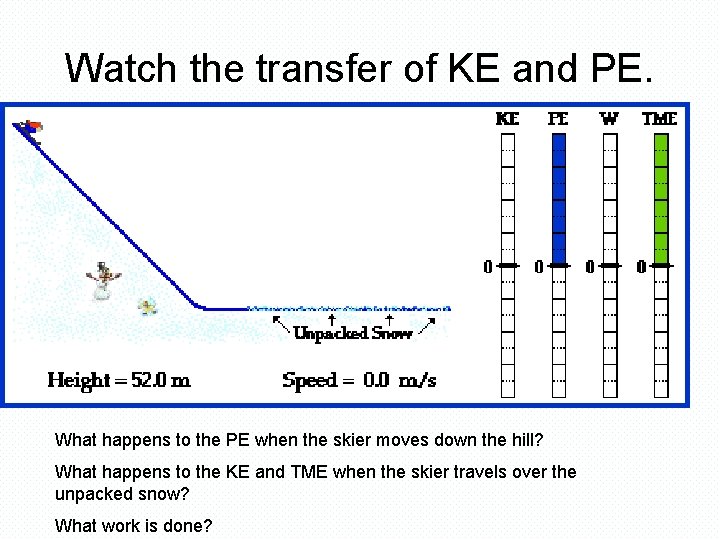
Watch the transfer of KE and PE. What happens to the PE when the skier moves down the hill? What happens to the KE and TME when the skier travels over the unpacked snow? What work is done?
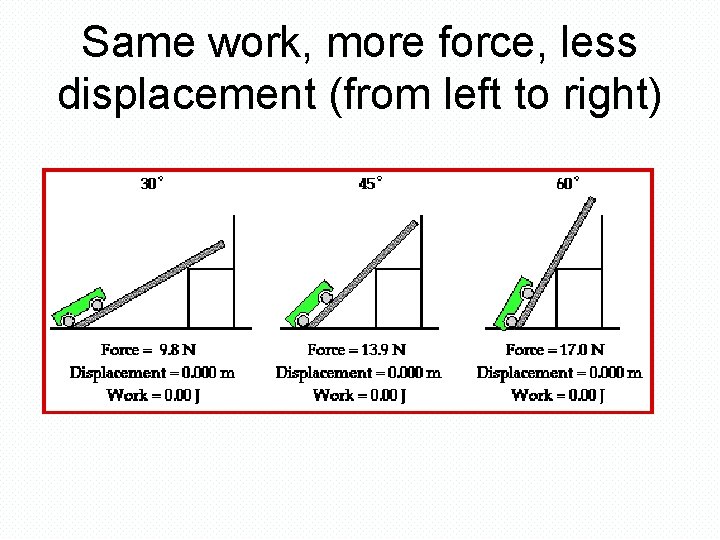
Same work, more force, less displacement (from left to right)
- Slides: 72