
Work and Energy Section 1 Work Power and
- Slides: 17
Work and Energy Section 1: Work, Power, and Machines Preview • Key Ideas • Bellringer • What Is Work? • Math Skills • Power • Machines and Mechanical Advantage
Work and Energy Section 1 Key Ideas 〉How is work calculated? 〉What is the relationship between work and power? 〉How do machines make work easier?
Work and Energy Section 1 Bellringer 1. Which of the following is an example of work: bowling or reading? 1. a. A man pushes against a brick wall, which doesn’t move. Is this an example of work? b. A student carries her books to class. Is this an example of work? c. A woman raises and lowers dumbbells at the gym. Is this an example of work? d. A book falls off a table and lands on the floor. Is this an example of work?
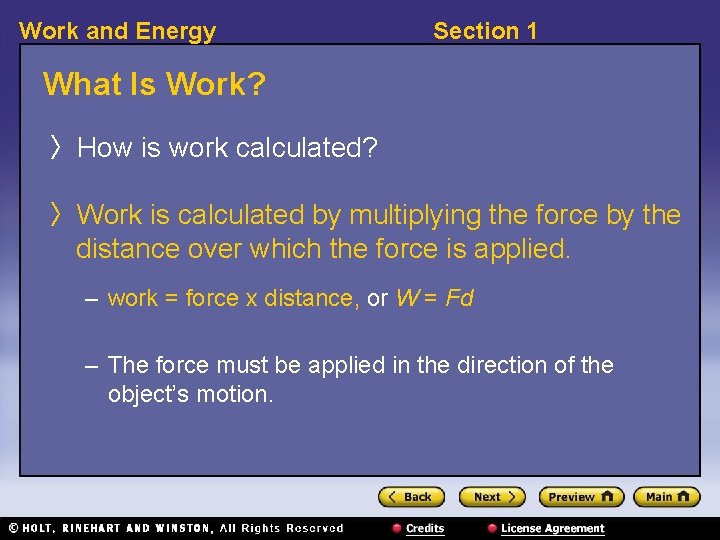
Work and Energy Section 1 What Is Work? 〉How is work calculated? 〉Work is calculated by multiplying the force by the distance over which the force is applied. – work = force x distance, or W = Fd – The force must be applied in the direction of the object’s motion.
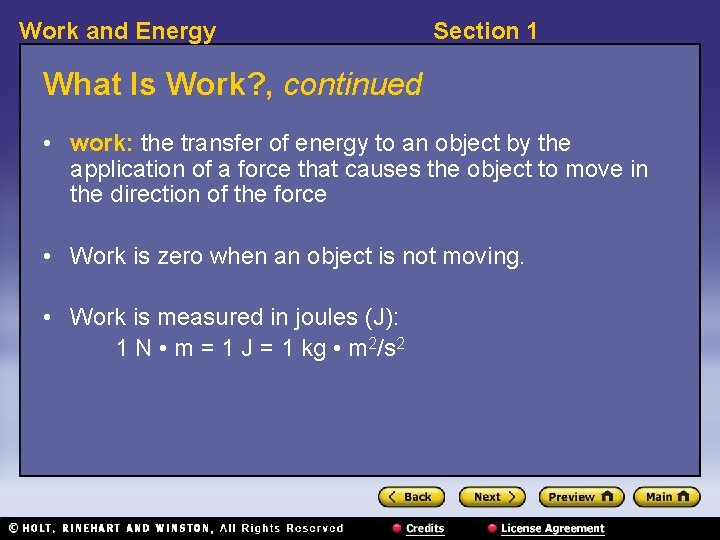
Work and Energy Section 1 What Is Work? , continued • work: the transfer of energy to an object by the application of a force that causes the object to move in the direction of the force • Work is zero when an object is not moving. • Work is measured in joules (J): 1 N • m = 1 J = 1 kg • m 2/s 2
Work and Energy Visual Concept: Work Section 1
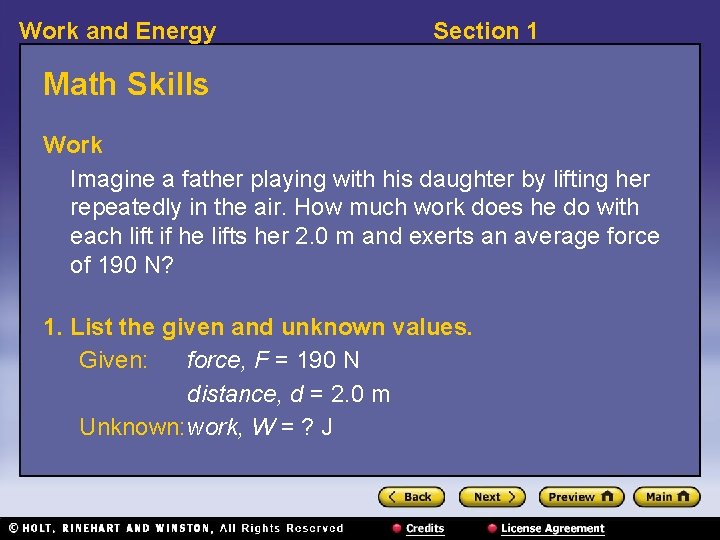
Work and Energy Section 1 Math Skills Work Imagine a father playing with his daughter by lifting her repeatedly in the air. How much work does he do with each lift if he lifts her 2. 0 m and exerts an average force of 190 N? 1. List the given and unknown values. Given: force, F = 190 N distance, d = 2. 0 m Unknown: work, W = ? J
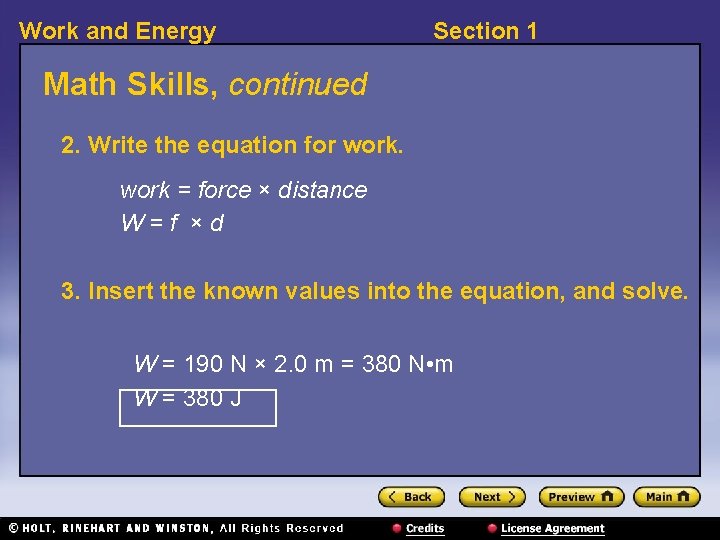
Work and Energy Section 1 Math Skills, continued 2. Write the equation for work = force × distance W=f ×d 3. Insert the known values into the equation, and solve. W = 190 N × 2. 0 m = 380 N • m W = 380 J
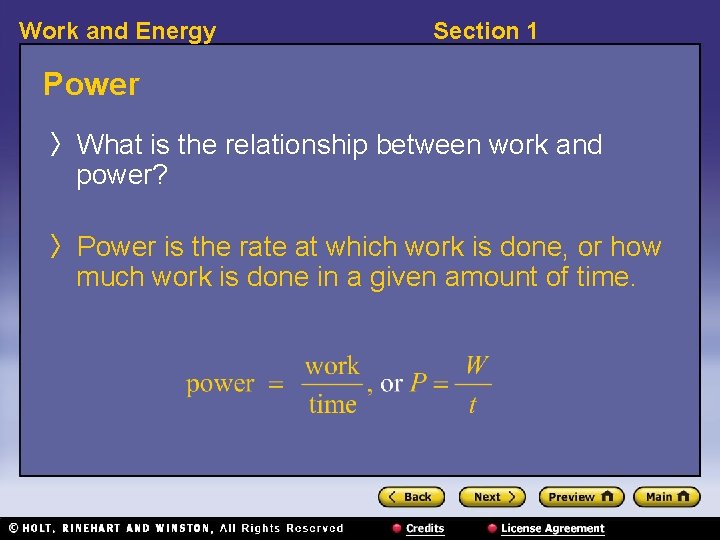
Work and Energy Section 1 Power 〉What is the relationship between work and power? 〉Power is the rate at which work is done, or how much work is done in a given amount of time.
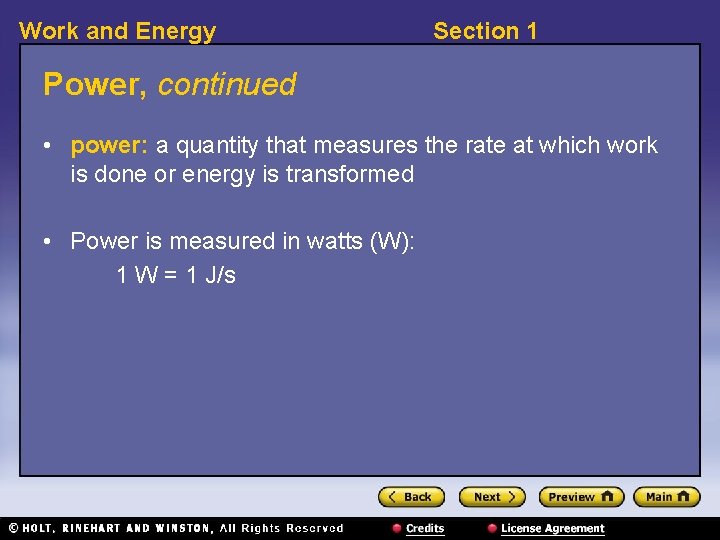
Work and Energy Section 1 Power, continued • power: a quantity that measures the rate at which work is done or energy is transformed • Power is measured in watts (W): 1 W = 1 J/s
Work and Energy Visual Concept: Power Section 1
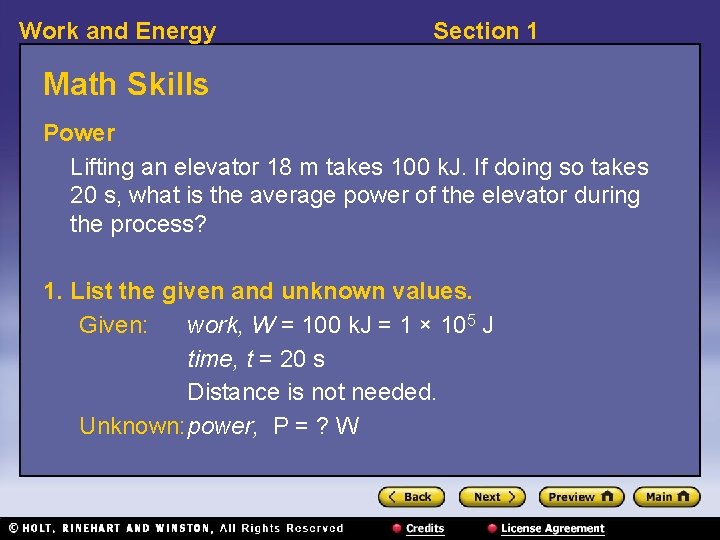
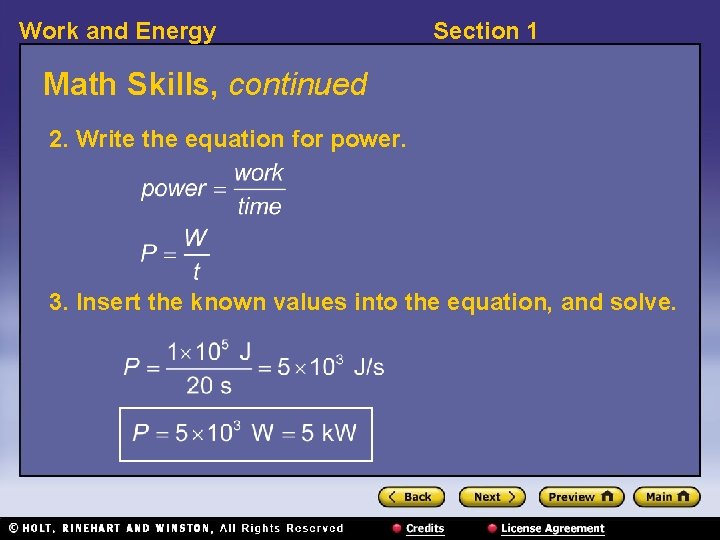
Work and Energy Section 1 Math Skills Power Lifting an elevator 18 m takes 100 k. J. If doing so takes 20 s, what is the average power of the elevator during the process? 1. List the given and unknown values. Given: work, W = 100 k. J = 1 × 10⁵ J time, t = 20 s Distance is not needed. Unknown: power, P = ? W
Work and Energy Section 1 Math Skills, continued 2. Write the equation for power. 3. Insert the known values into the equation, and solve.
Work and Energy Section 1 Machines and Mechanical Advantage 〉How do machines make work easier? 〉Machines help do work by changing the size of an input force, the direction of the force, or both.
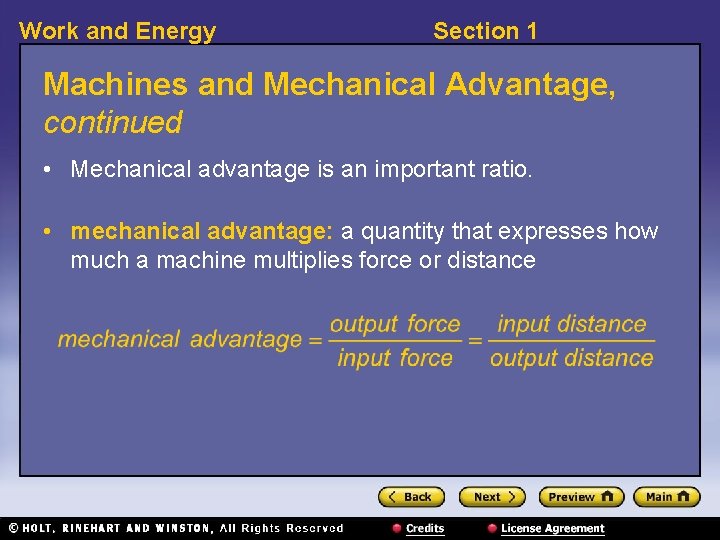
Work and Energy Section 1 Machines and Mechanical Advantage, continued • Mechanical advantage is an important ratio. • mechanical advantage: a quantity that expresses how much a machine multiplies force or distance
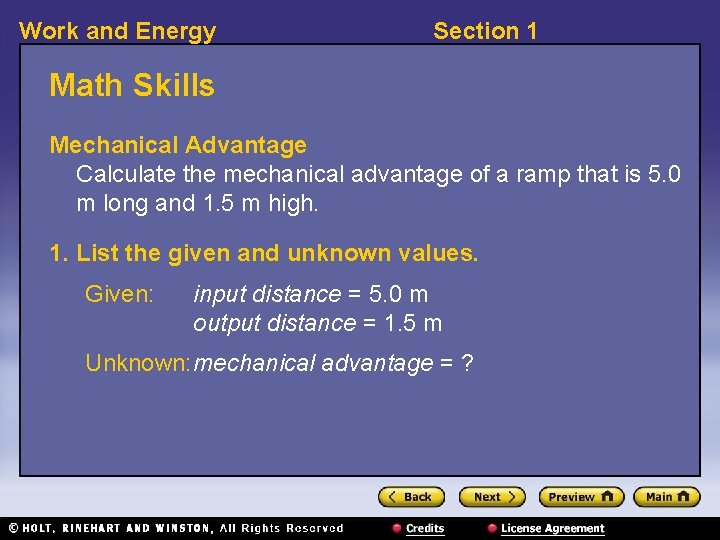
Work and Energy Section 1 Math Skills Mechanical Advantage Calculate the mechanical advantage of a ramp that is 5. 0 m long and 1. 5 m high. 1. List the given and unknown values. Given: input distance = 5. 0 m output distance = 1. 5 m Unknown: mechanical advantage = ?
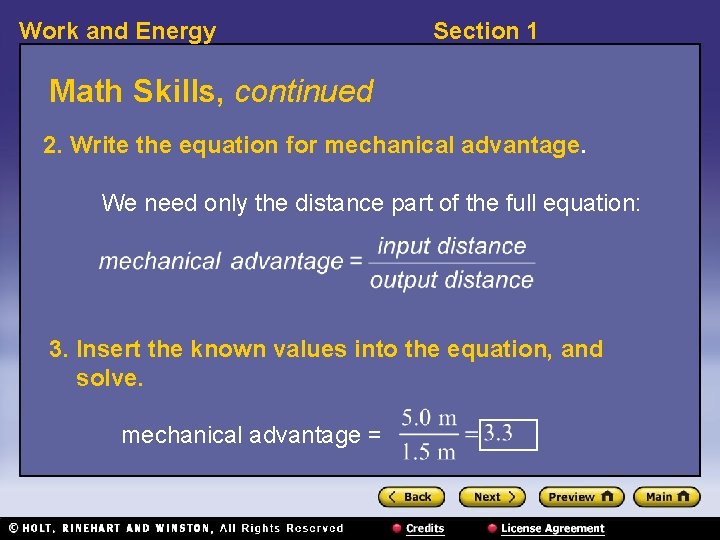
Work and Energy Section 1 Math Skills, continued 2. Write the equation for mechanical advantage. We need only the distance part of the full equation: 3. Insert the known values into the equation, and solve. mechanical advantage =