
Work and Energy Kinetic Energy Kinetic Energy The
- Slides: 18
Work and Energy
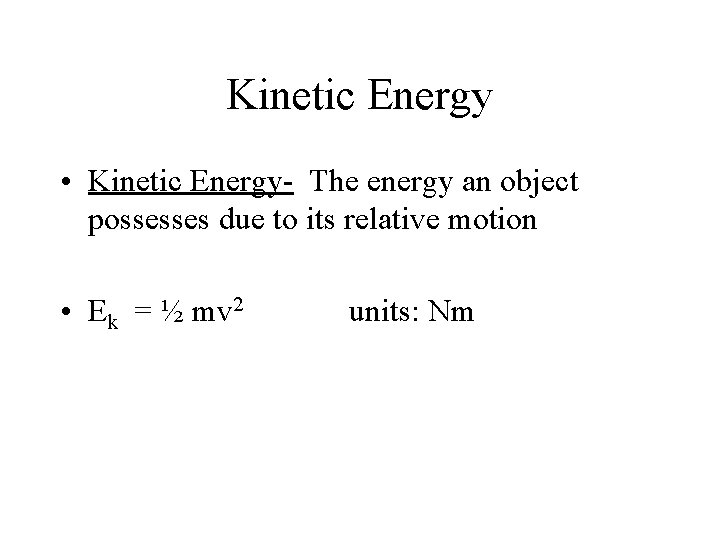
Kinetic Energy • Kinetic Energy- The energy an object possesses due to its relative motion • Ek = ½ mv 2 units: Nm
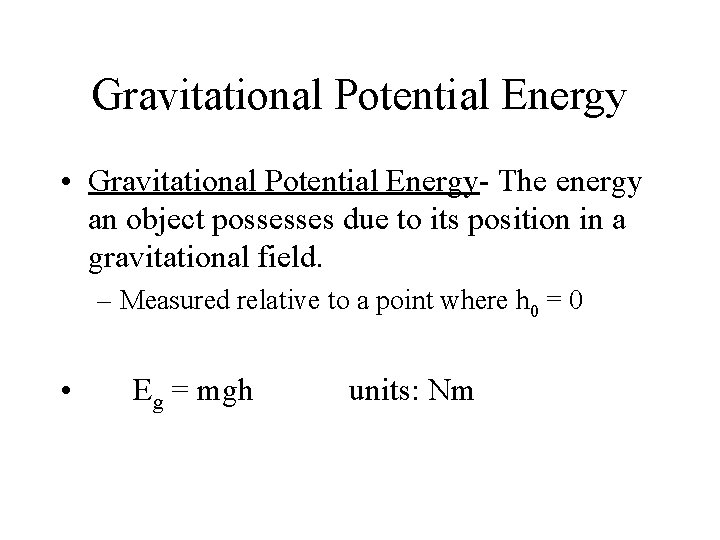
Gravitational Potential Energy • Gravitational Potential Energy- The energy an object possesses due to its position in a gravitational field. – Measured relative to a point where h 0 = 0 • Eg = mgh units: Nm
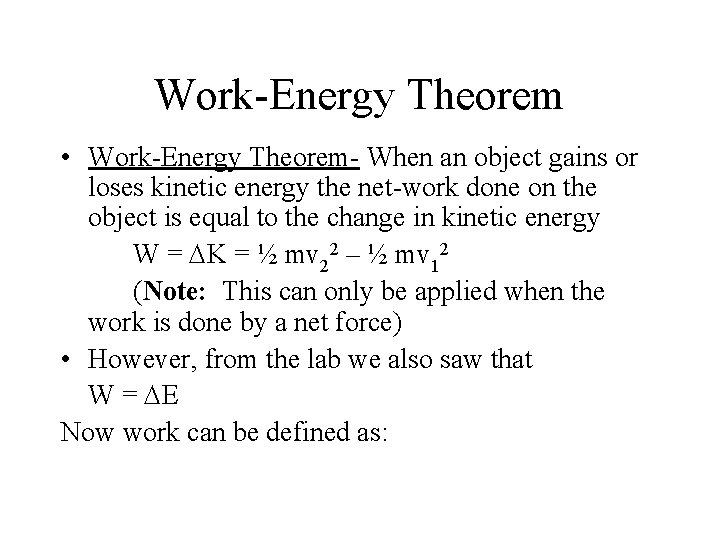
Work-Energy Theorem • Work-Energy Theorem- When an object gains or loses kinetic energy the net-work done on the object is equal to the change in kinetic energy W = K = ½ mv 22 – ½ mv 12 (Note: This can only be applied when the work is done by a net force) • However, from the lab we also saw that W = E Now work can be defined as:
Work (redefined) • Work- The process through which energy is transferred to or from an object. Energy transferred to an object is positive work, and energy transferred from the object is negative work.
Energy • Energy Defined: – Energy- the ability to do useful work
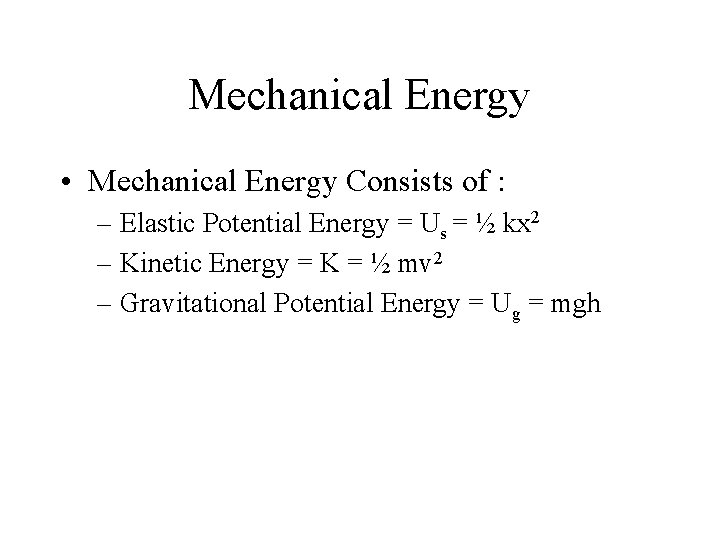
Mechanical Energy • Mechanical Energy Consists of : – Elastic Potential Energy = Us = ½ kx 2 – Kinetic Energy = K = ½ mv 2 – Gravitational Potential Energy = Ug = mgh
Vector or Scalar • Since Energy does not have a direction it is considered a scalar. • Since energy is a scalar quantity we can say that the magnitude of the work is independent of path. • However, there is such a designation as (+) and (-) work. (The (+) and (-) does not designate direction)
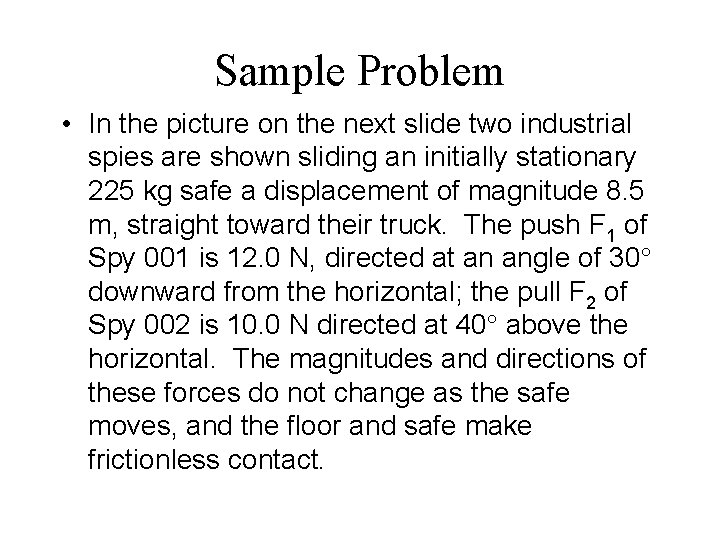
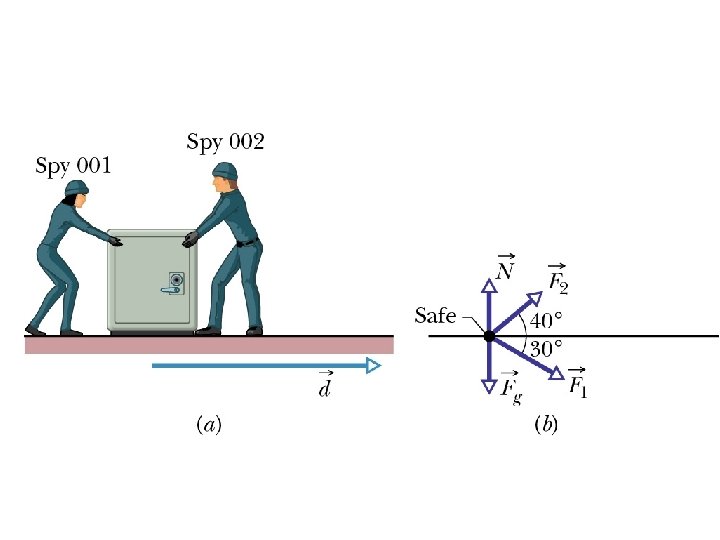
Sample Problem • In the picture on the next slide two industrial spies are shown sliding an initially stationary 225 kg safe a displacement of magnitude 8. 5 m, straight toward their truck. The push F 1 of Spy 001 is 12. 0 N, directed at an angle of 30 downward from the horizontal; the pull F 2 of Spy 002 is 10. 0 N directed at 40 above the horizontal. The magnitudes and directions of these forces do not change as the safe moves, and the floor and safe make frictionless contact.
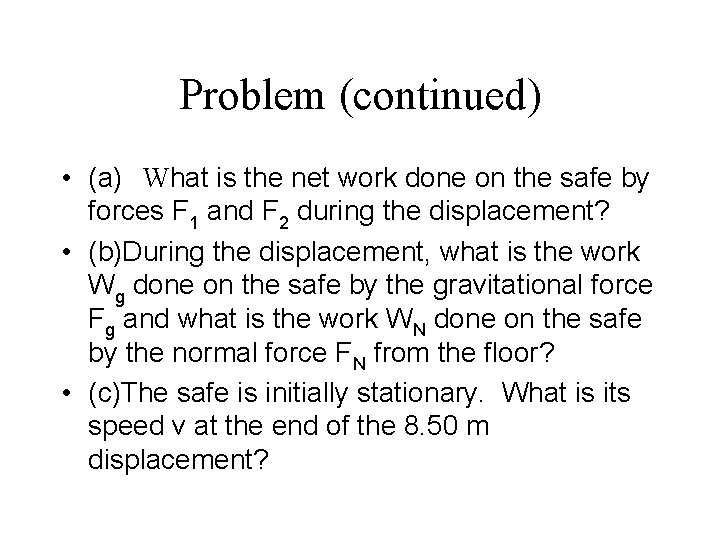
Problem (continued) • (a) What is the net work done on the safe by forces F 1 and F 2 during the displacement? • (b)During the displacement, what is the work Wg done on the safe by the gravitational force Fg and what is the work WN done on the safe by the normal force FN from the floor? • (c)The safe is initially stationary. What is its speed v at the end of the 8. 50 m displacement?
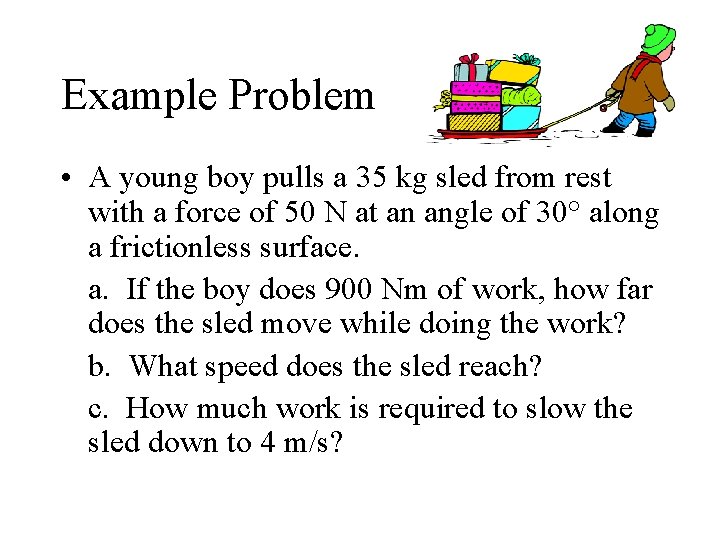
Example Problem • A young boy pulls a 35 kg sled from rest with a force of 50 N at an angle of 30° along a frictionless surface. a. If the boy does 900 Nm of work, how far does the sled move while doing the work? b. What speed does the sled reach? c. How much work is required to slow the sled down to 4 m/s?
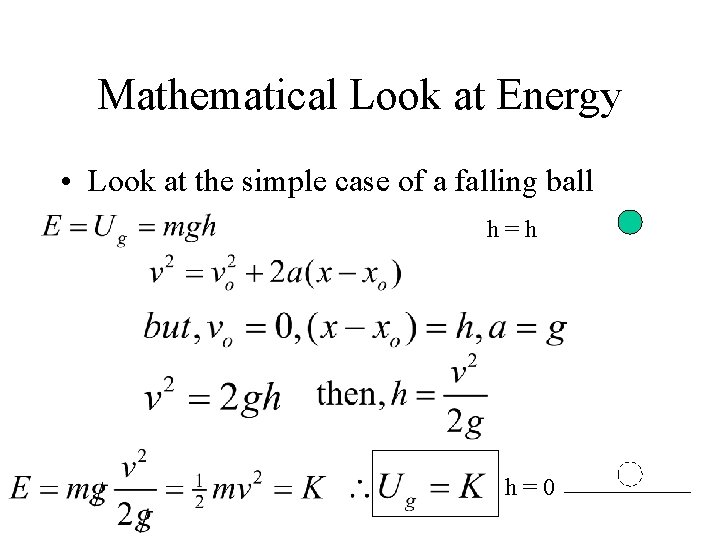
Mathematical Look at Energy • Look at the simple case of a falling ball h=h h=0
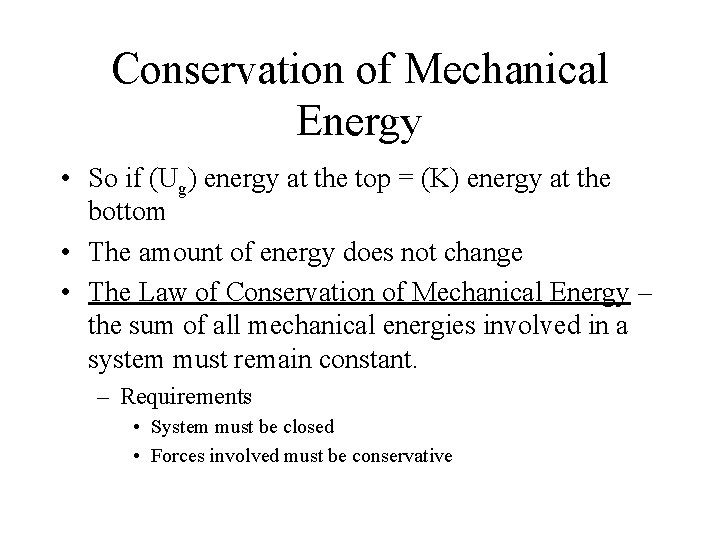
Conservation of Mechanical Energy • So if (Ug) energy at the top = (K) energy at the bottom • The amount of energy does not change • The Law of Conservation of Mechanical Energy – the sum of all mechanical energies involved in a system must remain constant. – Requirements • System must be closed • Forces involved must be conservative
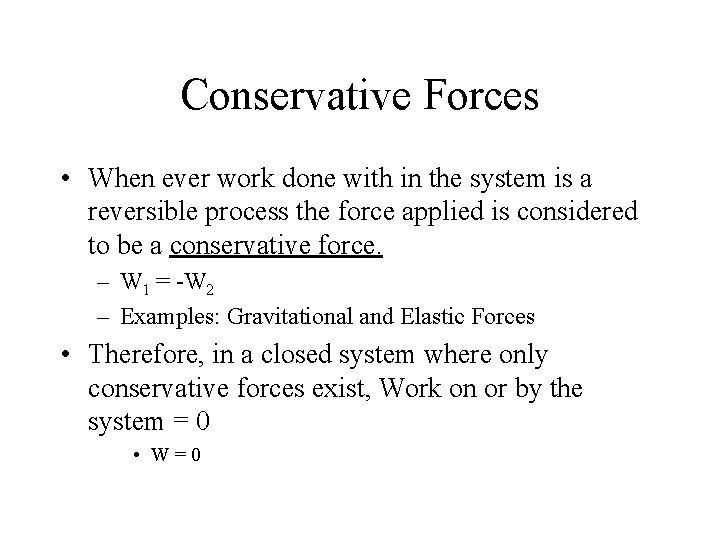
Conservative Forces • When ever work done with in the system is a reversible process the force applied is considered to be a conservative force. – W 1 = -W 2 – Examples: Gravitational and Elastic Forces • Therefore, in a closed system where only conservative forces exist, Work on or by the system = 0 • W=0
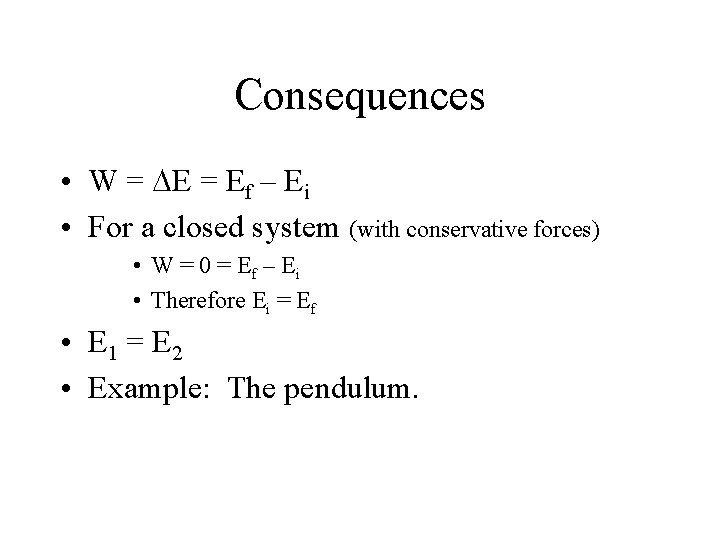
Consequences • W = Ef – Ei • For a closed system (with conservative forces) • W = 0 = E f – Ei • Therefore Ei = Ef • E 1 = E 2 • Example: The pendulum.
Conservation of Energy 1 st Law of Thermodynamics • Law of Conservation of Energy- The total energy in the universe must remain constant. Energy can not be created or destroyed it can only be transformed into another form. • Therefore, all energy must be accounted for.
Where does the energy go? • If mechanical energy is not conserved in a system, there are two possibilities. – Work has been done on the system(+W) – Work has been done by the system(-W) • The work can take many forms, but usually it is work done by the system(-W) in the form of friction. – Energy is transformed into Thermal Energy – First discovered by James Prescott Joule – Unit for Energy = N • m = J= Joule