
WORDS AND PARTS OF SPEECH Morphology The study
- Slides: 40
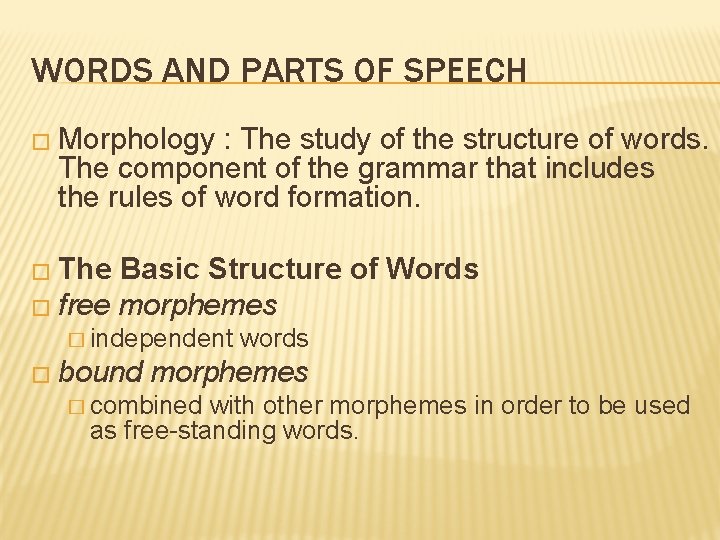
WORDS AND PARTS OF SPEECH � Morphology : The study of the structure of words. The component of the grammar that includes the rules of word formation. � The Basic Structure of Words � free morphemes � independent � bound words morphemes � combined with other morphemes in order to be used as free-standing words.
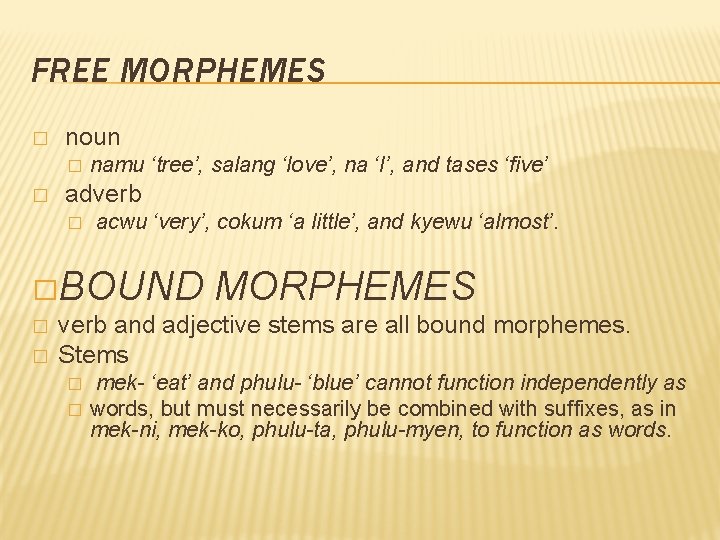
FREE MORPHEMES � noun � � namu ‘tree’, salang ‘love’, na ‘I’, and tases ‘five’ adverb � acwu ‘very’, cokum ‘a little’, and kyewu ‘almost’. �BOUND � � MORPHEMES verb and adjective stems are all bound morphemes. Stems � � mek- ‘eat’ and phulu- ‘blue’ cannot function independently as words, but must necessarily be combined with suffixes, as in mek-ni, mek-ko, phulu-ta, phulu-myen, to function as words.
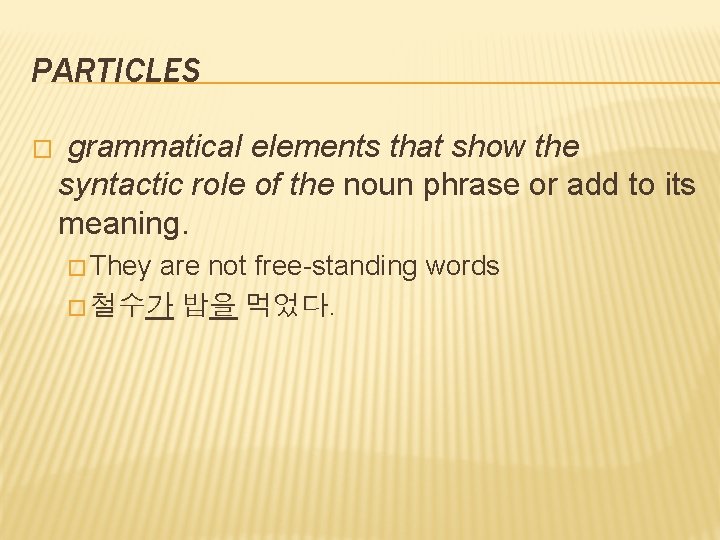
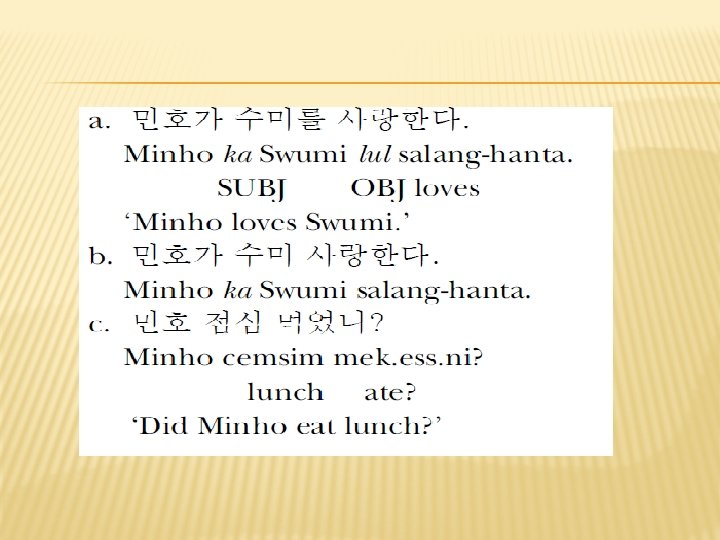
PARTICLES � grammatical elements that show the syntactic role of the noun phrase or add to its meaning. � They are not free-standing words � 철수가 밥을 먹었다.
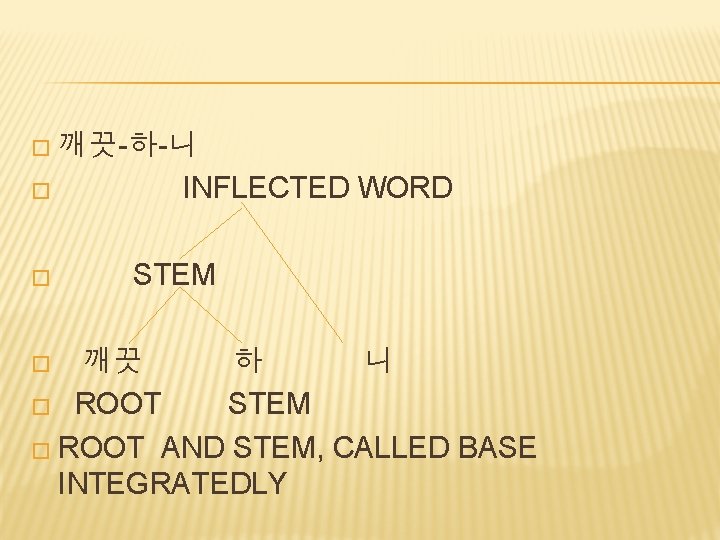
� 깨끗-하-니 � � INFLECTED WORD STEM 깨끗 하 니 � ROOT STEM � ROOT AND STEM, CALLED BASE INTEGRATEDLY �
AFFIX � derivational � used to generate words � inflectional � the affixes inflectional endings attached to verbs, adjectives, and the copula
� Affix ----- prefix and sufix � Prefix � They never change the part of speech of the word, but function only to limit its meaning. � suffix �Not only are they greater in number and type, but they also function far beyond simply limiting the meaning.
PARTS OF SPEECH � nouns, pronouns, numbers, verbs, adjectives, prenouns, adverbs, interjections, particles. � NOUNS � Nouns are generally marked by case particles. These postposed case particles express the grammatical functions of the nouns.
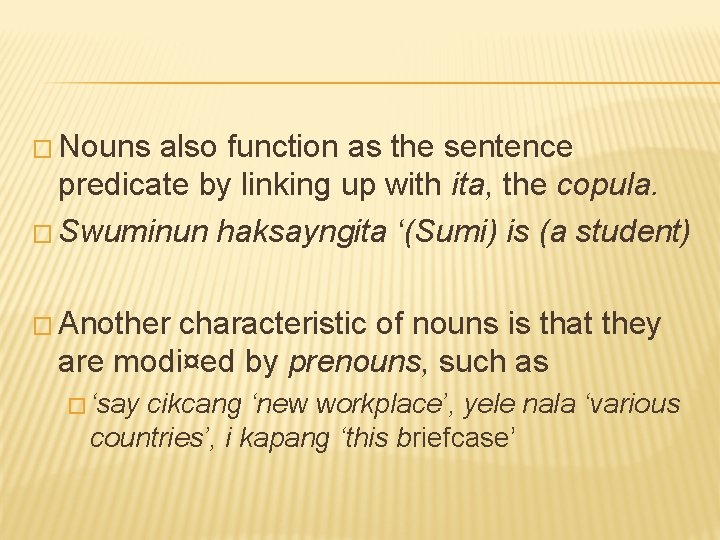
� Nouns also function as the sentence predicate by linking up with ita, the copula. � Swuminun haksayngita ‘(Sumi) is (a student) � Another characteristic of nouns is that they are modi¤ed by prenouns, such as � ‘say cikcang ‘new workplace’, yele nala ‘various countries’, i kapang ‘this briefcase’
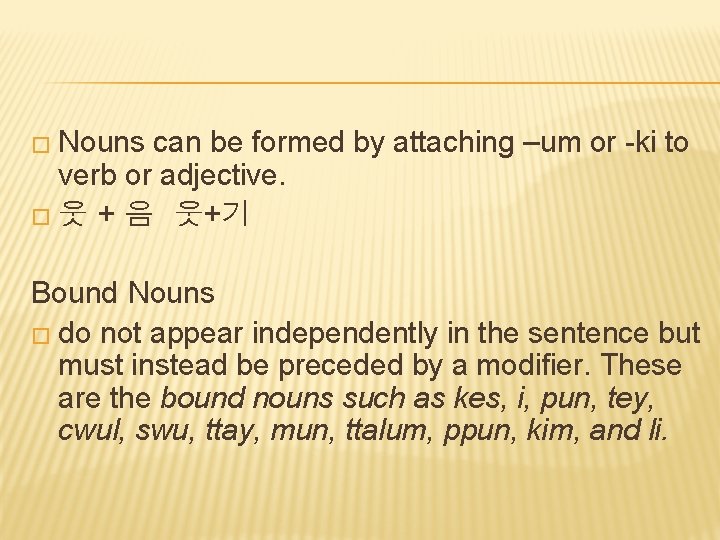
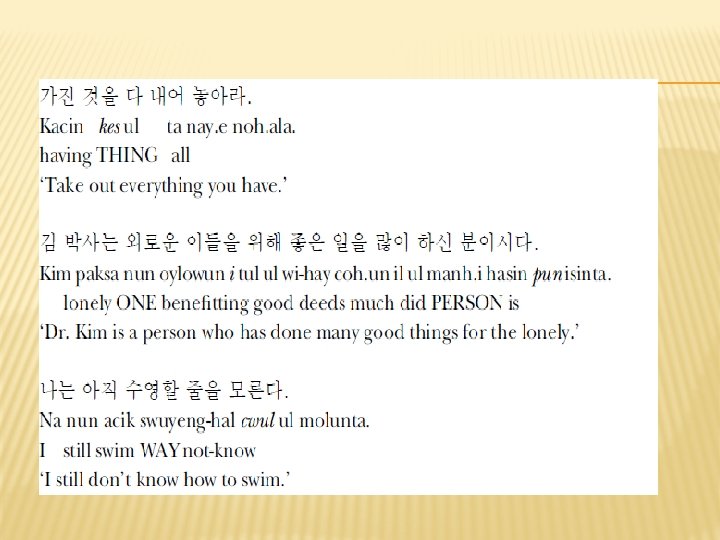
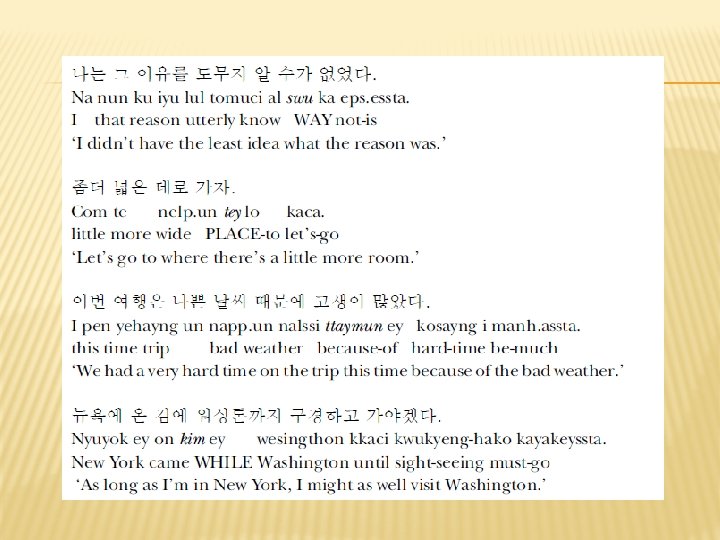
� Nouns can be formed by attaching –um or -ki to verb or adjective. � 웃 + 음 웃+기 Bound Nouns � do not appear independently in the sentence but must instead be preceded by a modifier. These are the bound nouns such as kes, i, pun, tey, cwul, swu, ttay, mun, ttalum, ppun, kim, and li.
� On the basis of form and function, it is clear that these words are nouns because they are modified by prenouns and followed by postposed particles. � what they refer to is abstract, generalized, and unspecified.
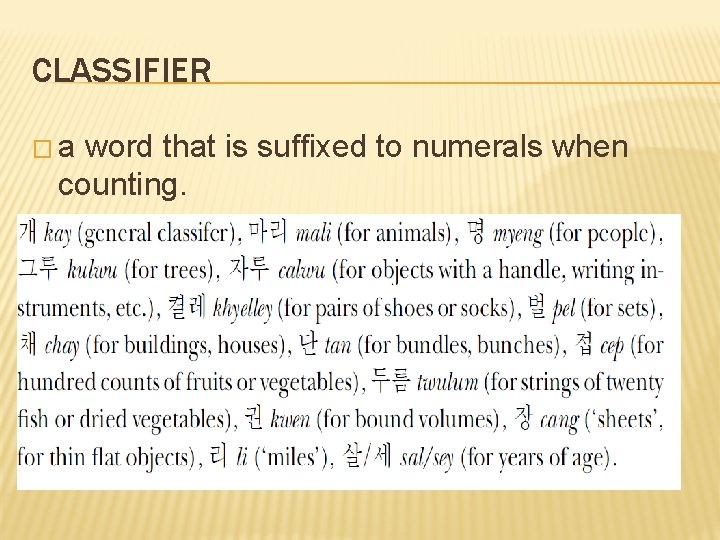
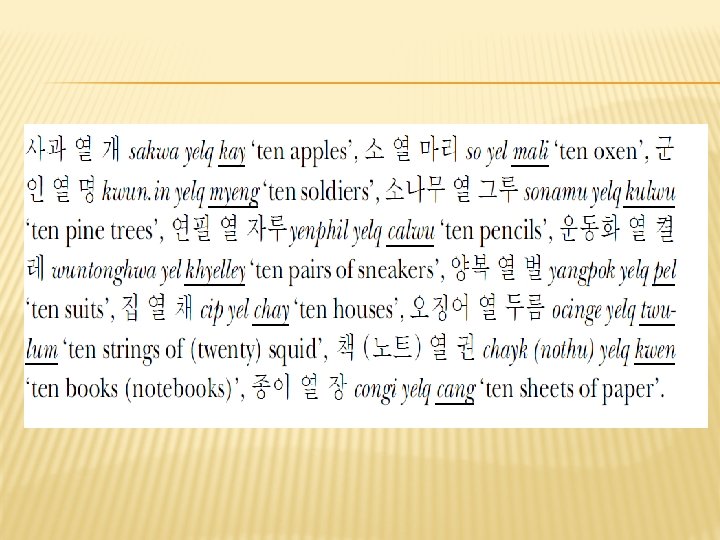
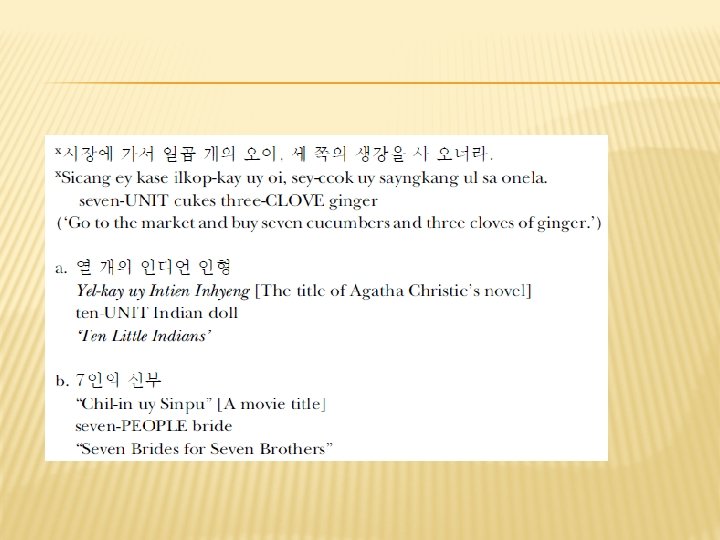
CLASSIFIER �a word that is suffixed to numerals when counting.
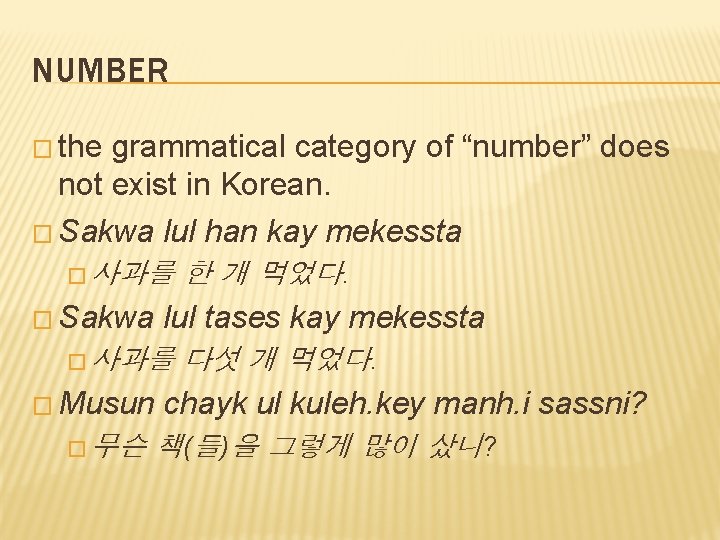
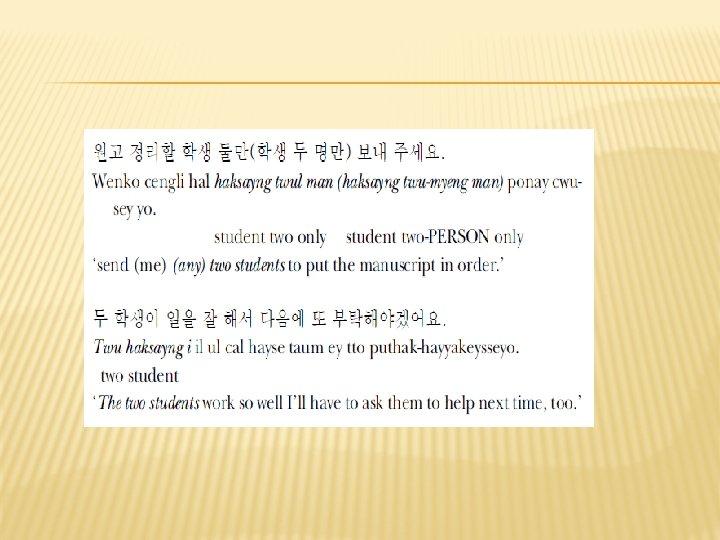
NUMBER � the grammatical category of “number” does not exist in Korean. � Sakwa lul han kay mekessta � 사과를 � Sakwa lul tases kay mekessta � 사과를 � Musun � 무슨 한 개 먹었다. 다섯 개 먹었다. chayk ul kuleh. key manh. i sassni? 책(들)을 그렇게 많이 샀니?
GENDER � There is also no grammatical category of “gender” in Korean � sakwa ‘apple’ or chayk ‘book’ or Han kang ‘the Han River’ � not masculine, feminine or neuter.
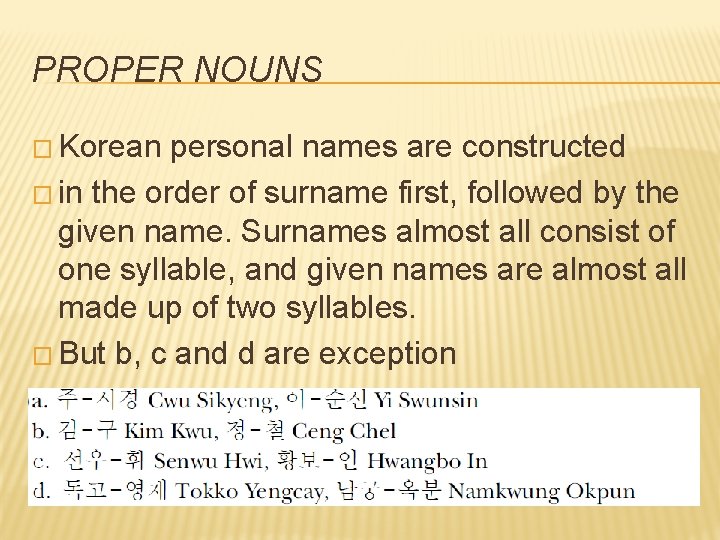
PROPER NOUNS � Korean personal names are constructed � in the order of surname first, followed by the given name. Surnames almost all consist of one syllable, and given names are almost all made up of two syllables. � But b, c and d are exception
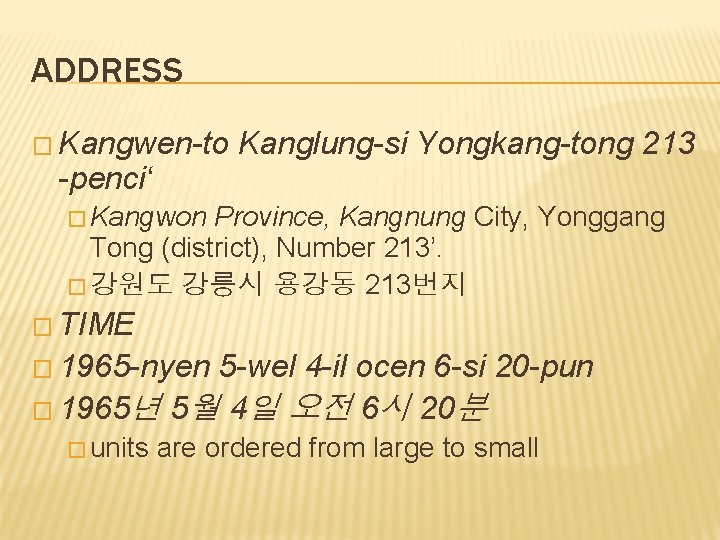
ADDRESS � Kangwen-to -penci‘ Kanglung-si Yongkang-tong 213 � Kangwon Province, Kangnung City, Yonggang Tong (district), Number 213’. � 강원도 강릉시 용강동 213번지 � TIME � 1965 -nyen 5 -wel 4 -il ocen 6 -si 20 -pun � 1965년 5월 4일 오전 6시 20분 � units are ordered from large to small
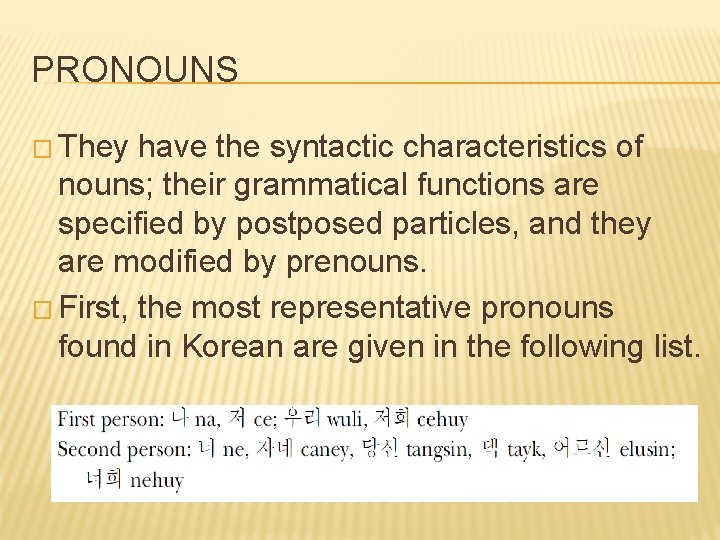
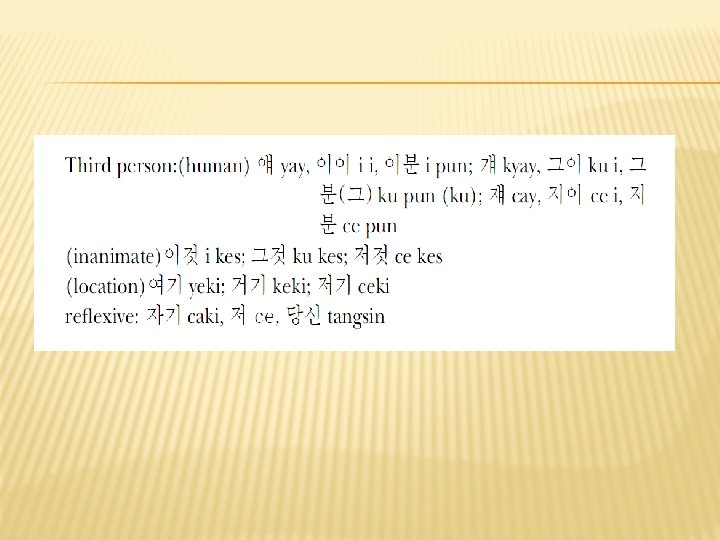
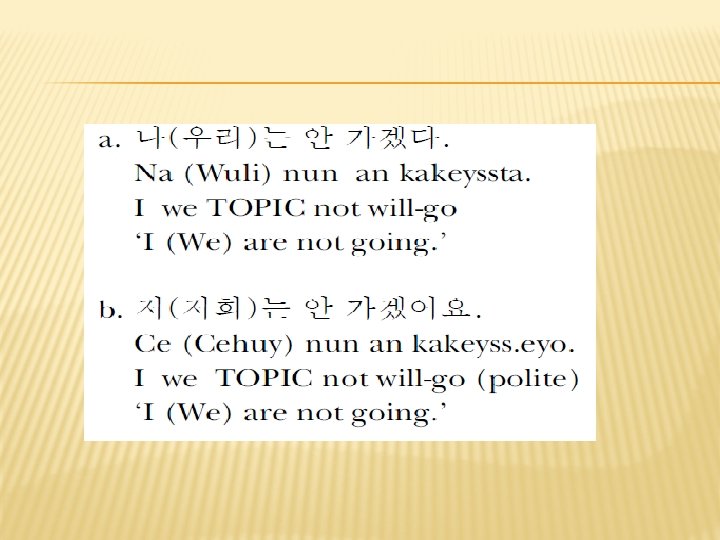
PRONOUNS � They have the syntactic characteristics of nouns; their grammatical functions are specified by postposed particles, and they are modified by prenouns. � First, the most representative pronouns found in Korean are given in the following list.
� When referring to family or household, the plural form wuli ‘our’ is used instead of the singular form na uy/nay ‘my’: wuli apeci ‘our (=my) father’, wuli enni ‘our (=my) older sister’, wuli cip ‘our (my) � home’, or even wuli manwula ‘our (=my) wife’.
� The forms used to denote third-person are not separate lexical items, � but rather are formed by combining the demonstrative prenouns i ‘this’, ku ‘that’ and ce ‘that (over there)’ with bound nouns. � The deictic use of (1) i, (2) ku, and (3) ce depends on the distance between the referent and the speaker; they indicate, respectively, (1) close proximity, (2) middle proximity, and (3) distant proximity
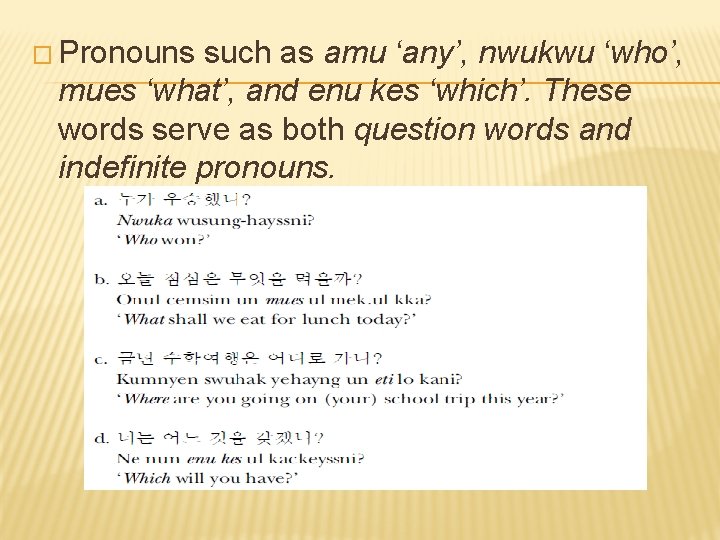
� Pronouns such as amu ‘any’, nwukwu ‘who’, mues ‘what’, and enu kes ‘which’. These words serve as both question words and indefinite pronouns.
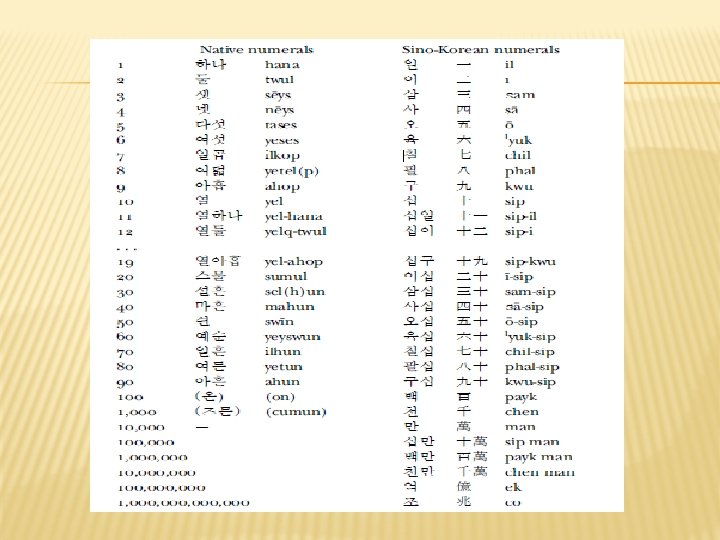
NUMERALS � There are two parallel sets of Korean numerals: one of native origin, and one of Chinese origin.
THE TWO KOREAN NUMERAL SYSTEMS DIFFER IN A NUMBER OF WAYS � First, there is a difference in the way ordinals are formed. � The native ordinals are formed with the suffix -ccay, as in twul-ccay ‘second’ and seys-ccay ‘third’. � The exception is hana ‘one’ because the ordinal ‘first’ is not hana-ccay (or hanccay), but rather the special form ches-ccay.
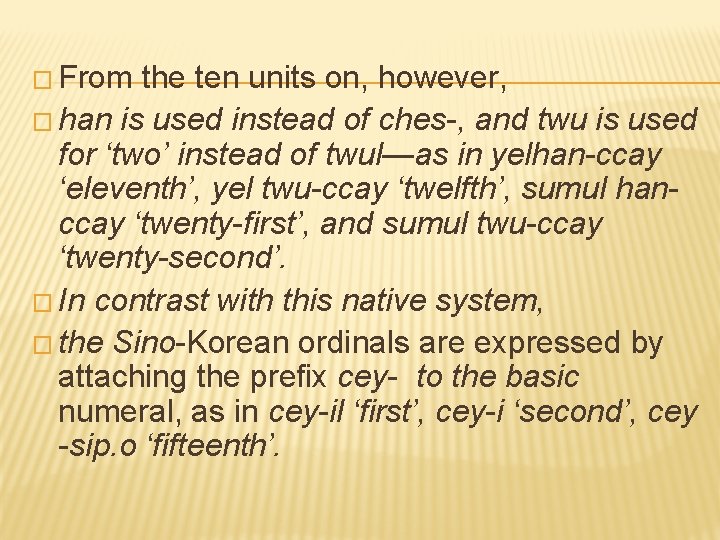
� From the ten units on, however, � han is used instead of ches-, and twu is used for ‘two’ instead of twul—as in yelhan-ccay ‘eleventh’, yel twu-ccay ‘twelfth’, sumul hanccay ‘twenty-first’, and sumul twu-ccay ‘twenty-second’. � In contrast with this native system, � the Sino-Korean ordinals are expressed by attaching the prefix cey- to the basic numeral, as in cey-il ‘first’, cey-i ‘second’, cey -sip. o ‘fifteenth’.
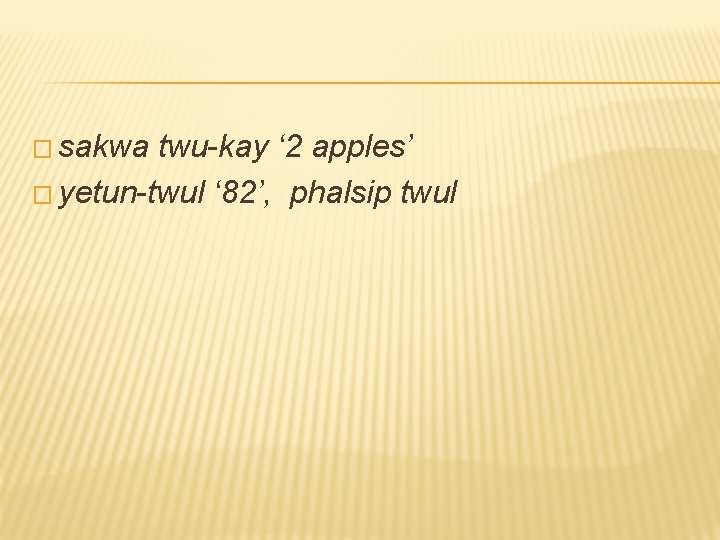
� sakwa twu-kay ‘ 2 apples’ � yetun-twul ‘ 82’, phalsip twul
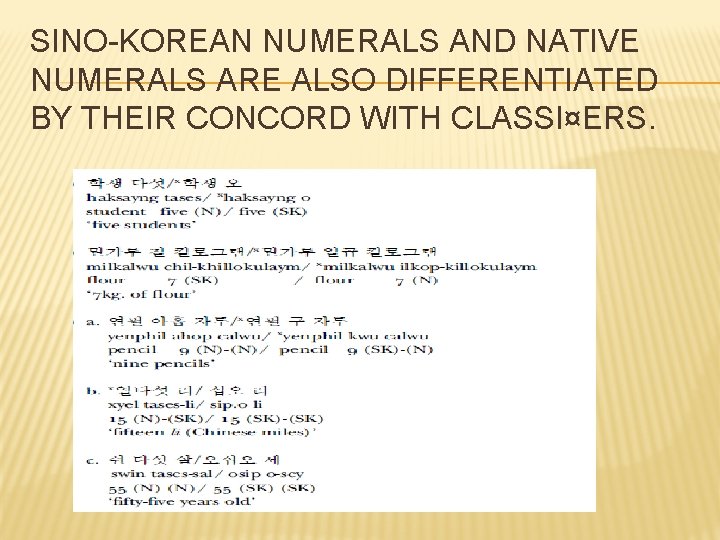
SINO-KOREAN NUMERALS AND NATIVE NUMERALS ARE ALSO DIFFERENTIATED BY THEIR CONCORD WITH CLASSI¤ERS.
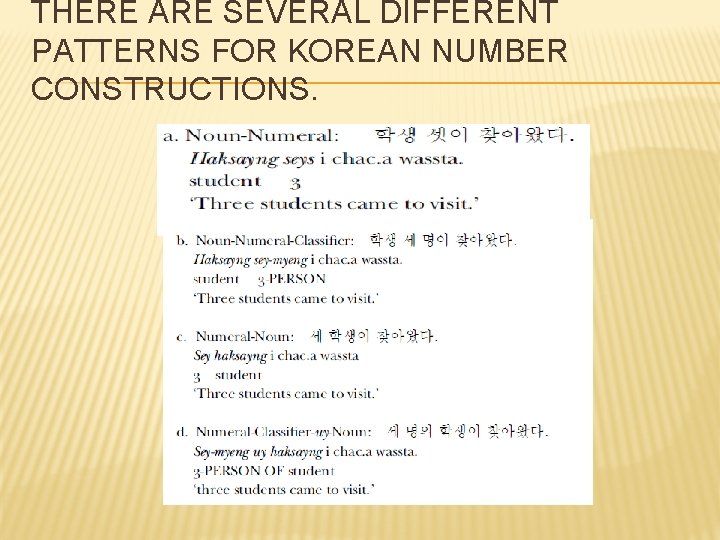
THERE ARE SEVERAL DIFFERENT PATTERNS FOR KOREAN NUMBER CONSTRUCTIONS.
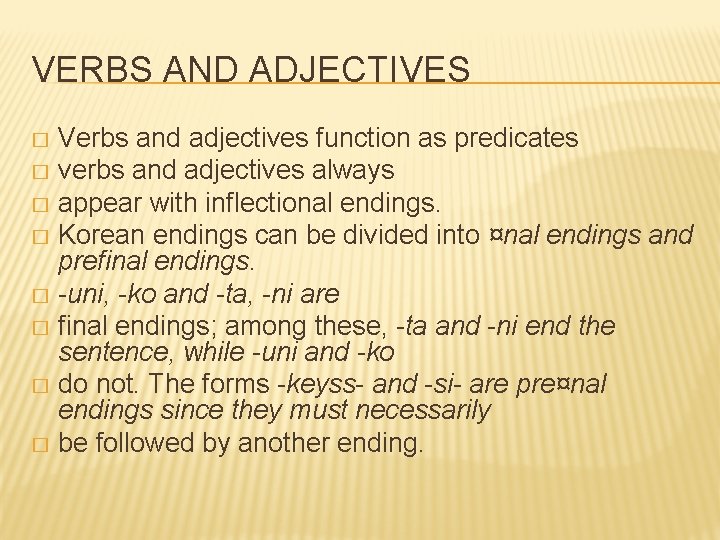
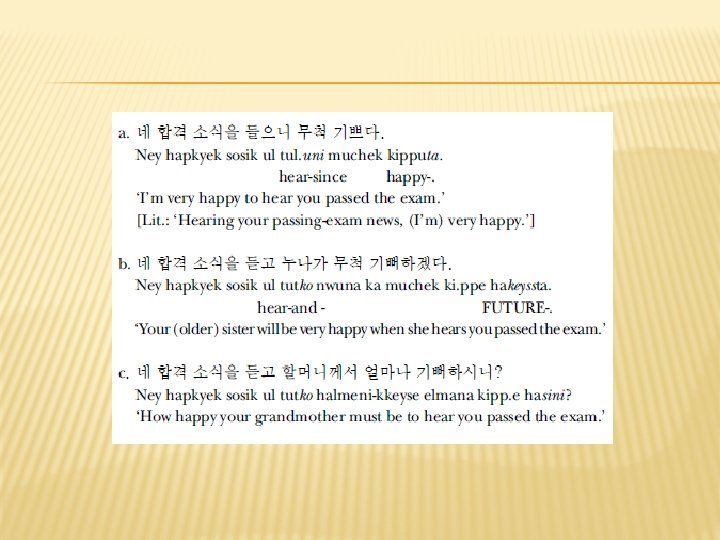
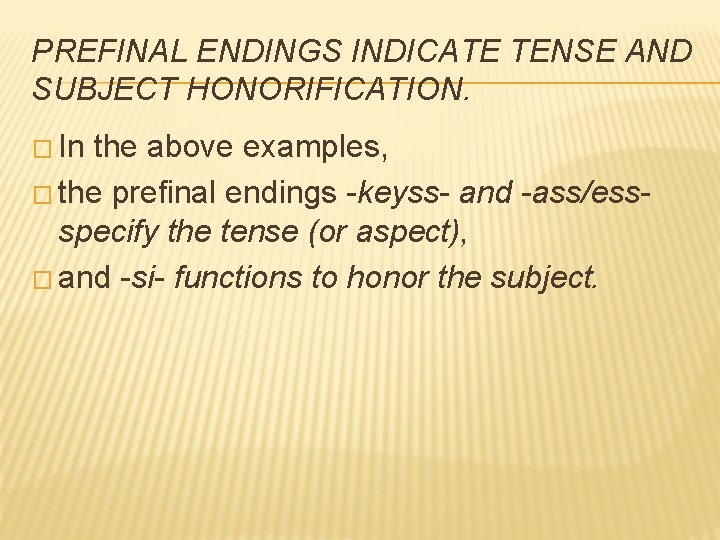
VERBS AND ADJECTIVES Verbs and adjectives function as predicates � verbs and adjectives always � appear with inflectional endings. � Korean endings can be divided into ¤nal endings and prefinal endings. � -uni, -ko and -ta, -ni are � final endings; among these, -ta and -ni end the sentence, while -uni and -ko � do not. The forms -keyss- and -si- are pre¤nal endings since they must necessarily � be followed by another ending. �
PREFINAL ENDINGS INDICATE TENSE AND SUBJECT HONORIFICATION. � In the above examples, � the prefinal endings -keyss- and -ass/essspecify the tense (or aspect), � and -si- functions to honor the subject.
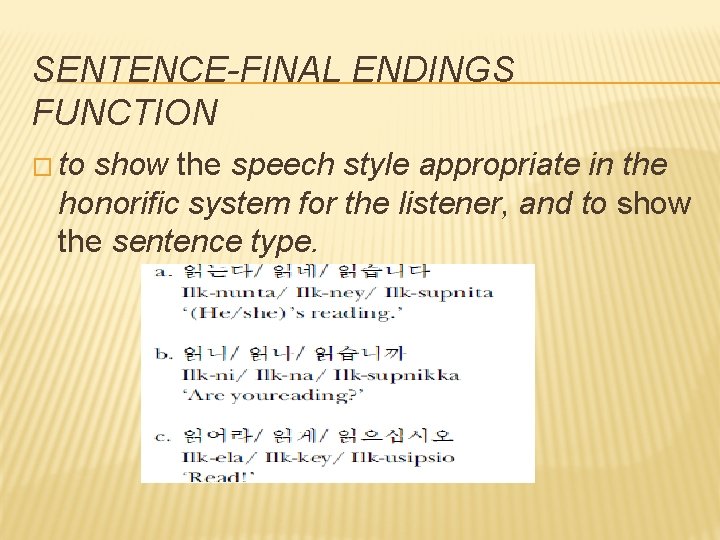
SENTENCE-FINAL ENDINGS FUNCTION � to show the speech style appropriate in the honorific system for the listener, and to show the sentence type.