
Word Wall experiment inference sample observation predic data

Word Wall experiment inference sample observation predic data control t investigation group survey testable dependent. Independent variable model
What do scientists do? § Nature is full of questions and mysteries. § Scientists look for answers to questions about the natural world. § Scientists collect clues to nature’s mysteries. § Scientists try to figure out what the clues mean.
What is a scientific question? (Testable Question) Many questions that scientists ask begin with What, How, When, Where. Scientific questions can be answered by gathering observations or measurements, called data Good questions for investigation are testable
How Can We Recognize a Testable Question? 1. Can be answered by an investigation. 2. Allows for collection and analysis of quantitative and/or qualitative data. 3. Can be tested with age appropriate supplies and equipment. 4. Is not answered with “yes” or “no” or by explanations in books. 5. Does not ask how to perform a skill.
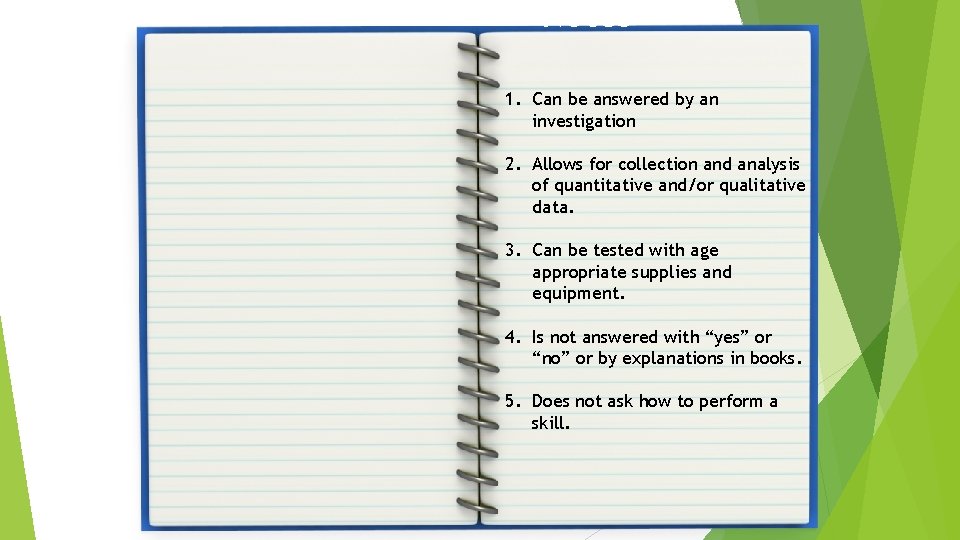
Notes 1. Can be answered by an investigation 2. Allows for collection and analysis of quantitative and/or qualitative data. 3. Can be tested with age appropriate supplies and equipment. 4. Is not answered with “yes” or “no” or by explanations in books. 5. Does not ask how to perform a skill.
Model Is this a testable question? Cite evidence How will a large force and a small force affect the movement of an object?
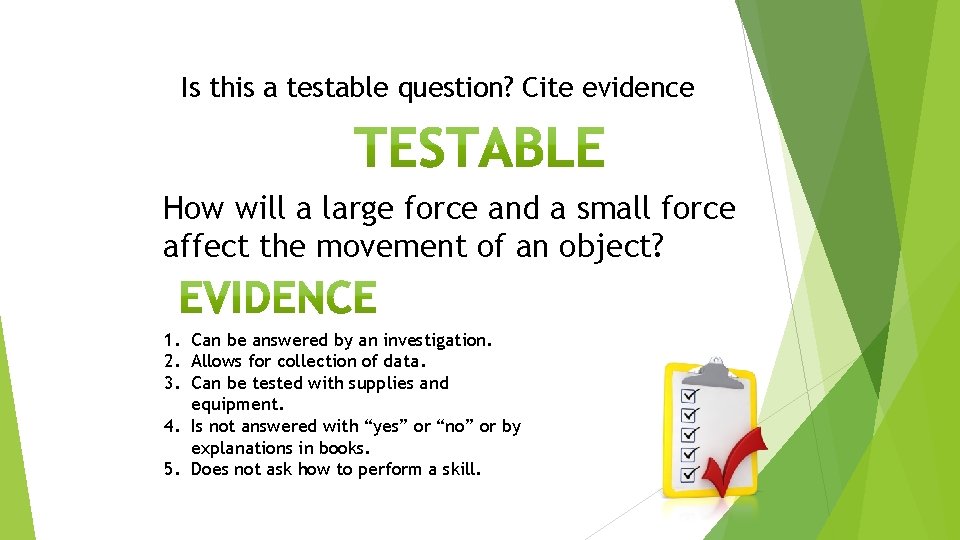
Model Is this a testable question? Cite evidence How will a large force and a small force affect the movement of an object? 1. Can be answered by an investigation. 2. Allows for collection of data. 3. Can be tested with supplies and equipment. 4. Is not answered with “yes” or “no” or by explanations in books. 5. Does not ask how to perform a skill.
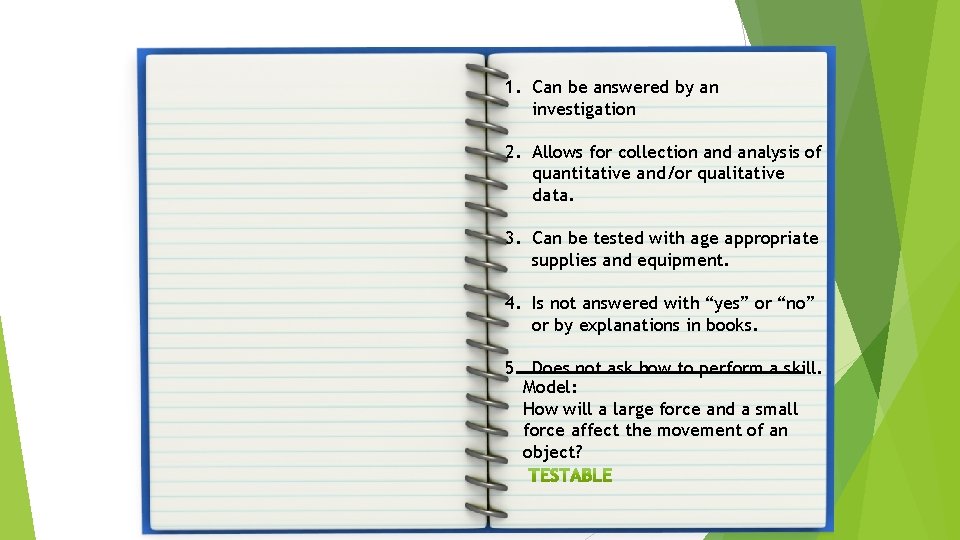
Notes 1. Can be answered by an investigation 2. Allows for collection and analysis of quantitative and/or qualitative data. 3. Can be tested with age appropriate supplies and equipment. 4. Is not answered with “yes” or “no” or by explanations in books. 5. Does not ask how to perform a skill. Model: How will a large force and a small force affect the movement of an object?
Model Is this a testable question? Cite evidence What is motion?
Model Is this a testable question? Cite evidence What is motion? 1. Is not answered with “yes” or “no” or by explanations in books. Can be answered by using a book. .
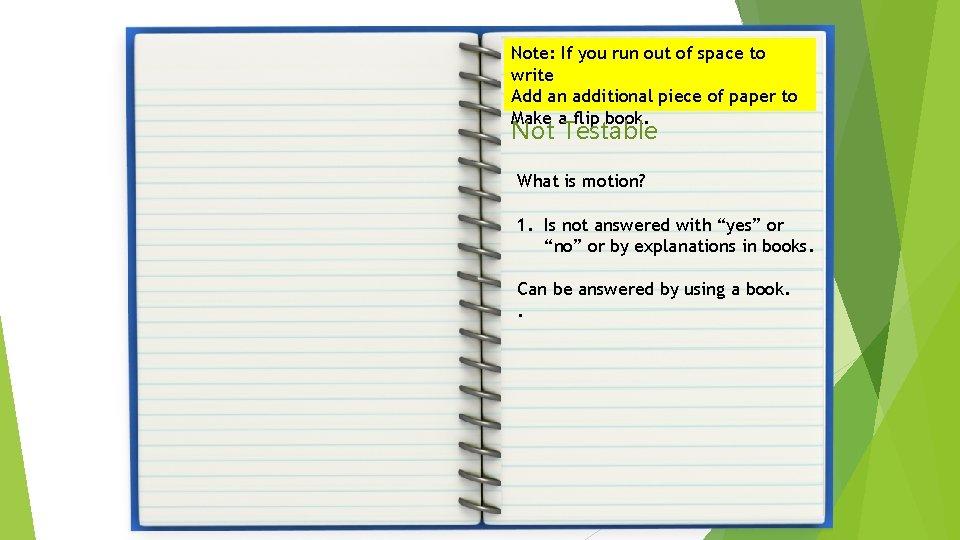
Model Note: If you run out of space to write 1. Can be answered by an Add an additional piece of paper to investigation Make a flip book. Not Testable 2. Allows for collection and analysis of quantitative What is motion? and/or qualitative data. 1. Is not answered with “yes” or 3. Can beor tested with age appropriate “no” by explanations in books. supplies and equipment. Can be answered by using a book. 4. . Is not answered with “yes” or “no” or by explanations in books. 5. Does not ask how to perform a skill. Model: How will a large force and a small force affect the movement of an object? Testable
Model How can we make this a testable question? What is motion? Using criteria for testable question. Make this a testable question.
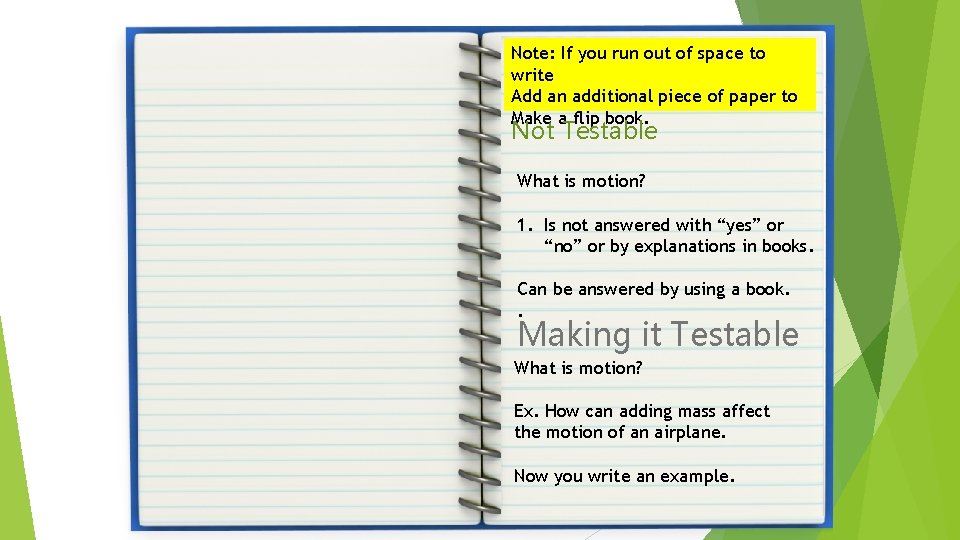
Model Note: If you run out of space to write 1. Can be answered by an Add an additional piece of paper to investigation Make a flip book. Not Testable 2. Allows for collection and analysis of quantitative What is motion? and/or qualitative data. 1. Is not answered with “yes” or 3. Can beor tested with age appropriate “no” by explanations in books. supplies and equipment. Can be answered by using a book. 4. . Is not answered with “yes” or “no” or by explanations in books. Making it Testable motion? 5. What Doesis not ask how to perform a skill. Model: How willcan a large force and a small Ex. How adding mass affect force affect movement of an the motion ofthe an airplane. object? Now you write an example. Testable
Guided Practice Is this a testable question? Cite evidence How do certain surfaces affect how far a ball will roll?
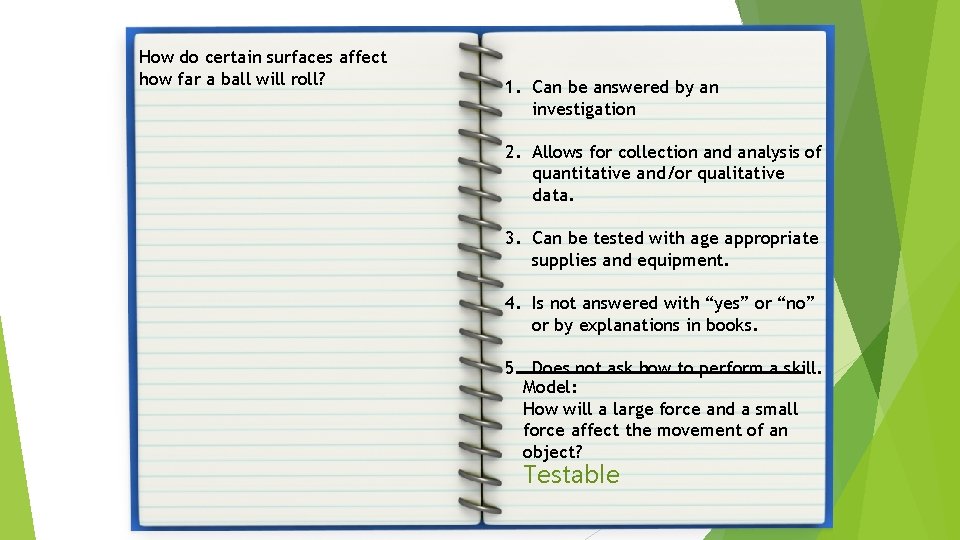
Guided Practice How do certain surfaces affect how far a ball will roll? 1. Can be answered by an investigation 2. Allows for collection and analysis of quantitative and/or qualitative data. 3. Can be tested with age appropriate supplies and equipment. 4. Is not answered with “yes” or “no” or by explanations in books. 5. Does not ask how to perform a skill. Model: How will a large force and a small force affect the movement of an object? Testable
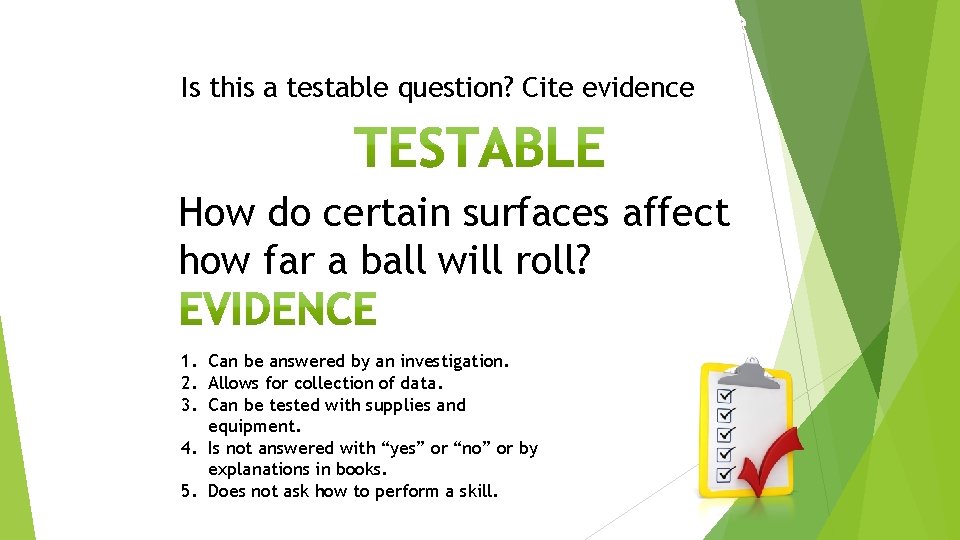
Guided Practice Is this a testable question? Cite evidence How do certain surfaces affect how far a ball will roll? 1. Can be answered by an investigation. 2. Allows for collection of data. 3. Can be tested with supplies and equipment. 4. Is not answered with “yes” or “no” or by explanations in books. 5. Does not ask how to perform a skill.
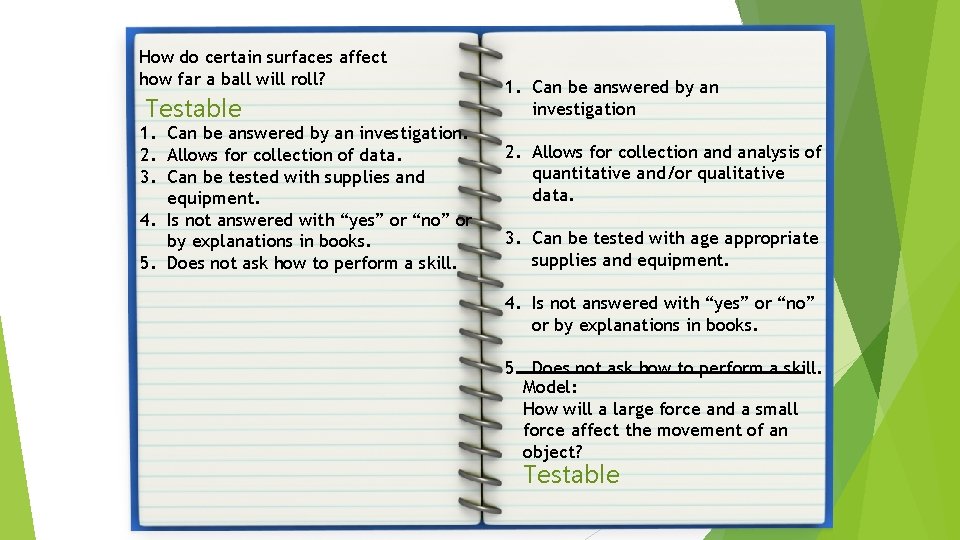
Guided Practice How do certain surfaces affect how far a ball will roll? Testable 1. Can be answered by an investigation. 2. Allows for collection of data. 3. Can be tested with supplies and equipment. 4. Is not answered with “yes” or “no” or by explanations in books. 5. Does not ask how to perform a skill. 1. Can be answered by an investigation 2. Allows for collection and analysis of quantitative and/or qualitative data. 3. Can be tested with age appropriate supplies and equipment. 4. Is not answered with “yes” or “no” or by explanations in books. 5. Does not ask how to perform a skill. Model: How will a large force and a small force affect the movement of an object? Testable
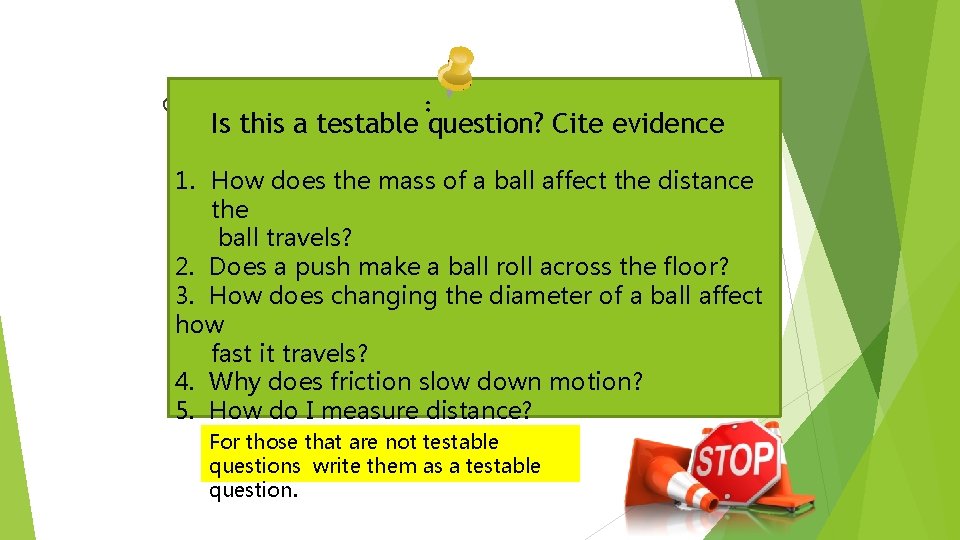
Exit Slip Question: Which questions are testable? Is this a testable question? Cite evidence 1. How does the mass of a ball affect the distance the ball travels? 2. Does a push make a ball roll across the floor? 3. How does changing the diameter of a ball affect how fast it travels? 4. Why does friction slow down motion? 5. How do I measure distance? For those that are not testable questions write them as a testable question.
How do scientist answer questions? Different kinds of scientific questions require different kinds of investigations Model Survey Sampling Experiment
How do scientist answer questions? Sometimes gives a proposed explanation made on the basis of limited evidence as a starting point for further investigation. A scientist must design an controlled experiment to test the hypothesis. Scientists must change one variable to see if it affects the experiment the way that was predicted They must compare the results to a control group, a group that did not have the variable changed The scientist gets clues to the answer by comparing the two groups. Then scientist must repeat the investigation at least three times to insure their data is valid
Variables The independent variable is the one that is changed by the scientist. To insure a fair test, a good experiment has only one independent variable. As the scientist changes the independent variable, he or she observes what happens. The scientist focuses his or her observations on the dependent variable to see how it responds to the change made to the independent variable. For example, if you open a faucet (the independent variable), the quantity of water flowing (dependent variable)
Variables Experiments also have controlled variables. Controlled variables are quantities that a scientist wants to remain constant or the same to insure the experiment is fair and valid. For example, if we want to measure how much water flow increases when we open a faucet, it is important to make sure that the water pressure (the controlled variable) is held constant. That's because both the water pressure and the opening of a faucet have an impact on how much water flows. If we change both of them at the same time, we can't be sure how much of the change in water flow is because of the faucet opening and how much because of the water pressure. In other words, it would not be a fair test. Most experiments have more than one controlled variable. Some people refer to controlled variables as "constant variables. " In a good experiment, the scientist must be able to measure the values for each variable.
Model What is the IV, DV and CV? A study was done to find if different tire treads affect the braking distance of a car. IV – What are we testing? Tire treads DV – What will respond to the IV ? What is the data you write down? Braking distance of car. CV – What will you keep the same to insure it is a fair test? the type of tire.
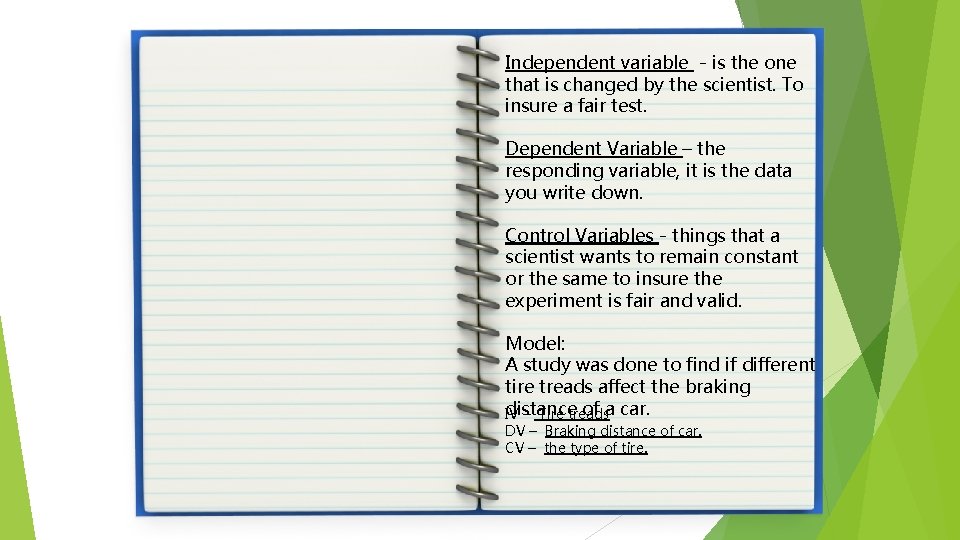
Guided Practice Independent variable - is the one that is changed by the scientist. To insure a fair test. Dependent Variable – the responding variable, it is the data you write down. Control Variables - things that a scientist wants to remain constant or the same to insure the experiment is fair and valid. Model: A study was done to find if different tire treads affect the braking distance of a car. IV – Tire treads DV – Braking distance of car. CV – the type of tire.
Guided Practice The time it takes to run a mile depends on the person’s running speed.
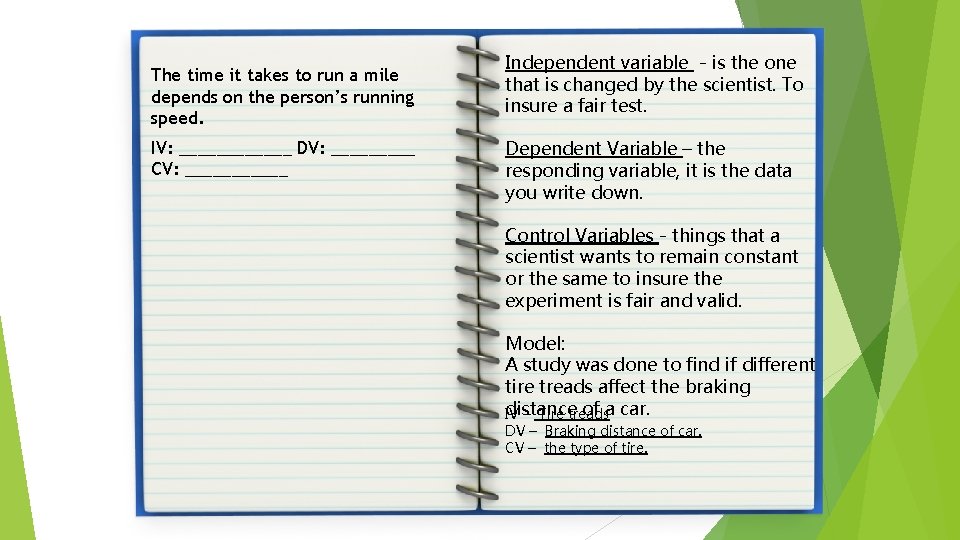
Guided Practice The time it takes to run a mile depends on the person’s running speed. IV: ______ DV: _____ CV: ______ Independent variable - is the one that is changed by the scientist. To insure a fair test. Dependent Variable – the responding variable, it is the data you write down. Control Variables - things that a scientist wants to remain constant or the same to insure the experiment is fair and valid. Model: A study was done to find if different tire treads affect the braking distance of a car. IV – Tire treads DV – Braking distance of car. CV – the type of tire.
- Slides: 27