
Word Stress Sentence Stress Word Stress English is



- Slides: 22
Word Stress & Sentence Stress
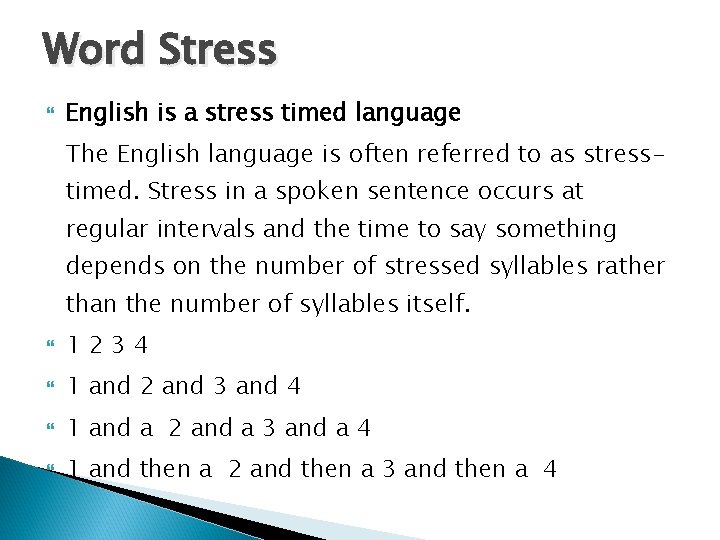
Word Stress English is a stress timed language The English language is often referred to as stresstimed. Stress in a spoken sentence occurs at regular intervals and the time to say something depends on the number of stressed syllables rather than the number of syllables itself. 1234 1 and 2 and 3 and 4 1 and a 2 and a 3 and a 4 1 and then a 2 and then a 3 and then a 4
Word Stress A word stress means a prominent syllable word pattern tea. cher • . beau. ti. ful • . . un. der. stand . . • con. ti. nue . • .
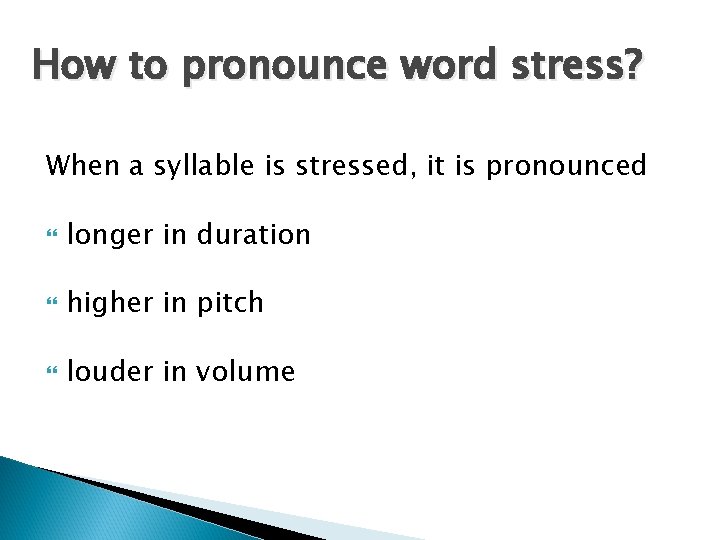
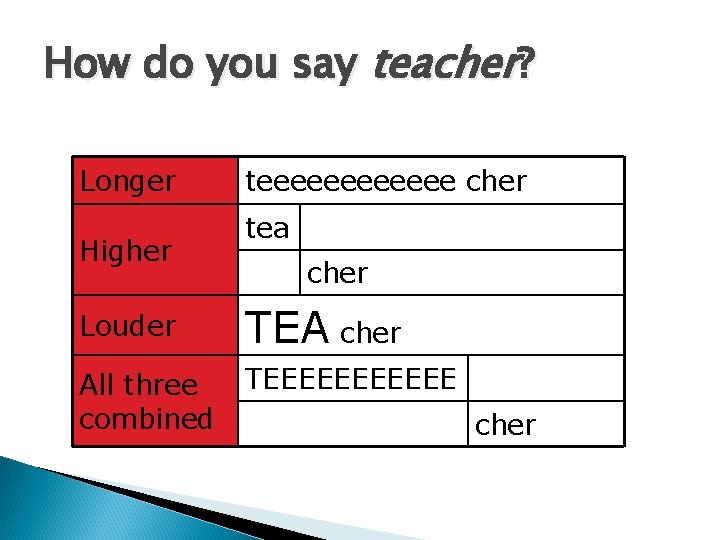
How to pronounce word stress? When a syllable is stressed, it is pronounced longer in duration higher in pitch louder in volume
How do you say teacher? Longer Higher teeeeee cher tea cher Louder TEA cher All three combined TEEEEEE cher
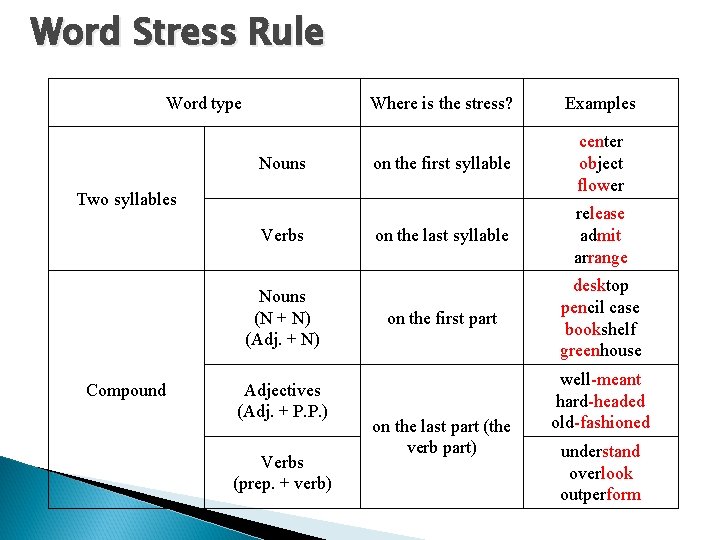
Word Stress Rule Word type Nouns Where is the stress? Examples on the first syllable center object flower on the last syllable release admit arrange on the first part desktop pencil case bookshelf greenhouse Two syllables Verbs Nouns (N + N) (Adj. + N) Compound Adjectives (Adj. + P. P. ) Verbs (prep. + verb) on the last part (the verb part) well-meant hard-headed old-fashioned understand overlook outperform
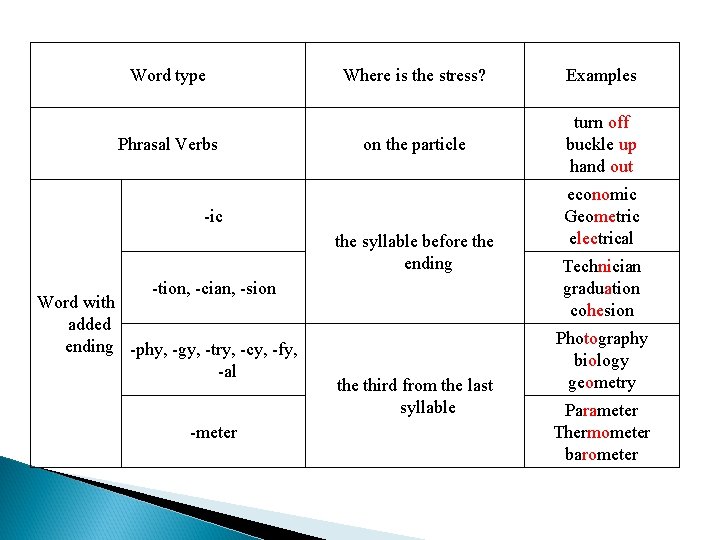
Word type Phrasal Verbs Where is the stress? Examples on the particle turn off buckle up hand out -ic the syllable before the ending -tion, -cian, -sion Word with added ending -phy, -gy, -try, -cy, -fy, -al -meter the third from the last syllable economic Geometric electrical Technician graduation cohesion Photography biology geometry Parameter Thermometer barometer
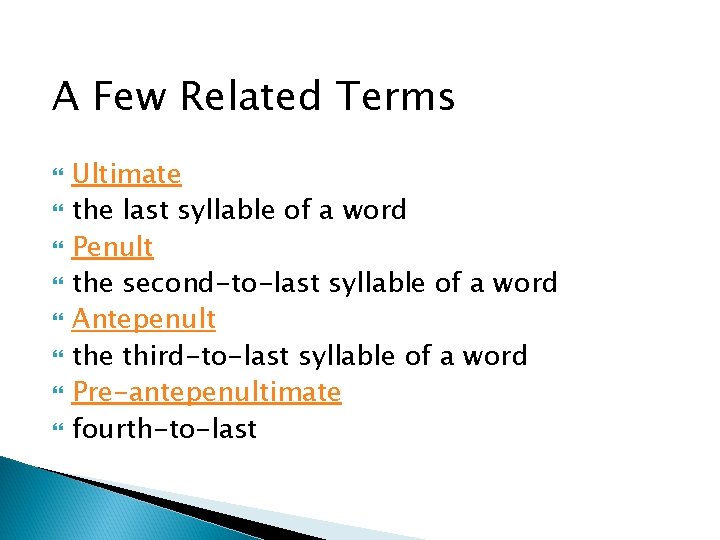
A Few Related Terms Ultimate the last syllable of a word Penult the second-to-last syllable of a word Antepenult the third-to-last syllable of a word Pre-antepenultimate fourth-to-last
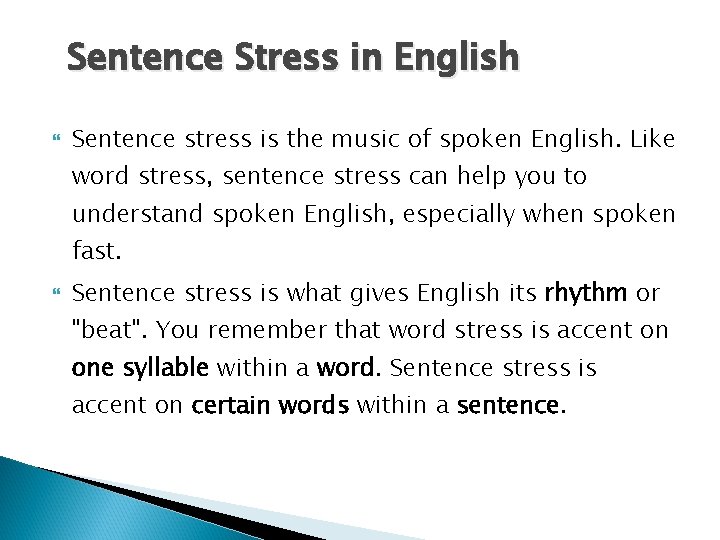
Sentence Stress in English Sentence stress is the music of spoken English. Like word stress, sentence stress can help you to understand spoken English, especially when spoken fast. Sentence stress is what gives English its rhythm or "beat". You remember that word stress is accent on one syllable within a word. Sentence stress is accent on certain words within a sentence.
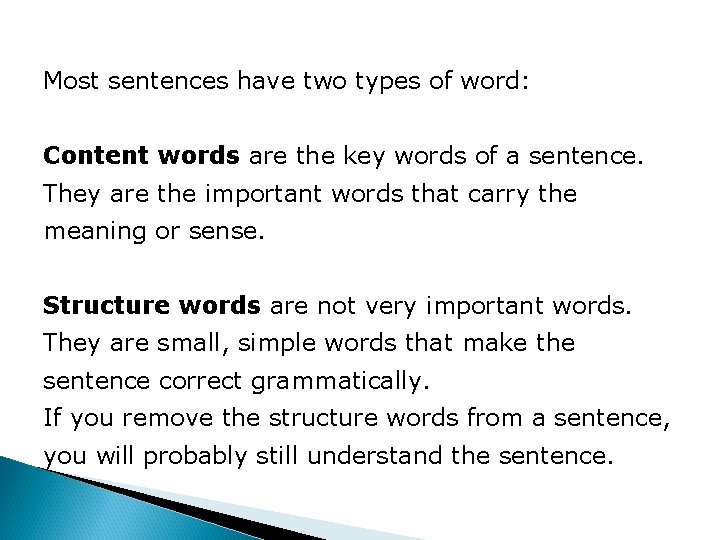
Most sentences have two types of word: Content words are the key words of a sentence. They are the important words that carry the meaning or sense. Structure words are not very important words. They are small, simple words that make the sentence correct grammatically. If you remove the structure words from a sentence, you will probably still understand the sentence.
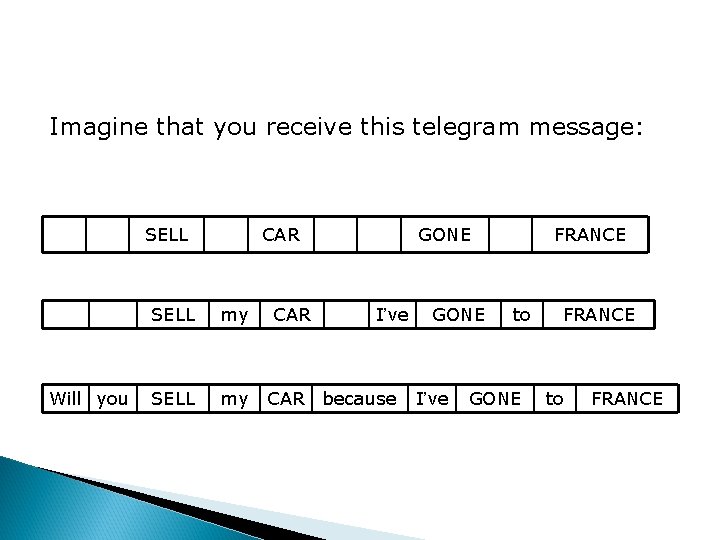
Imagine that you receive this telegram message: SELL Will you CAR SELL my CAR GONE I’ve because GONE I’ve FRANCE to GONE FRANCE to FRANCE
Rules for Sentence Stress in English The basic rules of sentence stress are: 1. 2. 3. content words are stressed structure words are unstressed the time between stressed words is always the same
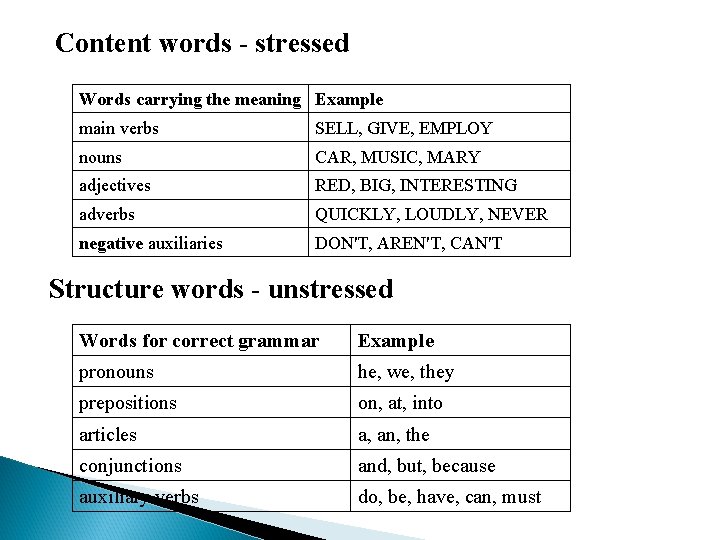
Content words - stressed Words carrying the meaning Example main verbs SELL, GIVE, EMPLOY nouns CAR, MUSIC, MARY adjectives RED, BIG, INTERESTING adverbs QUICKLY, LOUDLY, NEVER negative auxiliaries DON'T, AREN'T, CAN'T Structure words - unstressed Words for correct grammar Example pronouns he, we, they prepositions on, at, into articles a, an, the conjunctions and, but, because auxiliary verbs do, be, have, can, must
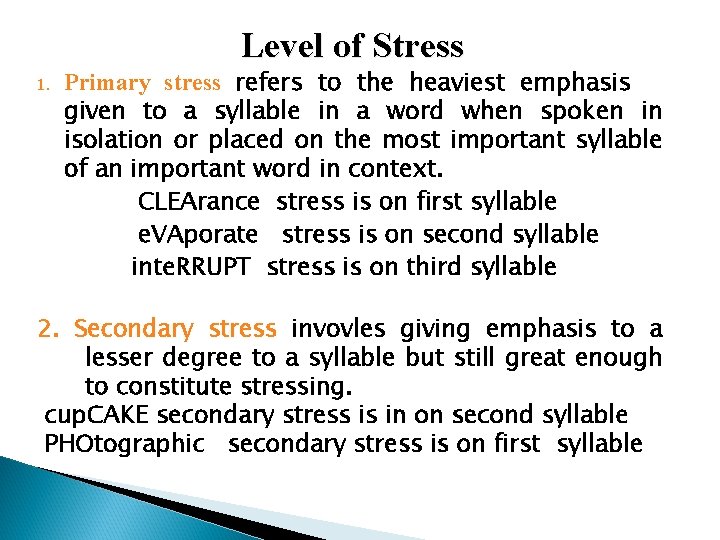
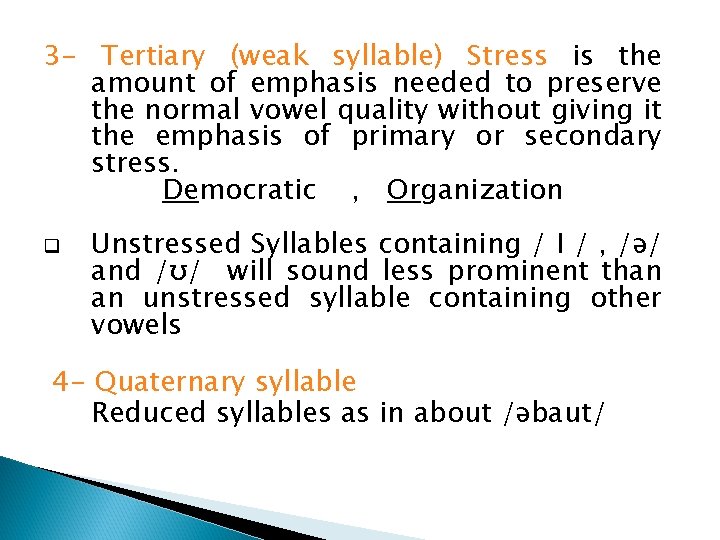
Level of Stress 1. Primary stress refers to the heaviest emphasis given to a syllable in a word when spoken in isolation or placed on the most important syllable of an important word in context. CLEArance stress is on first syllable e. VAporate stress is on second syllable inte. RRUPT stress is on third syllable 2. Secondary stress invovles giving emphasis to a lesser degree to a syllable but still great enough to constitute stressing. cup. CAKE secondary stress is in on second syllable PHOtographic secondary stress is on first syllable
3 - Tertiary (weak syllable) Stress is the amount of emphasis needed to preserve the normal vowel quality without giving it the emphasis of primary or secondary stress. Democratic , Organization q Unstressed Syllables containing / I / , /ə/ and /ʊ/ will sound less prominent than an unstressed syllable containing other vowels 4 - Quaternary syllable Reduced syllables as in about /əbaut/
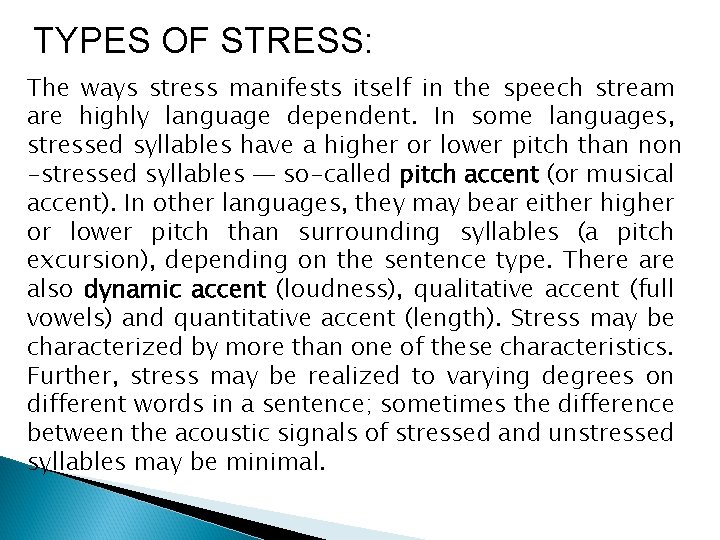
TYPES OF STRESS: The ways stress manifests itself in the speech stream are highly language dependent. In some languages, stressed syllables have a higher or lower pitch than non -stressed syllables — so-called pitch accent (or musical accent). In other languages, they may bear either higher or lower pitch than surrounding syllables (a pitch excursion), depending on the sentence type. There also dynamic accent (loudness), qualitative accent (full vowels) and quantitative accent (length). Stress may be characterized by more than one of these characteristics. Further, stress may be realized to varying degrees on different words in a sentence; sometimes the difference between the acoustic signals of stressed and unstressed syllables may be minimal.
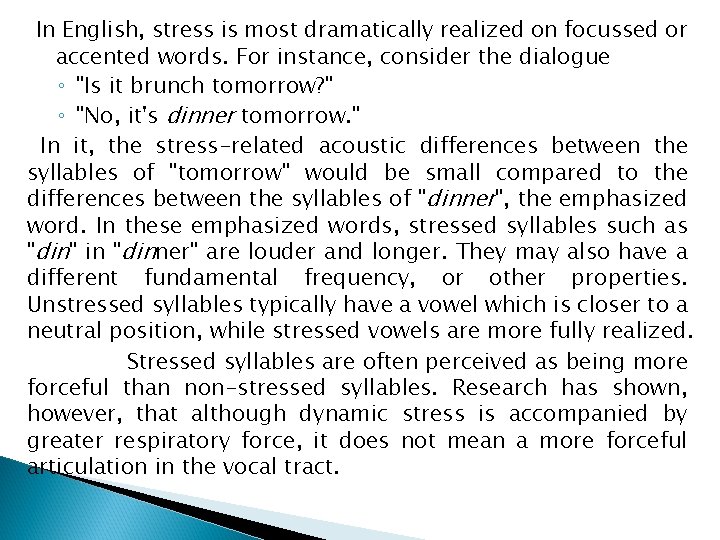
In English, stress is most dramatically realized on focussed or accented words. For instance, consider the dialogue ◦ "Is it brunch tomorrow? " ◦ "No, it's dinner tomorrow. " In it, the stress-related acoustic differences between the syllables of "tomorrow" would be small compared to the differences between the syllables of "dinner", the emphasized word. In these emphasized words, stressed syllables such as "din" in "dinner" are louder and longer. They may also have a different fundamental frequency, or other properties. Unstressed syllables typically have a vowel which is closer to a neutral position, while stressed vowels are more fully realized. Stressed syllables are often perceived as being more forceful than non-stressed syllables. Research has shown, however, that although dynamic stress is accompanied by greater respiratory force, it does not mean a more forceful articulation in the vocal tract.
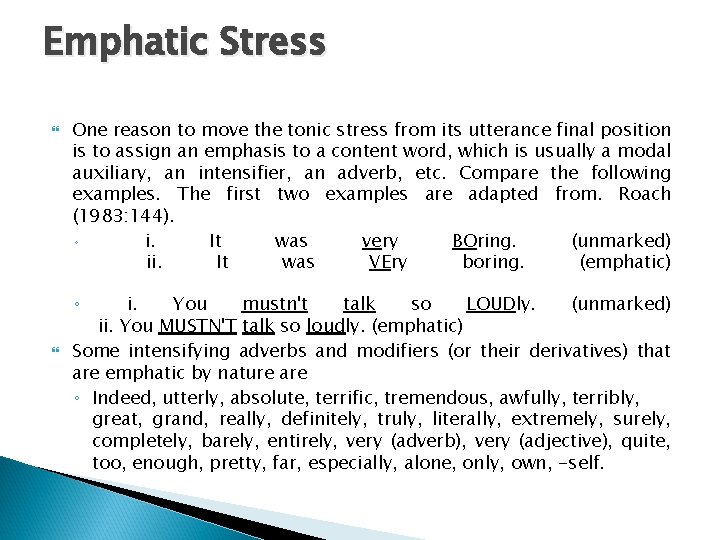
Emphatic Stress One reason to move the tonic stress from its utterance final position is to assign an emphasis to a content word, which is usually a modal auxiliary, an intensifier, an adverb, etc. Compare the following examples. The first two examples are adapted from. Roach (1983: 144). ◦ i. It was very BOring. (unmarked) ii. It was VEry boring. (emphatic) i. You mustn't talk so LOUDly. (unmarked) ii. You MUSTN'T talk so loudly. (emphatic) Some intensifying adverbs and modifiers (or their derivatives) that are emphatic by nature are ◦ Indeed, utterly, absolute, terrific, tremendous, awfully, terribly, great, grand, really, definitely, truly, literally, extremely, surely, completely, barely, entirely, very (adverb), very (adjective), quite, too, enough, pretty, far, especially, alone, only, own, -self. ◦
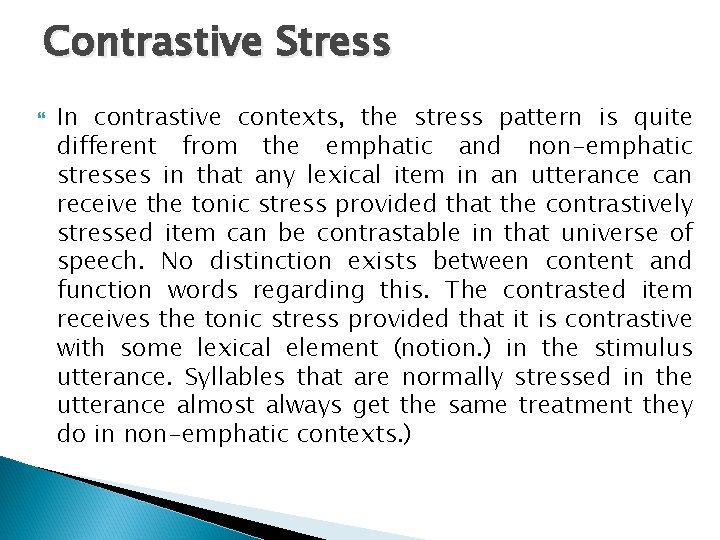
Contrastive Stress In contrastive contexts, the stress pattern is quite different from the emphatic and non-emphatic stresses in that any lexical item in an utterance can receive the tonic stress provided that the contrastively stressed item can be contrastable in that universe of speech. No distinction exists between content and function words regarding this. The contrasted item receives the tonic stress provided that it is contrastive with some lexical element (notion. ) in the stimulus utterance. Syllables that are normally stressed in the utterance almost always get the same treatment they do in non-emphatic contexts. )
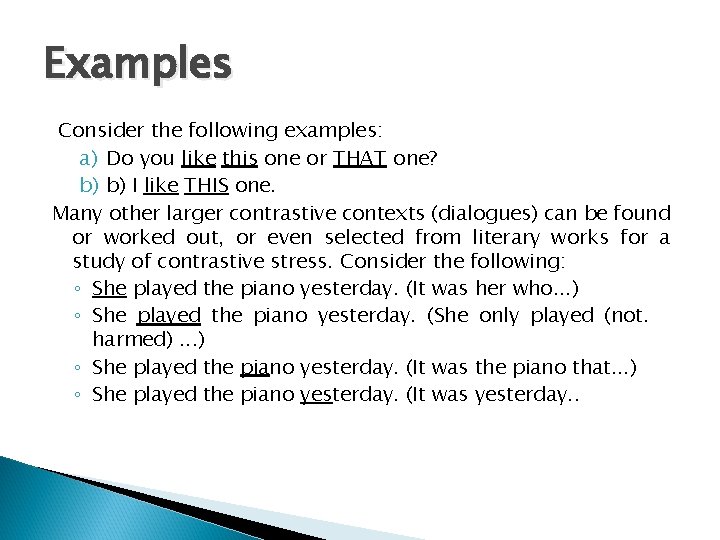
Examples Consider the following examples: a) Do you like this one or THAT one? b) b) I like THIS one. Many other larger contrastive contexts (dialogues) can be found or worked out, or even selected from literary works for a study of contrastive stress. Consider the following: ◦ She played the piano yesterday. (It was her who. . . ) ◦ She played the piano yesterday. (She only played (not. harmed). . . ) ◦ She played the piano yesterday. (It was the piano that. . . ) ◦ She played the piano yesterday. (It was yesterday. .
Tonic Stress An intonation unit almost always has one peak of stress, which is called 'tonic stress', or 'nucleus'. Because stress applies to syllables, the syllable that receives the tonic stress is called 'tonic syllable'. The term tonic stress is usually preferred to refer to this kind of stress in referring, proclaiming, and reporting utterances. Tonic stress is almost always found in a content word in utterance final position. Consider the following, in which the tonic syllable is underlined: I'm going to London for a holiday. A question does arise as to what happens to the previously tonic assigned syllables. They still get stressed, however, not as much as the tonic syllable, producing a three level stress for utterances. Then, the following is arrived at. , where the tonic syllable is further capitalized: I'm going to London for HOliday.
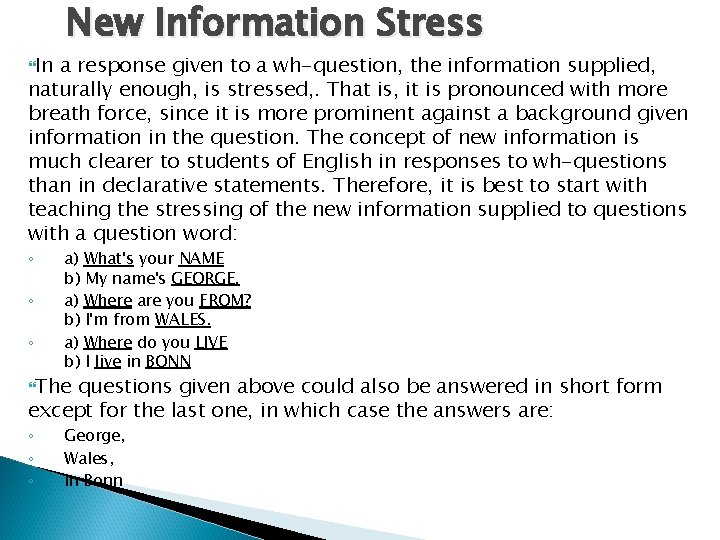
In New Information Stress a response given to a wh-question, the information supplied, naturally enough, is stressed, . That is, it is pronounced with more breath force, since it is more prominent against a background given information in the question. The concept of new information is much clearer to students of English in responses to wh-questions than in declarative statements. Therefore, it is best to start with teaching the stressing of the new information supplied to questions with a question word: ◦ ◦ ◦ a) What's your NAME b) My name's GEORGE. a) Where are you FROM? b) I'm from WALES. a) Where do you LIVE b) I live in BONN The questions given above could also be answered in short form except for the last one, in which case the answers are: ◦ ◦ ◦ George, Wales, in Bonn