
Word Sense Disambiguation for Automatic Taxonomy Construction from

Word Sense Disambiguation for Automatic Taxonomy Construction from Text-Based Web Corpora Jeroen de Knijff Kevin Meijer 312470 jk@student. eur. nl 312177 km@student. eur. nl Flavius Frasincar Frederik Hogenboom frasincar@ese. eur. nl fhogenboom@ese. eur. nl ; ) Erasmus University Rotterdam PO Box 1738, NL-3000 DR Rotterdam, the Netherlands October 14, 2011 12 th International Conference on Web Information System Engineering (WISE 2011)
Introduction (1) • An increasing amount of documents is digitally stored on the Web • Documents can be structured through taxonomies • Many documents are unstructured, hence driving the need for taxonomy construction 12 th International Conference on Web Information System Engineering (WISE 2011)
Introduction (2) • Taxonomy construction: – Manually: • More accurate • Main method – Automatic: • Less knowledge needed • Less time consuming • Taxonomy construction enables inter operability between Web sites, tools, etc. due to the knowledge aggregation into shared taxonomies 12 th International Conference on Web Information System Engineering (WISE 2011)
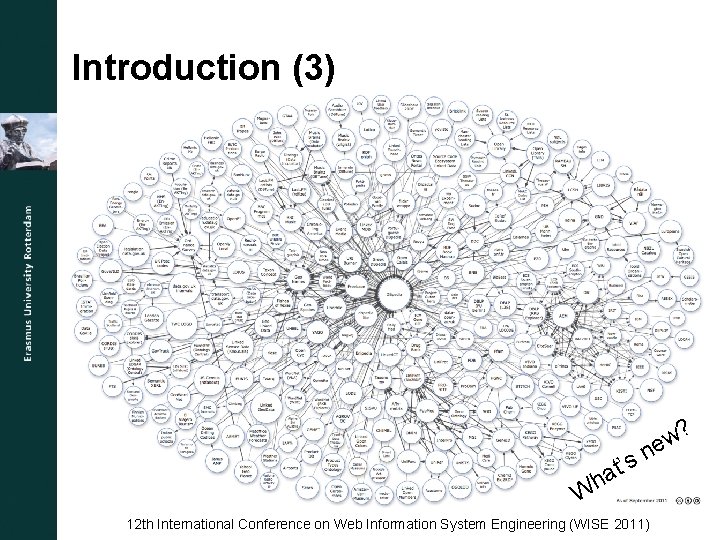
Introduction (3) s at’ n ? w e Wh 12 th International Conference on Web Information System Engineering (WISE 2011)
Introduction (4) • Taxonomy construction is a mature and widely researched topic • Little literature exists on applying Word Sense Disambiguation (WSD), even though WSD improves results of used techniques like clustering! • Hence, we propose the Automatic Taxonomy Construction from Text (ATCT) framework, which implements WSD 12 th International Conference on Web Information System Engineering (WISE 2011)
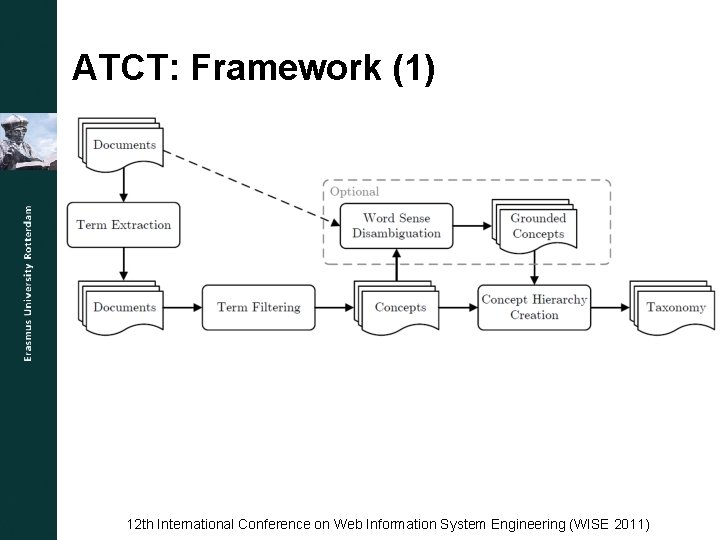
ATCT: Framework (1) 12 th International Conference on Web Information System Engineering (WISE 2011)
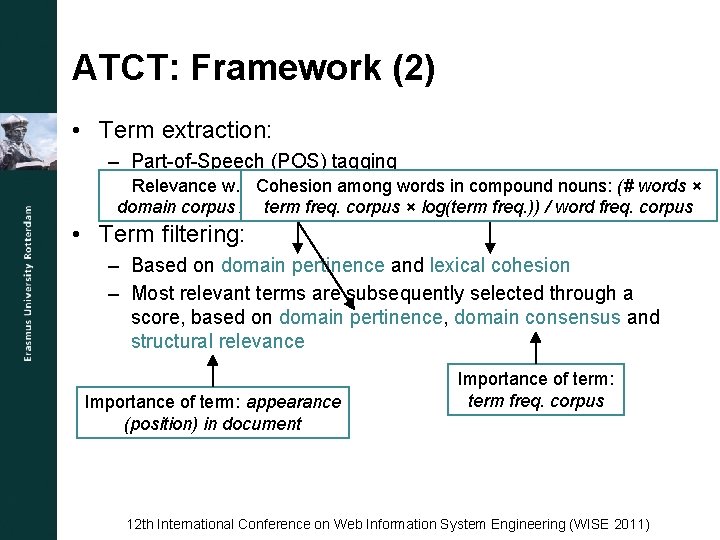
ATCT: Framework (2) • Term extraction: – Part-of-Speech (POS) tagging Cohesion amongterm words in compound nouns: (# words × Relevance w. r. t. extracted target domain: freq. – All nouns are term freq. corpus × log(term domain corpus / term freq. contrastive corpus freq. )) / word freq. corpus • Term filtering: – Based on domain pertinence and lexical cohesion – Most relevant terms are subsequently selected through a score, based on domain pertinence, domain consensus and structural relevance Importance of term: appearance (position) in document Importance of term: term freq. corpus 12 th International Conference on Web Information System Engineering (WISE 2011)
ATCT: Framework (3) • Word Sense Disambiguation: – – Optional step Synsets are retrieved from a semantic lexicon Structural Semantic Interconnections (SSI) Utilizes a similarity measure that is proposed by Jiang and Conrath (1997) – Terms with similar senses are removed – Term counts are aggregated per concept 12 th International Conference on Web Information System Engineering (WISE 2011)
ATCT: Framework (4) • Concept hierarchy creation: – Based on the subsumption algorithm, which determines potential parents (subsumers) of concepts: • x potentially subsumes y, if: 1) x appears in at least the proportion t of all documents in which y appears 2) y appears in less than the proportion t of all documents in which x appears – Additionally takes into account ancestor positions: • Weighting scheme based on the number of layers between terms x and y • Close parents get assigned more weight 12 th International Conference on Web Information System Engineering (WISE 2011)
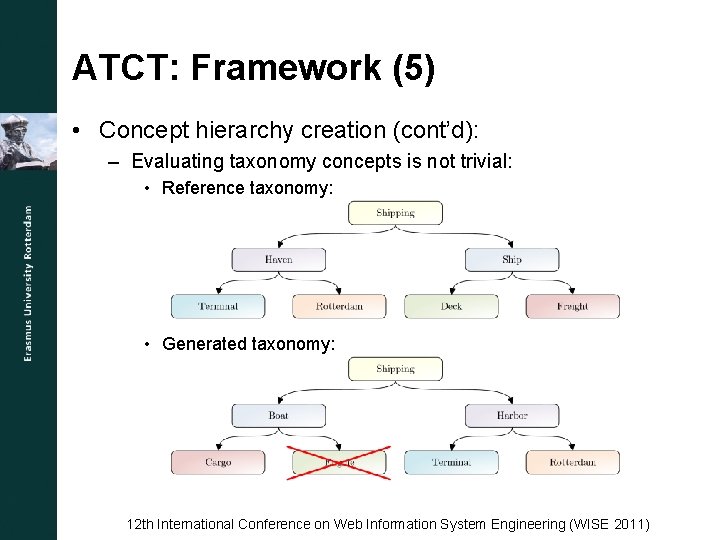
ATCT: Framework (5) • Concept hierarchy creation (cont’d): – Evaluating taxonomy concepts is not trivial: • Reference taxonomy: • Generated taxonomy: 12 th International Conference on Web Information System Engineering (WISE 2011)
ATCT: Framework (6) • Concept hierarchy creation (cont’d): – Look at senses through taxonomy concept disambiguation: • Similar to term WSD from text, but now surrounding concepts are used instead of surrounding words • Terms with single sense for lexicon are disambiguated • Other terms are disambiguated using their surrounding terms: – Concept neighborhood of 2 (up/down) – Root node is disregarded • Lexicon senses are compared • In case no sense is available (e. g. , compound nouns): – Lexical matching – Descendant / ancestor comparison • Graph distances are calculated 12 th International Conference on Web Information System Engineering (WISE 2011)
ATCT: Implementation • Java-based pipeline • Noun parsing with the Stanford parser • RDF implementation using Jena • Domain taxonomies are expressed in SKOS 12 th International Conference on Web Information System Engineering (WISE 2011)
Evaluation (1) • Data: – Economics & management: • 25, 000 abstracts from Re. Pub & Re. PEc • 2, 000 distinct concepts • Golden taxonomy using STW Thesaurus annotations – Medicine & health: • 10, 000 abstracts from Re. Pub • 1, 000 distinct concepts • Golden taxonomy using Me. SH annotations • Measures: – Precision – Recall – F-measure 12 th International Conference on Web Information System Engineering (WISE 2011)
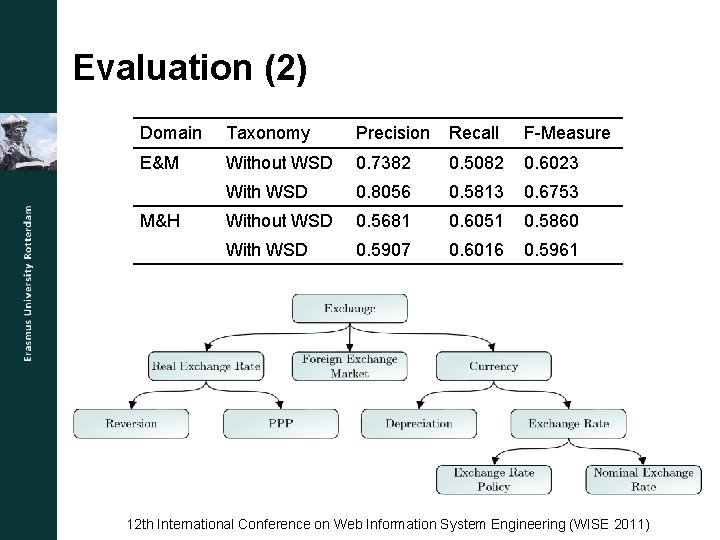
Evaluation (2) Domain Taxonomy Precision Recall F-Measure E&M Without WSD 0. 7382 0. 5082 0. 6023 With WSD 0. 8056 0. 5813 0. 6753 Without WSD 0. 5681 0. 6051 0. 5860 With WSD 0. 5907 0. 6016 0. 5961 M&H 12 th International Conference on Web Information System Engineering (WISE 2011)
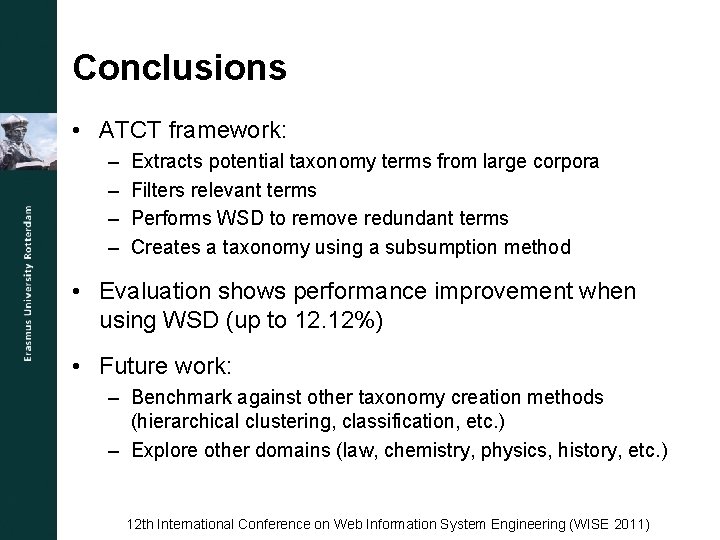
Conclusions • ATCT framework: – – Extracts potential taxonomy terms from large corpora Filters relevant terms Performs WSD to remove redundant terms Creates a taxonomy using a subsumption method • Evaluation shows performance improvement when using WSD (up to 12. 12%) • Future work: – Benchmark against other taxonomy creation methods (hierarchical clustering, classification, etc. ) – Explore other domains (law, chemistry, physics, history, etc. ) 12 th International Conference on Web Information System Engineering (WISE 2011)
Questions 12 th International Conference on Web Information System Engineering (WISE 2011)
- Slides: 16