
Word Pronunciation Julia Hirschberg CS 4706 9292020 1
Word Pronunciation Julia Hirschberg CS 4706 9/29/2020 1
Today • • Motivation Challenges for automatic word pronunciation Standard methods Innovative solutions 9/29/2020 2
• TTS demos: – AT&T – Cepstral • SNL Robot Repair 9/29/2020 3
Motivation • Intelligibility • Naturalness • Applications to language learning – Unlimited vocabulary – Type a word or phrase and hear it spoken in your target language • To imitate • To learn to recognize • Speech therapy 9/29/2020 4
Word Pronunciation • What determines how a word is pronounced? – History/Language Origin/Dictionaries: • shoe (ME shoo), phoenix (Gr) • mole, attaches, resume – Part-of-speech: • use, close, dove, multiply, coax – Morphology: • ferryboat, ferryboats • Popemobile (pope+mobile) 9/29/2020 5
Letter 2 Sound Rules • Define correspondences between orthography and phonemic representation, e. g. – i _{C}e$ /ai/ rise – Else i /ih/ rip • Deals with any input 9/29/2020 6
Problems with Rule-Based Systems • Must be built by hand • Many exceptions, e. g. • i _{C}e$ /ai/ matches magazine, crevice, beige • Proper names: Nice, Rise • Symbols and abbreviations: &c, evalu 8, cu, tsp • Assigning lexical stress is also tricky – Rules to decide primary stress – Monotone, monotony, monolingual, montage • Solutions – More complex rules – Consult exceptions dictionary first – But how do we handle morphological 9/29/2020 variation? E. g. Rise’s hat 7
Dictionary-based Approaches • Rely on very large dictionary with orthography and pronunciation for each word • Typically created by hand or by expansion of online pronouncing dictionary 9/29/2020 8
Problems • Redundancy of representation – Cat, cats, cat’s, cats’ • Out-of-vocabulary (OOV) items – Proper names: covering all U. K. surnames requires >5, 000 entries – New words: … • Technical terms: liposuction, anova, bernaise • Foreign borrowings: frappe, ciao, louche 9/29/2020 9
• Solutions – Even larger dictionary – Morphological preprocessing before dictionary look-up – Fall back to Letter 2 Sound rules if no dictionary ‘hit’ 9/29/2020 10
Major Challenges for TTS • Disambiguating homographs – bass/bass • Pronouncing new words – New names in the news: – New words: i. Pad, Kindle • Expanding abbreviations and pronouncing acronyms correctly 9/29/2020 11
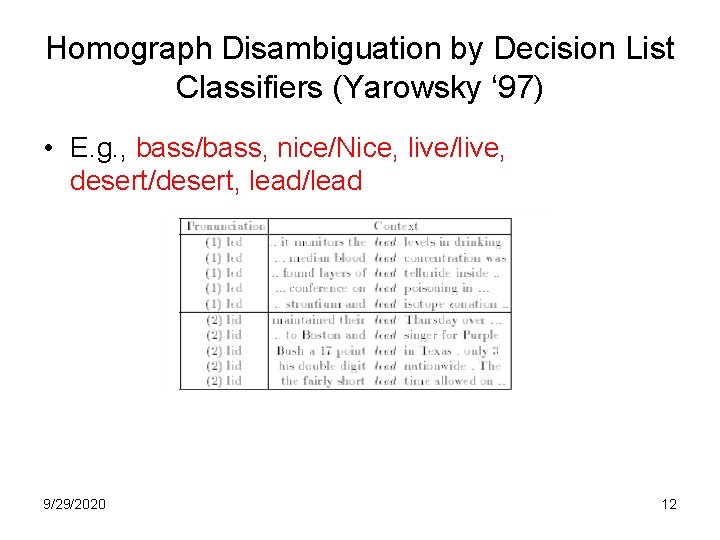
Homograph Disambiguation by Decision List Classifiers (Yarowsky ‘ 97) • E. g. , bass/bass, nice/Nice, live/live, desert/desert, lead/lead 9/29/2020 12
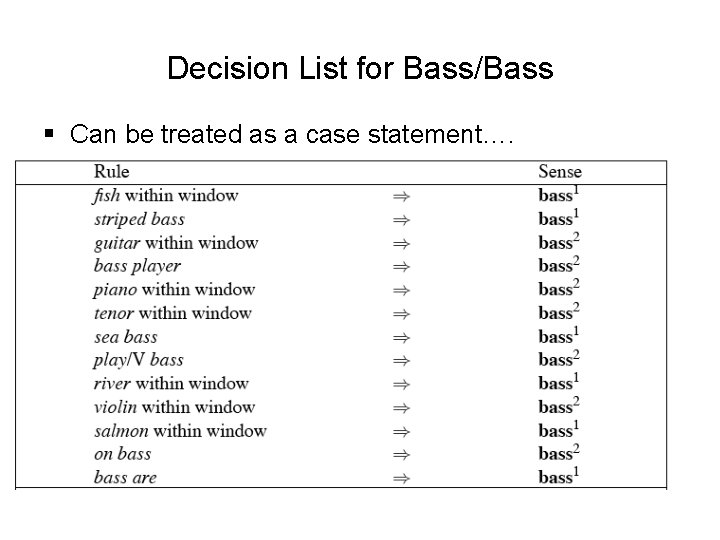
Decision List for Bass/Bass § Can be treated as a case statement….
Learning Decision Lists § Restrict lists to rules that test a single feature § Evaluate each possible test and rank them based on how well they classify § Order the top-N tests as the decision list
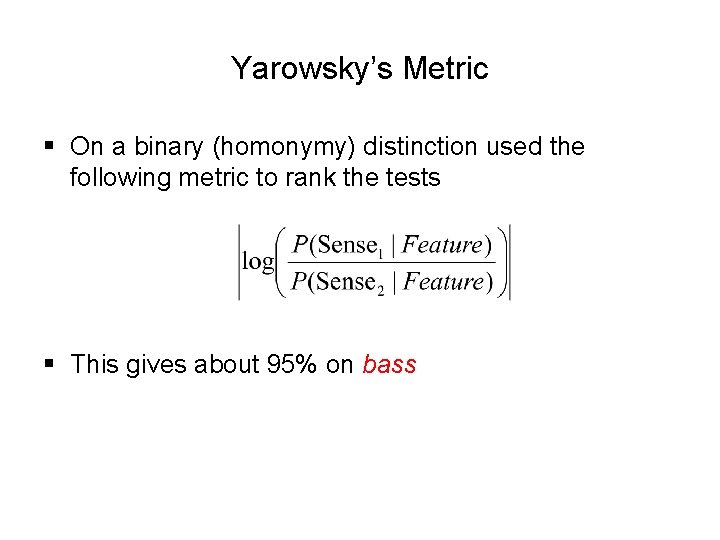
Yarowsky’s Metric § On a binary (homonymy) distinction used the following metric to rank the tests § This gives about 95% on bass
Semi-supervised Extensions • Bootstrap from decision list built from small amount of labeled data • Classify unlabeled data • Create decision list from new labeled corpus 9/29/2020 16
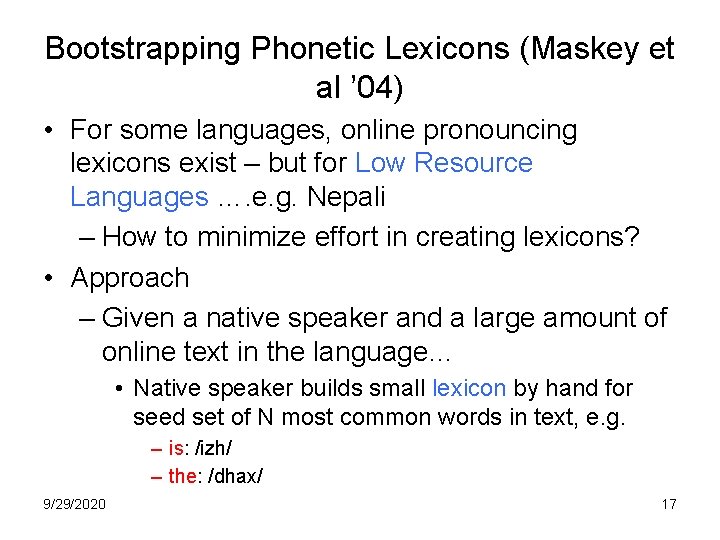
Bootstrapping Phonetic Lexicons (Maskey et al ’ 04) • For some languages, online pronouncing lexicons exist – but for Low Resource Languages …. e. g. Nepali – How to minimize effort in creating lexicons? • Approach – Given a native speaker and a large amount of online text in the language… • Native speaker builds small lexicon by hand for seed set of N most common words in text, e. g. – is: /izh/ – the: /dhax/ 9/29/2020 17
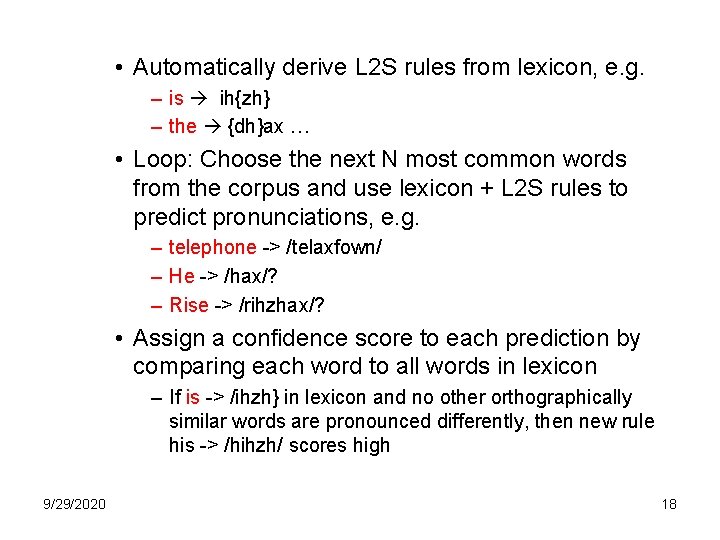
• Automatically derive L 2 S rules from lexicon, e. g. – is ih{zh} – the {dh}ax … • Loop: Choose the next N most common words from the corpus and use lexicon + L 2 S rules to predict pronunciations, e. g. – telephone -> /telaxfown/ – He -> /hax/? – Rise -> /rihzhax/? • Assign a confidence score to each prediction by comparing each word to all words in lexicon – If is -> /ihzh} in lexicon and no other orthographically similar words are pronounced differently, then new rule his -> /hihzh/ scores high 9/29/2020 18
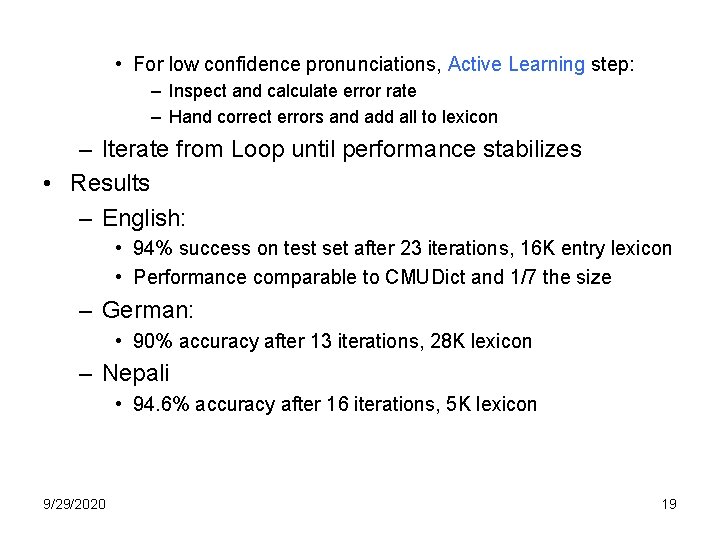
• For low confidence pronunciations, Active Learning step: – Inspect and calculate error rate – Hand correct errors and add all to lexicon – Iterate from Loop until performance stabilizes • Results – English: • 94% success on test set after 23 iterations, 16 K entry lexicon • Performance comparable to CMUDict and 1/7 the size – German: • 90% accuracy after 13 iterations, 28 K lexicon – Nepali • 94. 6% accuracy after 16 iterations, 5 K lexicon 9/29/2020 19
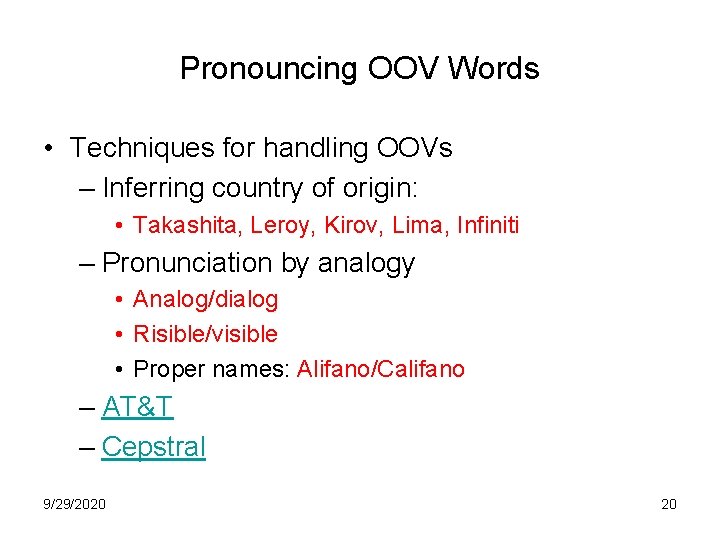
Pronouncing OOV Words • Techniques for handling OOVs – Inferring country of origin: • Takashita, Leroy, Kirov, Lima, Infiniti – Pronunciation by analogy • Analog/dialog • Risible/visible • Proper names: Alifano/Califano – AT&T – Cepstral 9/29/2020 20
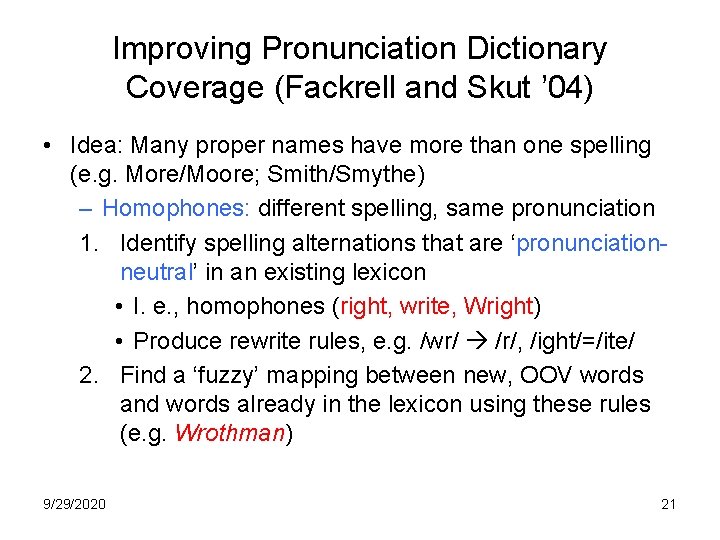
Improving Pronunciation Dictionary Coverage (Fackrell and Skut ’ 04) • Idea: Many proper names have more than one spelling (e. g. More/Moore; Smith/Smythe) – Homophones: different spelling, same pronunciation 1. Identify spelling alternations that are ‘pronunciationneutral’ in an existing lexicon • I. e. , homophones (right, write, Wright) • Produce rewrite rules, e. g. /wr/ /r/, /ight/=/ite/ 2. Find a ‘fuzzy’ mapping between new, OOV words and words already in the lexicon using these rules (e. g. Wrothman) 9/29/2020 21

• Pros? • Cons? 9/29/2020 22
Deriving Pronunciations from the Web (Ghoshal et al ’ 09) • Extract candidate orthography/pronunciation pairs (ad-hoc and IPA) – E. g. “…bruschetta (pronounced broo-SKETuh)…” • Validate the candidates: how likely are these pairs to represent a word and its pronunciation • Normalize ad-hoc and IPA pronunciations 9/29/2020 23

• Pros? • Cons? 9/29/2020 24
Pronunciation Evaluation • How would you evaluate the pronunciation module of a TTS system? 9/29/2020 25
Next Class • Readings • Download the To. BI cardinal examples (see http: //www 1. cs. columbia. edu/~agus/tobi/ for instructions) – You will first need to download Wave. Surfer • http: //www. speech. kth. se/wavesurfer/ – Then download the cardinal examples • http: //www 1. cs. columbia. edu/~agus/tobi/cardinals/manual. ph p – Follow the installation directions carefully • Listen to the cardinal examples for the following and see if you can hear the differences: – H* H- L%, H* H- H%, L* H- H%, H* !H- H% 9/29/2020 26
- Slides: 26