
Word origins The English vocabulary is made up
Word origins The English vocabulary is made up of two kinds of words – native and borrowed.
Native vocabulary Native words are those brought to England by our linguistic forefathers, the Angles and Saxons. Native word are the short, familiar words that every speaker has mastered in English.
Native word examples: Body parts – eye, foot, ear Family relationships – father, wife, son Everyday objects – stone, house, cow Physical acts – eat, drink, sleep Physical characteristics – red, small, quick
Borrowed vocabulary Borrowed words come from three sources: Latin and Greek French Other languages: Arabic, Chinese, Gaelic, Hindi, Italian American English also borrows words from Native people: Oklahoma – Choctaw Ohio - Iroquois
Native / Borrowed word activity
Learning new vocabulary �We learn new words three ways – � Absorption � Memorization � Analysis
Morphemes �Most classical borrowed words are composed of two or more smaller units, each with their own meaning. �These are called “morphemes. ” �Morph- “to change” / -eme “element of a system” �Morphemes are the meaningful pieces that make up words.
4 Characteristics of morphemes �Morphemes cannot be broken down into smaller parts. �Each morpheme has a meaning that contributes to the overall meaning of the words. �Morphemes are recyclable �Morphemes can be any length.
For example… �Morphemes are not the same as syllables. �The word ‘man’ can be divided 3 ways. � 1. m +a+n � 2. ma+n � 3. m+an � Each part does not have a separate meaning, though.
Morphemes have separate meanings �“unsportsmanlike” �Un = opposite, away from. �Sport = sport �Sportsman = one who plays sports �-like = similar to
Morphemes are recyclable �“re-” �Rearm �Restate �React �Reply �respect
Two classes of morphemes �Roots and affixes �Roots form the base of words. Every word must have at least one root �Affixes must be attached to a root or combination of roots to make sense. Prefixes go before a root, suffixes go at the end.
Stems � A stem is any construction to which another morpheme may be attached. A stem may be: �A single root �A comp 0 und of roots �Or a root with one or more affixes.
Stem examples… �‘Man’ is a stem because it can have other morphemes attached to it: �Manly �Mankind �gentleman � Gentleman is also a stem because it can have –ly attached to form gentlemanly � A STEM ALWAYS CONTAINS AT LEAST ONE ROOT!
Stem extenders �Usually suffixes attach directly to a stem � HOWEVER, sometimes a stem cannot take a regular suffix until a special suffix called a “stem extender” is added. � For example: �Ductile is made up of the morphemes �Duc- (‘lead, pull’) and –ile (‘having, being, pertaining to’) �The ‘t’ between the morphemes is the stem extender.
Common stem extenders �The most common stem extenders are the consonants �T �S �And the vowels �O �I �U
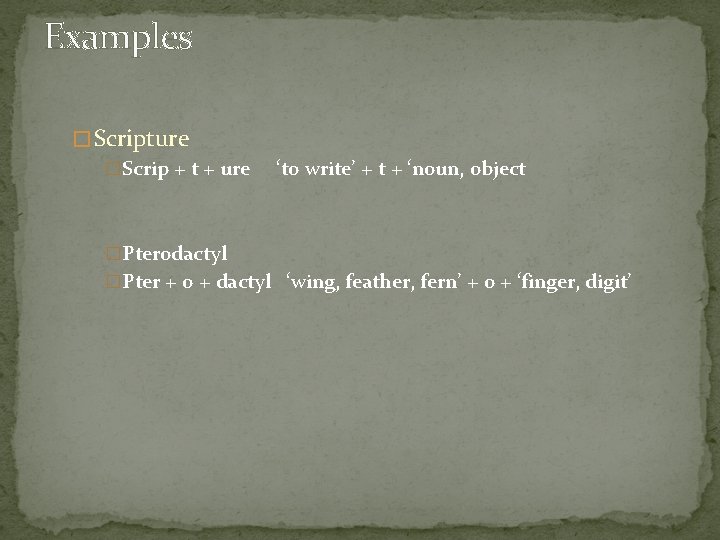
Examples � Scripture �Scrip + t + ure ‘to write’ + t + ‘noun, object �Pterodactyl �Pter + o + dactyl ‘wing, feather, fern’ + o + ‘finger, digit’
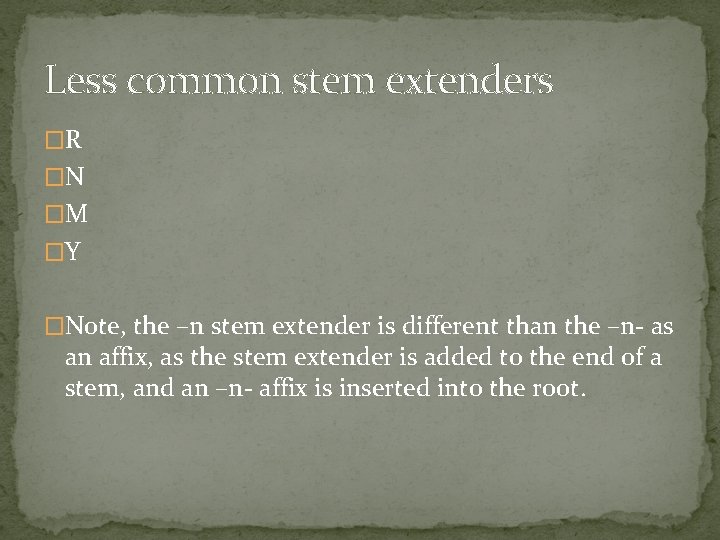
Less common stem extenders �R �N �M �Y �Note, the –n stem extender is different than the –n- as an affix, as the stem extender is added to the end of a stem, and an –n- affix is inserted into the root.
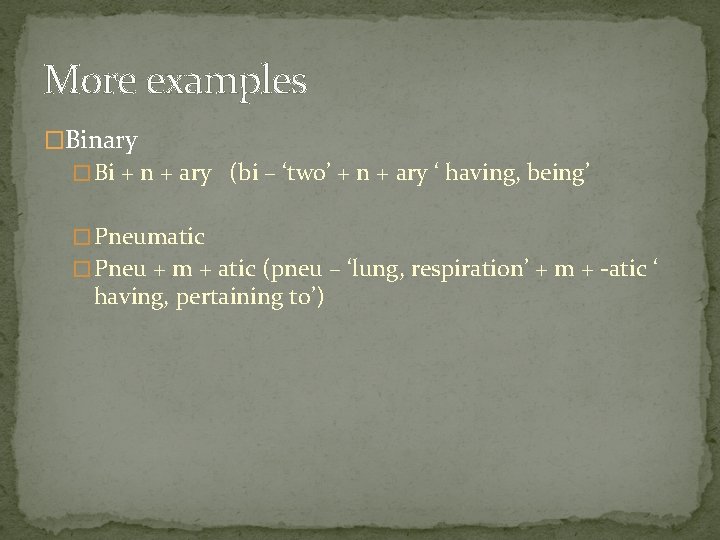
More examples �Binary � Bi + n + ary (bi – ‘two’ + n + ary ‘ having, being’ � Pneumatic � Pneu + m + atic (pneu – ‘lung, respiration’ + m + -atic ‘ having, pertaining to’)
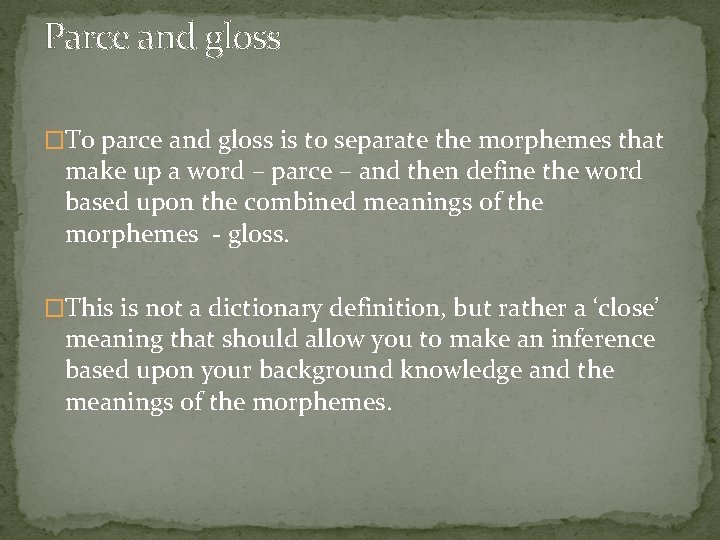
Parce and gloss �To parce and gloss is to separate the morphemes that make up a word – parce – and then define the word based upon the combined meanings of the morphemes - gloss. �This is not a dictionary definition, but rather a ‘close’ meaning that should allow you to make an inference based upon your background knowledge and the meanings of the morphemes.
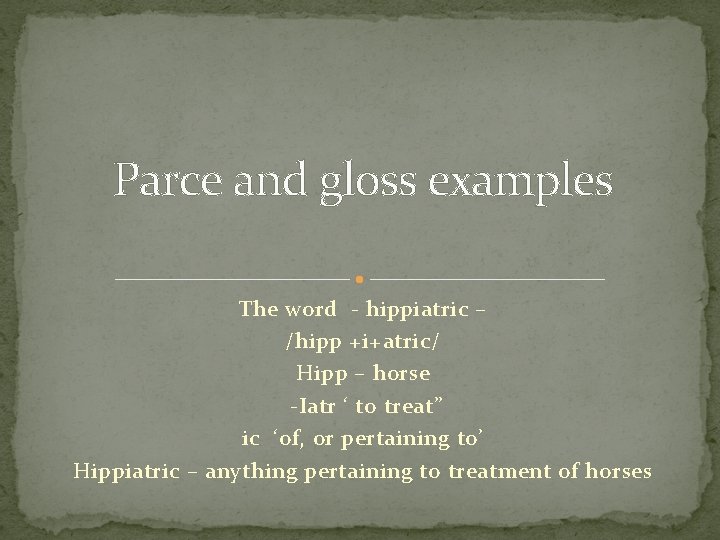
Parce and gloss examples The word - hippiatric – /hipp +i+atric/ Hipp – horse -Iatr ‘ to treat” ic ‘of, or pertaining to’ Hippiatric – anything pertaining to treatment of horses
Partner Parse and Gloss activity
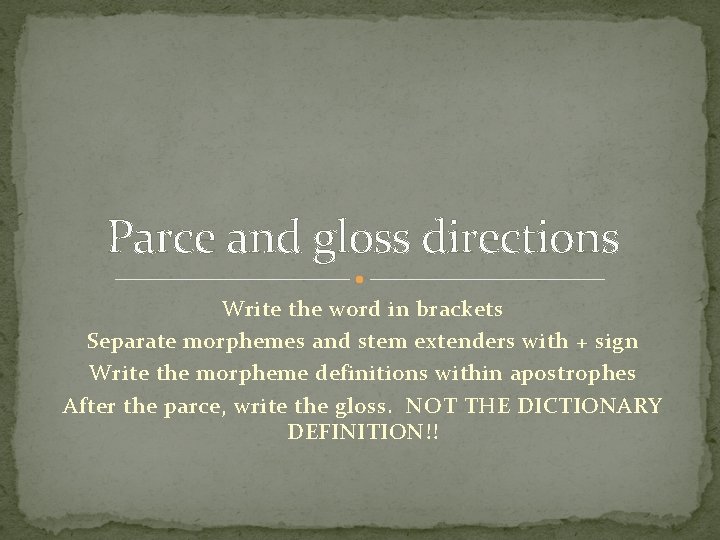
Parce and gloss directions Write the word in brackets Separate morphemes and stem extenders with + sign Write the morpheme definitions within apostrophes After the parce, write the gloss. NOT THE DICTIONARY DEFINITION!!
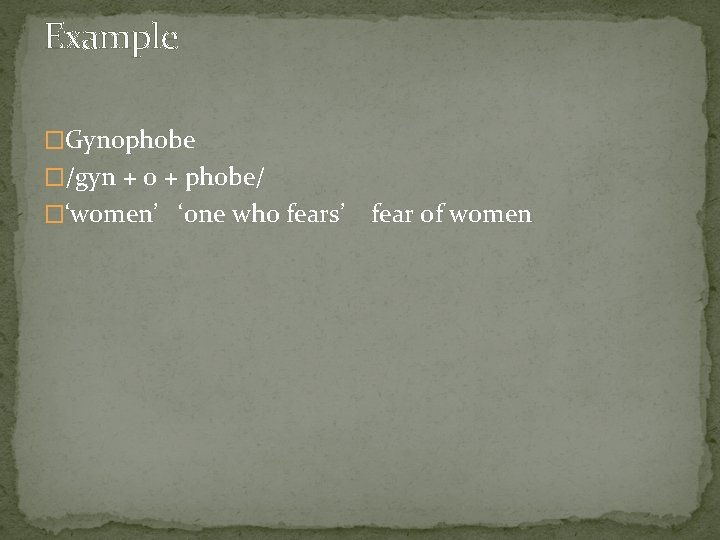
Example �Gynophobe �/gyn + o + phobe/ �‘women’ ‘one who fears’ fear of women
- Slides: 24