
Word order Part of knowing what a possible

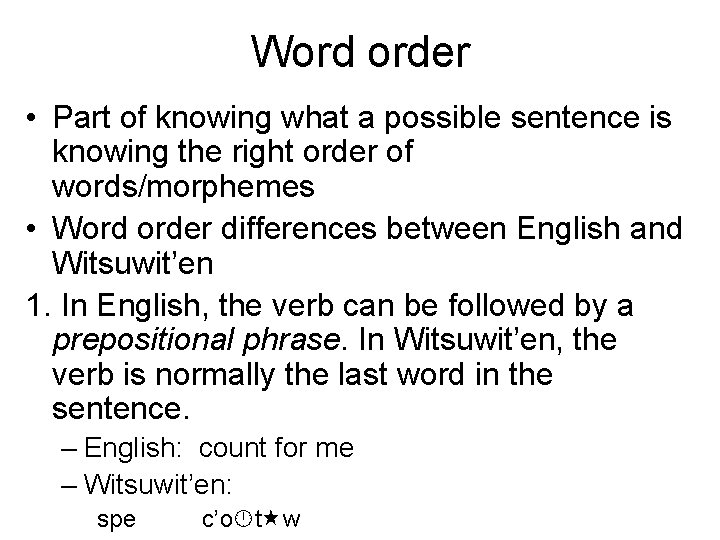
Word order • Part of knowing what a possible sentence is knowing the right order of words/morphemes • Word order differences between English and Witsuwit’en 1. In English, the verb can be followed by a prepositional phrase. In Witsuwit’en, the verb is normally the last word in the sentence. – English: count for me – Witsuwit’en: spe c’o t w
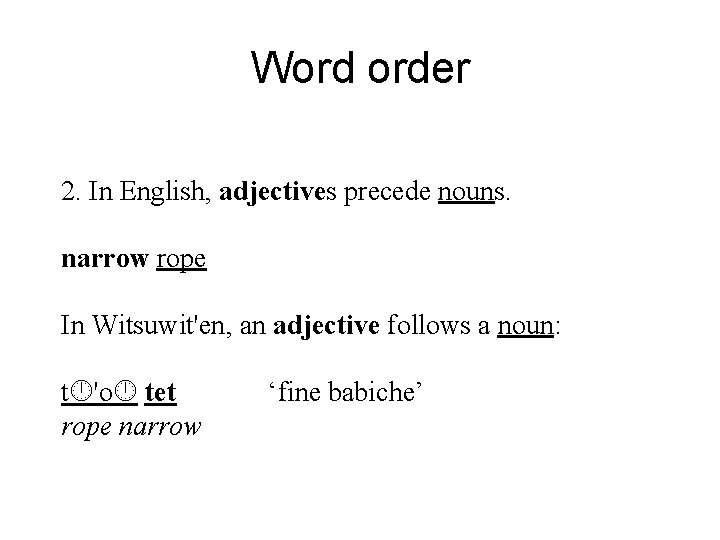
Word order 2. In English, adjectives precede nouns. narrow rope In Witsuwit'en, an adjective follows a noun: t 'o tet rope narrow ‘fine babiche’
![• Witsuwit’en – PP NP P • [le th. An t’Ats] st’E skewer](http://slidetodoc.com/presentation_image_h2/172476657e88fff682817c1016d16bab/image-4.jpg "• Witsuwit’en – PP NP P • [le th. An t’Ats] st’E skewer")
• Witsuwit’en – PP NP P • [le th. An t’Ats] st’E skewer by it cooked
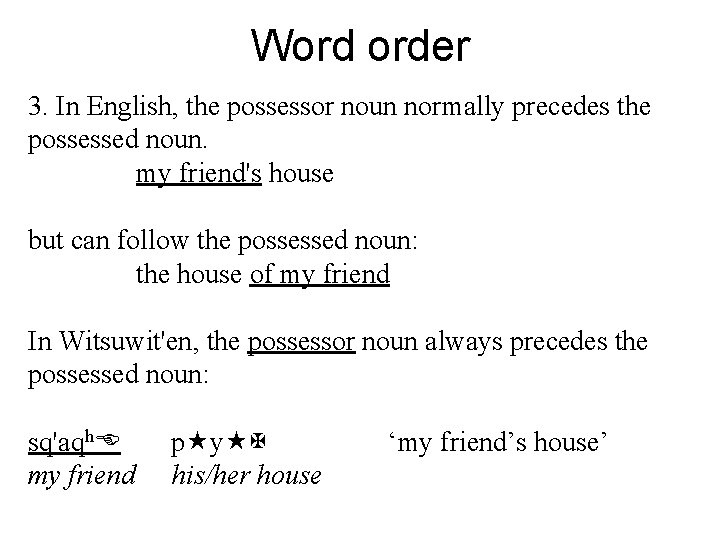
Word order 3. In English, the possessor noun normally precedes the possessed noun. my friend's house but can follow the possessed noun: the house of my friend In Witsuwit'en, the possessor noun always precedes the possessed noun: sq'aqh. E my friend p y X his/her house ‘my friend’s house’
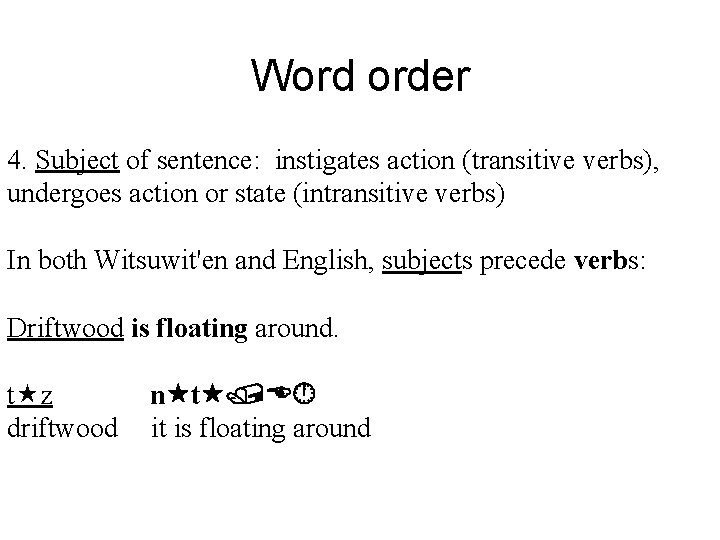
Word order 4. Subject of sentence: instigates action (transitive verbs), undergoes action or state (intransitive verbs) In both Witsuwit'en and English, subjects precede verbs: Driftwood is floating around. t z driftwood n t it is floating around
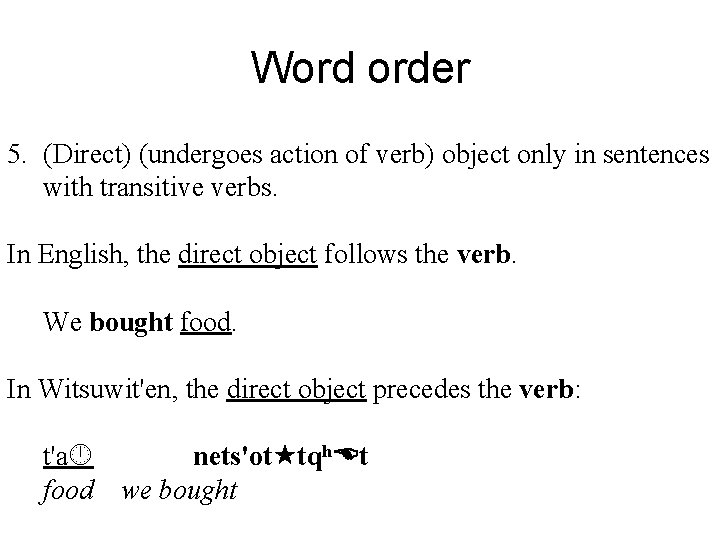
Word order 5. (Direct) (undergoes action of verb) object only in sentences with transitive verbs. In English, the direct object follows the verb. We bought food. In Witsuwit'en, the direct object precedes the verb: t'a nets'ot tqh t food we bought
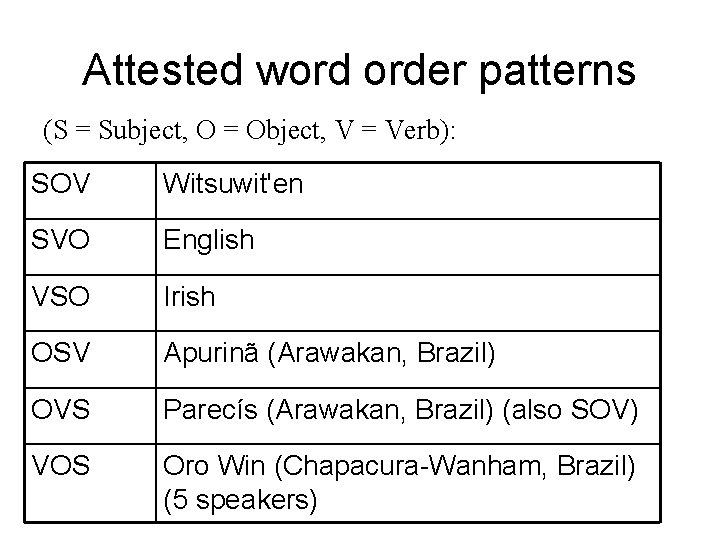
Attested word order patterns (S = Subject, O = Object, V = Verb): SOV Witsuwit'en SVO English VSO Irish OSV Apurinã (Arawakan, Brazil) OVS Parecís (Arawakan, Brazil) (also SOV) VOS Oro Win (Chapacura-Wanham, Brazil) (5 speakers)
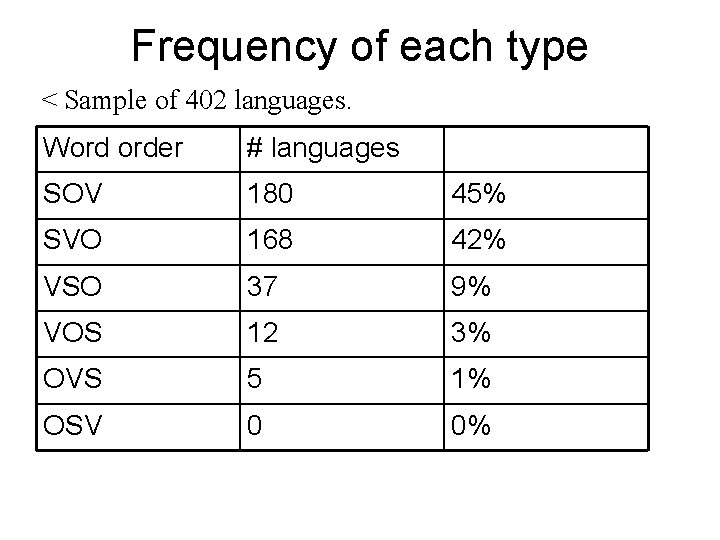
Frequency of each type < Sample of 402 languages. Word order # languages SOV 180 45% SVO 168 42% VSO 37 9% VOS 12 3% OVS 5 1% OSV 0 0%
- Slides: 9