
Word Classes Part of Speech Tagging Background Part
Word Classes & Part of Speech Tagging
Background Part of speech: Noun, verb, pronoun, preposition, adverb, conjunction, particle, and article Also know as word classes, morphological class, or lexical tags Recent lists of POS have much larger numbers of word classes. 45 for Penn Treebank 87 for the Brown corpus, and 146 for the C 7 tagset
Significance of the POS The significance of the POS for language processing is that it gives a significant amount of information about the word and its neighbors. For example these tagset distinguish between possessive pronoun –my , your, his , her, its personal pronoun – I , you, me, he Helps to identify what words are likely to occur in its vicinity Possessive pronouns are likely to be followed by a noun Personal pronouns by a verb Can be used in language model for speech recognition
Knowing the POS can produce more natural pronunciations in a speech synthesis system and more accuracy in a speech recognition system OBject(noun) ob. JECT(verb) POS can be used in stemming for IR, since Knowing a word’s POS can help tell us which morphological affixes it can take. They can help an IR application by helping select out nouns or other important words from a document.
English Word Classes This section gives a more complete definition of the classes of POS. Traditionally, the definition of POS has been based on morphological and syntactic function. Words that function similarly with respect to the affixes they take (their morphological properties) are grouped into classes Or with respect to what can occur nearby(their distributional properties) are grouped into classes While, it has tendencies toward semantic coherence (e. g. , nouns describe “people, places, or things and adjectives describe properties), this is not necessarily the case. In general we don’t use semantic coherence as a definition criteria for parts-of-speech
Supercategories of POS Two broad supercategories of POS: 1. Closed class 2. Open class
Closed class – Having relatively fixed membership, e. g. , prepositions – Because there is a fixed set of them in English – New propositions are rarely coined – Function words: Grammatical words like of, and, or you, which tend to be very short, occur frequently, and play an important role in grammar.
Open class Eg: Nouns and Verbs Continually coined or borrowed from other languages Four major open classes occurring in the languages of the world: nouns, verbs, adjectives, and adverbs. Many languages have no adjectives, e. g. , the native American language Lakhota, and Chinese
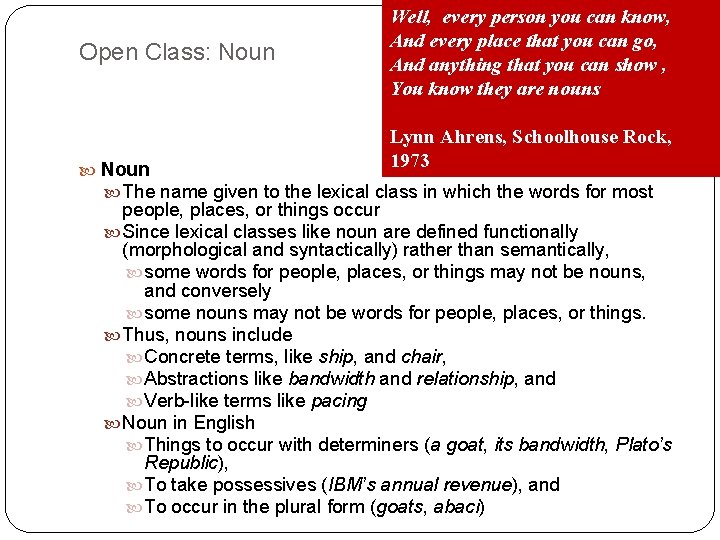
Open Class: Noun Well, every person you can know, And every place that you can go, And anything that you can show , You know they are nouns Lynn Ahrens, Schoolhouse Rock, 1973 Noun The name given to the lexical class in which the words for most people, places, or things occur Since lexical classes like noun are defined functionally (morphological and syntactically) rather than semantically, some words for people, places, or things may not be nouns, and conversely some nouns may not be words for people, places, or things. Thus, nouns include Concrete terms, like ship, and chair, Abstractions like bandwidth and relationship, and Verb-like terms like pacing Noun in English Things to occur with determiners (a goat, its bandwidth, Plato’s Republic), To take possessives (IBM’s annual revenue), and To occur in the plural form (goats, abaci)
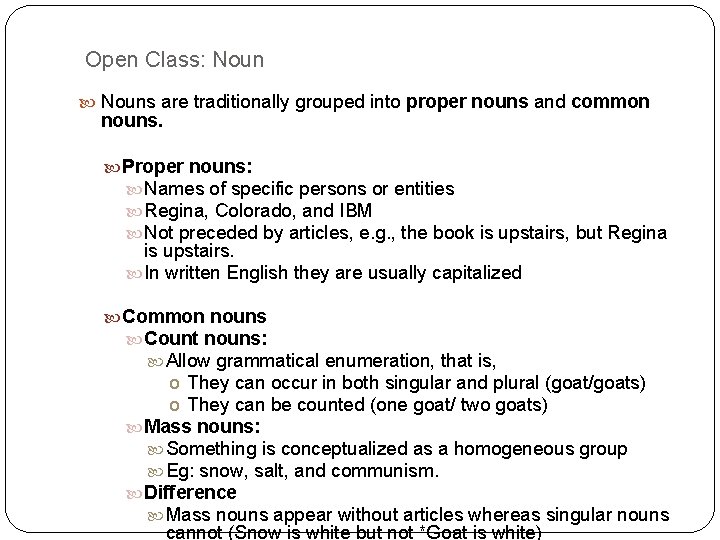
Open Class: Nouns are traditionally grouped into proper nouns and common nouns. Proper nouns: Names of specific persons or entities Regina, Colorado, and IBM Not preceded by articles, e. g. , the book is upstairs, but Regina is upstairs. In written English they are usually capitalized Common nouns Count nouns: Allow grammatical enumeration, that is, o They can occur in both singular and plural (goat/goats) o They can be counted (one goat/ two goats) Mass nouns: Something is conceptualized as a homogeneous group Eg: snow, salt, and communism. Difference Mass nouns appear without articles whereas singular nouns cannot (Snow is white but not *Goat is white)
Open Class: Verbs Most of the words referring to actions and processes including main verbs like draw, provide, differ, and go. A number of morphological forms: non-3 rd-personsg (eat), 3 rd-person-sg(eats), progressive (eating), past participle (eaten) A subclass: auxiliaries (discussed in closed class)
Open Class: Adjectives Terms describing properties or qualities Most languages have adjectives for the concepts of color (white, black), age (old, young), and value (good, bad), but There are languages without adjectives, e. g. , Chinese.
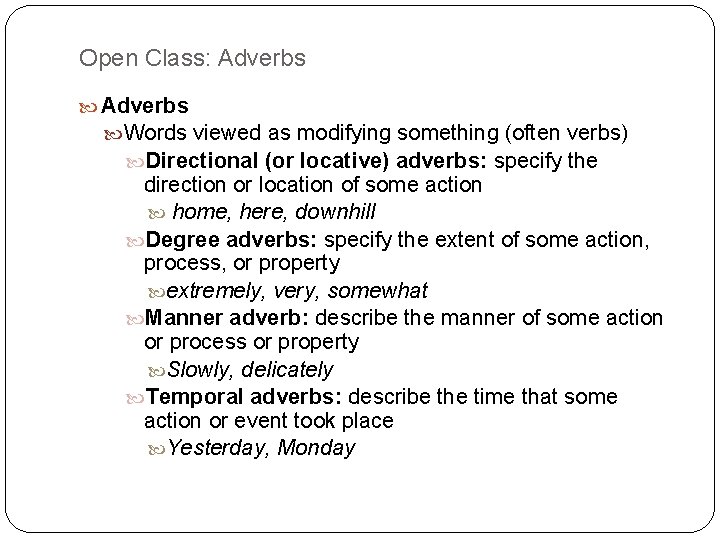
Open Class: Adverbs Words viewed as modifying something (often verbs) Directional (or locative) adverbs: specify the direction or location of some action home, here, downhill Degree adverbs: specify the extent of some action, process, or property extremely, very, somewhat Manner adverb: describe the manner of some action or process or property Slowly, delicately Temporal adverbs: describe the time that some action or event took place Yesterday, Monday
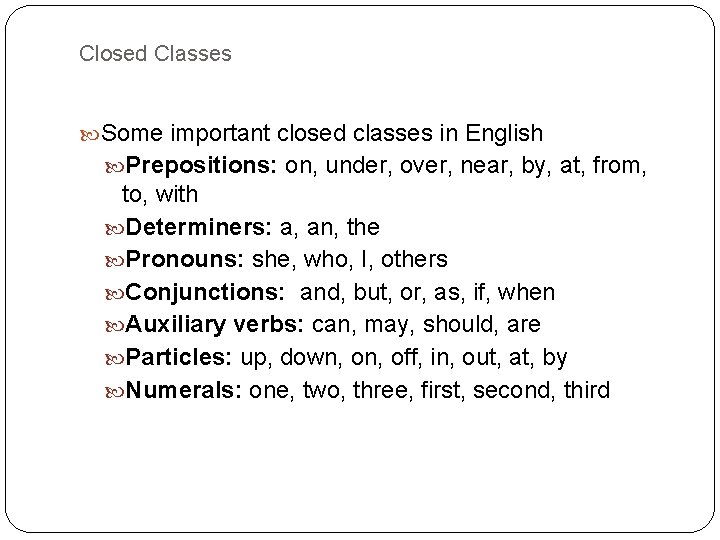
Closed Classes Some important closed classes in English Prepositions: on, under, over, near, by, at, from, to, with Determiners: a, an, the Pronouns: she, who, I, others Conjunctions: and, but, or, as, if, when Auxiliary verbs: can, may, should, are Particles: up, down, off, in, out, at, by Numerals: one, two, three, first, second, third
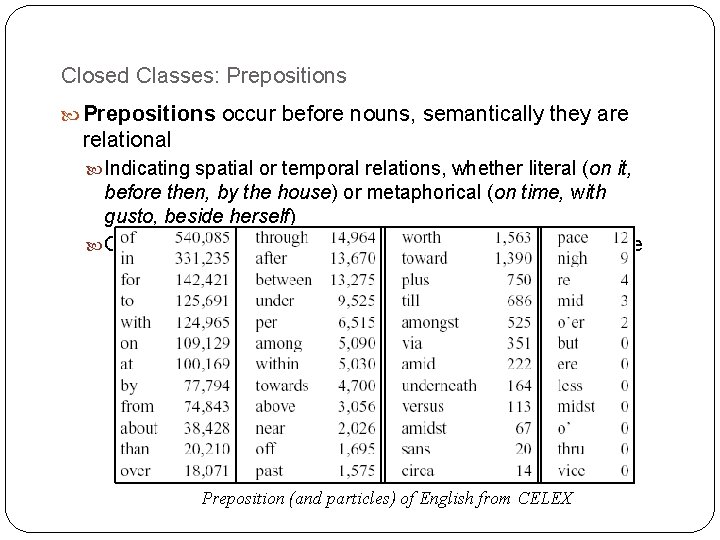
Closed Classes: Prepositions occur before nouns, semantically they are relational Indicating spatial or temporal relations, whether literal (on it, before then, by the house) or metaphorical (on time, with gusto, beside herself) Other relations as well – Hamlet was written by Shakespeare Preposition (and particles) of English from CELEX
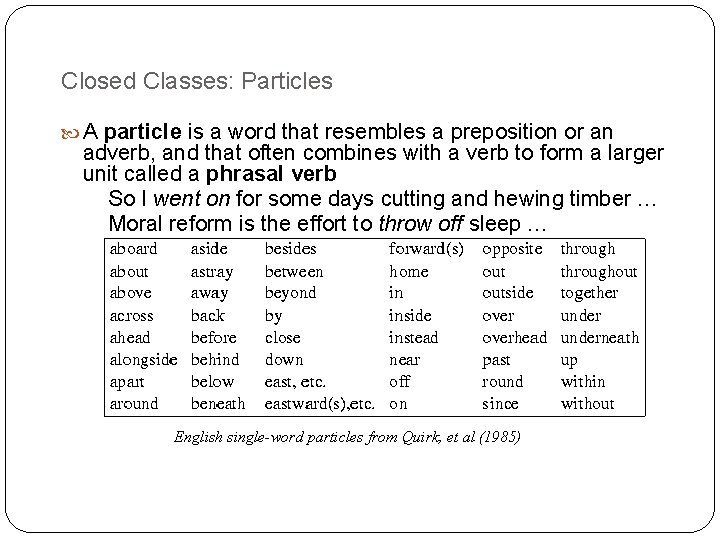
Closed Classes: Particles A particle is a word that resembles a preposition or an adverb, and that often combines with a verb to form a larger unit called a phrasal verb So I went on for some days cutting and hewing timber … Moral reform is the effort to throw off sleep … English single-word particles from Quirk, et al (1985)
Closed Classes: Articles English has three articles: a, and the Articles begin a noun phrase. A & an mark a noun phrase as indefinite The mark a noun phrase as definite Articles are frequent in English. ‘The’ is the most frequent word in most English corpora.
Closed Classes: Conjunctions are used to join two phrases, clauses, or sentences. Co-ordinating conjunctions like and, or but join two elements of equal status. Subordinating conjunctions are used when one of the elements is of some sort of embedded status. Eg: I thought that you might like some milk Links the main clause I thought with the subordinate clause you might like some milk. Subordinate because that entire clause is the ‘content’ of the main verb ‘thought’. Complementizer- Subordinate conjunction that links a verb to its argument is also called as complementizer.
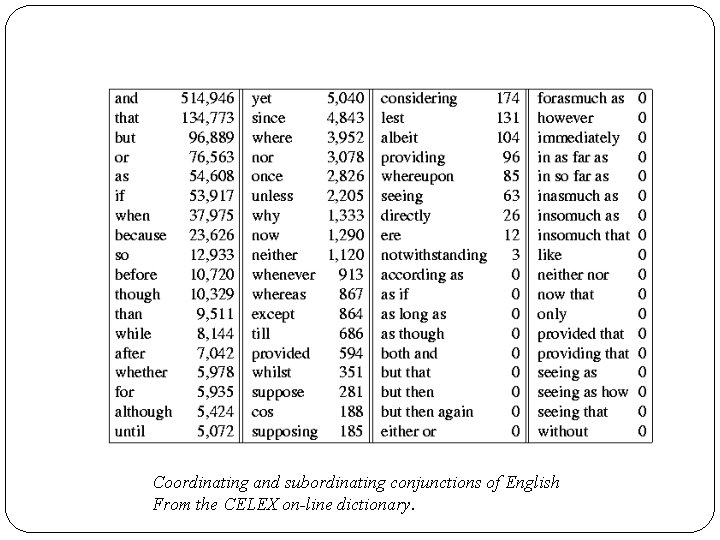
Coordinating and subordinating conjunctions of English From the CELEX on-line dictionary.
Closed Classes: Pronouns act as a kind of shorthand for referring to some noun phrase or entity or event. Personal pronouns: persons or entities (you, she, I, it, me, etc) Possessive pronouns: forms of personal pronouns indicating actual possession or just an abstract relation between the person and some objects(my, your, his, her, one’s , our, their) Wh-pronouns: used in certain question forms, or may act as complementizer (what, whom, whoever)
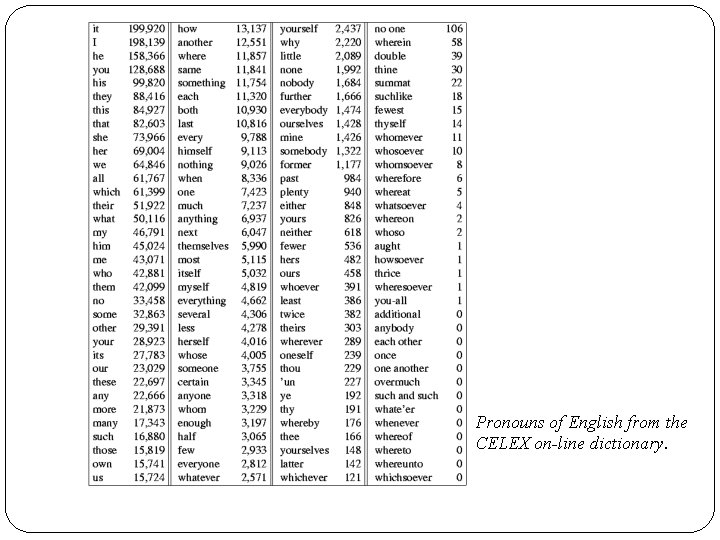
Pronouns of English from the CELEX on-line dictionary.
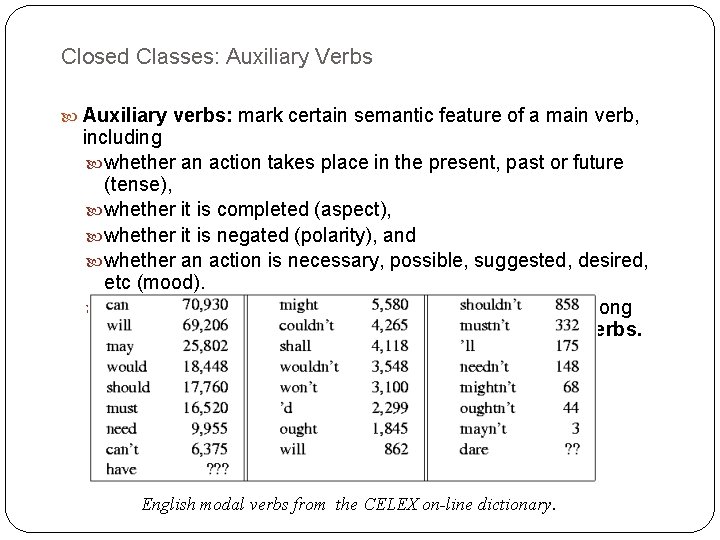
Closed Classes: Auxiliary Verbs Auxiliary verbs: mark certain semantic feature of a main verb, including whether an action takes place in the present, past or future (tense), whether it is completed (aspect), whether it is negated (polarity), and whether an action is necessary, possible, suggested, desired, etc (mood). Including copula verb be, the two verbs do and have along with their inflection forms, as well as a class of modal verbs. English modal verbs from the CELEX on-line dictionary.
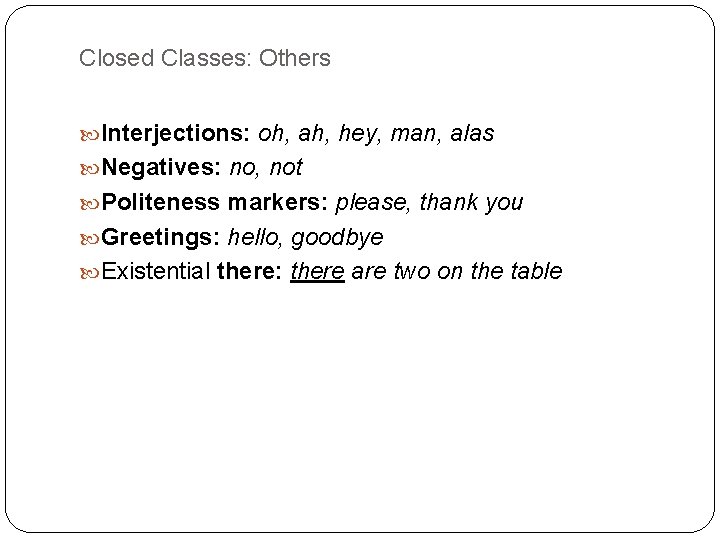
Closed Classes: Others Interjections: oh, ah, hey, man, alas Negatives: no, not Politeness markers: please, thank you Greetings: hello, goodbye Existential there: there are two on the table
Tagsets for English There a small number of popular tagsets for English, many of which evolved from the 87 -tag tagset used for the Brown corpus. Three commonly used The small 45 -tag Penn Treebank tagset The medium-sized 61 tag C 5 tageset used by the Lancaster UCREL project’s CLAWS tagger to tag the British National Corpus, and The larger 146 -tag C 7 tagset
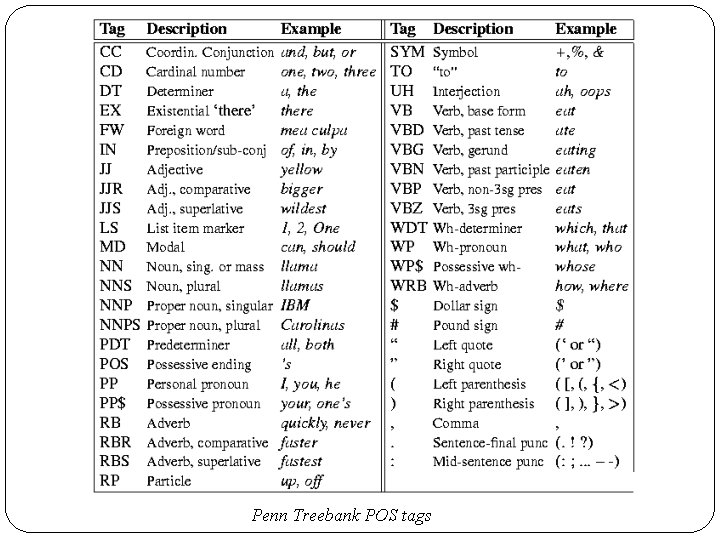
Penn Treebank POS tags
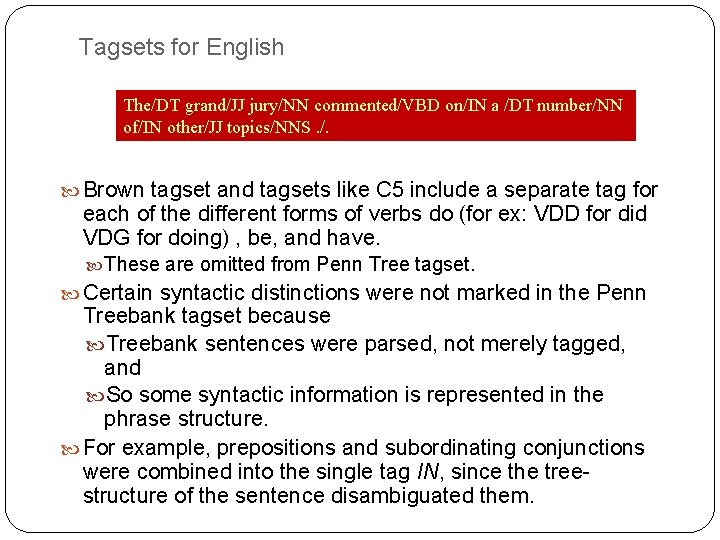
Tagsets for English The/DT grand/JJ jury/NN commented/VBD on/IN a /DT number/NN of/IN other/JJ topics/NNS. /. Brown tagset and tagsets like C 5 include a separate tag for each of the different forms of verbs do (for ex: VDD for did VDG for doing) , be, and have. These are omitted from Penn Tree tagset. Certain syntactic distinctions were not marked in the Penn Treebank tagset because Treebank sentences were parsed, not merely tagged, and So some syntactic information is represented in the phrase structure. For example, prepositions and subordinating conjunctions were combined into the single tag IN, since the treestructure of the sentence disambiguated them.
- Slides: 26