
Word classes OPEN CLASSES Nouns Pronouns Verbs Adjectives
Word classes
OPEN CLASSES • Nouns • Pronouns • Verbs • Adjectives • Adverbs CLOSED CLASSES • Prepositions • Conjunctions • Determiners [Chapter 5 for self-study] [Activities 6. 4 for self-study]
Prepositions • One word – In, at, on, above, over, after, before… • Multi-word prepositions – Near to, in front of…
Conjunctions • Coordinators link units with the same grammatical status – and, or, but, yet – Both…and; either…or; not only…but also; • Subordinators link a subordinate clause to the main part of a sentence – Although…
• Some words can be either prepositions or subordinators • Before + NP We left before breakfast • Before + CLAUSE We left before you called us
Determiners • Used before nouns to form a noun phrase • Express – Quantity: some/many – Possession: my – Definiteness : the
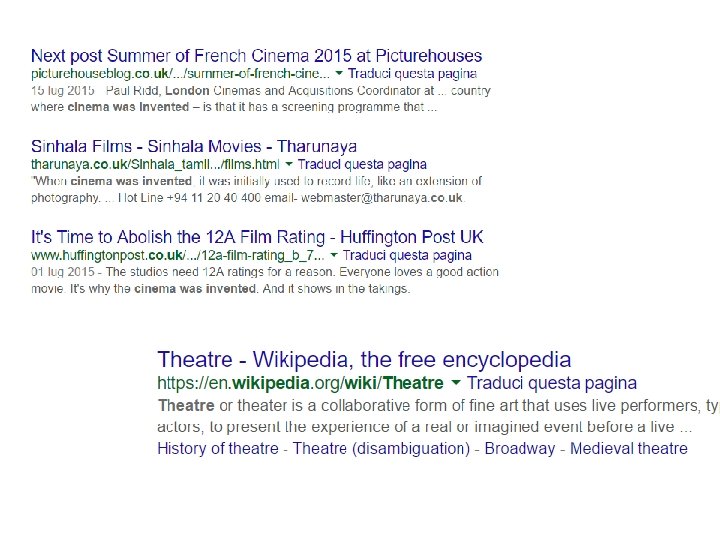
Determiners: translation problems 1 • Definite article used more frequently in Italian than English 1. General reference • • L’inquinamento > ___pollution (Essere) contro la guerra > against___ war Contro la guerra in Iraq > against the war on/to Iraq L'insegnante deve amare il suo lavoro > a teacher must love his/her job. 2. Instead of personal pronouns • Lavati le mani > wash your hands
1. Definite articles for general reference • However, in some cases English uses the definite article for general reference: – Animals/ plants the lion – Musical instruments the guitar – Scientific inventions/technology the radio – Some common expressions the town, the country(side), the sea(side), the snow. – Some adjectives referring to categories of people The young, the old, the rich, the poor, – Some nationalities the English, the Dutch, the Swiss, the Japanese
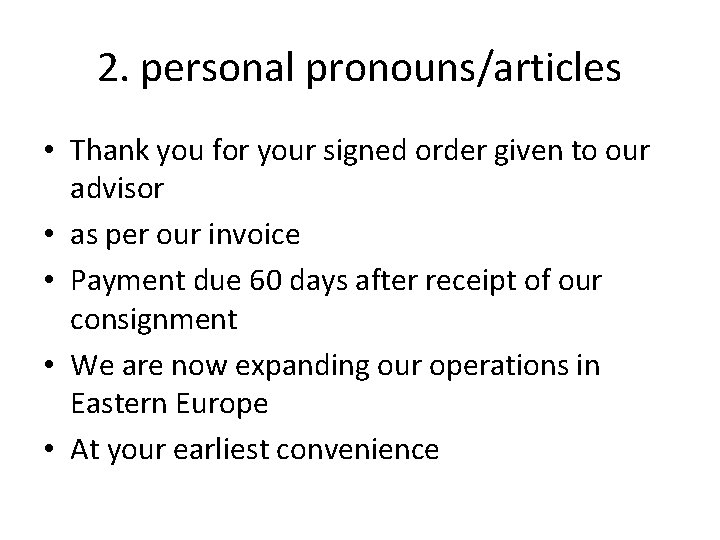
2. personal pronouns/articles • Thank you for your signed order given to our advisor • as per our invoice • Payment due 60 days after receipt of our consignment • We are now expanding our operations in Eastern Europe • At your earliest convenience
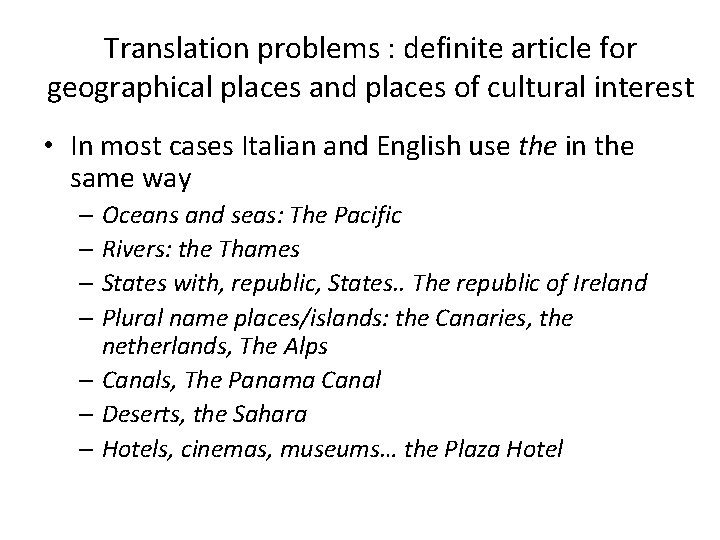
Translation problems : definite article for geographical places and places of cultural interest • In most cases Italian and English use the in the same way – Oceans and seas: The Pacific – Rivers: the Thames – States with, republic, States. . The republic of Ireland – Plural name places/islands: the Canaries, the netherlands, The Alps – Canals, The Panama Canal – Deserts, the Sahara – Hotels, cinemas, museums… the Plaza Hotel
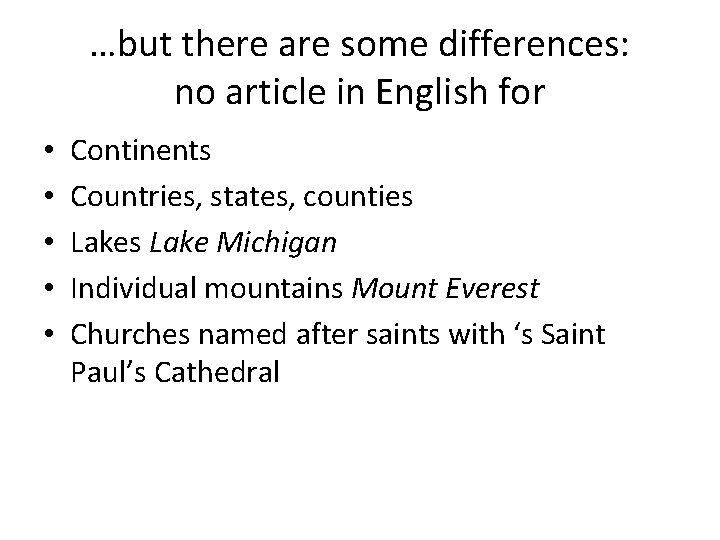
…but there are some differences: no article in English for • • • Continents Countries, states, counties Lake Michigan Individual mountains Mount Everest Churches named after saints with ‘s Saint Paul’s Cathedral
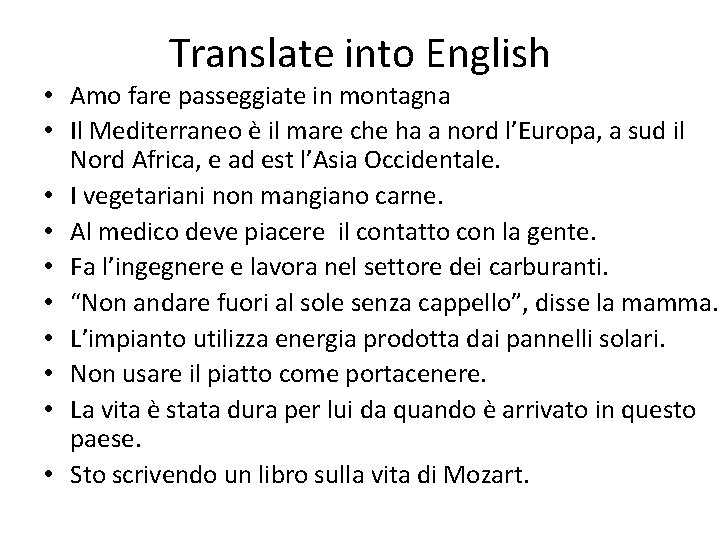
Translate into English • Amo fare passeggiate in montagna • Il Mediterraneo è il mare che ha a nord l’Europa, a sud il Nord Africa, e ad est l’Asia Occidentale. • I vegetariani non mangiano carne. • Al medico deve piacere il contatto con la gente. • Fa l’ingegnere e lavora nel settore dei carburanti. • “Non andare fuori al sole senza cappello”, disse la mamma. • L’impianto utilizza energia prodotta dai pannelli solari. • Non usare il piatto come portacenere. • La vita è stata dura per lui da quando è arrivato in questo paese. • Sto scrivendo un libro sulla vita di Mozart.
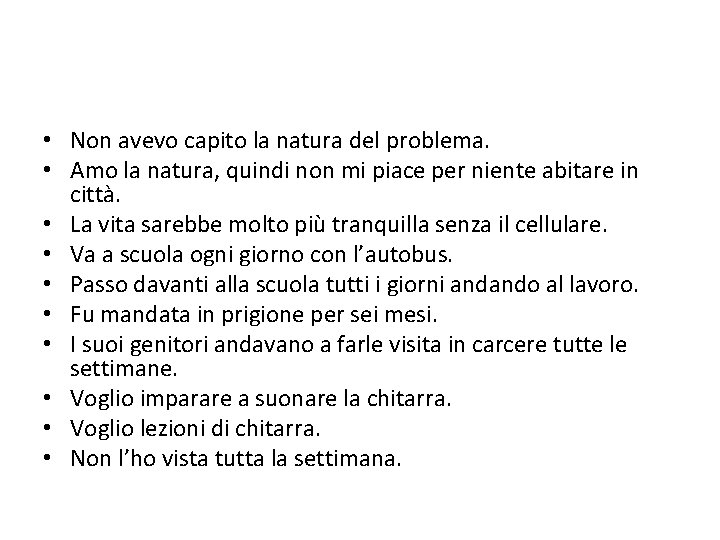
• Non avevo capito la natura del problema. • Amo la natura, quindi non mi piace per niente abitare in città. • La vita sarebbe molto più tranquilla senza il cellulare. • Va a scuola ogni giorno con l’autobus. • Passo davanti alla scuola tutti i giorni andando al lavoro. • Fu mandata in prigione per sei mesi. • I suoi genitori andavano a farle visita in carcere tutte le settimane. • Voglio imparare a suonare la chitarra. • Voglio lezioni di chitarra. • Non l’ho vista tutta la settimana.
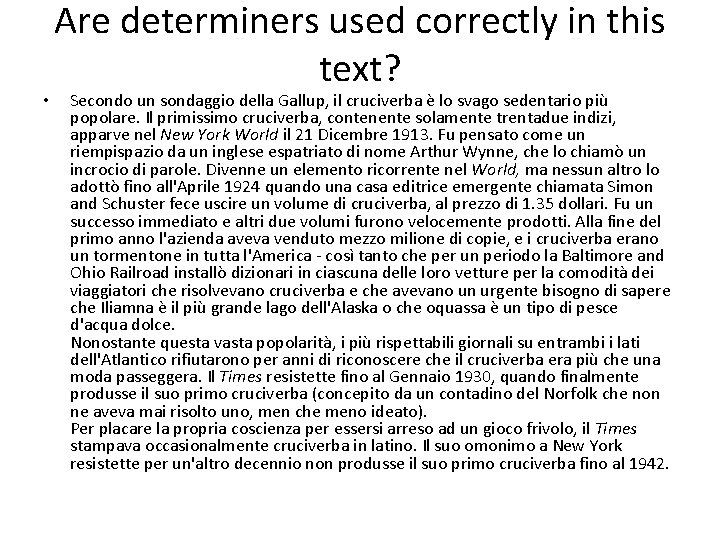
• Are determiners used correctly in this text? Secondo un sondaggio della Gallup, il cruciverba è lo svago sedentario più popolare. Il primissimo cruciverba, contenente solamente trentadue indizi, apparve nel New York World il 21 Dicembre 1913. Fu pensato come un riempispazio da un inglese espatriato di nome Arthur Wynne, che lo chiamò un incrocio di parole. Divenne un elemento ricorrente nel World, ma nessun altro lo adottò fino all'Aprile 1924 quando una casa editrice emergente chiamata Simon and Schuster fece uscire un volume di cruciverba, al prezzo di 1. 35 dollari. Fu un successo immediato e altri due volumi furono velocemente prodotti. Alla fine del primo anno l'azienda aveva venduto mezzo milione di copie, e i cruciverba erano un tormentone in tutta l'America - così tanto che per un periodo la Baltimore and Ohio Railroad installò dizionari in ciascuna delle loro vetture per la comodità dei viaggiatori che risolvevano cruciverba e che avevano un urgente bisogno di sapere che Iliamna è il più grande lago dell'Alaska o che oquassa è un tipo di pesce d'acqua dolce. Nonostante questa vasta popolarità, i più rispettabili giornali su entrambi i lati dell'Atlantico rifiutarono per anni di riconoscere che il cruciverba era più che una moda passeggera. Il Times resistette fino al Gennaio 1930, quando finalmente produsse il suo primo cruciverba (concepito da un contadino del Norfolk che non ne aveva mai risolto uno, men che meno ideato). Per placare la propria coscienza per essersi arreso ad un gioco frivolo, il Times stampava occasionalmente cruciverba in latino. Il suo omonimo a New York resistette per un'altro decennio non produsse il suo primo cruciverba fino al 1942.
- Slides: 15