
WOOF The Worlds First Opensource Outoforder Processor Raghu
- Slides: 1
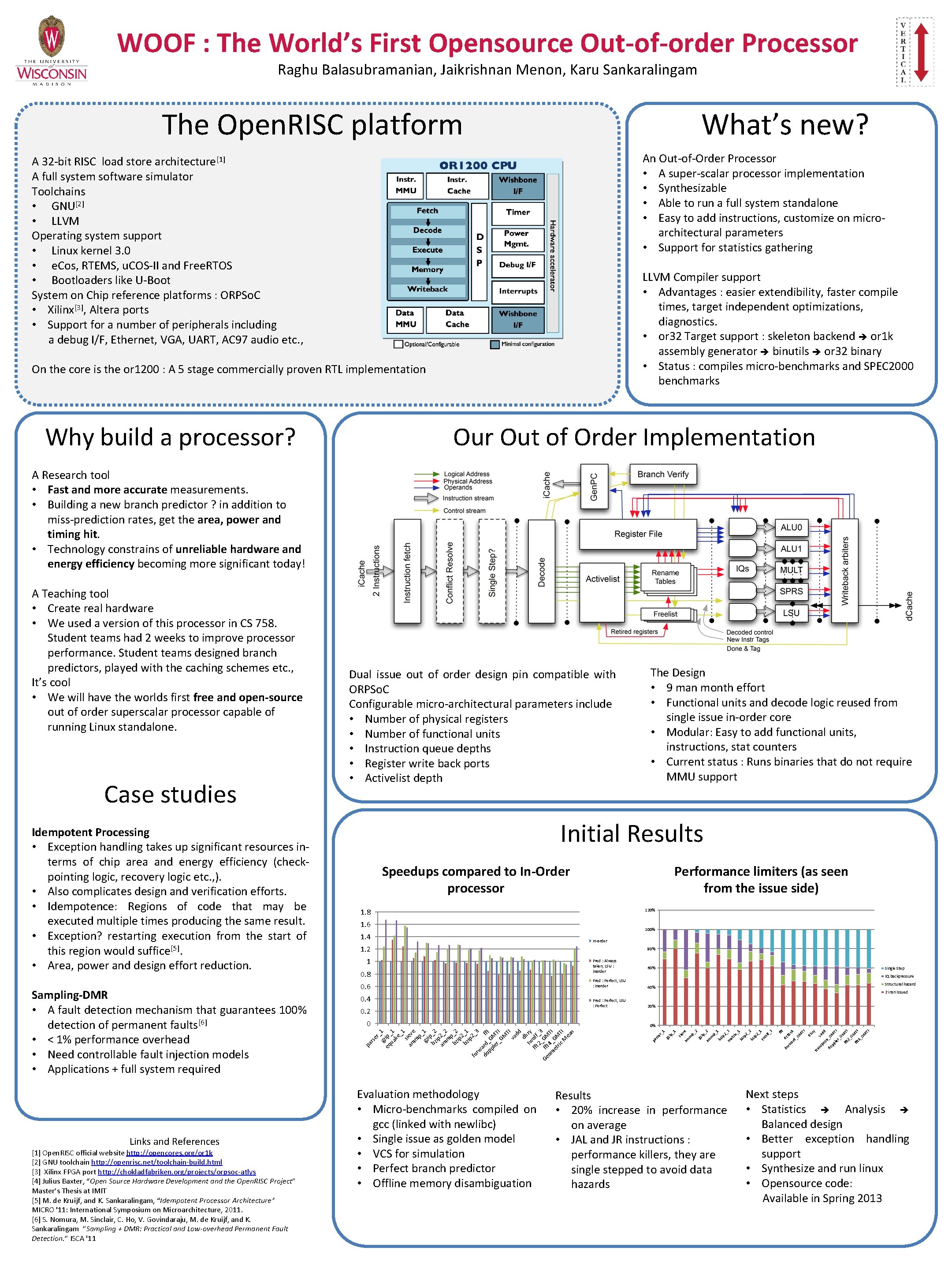
WOOF : The World’s First Opensource Out-of-order Processor Raghu Balasubramanian, Jaikrishnan Menon, Karu Sankaralingam The Open. RISC platform What’s new? An Out-of-Order Processor • A super-scalar processor implementation • Synthesizable • Able to run a full system standalone • Easy to add instructions, customize on microarchitectural parameters • Support for statistics gathering A 32 -bit RISC load store architecture[1] A full system software simulator Toolchains • GNU[2] • LLVM Operating system support • Linux kernel 3. 0 • e. Cos, RTEMS, u. COS-II and Free. RTOS • Bootloaders like U-Boot System on Chip reference platforms : ORPSo. C • Xilinx[3], Altera ports • Support for a number of peripherals including a debug I/F, Ethernet, VGA, UART, AC 97 audio etc. , LLVM Compiler support • Advantages : easier extendibility, faster compile times, target independent optimizations, diagnostics. • or 32 Target support : skeleton backend or 1 k assembly generator binutils or 32 binary • Status : compiles micro-benchmarks and SPEC 2000 benchmarks On the core is the or 1200 : A 5 stage commercially proven RTL implementation Our Out of Order Implementation Why build a processor? A Research tool • Fast and more accurate measurements. • Building a new branch predictor ? in addition to miss-prediction rates, get the area, power and timing hit. • Technology constrains of unreliable hardware and energy efficiency becoming more significant today! Links and References [1] Open. RISC official website http: //opencores. org/or 1 k [2] GNU toolchain http: //openrisc. net/toolchain-build. html [3] Xilinx FPGA port http: //chokladfabriken. org/projects/orpsoc-atlys [4] Julius Baxter, “Open Source Hardware Development and the Open. RISC Project” Master’s Thesis at IMIT [5] M. de Kruijf, and K. Sankaralingam, “Idempotent Processor Architecture” MICRO '11: International Symposium on Microarchitecture, 2011. [6] S. Nomura, M. Sinclair, C. Ho, V. Govindaraju, M. de Kruijf, and K. Sankaralingam ”Sampling + DMR: Practical and Low-overhead Permanent Fault Detection. ” ISCA '11 Initial Results Speedups compared to In-Order processor Performance limiters (as seen from the issue side) 1. 8 120% 1. 6 100% 1. 4 In-order 1. 2 80% 1 Pred : Always taken, LSU : inorder 0. 8 Pred : Perfect, LSU : inorder 0. 6 0. 4 Pred : Perfect, LSU : Perfect 0. 2 0 60% Single Step IQ backpressure Structural hazard 40% 2 insn issued 20% Evaluation methodology • Micro-benchmarks compiled on gcc (linked with newlibc) • Single issue as golden model • VCS for simulation • Perfect branch predictor • Offline memory disambiguation Results • 20% increase in performance on average • JAL and JR instructions : performance killers, they are single stepped to avoid data hazards T r_ I GM T fft 2_ I GM T fft 4_ I GM TI do pp le _G M va dd se po ns TI ry dh tra fo rw ar d _G M t 8 x 8 fft dc 2 gz ip _ am 2 m p_ 1 bz ip 2_ 3 m at rix _1 bz ip 2_ 2 bz ip 2_ 1 tw ol f_ 3 p_ m ve am sie _1 gz ip er _1 0% rs Sampling-DMR • A fault detection mechanism that guarantees 100% detection of permanent faults[6] • < 1% performance overhead • Need controllable fault injection models • Applications + full system required The Design • 9 man month effort • Functional units and decode logic reused from single issue in-order core • Modular: Easy to add functional units, instructions, stat counters • Current status : Runs binaries that do not require MMU support pa Idempotent Processing • Exception handling takes up significant resources interms of chip area and energy efficiency (checkpointing logic, recovery logic etc. , ). • Also complicates design and verification efforts. • Idempotence: Regions of code that may be executed multiple times producing the same result. • Exception? restarting execution from the start of this region would suffice[5]. • Area, power and design effort reduction. rs er _ gz 1 eq ip_ ua 1 ke _1 sie am ve m p_ gz 1 ip bz _2 ip am 2_2 m p bz _2 ip 2 bz _1 ip 2_ fo 3 rw a do rd fft pp _G le MT r_ I GM TI va dd d tw hry fft olf 2_ _3 Ge ff GM om t 4_ TI et GM ric T M I ea n Case studies Dual issue out of order design pin compatible with ORPSo. C Configurable micro-architectural parameters include • Number of physical registers • Number of functional units • Instruction queue depths • Register write back ports • Activelist depth pa A Teaching tool • Create real hardware • We used a version of this processor in CS 758. Student teams had 2 weeks to improve processor performance. Student teams designed branch predictors, played with the caching schemes etc. , It’s cool • We will have the worlds first free and open-source out of order superscalar processor capable of running Linux standalone. Next steps • Statistics Analysis Balanced design • Better exception handling support • Synthesize and run linux • Opensource code: Available in Spring 2013