
Wood Fasteners Joinery Adhesives Joinery The process of




- Slides: 13
Wood Fasteners, Joinery, & Adhesives
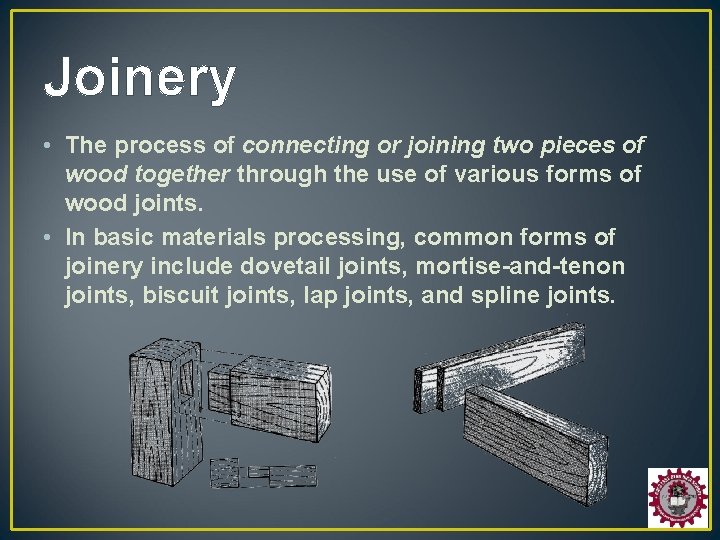
Joinery • The process of connecting or joining two pieces of wood together through the use of various forms of wood joints. • In basic materials processing, common forms of joinery include dovetail joints, mortise-and-tenon joints, biscuit joints, lap joints, and spline joints.
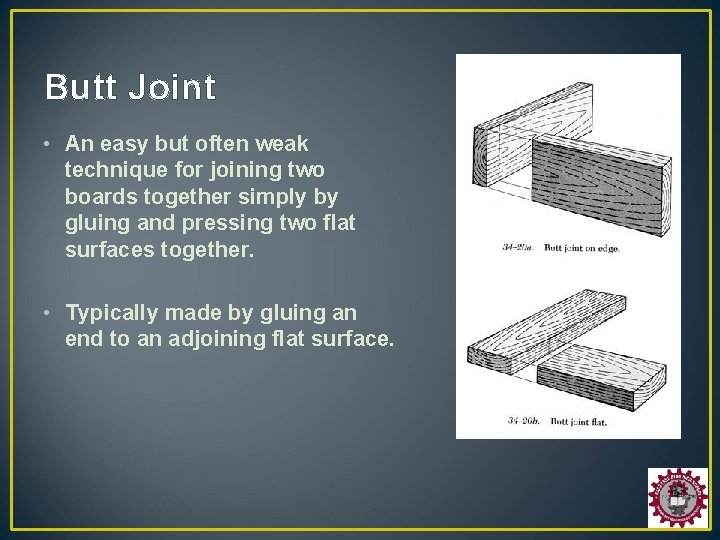
Butt Joint • An easy but often weak technique for joining two boards together simply by gluing and pressing two flat surfaces together. • Typically made by gluing an end to an adjoining flat surface.
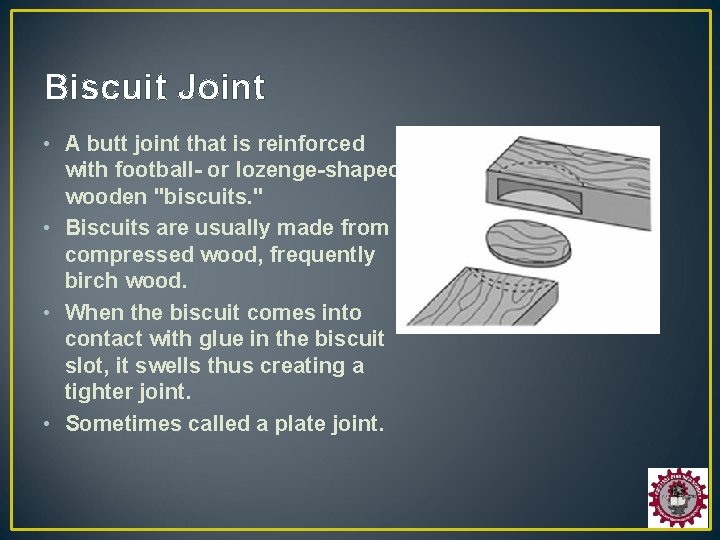
Biscuit Joint • A butt joint that is reinforced with football- or lozenge-shaped wooden "biscuits. " • Biscuits are usually made from compressed wood, frequently birch wood. • When the biscuit comes into contact with glue in the biscuit slot, it swells thus creating a tighter joint. • Sometimes called a plate joint.
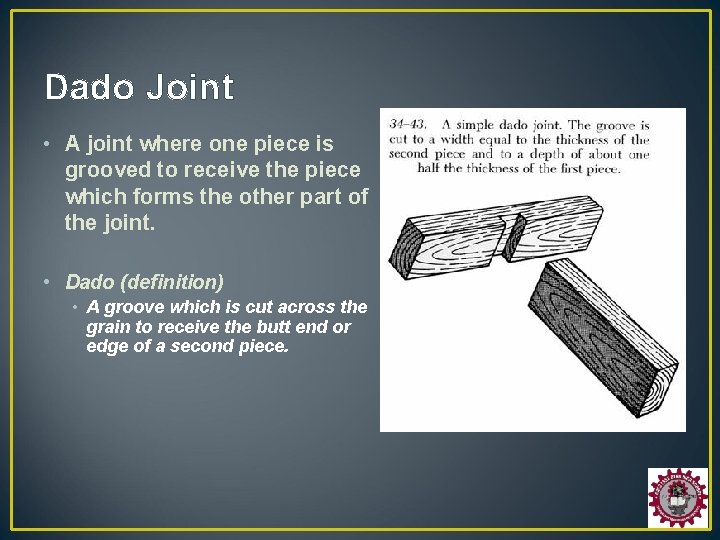
Dado Joint • A joint where one piece is grooved to receive the piece which forms the other part of the joint. • Dado (definition) • A groove which is cut across the grain to receive the butt end or edge of a second piece.
Dovetail Joint • Joining two boards in which alternating slots (or tails) and protrusions (or pins), each resembling in shape the vshaped outline of a bird's tail, are snugly fitted together, thus increasing the gluing area. • Produces a joint that, even without glue, can be difficult to pull apart. • Regarded as one of the strongest and most reliable forms of wood joinery.
Lap Joint • A joint where one piece of wood is crossed over another.
Miter Joint • The woodworking joint created when two boards are cut at an angle to one another. • The most common miter joint is the 45 -degree miter such as the cuts used to build square or rectangular picture frames.
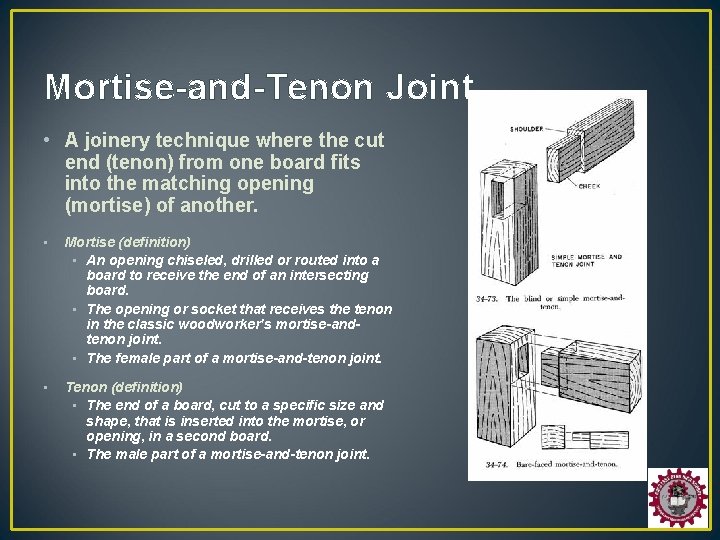
Mortise-and-Tenon Joint • A joinery technique where the cut end (tenon) from one board fits into the matching opening (mortise) of another. • Mortise (definition) • An opening chiseled, drilled or routed into a board to receive the end of an intersecting board. • The opening or socket that receives the tenon in the classic woodworker's mortise-andtenon joint. • The female part of a mortise-and-tenon joint. • Tenon (definition) • The end of a board, cut to a specific size and shape, that is inserted into the mortise, or opening, in a second board. • The male part of a mortise-and-tenon joint.
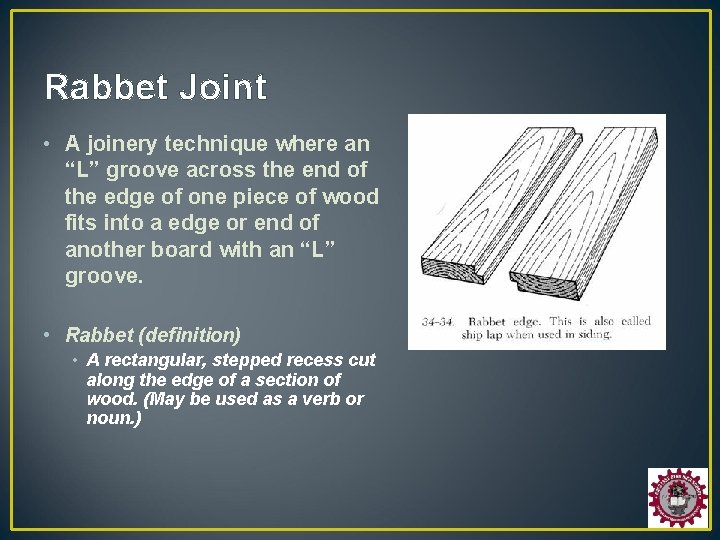
Rabbet Joint • A joinery technique where an “L” groove across the end of the edge of one piece of wood fits into a edge or end of another board with an “L” groove. • Rabbet (definition) • A rectangular, stepped recess cut along the edge of a section of wood. (May be used as a verb or noun. )
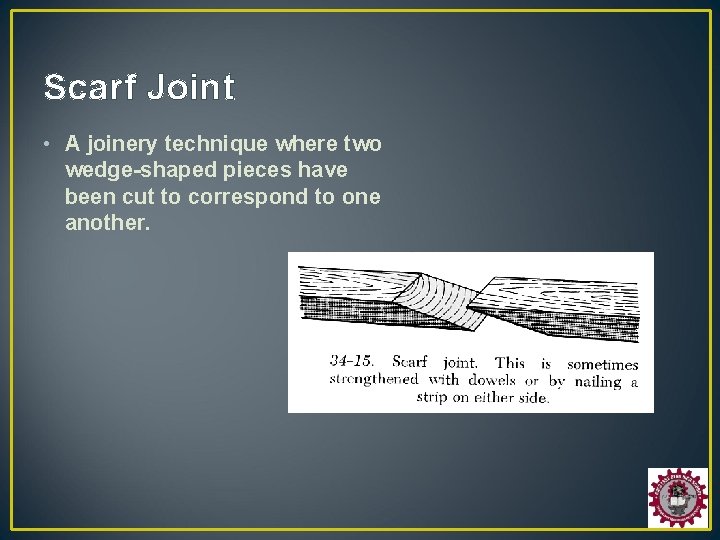
Scarf Joint • A joinery technique where two wedge-shaped pieces have been cut to correspond to one another.
Finger Joint • A joinery technique used mostly in industry where small “fingers” are cut into corresponding pieces that will be joined together. • Finger joints are used to making wide boards, in extending the length of dimensional lumber, and in laminated construction.
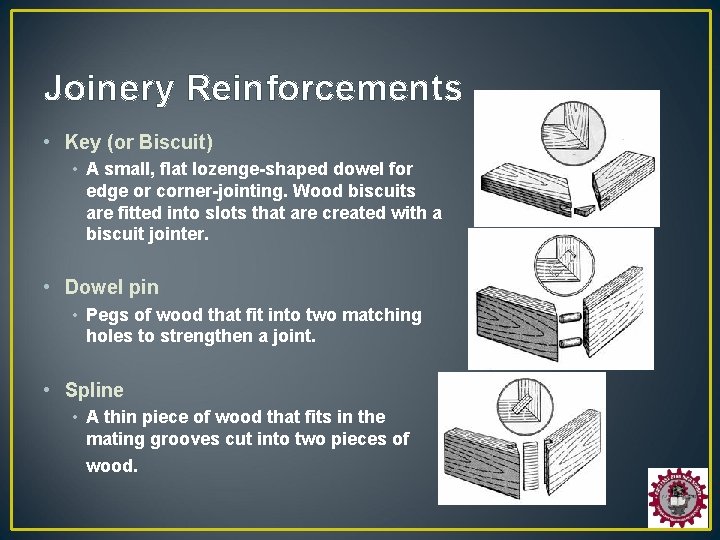
Joinery Reinforcements • Key (or Biscuit) • A small, flat lozenge-shaped dowel for edge or corner-jointing. Wood biscuits are fitted into slots that are created with a biscuit jointer. • Dowel pin • Pegs of wood that fit into two matching holes to strengthen a joint. • Spline • A thin piece of wood that fits in the mating grooves cut into two pieces of wood.