
Wood Construction Methods and Materials Wood History of
- Slides: 29
Wood Construction Methods and Materials Wood
History of the Lumber Wood is perhaps one of the oldest building materials. It is used extensively in the United States and Canada. Most wood used in construction comes from the Pacific Northwest; current practices call for replanting of harvested forests. Construction Methods and Materials Wood
Material Properties and Uses Most residential construction is accomplished with wood framing. Commercial structures are typically steel (stud) and concrete construction though can use wood if certain codes (sprinklers) are met. Construction Methods and Materials Wood
Hardwood Wood from a tree that looses its leaves annually; called deciduous. Examples: Oak, maple, cherry, and walnut. Construction Methods and Materials Wood
Softwood Wood from a coniferous (cone bearing) tree that retains its needles all year, often referred to as evergreen. Examples: Pine, spruce, and fir. Construction Methods and Materials Wood
Rough Lumber Wood that has been sawed, edged and trimmed but not dressed. Example: A 2 x 4 that is truly 2”x 4”. Construction Methods and Materials Wood
Dressed Lumber that has been surfaced on all four sides. Example: A 2 x 4 that is actually 1½” x 3½”. Construction Methods and Materials Wood
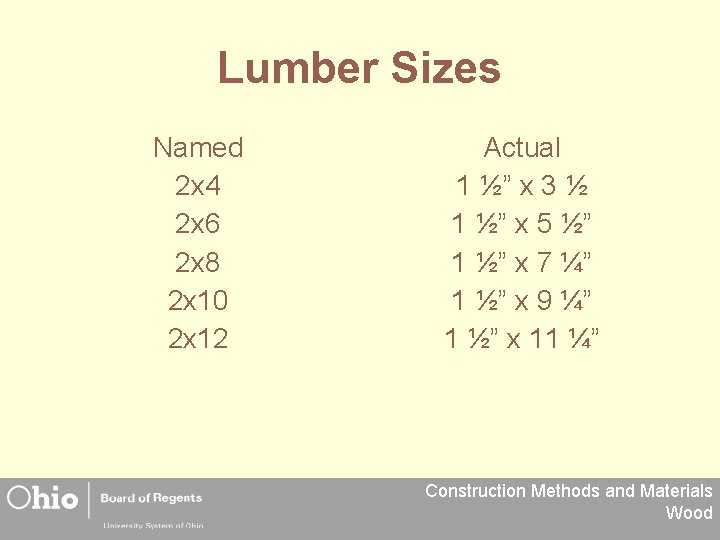
Lumber Sizes Named 2 x 4 2 x 6 2 x 8 2 x 10 2 x 12 Actual 1 ½” x 3 ½ 1 ½” x 5 ½” 1 ½” x 7 ¼” 1 ½” x 9 ¼” 1 ½” x 11 ¼” Construction Methods and Materials Wood
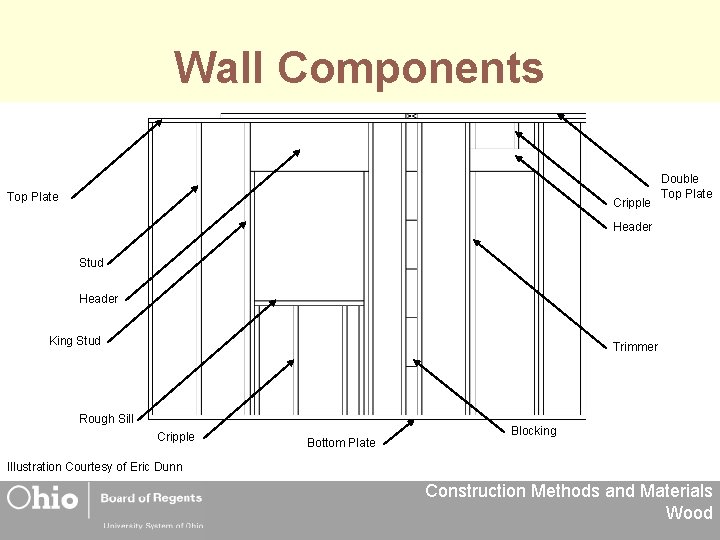
Wall Components Top Plate Cripple Double Top Plate Header Stud Header King Stud Trimmer Rough Sill Cripple Bottom Plate Blocking Illustration Courtesy of Eric Dunn Construction Methods and Materials Wood
Lumber Most interior and exterior walls are framed with 2 x 4 studs. Some exterior walls use 2 x 6 studs to allow for more insulation. 2 x 6 walls are used for waste plumbing walls where the added thickness of the wood allows for 1 ½” or 2” waste pipes. Construction Methods and Materials Wood
Floor Framing Girders Joists Decking Sills Joist Headers Bridging – every 8’ of span Usually joists are 16” on center (OC) sometimes 12”, 20”, 24”, 30” & 36” Construction Methods and Materials Wood
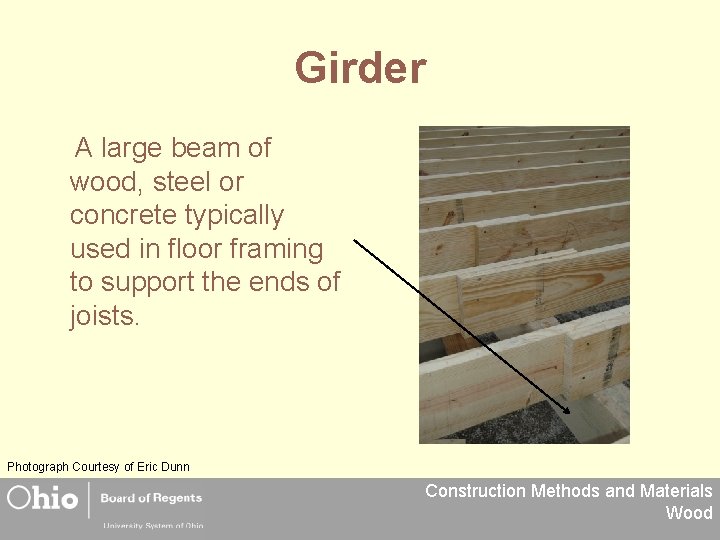
Girder A large beam of wood, steel or concrete typically used in floor framing to support the ends of joists. Photograph Courtesy of Eric Dunn Construction Methods and Materials Wood
Joist Parallel framing members that support a floor system. The subflooring is attached to the tops of these members. Construction Methods and Materials Wood
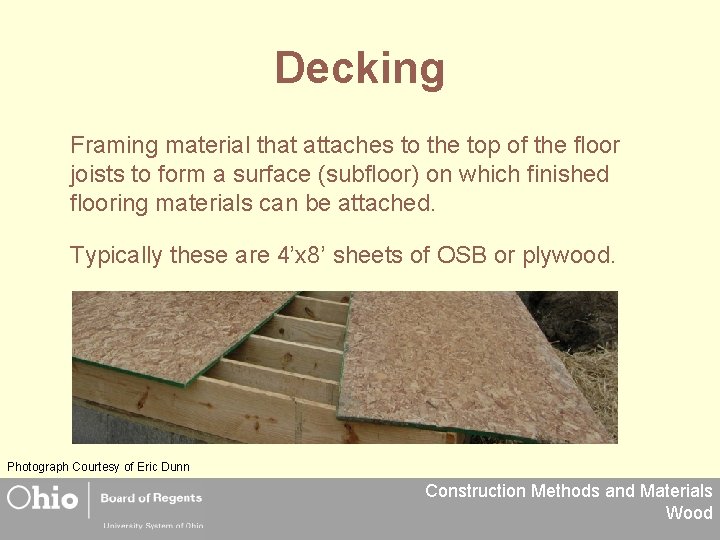
Decking Framing material that attaches to the top of the floor joists to form a surface (subfloor) on which finished flooring materials can be attached. Typically these are 4’x 8’ sheets of OSB or plywood. Photograph Courtesy of Eric Dunn Construction Methods and Materials Wood
Sheathing Framing material that attaches to the exterior wall framing for strength and as a medium for attaching the finished siding material (vinyl siding/bricks/etc. ). The term is also used for the medium that attaches to the top of rafters or trusses to which shingles will eventually be applied. Typically these are 4’x 8’ sheets of OSB or plywood. Construction Methods and Materials Wood
Rough Sill A horizontal framing member that lies directly underneath a window or opening that distributes the weight of the window to the wall framing members. Construction Methods and Materials Wood
Header A built up framing member that spans an opening (door or window) to transfer weight from above to wall framing around the door or window. Construction Methods and Materials Wood
Headers distribute weight around opening Two pieces of lumber with a piece of ½” plywood/OSB sandwiched in between Headers sit on top of the trimmers If the opening is greater than 6’, two trimmers should be used Not required on non-load bearing walls (check specs) Construction Methods and Materials Wood
Bridging Framing members between floor joists that help distribute weight from the floor loads to the next parallel joist and help prevent the joists from twisting. Bridging can be metal, solid wood or cross wood bracing. Construction Methods and Materials Wood
Engineered Lumber that is manufactured using pieces of wood glued and pressed together. Typically these engineered pieces are larger and stronger than natural materials would be allowing for longer spans and greater weight support. Examples: Glulam, LVL, I-Joist Construction Methods and Materials Wood
Roof Framing Most roof framing is accomplished with prefabricated trusses. Sheathing is calculated the same as decking – remember the slope of the roof. Some portions of roof might need to be stick framed – use appropriate size lumber – usually 2 x 6 minimum. If stick frame roof, be sure to include ceiling joists and collar ties, soffits and fascia. Construction Methods and Materials Wood
Rafter A framing member used in parallel with other rafters to form a sloped surface for a roof. Rafters are cut on site. Construction Methods and Materials Wood
Truss A manufactured building component used in roof framing that is built of several smaller pieces, typically in a triangular configuration for strength. Trusses allow a reduction in labor on site. Construction Methods and Materials Wood
Wood Trim comes in numerous shapes and sizes and includes Baseboard Toe mold Window casing Door casing Time and money can be saved by buying primed trim if the trim is to be painted. Construction Methods and Materials Wood
Baseboard Trim material that follows the wall where the floor and wall meet. Different profiles are used based on the style of the building. This material can be wood, plastic or composite. Construction Methods and Materials Wood
Casing Finish trim material that encircles a window or door opening. Different profiles are used based on the style of the building. This can be wood, plastic or composite. Construction Methods and Materials Wood
Board Foot Some lumber is purchased, priced and sold by the thousand feet-board measure: mfbm One board foot is equal to a piece of wood 1” thick and 1’ wide by 1’ long. Use nominal size (size before dressed). Construction Methods and Materials Wood
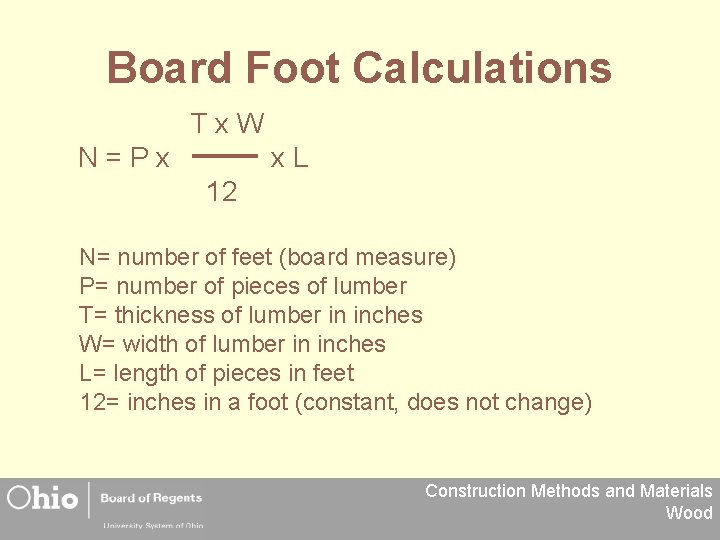
Board Foot Calculations Tx. W N=Px x. L 12 N= number of feet (board measure) P= number of pieces of lumber T= thickness of lumber in inches W= width of lumber in inches L= length of pieces in feet 12= inches in a foot (constant, does not change) Construction Methods and Materials Wood
Additional Information National Hardwood Association The Engineered Wood Association Engineered Wood Products Association U. S. Green Building Council Ohio 2007 Residential Building Codes American Chemistry Council Construction Methods and Materials Wood