
WOMENS SUFFRAGE FEMINISM Womens Suffrage Definition the right





- Slides: 18
WOMEN’S SUFFRAGE & FEMINISM
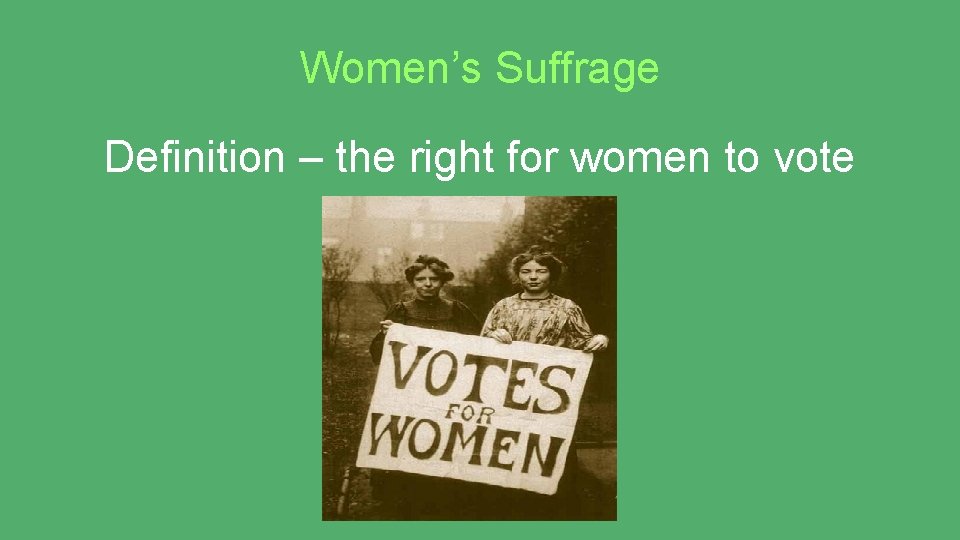
Women’s Suffrage Definition – the right for women to vote
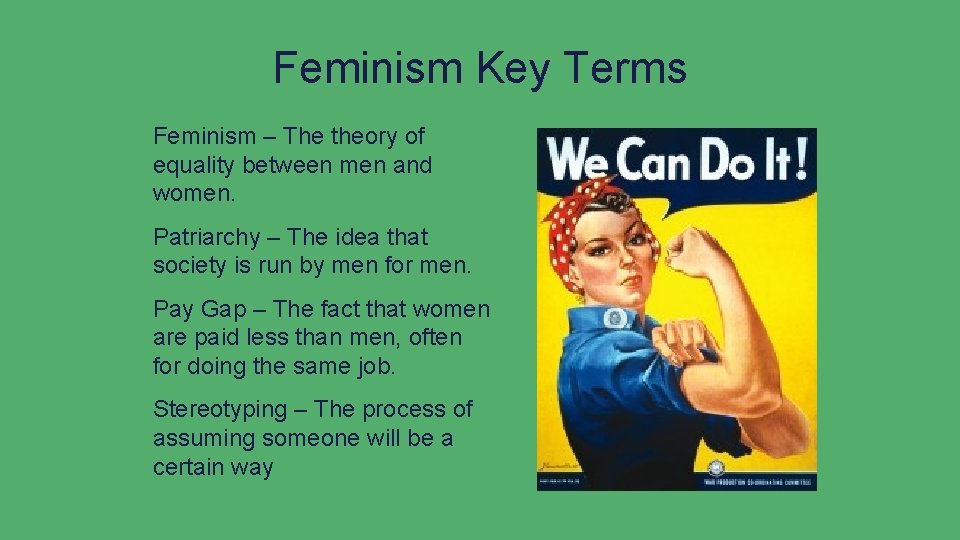
Feminism Key Terms Feminism – The theory of equality between men and women. Patriarchy – The idea that society is run by men for men. Pay Gap – The fact that women are paid less than men, often for doing the same job. Stereotyping – The process of assuming someone will be a certain way
Brain Teaser A man and his son are driving in a car when it crashes, killing the father instantly. The boy is rushed to hospital and sent into surgery. The surgeon takes one look at him and says: “I can’t operate on him, he’s my son!” How is this possible? Answer: The surgeon is the boys mother.
With your neighbor, discuss the following: Do you think issues of equality for women applies today?
Kate Chopin Some scholars consider Kate Chopin as a forerunner of American 20 th century feminist authors.
+ “The Story of an Hour” By Kate Chopin
+ Kate Chopin n She is an American writer of short stories and novels. n Chopin wrote about issues concerning women long before the feminist movement. n She had a free independent spirit. Chopin did not care much about the strict rules of society. n Just like her protagonist, Chopin’s husband died unexpectedly. She mourned and felt his loss; but no sooner did she embrace her independence.
Analysis + n Plot (closed): In one hour, we meet Louise Mallard who learns about the death of her husband from a train crash. She is sad and in despair; but no sooner does she realize her freedom. However, her “supposedly” dead husband shows up suddenly and she dies out of shock (not joy). l Characters: Louise Mallard (major) Brently Mallard, Josephine, Richards (minor) l Setting: - Place: The Mallard’s house - Time: An hour (around 1894)
+ . n Themes: - The hidden joy of independence. - Time (in such a short period, so much can happen) - Words and Communication (the way news is delivered is more important than the news itself) - Death (the supposed death of her husband made her alive and cheerful; but when he turned out to be alive, she died. ) l Narration: Third person omniscient (the narrator takes the reader into the mind and feelings of Louise)
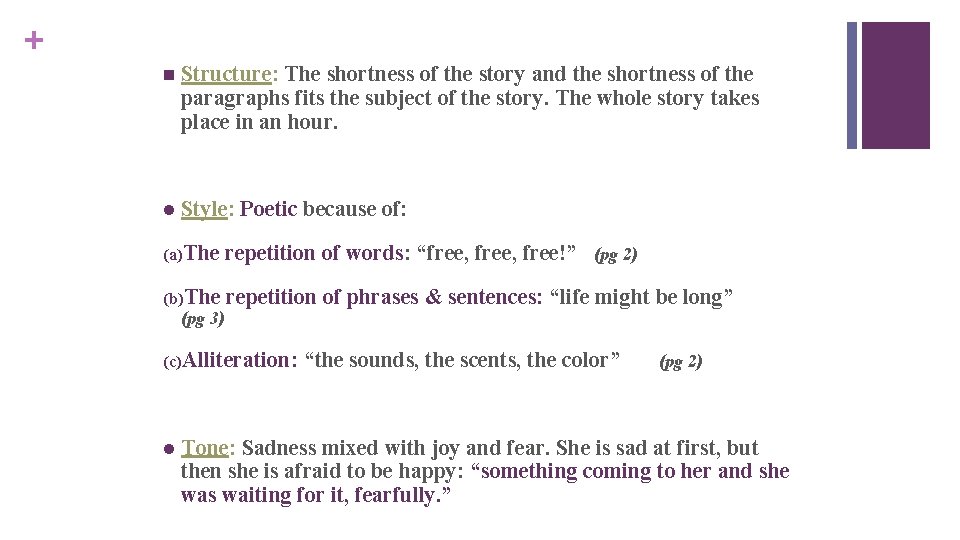
+ . n Structure: The shortness of the story and the shortness of the paragraphs fits the subject of the story. The whole story takes place in an hour. l Style: Poetic because of: (a)The repetition of words: “free, free!” (pg 2) (b)The repetition of phrases & sentences: “life might be long” (pg 3) (c)Alliteration: l “the sounds, the scents, the color” (pg 2) Tone: Sadness mixed with joy and fear. She is sad at first, but then she is afraid to be happy: “something coming to her and she was waiting for it, fearfully. ”
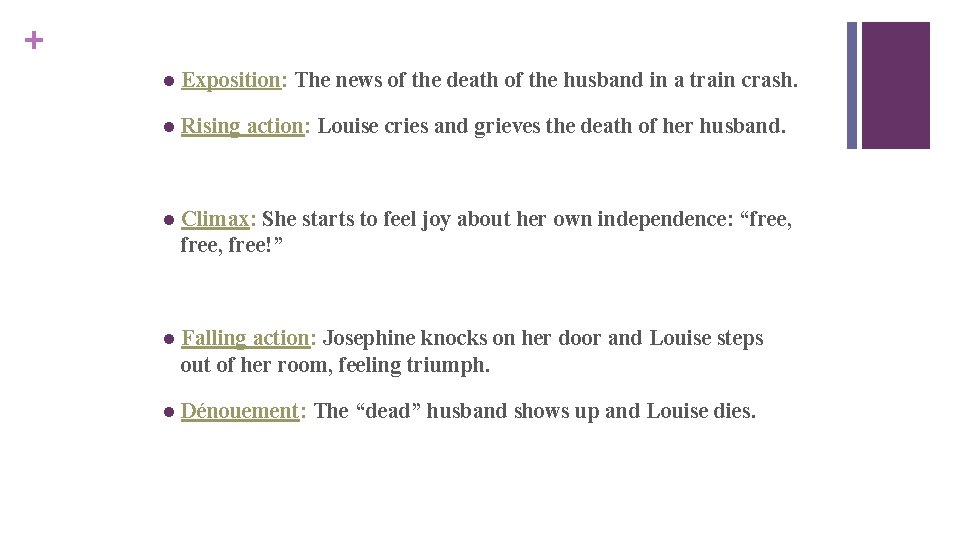
+ . l Exposition: The news of the death of the husband in a train crash. l Rising action: Louise cries and grieves the death of her husband. l Climax: She starts to feel joy about her own independence: “free, free!” l Falling action: Josephine knocks on her door and Louise steps out of her room, feeling triumph. l Dénouement: The “dead” husband shows up and Louise dies.
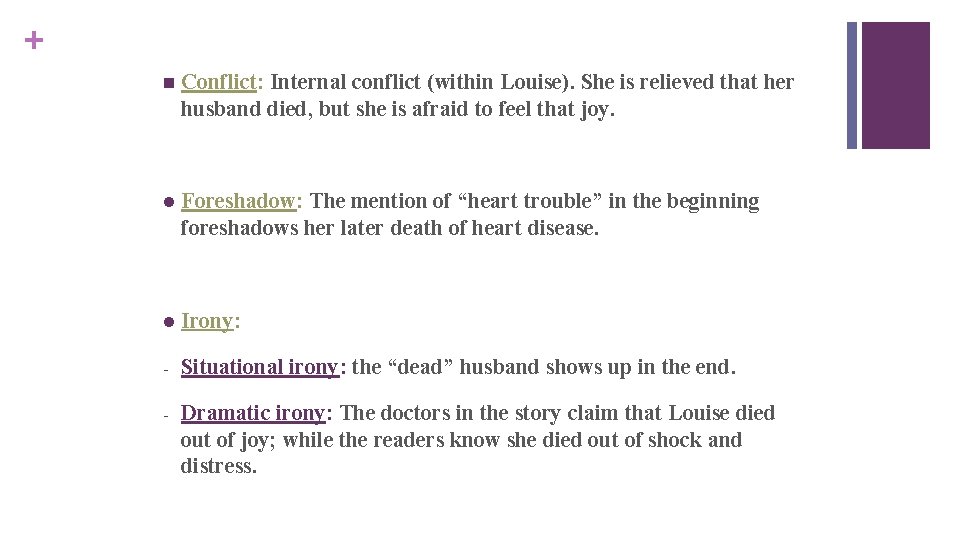
+ . n Conflict: Internal conflict (within Louise). She is relieved that her husband died, but she is afraid to feel that joy. l Foreshadow: The mention of “heart trouble” in the beginning foreshadows her later death of heart disease. l Irony: - Situational irony: the “dead” husband shows up in the end. - Dramatic irony: The doctors in the story claim that Louise died out of joy; while the readers know she died out of shock and distress.
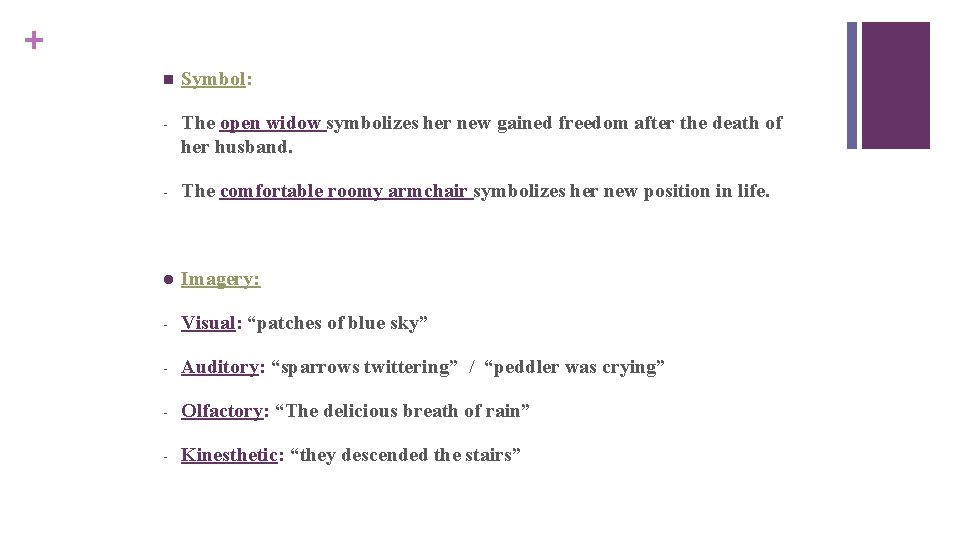
+ . n Symbol: - The open widow symbolizes her new gained freedom after the death of her husband. - The comfortable roomy armchair symbolizes her new position in life. l Imagery: - Visual: “patches of blue sky” - Auditory: “sparrows twittering” / “peddler was crying” - Olfactory: “The delicious breath of rain” - Kinesthetic: “they descended the stairs”
+ Important Quotations n “And yet she had loved him … … impulse of her being!” (pg. 2) n Some one was opening … … of joy that kills. ” (pg. 3)