
Womenomics GenderInclusive Software Margaret Burnett Oregon State University
"Womenomics" & Gender-Inclusive Software Margaret Burnett Oregon State University October 2017 #gendermag
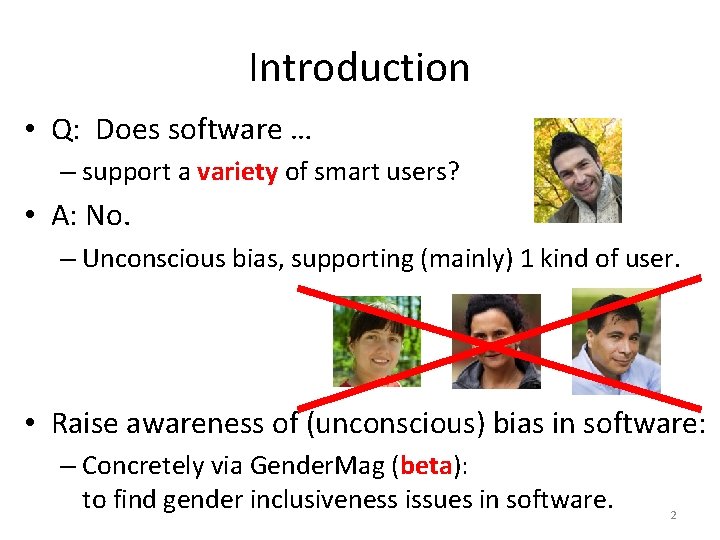
Introduction • Q: Does software … – support a variety of smart users? • A: No. – Unconscious bias, supporting (mainly) 1 kind of user. • Raise awareness of (unconscious) bias in software: – Concretely via Gender. Mag (beta): to find gender inclusiveness issues in software. 2
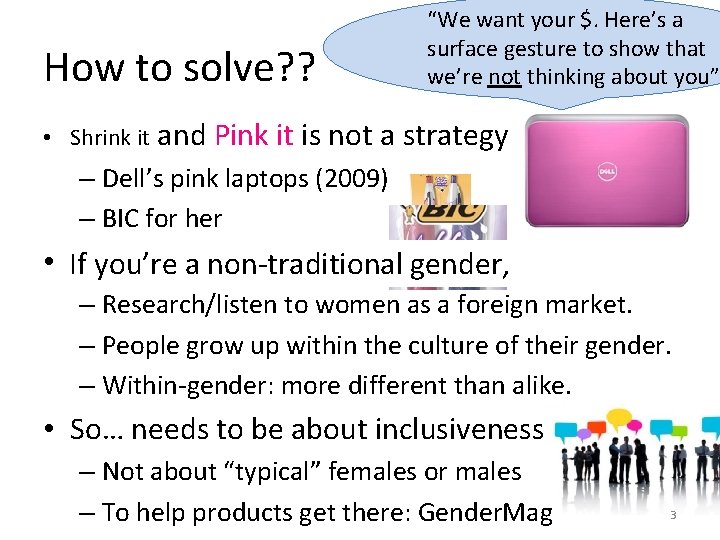
How to solve? ? “We want your $. Here’s a surface gesture to show that we’re not thinking about you” • Shrink it and Pink it is not a strategy – Dell’s pink laptops (2009) – BIC for her • If you’re a woman, If you’re a man: If you’re a non-traditional gender, – Research/listen to women as a foreign market. – People grow up within the culture of their gender. – Within-gender: more different than alike. • So… needs to be about inclusiveness – Not about “typical” females or males – To help products get there: Gender. Mag 3
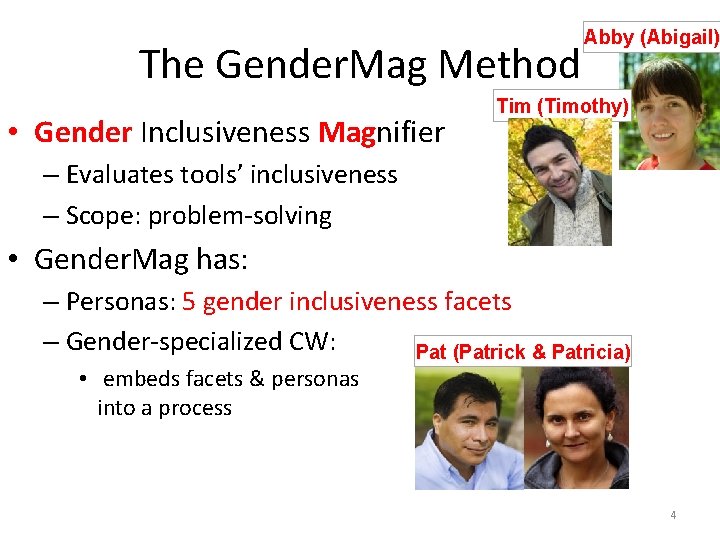
The Gender. Mag Method • Gender Inclusiveness Magnifier Abby (Abigail) Tim (Timothy) – Evaluates tools’ inclusiveness – Scope: problem-solving • Gender. Mag has: – Personas: 5 gender inclusiveness facets – Gender-specialized CW: Pat (Patrick & Patricia) • embeds facets & personas into a process 4
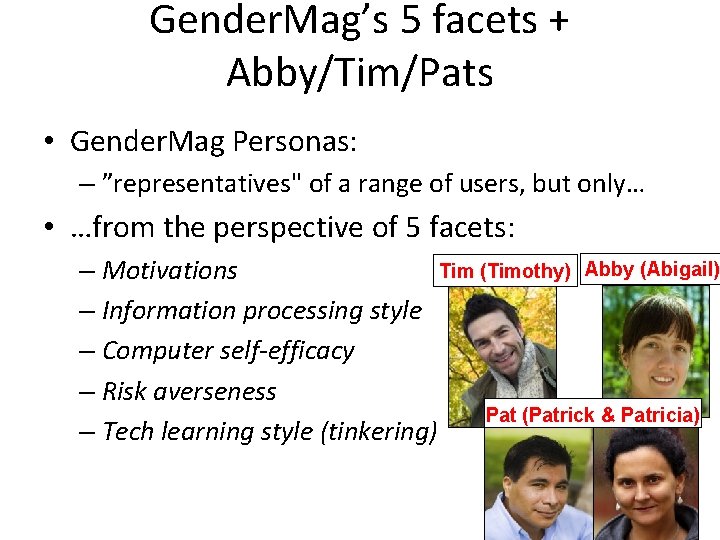
Gender. Mag’s 5 facets + Abby/Tim/Pats • Gender. Mag Personas: – ”representatives" of a range of users, but only… • …from the perspective of 5 facets: Tim (Timothy) Abby (Abigail) – Motivations – Information processing style – Computer self-efficacy – Risk averseness Pat (Patrick & Patricia) – Tech learning style (tinkering) 5
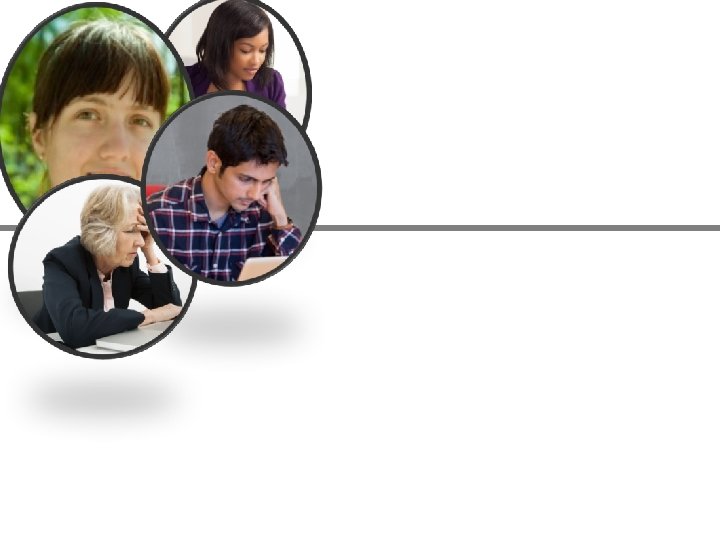
abby
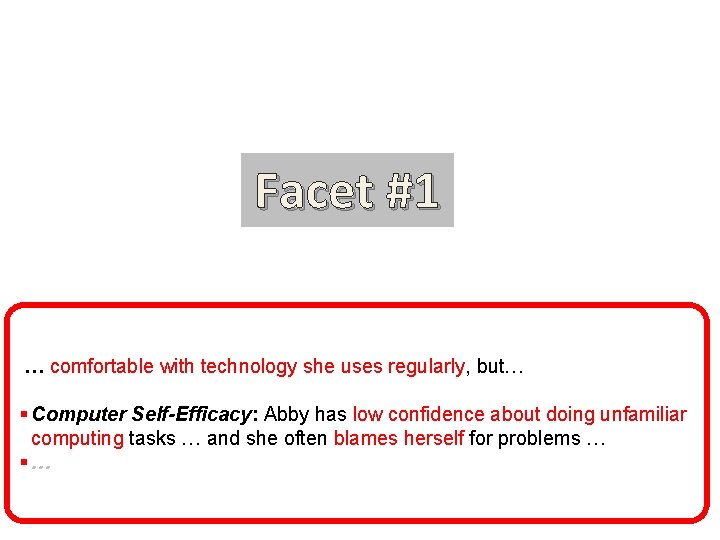
abby-Self-Efficacy Facet #1 … comfortable with technology she uses regularly, but… § Computer Self-Efficacy: Abby has low confidence about doing unfamiliar computing tasks … and she often blames herself for problems … §…
![Computer self-efficacy [Bandura] • A form of self-confidence: – W. r. t. a specific](http://slidetodoc.com/presentation_image/204c66de974c1754dbeb6e3182d02b6c/image-8.jpg "Computer self-efficacy [Bandura] • A form of self-confidence: – W. r. t. a specific")
Computer self-efficacy [Bandura] • A form of self-confidence: – W. r. t. a specific task. – A general theory. • Predictive of: – Willingness to try, perseverance, … • Literature: – Females lower computer self-efficacy than their male peers [Beckwith, Burnett, Hartzell …]
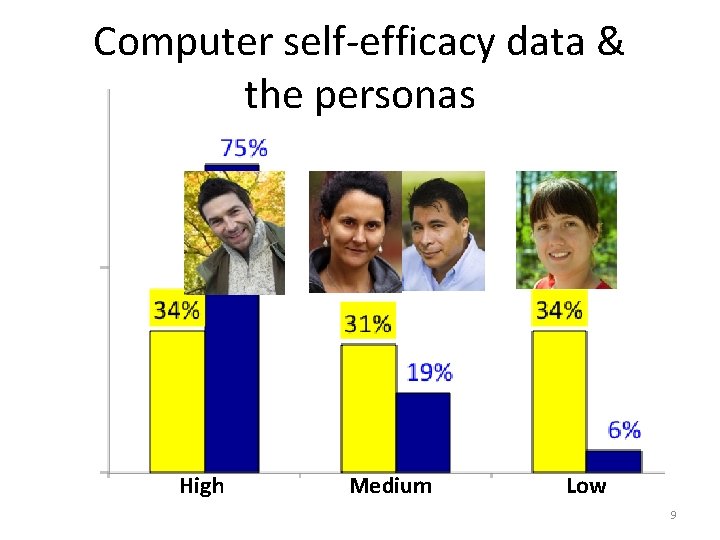
Computer self-efficacy data & the personas High Medium Low 9
![Features + self-efficacy [Beckwith] • Type familiar: formula edits. • Type taught: √, ->.](http://slidetodoc.com/presentation_image/204c66de974c1754dbeb6e3182d02b6c/image-10.jpg "Features + self-efficacy [Beckwith] • Type familiar: formula edits. • Type taught: √, ->.")
Features + self-efficacy [Beckwith] • Type familiar: formula edits. • Type taught: √, ->. • Type untaught: X.
![Confidence and features [Beckwith] • Self-efficacy as a predictor of effective use: – F](http://slidetodoc.com/presentation_image/204c66de974c1754dbeb6e3182d02b6c/image-11.jpg "Confidence and features [Beckwith] • Self-efficacy as a predictor of effective use: – F")
Confidence and features [Beckwith] • Self-efficacy as a predictor of effective use: – F lower computer self-efficacy than M. – F: self-efficacy mattered to willingness to use new features. (Not so for M). 11
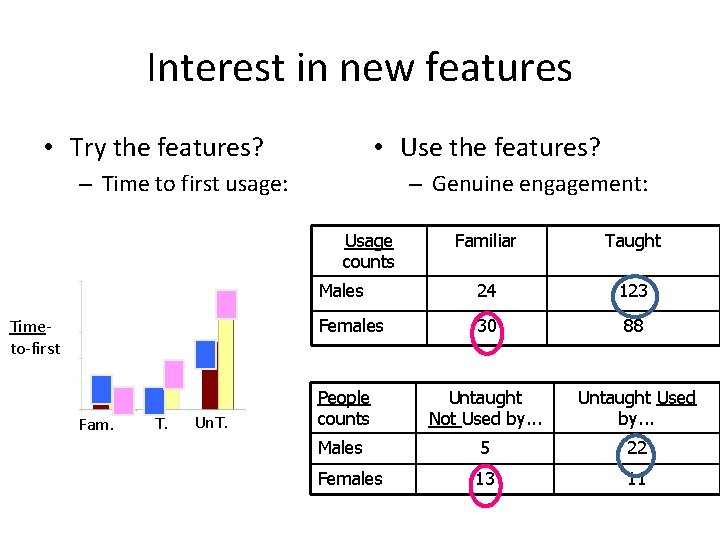
Interest in new features • Try the features? • Use the features? – Time to first usage: – Genuine engagement: Usage counts Timeto-first Fam. T. Un. T. Familiar Taught Males 24 123 Females 30 88 People counts Untaught Not Used by. . . Untaught Used by. . . Males 5 22 Females 13 11
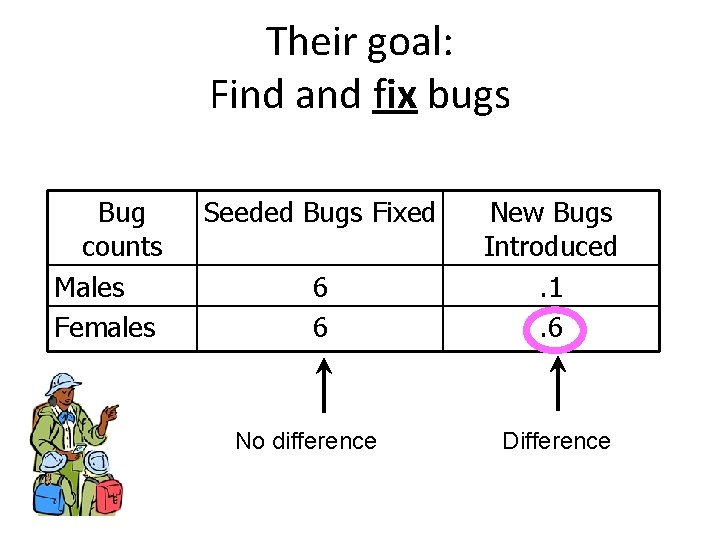
Their goal: Find and fix bugs Bug counts Males Females Seeded Bugs Fixed 6 6 No difference New Bugs Introduced. 1. 6 Difference
Pausing our Story: What Changes Can We Make?
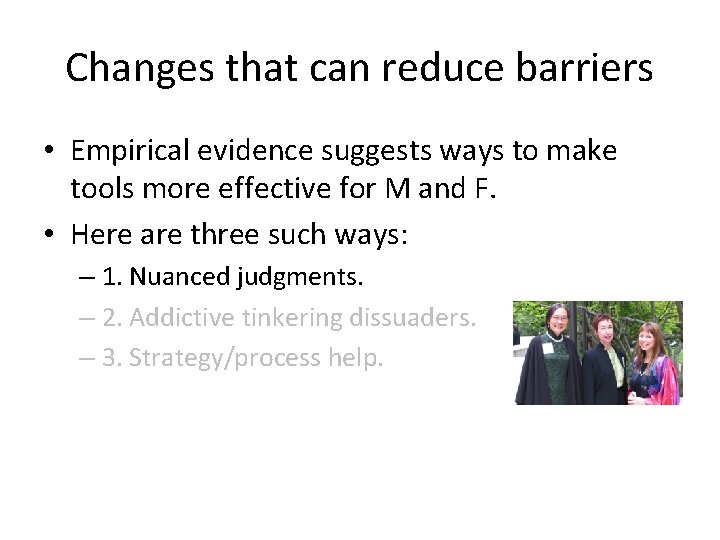
Changes that can reduce barriers • Empirical evidence suggests ways to make tools more effective for M and F. • Here are three such ways: – 1. Nuanced judgments. – 2. Addictive tinkering dissuaders. – 3. Strategy/process help.
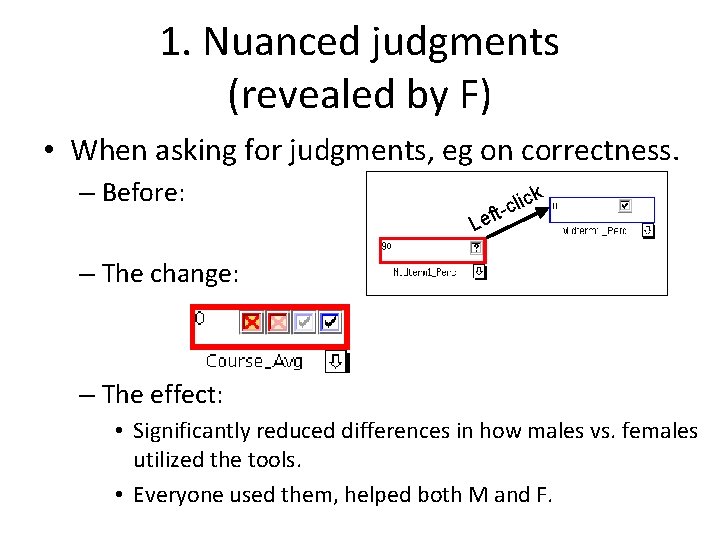
1. Nuanced judgments (revealed by F) • When asking for judgments, eg on correctness. – Before: ck i l c ft- Le – The change: – The effect: • Significantly reduced differences in how males vs. females utilized the tools. • Everyone used them, helped both M and F.
And Now, Back to Abby and the Facets
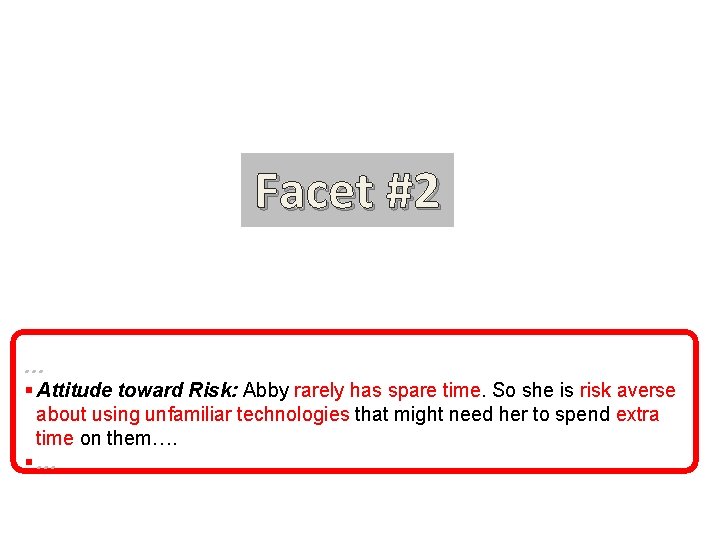
abby: risk Facet #2 … § Attitude toward Risk: Abby rarely has spare time. So she is risk averse about using unfamiliar technologies that might need her to spend extra time on them…. §…
Risk 19
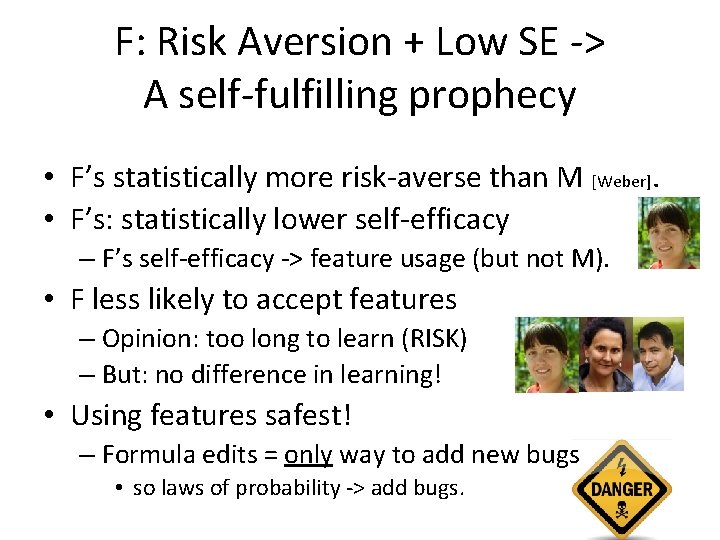
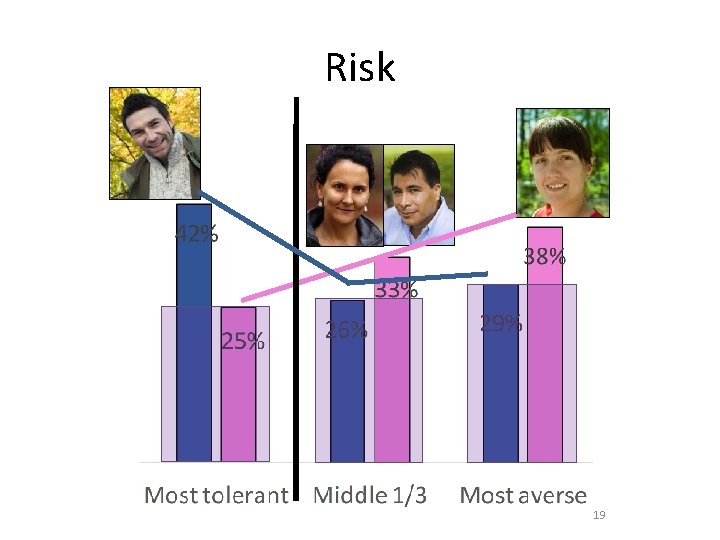
F: Risk Aversion + Low SE -> A self-fulfilling prophecy • F’s statistically more risk-averse than M [Weber]. • F’s: statistically lower self-efficacy – F’s self-efficacy -> feature usage (but not M). • F less likely to accept features – Opinion: too long to learn (RISK) – But: no difference in learning! • Using features safest! – Formula edits = only way to add new bugs • so laws of probability -> add bugs.
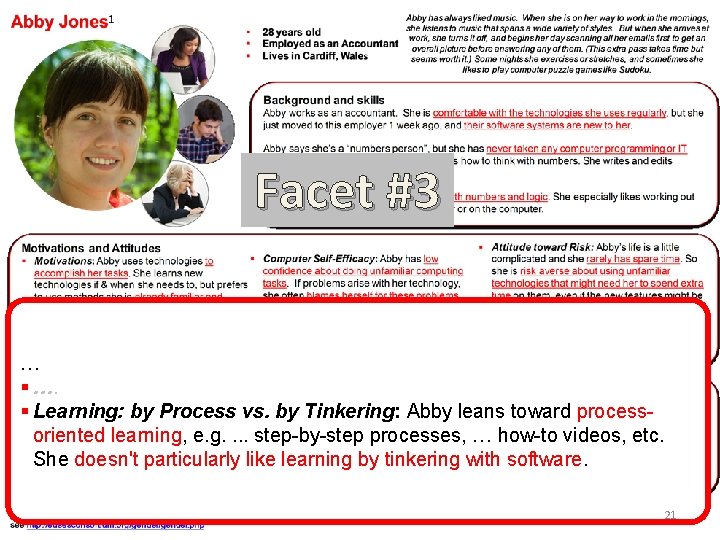
Abby: tinkering/ways of learning tech Facet #3 … § …. § Learning: by Process vs. by Tinkering: Abby leans toward processoriented learning, e. g. . step-by-step processes, … how-to videos, etc. She doesn't particularly like learning by tinkering with software. 21
![Tech Learning: by Tinkering? [Beckwith, Burnett] • Females’ tinkering to learn: – Males: •](http://slidetodoc.com/presentation_image/204c66de974c1754dbeb6e3182d02b6c/image-22.jpg "Tech Learning: by Tinkering? [Beckwith, Burnett] • Females’ tinkering to learn: – Males: •")
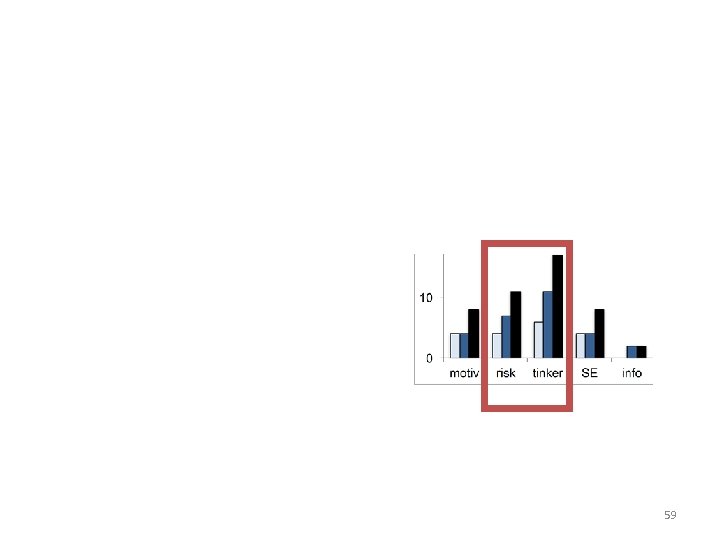
Tech Learning: by Tinkering? [Beckwith, Burnett] • Females’ tinkering to learn: – Males: • Tinkered less. • Prefer other ways of learning tech. • Tinkering “pausefully” • Tinkered more. • Sometimes pauseful too… • but sometimes went crazy. – When went crazy, it hurt. • But when F did tinker, was “pauseful”. • Education literature: pauses improve critical thinking • Our results: pauses predictive of … – Understanding – Effective use of these features Females Males 22
Pausing our Story Again: What Changes? (cont. )
Changes that can reduce barriers • Empirical evidence suggests ways to make tools more effective for M and F. • Here are three such ways: – 1. Nuanced judgments. – 2. Addictive tinkering dissuaders. – 3. Strategy/process help.
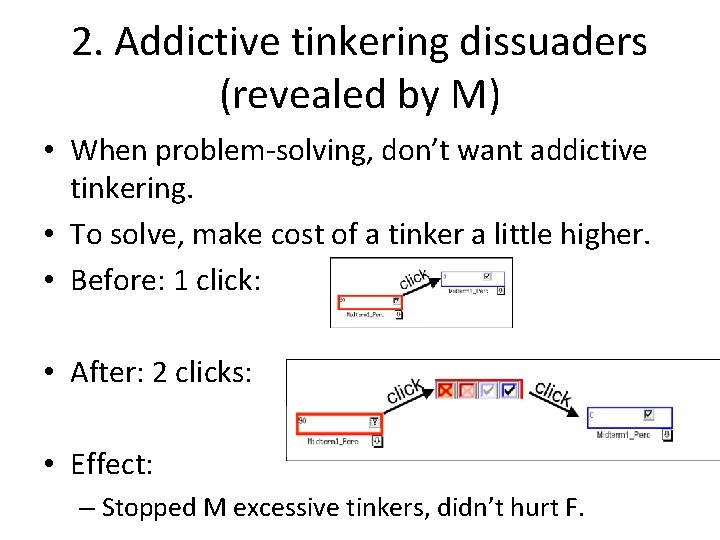
2. Addictive tinkering dissuaders (revealed by M) • When problem-solving, don’t want addictive tinkering. • To solve, make cost of a tinker a little higher. • Before: 1 click: • After: 2 clicks: • Effect: – Stopped M excessive tinkers, didn’t hurt F.
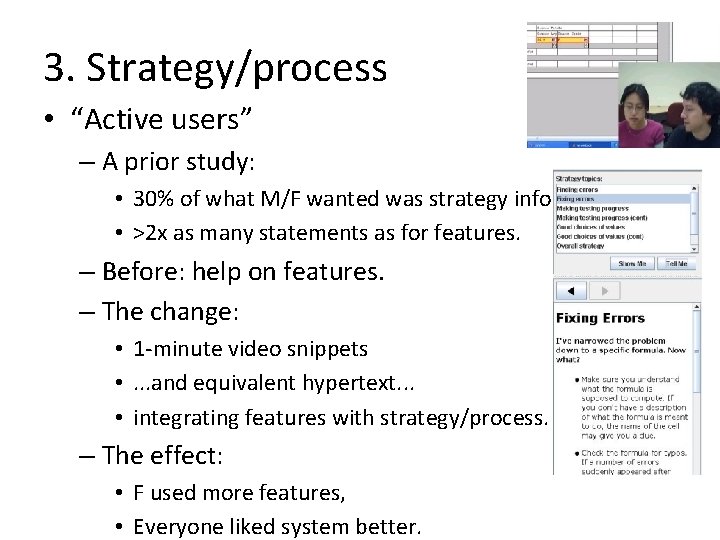
3. Strategy/process • “Active users” – A prior study: • 30% of what M/F wanted was strategy info. • >2 x as many statements as for features. – Before: help on features. – The change: • 1 -minute video snippets • . . . and equivalent hypertext. . . • integrating features with strategy/process. – The effect: • F used more features, • Everyone liked system better.
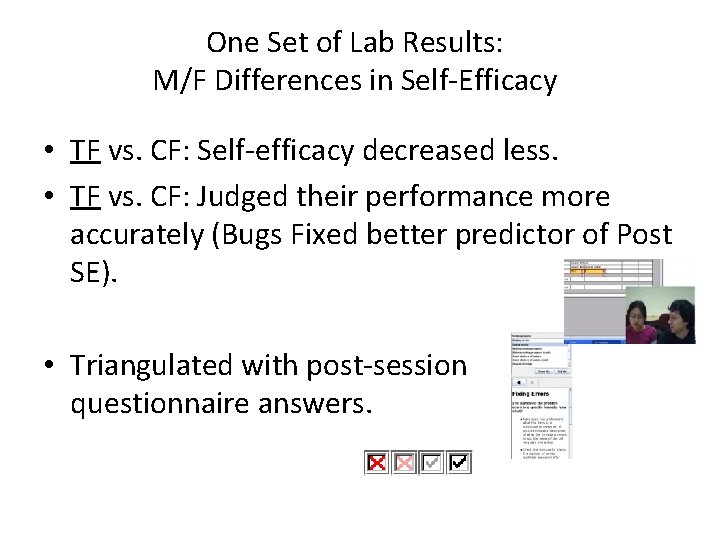
One Set of Lab Results: M/F Differences in Self-Efficacy • TF vs. CF: Self-efficacy decreased less. • TF vs. CF: Judged their performance more accurately (Bugs Fixed better predictor of Post SE). • Triangulated with post-session questionnaire answers.
Returning to Abby and the Facets…
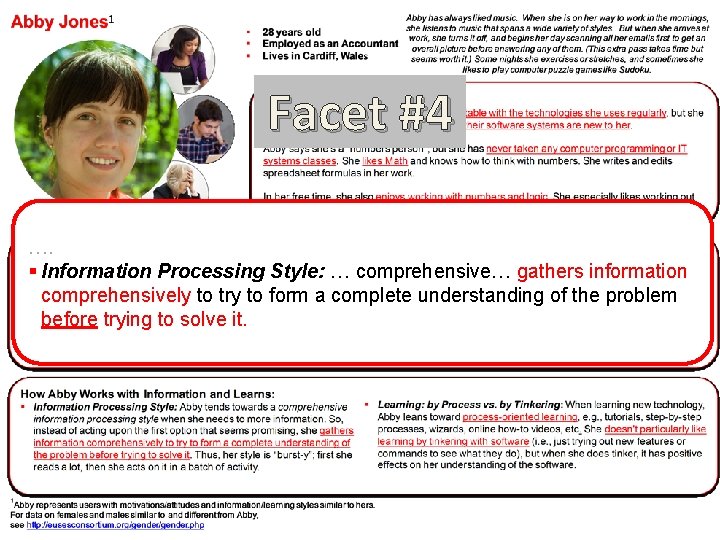
abby: info processing Facet #4 …. § Information Processing Style: … comprehensive… gathers information comprehensively to try to form a complete understanding of the problem before trying to solve it.
![Information Processing • Comprehensive vs. Selective [Meyers-Levy] – “Everything first” vs. “Depth first” –](http://slidetodoc.com/presentation_image/204c66de974c1754dbeb6e3182d02b6c/image-30.jpg "Information Processing • Comprehensive vs. Selective [Meyers-Levy] – “Everything first” vs. “Depth first” –")
Information Processing • Comprehensive vs. Selective [Meyers-Levy] – “Everything first” vs. “Depth first” – In batches vs. Highly incremental – Here’s what it looked like in a sensemaking study… 30
![Information Processing [Grigoreanu] • Example (M top, F bottom): 31](http://slidetodoc.com/presentation_image/204c66de974c1754dbeb6e3182d02b6c/image-31.jpg "Information Processing [Grigoreanu] • Example (M top, F bottom): 31")
Information Processing [Grigoreanu] • Example (M top, F bottom): 31
Pausing Again: Changes (cont. )
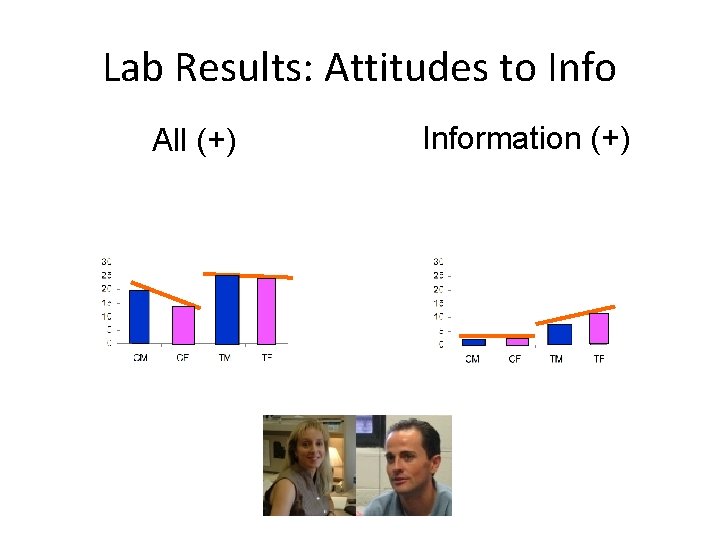
Lab Results: Attitudes to Info All (+) Information (+)
Back to Abby
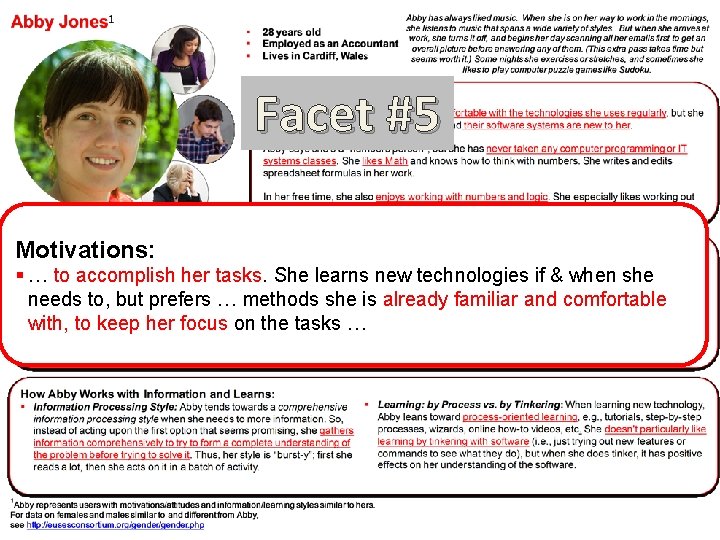
abby: motivations Facet #5 Motivations: § … to accomplish her tasks. She learns new technologies if & when she needs to, but prefers … methods she is already familiar and comfortable with, to keep her focus on the tasks …
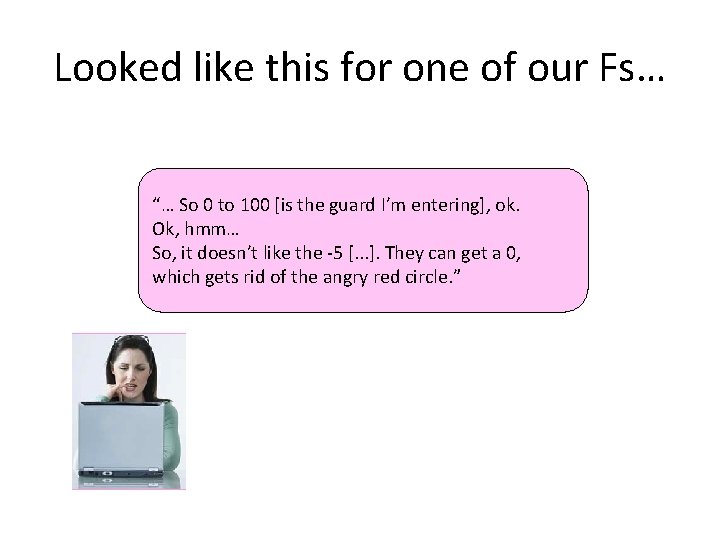
Looked like this for one of our Fs… “… So 0 to 100 [is the guard I’m entering], ok. Ok, hmm… So, it doesn’t like the -5 [. . . ]. They can get a 0, which gets rid of the angry red circle. ”
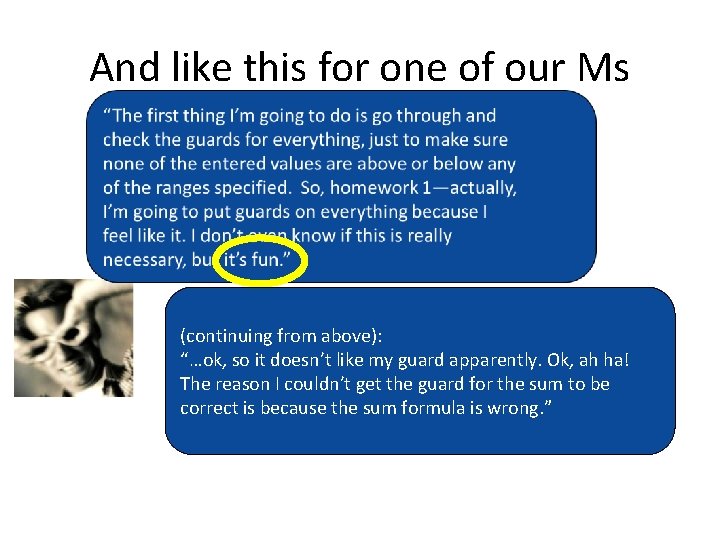
And like this for one of our Ms (continuing from above): “…ok, so it doesn’t like my guard apparently. Ok, ah ha! The reason I couldn’t get the guard for the sum to be correct is because the sum formula is wrong. ”
![Across Populations [Burnett] • Stay with familiar features: • Fiddle with new ones: pink](http://slidetodoc.com/presentation_image/204c66de974c1754dbeb6e3182d02b6c/image-38.jpg "Across Populations [Burnett] • Stay with familiar features: • Fiddle with new ones: pink")
Across Populations [Burnett] • Stay with familiar features: • Fiddle with new ones: pink
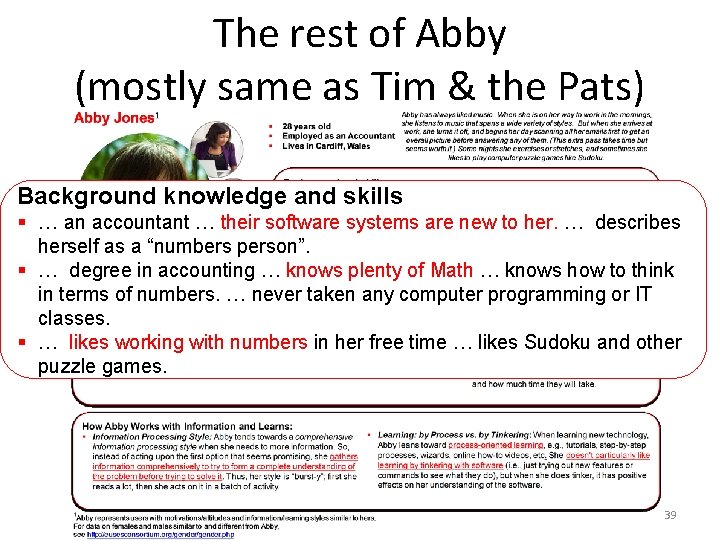
The rest of Abby (mostly same as Tim & the Pats) Background knowledge and skills § … an accountant … their software systems are new to her. … describes herself as a “numbers person”. § … degree in accounting … knows plenty of Math … knows how to think in terms of numbers. … never taken any computer programming or IT classes. § … likes working with numbers in her free time … likes Sudoku and other puzzle games. 39
Gender. Mag Cognitive Walkthrough • Standard CW: evaluates usability & learnability for a first-time user. • Gender. Mag CW: streamlines a little, integrated reminders to the relevant persona facets, like this 40
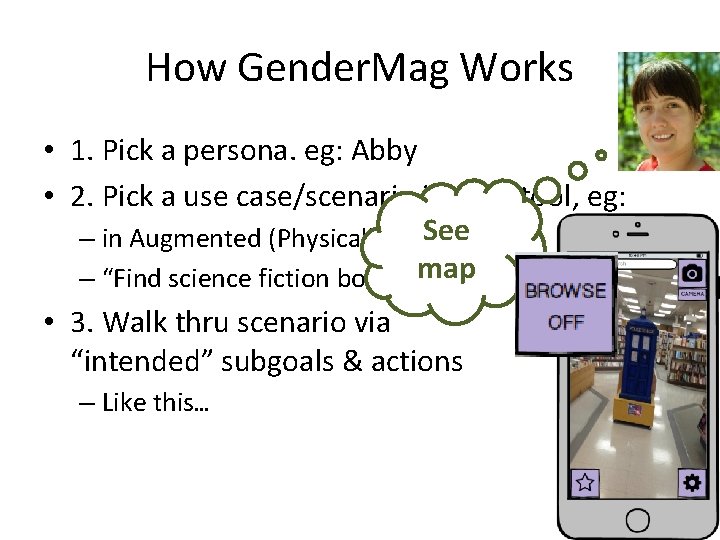
How Gender. Mag Works • 1. Pick a persona. eg: Abby • 2. Pick a use case/scenario in your tool, eg: See – in Augmented (Physical) Bookstore – “Find science fiction books” map • 3. Walk thru scenario via “intended” subgoals & actions – Like this… 41
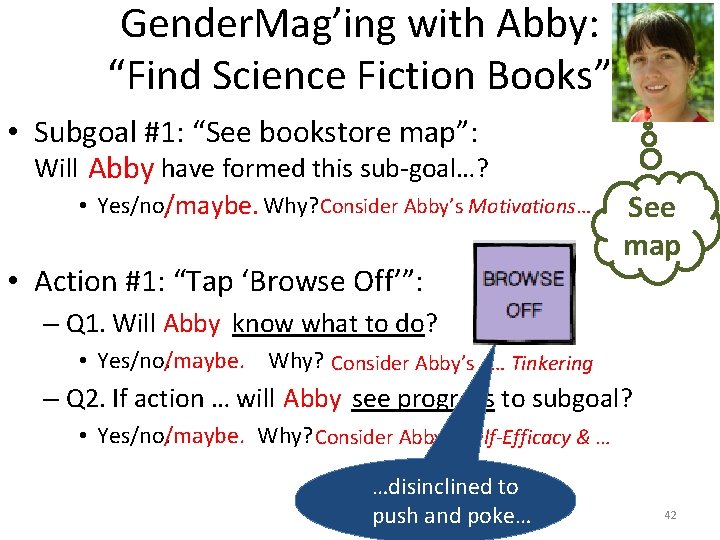
Gender. Mag’ing with Abby: “Find Science Fiction Books” • Subgoal #1: “See bookstore map”: Will have formed this sub-goal…? Abby • Yes/no. Why? Consider Abby’s Motivations… /maybe. • Action #1: “Tap ‘Browse Off’”: See map Abby – Q 1. Will know what to do? /maybe. • Yes/no. Why? Consider Abby’s , … Tinkering Abby – Q 2. If action … will see progress to subgoal? • Yes/no. Why? /maybe. Consider Abby’s Self-Efficacy & … …disinclined to push and poke… 42
Does it work? Empirical Overview • From: – Formative case study at Company X [Iw. C’ 16] – Formative Workshop Event at VLHCC’ 13 [Iw. C’ 16] – Lab Study with UX practitioners in London [Iw. C’ 16] – Field study (4 real-world software teams) [CHI’ 16] – Working with several companies with Microsoft in the lead • Results: – People: Usable by UX’ers, developers, etc. [CHI’ 16, VLHCC’ 16] – Products: Makes them better! [Iw. C’ 16 + VLHCC’ 17] 43
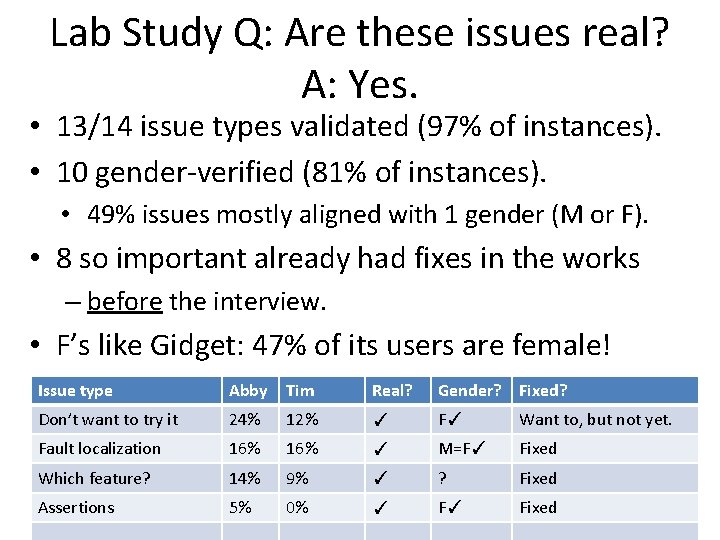
Lab Study Q: Are these issues real? A: Yes. • 13/14 issue types validated (97% of instances). • 10 gender-verified (81% of instances). • 49% issues mostly aligned with 1 gender (M or F). • 8 so important already had fixes in the works – before the interview. • F’s like Gidget: 47% of its users are female! Issue type Abby Tim Real? Gender? Fixed? Don’t want to try it 24% 12% ✓ F✓ Want to, but not yet. Fault localization 16% ✓ M=F✓ Fixed Which feature? 14% 9% ✓ ? Fixed Assertions 5% 0% ✓ F✓ Fixed 44
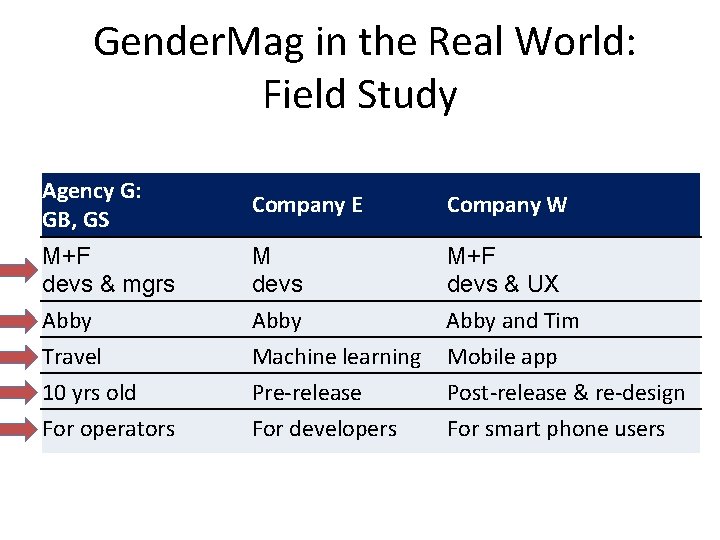
Gender. Mag in the Real World: Field Study Agency G: GB, GS Company E Company W M+F devs & mgrs Abby Travel 10 yrs old For operators M devs Abby Machine learning Pre-release For developers M+F devs & UX Abby and Tim Mobile app 45 Post-release & re-design For smart phone users
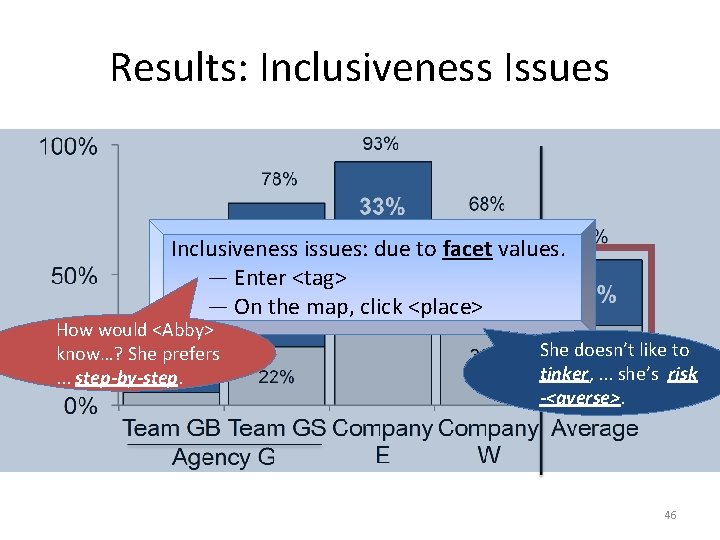
Results: Inclusiveness Issues Inclusiveness issues: due to facet values. — Enter <tag> — On the map, click <place> How would <Abby> know…? She prefers . . . step-by-step. She doesn’t like to tinker, . . . she’s risk -<averse>. 46
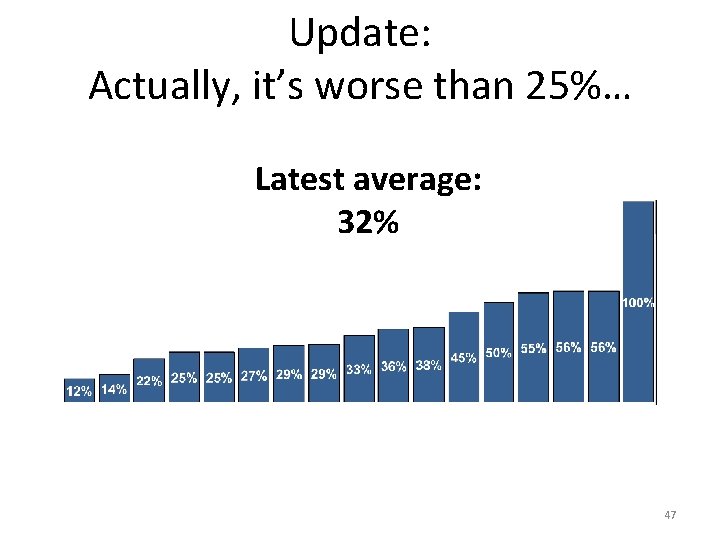
Update: Actually, it’s worse than 25%… Latest average: 32% 47
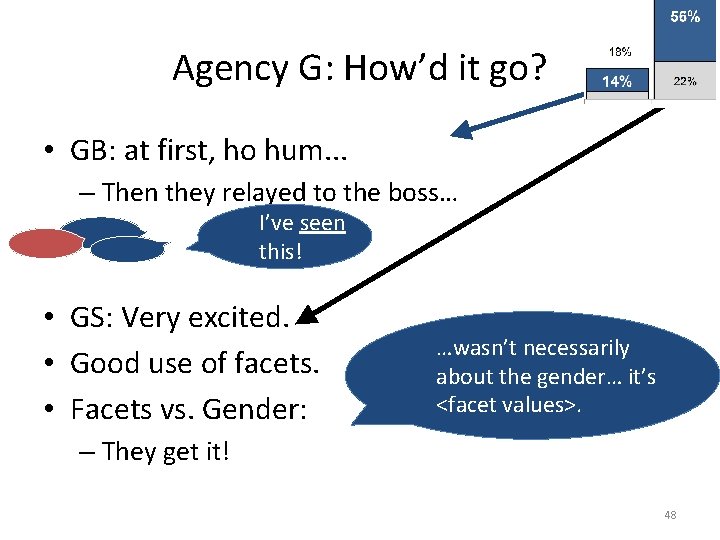
Agency G: How’d it go? • GB: at first, ho hum. . . – Then they relayed to the boss… I’ve seen this! • GS: Very excited. • Good use of facets. • Facets vs. Gender: …wasn’t necessarily about the gender… it’s <facet values>. – They get it! 48
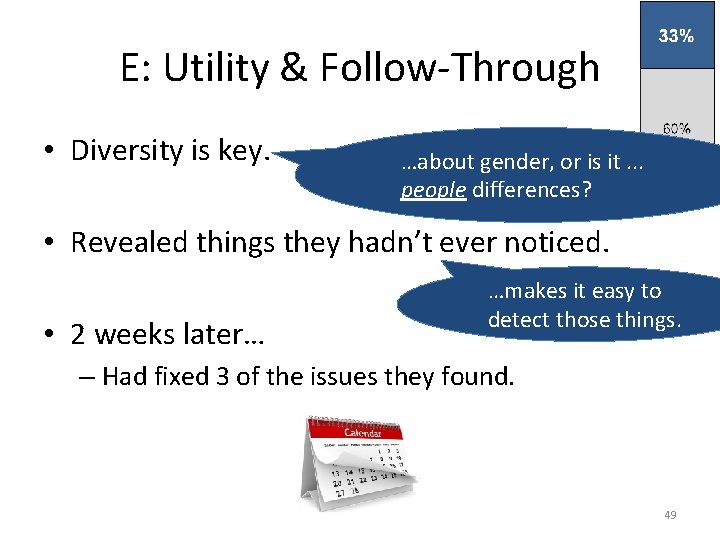
E: Utility & Follow-Through • Diversity is key. …about gender, or is it. . . people differences? • Revealed things they hadn’t ever noticed. • 2 weeks later… …makes it easy to detect those things. – Had fixed 3 of the issues they found. 49
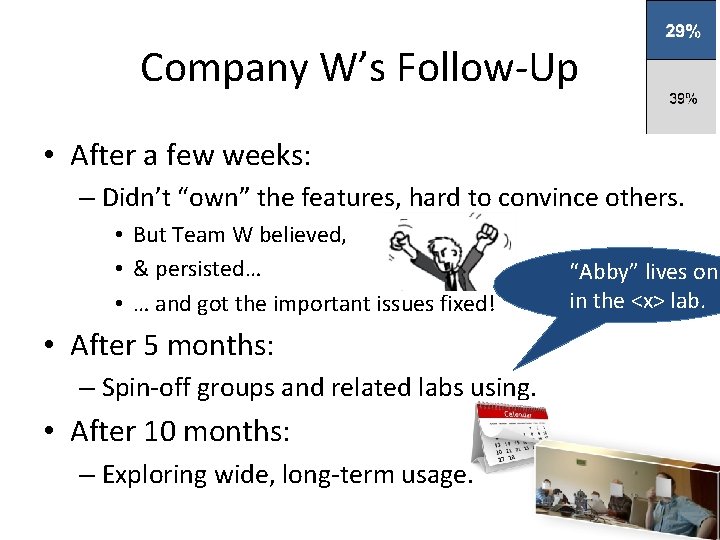
Company W’s Follow-Up • After a few weeks: – Didn’t “own” the features, hard to convince others. • But Team W believed, • & persisted… • … and got the important issues fixed! “Abby” lives on in the <x> lab. • After 5 months: – Spin-off groups and related labs using. • After 10 months: – Exploring wide, long-term usage. 50
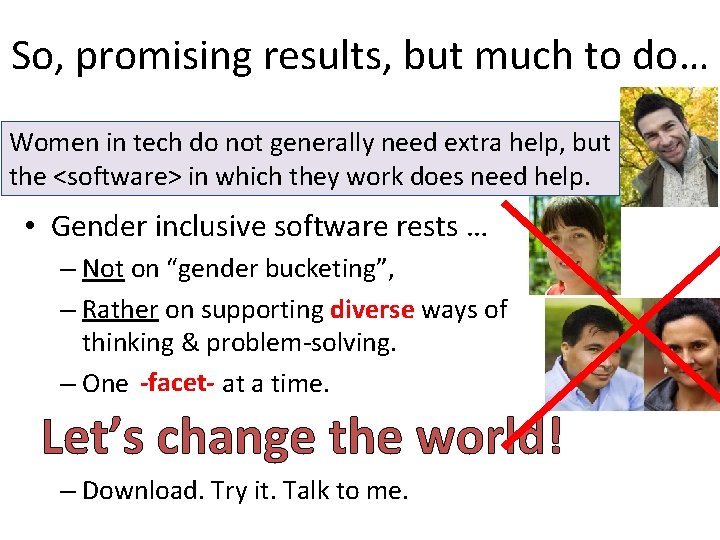
So, promising results, but much to do… Women in tech do not generally need extra help, but the <software> in which they work does need help. • Gender inclusive software rests … – Not on “gender bucketing”, – Rather on supporting diverse ways of thinking & problem-solving. -facet– One gender at a time. Let’s change the world! – Download. Try it. Talk to me.
Follow-ups & Resources • @Gender. Mag, #Gender. Mag • gendermag. method • Resources: gendermag. org – Flyer, papers, personas, foundations, … Gender. Mag – Download the kit! – Help make it happen @ your university/company! – web. engr. oregonstate. edu/~burnett/ – Margaret. Burnett@oregonstate. edu 52

53
Leftovers 54
55
![Motivation looked like this in “Clubhouse” [Margolis/Fisher] • One form of computing = majoring](http://slidetodoc.com/presentation_image/204c66de974c1754dbeb6e3182d02b6c/image-56.jpg "Motivation looked like this in “Clubhouse” [Margolis/Fisher] • One form of computing = majoring")
Motivation looked like this in “Clubhouse” [Margolis/Fisher] • One form of computing = majoring in CS: 56
![And like this in “From Barbie…” [Cassell/Jenkins] • From a study in which males](http://slidetodoc.com/presentation_image/204c66de974c1754dbeb6e3182d02b6c/image-57.jpg "And like this in “From Barbie…” [Cassell/Jenkins] • From a study in which males")
And like this in “From Barbie…” [Cassell/Jenkins] • From a study in which males and females fantasized about technology Men Women Fantasize about it as a product Fantasize about it as a medium Want to use it for control Want to use it for communication Are impressed with its potential for power for creation Ask it for speed … Ask it for flexibility … 57
![Information Processing • Comprehensive vs. Selective [Meyers-Levy] – “Everything first” vs. “Depth first” –](http://slidetodoc.com/presentation_image/204c66de974c1754dbeb6e3182d02b6c/image-58.jpg "Information Processing • Comprehensive vs. Selective [Meyers-Levy] – “Everything first” vs. “Depth first” –")
Information Processing • Comprehensive vs. Selective [Meyers-Levy] – “Everything first” vs. “Depth first” – E. g. , (spreadsheets): Dataflow [Subrahmaniyan] “Systematically go from the formulas that rely wholly on data cells, progressing to formulas that rely on other formula driven cells. ” – Males followed dataflow > females (p<. 04) – Dataflow more helpful to M who used it than F who used it [Subrahmaniyan] 58
59
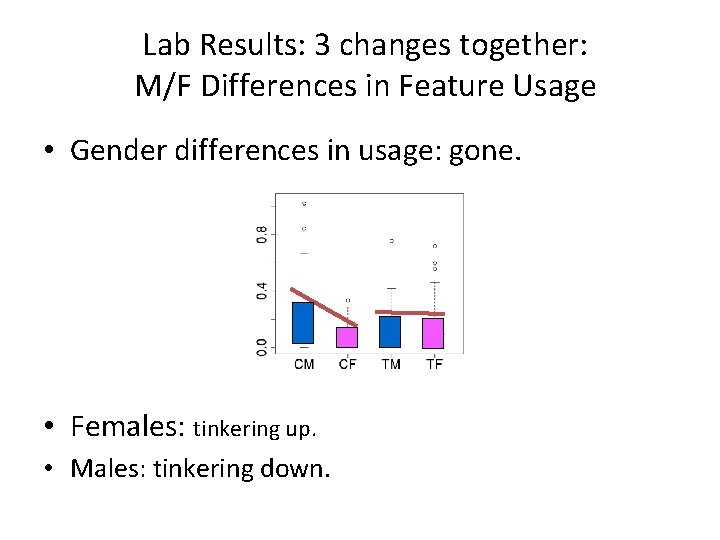
Lab Results: 3 changes together: M/F Differences in Feature Usage • Gender differences in usage: gone. • Females: tinkering up. • Males: tinkering down.
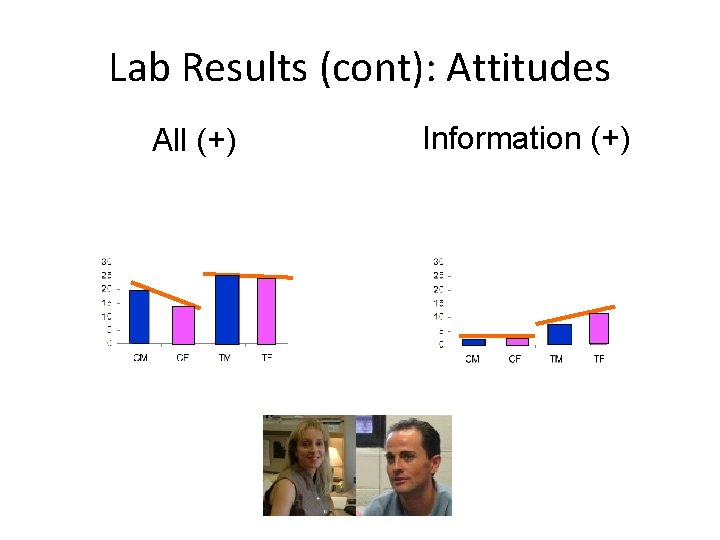
Lab Results (cont): Attitudes All (+) Information (+)
- Slides: 61