
Women in Computer Science The BRAID Initiative A

Women in Computer Science The BRAID Initiative A Wide-Scale Assessment of Promising Practices to Increase Diversity in Computing Prof. Joanne Atlee Director of Women in Computer Science University of Waterloo
Building, Recruiting, and Inclusion for Diversity (BRAID) BRAID is a multi-year, multi-institutional study of the impact of a number of promising practices that aim to increase representation of women and students of colour in university computer-science programs.
Some history: the Stats
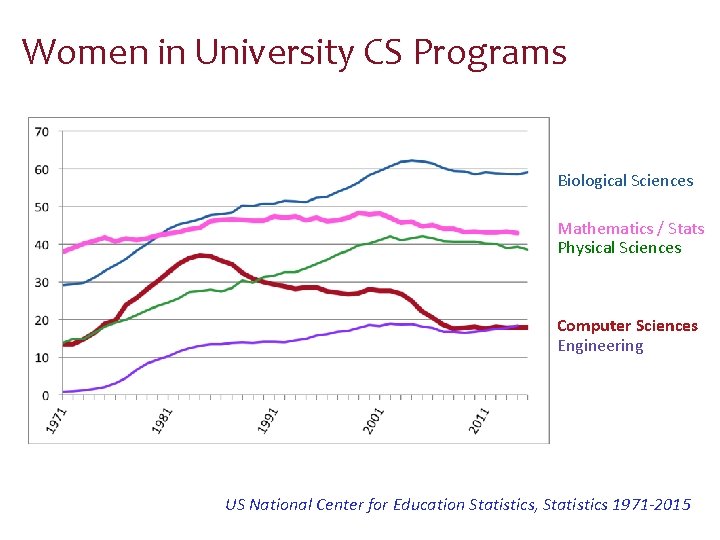
Women in University CS Programs Biological Sciences Mathematics / Stats Physical Sciences Computer Sciences Engineering US National Center for Education Statistics, Statistics 1971 -2015
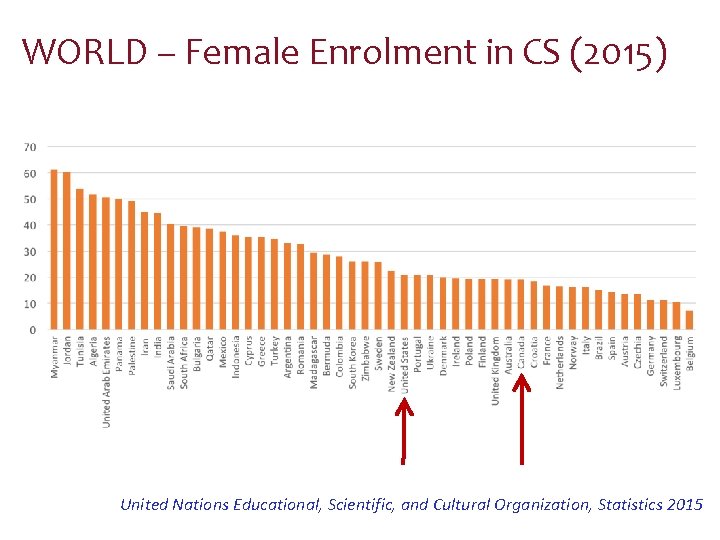
WORLD – Female Enrolment in CS (2015) United Nations Educational, Scientific, and Cultural Organization, Statistics 2015
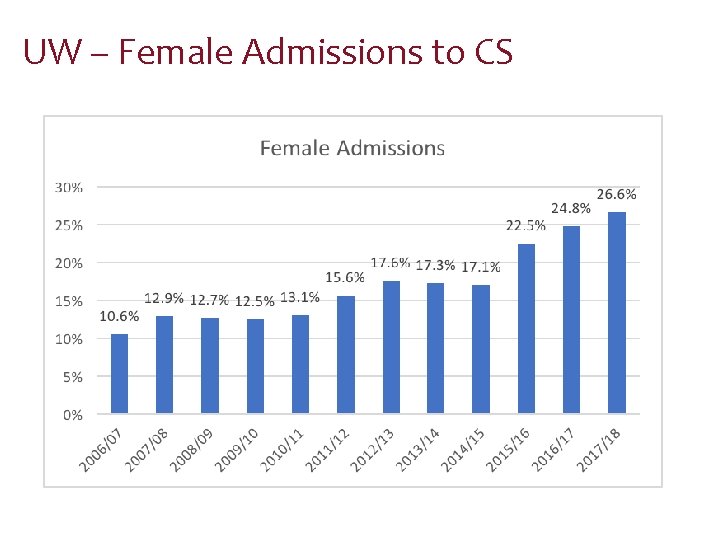
UW – Female Admissions to CS
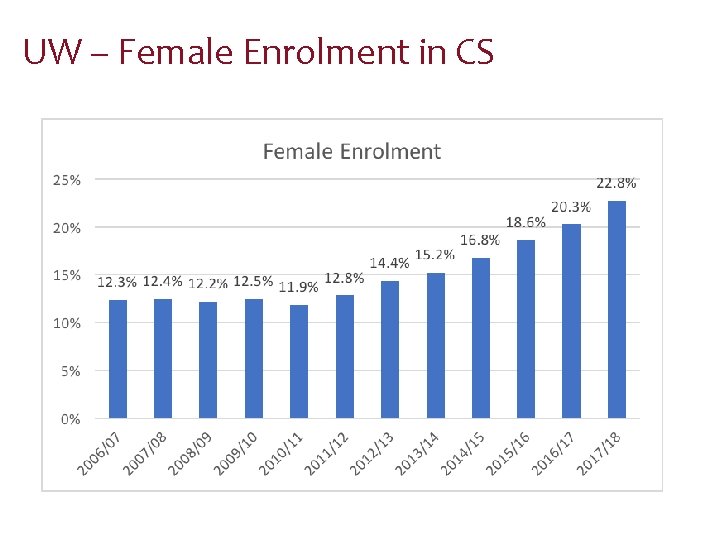
UW – Female Enrolment in CS
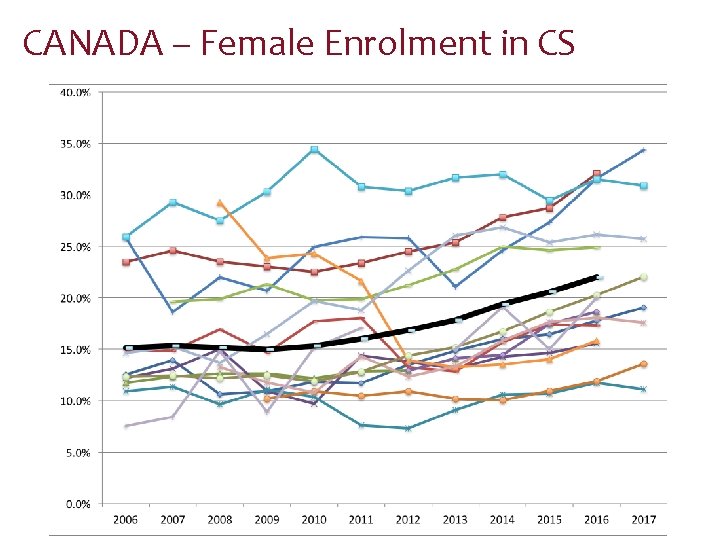
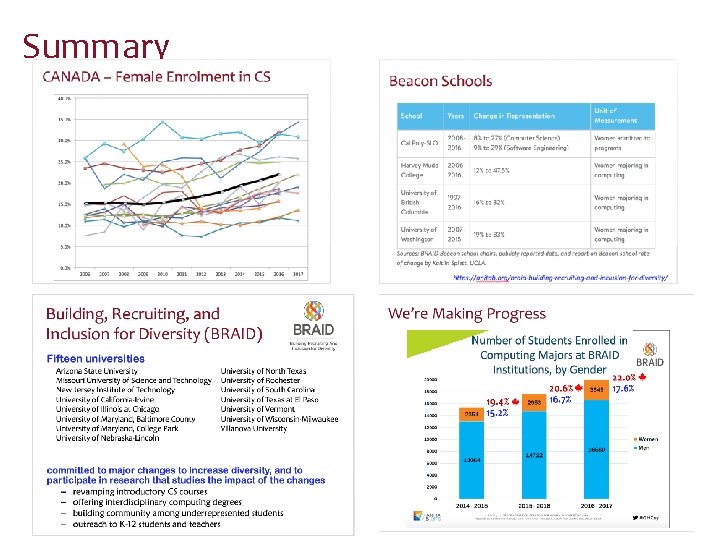
CANADA – Female Enrolment in CS
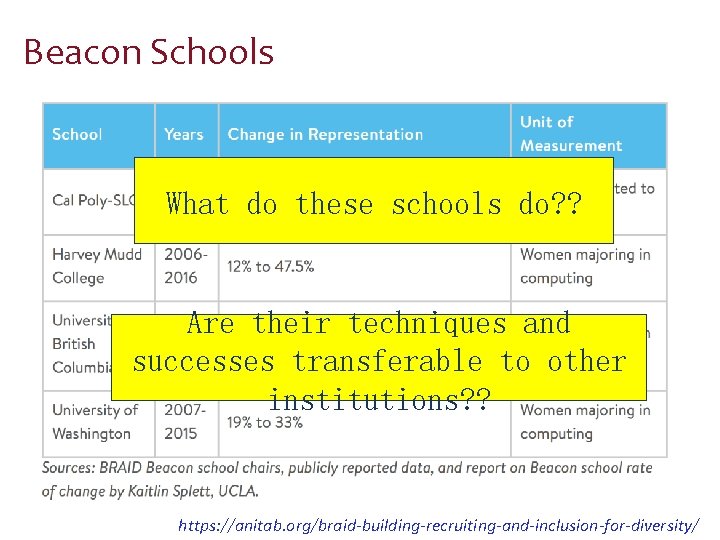
Beacon Schools What do these schools do? ? Are their techniques and successes transferable to other institutions? ? https: //anitab. org/braid-building-recruiting-and-inclusion-for-diversity/

Beacon Schools: what do they do? ?
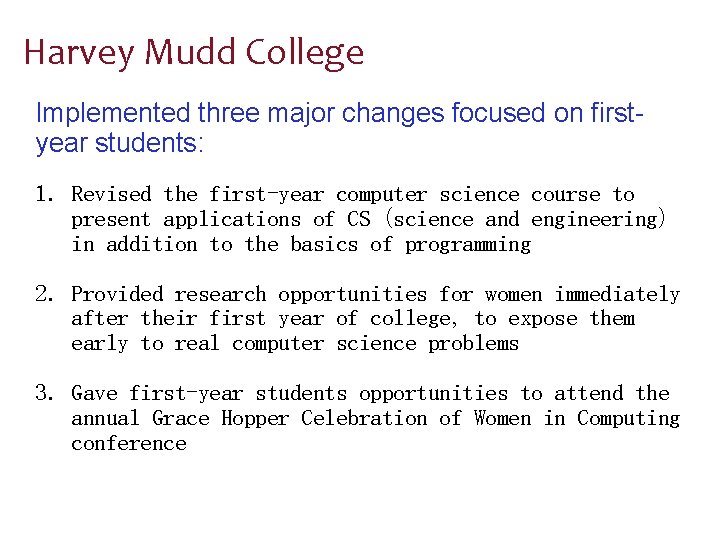
Harvey Mudd College Implemented three major changes focused on firstyear students: 1. Revised the first-year computer science course to present applications of CS (science and engineering) in addition to the basics of programming 2. Provided research opportunities for women immediately after their first year of college, to expose them early to real computer science problems 3. Gave first-year students opportunities to attend the annual Grace Hopper Celebration of Women in Computing conference
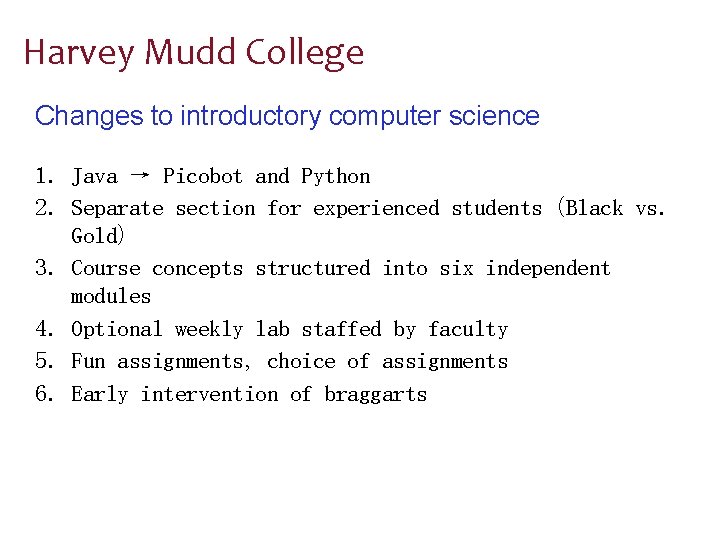
Harvey Mudd College Changes to introductory computer science 1. Java → Picobot and Python 2. Separate section for experienced students (Black vs. Gold) 3. Course concepts structured into six independent modules 4. Optional weekly lab staffed by faculty 5. Fun assignments, choice of assignments 6. Early intervention of braggarts
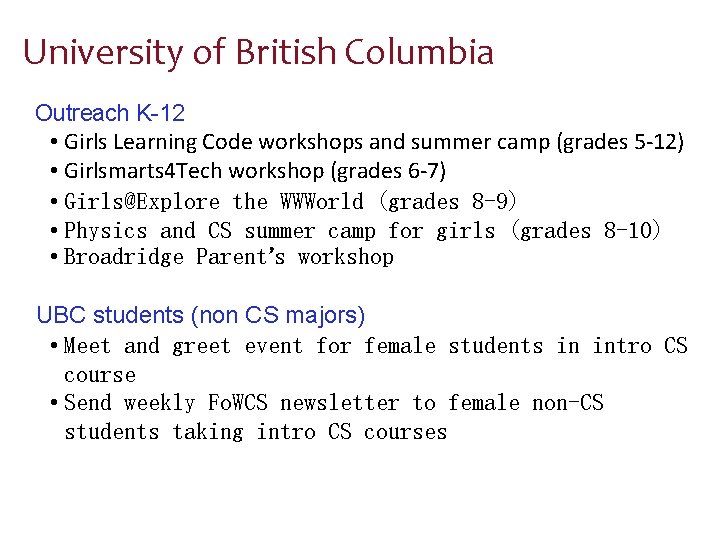
University of British Columbia Outreach K-12 • Girls Learning Code workshops and summer camp (grades 5 -12) • Girlsmarts 4 Tech workshop (grades 6 -7) • Girls@Explore the WWWorld (grades 8 -9) • Physics and CS summer camp for girls (grades 8 -10) • Broadridge Parent’s workshop UBC students (non CS majors) • Meet and greet event for female students in intro CS course • Send weekly Fo. WCS newsletter to female non-CS students taking intro CS courses
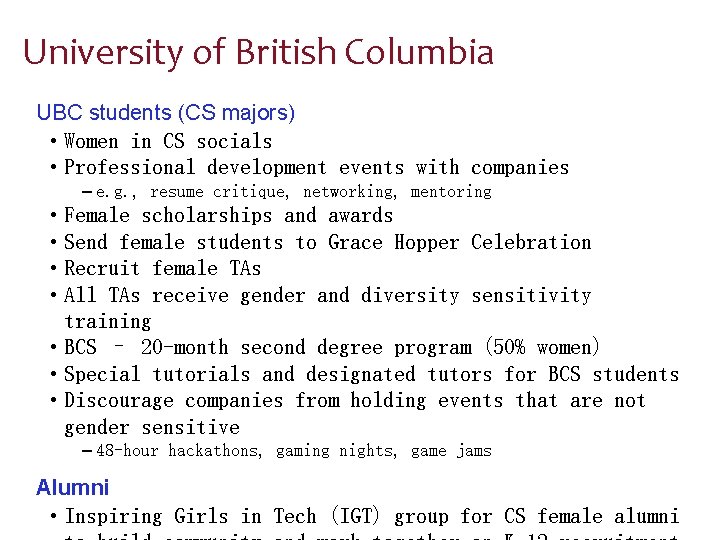
University of British Columbia UBC students (CS majors) • Women in CS socials • Professional development events with companies – e. g. , resume critique, networking, mentoring • Female scholarships and awards • Send female students to Grace Hopper Celebration • Recruit female TAs • All TAs receive gender and diversity sensitivity training • BCS – 20 -month second degree program (50% women) • Special tutorials and designated tutors for BCS students • Discourage companies from holding events that are not gender sensitive – 48 -hour hackathons, gaming nights, game jams Alumni • Inspiring Girls in Tech (IGT) group for CS female alumni
Are their successes transferable?
Building, Recruiting, and Inclusion for Diversity (BRAID) A multi-year, multi-institutional study of the impact of promising practices that aim to increase representation of women and students of colour in university CS programs. Led by the Anita Borg Institute and Harvey Mudd College Funded by Facebook, Google, Intel, Microsoft, and Qualcomm Additional research funds provided by the Computing Research Association (CRA) and the National Science Foundation (NSF). The National Center for Women & Information Technology (NCWIT) and the Center for Minorities and People with Disabilities in IT (CMD-IT) are nonprofit partners on the BRAID initiative.
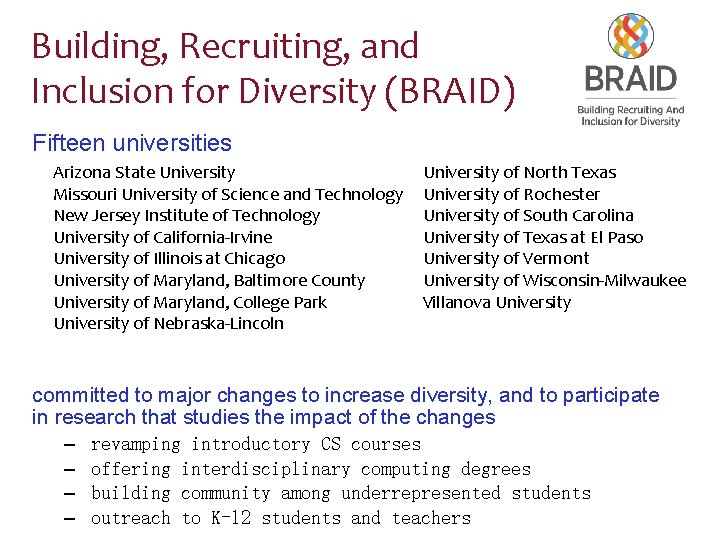
Building, Recruiting, and Inclusion for Diversity (BRAID) Fifteen universities Arizona State University Missouri University of Science and Technology New Jersey Institute of Technology University of California-Irvine University of Illinois at Chicago University of Maryland, Baltimore County University of Maryland, College Park University of Nebraska-Lincoln University of North Texas University of Rochester University of South Carolina University of Texas at El Paso University of Vermont University of Wisconsin-Milwaukee Villanova University committed to major changes to increase diversity, and to participate in research that studies the impact of the changes – revamping introductory CS courses – offering interdisciplinary computing degrees – building community among underrepresented students – outreach to K-12 students and teachers
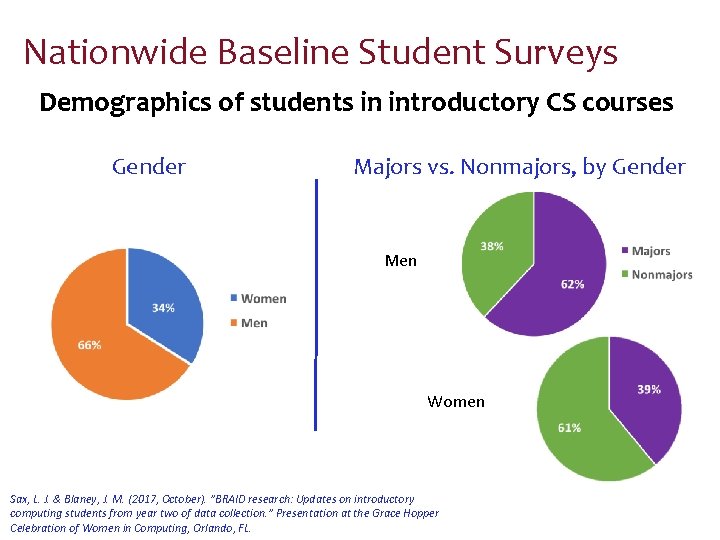
Nationwide Baseline Student Surveys Demographics of students in introductory CS courses Gender Majors vs. Nonmajors, by Gender Men Women Sax, L. J. & Blaney, J. M. (2017, October). ”BRAID research: Updates on introductory computing students from year two of data collection. ” Presentation at the Grace Hopper Celebration of Women in Computing, Orlando, FL.
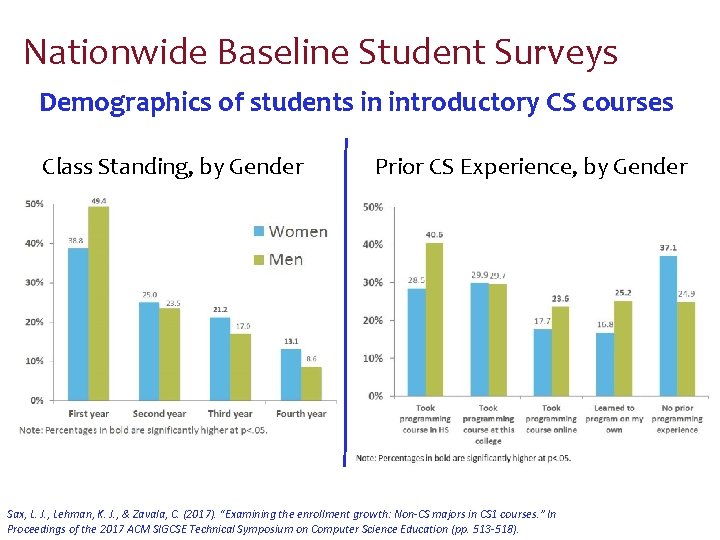
Nationwide Baseline Student Surveys Demographics of students in introductory CS courses Class Standing, by Gender Prior CS Experience, by Gender Sax, L. J. , Lehman, K. J. , & Zavala, C. (2017). “Examining the enrollment growth: Non-CS majors in CS 1 courses. ” In Proceedings of the 2017 ACM SIGCSE Technical Symposium on Computer Science Education (pp. 513 -518).
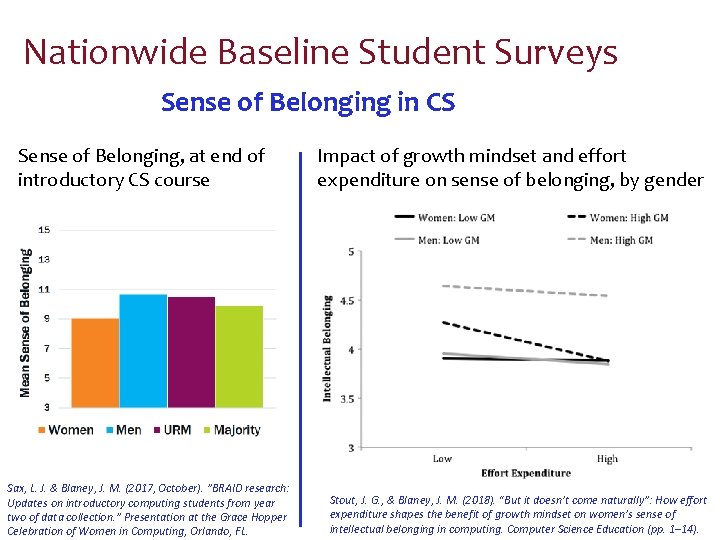
Nationwide Baseline Student Surveys Sense of Belonging in CS Sense of Belonging, at end of introductory CS course Sax, L. J. & Blaney, J. M. (2017, October). ”BRAID research: Updates on introductory computing students from year two of data collection. ” Presentation at the Grace Hopper Celebration of Women in Computing, Orlando, FL. Impact of growth mindset and effort expenditure on sense of belonging, by gender Stout, J. G. , & Blaney, J. M. (2018). “But it doesn’t come naturally”: How effort expenditure shapes the benefit of growth mindset on women’s sense of intellectual belonging in computing. Computer Science Education (pp. 1– 14).
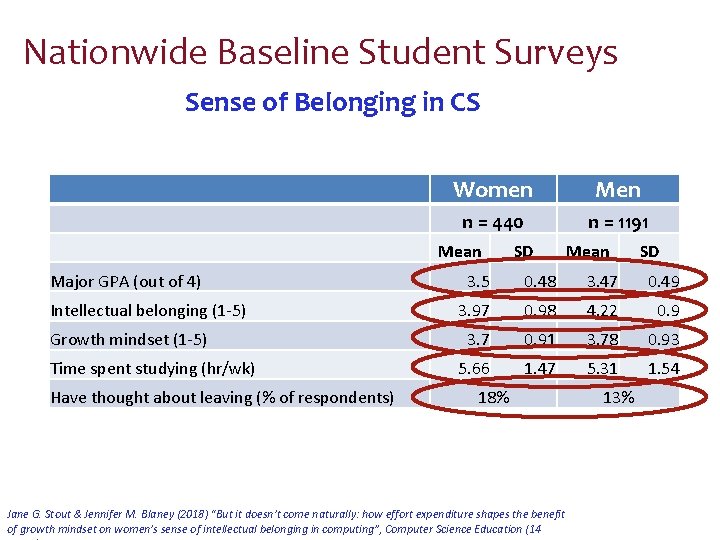
Nationwide Baseline Student Surveys Sense of Belonging in CS Women Men n = 440 n = 1191 Mean Major GPA (out of 4) Intellectual belonging (1 -5) Growth mindset (1 -5) Time spent studying (hr/wk) Have thought about leaving (% of respondents) SD Mean SD 3. 5 0. 48 3. 47 0. 49 3. 97 0. 98 4. 22 0. 9 3. 7 0. 91 3. 78 0. 93 5. 66 1. 47 5. 31 1. 54 18% Jane G. Stout & Jennifer M. Blaney (2018) “But it doesn’t come naturally: how effort expenditure shapes the benefit of growth mindset on women’s sense of intellectual belonging in computing”, Computer Science Education (14 13%
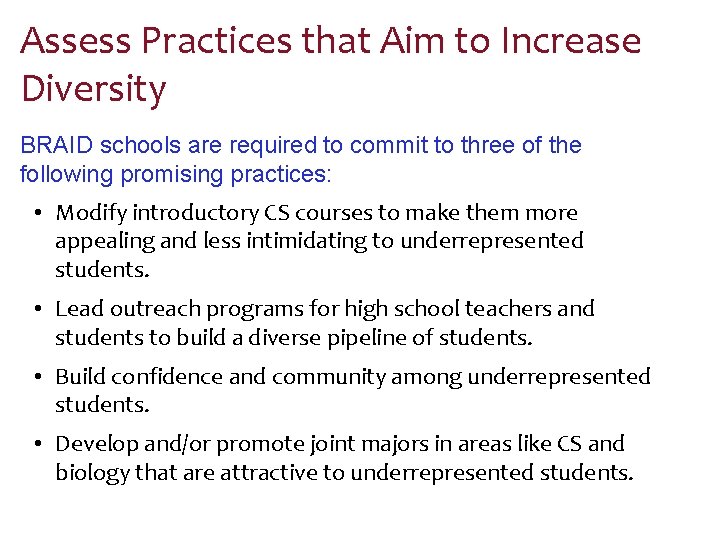
Assess Practices that Aim to Increase Diversity BRAID schools are required to commit to three of the following promising practices: • Modify introductory CS courses to make them more appealing and less intimidating to underrepresented students. • Lead outreach programs for high school teachers and students to build a diverse pipeline of students. • Build confidence and community among underrepresented students. • Develop and/or promote joint majors in areas like CS and biology that are attractive to underrepresented students.
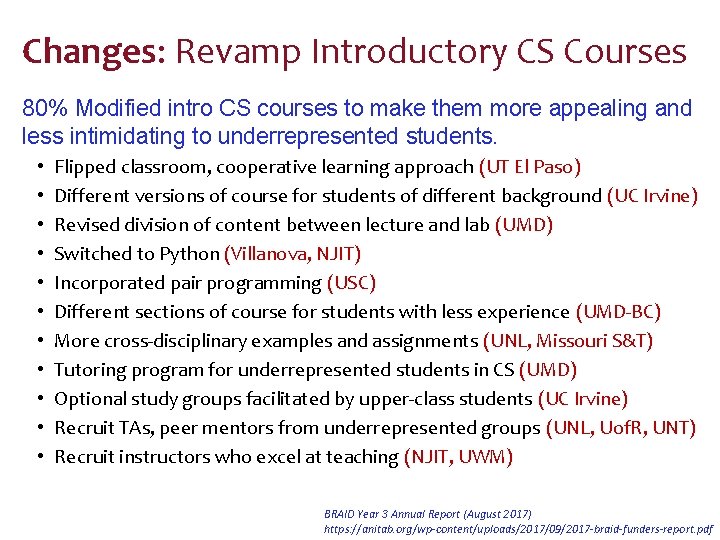
Changes: Revamp Introductory CS Courses 80% Modified intro CS courses to make them more appealing and less intimidating to underrepresented students. • • • Flipped classroom, cooperative learning approach (UT El Paso) Different versions of course for students of different background (UC Irvine) Revised division of content between lecture and lab (UMD) Switched to Python (Villanova, NJIT) Incorporated pair programming (USC) Different sections of course for students with less experience (UMD-BC) More cross-disciplinary examples and assignments (UNL, Missouri S&T) Tutoring program for underrepresented students in CS (UMD) Optional study groups facilitated by upper-class students (UC Irvine) Recruit TAs, peer mentors from underrepresented groups (UNL, Uof. R, UNT) Recruit instructors who excel at teaching (NJIT, UWM) BRAID Year 3 Annual Report (August 2017) https: //anitab. org/wp-content/uploads/2017/09/2017 -braid-funders-report. pdf
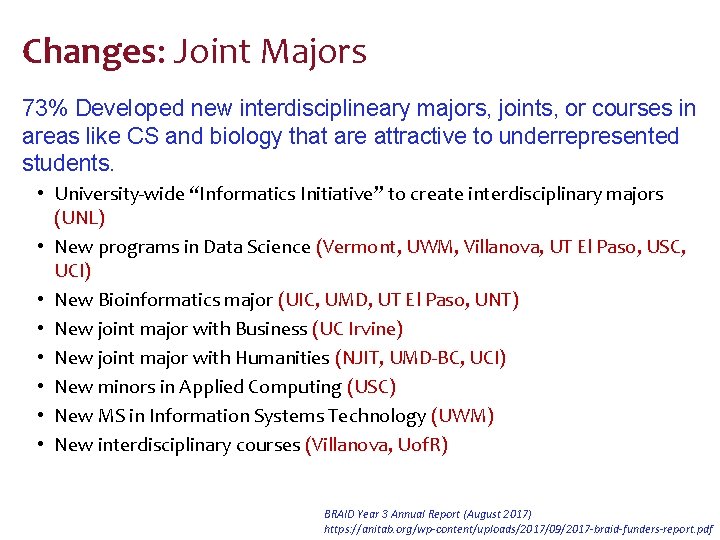
Changes: Joint Majors 73% Developed new interdisciplineary majors, joints, or courses in areas like CS and biology that are attractive to underrepresented students. • University-wide “Informatics Initiative” to create interdisciplinary majors (UNL) • New programs in Data Science (Vermont, UWM, Villanova, UT El Paso, USC, UCI) • New Bioinformatics major (UIC, UMD, UT El Paso, UNT) • New joint major with Business (UC Irvine) • New joint major with Humanities (NJIT, UMD-BC, UCI) • New minors in Applied Computing (USC) • New MS in Information Systems Technology (UWM) • New interdisciplinary courses (Villanova, Uof. R) BRAID Year 3 Annual Report (August 2017) https: //anitab. org/wp-content/uploads/2017/09/2017 -braid-funders-report. pdf
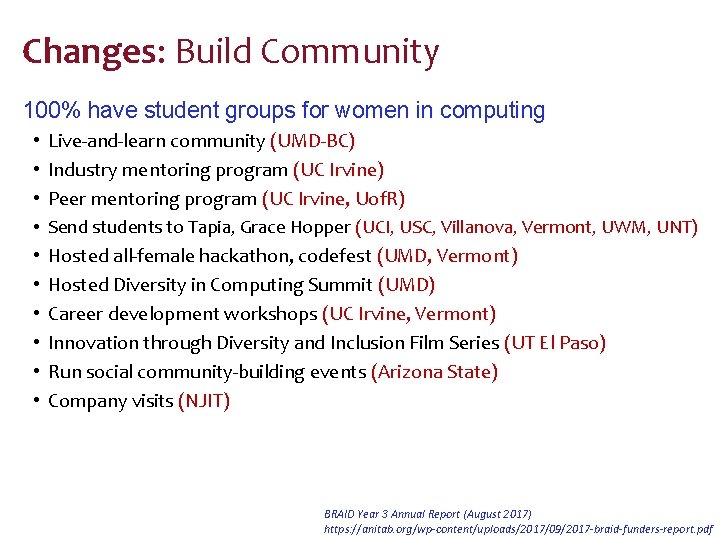
Changes: Build Community 100% have student groups for women in computing • • • Live-and-learn community (UMD-BC) Industry mentoring program (UC Irvine) Peer mentoring program (UC Irvine, Uof. R) Send students to Tapia, Grace Hopper (UCI, USC, Villanova, Vermont, UWM, UNT) Hosted all-female hackathon, codefest (UMD, Vermont) Hosted Diversity in Computing Summit (UMD) Career development workshops (UC Irvine, Vermont) Innovation through Diversity and Inclusion Film Series (UT El Paso) Run social community-building events (Arizona State) Company visits (NJIT) BRAID Year 3 Annual Report (August 2017) https: //anitab. org/wp-content/uploads/2017/09/2017 -braid-funders-report. pdf
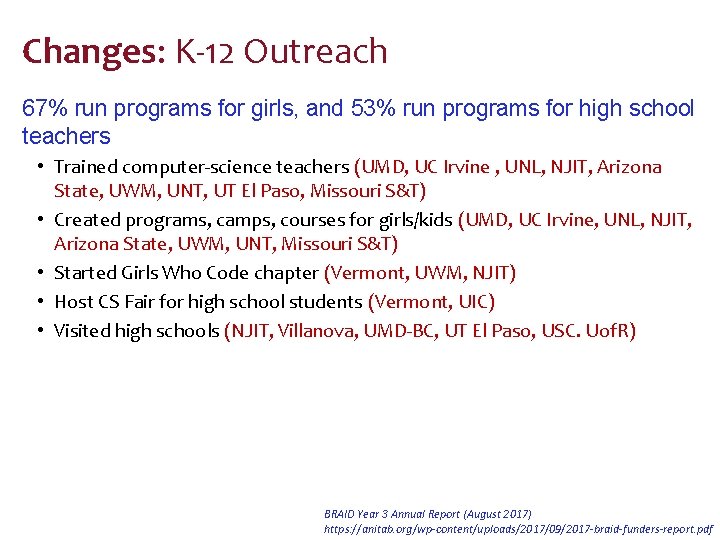
Changes: K-12 Outreach 67% run programs for girls, and 53% run programs for high school teachers • Trained computer-science teachers (UMD, UC Irvine , UNL, NJIT, Arizona State, UWM, UNT, UT El Paso, Missouri S&T) • Created programs, camps, courses for girls/kids (UMD, UC Irvine, UNL, NJIT, Arizona State, UWM, UNT, Missouri S&T) • Started Girls Who Code chapter (Vermont, UWM, NJIT) • Host CS Fair for high school students (Vermont, UIC) • Visited high schools (NJIT, Villanova, UMD-BC, UT El Paso, USC. Uof. R) BRAID Year 3 Annual Report (August 2017) https: //anitab. org/wp-content/uploads/2017/09/2017 -braid-funders-report. pdf
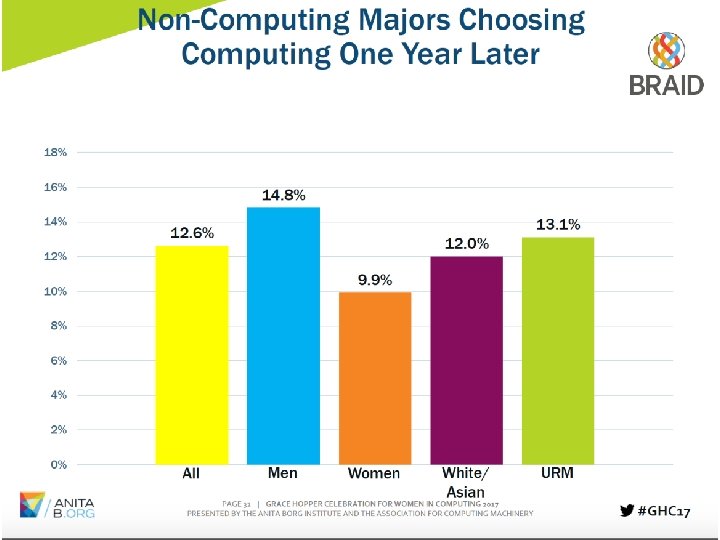
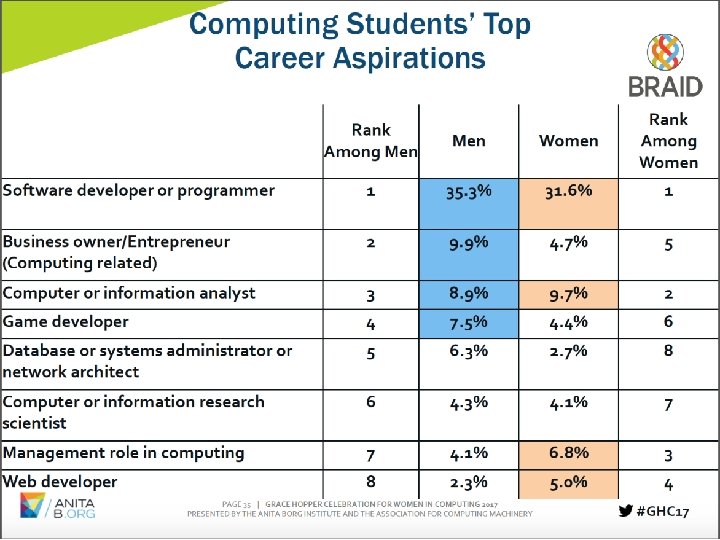
Preliminary Results Sax, L. J. & Blaney, J. M. (2017, October). ”BRAID research: Updates on introductory computing students from year two of data collection. ” Presentation at the Grace Hopper Celebration of Women in Computing, Orlando, FL.
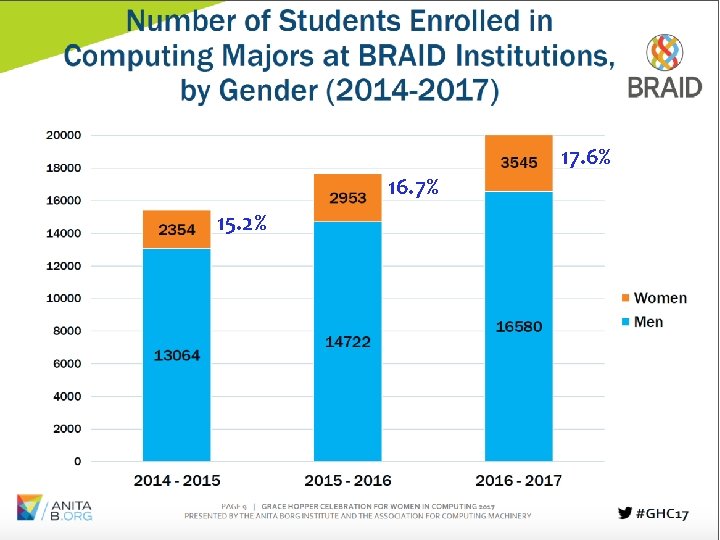
17. 6% 16. 7% 15. 2%

Summary and Next Steps

Summary
- Slides: 35