
WOMAN LIFE CYCLE Womans life cycle 1 2
- Slides: 23
WOMAN LIFE CYCLE
Woman’s life cycle 1. 2. 3. 4. 5. 6. 7. Intrauterine Childhood Puberty Adulthood Pre menopause Peri menopause Post menopause
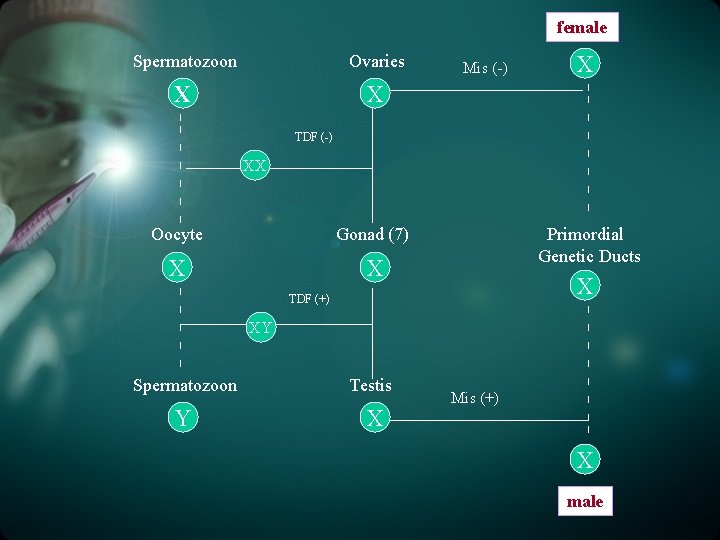
1. Intrauterine a. b. c. d. Begin at the time of fertilization when an oocyte is fertilized by a spermatozoon containing X chromosome female zygote Female zygote doesn’t have testis determining factor allow primitive gonad develop into ovaries At the seventh weeks of embryonic life, the fetus contains the primordia of both female and male genital duct. Because ovary doesn’t have mullerianinhibiting substance (MIS) allows genital duct develop in the female direction
female Spermatozoon Ovaries X X Mis (-) X TDF (-) XX Oocyte Gonad (7) X X Primordial Genetic Ducts X TDF (+) XY Spermatozoon Testis Y X Mis (+) X male
e. f. g. By 13 -14 weeks of embryonic life, primordial follicles are noticeable. The maximal number a primordial follicles as reached at approximately 20 weeks of gestation, at which time six to seven millions are present. Subsequently, their number is gradually decreased by a process term atresia so that by the time of birth only one to two millions primordial follicles have survive
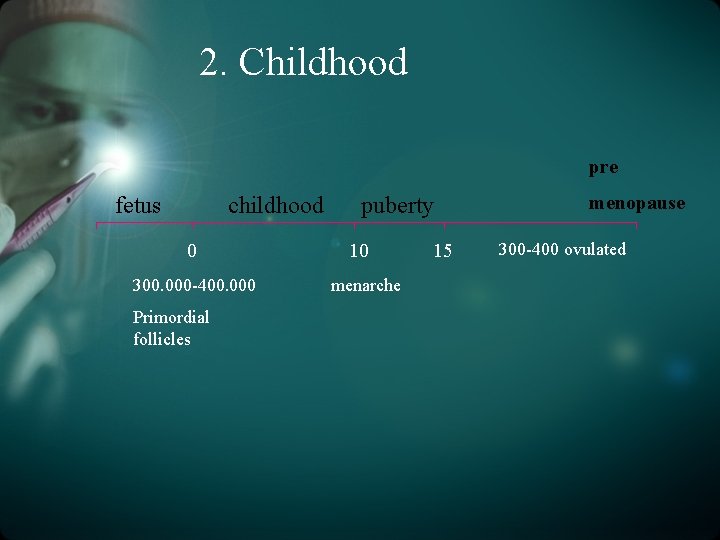
2. Childhood pre fetus childhood 0 300. 000 -400. 000 Primordial follicles puberty 10 menarche 15 menopause 300 -400 ovulated
The period between birth and puberty. By the time of birth only one to two million of primordial follicles have survive, continuous through out childhood and, at the time of puberty, 300. 000 -400. 000 primordial follicles are present within the ovaries. Of these, approximately 300400 will be ovulated during the woman’s reproductive life from menarche to menopause, while the remainder under go atresia.
3. Puberty The age during which a child matures sexually and becomes an adult and is able to reproduce. Development of internal sex organ, external genitalia and sexual secondary characteristics. Activation of the ovary under the dependence of the hypothalamo-pituitary system. Irregular menstrual cycle
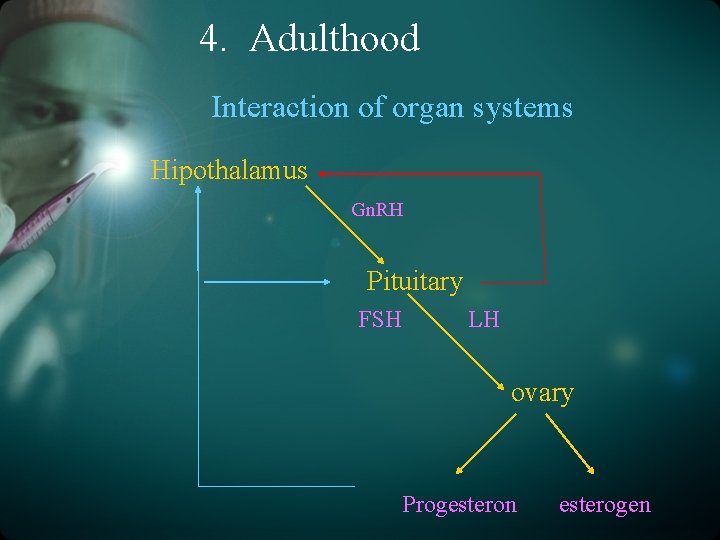
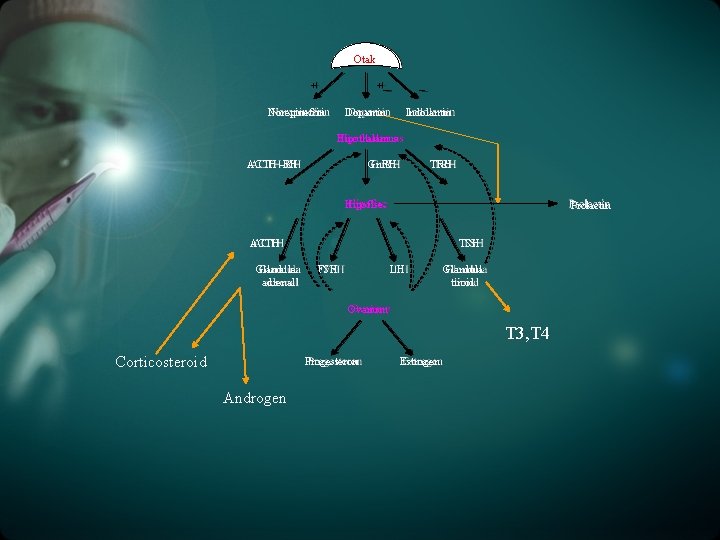
4. Adulthood Interaction of organ systems Hipothalamus Gn. RH Pituitary FSH LH ovary Progesteron esterogen
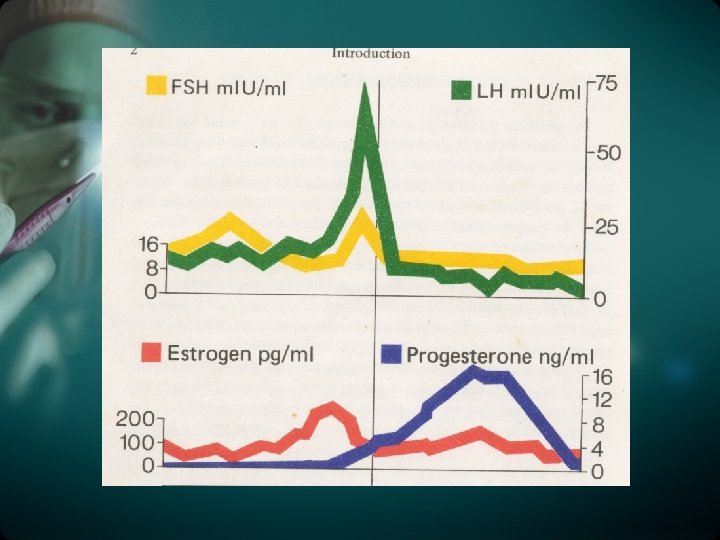
Regular menstrual cycle Cyclic hormonal stimulation of endometrial growth Average length 28 days (21 -35 days) Divided into two phases : Follicular phase Lutheal phase
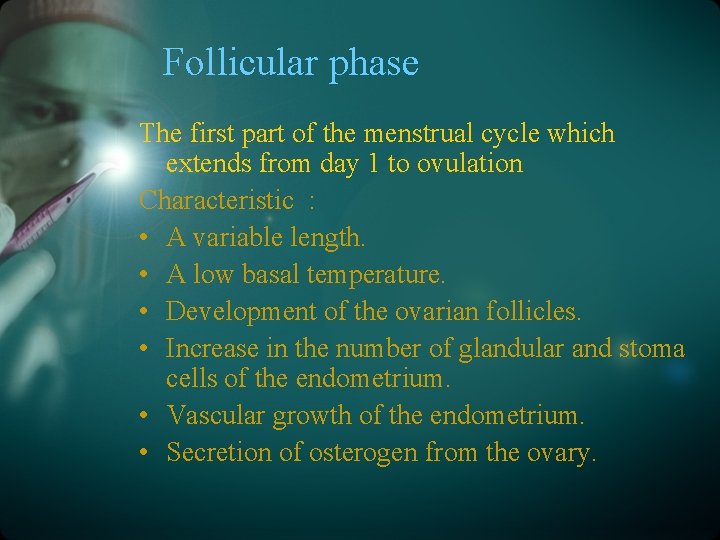
Follicular phase The first part of the menstrual cycle which extends from day 1 to ovulation Characteristic : • A variable length. • A low basal temperature. • Development of the ovarian follicles. • Increase in the number of glandular and stoma cells of the endometrium. • Vascular growth of the endometrium. • Secretion of osterogen from the ovary.
Luteal phase The second part of the menstrual cycle, which extends from ovulation to the onset of menses. Characteristic : • A fairly constant duration of 12 to 16 days (usually 12 days). • A basal body temperature that is elevated above 98 o. F. • Tortuosity of endometrial glands. • Marked edema of the endometrial stroma. • Increased secretion of progesterone by the ovary.
Otak + +_ Norepinefrin _ Dopamin Indolamin Hipothalamus ACTH -RH Gn. RH TRH Hipofise Prolactin ACTH Glandula adrenal TSH FSH LH Glandula tiroid Ovarium T 3, T 4 Corticosteroid Progesteron Androgen Estrogen
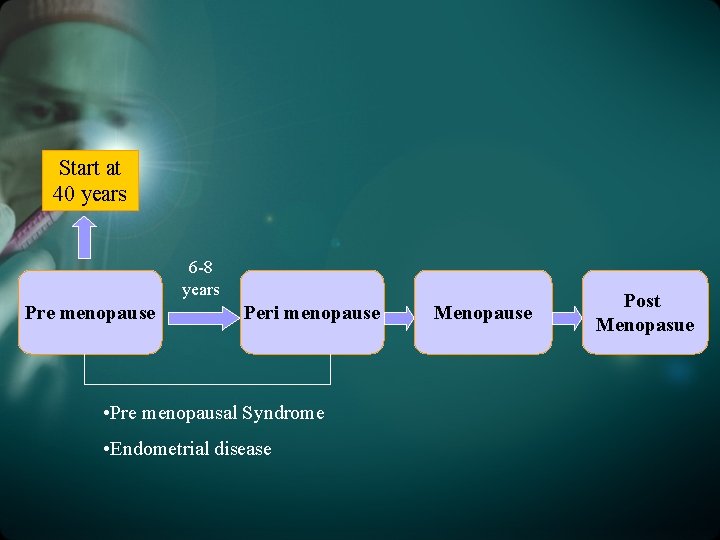
Start at 40 years 6 -8 years Pre menopause Peri menopause • Pre menopausal Syndrome • Endometrial disease Menopause Post Menopasue
5, 6. PRE MENOPAUSE AND PERI MENOPAUSE Menopause denotes the final menstrual bleeding. The time closest to this event is called the peri menopause’, before that is the pre-menopause, and after it the postmenopause. The pre menopause does not cover the whole of the woman’s life before the menopause, but merely the time (a) from around 40 years of age when a woman can reasonably be said to be approaching the menopause, or (when a woman feels the approach of the menopause, by experiencing pre menopausal irregularities in her menstrual cycle or other `menopausal` or `climacteric` symptoms. The last few years of menstrual life are usually years of varied patterns of short and long cycles; This periods of transition vary considerably in length, but usually to occupy about six to eight years before menopause.
A PREMENOPAUSAL SYNDROME The disruption of the ovulatory mechanism and the imbalance between progesterone and estrogen establish a characteristic syndrome of pre menopause. Such as sweating. a certain amount of hot flushes. D dizziness tingling sensation the in the extremities. headaches. sleeplessness. Worry and anxiety
• Endometrial disease The relative estrogen dominance at pre menopausal age is responsible for a higher than usual incidence of unscheduled bleeding The estrogen's stimulations without progesterone develops endometrial hyperplasia. and continuous stimulation develops atypical hyperplasia and then endometrial carcinoma
7. POST MENOPAUSE A. Menstrual cycle changes 1. 2. 3. changes in menstrual cycle regulatory occur as women progress through their forties the remaining follicles in both ovaries become less sensitive to gonadotropin stimulation. There is a resultant: a. Increase in follicle –stimulating hormone (FSH) b. Reduction in estrogen concentration The limited follicle maturation leads to either a decreased cycle interval or lapses of cycles with oligomenorrhea
B. The Cessation of Menses 1. The menses usually cease between the ages of 50 and 52 years. The reduced level of estrogen from the remaining follicles is no longer sufficient to induced endometrial proliferative changes capable of producing visible menstruation. 2. FSH levels rise 10 - to 20 -fold above usual cycle levels.
C. Circulating Estrogen in Postmenopausal Women 1. 2. Estrogenic activity is evident for many years after the menopause but at much reduced levels. Estrone, the principal estrogen in a postmenopausal woman, is produced from the androgen precursor, androstenedione, via extraglandular and extrahepatic aromatization. a. Most of the androstenedione comes from adrenal gland. b. Ovarian stroma secretes androstenedione for a short time before that tissue becomes quiescent
3. Obesity is a factor in postmenopausal estrogen levels. a. In Obese women, there is an increased conversion of androstenedione to estrone. b. The conversion reflect the ability of fat cells to aromatize androgens. 4. The extraglandular source of estrogen is sustained for several years and maintains reasonably normal function of such estrogen-dependent tissues as breasts, urethra, vagina and vulva.
Reference ADT Govan, Colin Hodge, Robin Callander, Gynecology Illustrated, Churchill Livingstone Edunbary, London Melbourne, New York, 1985, 124 -127. Vesna Dramusic, SS Ratnam, Clinical Approach to Paediatric and Adolescent Gynaecology, Oxford University Press Singapore, 1998, 1 -11. William W. Beck VR, Obstetrics and Gynecology, Harval Publishing Company, Pensylvania, 1986, 189 -195. Allan Rossenfield and Mahmud F. Futhaha, The FIGO. Manual of Human Reproduction Vol. I Reproductive The Trustee of Columbia University, New York, 1990, 22 -54. PA Van Keep, VH Utian, A. Vermulan, The Controversial Climateric, MTP Press Limited, Lancaster The Hague, 1985, 1 -9.