
WMO Severe Weather Forecasting Demonstration Project SWFDP Bay
WMO Severe Weather Forecasting Demonstration Project (SWFDP) Bay of Bengal Alice Soares Scientific Officer Data-Processing and Forecasting Systems (DPFS) Division Weather and DRR Services Department asoares@wmo. int WMO; WDS
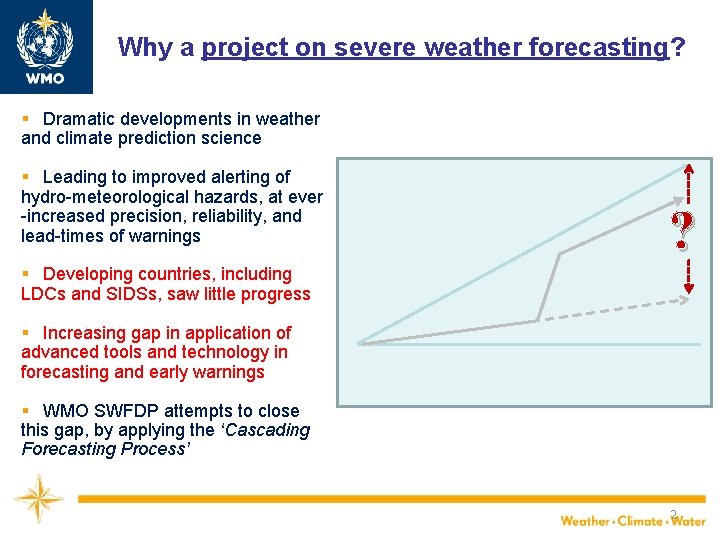
Why a project on severe weather forecasting? § Dramatic developments in weather and climate prediction science § Leading to improved alerting of hydro-meteorological hazards, at ever -increased precision, reliability, and lead-times of warnings ? § Developing countries, including LDCs and SIDSs, saw little progress § Increasing gap in application of advanced tools and technology in forecasting and early warnings § WMO SWFDP attempts to close this gap, by applying the ‘Cascading Forecasting Process’ 2
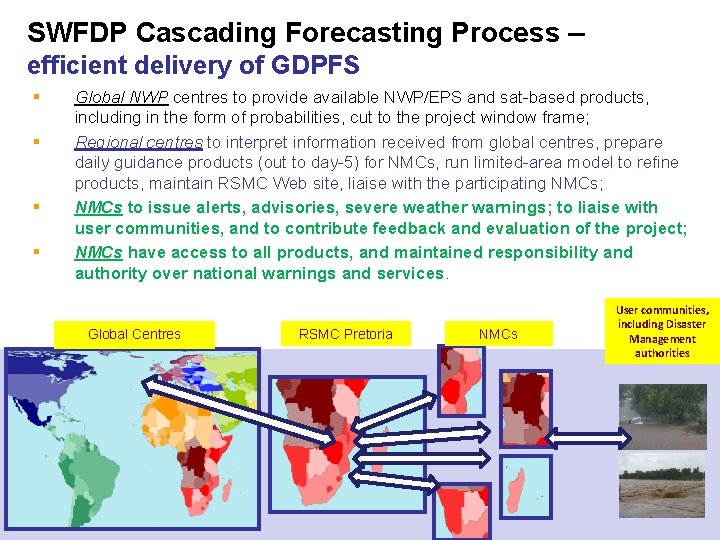
SWFDP Cascading Forecasting Process – efficient delivery of GDPFS § Global NWP centres to provide available NWP/EPS and sat-based products, including in the form of probabilities, cut to the project window frame; Regional centres to interpret information received from global centres, prepare daily guidance products (out to day-5) for NMCs, run limited-area model to refine products, maintain RSMC Web site, liaise with the participating NMCs; NMCs to issue alerts, advisories, severe weather warnings; to liaise with user communities, and to contribute feedback and evaluation of the project; NMCs have access to all products, and maintained responsibility and authority over national warnings and services. § § § Global Centres 3 RSMC Pretoria NMCs User communities, including Disaster Management authorities
SWFDP Main Goals § Implement the WMO’s GDPFS three-level system – the ‘Cascading Forecasting Process’ ü ü § § § International collaboration among operational centres at global, regional and national levels Improve the skill of products from WMO operational centres through feedback and forecast verification Continuous learning and modernization Address the needs of groups of “like-countries” Improve lead-time of Warnings Improve interaction of NMHSs with their users Identify areas for improvement and requirements for the WMO Basic Systems
SWFDP Strengths • • • Cost effectiveness; Simplicity; NMHSs need good internet only; Highly operational; Capacity development through specialized training programme • improved forecasts and lead-time of warnings 5
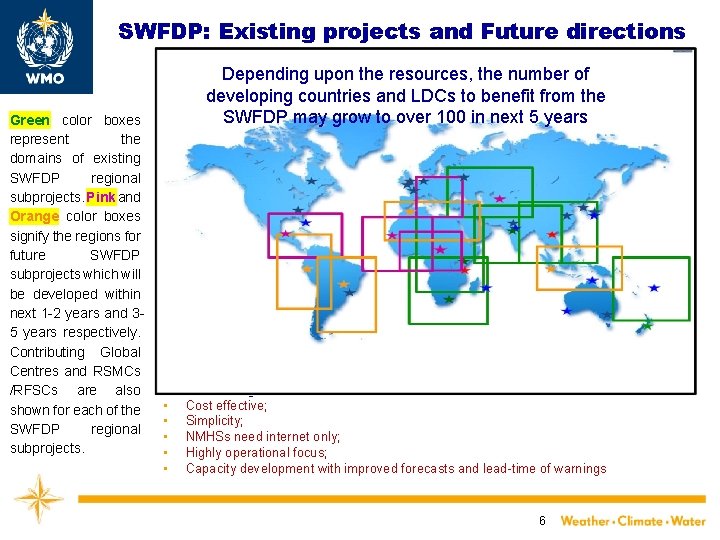
SWFDP: Existing projects and Future directions Green color boxes represent the domains of existing SWFDP regional subprojects. Pink and Orange color boxes signify the regions for future SWFDP subprojects which will be developed within next 1 -2 years and 35 years respectively. Contributing Global Centres and RSMCs /RFSCs are also shown for each of the SWFDP regional subprojects. Depending upon the resources, the number of developing countries and LDCs to benefit from the SWFDP may grow to over 100 in next 5 years SWFDP Strengths: • Cost effective; • Simplicity; • NMHSs need internet only; • Highly operational focus; • Capacity development with improved forecasts and lead-time of warnings 6
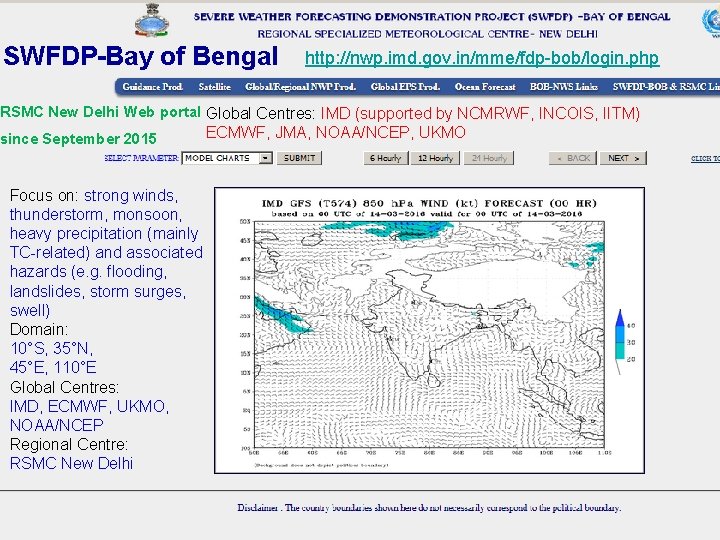
SWFDP-Bay of Bengal http: //nwp. imd. gov. in/mme/fdp-bob/login. php RSMC New Delhi Web portal Global Centres: IMD (supported by NCMRWF, INCOIS, IITM) since September 2015 ECMWF, JMA, NOAA/NCEP, UKMO Focus on: strong winds, thunderstorm, monsoon, heavy precipitation (mainly TC-related) and associated hazards (e. g. flooding, landslides, storm surges, swell) Domain: 10°S, 35°N, 45°E, 110°E Global Centres: IMD, ECMWF, UKMO, NOAA/NCEP Regional Centre: RSMC New Delhi test footer 7
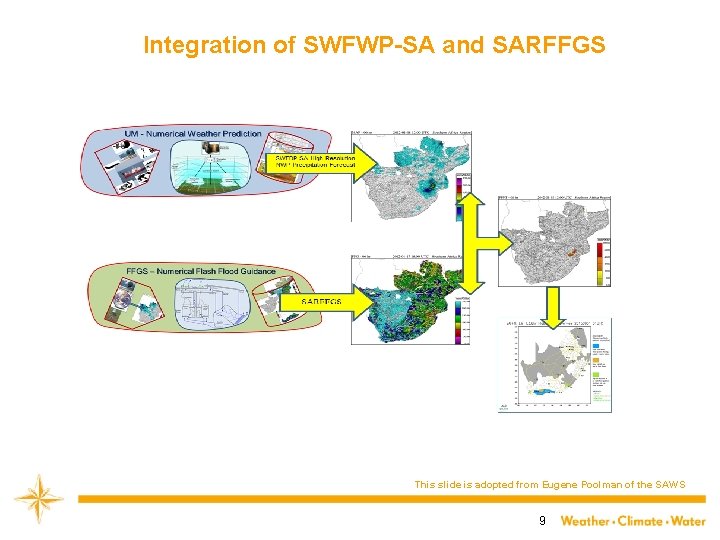
SWFDP Synergies SWFDP linkages are developed with various programmes and projects wherever appropriate o Flash Flood Forecasts Guidance System (FFGS) o Tropical Cyclones Programme (TCP) o SCOPE-Nowcasting (SAT) o Coastal Inundation Forecasting Demonstration Project
Integration of SWFWP-SA and SARFFGS This slide is adopted from Eugene Poolman of the SAWS 9
WMO Thank You Alice Soares asoares@wmo. int
- Slides: 10