
WMO GMAS Global MultiHazard Alert System Framework for

WMO GMAS Global Multi-Hazard Alert System Framework for Meteorological and Hydrological Early Warnings and Hazard Mapping Services Ivan Čačić President RA VI Member of WMO EC WG DRR / EG GMAS RA VI RECO, 5 -6 February 2018, Geneva, Switzerland
Developent of Global DRR Services Platform WHY Key Drivers • Background - World Meteorological Organization Convention: o All WMO Members need to work together to coordinate, standardize, improve and encourage efficiencies in the exchange of meteorological, climatological and hydrological and related information between them, in the aid of human activities o Meteorology is best coordinated at the international level o The need for close cooperation with other international organizations • Increasing impacts related to weather, water and climate hazards at the national, regional and global levels • Significant advancements in the accuracy and timeliness of monitoring, forecasting and warnings capacities • The development of global indicators to measure success of warnings (i. e. Sendai Framework Agreement) which will require coordinated responses from Members RA VI RECO, 5 -6 February 2018, Geneva, Switzerland 2 /16
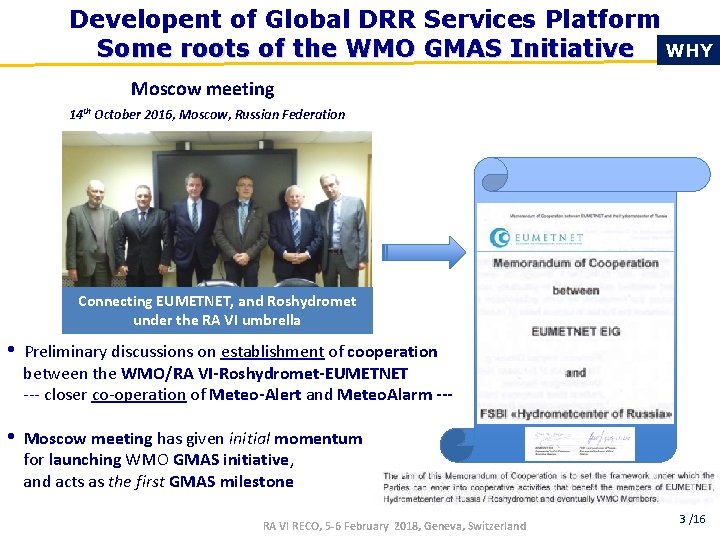
Developent of Global DRR Services Platform Some roots of the WMO GMAS Initiative WHY Moscow meeting 14 th October 2016, Moscow, Russian Federation Connecting EUMETNET, and Roshydromet under the RA VI umbrella • Preliminary discussions on establishment of cooperation between the WMO/RA VI-Roshydromet-EUMETNET --- closer co-operation of Meteo-Alert and Meteo. Alarm --- • Moscow meeting has given initial momentum for launching WMO GMAS initiative, and acts as the first GMAS milestone RA VI RECO, 5 -6 February 2018, Geneva, Switzerland 3 /16
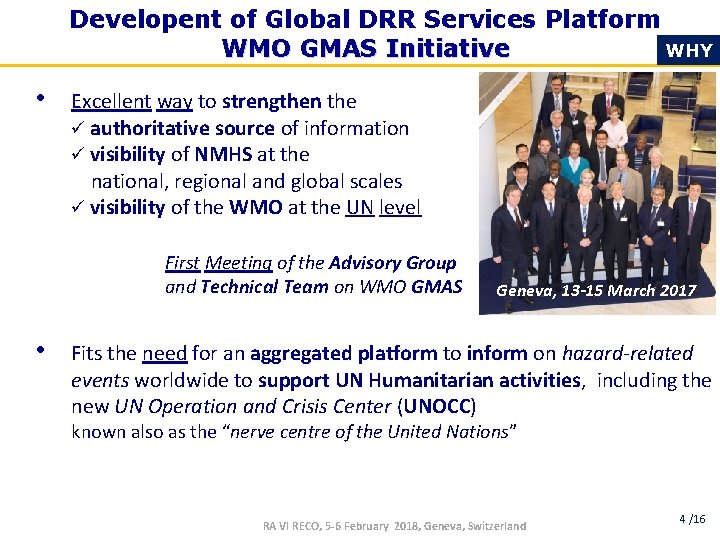
Developent of Global DRR Services Platform WHY WMO GMAS Initiative • Excellent way to strengthen the ü authoritative source of information ü visibility of NMHS at the national, regional and global scales ü visibility of the WMO at the UN level First Meeting of the Advisory Group and Technical Team on WMO GMAS • Geneva, 13 -15 March 2017 Fits the need for an aggregated platform to inform on hazard-related events worldwide to support UN Humanitarian activities, including the new UN Operation and Crisis Center (UNOCC) known also as the “nerve centre of the United Nations” RA VI RECO, 5 -6 February 2018, Geneva, Switzerland 4 /16
Developent of Global DRR Services Platform WHY WMO GMAS Benefits • Provision of authoritative information and advice to agencies operating at global and regional levels (including UN and humanitarian agencies) • • Increased recognition of the NMHS products and services • Increased sharing and harmonization of hydrometeorological ü warning and hazard products / information (when appropriate) among WMO Members • Increased focus on NMHS capacity development to provide reliable, actionable and timely warnings for hydrometeorological hazards • Better informed ü United Nations system, particularly decision makers in humanitarian agencies ü general public ü tourism sectors ü other sectors vulnerable to hydro-meteorological hazards through quick access to national warning information Increased standardization of hydrometeorological warning information among WMO Members (through utilization of Common Alerting Protocol) RA VI RECO, 5 -6 February 2018, Geneva, Switzerland 5 /16
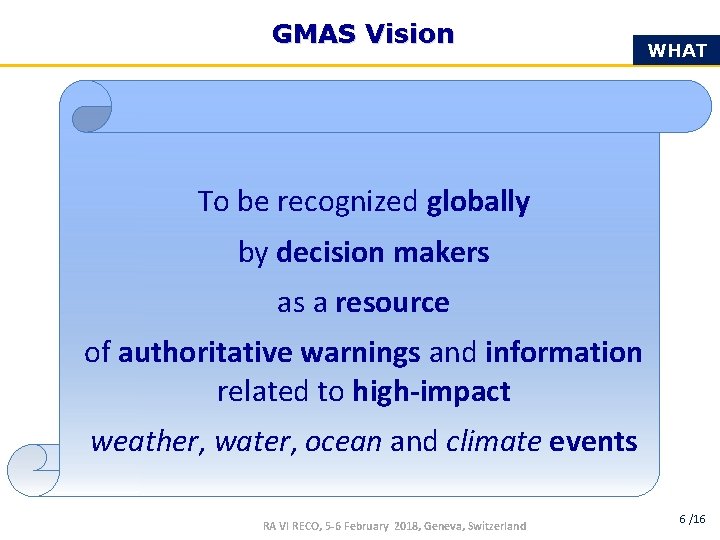
GMAS Vision WHAT To be recognized globally by decision makers as a resource of authoritative warnings and information related to high-impact weather, water, ocean and climate events RA VI RECO, 5 -6 February 2018, Geneva, Switzerland 6 /16
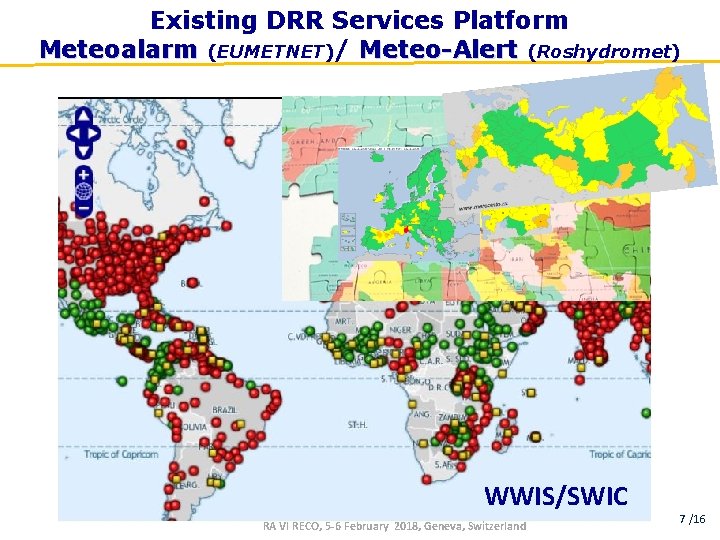
Existing DRR Services Platform Meteoalarm (EUMETNET)/ Meteo-Alert (Roshydromet) WWIS/SWIC RA VI RECO, 5 -6 February 2018, Geneva, Switzerland 7 /16
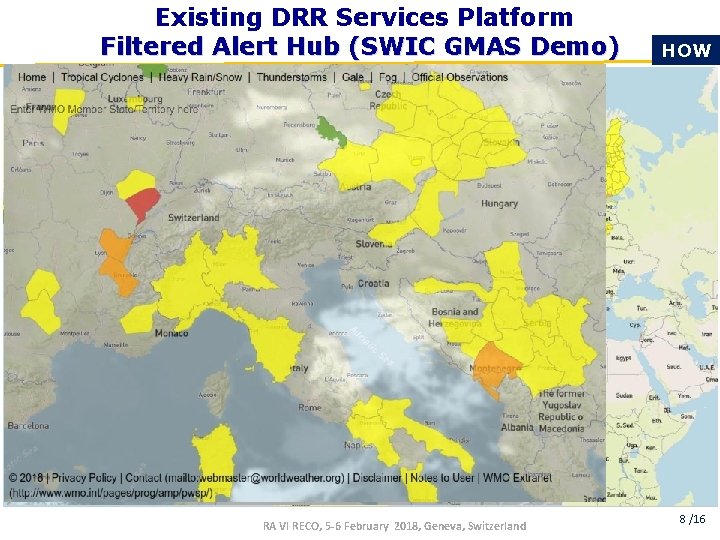
Existing DRR Services Platform Filtered Alert Hub (SWIC GMAS Demo) RA VI RECO, 5 -6 February 2018, Geneva, Switzerland HOW 8 /16
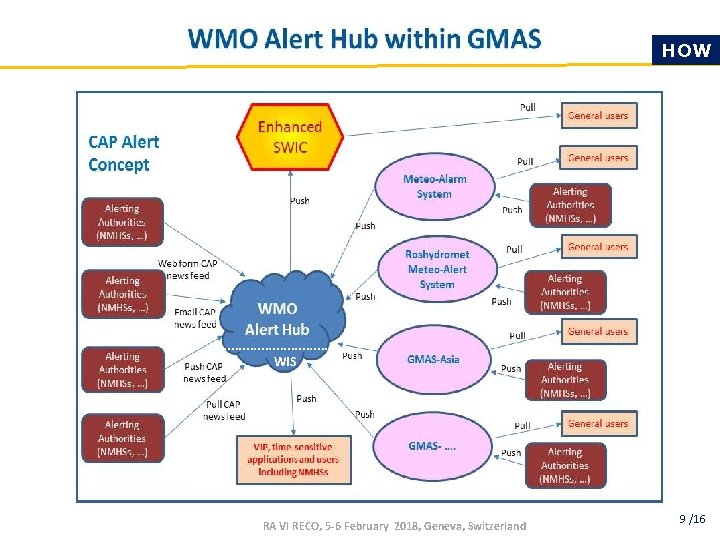
HOW . . WIS RA VI RECO, 5 -6 February 2018, Geneva, Switzerland 9 /16
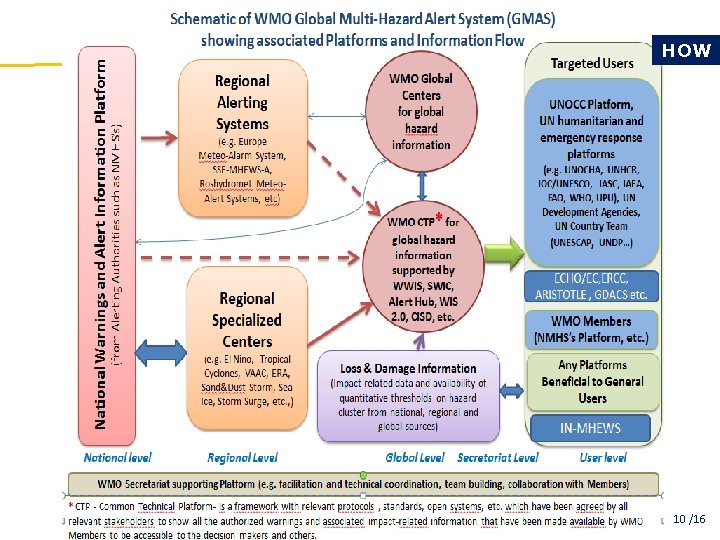
HOW CBS/OPAG-PWS ICT/PWS, Beijing, China, 3– 4 November 2017 10 /16
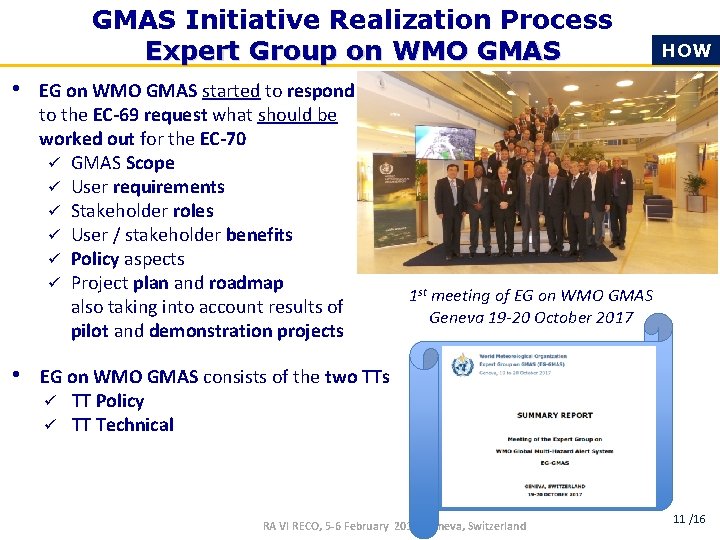
GMAS Initiative Realization Process Expert Group on WMO GMAS • • EG on WMO GMAS started to respond to the EC-69 request what should be worked out for the EC-70 ü GMAS Scope ü User requirements ü Stakeholder roles ü User / stakeholder benefits ü Policy aspects ü Project plan and roadmap also taking into account results of pilot and demonstration projects HOW 1 st meeting of EG on WMO GMAS Geneva 19 -20 October 2017 EG on WMO GMAS consists of the two TTs ü TT Policy ü TT Technical RA VI RECO, 5 -6 February 2018, Geneva, Switzerland 11 /16
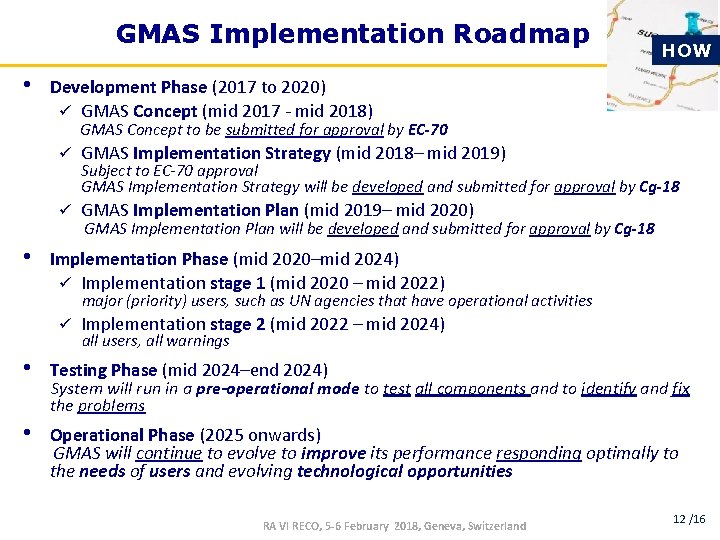
GMAS Implementation Roadmap • HOW Development Phase (2017 to 2020) ü GMAS Concept (mid 2017 - mid 2018) GMAS Concept to be submitted for approval by EC-70 • ü GMAS Implementation Strategy (mid 2018– mid 2019) ü GMAS Implementation Plan (mid 2019– mid 2020) Subject to EC-70 approval GMAS Implementation Strategy will be developed and submitted for approval by Cg-18 GMAS Implementation Plan will be developed and submitted for approval by Cg-18 Implementation Phase (mid 2020–mid 2024) ü Implementation stage 1 (mid 2020 – mid 2022) major (priority) users, such as UN agencies that have operational activities ü Implementation stage 2 (mid 2022 – mid 2024) all users, all warnings • Testing Phase (mid 2024–end 2024) • Operational Phase (2025 onwards) GMAS will continue to evolve to improve its performance responding optimally to the needs of users and evolving technological opportunities System will run in a pre-operational mode to test all components and to identify and fix the problems RA VI RECO, 5 -6 February 2018, Geneva, Switzerland 12 /16
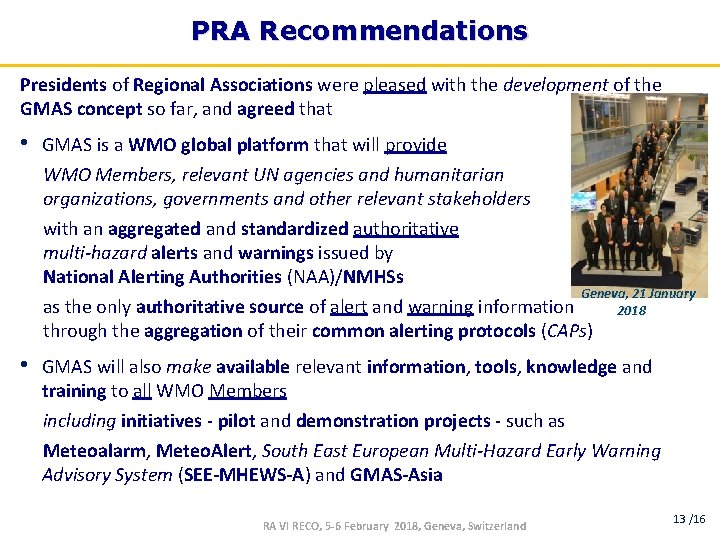
PRA Recommendations Presidents of Regional Associations were pleased with the development of the GMAS concept so far, and agreed that • GMAS is a WMO global platform that will provide WMO Members, relevant UN agencies and humanitarian organizations, governments and other relevant stakeholders with an aggregated and standardized authoritative multi-hazard alerts and warnings issued by National Alerting Authorities (NAA)/NMHSs Geneva, 21 January as the only authoritative source of alert and warning information 2018 through the aggregation of their common alerting protocols (CAPs) • GMAS will also make available relevant information, tools, knowledge and training to all WMO Members including initiatives - pilot and demonstration projects - such as Meteoalarm, Meteo. Alert, South East European Multi-Hazard Early Warning Advisory System (SEE-MHEWS-A) and GMAS-Asia RA VI RECO, 5 -6 February 2018, Geneva, Switzerland 13 /16
PRA Recommendations Presidents of Regional Associations were pleased with the development of the GMAS concept so far, and agreed that • The objectives of GMAS ü To enhance the authoritative voice of Members’ NAA/ NMHSs in issuing official early warnings ü To enhance the visibility of WMO and its Members in contributing to the Sendai Framework for Disaster Risk Reduction 2015– 2030 and the Sustainable Development Goals to the UN ü To address WMO Members’ needs for development impact-based forecasting and warning ü To provide a central repository for CAP messages of authoritative multihazard alerts and warnings • GMAS Principles o GMAS is neither replacing nor duplicating existing mechanisms developed under the auspices of the WMO technical commissions, regional associations and their respective programmes and projects RA VI RECO, 5 -6 February 2018, Geneva, Switzerland 14 /16
PRA Recommendations Presidents of Regional Associations were pleased with the development of the GMAS concept so far, and agreed that • GMAS Principles o GMAS is to facilitate and promote ü usage of existing national capabilities and national investment for further NMHS development ü cross boarder collaboration wherever / whenever is possible o Important building block of the GMAS is the GDPFS with a role to support the NAA/NMHSs in tuning their perspective in the process of tailoring of national alerts and warnings / CAPs. Thus GDPFS with its centers of excellence act ü as an advisory entity and a vital source of information, in particular for developing and least developed Members that are primarily most vulnerable ü as global driving force for the national development and maintenance of its observation network and derivation of local NWP products primarily produced by the NMHSs RA VI RECO, 5 -6 February 2018, Geneva, Switzerland 15 /16
PRA Recommendations Presidents of Regional Associations were pleased with the development of the GMAS concept so far, and agreed that • GMAS Principles o GMAS development and implementation process will include: ü clear protocols, standards, code of behaviors - standard operative procedures - need to be elaborated ü Demonstration and pilot projects - to test ü Risk assessment - should be the vital part RA VI RECO, 5 -6 February 2018, Geneva, Switzerland 16 /16
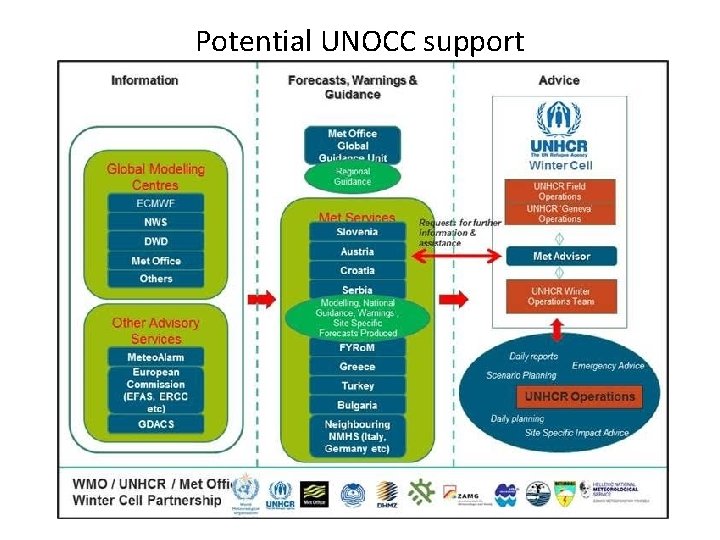
Potential UNOCC support
Thank you
- Slides: 18