
WMO Contributions to TWS I WMOs GTS support
WMO Contributions to TWS I. WMO's GTS support to TWS II. Support of Regional Warning Centers III. IOC/WMO/ISDR Assessments IV. Multi-hazard approach to ocean-related early warning systems
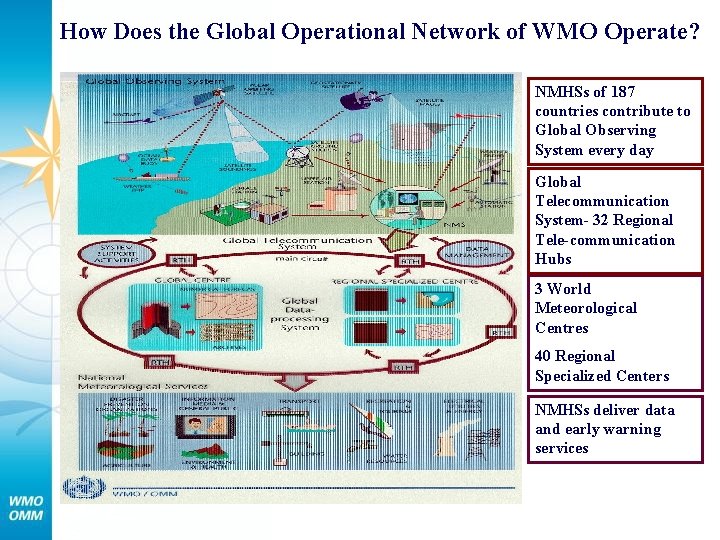
How Does the Global Operational Network of WMO Operate? NMHSs of 187 countries contribute to Global Observing System every day Global Telecommunication System- 32 Regional Tele-communication Hubs 3 World Meteorological Centres 40 Regional Specialized Centers NMHSs deliver data and early warning services
WMO Global Telecommunication System (GTS), linking National Meteorological Services of 187 countries and territories, has been established as the backbone for exchange of natural hazards related information and warnings, including tsunami (e. g. Pacific, Indian Ocean).
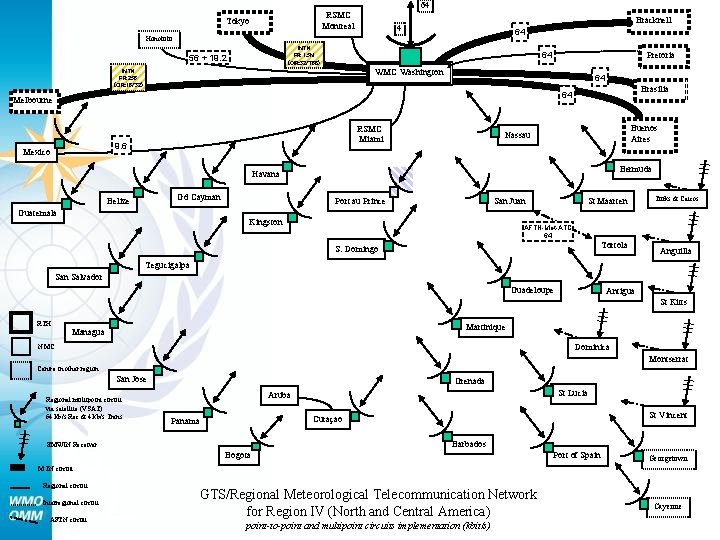
64 RSMC Montreal Tokyo Bracknell 4 64 Honolulu IMTN FR 1. 5 M (CIR: 32/768) 56 + 19. 2 Pretoria 64 WMC Washington IMTN FR 256 (CIR: 16/32) 64 Brasilia 64 Melbourne RSMC Miami 9. 6 Mexico Buenos Aires Nassau Bermuda Havana Gd Cayman Belize Guatemala San Juan Port au Prince Kingston St Maarten Turks & Caicos AFTN-Met-ATC 64 Tortola S. Domingo Anguilla Tegucigalpa San Salvador Guadeloupe Antigua St Kitts RTH Martinique Managua Dominica NMC Montserrat Centre in other region San Jose Regional multipoint circuit via satellite (VSAT) 64 kb/s Rec & 4 kb/s Trans Grenada St Lucia Aruba St Vincent Curaçao Panama Barbados EMWIN Receiver Bogota Port of Spain Georgetown MTN circuit Regional circuit Interregional circuit AFTN circuit GTS/Regional Meteorological Telecommunication Network for Region IV (North and Central America) point-to-point and multipoint circuits implementation (kbit/s) Cayenne
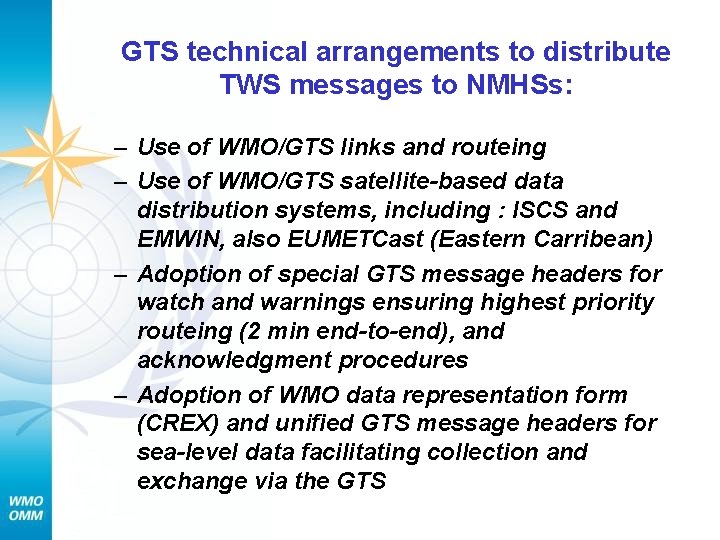
GTS technical arrangements to distribute TWS messages to NMHSs: – Use of WMO/GTS links and routeing – Use of WMO/GTS satellite-based data distribution systems, including : ISCS and EMWIN, also EUMETCast (Eastern Carribean) – Adoption of special GTS message headers for watch and warnings ensuring highest priority routeing (2 min end-to-end), and acknowledgment procedures – Adoption of WMO data representation form (CREX) and unified GTS message headers for sea-level data facilitating collection and exchange via the GTS
WMO Contributions to TWS I. WMO's GTS support to IO-TWS II. Support of Regional Warning Centers III. IOC/WMO/ISDR Assessments IV. Multi-hazard approach to ocean-related early warning systems
WMO’s unique experience in Operational Requirements of Regional Warning Centers • Multi-Hazard Early Warning Centres: Concept of Operations on: • • • Organizational arrangements, Operations and Procedures, Standards, Communications, Output coordination, International collaboration • WMO has shared its operational manuals and accreditation process for regional centres with IOC
WMO Contributions to TWS I. WMO's GTS support to IO-TWS II. Support of Regional Warning Centers III. IOC/WMO/ISDR Assessments IV. Multi-hazard approach to ocean-related early warning systems
IOC/WMO/ISDR Assessment Missions • Mission Objective: – To identify current capabilities, gaps, needs and problem areas wrt TWS • IOC/WMO/ISDR missions were held in IO – A questionnaire was circulated among NMHSs to determine needs prior to the missions • Analyses leading to projects addressing gaps and needs
WMO Contributions to TWS I. WMO's GTS support to IO-TWS II. Support of Regional Warning Centers III. IOC/WMO/ISDR Assessments IV. Multi-hazard approach to ocean-related early warning systems
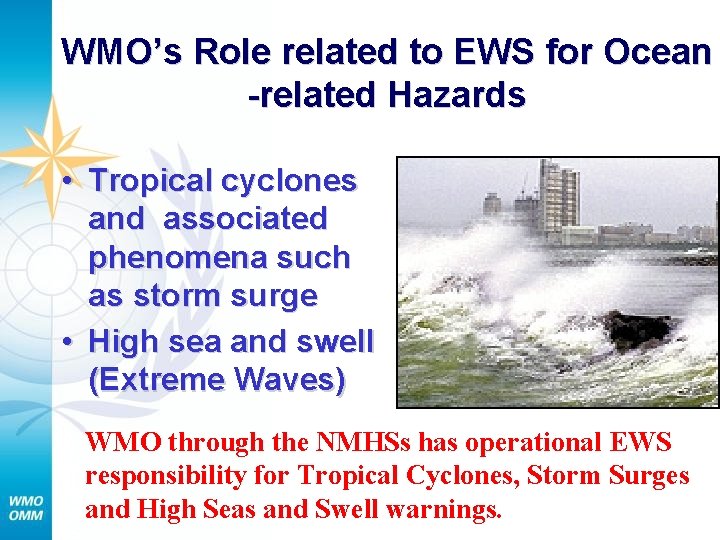
WMO’s Role related to EWS for Ocean -related Hazards • Tropical cyclones and associated phenomena such as storm surge • High sea and swell (Extreme Waves) WMO through the NMHSs has operational EWS responsibility for Tropical Cyclones, Storm Surges and High Seas and Swell warnings.
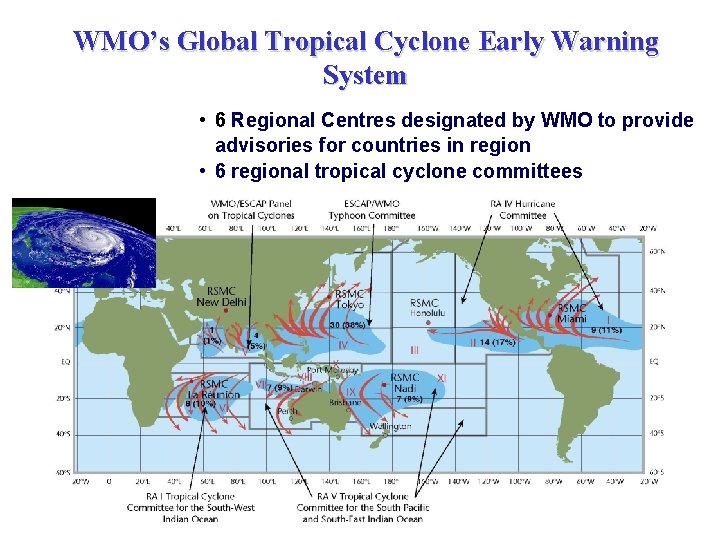
WMO’s Global Tropical Cyclone Early Warning System • 6 Regional Centres designated by WMO to provide advisories for countries in region • 6 regional tropical cyclone committees
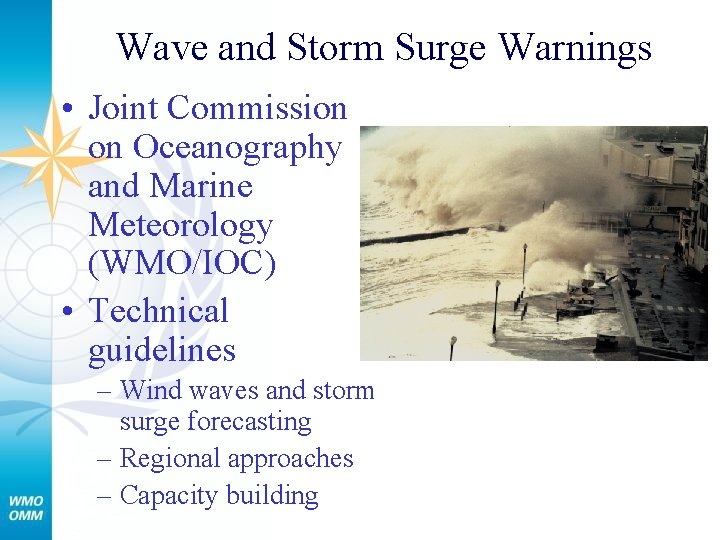
Wave and Storm Surge Warnings • Joint Commission on Oceanography and Marine Meteorology (WMO/IOC) • Technical guidelines – Wind waves and storm surge forecasting – Regional approaches – Capacity building
Warnings for Enhanced Coastal Risk Management • Enhanced technical capacities linking tropical cyclones, storm surges and coastal flooding forecasts and warnings – Interdisciplinary methodologies and models – WMO Tropical Cyclone, Marine Meteorology and Oceanography and Hydrology programmes – Role of JCOMM and other key WMO Technical Commissions (Basic Systems and Hydrology)
IOC – Ad Hoc Working Group on the Framework for a Global Tsunami and other Ocean-Related Hazards Early Warning System • Resolution: XXIII-15 • To. R: To address global issues common to four ICGs related to tsunami and ocean-related hazard warning systems • First meeting: at IOC EC-39 (24 June 2006) • Second meeting: at Bonn (6 February 2007) • Expected Outcome: Develop technical guidance for governments for pursuit of ocean-related hazards – Framework document to be presented in the forthcoming IOC Assembly (June 2007) WMO will support the IOC-Ad Hoc Working related to ocean-hazards under its mandate.
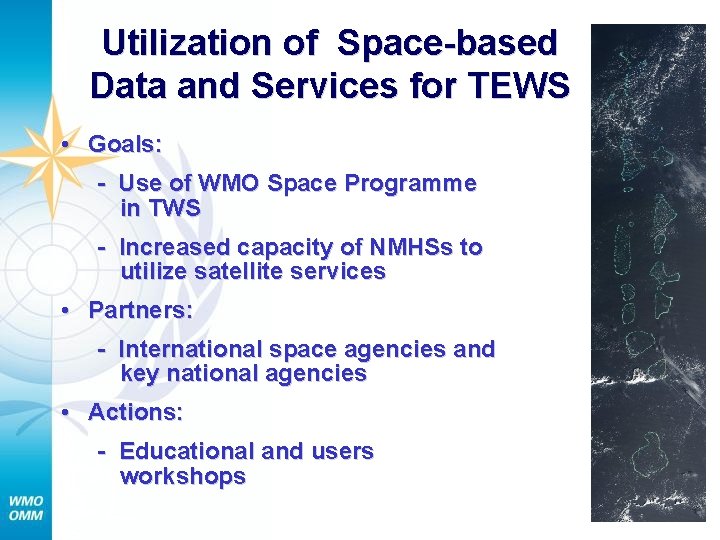
Utilization of Space-based Data and Services for TEWS • Goals: - Use of WMO Space Programme in TWS - Increased capacity of NMHSs to utilize satellite services • Partners: - International space agencies and key national agencies • Actions: - Educational and users workshops
- Slides: 16