
WLTP Test Procedures for Chassis Dynamometer Testing Chris
- Slides: 14
WLTP Test Procedures for Chassis Dynamometer Testing Chris Laroo - U. S. EPA April 14, 2010 WLTP-DTP-01 -13 1
Outline • Overview of current US domestic test procedures, WHDC, and NRMM GTR • Overview of proposed WLTP test procedures • Conclusions WLTP-DTP-01 -13 2
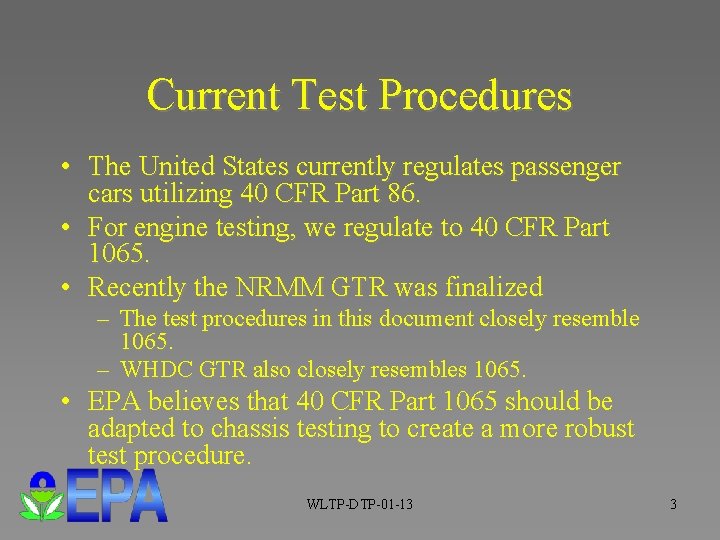
Current Test Procedures • The United States currently regulates passenger cars utilizing 40 CFR Part 86. • For engine testing, we regulate to 40 CFR Part 1065. • Recently the NRMM GTR was finalized – The test procedures in this document closely resemble 1065. – WHDC GTR also closely resembles 1065. • EPA believes that 40 CFR Part 1065 should be adapted to chassis testing to create a more robust test procedure. WLTP-DTP-01 -13 3
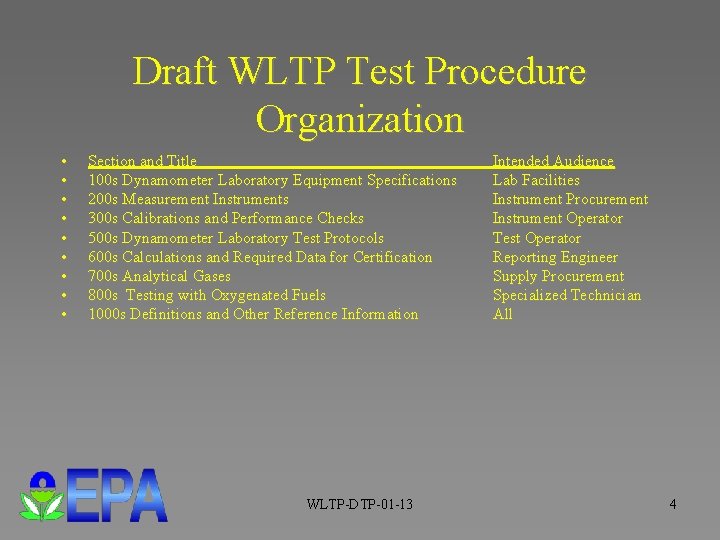
Draft WLTP Test Procedure Organization • • • Section and Title 100 s Dynamometer Laboratory Equipment Specifications 200 s Measurement Instruments 300 s Calibrations and Performance Checks 500 s Dynamometer Laboratory Test Protocols 600 s Calculations and Required Data for Certification 700 s Analytical Gases 800 s Testing with Oxygenated Fuels 1000 s Definitions and Other Reference Information WLTP-DTP-01 -13 Intended Audience Lab Facilities Instrument Procurement Instrument Operator Test Operator Reporting Engineer Supply Procurement Specialized Technician All 4
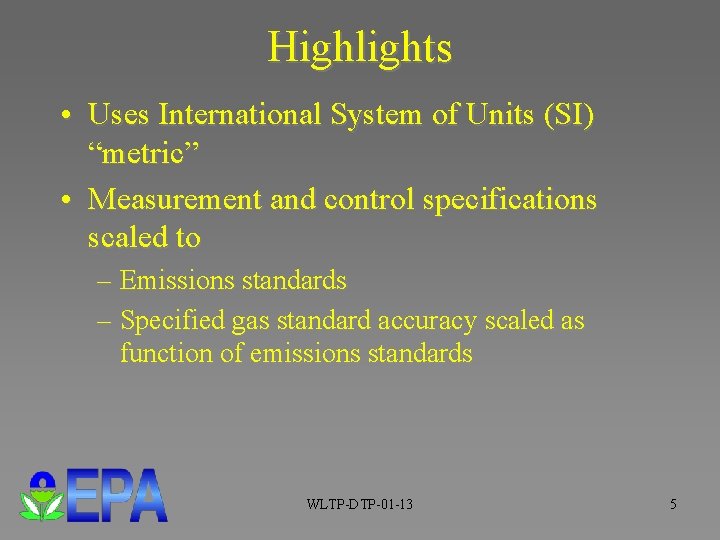
Highlights • Uses International System of Units (SI) “metric” • Measurement and control specifications scaled to – Emissions standards – Specified gas standard accuracy scaled as function of emissions standards WLTP-DTP-01 -13 5
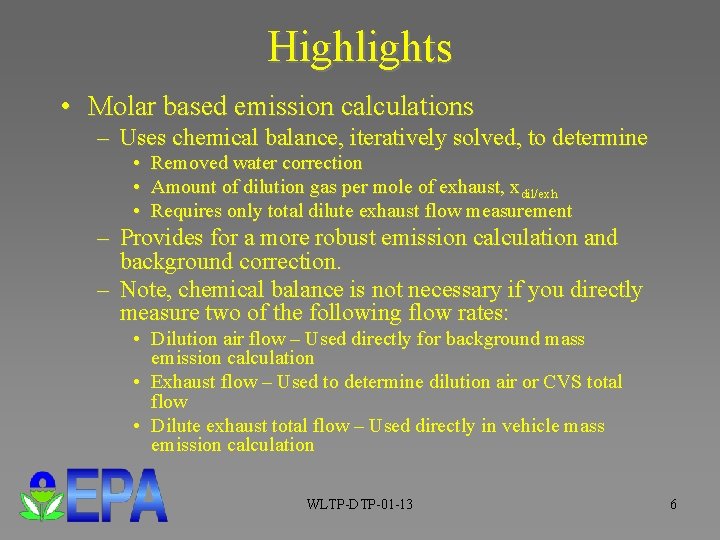
Highlights • Molar based emission calculations – Uses chemical balance, iteratively solved, to determine • Removed water correction • Amount of dilution gas per mole of exhaust, xdil/exh • Requires only total dilute exhaust flow measurement – Provides for a more robust emission calculation and background correction. – Note, chemical balance is not necessary if you directly measure two of the following flow rates: • Dilution air flow – Used directly for background mass emission calculation • Exhaust flow – Used to determine dilution air or CVS total flow • Dilute exhaust total flow – Used directly in vehicle mass emission calculation WLTP-DTP-01 -13 6
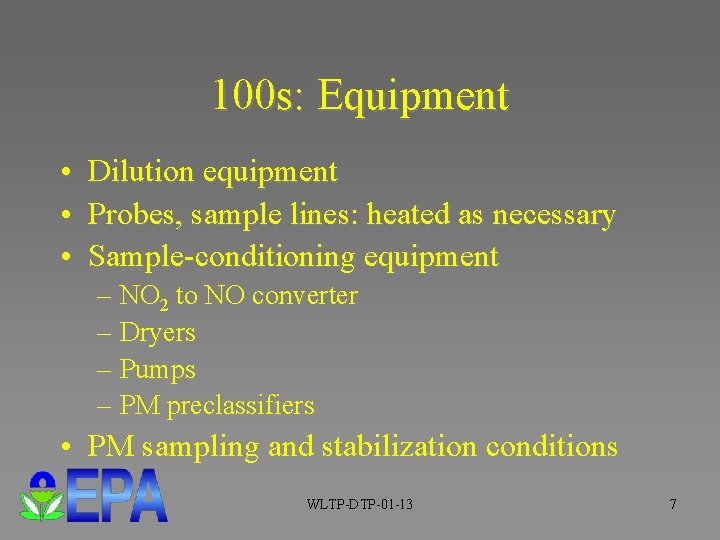
100 s: Equipment • • • Dilution equipment Probes, sample lines: heated as necessary Sample-conditioning equipment – NO 2 to NO converter – Dryers – Pumps – PM preclassifiers • PM sampling and stabilization conditions WLTP-DTP-01 -13 7
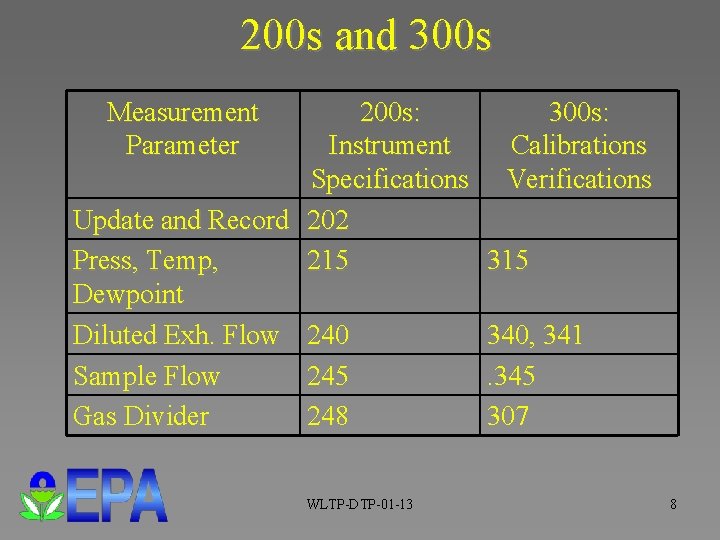
200 s and 300 s Measurement Parameter 200 s: 300 s: Instrument Calibrations Specifications Verifications Update and Record 202 Press, Temp, 215 315 Dewpoint Diluted Exh. Flow 240 340, 341 Sample Flow 245. 345 Gas Divider 248 307 WLTP-DTP-01 -13 8
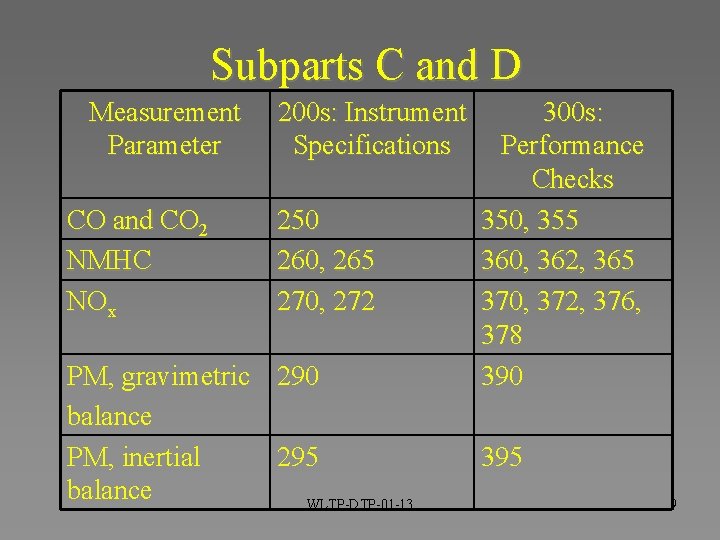
Subparts C and D Measurement Parameter CO and CO 2 NMHC NOx 200 s: Instrument Specifications 250 260, 265 270, 272 PM, gravimetric 290 balance PM, inertial 295 balance WLTP-DTP-01 -13 300 s: Performance Checks 350, 355 360, 362, 365 370, 372, 376, 378 390 395 9
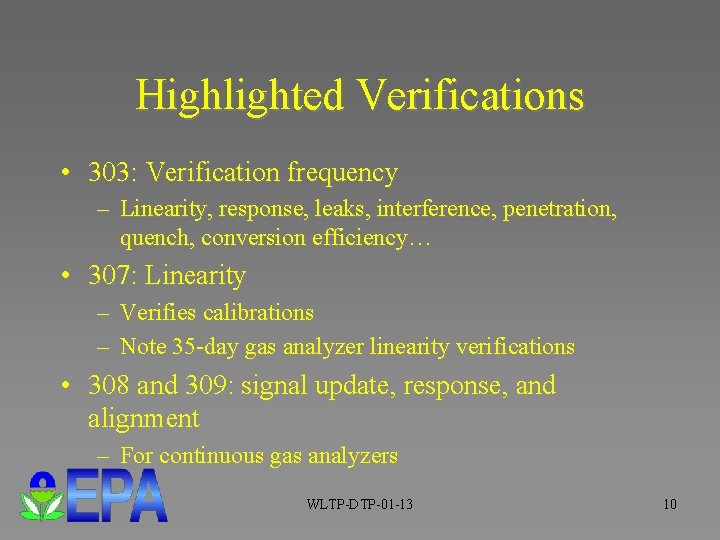
Highlighted Verifications • 303: Verification frequency – Linearity, response, leaks, interference, penetration, quench, conversion efficiency… • 307: Linearity – Verifies calibrations – Note 35 -day gas analyzer linearity verifications • 308 and 309: signal update, response, and alignment – For continuous gas analyzers WLTP-DTP-01 -13 10
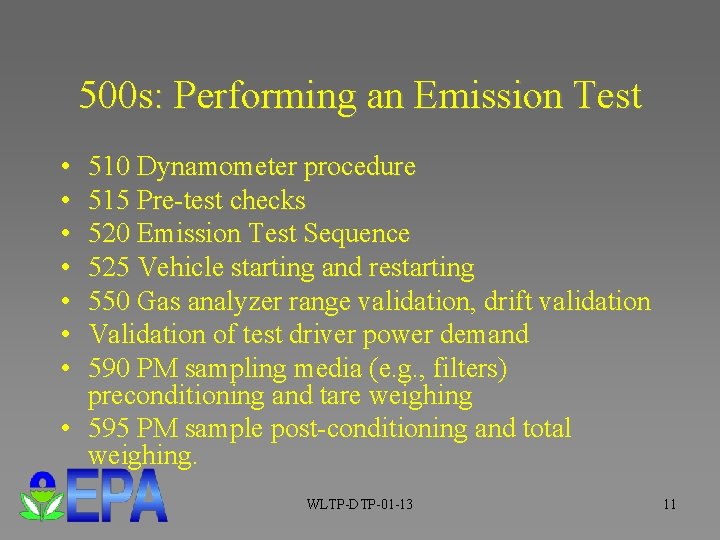
500 s: Performing an Emission Test • • 510 Dynamometer procedure 515 Pre-test checks 520 Emission Test Sequence 525 Vehicle starting and restarting 550 Gas analyzer range validation, drift validation Validation of test driver power demand 590 PM sampling media (e. g. , filters) preconditioning and tare weighing • 595 PM sample post-conditioning and total weighing. WLTP-DTP-01 -13 11
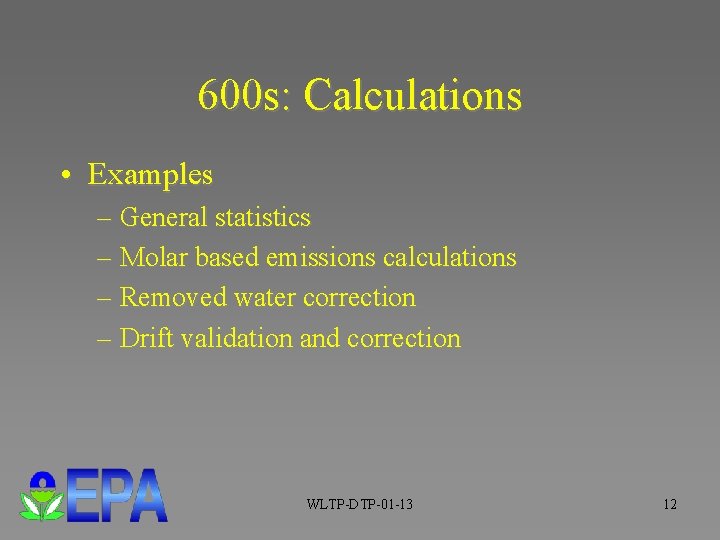
600 s: Calculations • Examples – General statistics – Molar based emissions calculations – Removed water correction – Drift validation and correction WLTP-DTP-01 -13 12
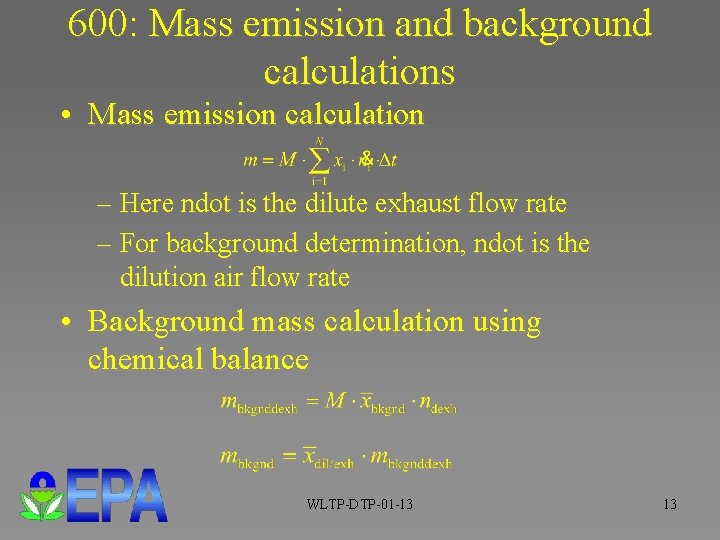
600: Mass emission and background calculations • Mass emission calculation – Here ndot is the dilute exhaust flow rate – For background determination, ndot is the dilution air flow rate • Background mass calculation using chemical balance WLTP-DTP-01 -13 13
Conclusions • EPA believes that one set of improved test procedures for labs should improve repeatability • One set of test procedures provides pathway for significant international harmonization across all testing platforms • 40 CFR 1065 should be used as a basis for international harmonization across all certification platforms (chassis and engine). WLTP-DTP-01 -13 14