
WJEC A 2 Unit 4 Crime and Deviance





- Slides: 31
WJEC A 2 Unit 4, Crime and Deviance Week 8: Gender and Crime 10/29/2020 Crime and Deviance Chapter 13 1
Accessibility Statement n This slide show has been designed to be user friendly to people with dyslexia and those with visual impairment. n The accessible font Arial is used. n Black font on a white background is avoided. n Instead, font colour and background have been chosen to complement each other in order to avoid stark contrasts which dyslexic readers find hinders reading. n All text is left-justified to avoid ‘rivers of white’. 10/29/2020 Crime and Deviance Chapter 13 2
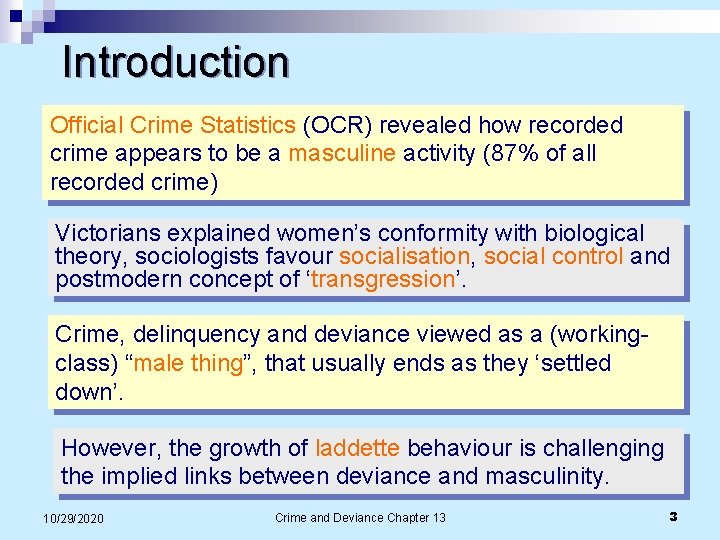
Introduction Official Crime Statistics (OCR) revealed how recorded crime appears to be a masculine activity (87% of all recorded crime) Victorians explained women’s conformity with biological theory, sociologists favour socialisation, social control and postmodern concept of ‘transgression’. Crime, delinquency and deviance viewed as a (workingclass) “male thing”, that usually ends as they ‘settled down’. However, the growth of laddette behaviour is challenging the implied links between deviance and masculinity. 10/29/2020 Crime and Deviance Chapter 13 3
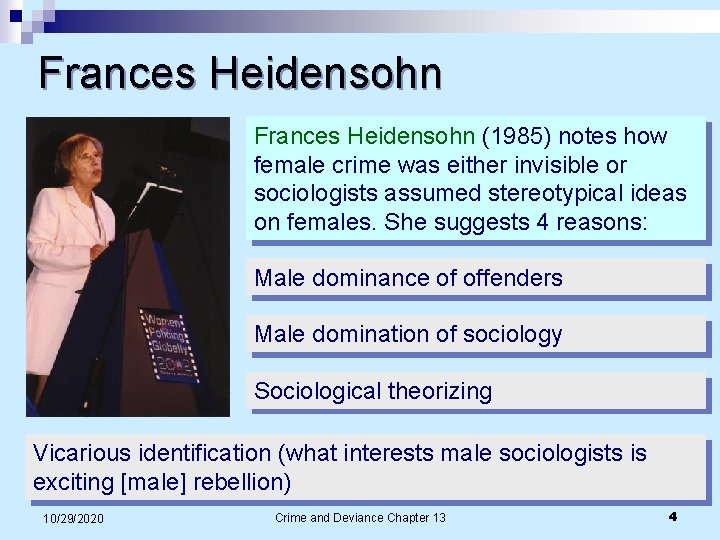
Frances Heidensohn (1985) notes how female crime was either invisible or sociologists assumed stereotypical ideas on females. She suggests 4 reasons: Male dominance of offenders Male domination of sociology Sociological theorizing Vicarious identification (what interests male sociologists is exciting [male] rebellion) 10/29/2020 Crime and Deviance Chapter 13 4
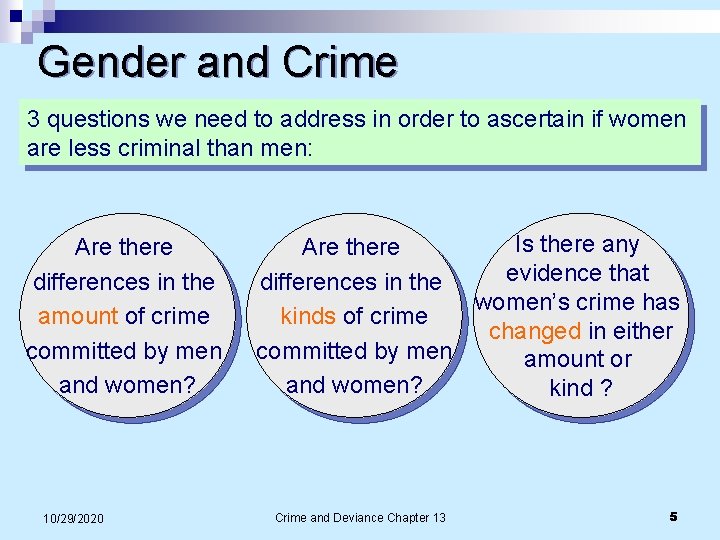
Gender and Crime 3 questions we need to address in order to ascertain if women are less criminal than men: Are there differences in the amount of crime committed by men and women? 10/29/2020 Is there any Are there evidence that differences in the women’s crime has kinds of crime changed in either committed by men amount or and women? kind ? Crime and Deviance Chapter 13 5
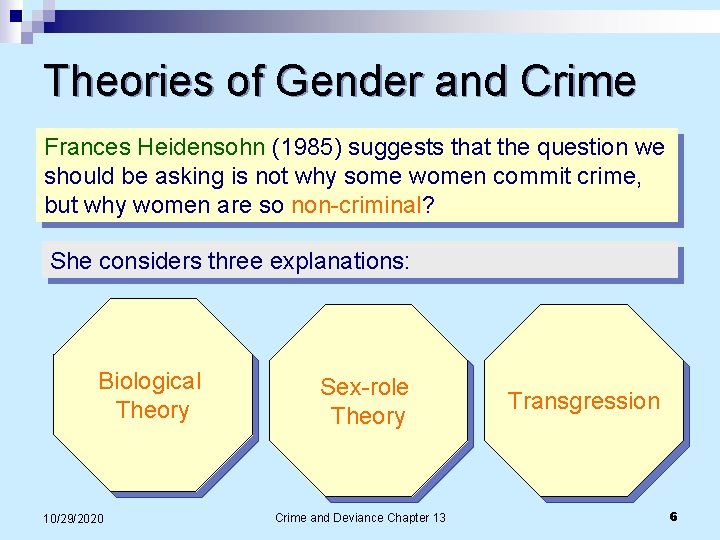
Theories of Gender and Crime Frances Heidensohn (1985) suggests that the question we should be asking is not why some women commit crime, but why women are so non-criminal? She considers three explanations: Biological Theory 10/29/2020 Sex-role Theory Crime and Deviance Chapter 13 Transgression 6
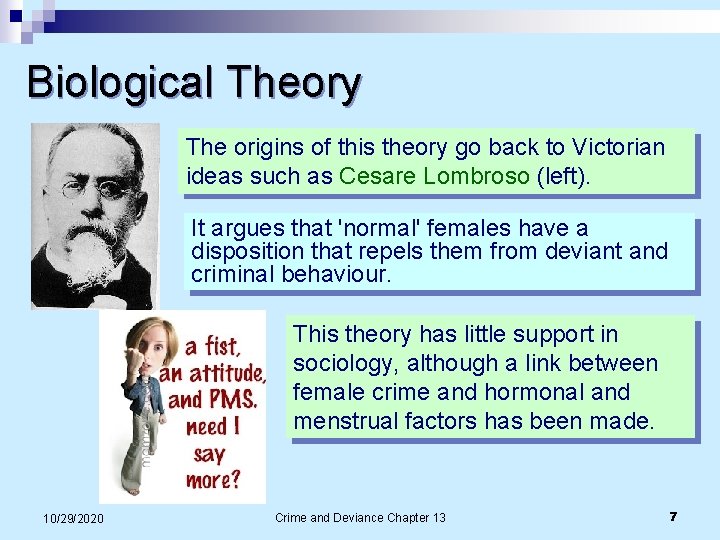
Biological Theory The origins of this theory go back to Victorian ideas such as Cesare Lombroso (left). It argues that 'normal' females have a disposition that repels them from deviant and criminal behaviour. This theory has little support in sociology, although a link between female crime and hormonal and menstrual factors has been made. 10/29/2020 Crime and Deviance Chapter 13 7
Sex-role Theory (Socialization) From infancy, children are socialized that the two sexes are different. Female rôles contain such elements as caring, passivity, and domesticity. Male rôles, on the other hand, stress elements of toughness, aggressiveness and sexual conquest. It is argued that females generally lack the values that are typically associated with delinquency. However, laddette behaviour challenges this. 10/29/2020 Crime and Deviance Chapter 13 8
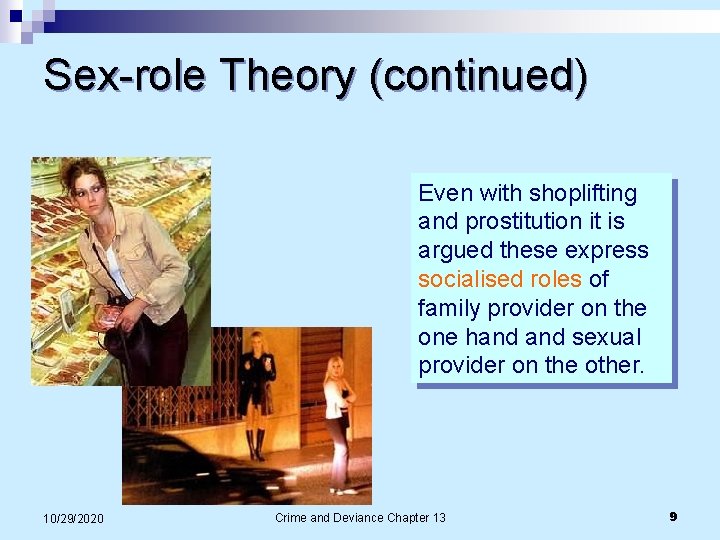
Sex-role Theory (continued) Even with shoplifting and prostitution it is argued these express socialised roles of family provider on the one hand sexual provider on the other. 10/29/2020 Crime and Deviance Chapter 13 9
Social Control Frances Heidensohn (1985) says women commit so few crimes because of the ways in which they are ideologically controlled. Firstly in the way in which societies are cemented together by a shared value system. Secondly in the way bonding occurs within relationships of family, the peer group, and the school. 10/29/2020 Crime and Deviance Chapter 13 10
Pat Carlen and Control Theory Frances Heidensohn argues most women conform because failure to do results in labelling as unfeminine behaviour. Pat Carlen (1985) has adopted control theory located in 'class deals' and 'gender deals'. Females who are most likely to become criminal are those who have not had, or have rejected, the 'gender deal'. Females who have been in care, thrown out of home, or have rejected 'normal' family life, are the most likely to be lawbreakers. 10/29/2020 Crime and Deviance Chapter 13 11
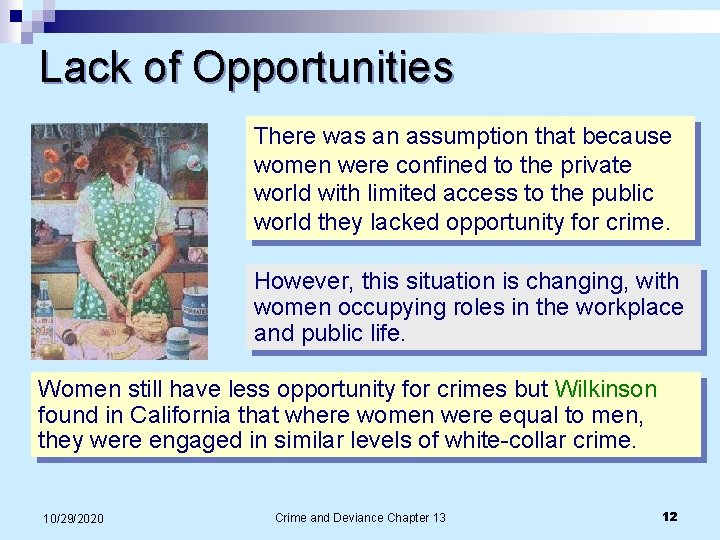
Lack of Opportunities There was an assumption that because women were confined to the private world with limited access to the public world they lacked opportunity for crime. However, this situation is changing, with women occupying roles in the workplace and public life. Women still have less opportunity for crimes but Wilkinson found in California that where women were equal to men, they were engaged in similar levels of white-collar crime. 10/29/2020 Crime and Deviance Chapter 13 12
Transgression Adopting a Postmodernist approach Carol Smart (1990) introduced the concept of 'transgressive criminology‘. In order to understand crime in a Postmodernist society, transgression takes us beyond the boundaries of conventional criminology. It considers ideas as diverse as selfimposed curfews; treatment of women as victims; domestic violence, abuse and rape. 10/29/2020 Crime and Deviance Chapter 13 13
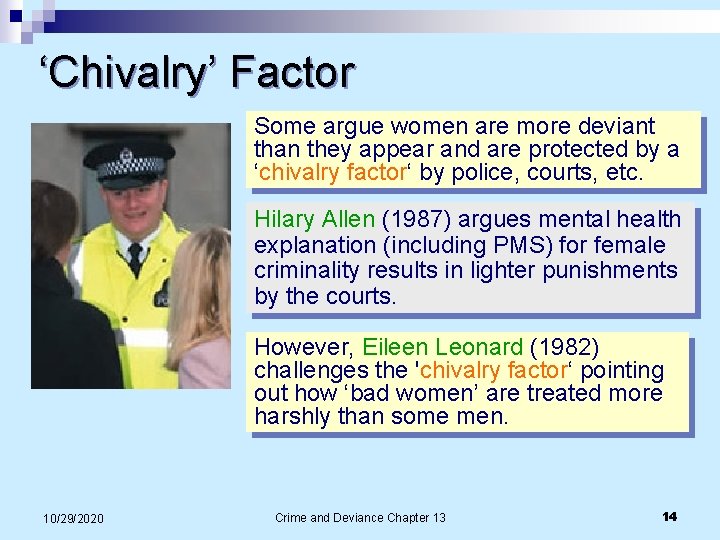
‘Chivalry’ Factor Some argue women are more deviant than they appear and are protected by a ‘chivalry factor‘ by police, courts, etc. Hilary Allen (1987) argues mental health explanation (including PMS) for female criminality results in lighter punishments by the courts. However, Eileen Leonard (1982) challenges the 'chivalry factor‘ pointing out how ‘bad women’ are treated more harshly than some men. 10/29/2020 Crime and Deviance Chapter 13 14
A 02 Exam Evaluation Point Factors that label a woman as ‘bad’ include anything that implies she is a ‘bad Mother’ (neglect, abuse, children in care, etc. ) or promiscuous (prostitute, teenage mother, children from several fathers, etc. Such women seem to be treated quite harshly by the agents of social control because they do not conform to expected norms of femininity. 10/29/2020 Crime and Deviance Chapter 13 15
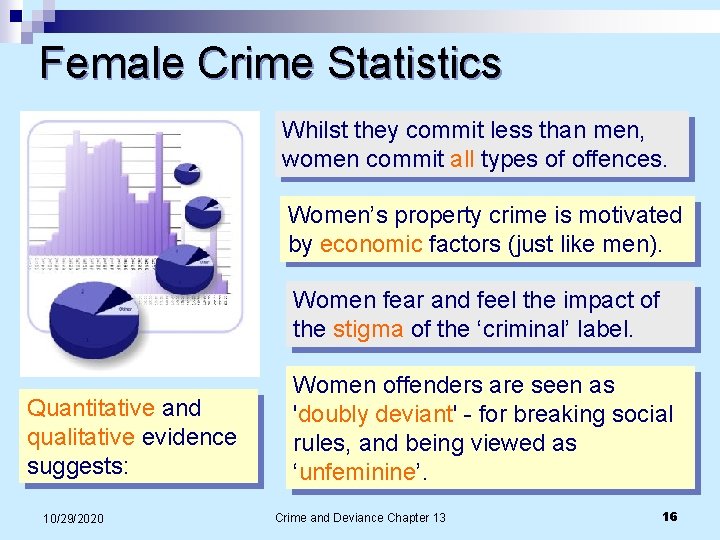
Female Crime Statistics Whilst they commit less than men, women commit all types of offences. Women’s property crime is motivated by economic factors (just like men). Women fear and feel the impact of the stigma of the ‘criminal’ label. Quantitative and qualitative evidence suggests: 10/29/2020 Women offenders are seen as 'doubly deviant' - for breaking social rules, and being viewed as ‘unfeminine’. Crime and Deviance Chapter 13 16
Will Women’s Crime Rise? Freda Adler (1975) believes that women’s liberation will increase women’s participation in criminal activity. Her evidence is partly based on a growth of juvenile crime by (liberated) girls. Just as they are penetrating the labour market, so they are moving also into ‘criminal careers’. However, Carol Smart (1979) criticises Adler on the grounds that she (wrongly) sees juvenile delinquency as reflective of future adult crime 10/29/2020 Crime and Deviance Chapter 13 17
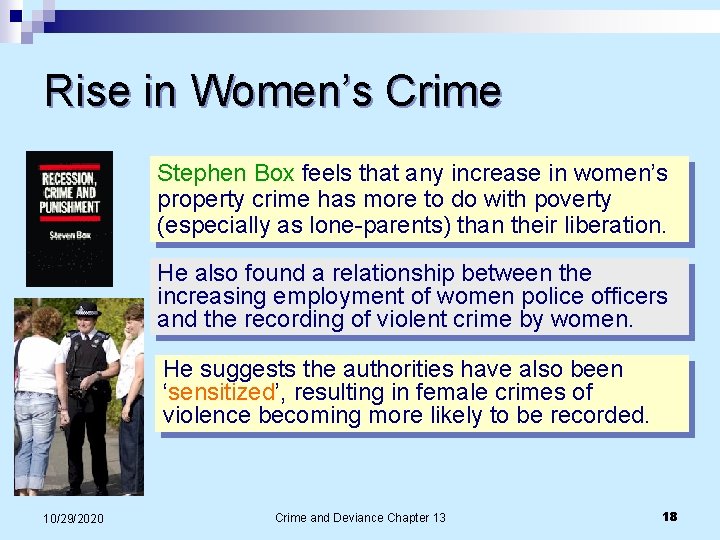
Rise in Women’s Crime Stephen Box feels that any increase in women’s property crime has more to do with poverty (especially as lone-parents) than their liberation. He also found a relationship between the increasing employment of women police officers and the recording of violent crime by women. He suggests the authorities have also been ‘sensitized’, resulting in female crimes of violence becoming more likely to be recorded. 10/29/2020 Crime and Deviance Chapter 13 18
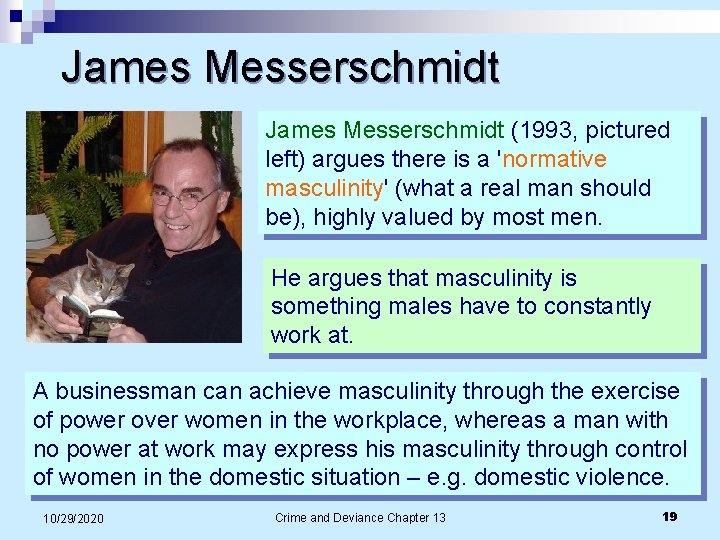
James Messerschmidt (1993, pictured left) argues there is a 'normative masculinity' (what a real man should be), highly valued by most men. He argues that masculinity is something males have to constantly work at. A businessman can achieve masculinity through the exercise of power over women in the workplace, whereas a man with no power at work may express his masculinity through control of women in the domestic situation – e. g. domestic violence. 10/29/2020 Crime and Deviance Chapter 13 19
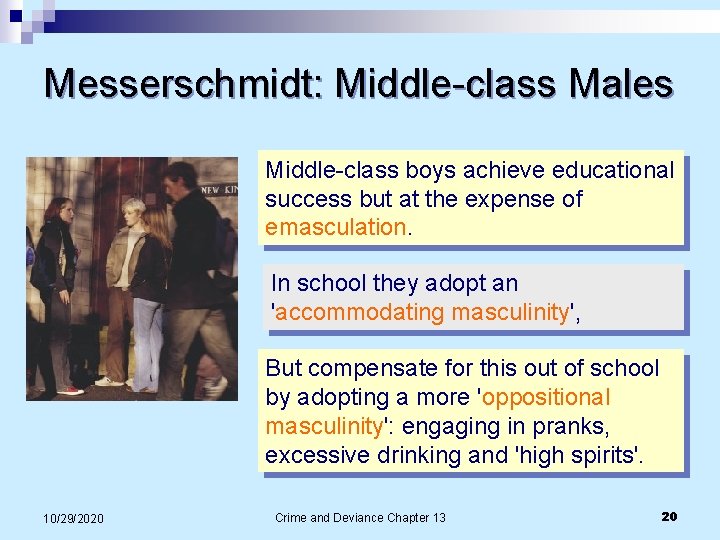
Messerschmidt: Middle-class Males Middle-class boys achieve educational success but at the expense of emasculation. In school they adopt an 'accommodating masculinity', But compensate for this out of school by adopting a more 'oppositional masculinity': engaging in pranks, excessive drinking and 'high spirits'. 10/29/2020 Crime and Deviance Chapter 13 20
Messerschmidt: Working-class Males Working-class males adopt an 'oppositional masculinity', both inside and outside school, which is more aggressive in nature. Young Black males can be sucked into property and violent crime as ways of enhancing 'hegemonic masculinity‘ (Bob Connell). Messerschmidt notes how rape and pimping is sometimes used to express control over women. 10/29/2020 Crime and Deviance Chapter 13 21
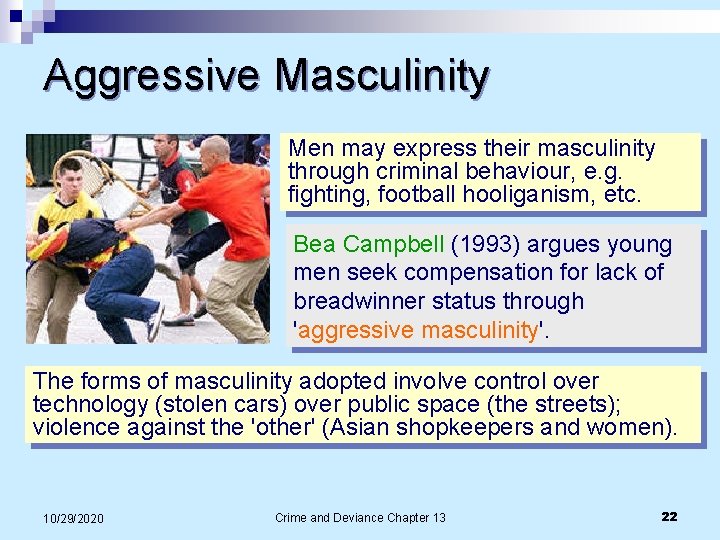
Aggressive Masculinity Men may express their masculinity through criminal behaviour, e. g. fighting, football hooliganism, etc. Bea Campbell (1993) argues young men seek compensation for lack of breadwinner status through 'aggressive masculinity'. The forms of masculinity adopted involve control over technology (stolen cars) over public space (the streets); violence against the 'other' (Asian shopkeepers and women). 10/29/2020 Crime and Deviance Chapter 13 22
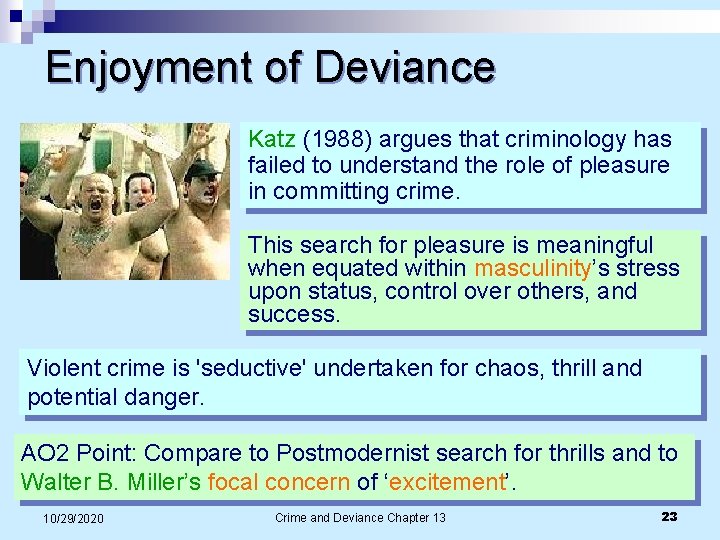
Enjoyment of Deviance Katz (1988) argues that criminology has failed to understand the role of pleasure in committing crime. This search for pleasure is meaningful when equated within masculinity’s stress upon status, control over others, and success. Violent crime is 'seductive' undertaken for chaos, thrill and potential danger. AO 2 Point: Compare to Postmodernist search for thrills and to Walter B. Miller’s focal concern of ‘excitement’. 10/29/2020 Crime and Deviance Chapter 13 23
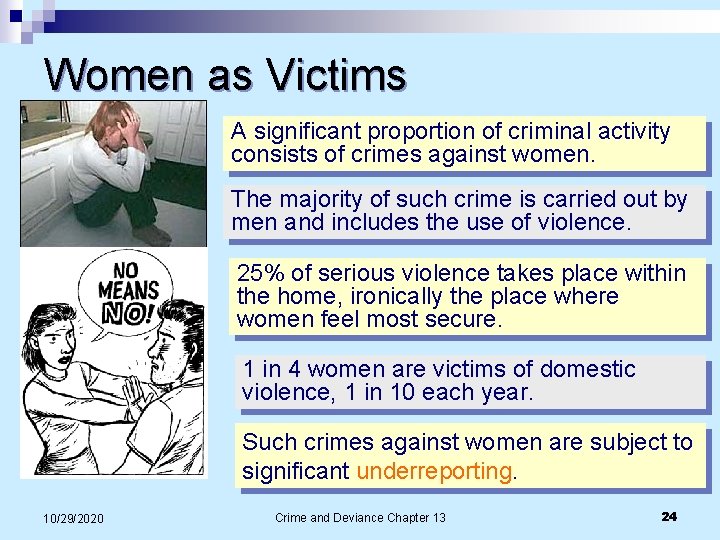
Women as Victims A significant proportion of criminal activity consists of crimes against women. The majority of such crime is carried out by men and includes the use of violence. 25% of serious violence takes place within the home, ironically the place where women feel most secure. 1 in 4 women are victims of domestic violence, 1 in 10 each year. Such crimes against women are subject to significant underreporting. 10/29/2020 Crime and Deviance Chapter 13 24
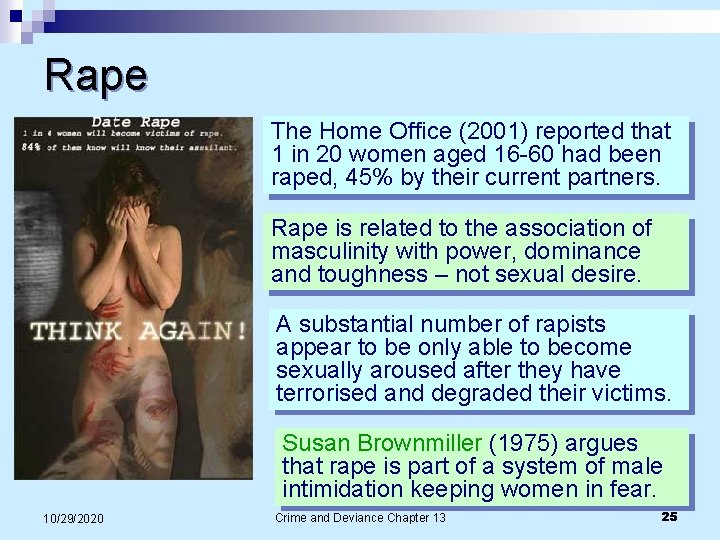
Rape The Home Office (2001) reported that 1 in 20 women aged 16 -60 had been raped, 45% by their current partners. Rape is related to the association of masculinity with power, dominance and toughness – not sexual desire. A substantial number of rapists appear to be only able to become sexually aroused after they have terrorised and degraded their victims. Susan Brownmiller (1975) argues that rape is part of a system of male intimidation keeping women in fear. 10/29/2020 Crime and Deviance Chapter 13 25
Domestic Violence Betsy Stanko (2000) found an act of domestic violence is committed every 6 seconds in Britain. It is estimated that a quarter of all violent crimes committed are "domestics“. In 45 -70% of cases, the father inflicts violence on the children as well as the mother (BMA Report, 1998). 10/29/2020 Crime and Deviance Chapter 13 26
BMA Report on Domestic Violence (1998) More than 1 in 4 women experience domestic violence in their lives. 1 in 10 women experience domestic violence every year. Violence ranges from being punched, choked, bitten, burning, starving and knifing, to being forced to have sex against their will. Domestic violence is more likely to occur during pregnancy. 10/29/2020 Crime and Deviance Chapter 13 27
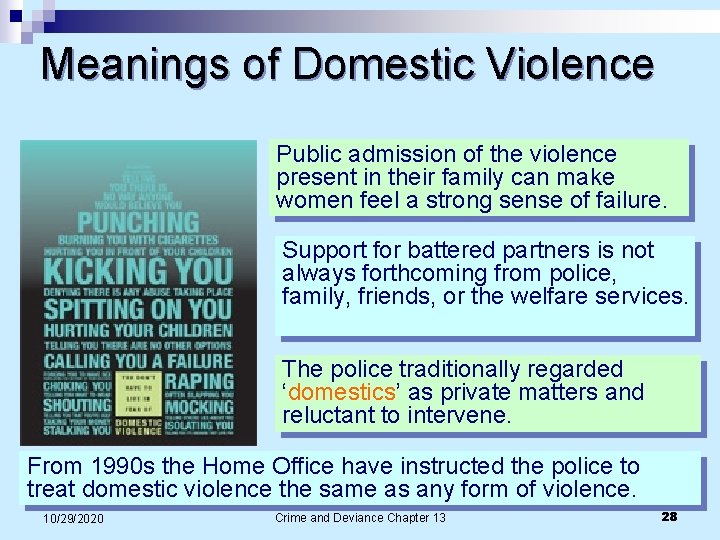
Meanings of Domestic Violence Public admission of the violence present in their family can make women feel a strong sense of failure. Support for battered partners is not always forthcoming from police, family, friends, or the welfare services. The police traditionally regarded ‘domestics’ as private matters and reluctant to intervene. From 1990 s the Home Office have instructed the police to treat domestic violence the same as any form of violence. 10/29/2020 Crime and Deviance Chapter 13 28
Key Factors in Explaining Women as Victims The relationship between crime and the wider patriarchal social control of women in society. Traditional gender role socialisation (male = dominant). The link between the ‘crisis of masculinity’ (powerlessnes at work, divorce, unemployment) and crimes against women. Men’s reaction to the feminisation of the labour force and the growing economic and cultural power of women The sexual objectification of women: women as property. 10/29/2020 Crime and Deviance Chapter 13 29
AO 2 Exam Evaluation Points In evaluating the ‘women as victims’ situation reference should be made to the significant contribution of feminism in raising our awareness and understanding. However, some might question whether feminists have exaggerated male power and/or the extent of female victimisation. Answers might recognise social changes, for example the increasing level of violent crime committed by females against females. 10/29/2020 Crime and Deviance Chapter 13 30
End of Slide Show 10/29/2020 Crime and Deviance Chapter 13 31