
WITHHOLDING WORK FORMS AND WORK LAWS WORKRELATED FORMS



- Slides: 28
WITHHOLDING, WORK FORMS, AND WORK LAWS WORK-RELATED FORMS AND LAWS
OBJECTIVES: • What are withholdings • Who must pay taxes • How are my taxes paid • Required Work forms needed for employment
WITHHOLDING TAXES • Withholding • aka pay-as-you earn taxation • Money employers withhold from your paycheck and pay directly to the government to be used for social security taxes, income taxes, state and local taxes.
WHO MUST PAY TAXES? • Most people owe taxes their income • More you earn = more you owe • Some are exempt from paying taxes • Non-profit organizations • US workers working Abroad • Taxpayers with Many Deductions • Taxpayers with Many Dependents • Low-Income Taxpayers - If you earn an income that does not exceed the standard deduction
DID YOU KNOW? • Use you phone, chrome book, or a computer in back and answer the 2 questions in your activity packet on the bottom of page 1: • What is a Standard Deduction • How much is the 2021 Standard Deduction
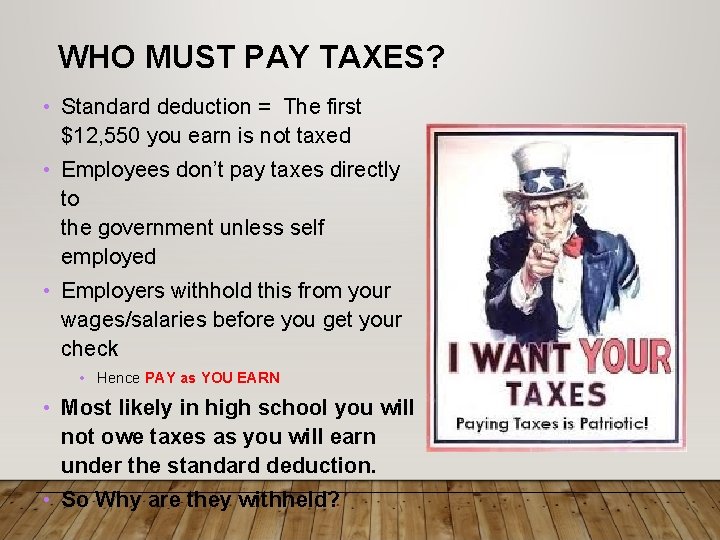
WHO MUST PAY TAXES? • Standard deduction = The first $12, 550 you earn is not taxed • Employees don’t pay taxes directly to the government unless self employed • Employers withhold this from your wages/salaries before you get your check • Hence PAY as YOU EARN • Most likely in high school you will not owe taxes as you will earn under the standard deduction. • So Why are they withheld?
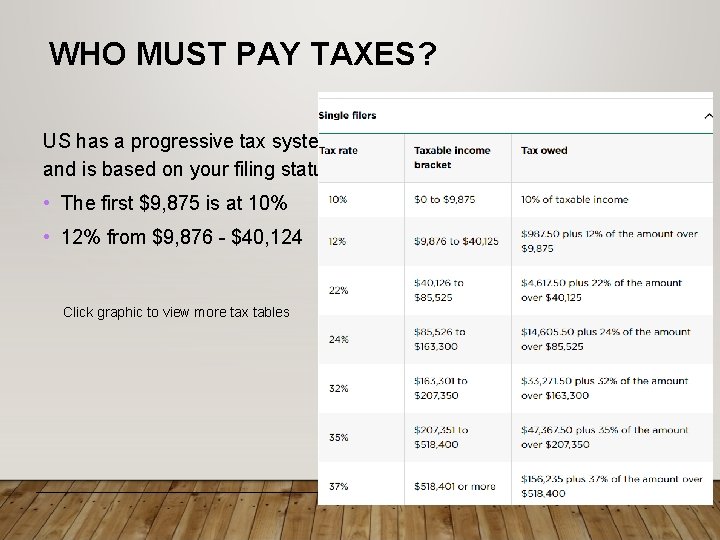
WHO MUST PAY TAXES? US has a progressive tax system and is based on your filing status: • The first $9, 875 is at 10% • 12% from $9, 876 - $40, 124 Click graphic to view more tax tables
WHY DO WE PAY TAXES? • Go to Google Classroom and complete the Why we pay Taxes Assignment
REQUIRED WORK FORMS • Form W-4: Employee’s Withholding Allowance Certificate • Social Security forms • I-9 Forms • Form W-2: Wage and Tax Statement
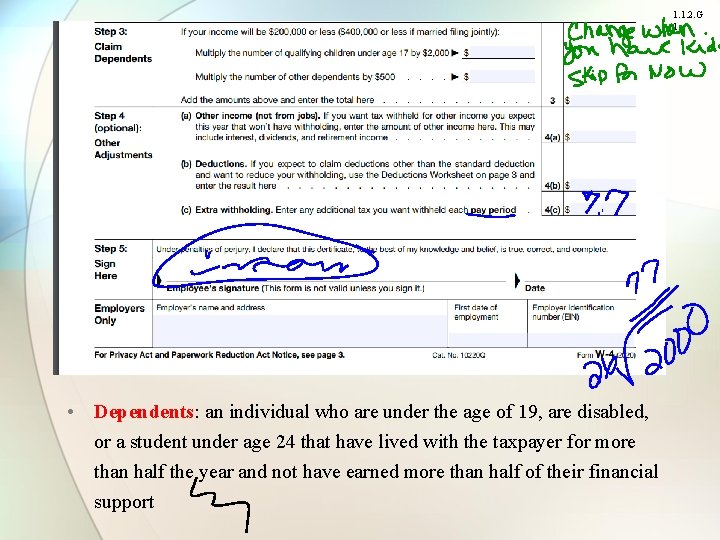
FORM W-4: EMPLOYEE’S WITHHOLDING • W-4 form: the IRS document you complete for your employer to determine how much should be withheld from your paycheck for federal income taxes and sent to the IRS • tells the employer the amount of tax to withhold from an employee's paycheck based on their marital status, number of dependents, and other factors.
KEY FACTS: EMPLOYEE’S WITHHOLDING • Determines the amount of money for taxes withheld (taken out) • Completed the first day on the job/career • Does not determine what you owe in taxes, only what is paid from each pay check: • The more you earn the more you owe in taxes, the more withheld from your check • When you don’t withhold enough = you owe taxes at end of year • When you pay to much in taxes, you will get a refund • Can be changed at any times due to significant life events • getting a new job, getting married, or having children
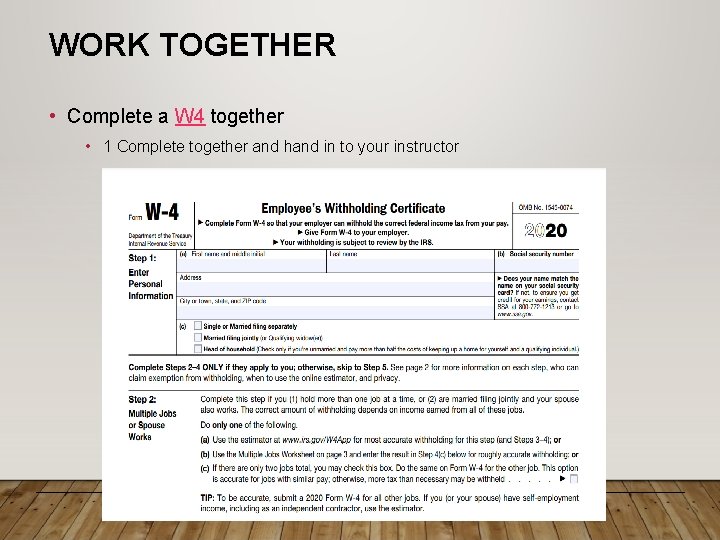
WORK TOGETHER • Complete a W 4 together • 1 Complete together and hand in to your instructor
1. 1. 2. G 1 • Dependents: an individual who are under the age of 19, are disabled, or a student under age 24 that have lived with the taxpayer for more than half the year and not have earned more than half of their financial support
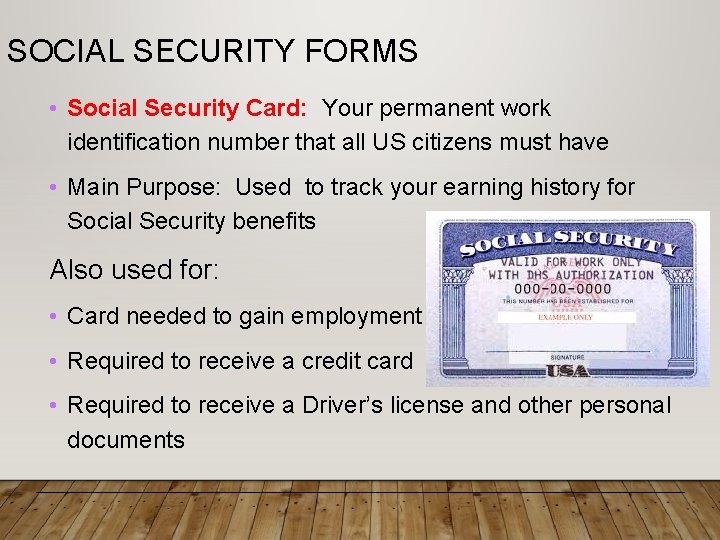
SOCIAL SECURITY FORMS • Social Security Card: Your permanent work identification number that all US citizens must have • Main Purpose: Used to track your earning history for Social Security benefits Also used for: • Card needed to gain employment • Required to receive a credit card • Required to receive a Driver’s license and other personal documents
SOCIAL SECURITY CARD Card Security: • Do not give your SS# to anyone on the phone or internet services , mail, email, • Keep in a safe place at home – not in wallet If Lost or Stolen: • Get a new one for free from any Social Security Office • 3 copies in one year, 10 copies in your lifetime • Can get an application on-line for a SS# - must mail it in along with proof of age and identity: • Proof of age = birth certificate • Proof of Identity = A govt. issued photo ID, driver’s license, or Passport • Items of proof must be mailed, not scanned or copied. They will be returned to you within 5 -10 business days.
STOP HERE
SOCIAL SECURITY ASSIGNMENT 1. On the bottom of page 3 of the Activity Packet fill out the payroll tax notes from slides
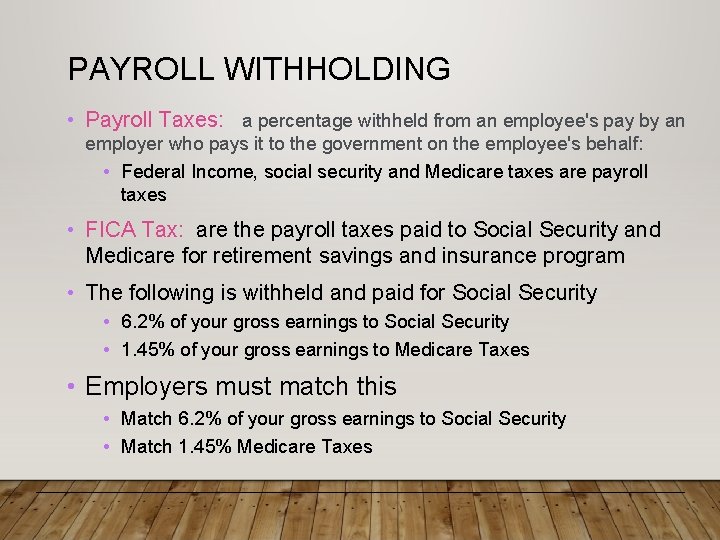
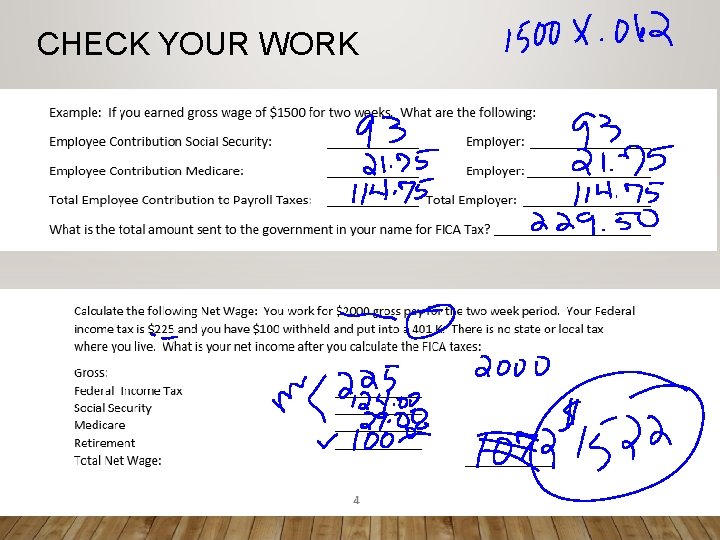
PAYROLL WITHHOLDING • Payroll Taxes: a percentage withheld from an employee's pay by an employer who pays it to the government on the employee's behalf: • Federal Income, social security and Medicare taxes are payroll taxes • FICA Tax: are the payroll taxes paid to Social Security and Medicare for retirement savings and insurance program • The following is withheld and paid for Social Security • 6. 2% of your gross earnings to Social Security • 1. 45% of your gross earnings to Medicare Taxes • Employers must match this • Match 6. 2% of your gross earnings to Social Security • Match 1. 45% Medicare Taxes
CHECK YOUR WORK
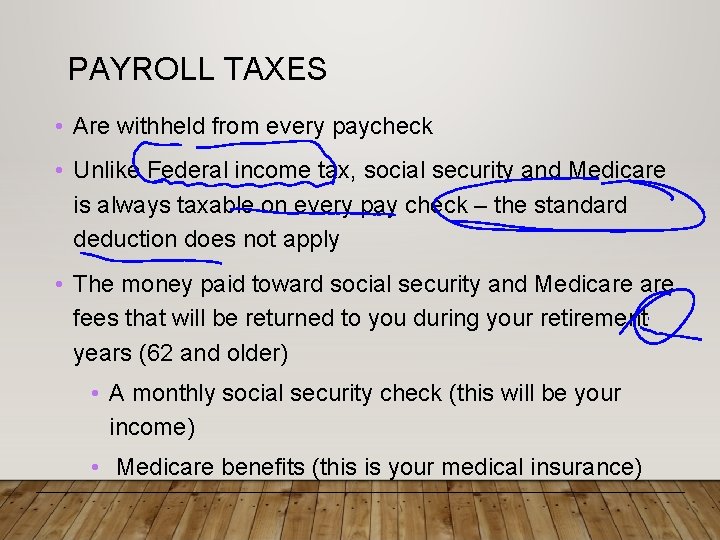
PAYROLL TAXES • Are withheld from every paycheck • Unlike Federal income tax, social security and Medicare is always taxable on every pay check – the standard deduction does not apply • The money paid toward social security and Medicare fees that will be returned to you during your retirement years (62 and older) • A monthly social security check (this will be your income) • Medicare benefits (this is your medical insurance)
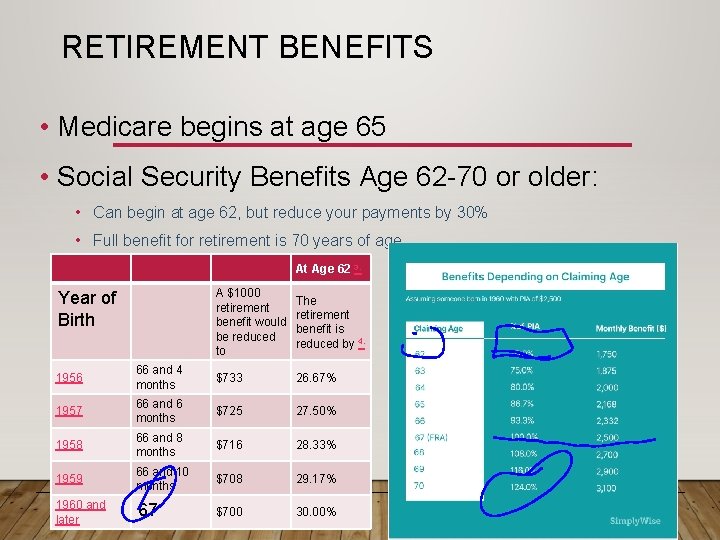
RETIREMENT BENEFITS • Medicare begins at age 65 • Social Security Benefits Age 62 -70 or older: • Can begin at age 62, but reduce your payments by 30% • Full benefit for retirement is 70 years of age. At Age 62 3. Year of Birth A $1000 retirement benefit would be reduced to The retirement benefit is reduced by 4. 1956 66 and 4 months $733 26. 67% 1957 66 and 6 months $725 27. 50% 1958 66 and 8 months $716 28. 33% 1959 66 and 10 months $708 29. 17% 1960 and later 67 $700 30. 00%
EMPLOYMENT FORMS CONTINUED
I-9 FORMS: EMPLOYMENT ELIGIBILITY VERIFICATION • Definition: Employment Eligibility verification form that states you are eligible to work in the US • Completed before you begin work • Verifies person is eligible to Work in US • Employer required to have on file for each employee • Requires two forms of ID, usually your drivers license and social security card • Can also use your passport
WORK TOGETHER • Complete an I-9 Form
FORM W-2: WAGE AND TAX STATEMENT • Completed by employer – not employee • One from each job you held this past year • Used to File Your taxes by April 15 • Maintain this on file with your taxes. Don’t throw it!!! • Required by Law to be mailed by January 31 • If you don’t receive one by 31 Jan, call to request it
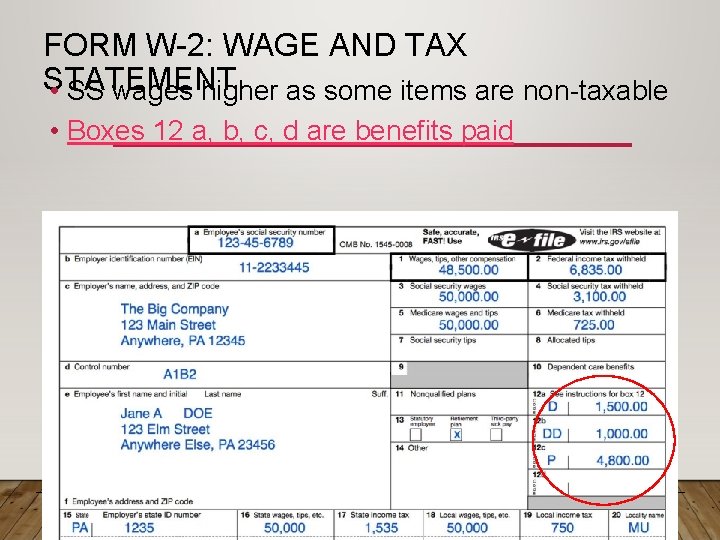
1. 1. 2. G 1 Form W-2: Wage and Tax Statement − Box 1: Gross income for the previous year − Box 2, 4 &6: All taxes paid from your check − Box 17 State Taxes - ND State Income Tax – between 1. 10% - 2. 90%
FORM W-2: WAGE AND TAX STATEMENT • SS wages higher as some items are non-taxable • Boxes 12 a, b, c, d are benefits paid