
Wither the Brain CLPS 0020 Introduction to Cognitive
Wither the Brain? CLPS 0020: Introduction to Cognitive Science Professor Dave Sobel Fall 2016
What’s the role of the brain in Cognitive Science? • Connectionism as a modeling technique was “neurally inspired” • Today: What is the Brain? – Basic Anatomy – Anatomy Function (One Example)
Why Study Anatomy? • Interaction of Reductionist and Functionalist Approach • Reductionism: Look at smaller pieces to understand the system. – Understanding the mind might emerge from understanding the brain • Functionalism: Anatomy reveals function as they interact
Basic Anatomy • Neurons (Nerve Cells) – Electrical Signals • Glia (Support Cells) – Non-electric Signals. Hold neurons in place, provide nutrients, create myelin, act as protection, etc.
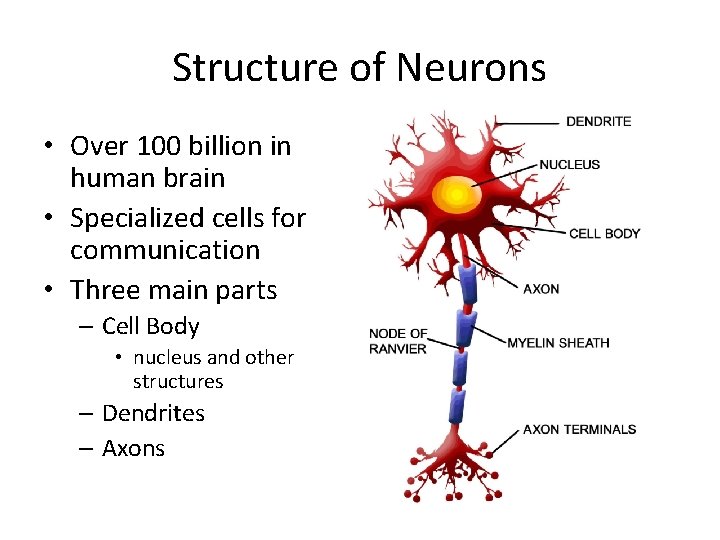
Structure of Neurons • Over 100 billion in human brain • Specialized cells for communication • Three main parts – Cell Body • nucleus and other structures – Dendrites – Axons
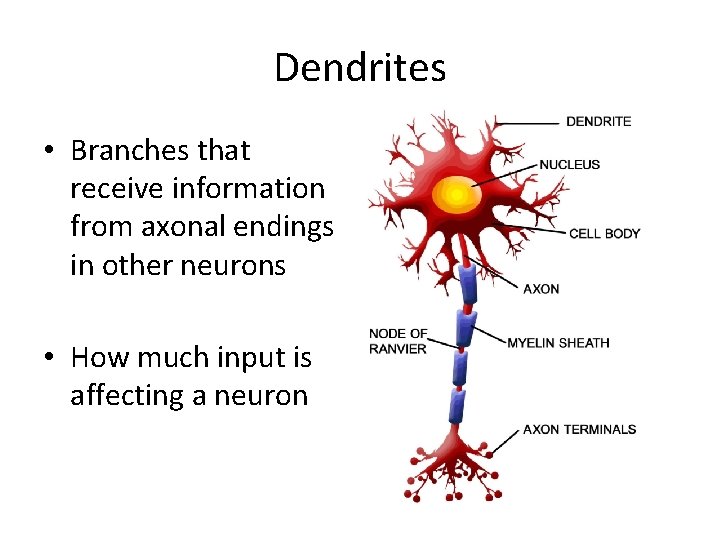
Dendrites • Branches that receive information from axonal endings in other neurons • How much input is affecting a neuron
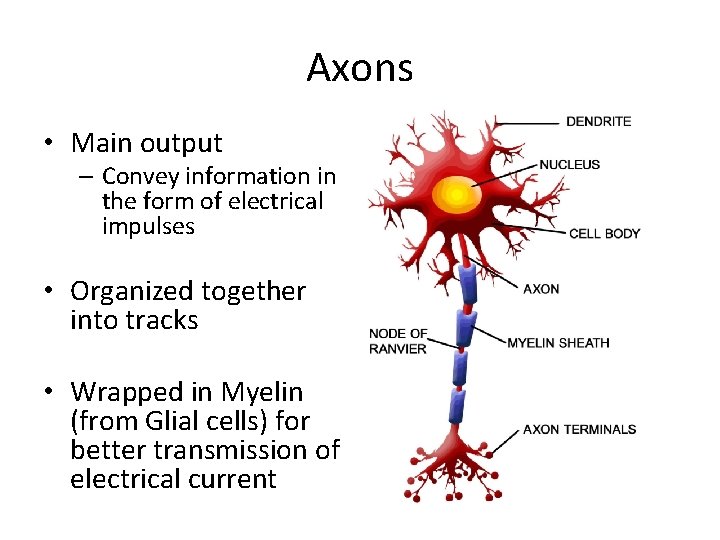
Axons • Main output – Convey information in the form of electrical impulses • Organized together into tracks • Wrapped in Myelin (from Glial cells) for better transmission of electrical current
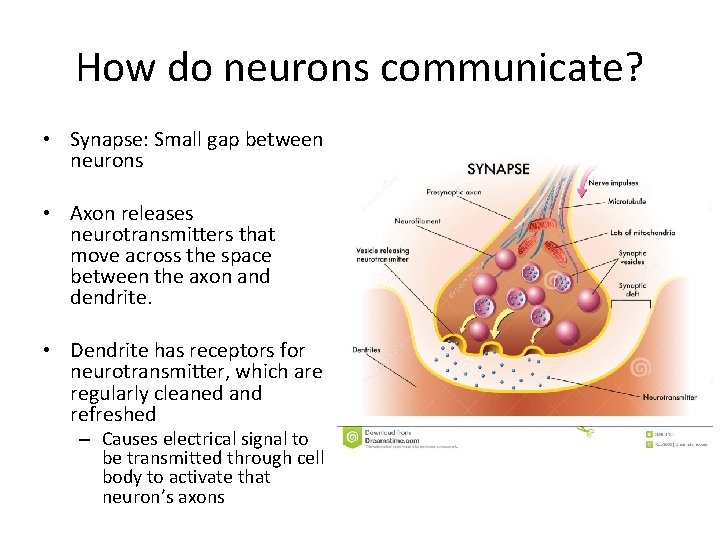
How do neurons communicate? • Synapse: Small gap between neurons • Axon releases neurotransmitters that move across the space between the axon and dendrite. • Dendrite has receptors for neurotransmitter, which are regularly cleaned and refreshed – Causes electrical signal to be transmitted through cell body to activate that neuron’s axons
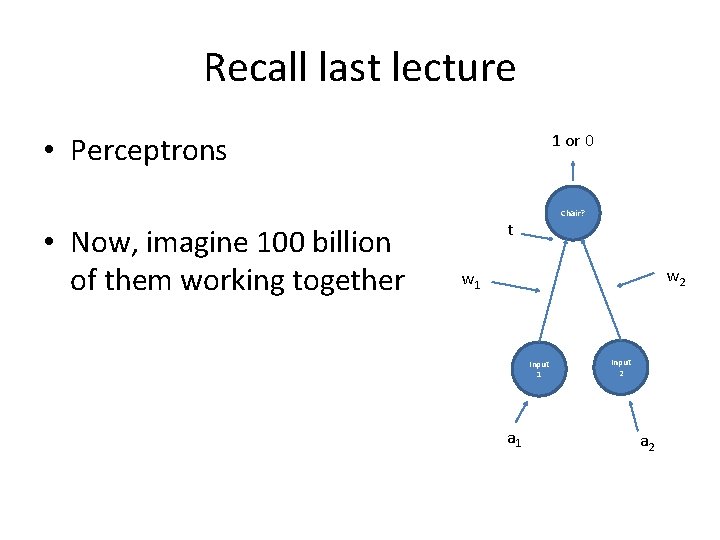
Recall last lecture • Perceptrons • Now, imagine 100 billion of them working together 1 or 0 Chair? t w 2 w 1 Input 1 a 1 Input 2 a 2
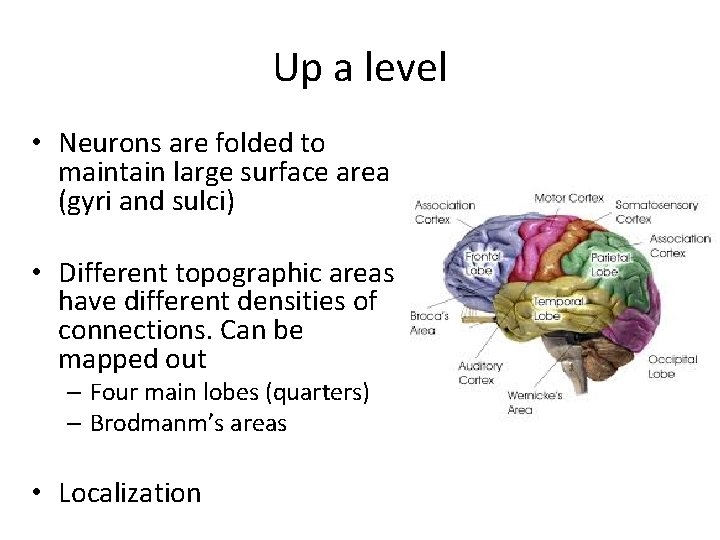
Up a level • Neurons are folded to maintain large surface area (gyri and sulci) • Different topographic areas have different densities of connections. Can be mapped out – Four main lobes (quarters) – Brodmanm’s areas • Localization
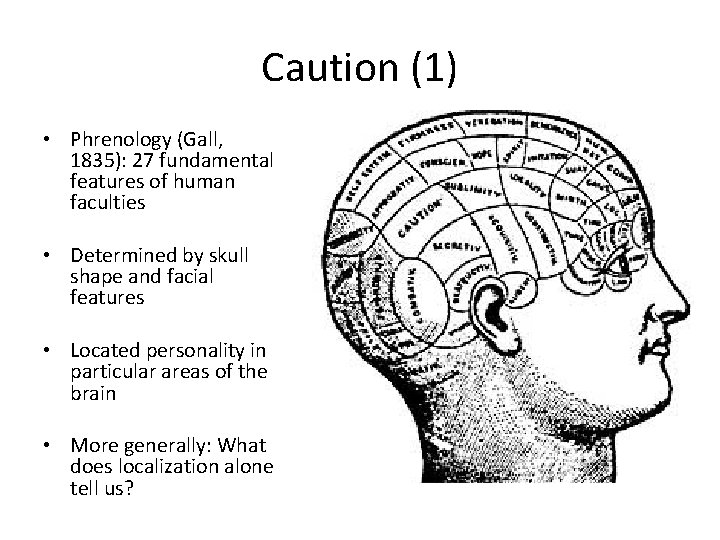
Caution (1) • Phrenology (Gall, 1835): 27 fundamental features of human faculties • Determined by skull shape and facial features • Located personality in particular areas of the brain • More generally: What does localization alone tell us?
Caution (2) • One area <> one function – When I say that “hippocampus is implicated in working memory” that doesn’t mean that’s the ONLY mental faculty that hippocampus is involved in. • Take ASD. These are all areas implicated in individuals with ASD: – – – – Amygdala Superior colliculus Cerebellum/basal ganglia Orbital Frontal and Dorsal Lateral Frontal Cortex Left occipital lobe Right parietal lobe And, this is just the beginning. • Neural Systems aren’t the sum of their parts
Example • Clinical Patient Work: Shimamura and Squire (1991): Examined patients with lesions in frontal lobes, particularly, Dorsallateral Frontal Cortex – Little digit span capacity. – Free Recall Procedure: Overall, performance was relatively poor, but encoding occurred. No recency effect. • Hypothesis: – Working memory is affected by DFC impairment. But encoding process happens elsewhere
Imaging Study 1 • Jonides et al. (1994) – Normal subjects in f. MRI for two tasks – Task 1: Memory - Subjects saw three dots, then a blank screen, and then a circle. They were asked to respond whether the circle appeared around where one of the dots had been. – Task 2: Perception: Subjects saw three dots, then a circle appears and they have to respond whether the circle appears around one of the dots. – Only difference between these two tasks is memory

Paradigm Example
Results • Measure how much blood flow is in a particular area of the brain for one task vs. the other. • Only interested in one area because there are too many to analyze • Subtract Task 2 (Perceptual) from Task 1 (Memory): find activation in frontal cortex
Imaging Study 2 • Schacter et al. (1998) – Presented normal subjects with a list of words to remember while they were in the scanner • Scanned brains during the serial presentation of each word – Later, outside of the scanner, subjects recalled the words – Compare average brain activity for remembered words vs. words that were not retained • Found that frontal lobes are more greatly activated for the remembered words than the forgotten words.

Conclusion • The study of the brain can tell us whether memory systems are separate or integrated. • Conclusions here suggest that there are two separate neural systems related to short term memory – One for holding information (maintenance) – in frontal cortex – Another for encoding and retrieving information to/from long term memory (in hippocampus) • In general, cognitive neuroscience should give us insight to the mind and mental faculties (here: two potential memory processes) based on different localization/activation
- Slides: 18