
Wisconsin FACETS Webinar What are Executive Function Skills
Wisconsin FACETS Webinar: What are Executive Function Skills & How Can They be Addressed in a Student’s IEP Eva M. Kubinski, MS School Administration Consultant February 10, 2021
Who am I – Eva M. Kubinski, MS Wisconsin DPI consultant for: • Orthopedic Impairments (OI) • Other Health Impairments (OHI) • Traumatic Brain Injury (TBI) • Adapted/Specially Designed Physical Education (APE) • American Indian Students with IEPs

Executive Function (EF) Skills Definition and Description How to foster the development • Examples Where to document in an IEP
At DPI, Educational Equity Means… That every student has access to the educational resources and rigor they need at the right moment in their education, across race, gender, ethnicity, language, disability, sexual orientation, family background, and/or family income.
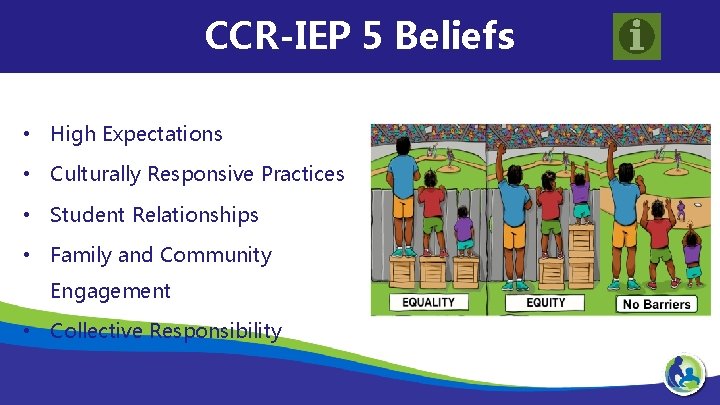
CCR-IEP 5 Beliefs • High Expectations • Culturally Responsive Practices • Student Relationships • Family and Community Engagement • Collective Responsibility
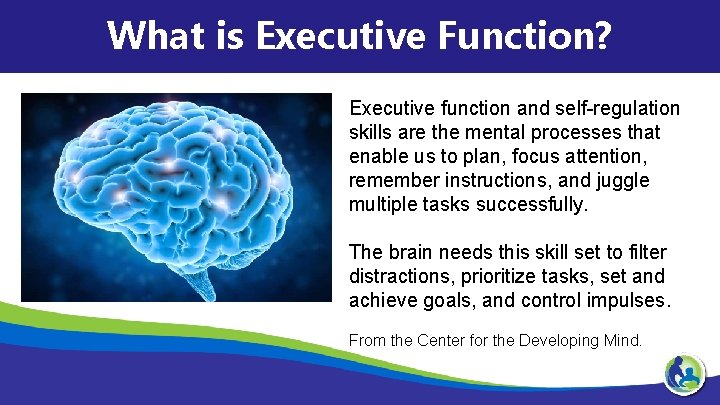
What is Executive Function? Executive function and self-regulation skills are the mental processes that enable us to plan, focus attention, remember instructions, and juggle multiple tasks successfully. The brain needs this skill set to filter distractions, prioritize tasks, set and achieve goals, and control impulses. From the Center for the Developing Mind.
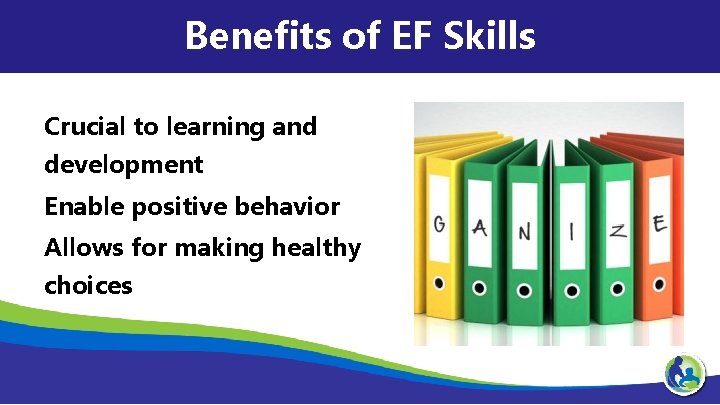
Benefits of EF Skills Crucial to learning and development Enable positive behavior Allows for making healthy choices
Executive Function (EF) • Where do the skills come from? • Do I use executive function skills? • Don’t all children just have them? • Isn’t this a difficulty that only kids with Autism or ADHD have?
Where does it come from? #1 – it’s not something you are born with #2 – It is not an indicator of intelligence #3 – It’s not connected to any one disability You aren’t born with Executive Function skills – but nearly everyone can learn these skills
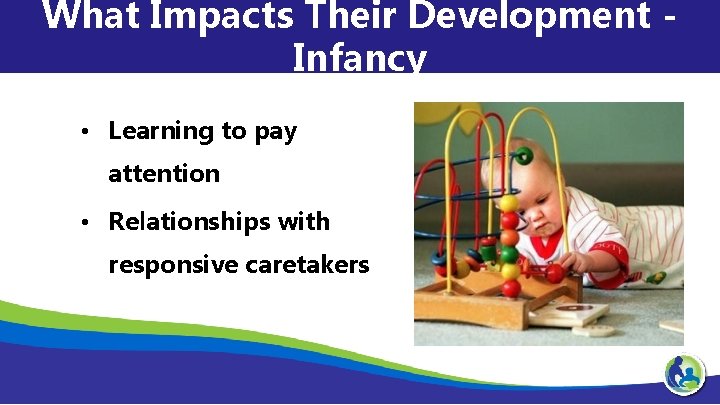
What Impacts Their Development Infancy • Learning to pay attention • Relationships with responsive caretakers
What Impacts Their Development Childhood • Establishment of routines • Breaking big tasks into smaller ones • Playing games that promote imagination, role playing, following rules, and controlling impulses
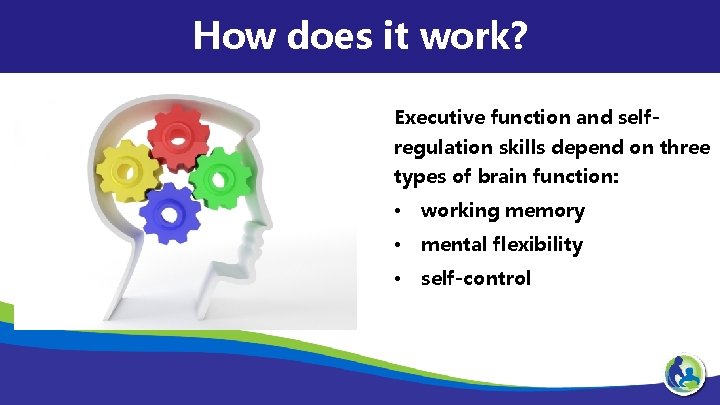
How does it work? Executive function and selfregulation skills depend on three types of brain function: • working memory • mental flexibility • self-control
Executive Function Disorder When something such as neurological disorders, mental health and behavioral disorders interfere with: • working memory • mental flexibility • self-control Result: Executive Function
Primary EF Skills That May Be Impacted • Self-awareness • Verbal working memory • Inhibition • Emotional self-regulation • Non-verbal working • Self-motivation memory • Planning and problem solving
Executive Function Disorder Symptom Test for Children (ADDITUDE) A 13 question multiple choice personal screener (e. g. for your own child) that may indicate if further evaluation would be helpful. Note: Including this screener in this presentation does not imply any endorsement of the screener. It is provided for informational purposes only.
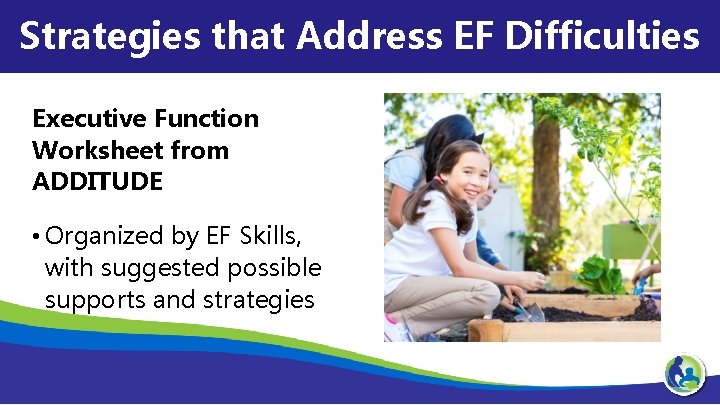
Strategies that Address EF Difficulties Executive Function Worksheet from ADDITUDE • Organized by EF Skills, with suggested possible supports and strategies
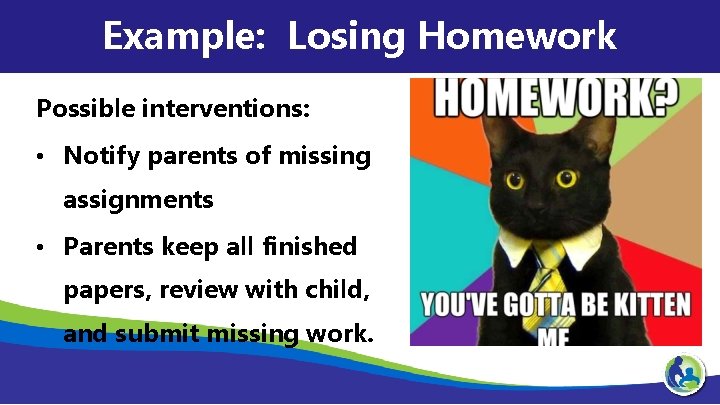
Example: Losing Homework Possible interventions: • Notify parents of missing assignments • Parents keep all finished papers, review with child, and submit missing work.
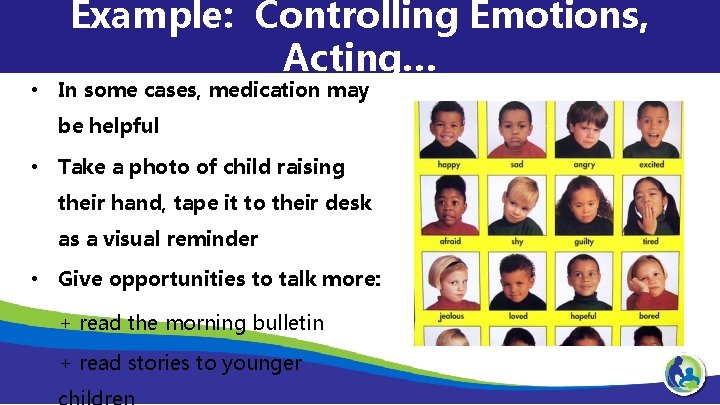
Example: Controlling Emotions, Acting… • In some cases, medication may be helpful • Take a photo of child raising their hand, tape it to their desk as a visual reminder • Give opportunities to talk more: + read the morning bulletin + read stories to younger
Documenting in IEP I-4 Form • Current Academic Achievement and Functional Performance – current situation, results of observations and perhaps a checklist or other instrument • Special Factors #1 – Does behavior impede learning • Summary of Disability Related Needs • If disability relate need, include in at least one goal
To Summarize: What Can You Do? • Establish routines • Model social behavior (including talk alouds) • Create and maintaining supportive, reliable relationships • Encourage creative play and social connection • Teach how to cope with stress • Encourage vigorous exercise (video games do not count) • Encourage self-direction of their own actions with decreasing adult supervision.
For further assistance • Eva M. Kubinski • 608 -266 -2899 • eva. kubinski@dpi. wi. gov
- Slides: 21