
Wisconsin Department of Transportation Access Management Module 5
- Slides: 47
Wisconsin Department of Transportation Access Management Module 5: Identifying Access Controls Final: 1 -13 -18 1
Module Outline This program discusses access management as it relates to acquisition of access rights and how to review plans to identify applicable access controls It also includes the use of tools such as scenic easements and access covenants Speaker introduction Module 5 Modules: Summary of Principles and Practices Introduction to Legal Foundations Access Standards Planning (5) Identifying Access Controls STH Connection Permits Special Topics References & Resources 2
Module 5: Identifying Access Controls Objectives Which Wisconsin statutes provide access management controls How to answer questions such as, “May I have a driveway? ” How to identify the types of access controls on a specific property How is access management linked with jurisdictional reassignments What are the access management techniques most commonly used in real estate transactions Module 5 3
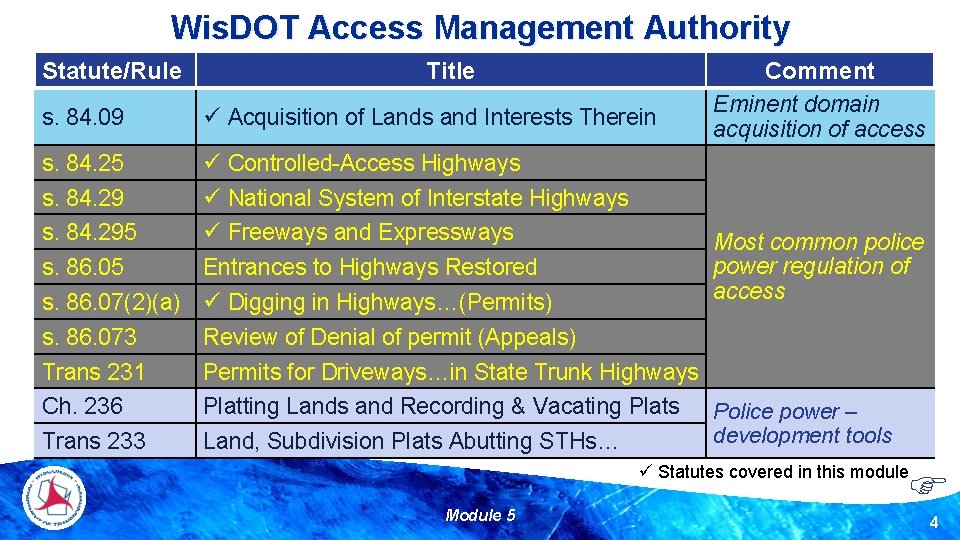
Wis. DOT Access Management Authority Statute/Rule Title s. 84. 09 Acquisition of Lands and Interests Therein s. 84. 25 Controlled-Access Highways s. 84. 29 National System of Interstate Highways s. 84. 295 Freeways and Expressways s. 86. 05 Entrances to Highways Restored s. 86. 07(2)(a) Digging in Highways…(Permits) s. 86. 073 Review of Denial of permit (Appeals) Trans 231 Permits for Driveways…in State Trunk Highways Ch. 236 Platting Lands and Recording & Vacating Plats Trans 233 Land, Subdivision Plats Abutting STHs… Comment Eminent domain acquisition of access Most common police power regulation of access Police power – development tools Statutes covered in this module Module 5 4
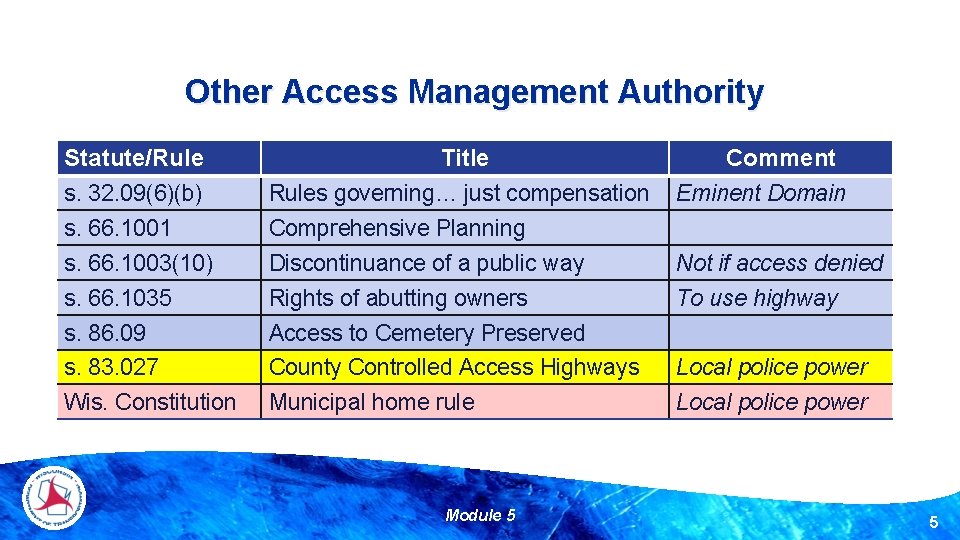
Other Access Management Authority Statute/Rule s. 32. 09(6)(b) s. 66. 1001 s. 66. 1003(10) s. 66. 1035 s. 86. 09 s. 83. 027 Wis. Constitution Title Rules governing… just compensation Comprehensive Planning Discontinuance of a public way Rights of abutting owners Access to Cemetery Preserved County Controlled Access Highways Municipal home rule Module 5 Comment Eminent Domain Not if access denied To use highway Local police power 5
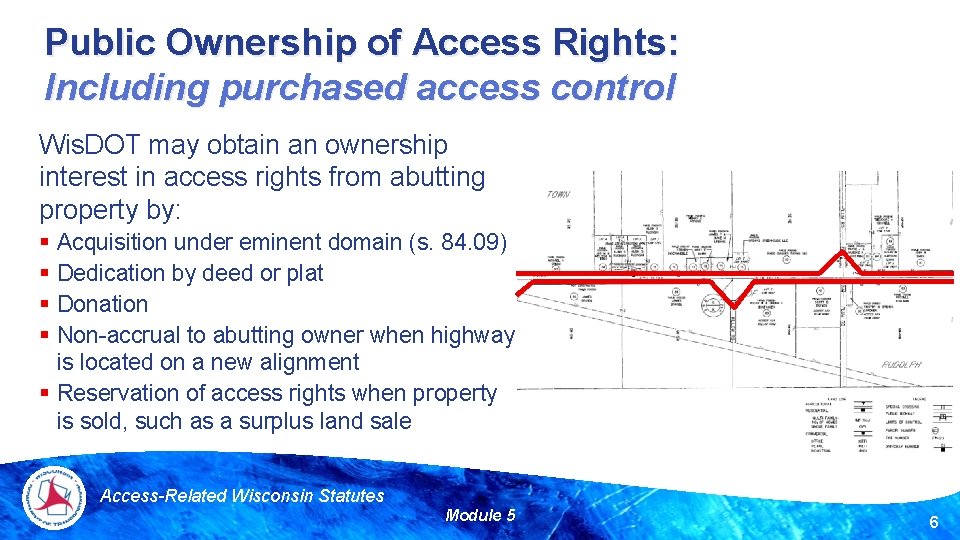
Public Ownership of Access Rights: Including purchased access control Wis. DOT may obtain an ownership interest in access rights from abutting property by: § § Acquisition under eminent domain (s. 84. 09) Dedication by deed or plat Donation Non-accrual to abutting owner when highway is located on a new alignment § Reservation of access rights when property is sold, such as a surplus land sale Access-Related Wisconsin Statutes Module 5 6
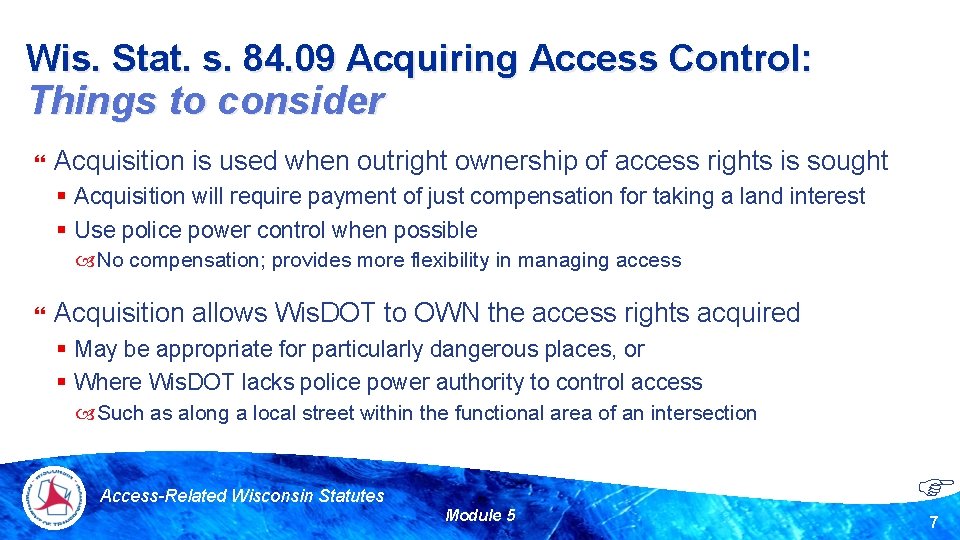
Wis. Stat. s. 84. 09 Acquiring Access Control: Things to consider Acquisition is used when outright ownership of access rights is sought § Acquisition will require payment of just compensation for taking a land interest § Use police power control when possible No compensation; provides more flexibility in managing access Acquisition allows Wis. DOT to OWN the access rights acquired § May be appropriate for particularly dangerous places, or § Where Wis. DOT lacks police power authority to control access Such as along a local street within the functional area of an intersection Access-Related Wisconsin Statutes Module 5 7
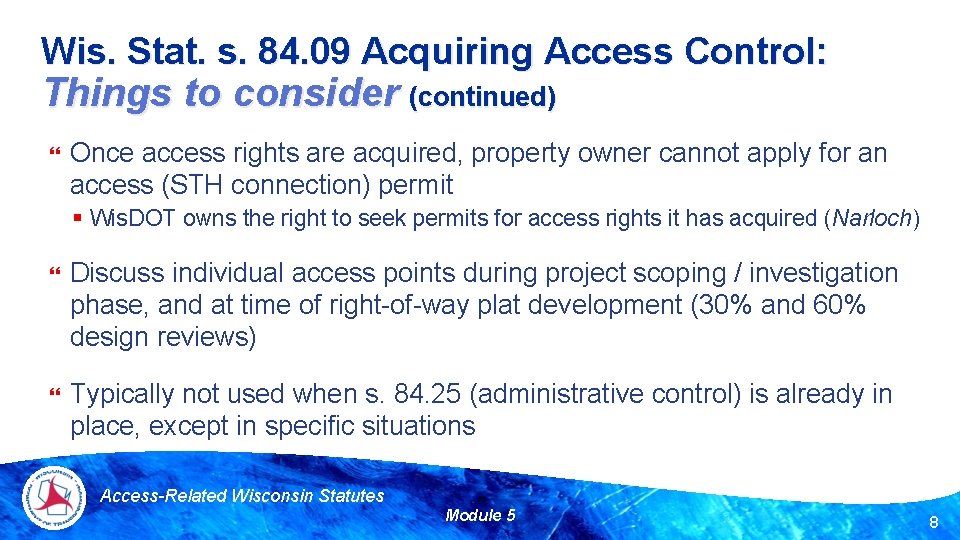
Wis. Stat. s. 84. 09 Acquiring Access Control: Things to consider (continued) Once access rights are acquired, property owner cannot apply for an access (STH connection) permit § Wis. DOT owns the right to seek permits for access rights it has acquired (Narloch) Discuss individual access points during project scoping / investigation phase, and at time of right-of-way plat development (30% and 60% design reviews) Typically not used when s. 84. 25 (administrative control) is already in place, except in specific situations Access-Related Wisconsin Statutes Module 5 8
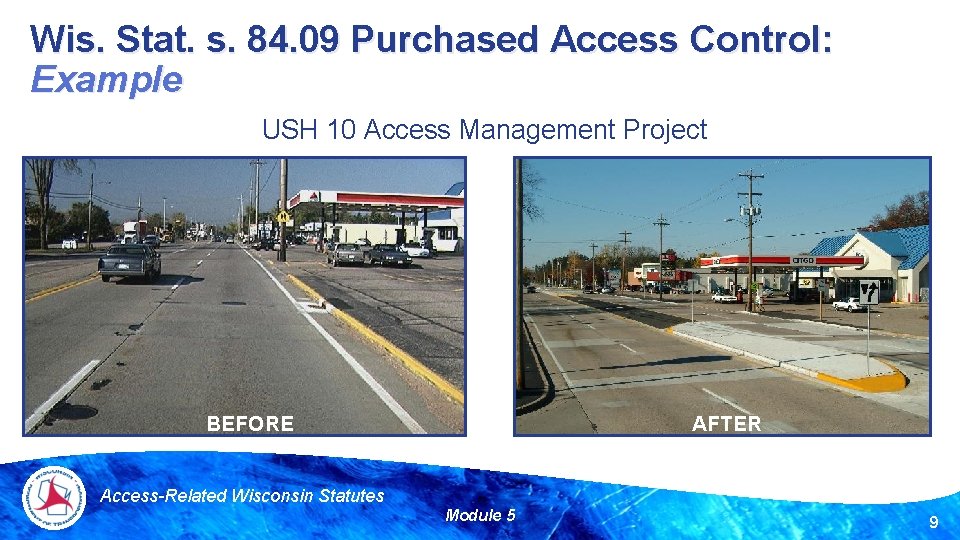
Wis. Stat. s. 84. 09 Purchased Access Control: Example USH 10 Access Management Project BEFORE AFTER Access-Related Wisconsin Statutes Module 5 9
Sale of Surplus Land: Access Considerations When Wis. DOT-owned land is designated as surplus for sale… Review documents to identify any access restrictions ANY conveyance of the land MUST re-reserve the access rights, or Wis. DOT may find that it no longer owns those access rights Access-Related Wisconsin Statutes Module 5 10
Surplus Land Sale: Case Study (Actual Situation) Wis. DOT bought a parcel years ago that included access rights Wis. DOT decided to sell the parcel as surplus property The access controls from the original purchase merged with Wis. DOT’s outright ownership interest in the property Wis. DOT needed to, but did not reserve the access rights as part of the sale § Wis. DOT lost those access rights, and would have to pay to reacquire them Access-Related Wisconsin Statutes Module 5 11
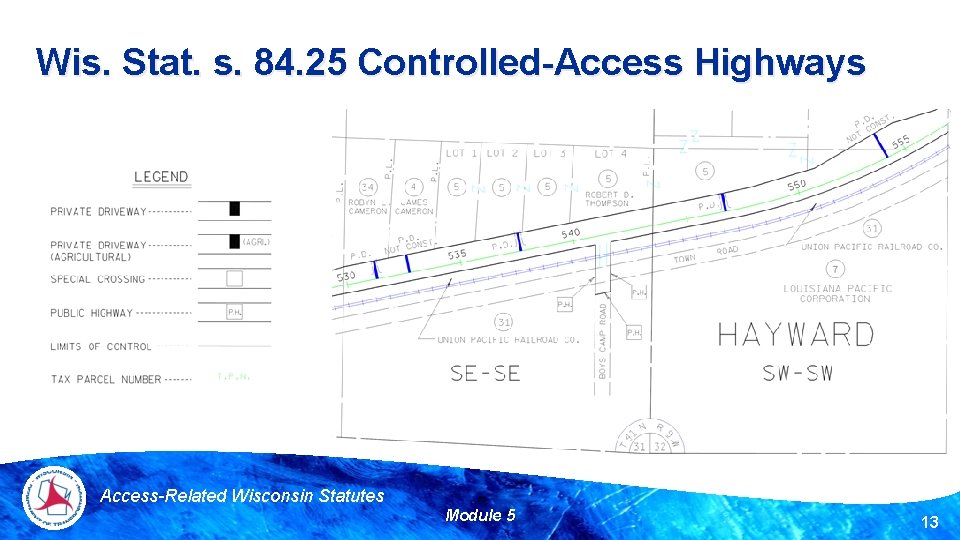
Wis. Stat. s. 84. 25 Controlled-Access Highways: What it does Authorizes Wis. DOT to place access controls on properties abutting rural portions of a state trunk highway by following administrative procedures Once designated, it is recorded and the highway is considered a controlled-access highway Access-Related Wisconsin Statutes Module 5 No rights of access remain except the “controlled right of access” Gives Wis. DOT “administrative control” to manage access while the highway is still in its rural state § Remains in place after urbanization 12
Wis. Stat. s. 84. 25 Controlled-Access Highways Access-Related Wisconsin Statutes Module 5 13
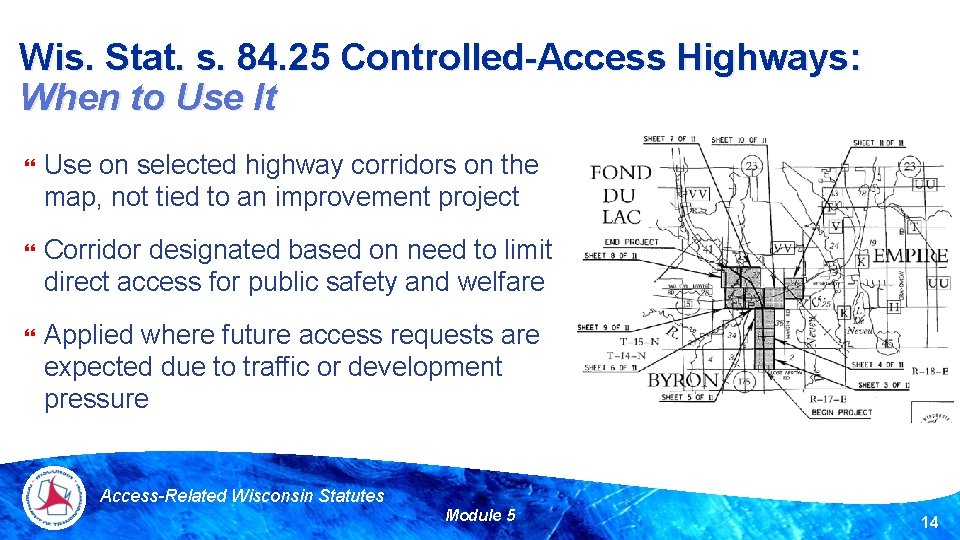
Wis. Stat. s. 84. 25 Controlled-Access Highways: When to Use It Use on selected highway corridors on the map, not tied to an improvement project Corridor designated based on need to limit direct access for public safety and welfare Applied where future access requests are expected due to traffic or development pressure Access-Related Wisconsin Statutes Module 5 14
Wis. Stat. s. 84. 25 Controlled-Access Highways: Considerations What to consider after implementation How to manage access as properties develop or the highway is improved The processing of access permit requests Updating the project over time Effect on roadway improvement projects Tip: Consult with Central Office before budgeting funds for a project FDM 4 -5 -1 Access-Related Wisconsin Statutes Module 5 15
Wis. Stat. s. 84. 295 Freeways and Expressways: Explained Determine future STH system needs Allows access control on properties abutting freeways and expressways Caution: Statutes require the purchase of existing access for designating freeways on existing alignments with no planned service roads Access-Related Wisconsin Statutes Module 5 16
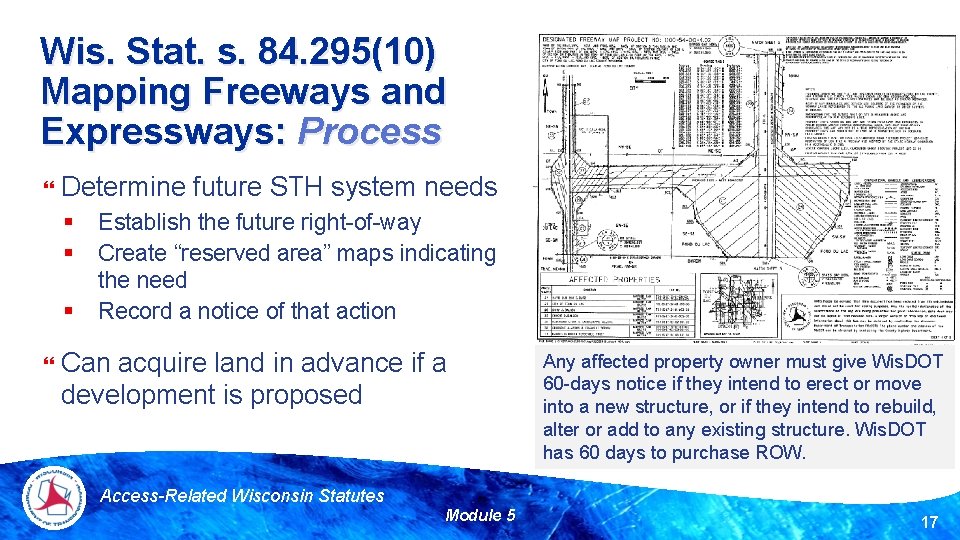
Wis. Stat. s. 84. 295(10) Mapping Freeways and Expressways: Process Determine future STH system needs § § § Establish the future right-of-way Create “reserved area” maps indicating the need Record a notice of that action Can acquire land in advance if a development is proposed Any affected property owner must give Wis. DOT 60 -days notice if they intend to erect or move into a new structure, or if they intend to rebuild, alter or add to any existing structure. Wis. DOT has 60 days to purchase ROW. Access-Related Wisconsin Statutes Module 5 17
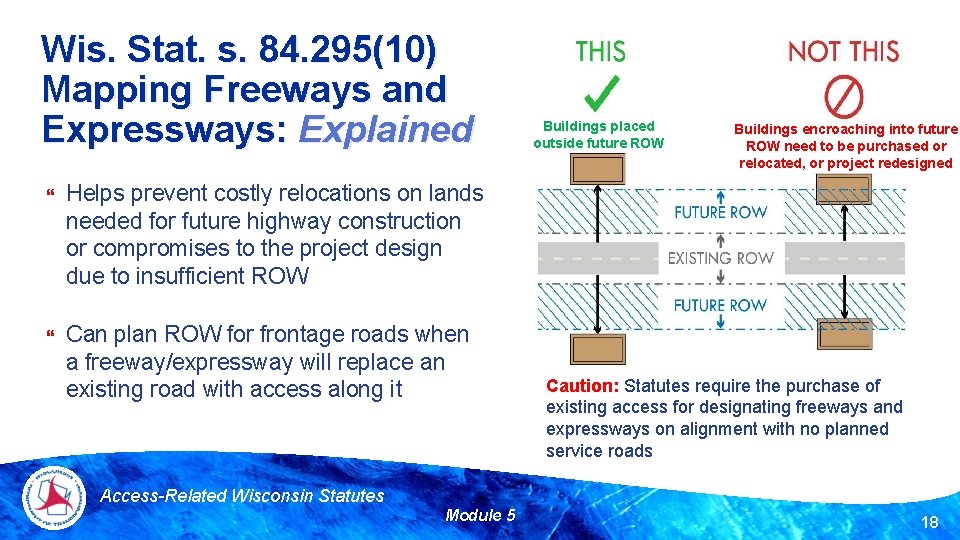
Wis. Stat. s. 84. 295(10) Mapping Freeways and Expressways: Explained Helps prevent costly relocations on lands needed for future highway construction or compromises to the project design due to insufficient ROW Can plan ROW for frontage roads when a freeway/expressway will replace an existing road with access along it Buildings placed outside future ROW Buildings encroaching into future ROW need to be purchased or relocated, or project redesigned Caution: Statutes require the purchase of existing access for designating freeways and expressways on alignment with no planned service roads Access-Related Wisconsin Statutes Module 5 18
Wis. Stat. s. 86. 05 Entrances to Highways Restored: Process Review accesses along the highway being reconstructed § Remove illegal accesses § Restore only those necessary to serve properties § Consolidate accesses wherever possible § On relocation, no right of access accrues to any abutting property owner Coordinate with real estate when right-of-way is being purchased NOTE: The law does not require every entrance to be reconstructed § Do not construct additional accesses either during project See Real Estate Program Manual sections 2. 7. 2 and 2. 8. 4 Access-Related Wisconsin Statutes Module 5 19
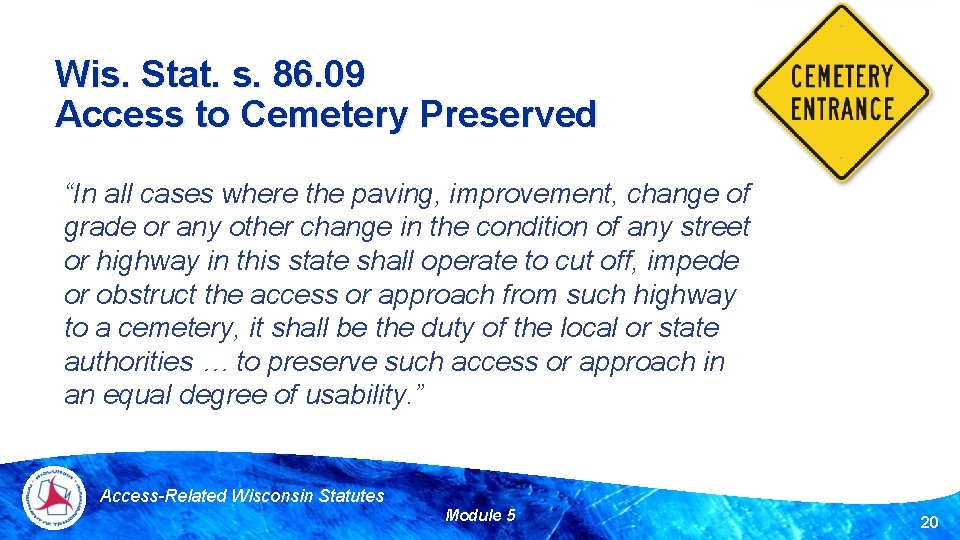
Wis. Stat. s. 86. 09 Access to Cemetery Preserved “In all cases where the paving, improvement, change of grade or any other change in the condition of any street or highway in this state shall operate to cut off, impede or obstruct the access or approach from such highway to a cemetery, it shall be the duty of the local or state authorities … to preserve such access or approach in an equal degree of usability. ” Access-Related Wisconsin Statutes Module 5 20
Wisconsin Access Statutes and Administrative Rules Related to Subdivision Plats Chapter 236 § Region plat reviewer reviews subdivision plats § Work with region access management engineer/coordinator and/or permit engineer/coordinator § Subdivisions may include restrictions on access for initial development but also for future splits and changes Trans 233: Admin Rule related to Ch. 236 Subdivision Platting Process (and Wis. DOT’s objecting authority) § Special rules regarding the subdivision of land abutting state trunk highways and connecting highways Access-Related Wisconsin Statutes Module 5 21
Trans 233 Division of Land Abutting a STH or Connecting Highway: Explained Review land division to ensure it will not compromise Wis. DOT’s access management goals Appropriate requirements are placed on a property to mitigate the potential impact of the development on the highway system Wis. DOT may object to a proposed subdivision plat thereby preventing the plat from being recorded Access-Related Wisconsin Statutes Module 5 Wis. DOT Objectives: § Provide for safety § Preserve the public interest and investment in state trunk highways § Enhance capacity and operations § Support efficient movement of freight and goods 22
Trans 233 Division of Land Abutting a STH or Connecting Highway: Explained (continued) The process proactively ensures a long-term access plan § Mitigate traffic impacts on the highway caused by increased access requirements from the subdivided lands § Protects the subdivision lot purchasers from buying lands with limited or no access to the state highway Wis. DOT Objectives: § Provide for safety § Preserve the public interest and investment in state trunk highways § Enhance capacity and operations § Support efficient movement of freight and goods Access-Related Wisconsin Statutes Module 5 23
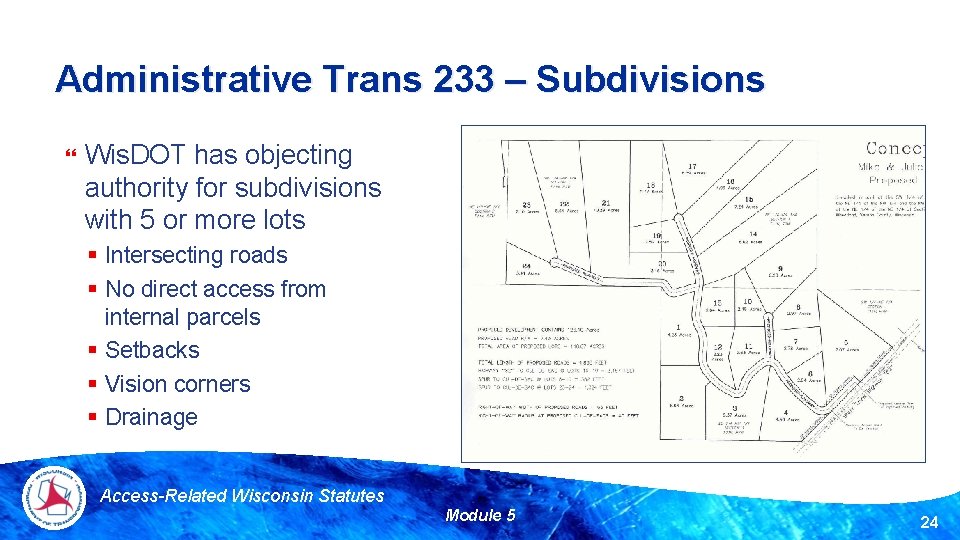
Administrative Trans 233 – Subdivisions Wis. DOT has objecting authority for subdivisions with 5 or more lots § Intersecting roads § No direct access from internal parcels § Setbacks § Vision corners § Drainage Access-Related Wisconsin Statutes Module 5 24
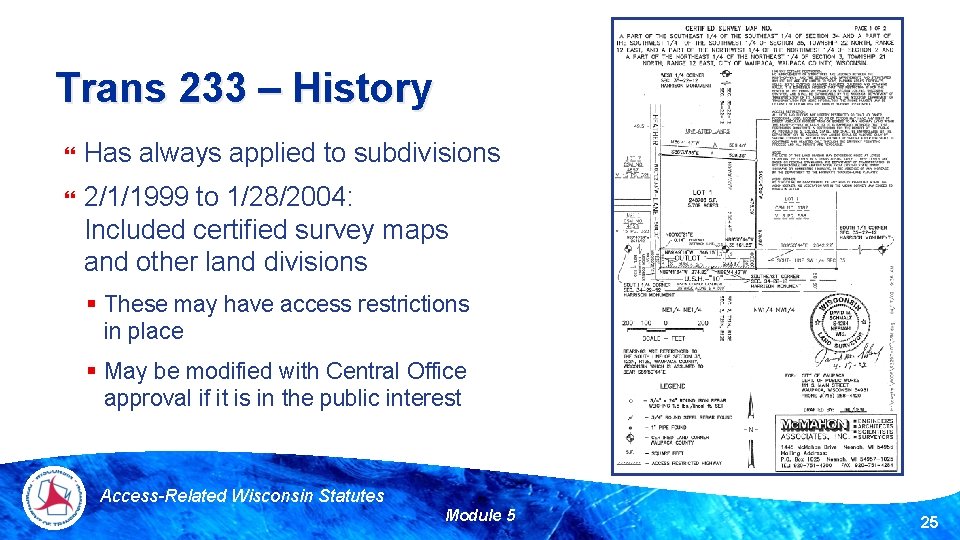
Trans 233 – History Has always applied to subdivisions 2/1/1999 to 1/28/2004: Included certified survey maps and other land divisions § These may have access restrictions in place § May be modified with Central Office approval if it is in the public interest Access-Related Wisconsin Statutes Module 5 25
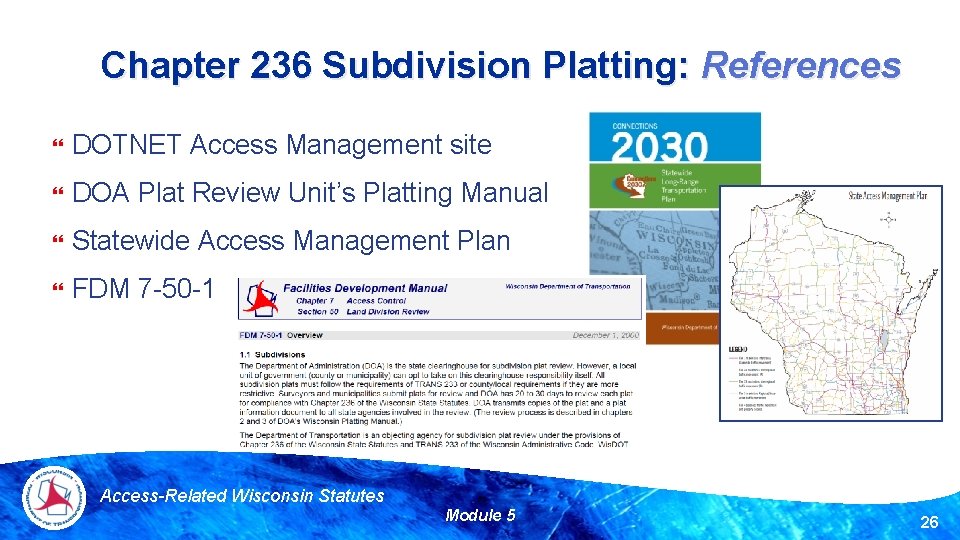
Chapter 236 Subdivision Platting: References DOTNET Access Management site DOA Plat Review Unit’s Platting Manual Statewide Access Management Plan FDM 7 -50 -1 Access-Related Wisconsin Statutes Module 5 26
Identifying Access Controls Module 5 27
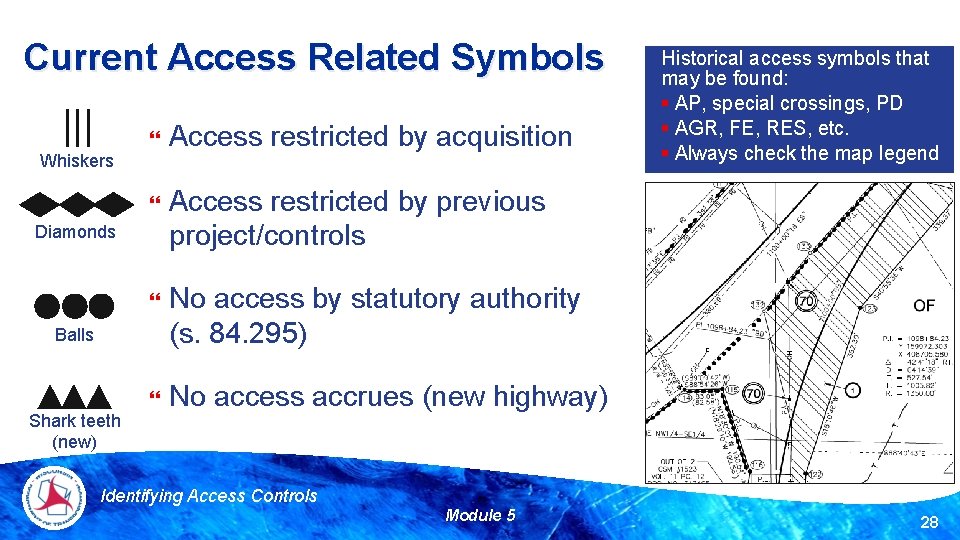
Current Access Related Symbols ||| Access restricted by acquisition Access restricted by previous project/controls No access by statutory authority (s. 84. 295) No access accrues (new highway) Whiskers Diamonds Balls Shark teeth (new) Historical access symbols that may be found: § AP, special crossings, PD § AGR, FE, RES, etc. § Always check the map legend Identifying Access Controls Module 5 28
Where to Look for Access-related Symbols and Restrictions Recorded property deeds Official jurisdictional reassignment documents s. 84. 295(10) Freeway and Expressway Official Map s. 84. 25 Controlled Access Map (driveway symbols) Subdivision plats/CSM’s – Trans 233 Scenic easements Access covenants s. 84. 09 Transportation Project Plat Identifying Access Controls Module 5 29
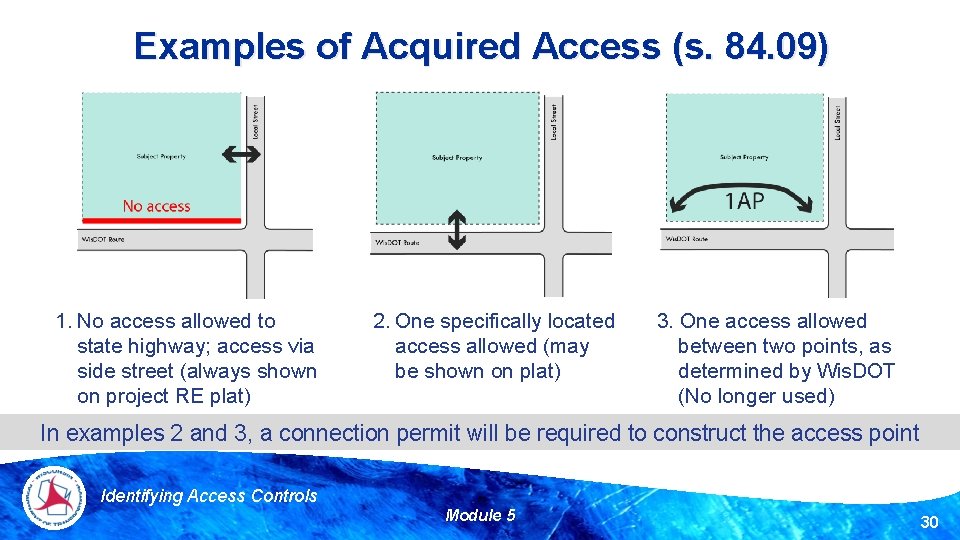
Examples of Acquired Access (s. 84. 09) 1. No access allowed to state highway; access via side street (always shown on project RE plat) 2. One specifically located access allowed (may be shown on plat) 3. One access allowed between two points, as determined by Wis. DOT (No longer used) In examples 2 and 3, a connection permit will be required to construct the access point Identifying Access Controls Module 5 30
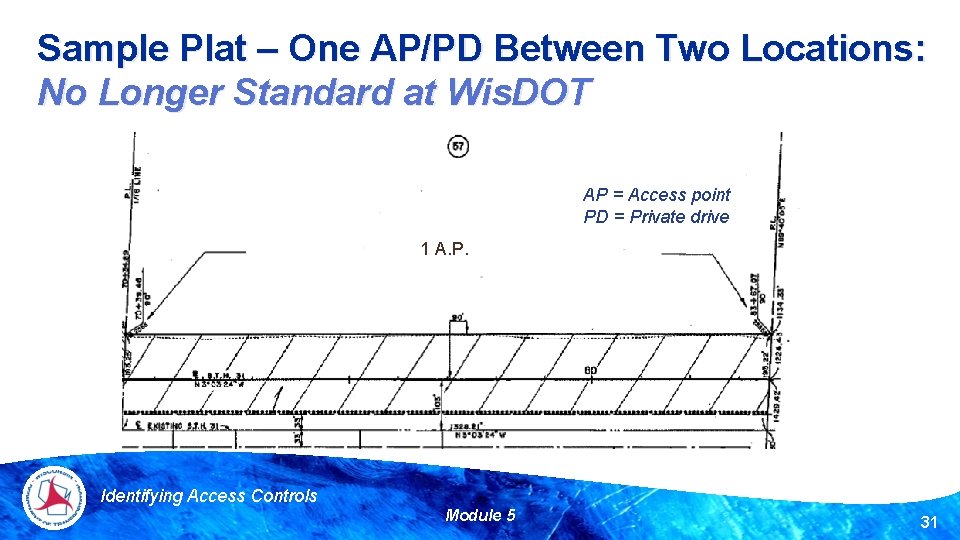
Sample Plat – One AP/PD Between Two Locations: No Longer Standard at Wis. DOT AP = Access point PD = Private drive 1 A. P. Identifying Access Controls Module 5 31
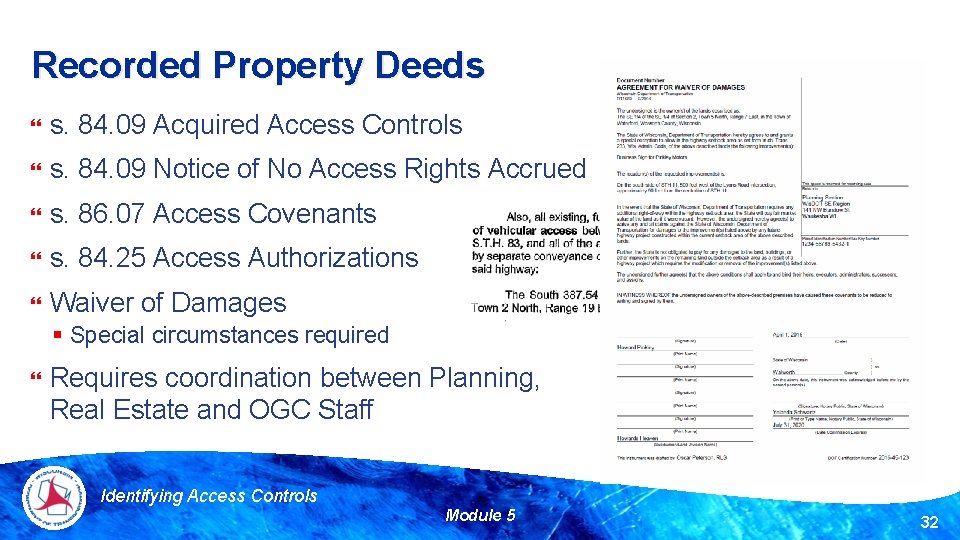
Recorded Property Deeds s. 84. 09 Acquired Access Controls s. 84. 09 Notice of No Access Rights Accrued s. 86. 07 Access Covenants s. 84. 25 Access Authorizations Waiver of Damages {Insert picture of an 84. 09 property deed with best access related language – use Sue V. } § Special circumstances required Requires coordination between Planning, Real Estate and OGC Staff Identifying Access Controls Module 5 32
Jurisdictional Reassignments (JRs) All access should be reviewed as part of STH to local JR so: § Local government knows what they are getting (decide what it wants to continue) § Wis. DOT may determine what controls to keep All access should be reviewed as part of local to STH designation so: § Wis. DOT knows what liability it may be acquiring § Wis. DOT may negotiate with local government to correct access issues Avoid accepting a local highway where access is substandard to STH standards Avoid Wis. DOT costs to repair access problems that may result in costly safety or operational improvements in the future Identifying Access Controls Module 5 33
Jurisdictional Reassignments Various access controls to review for jurisdictional reassignments: § s. 86. 07 PERMIT – Remains in place unless it specifies it was only valid while on the STH § s. 84. 09 ACQUIRED – Runs with the property title as long as it is a public highway, and the acquisition deed does not state that the access rights extinguish if highway ceases to be a STH (can only be transferred by deed) § s. 84. 25 CONTROLLED ACCESS – These controls may be vacated once the STH designation is removed. Local government may enact an ordinance to perpetuate access controls. See Wis. DOT FDM 4 -5 -1 for more information Identifying Access Controls Module 5 34
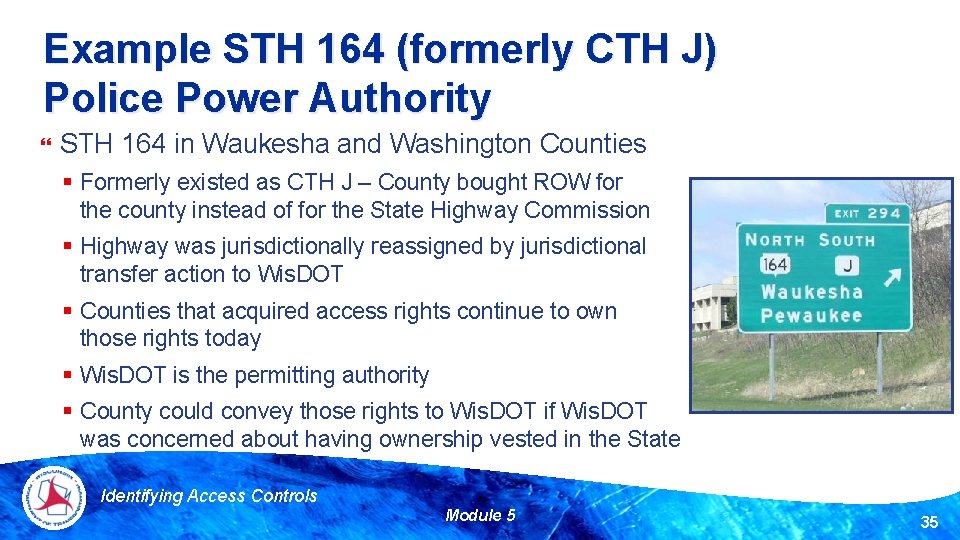
Example STH 164 (formerly CTH J) Police Power Authority STH 164 in Waukesha and Washington Counties § Formerly existed as CTH J – County bought ROW for the county instead of for the State Highway Commission § Highway was jurisdictionally reassigned by jurisdictional transfer action to Wis. DOT § Counties that acquired access rights continue to own those rights today § Wis. DOT is the permitting authority § County could convey those rights to Wis. DOT if Wis. DOT was concerned about having ownership vested in the State Identifying Access Controls Module 5 35
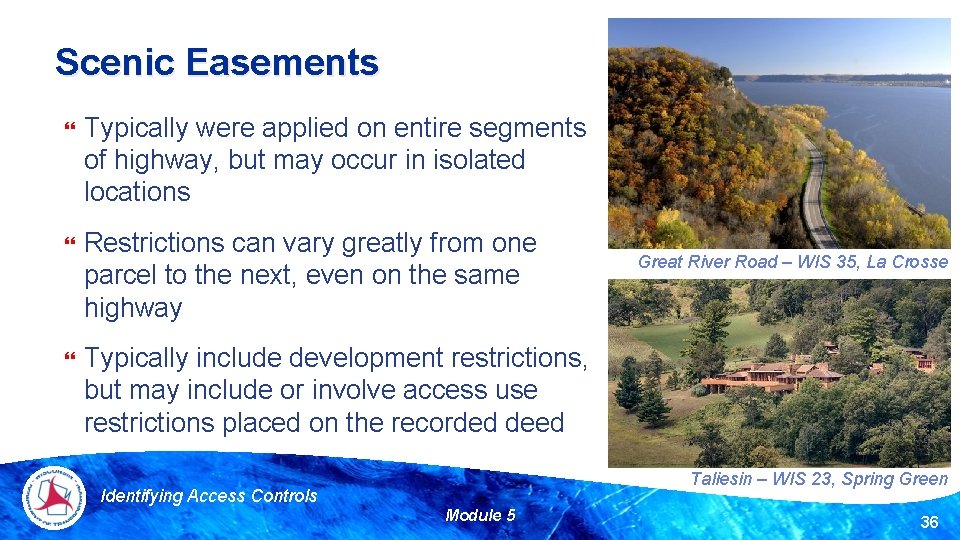
Scenic Easements Typically were applied on entire segments of highway, but may occur in isolated locations Restrictions can vary greatly from one parcel to the next, even on the same highway Typically include development restrictions, but may include or involve access use restrictions placed on the recorded deed Great River Road – WIS 35, La Crosse Taliesin – WIS 23, Spring Green Identifying Access Controls Module 5 36
Access Covenants Recorded agreement between a property owner and Wis. DOT that places STH access restrictions on owner’s property pertaining to: § Number of accesses § Location of access(es) § Use or type of access Used to clearly define a specific future action or unique restriction that must run with the property title rather than using permit alone A covenant transfers the property owner’s rights specific to the item in the covenant Identifying Access Controls Module 5 37
Driveway Permit Access Covenant Owner wants a new driveway permit and has a lot of STH frontage Potential for future development. Make the owner think about what s/he wants to do in the future and where the future access points should be. Covenant is a condition of issuing the requested permit Covenant identifies future access points at locations that meet Wis. DOT requirements Identifying Access Controls Module 5 38
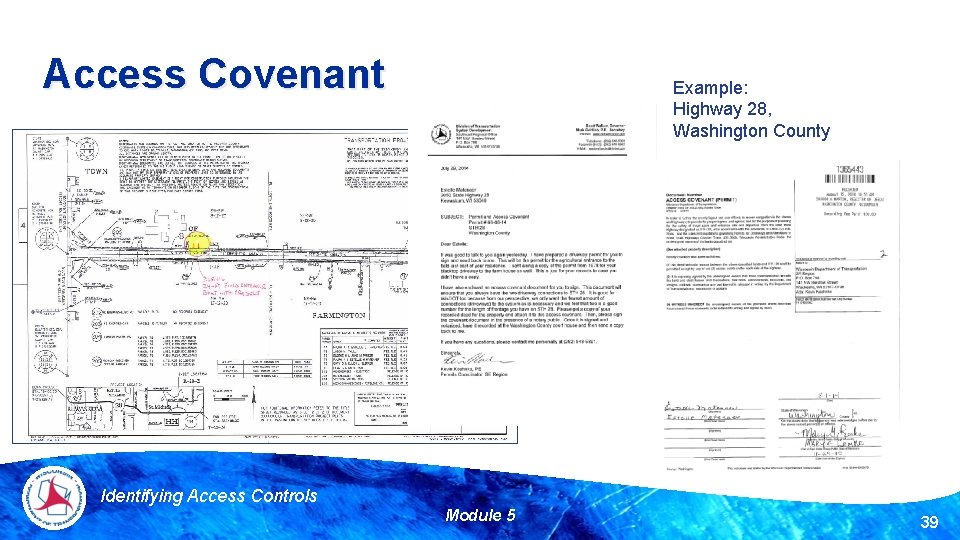
Access Covenant Example: Highway 28, Washington County Identifying Access Controls Module 5 39
Subdivision Access Covenants Owner has more highway frontage than the proposed subdivision Potential for future development. Make the owner think about what s/he wants to do in the future and where the future access points should be. Access covenant is a condition of non-objection to the proposed subdivision Covenant identifies future access at points at locations that meet Wis. DOT requirements Identifying Access Controls Module 5 40
Access Covenants When to use? § SAMP Tiers 2 a, 2 b and 3 § Tie in with existing corridor plans § Potential land division into many parcels fronting STH § Advancing development; potential change of use § Preserve functional area of an interchange or intersection § Used to clearly define a specific future action or unique restriction that must run with the property title rather than by permit alone § Used in anticipation of future changes along a STH corridor Identifying Access Controls Module 5 41
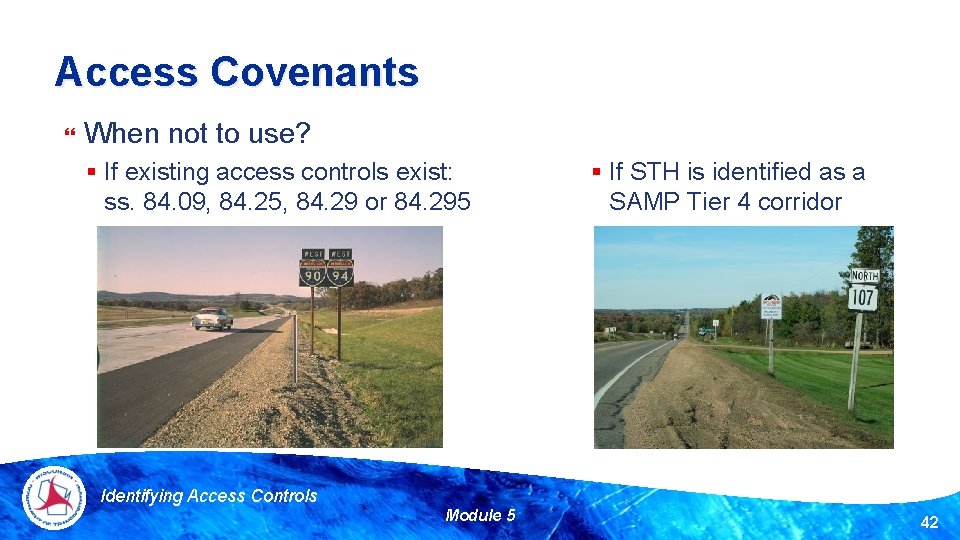
Access Covenants When not to use? § If existing access controls exist: ss. 84. 09, 84. 25, 84. 29 or 84. 295 § If STH is identified as a SAMP Tier 4 corridor Identifying Access Controls Module 5 42
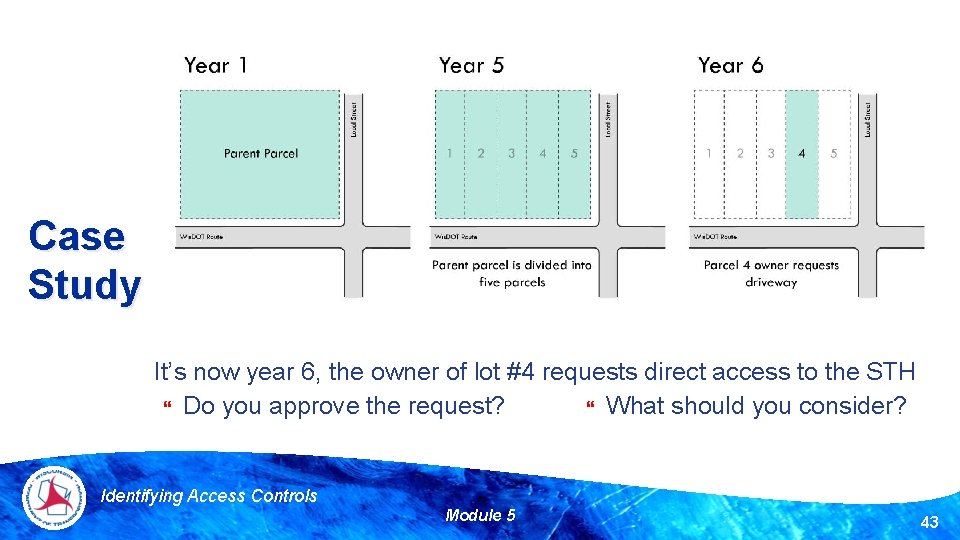
Case Study It’s now year 6, the owner of lot #4 requests direct access to the STH What should you consider? Do you approve the request? Identifying Access Controls Module 5 43
Identifying Access Controls Takeaways: Know how to distinguish eminent domain from police power Don't pay for what Wis. DOT already owns Communication is important – emphasize the benefits to safety and traffic flow with owners: Say, “We are improving the road” rather than, “We are reducing your access. ” Identifying Access Controls Module 5 44
Identifying Access Controls Takeaways: Negotiators – don't offer compensation for police power controls Appraisers – don't calculate value of access when its regulated by police power (i. e. , don't pay for land being acquired and then more money for changes to access due to a change in road design or Wisconsin law) Contact access management staff when excess land sales, jurisdictional transfers, and other transactions involve access issues Identifying Access Controls Module 5 45
Acknowledgments Special thanks to the Wis. DOT Access Management Team members who contributed their time, input, and experiences to develop this training program: Mike Roach – Statewide Access Engineer Sue Voight – SE Region Access Coordinator Dave Nielsen – NE Region Access Engineer Tom Beekman – NW Region Planning Chief Ernie Peterson – Statewide Access Engineer (Retired) Bob Fasick – State ROW Permits Engineer John Sobotik – Assistant General Counsel Kathy Batha – Assistant General Counsel Module 5 Consultants: Brad Strader, MKSK, TRB Access Management Committee member Charles (Chuck) Wade, Tran. Smart, consultant for Wis. DOT 2005 Access Management Training program Bill Eisele, TTI and TRB Access Management Committee past member Karen Dixon, TTI and TRB Access Management Manual co-author Josh Penn, LSL Planning, a SAFEbuilt Company 46
Discussion Module 5 47