
Wireshark Dissectors 3 ways to eat bytes Graham
Wireshark Dissectors 3 ways to eat bytes Graham Bloice – Software Developer
Introduction • Software Developer with Trihedral UK Limited • Use C++ and scripting for SCADA toolkit VTScada™ • Use Wireshark with industrial tele-control protocols • Wireshark Core Developer • First contributed to Wireshark in 1999 • Maintain DNP 3 dissector • Frequent contributor to “Ask Wireshark” • Mostly fixing formatting and converting “answers” to comments Sharkfest 2014 2

Topics to be Covered • Wireshark internals brief overview • Where dissectors fit in • Dissectors • Brief overview • Paths to implementation • Complexity and performance tradeoffs Sharkfest 2014 3
Wireshark Internals • Wireshark provides a framework for loading, dissection and visualization of network traffic • Wireshark framework allows individual dissectors access to network data via libwiretap • Wireshark framework provides utility functions for dissectors when dissecting data • Wireshark framework allows dissectors to write out products of dissection Sharkfest 2014 4
Dissectors overview • Dissectors “register” their interest in data from a lower level protocol dissector, e. g. tcp port 54321 • The lower level dissector hands the payload body to the registered dissector • Dissectors “pick apart” a protocol into the individual elements of the protocol message • Each element of a protocol may have a type, e. g. integer, string, bit field, timestamp • Dissectors provide elements that may be used in display filters Sharkfest 2014 5
Dissector output • Set the protocol column • Set the info column • Create tree entries as required • Create subtree entries for protocol components • Add values, text to tree entries • Call sub-dissectors as required Sharkfest 2014 6
Dissector Construction Options • Text based • Built-in, with compilation – ASN. 1, IDL • External, without compilation – Wireshark Generic Dissector (WSGD)* • Scripting language based • Built-in, Lua*, Python (not in Windows) • External, Python (pyreshark) • C based* • Traditional format, requires a development environment Sharkfest 2014 7
Demonstration protocol • Made up for this presentation • Has a header with a byte indicating the message type, and a short (2 bytes in big-endian format) for the total message length (including the header) • Commands are: • connect (20) and connect_ack (21) that have a long (4 bytes in little-endian format) id • disconnect (60) and disconnect_ack (61) that have a long (4 bytes in little-endian format) id • request_data and request_reply that have a byte indicating the data type and for the reply an actual data value; • Data type 0 – a little-endian short • Data type 1 – a little-endian long • Data type 2 – a 15 character string Sharkfest 2014 8
Text based Dissectors • Protocol definition held in text file(s) in human readable form • Definitions are interpreted or compiled to produce a dissector • Low barrier to entry, although ASN. 1 and IDL requires a development environment to compile resulting dissector • Interpreted text files are least performant option • Least flexible option for access to libwireshark infrastructure Sharkfest 2014 9

Wireshark Generic Dissector (WSGD) • A Wireshark add-on created by Olivier Aveline, info at http: //wsgd. free. fr/ • Allows dissection of a protocol based on a text description of the protocol elements • Available for Windows and Linux as a plug-in module • Has some limitations but relatively simple to use and doesn’t require a development environment Sharkfest 2014 10
WSGD Dissectors • Copy the appropriate version of the plugin into your Wireshark installation: • Global plugins • Personal plugins • Copy (or create) the definition files in the required location: • As specified by the environment variable “WIRESHARK_GENERIC_DISSECTOR_DIR” • Profiles directory • User data directory • Global plugin directory • Wireshark main directory Sharkfest 2014 11
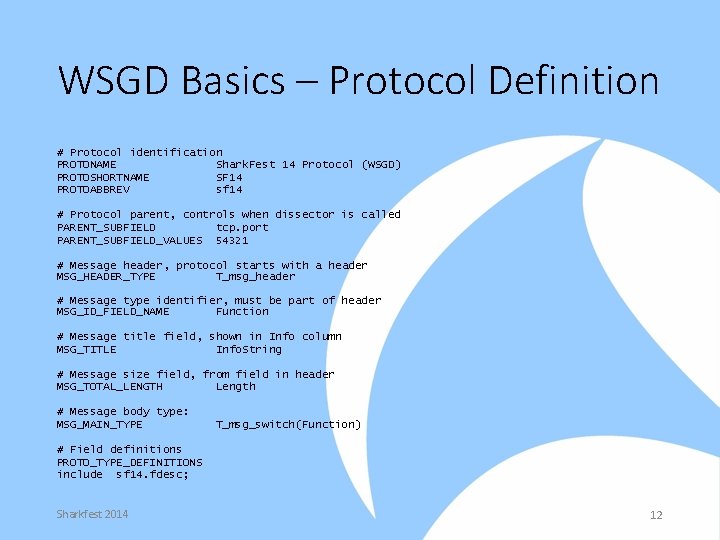
WSGD Basics – Protocol Definition # Protocol identification PROTONAME Shark. Fest 14 Protocol (WSGD) PROTOSHORTNAME SF 14 PROTOABBREV sf 14 # Protocol parent, controls when dissector is called PARENT_SUBFIELD tcp. port PARENT_SUBFIELD_VALUES 54321 # Message header, protocol starts with a header MSG_HEADER_TYPE T_msg_header # Message type identifier, must be part of header MSG_ID_FIELD_NAME Function # Message title field, shown in Info column MSG_TITLE Info. String # Message size field, from field in header MSG_TOTAL_LENGTH Length # Message body type: MSG_MAIN_TYPE T_msg_switch(Function) # Field definitions PROTO_TYPE_DEFINITIONS include sf 14. fdesc; Sharkfest 2014 12
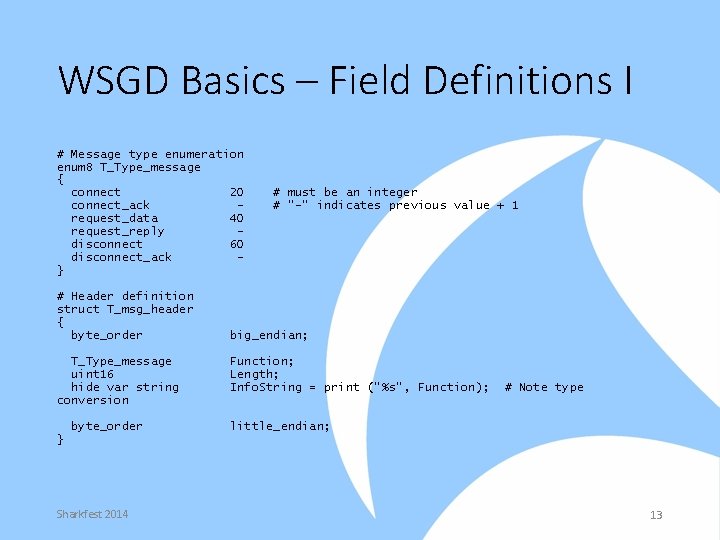
WSGD Basics – Field Definitions I # Message type enumeration enum 8 T_Type_message { connect 20 connect_ack request_data 40 request_reply disconnect 60 disconnect_ack } # Header definition struct T_msg_header { byte_order T_Type_message uint 16 hide var string conversion byte_order # must be an integer # "-" indicates previous value + 1 big_endian; Function; Length; Info. String = print ("%s", Function); # Note type little_endian; } Sharkfest 2014 13
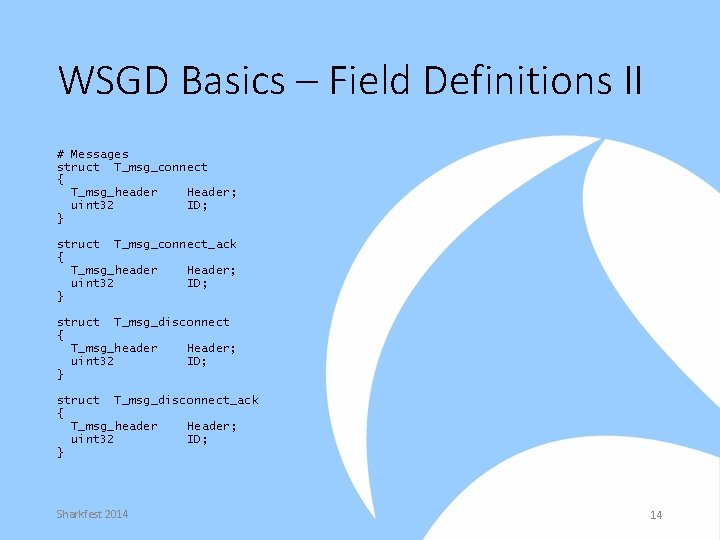
WSGD Basics – Field Definitions II # Messages struct T_msg_connect { T_msg_header Header; uint 32 ID; } struct T_msg_connect_ack { T_msg_header Header; uint 32 ID; } struct T_msg_disconnect_ack { T_msg_header Header; uint 32 ID; } Sharkfest 2014 14
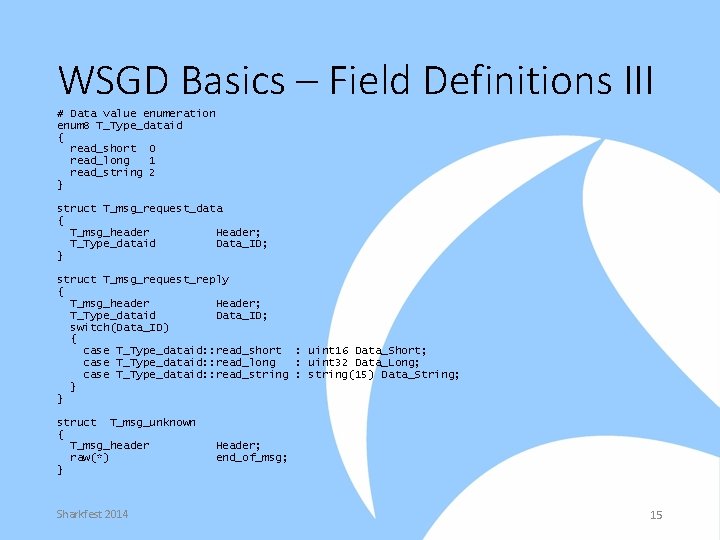
WSGD Basics – Field Definitions III # Data value enumeration enum 8 T_Type_dataid { read_short 0 read_long 1 read_string 2 } struct T_msg_request_data { T_msg_header Header; T_Type_dataid Data_ID; } struct T_msg_request_reply { T_msg_header Header; T_Type_dataid Data_ID; switch(Data_ID) { case T_Type_dataid: : read_short : uint 16 Data_Short; case T_Type_dataid: : read_long : uint 32 Data_Long; case T_Type_dataid: : read_string : string(15) Data_String; } } struct T_msg_unknown { T_msg_header raw(*) } Sharkfest 2014 Header; end_of_msg; 15
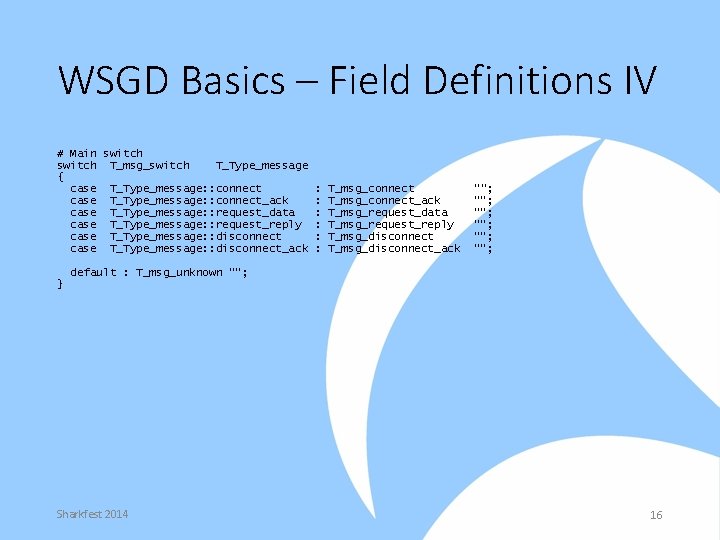
WSGD Basics – Field Definitions IV # Main switch T_msg_switch T_Type_message { case T_Type_message: : connect_ack case T_Type_message: : request_data case T_Type_message: : request_reply case T_Type_message: : disconnect_ack : : : T_msg_connect_ack T_msg_request_data T_msg_request_reply T_msg_disconnect_ack ""; ""; ""; default : T_msg_unknown ""; } Sharkfest 2014 16
Scripting language based dissectors • Protocol definition held in text file(s) using the script language syntax • Definitions are interpreted by the scripting language run-time • Scripting run-time exposes access to libwireshark infrastructure • Not all libwireshark infrastructure exposed • No development environment required • Faster than text dissectors, slower than C Sharkfest 2014 17
Lua dissectors • Lua is built-in to Wireshark (on most platforms) • The lua support can be used to build dissectors, postdissectors and taps • init. lua in the global configuration directory is run at Wireshark start-up • If disable_lua is not set to 0 runs init. lua from the personal configuration directory • Loads all lua scripts (*. lua) in the global and personal plugins directory • Runs any scripts passed on the command line with –X lua_script: xxx. lua Sharkfest 2014 18
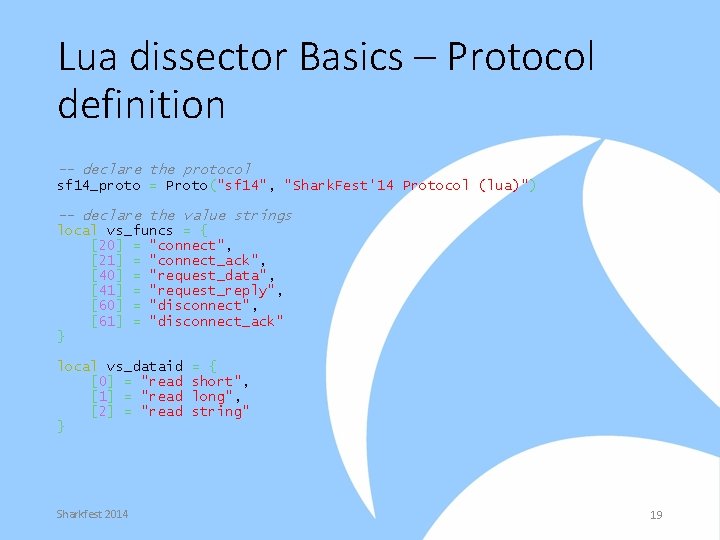
Lua dissector Basics – Protocol definition -- declare the protocol sf 14_proto = Proto("sf 14", "Shark. Fest'14 Protocol (lua)") -- declare the value strings local vs_funcs = { [20] = "connect", [21] = "connect_ack", [40] = "request_data", [41] = "request_reply", [60] = "disconnect", [61] = "disconnect_ack" } local vs_dataid = { [0] = "read short", [1] = "read long", [2] = "read string" } Sharkfest 2014 19
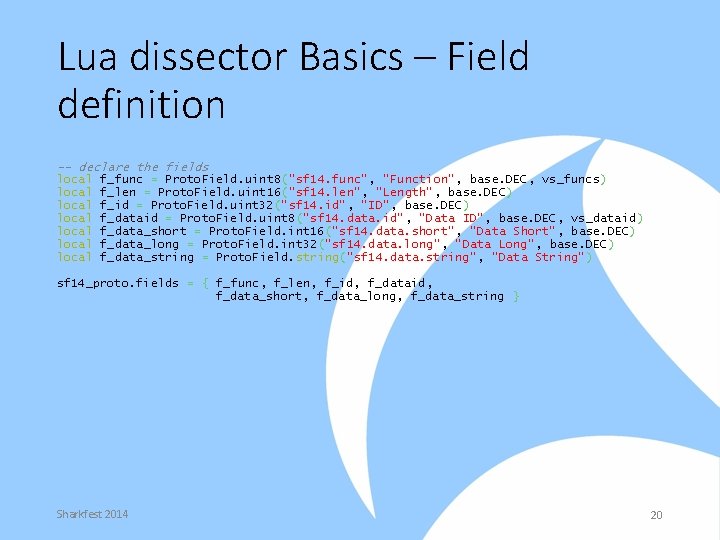
Lua dissector Basics – Field definition -- declare the fields local f_func = Proto. Field. uint 8("sf 14. func", "Function", base. DEC, vs_funcs) local f_len = Proto. Field. uint 16("sf 14. len", "Length", base. DEC) local f_id = Proto. Field. uint 32("sf 14. id", "ID", base. DEC) local f_dataid = Proto. Field. uint 8("sf 14. data. id", "Data ID", base. DEC, vs_dataid) local f_data_short = Proto. Field. int 16("sf 14. data. short", "Data Short", base. DEC) local f_data_long = Proto. Field. int 32("sf 14. data. long", "Data Long", base. DEC) local f_data_string = Proto. Field. string("sf 14. data. string", "Data String") sf 14_proto. fields = { f_func, f_len, f_id, f_dataid, f_data_short, f_data_long, f_data_string } Sharkfest 2014 20
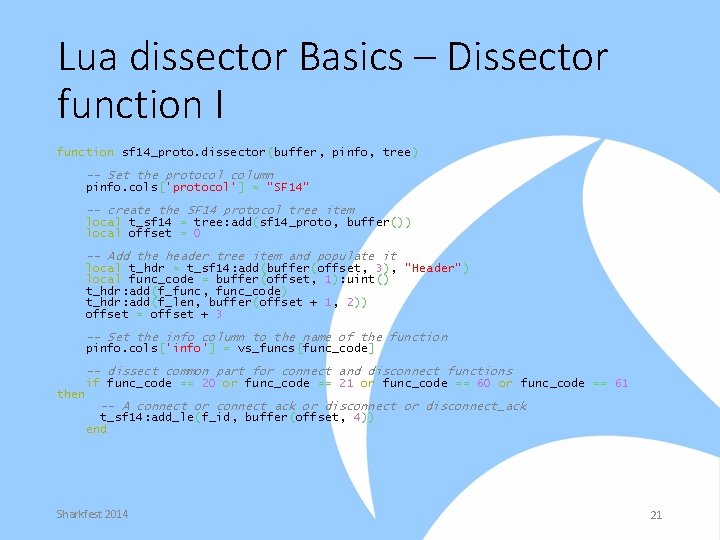
Lua dissector Basics – Dissector function I function sf 14_proto. dissector(buffer, pinfo, tree) -- Set the protocol column pinfo. cols['protocol'] = "SF 14" -- create the SF 14 protocol tree item local t_sf 14 = tree: add(sf 14_proto, buffer()) local offset = 0 -- Add the header tree item and populate it local t_hdr = t_sf 14: add(buffer(offset, 3), "Header") local func_code = buffer(offset, 1): uint() t_hdr: add(f_func, func_code) t_hdr: add(f_len, buffer(offset + 1, 2)) offset = offset + 3 -- Set the info column to the name of the function pinfo. cols['info'] = vs_funcs[func_code] -- dissect common part for connect and disconnect functions if func_code == 20 or func_code == 21 or func_code == 60 or func_code == 61 then -- A connect or connect ack or disconnect_ack t_sf 14: add_le(f_id, buffer(offset, 4)) end Sharkfest 2014 21
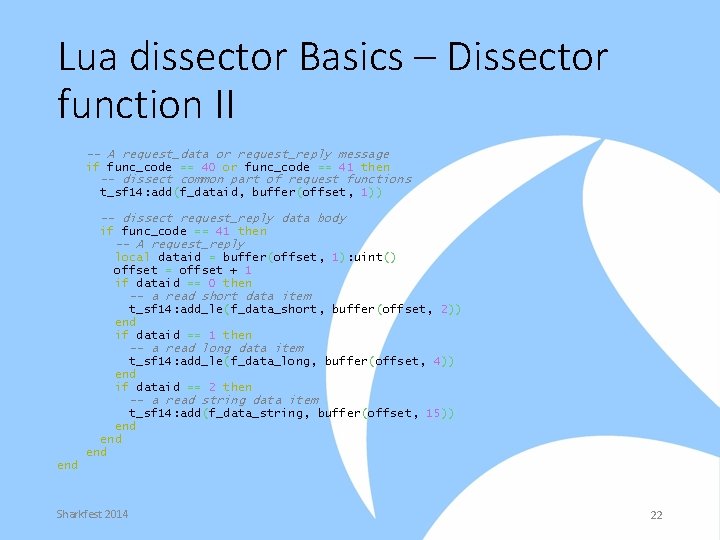
Lua dissector Basics – Dissector function II -- A request_data or request_reply message if func_code == 40 or func_code == 41 then -- dissect common part of request functions t_sf 14: add(f_dataid, buffer(offset, 1)) -- dissect request_reply data body if func_code == 41 then -- A request_reply local dataid = buffer(offset, 1): uint() offset = offset + 1 if dataid == 0 then -- a read short data item t_sf 14: add_le(f_data_short, buffer(offset, 2)) end if dataid == 1 then -- a read long data item t_sf 14: add_le(f_data_long, buffer(offset, 4)) end if dataid == 2 then -- a read string data item t_sf 14: add(f_data_string, buffer(offset, 15)) end end Sharkfest 2014 22
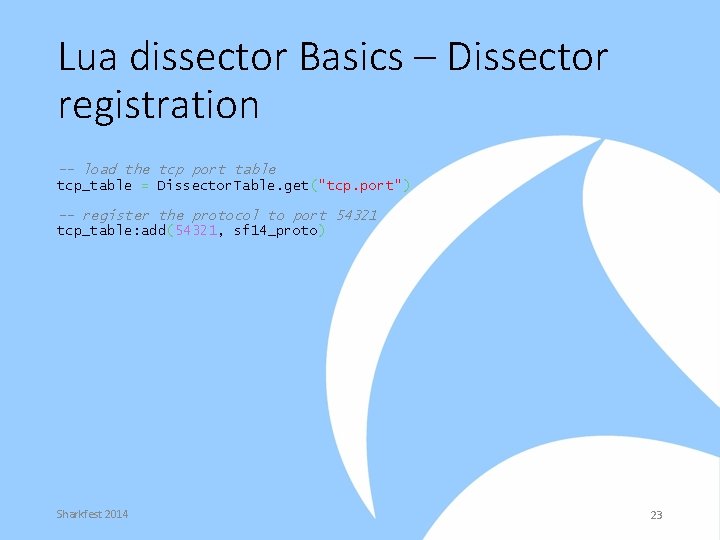
Lua dissector Basics – Dissector registration -- load the tcp port table tcp_table = Dissector. Table. get("tcp. port") -- register the protocol to port 54321 tcp_table: add(54321, sf 14_proto) Sharkfest 2014 23
C based dissectors • Protocol definition, implied in dissector source • Dissector source file compiled into libwireshark or as a plugin • All libwireshark infrastructure available • Full development environment required • High knowledge barrier to initial implementation • Use existing dissectors as a guide • Developers Guide is essential reading, also README. developer Sharkfest 2014 24
C dissector installation • Place source file in epandissectors • Add entry for source to Makefile. common, epanCMake. Lists. txt • Quick test compile in the dissectors directory, e. g. nmake –f Makefile. nmake packet-sf 14. obj • Rebuild Wireshark in the normal way Sharkfest 2014 25
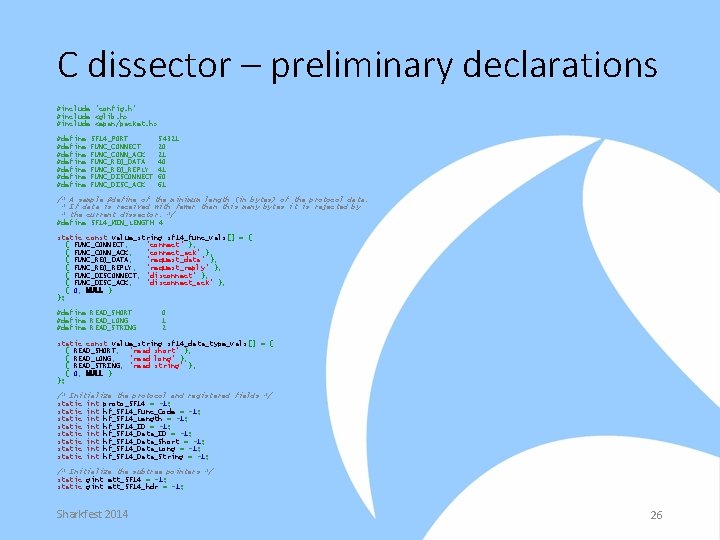
C dissector – preliminary declarations #include "config. h" #include <glib. h> #include <epan/packet. h> #define SF 14_PORT 54321 #define FUNC_CONNECT 20 #define FUNC_CONN_ACK 21 #define FUNC_REQ_DATA 40 #define FUNC_REQ_REPLY 41 #define FUNC_DISCONNECT 60 #define FUNC_DISC_ACK 61 /* A sample #define of the minimum length (in bytes) of the protocol data. * If data is received with fewer than this many bytes it is rejected by * the current dissector. */ #define SF 14_MIN_LENGTH 4 static const value_string sf 14_func_vals[] = { { FUNC_CONNECT, "connect" }, { FUNC_CONN_ACK, "connect_ack" }, { FUNC_REQ_DATA, "request_data" }, { FUNC_REQ_REPLY, "request_reply" }, { FUNC_DISCONNECT, "disconnect" }, { FUNC_DISC_ACK, "disconnect_ack" }, { 0, NULL } }; #define READ_SHORT 0 #define READ_LONG 1 #define READ_STRING 2 static const value_string sf 14_data_type_vals[] = { { READ_SHORT, "read short" }, { READ_LONG, "read long" }, { READ_STRING, "read string" }, { 0, NULL } }; /* Initialize the protocol and registered fields */ static static int int proto_SF 14 = -1; hf_SF 14_Func_Code = -1; hf_SF 14_Length = -1; hf_SF 14_ID = -1; hf_SF 14_Data_Short = -1; hf_SF 14_Data_Long = -1; hf_SF 14_Data_String = -1; /* Initialize the subtree pointers */ static gint ett_SF 14 = -1; static gint ett_SF 14_hdr = -1; Sharkfest 2014 26

C dissector – dissection function I /* Code to actually dissect the packets */ static int dissect_SF 14(tvbuff_t *tvb, packet_info *pinfo, proto_tree *tree, void *data _U_) { /* Set up structures needed to add the protocol subtree and manage it */ proto_item *ti, *hdr_ti; proto_tree *SF 14_tree, *SF 14_hdr_tree; /* Other misc. local variables. */ guint offset = 0; guint 8 func_code ; guint 8 data_id; /* Check that there's enough data */ if (tvb_length(tvb) < SF 14_MIN_LENGTH) return 0; /* Fetch some values from the packet header using tvb_get_*(). If these * values are not valid/possible in your protocol then return 0 to give * some other dissector a chance to dissect it. */ func_code = tvb_get_guint 8(tvb, offset); if (try_val_to_str(func_code, sf 14_func_vals) == NULL) return 0; /*** COLUMN DATA ***/ /* Set the Protocol column to the constant string of sf 14 */ col_set_str(pinfo->cinfo, COL_PROTOCOL, "SF 14"); col_clear(pinfo->cinfo, COL_INFO); col_add_str(pinfo->cinfo, COL_INFO, val_to_str (func_code, sf 14_func_vals, "Unknown function (%d )")); Sharkfest 2014 27
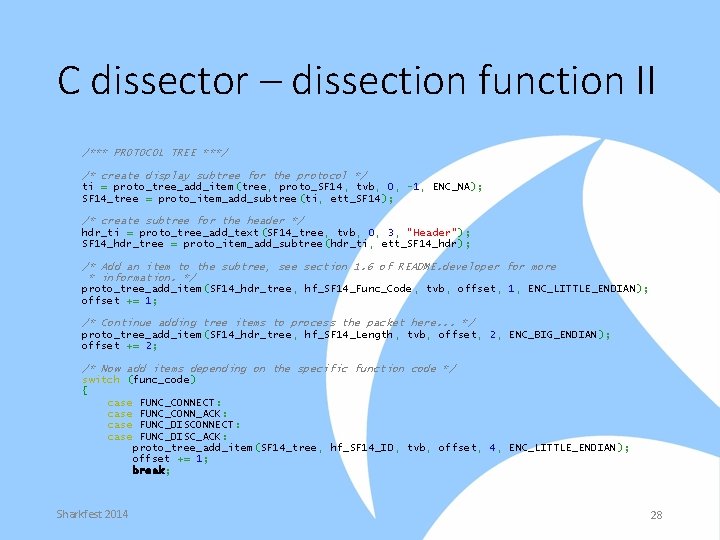
C dissector – dissection function II /*** PROTOCOL TREE ***/ /* create display subtree for the protocol */ ti = proto_tree_add_item (tree, proto_SF 14, tvb, 0, -1, ENC_NA); SF 14_tree = proto_item_add_subtree (ti, ett_SF 14); /* create subtree for the header */ hdr_ti = proto_tree_add_text(SF 14_tree, tvb, 0, 3, "Header"); SF 14_hdr_tree = proto_item_add_subtree (hdr_ti, ett_SF 14_hdr); /* Add an item to the subtree, see section 1. 6 of README. developer for more * information. */ proto_tree_add_item(SF 14_hdr_tree, hf_SF 14_Func_Code, tvb, offset, 1, ENC_LITTLE_ENDIAN); offset += 1; /* Continue adding tree items to process the packet here. . . */ proto_tree_add_item(SF 14_hdr_tree, hf_SF 14_Length, tvb, offset, 2, ENC_BIG_ENDIAN); offset += 2; /* Now add items depending on the specific function code */ switch (func_code) { case FUNC_CONNECT: case FUNC_CONN_ACK: case FUNC_DISCONNECT: case FUNC_DISC_ACK: proto_tree_add_item(SF 14_tree, hf_SF 14_ID, tvb, offset, 4, ENC_LITTLE_ENDIAN); offset += 1; break; Sharkfest 2014 28
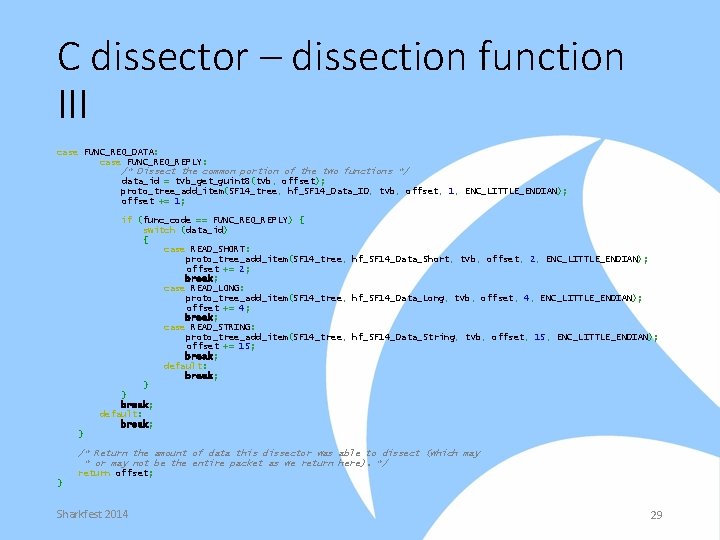
C dissector – dissection function III case FUNC_REQ_DATA: case FUNC_REQ_REPLY: /* Dissect the common portion of the two functions */ data_id = tvb_get_guint 8(tvb, offset); proto_tree_add_item(SF 14_tree, hf_SF 14_Data_ID, tvb, offset, 1, ENC_LITTLE_ENDIAN); offset += 1; if (func_code == FUNC_REQ_REPLY) { switch (data_id) { case READ_SHORT: proto_tree_add_item(SF 14_tree, hf_SF 14_Data_Short, tvb, offset, 2, ENC_LITTLE_ENDIAN); offset += 2; break; case READ_LONG: proto_tree_add_item(SF 14_tree, hf_SF 14_Data_Long, tvb, offset, 4, ENC_LITTLE_ENDIAN); offset += 4; break; case READ_STRING: proto_tree_add_item(SF 14_tree, hf_SF 14_Data_String, tvb, offset, 15, ENC_LITTLE_ENDIAN); offset += 15; break; default: break; } break; default: break; } /* Return the amount of data this dissector was able to dissect (which may * or may not be the entire packet as we return here). */ return offset; } Sharkfest 2014 29
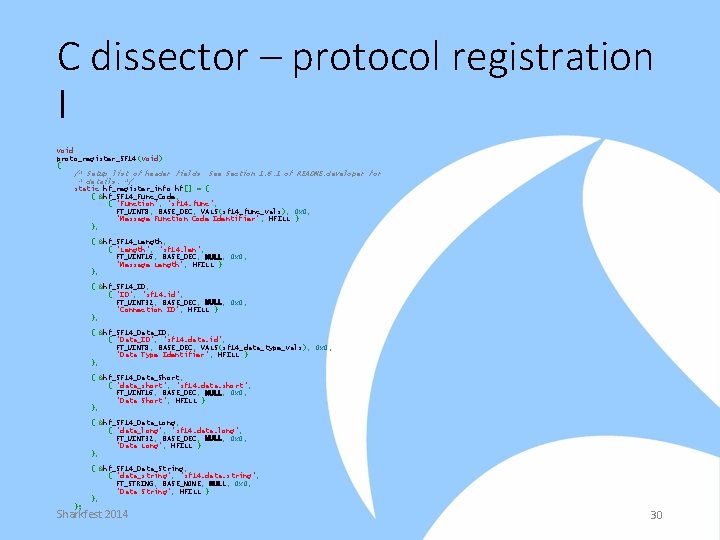
C dissector – protocol registration I void proto_register_SF 14(void) { /* Setup list of header fields See Section 1. 6. 1 of README. developer for * details. */ static hf_register_info hf [] = { { &hf_SF 14_Func_Code, { "Function", "sf 14. func", FT_UINT 8 , BASE_DEC, VALS(sf 14_func_vals), 0 x 0, "Message Function Code Identifier" , HFILL } }, { &hf_SF 14_Length, { "Length", "sf 14. len", FT_UINT 16 , BASE_DEC, NULL, 0 x 0, "Message Length", HFILL } }, { &hf_SF 14_ID, { "ID", "sf 14. id", FT_UINT 32 , BASE_DEC, NULL, 0 x 0, "Connection ID", HFILL } }, { &hf_SF 14_Data_ID, { "Data_ID", "sf 14. data. id", FT_UINT 8 , BASE_DEC, VALS(sf 14_data_type_vals), 0 x 0, "Data Type Identifier" , HFILL } }, { &hf_SF 14_Data_Short, { "data_short", "sf 14. data. short", FT_UINT 16 , BASE_DEC, NULL, 0 x 0, "Data Short", HFILL } }, { &hf_SF 14_Data_Long, { "data_long", "sf 14. data. long", FT_UINT 32 , BASE_DEC, NULL, 0 x 0, "Data Long", HFILL } }, { &hf_SF 14_Data_String, { "data_string", "sf 14. data. string", FT_STRING , BASE_NONE, NULL, 0 x 0, "Data String", HFILL } }, }; Sharkfest 2014 30
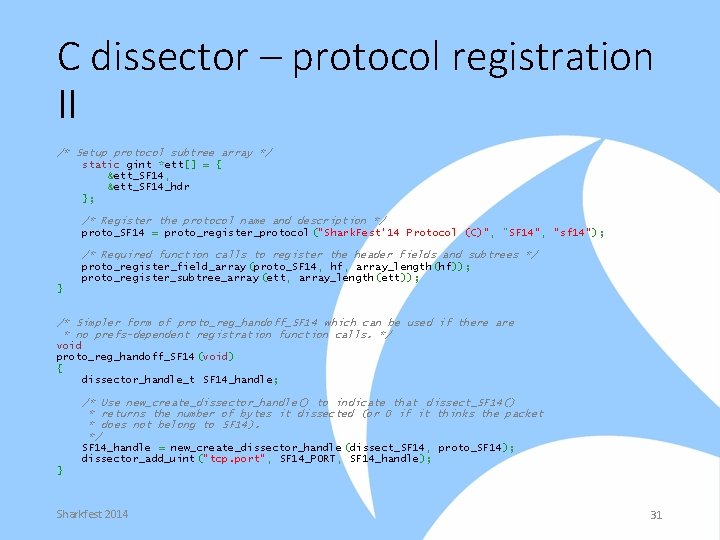
C dissector – protocol registration II /* Setup protocol subtree array */ static gint *ett[] = { &ett_SF 14, &ett_SF 14_hdr }; /* Register the protocol name and description */ proto_SF 14 = proto_register_protocol ("Shark. Fest'14 Protocol (C)", “SF 14", "sf 14"); /* Required function calls to register the header fields and subtrees */ proto_register_field_array (proto_SF 14, hf, array_length(hf)); proto_register_subtree_array (ett, array_length(ett)); } /* Simpler form of proto_reg_handoff_SF 14 which can be used if there are * no prefs-dependent registration function calls. */ void proto_reg_handoff_SF 14 (void) { dissector_handle_t SF 14_handle; /* Use new_create_dissector_handle() to indicate that dissect_SF 14() * returns the number of bytes it dissected (or 0 if it thinks the packet * does not belong to SF 14). */ SF 14_handle = new_create_dissector_handle (dissect_SF 14, proto_SF 14); dissector_add_uint ("tcp. port", SF 14_PORT, SF 14_handle); } Sharkfest 2014 31
Comparison of dissectors • For this simple “protocol”, Wireshark displays are almost identical • WSGD and Lua dissectors are quick and easy to develop; edit file and restart Wireshark • WSGD facilities are most limited option, Lua more advanced • C dissectors easy to distribute, build an installer package, easy to contribute back to Wireshark • WSGD 124 lines, Lua 89 lines, C 270 lines Sharkfest 2014 32
Comparison of dissectors performance • No visible difference for a small capture file, 11 packets • Medium capture file (~ 1 M packets) results: • WSGD: 2: 16 • Lua: 0: 39 • C: 0: 20 Sharkfest 2014 33
Questions? • Other dissector options? • Future directions? Sharkfest 2014 34
- Slides: 34