
Wireless Technology Networking Fundamentals Electromagnetic Waves Radio Waves
- Slides: 29
Wireless Technology Networking Fundamentals
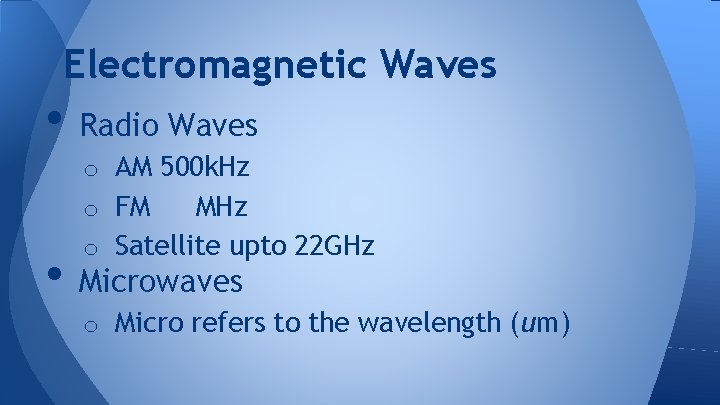
Electromagnetic Waves • Radio Waves o AM 500 k. Hz o FM MHz o Satellite upto 22 GHz • Microwaves o Micro refers to the wavelength (um)
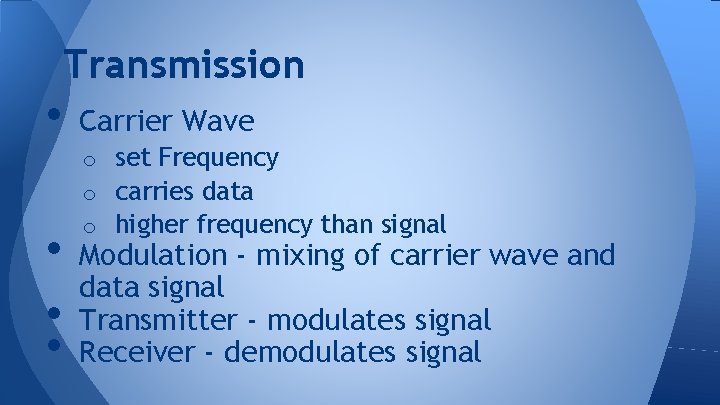
• • Transmission Carrier Wave o set Frequency o carries data o higher frequency than signal Modulation - mixing of carrier wave and data signal Transmitter - modulates signal Receiver - demodulates signal
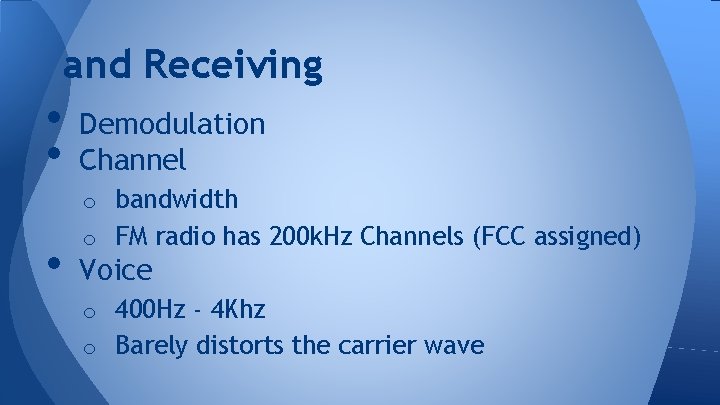
and Receiving • • Demodulation Channel o bandwidth • o FM radio has 200 k. Hz Channels (FCC assigned) Voice o 400 Hz - 4 Khz o Barely distorts the carrier wave
• • • Infrared TV remote Digital on-off light signal Line of sight (but bounces) o requires aim o short distances (unless lasers used) Dispersion controlled with lenses 1 -2 Mbps Higher rates possible with lasers
• • • Radio Interference FCC o responsible for preventing/controlling interference by devices o Divides EM spectrum for control AM radio highly susceptible to RI ISM band o 902 -928 Mhz, 2. 4 -2. 48 GHz, & 5. 725 -5. 85 GHz o industrial scientific and medical devices
Antenna • Omni • Dipole • Yagi • Flat Panel • Parabolic
Radio Waves • Frequency o 10 k. Hz o 3, 000 MHz (3 THz) • Longer wavelength infrared/microwave • Networking o 802. 11 and Bluetooth o specifies 2. 4 GHz
RW Transmission Techniques • Single Frequency • Spread Spectrum • Orthogonal Frequency-Division Multiplexing
Spread Spectrum • Multiple channels spread across the bandwidth spectrum • frequency hopping - simultaneous • direct sequencing - sequential
FHSS • data packets skip channels • some channels may have interference • limited data rate • divides 2. 4 GHz band (bandwidth 83. 5 Mhz) into 79 1 Mhz Channels
DSSS 11 83 Mhz channels 3 subchannels of 22 MHz at 11 Mbps can achieve 33 Mbps in parallel
OFDM 5 GHz band at 54 Mbps Classified U-NII 1/2/3 100 Mhz each 4 20 Mhz channels for each class 52 300 k 0 Hz subchannels (48 data, 4 ec) • a method of encoding digital data on multiple carrier frequencies • used in applications such as digital television and audio broadcasting • OFDM may be viewed as using many slowly modulated narrowband signals rather than one rapidly modulated wideband signal.
Wireless Access Points (WAP) • • • Connects wireless to cable network Two omni antennae Service Set ID (SSID) o shared by Multiple Access Points (ESSID) Encryption slows the network o provides some security Independent Basic Service Set - no AP o adhoc networking between wireless devices
802. 11 a • 5 GHz o short range o penetration issues • 54, 48, 36, 24, 18, 12, 9, or 6 Mbps
802. 11 b • adopted before 802. 11 a • 11, 5. 5, 2, or 1 Mbps • 11 channels to select from • 2. 4 GHz doesn’t interfere with 802. 11 a
802. 11 g • 2. 4 GHz (not compatible with 802. 11 a) • compatible with 802. 11 b • 54 Mbps o 48, 36, 28, 24, or 12 Mbps o 11, 9, 6, 5. 5, 2, or 1 Mbps • Shorter range than 802. 11 b
802. 11 n • 5 Ghz • but compatible with 2. 4 Ghz • compatible with 802. 11 a, b & g • MIMO technology is spatial multiplexing o multiple data streams o will eventually allow 600 Mbps or higher
• 802. 11 Access Method CSMA/CA o Carrier Sense Multiple Access with Collision Avoidance o Listen, if quiet generate RTS § RTS signal -- ready to send o CTS wait for it -- clear to send o NOT CSMA/CD § § Carrier Sense Multiple Access with Collision Detection Wireless device cannot see all devices in range of WAP
Collision Detection vs Avoidance • • Always possible on Cable segment 2 Wireless devices can be in range of AP and not in range of each other o Cannot detect collisions • o Collision occurs at WAP Other methods of Collision Avoidance exist o token (ring), time slice, channels
IEEE Wireless Working Groups • 802. 15 WPAN / PAN o Wireless Personal Network • 802. 16 BWA o Broadband Wireless Access o Currently a hodgepodge of proprietary standards
802. 15 PAN / WPAN 802. 15. 1 Bluetooth 802. 15. 2 Sharing 2. 4 GHz with 802. 11 802. 15. 3 High Speed PAN (10 m) 802. 15. 4 Low Speed PAN Zig. Bee fits under 802. 15. 4
USB wireless and Bluetooth USB Wireless 3 m at 480 Mbps 10 m at 100 Mbps Bluetooth - wattage determines range 2. 4 GHz but non interfering with 802. 11 b. 79 channel FHSS short range piconet/WPAN 1, 3, 24 Mbps based on standard version 1. 0, 2. 0, 3. 0 • • •
Cellular Technology Cells use radio waves to communicate with devices in the cell and microwave to communicate to other cells.
Microwave Transmissions • Wavelength 1 mm to 30 cm • Frequencies 1 GHz to 300 GHz o includes 802. 11 • Data rates are tied to frequency o higher is better
Satellites • • • High Orbit slower than Geosyncronous Geo. Synchronous Orbit o 22, 300 Miles (35, 880 km) up o o 68, 000 mph 24 hr orbit appears stationary Easy to track propagation delay (latency) 250 ms (data) or ½ sec (telephone) § controlling jitter via buffering Low Orbit faster than Geosynchronous o Motorola’s Iridium § 66 sats, low propagation delay, $$$$ § abandoned
Wireless Security • There is none o signal escapes through glass o cable can be physically secured o War Driving in google street view cars • There are some measures o 802. 1 x Authentication o 802. 1 x Encryption
Authentication EAP Extensible Authentication Protocol PEAP Protected EAP Computers/Devices are authenticated not users. Password alone not enough to get on the network.
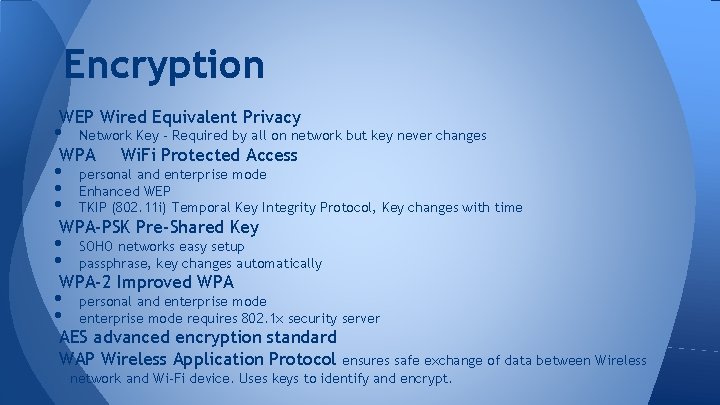
Encryption WEP Wired Equivalent Privacy • Network Key - Required by all on network but key never changes • • • personal and enterprise mode Enhanced WEP TKIP (802. 11 i) Temporal Key Integrity Protocol, Key changes with time • • SOHO networks easy setup passphrase, key changes automatically • • personal and enterprise mode requires 802. 1 x security server WPA Wi. Fi Protected Access WPA-PSK Pre-Shared Key WPA-2 Improved WPA AES advanced encryption standard WAP Wireless Application Protocol ensures safe exchange of data between Wireless network and Wi-Fi device. Uses keys to identify and encrypt.