
Wireless Systems Lecture Network coding techniques Elena Fasolo
![Linear network coding q When we refer to linear network coding [2], we intend](https://slidetodoc.com/presentation_image_h/76350c7ba62b93d0b45d15305ee8f3d9/image-7.jpg "Linear network coding q When we refer to linear network coding [2], we intend")
![Practical Random NC q Main idea [4]: Ø Ø Select the linear coefficients in](https://slidetodoc.com/presentation_image_h/76350c7ba62b93d0b45d15305ee8f3d9/image-13.jpg "Practical Random NC q Main idea [4]: Ø Ø Select the linear coefficients in")
![Energy efficient broadcasting with NC [5] RING NETWORK q q All nodes are senders;](https://slidetodoc.com/presentation_image_h/76350c7ba62b93d0b45d15305ee8f3d9/image-21.jpg "Energy efficient broadcasting with NC [5] RING NETWORK q q All nodes are senders;")
![Broadcasting in random networks [6] q q At each node v in the graph](https://slidetodoc.com/presentation_image_h/76350c7ba62b93d0b45d15305ee8f3d9/image-23.jpg "Broadcasting in random networks [6] q q At each node v in the graph")
- Slides: 27
Wireless Systems - Lecture Network coding techniques Elena Fasolo Ph. D Student - SIGNET Group fasoloel@dei. unipd. it March, 7 th 2004
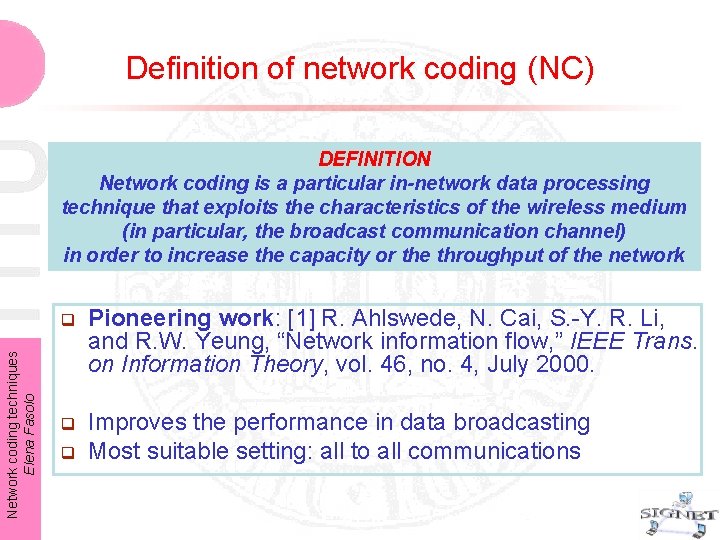
Definition of network coding (NC) Network coding techniques Elena Fasolo DEFINITION Network coding is a particular in-network data processing technique that exploits the characteristics of the wireless medium (in particular, the broadcast communication channel) in order to increase the capacity or the throughput of the network q Pioneering work: [1] R. Ahlswede, N. Cai, S. -Y. R. Li, and R. W. Yeung, “Network information flow, ” IEEE Trans. on Information Theory, vol. 46, no. 4, July 2000. q Improves the performance in data broadcasting Most suitable setting: all to all communications q
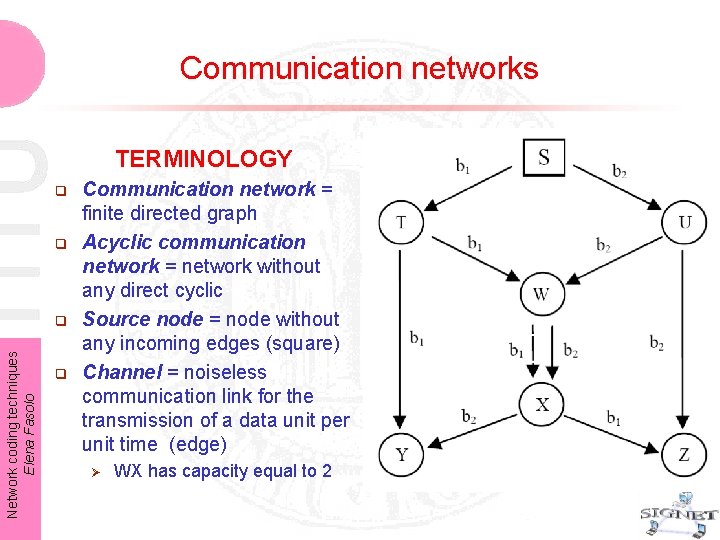
Communication networks TERMINOLOGY q q Network coding techniques Elena Fasolo q q Communication network = finite directed graph Acyclic communication network = network without any direct cyclic Source node = node without any incoming edges (square) Channel = noiseless communication link for the transmission of a data unit per unit time (edge) Ø WX has capacity equal to 2
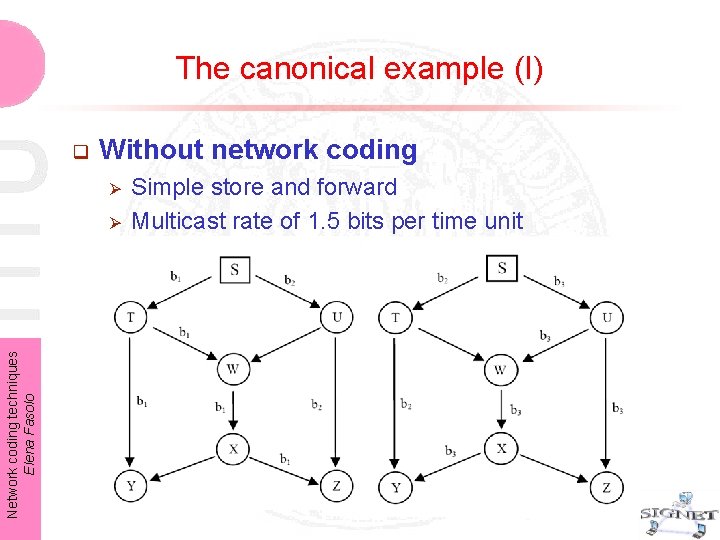
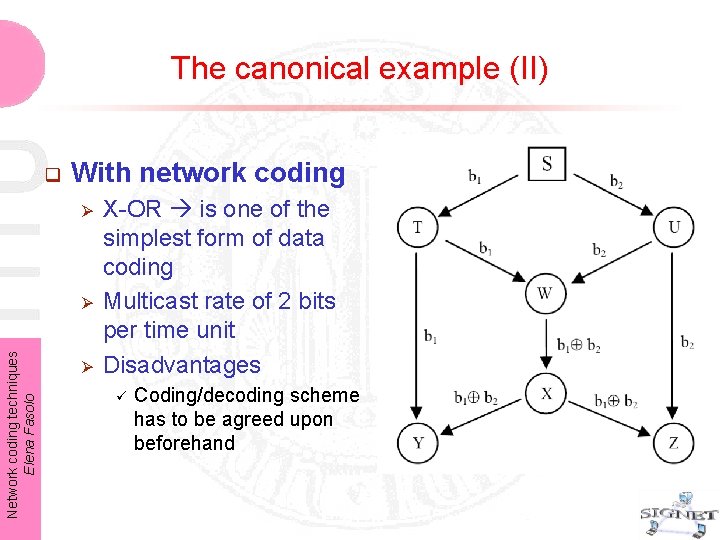
The canonical example (I) q Without network coding Ø Network coding techniques Elena Fasolo Ø Simple store and forward Multicast rate of 1. 5 bits per time unit
The canonical example (II) q With network coding Ø Network coding techniques Elena Fasolo Ø Ø X-OR is one of the simplest form of data coding Multicast rate of 2 bits per time unit Disadvantages ü Coding/decoding scheme has to be agreed upon beforehand
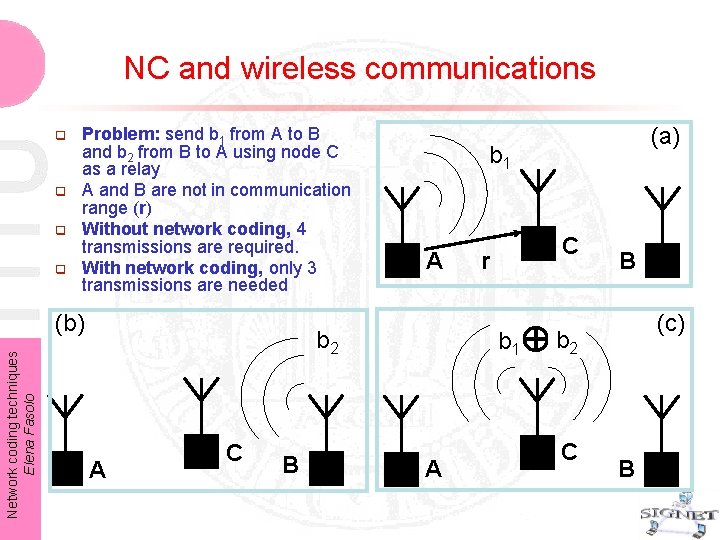
NC and wireless communications q q Problem: send b 1 from A to B and b 2 from B to A using node C as a relay A and B are not in communication range (r) Without network coding, 4 transmissions are required. With network coding, only 3 transmissions are needed Network coding techniques Elena Fasolo (b) b 1 A b 2 A C B (a) C r b 1 A B (c) b 2 C B
Linear network coding q When we refer to linear network coding [2], we intend that: The output flow at a given node is obtained as a linear combination of its input flows. The coefficients of the combination are, by definition, selected from a finite field Ø Network coding techniques Elena Fasolo q Coding can be implemented at low computational cost Moreover, the information traversing a non source node has the following property: The content of any information flowing out of a set of non source nodes can be derived from the accumulated information that has flown into the set of nodes [2] S. -Y. R. Li, R. W. Yeung, and N. Cai, “Linear network Coding”, IEEE Trans. on Information Theory, vol. 49, no. 2, Feb. 2003.
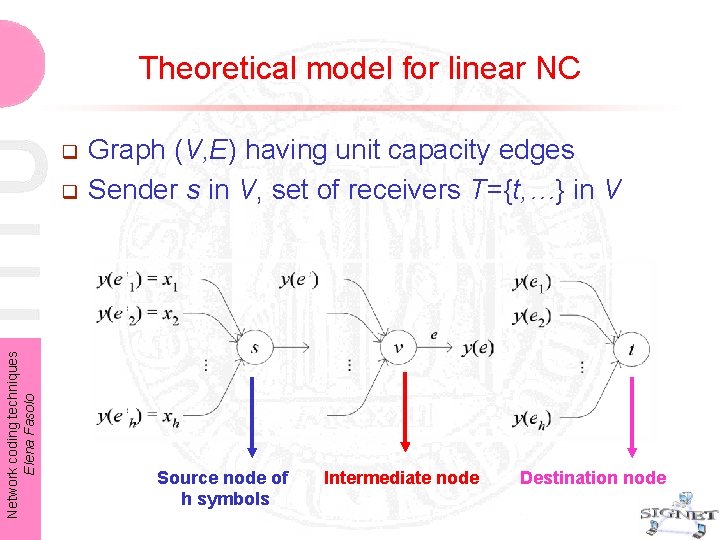
Theoretical model for linear NC q Network coding techniques Elena Fasolo q Graph (V, E) having unit capacity edges Sender s in V, set of receivers T={t, …} in V Source node of h symbols Intermediate node Destination node
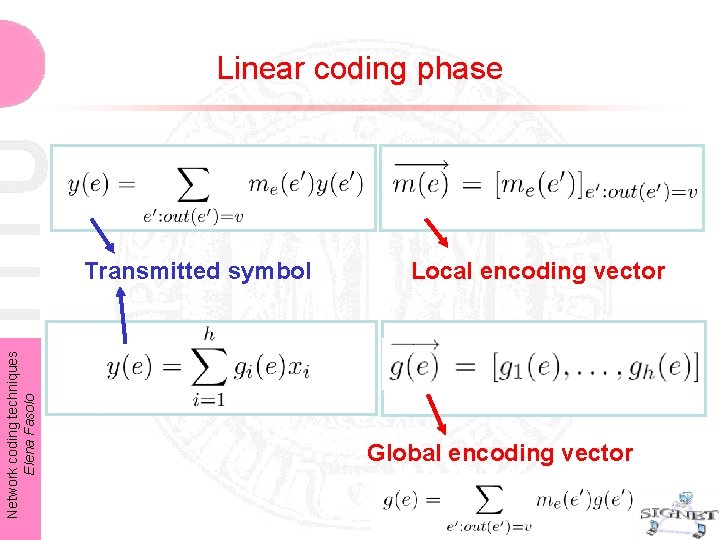
Linear coding phase Network coding techniques Elena Fasolo Transmitted symbol Local encoding vector Global encoding vector
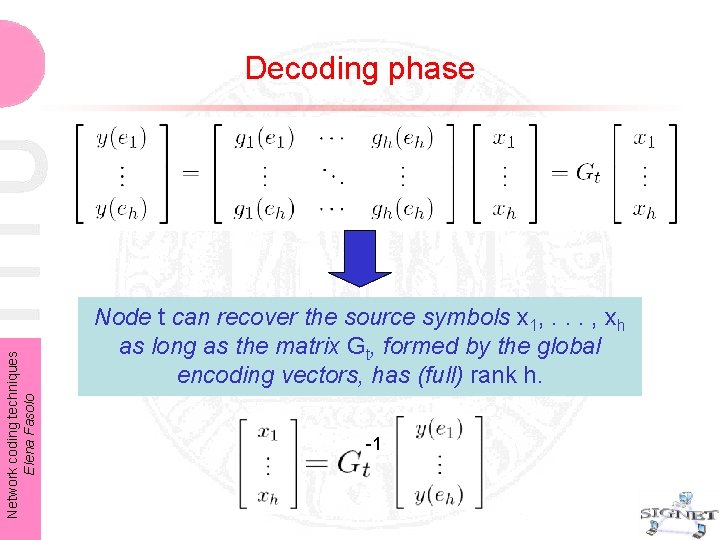
Network coding techniques Elena Fasolo Decoding phase Node t can recover the source symbols x 1, . . . , xh as long as the matrix Gt, formed by the global encoding vectors, has (full) rank h. -1
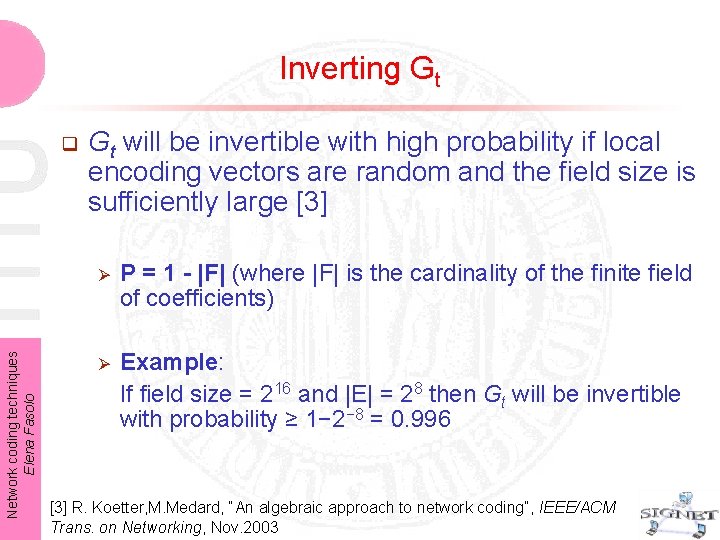
Inverting Gt Network coding techniques Elena Fasolo q Gt will be invertible with high probability if local encoding vectors are random and the field size is sufficiently large [3] Ø P = 1 - |F| (where |F| is the cardinality of the finite field of coefficients) Ø Example: If field size = 216 and |E| = 28 then Gt will be invertible with probability ≥ 1− 2− 8 = 0. 996 [3] R. Koetter, M. Medard, “An algebraic approach to network coding”, IEEE/ACM Trans. on Networking, Nov. 2003
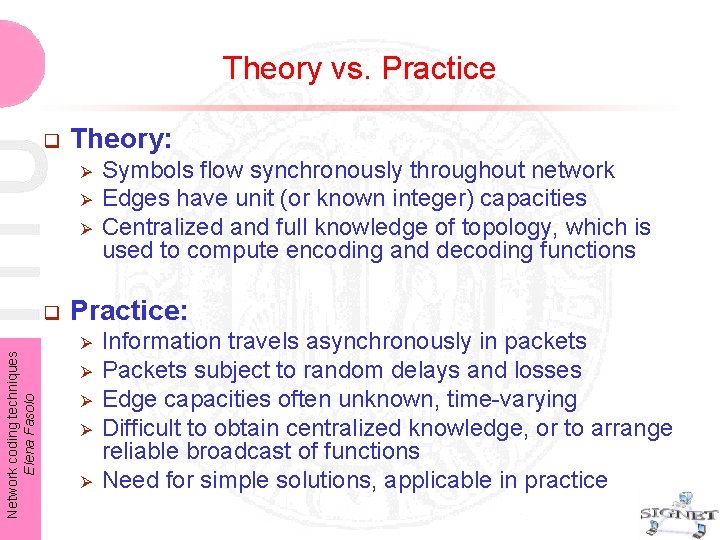
Theory vs. Practice q Theory: Ø Ø Ø Network coding techniques Elena Fasolo q Symbols flow synchronously throughout network Edges have unit (or known integer) capacities Centralized and full knowledge of topology, which is used to compute encoding and decoding functions Practice: Ø Ø Ø Information travels asynchronously in packets Packets subject to random delays and losses Edge capacities often unknown, time-varying Difficult to obtain centralized knowledge, or to arrange reliable broadcast of functions Need for simple solutions, applicable in practice
Practical Random NC q Main idea [4]: Ø Ø Select the linear coefficients in a finite field of opportune size in a random way Send the encoding vector within the same packet Network coding techniques Elena Fasolo ü Ø Packetization: Header removes need for centralized knowledge of graph topology and encoding/decoding functions Nodes stores within their buffers the received packets ü Buffering: Allows asynchronous packets arrivals & departures with arbitrarily varying rates, delay, loss [4] P. A. Chou, T. Wu, and K. Jain, “Practical network coding”, in 51 st Allerton Conf. Communication, Control and Computing, Oct. 2003.
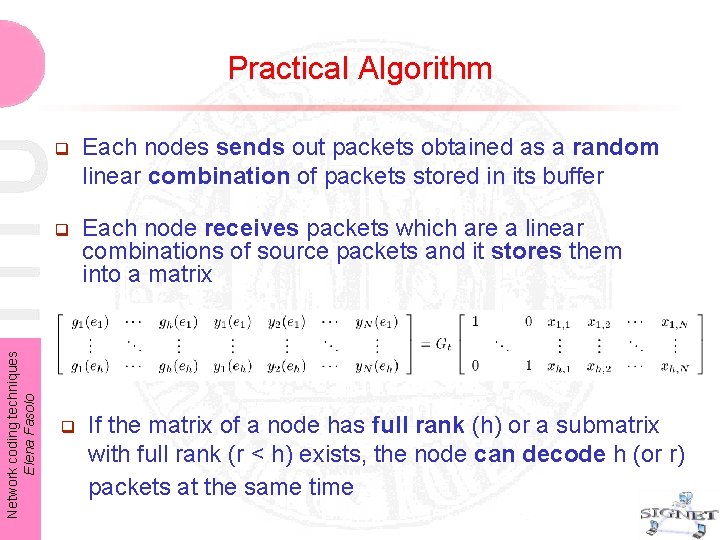
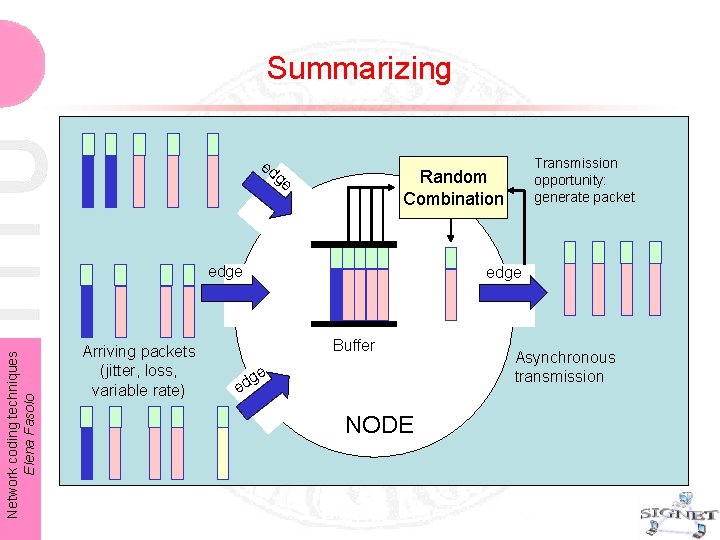
Network coding techniques Elena Fasolo Practical Algorithm q Each nodes sends out packets obtained as a random linear combination of packets stored in its buffer q Each node receives packets which are a linear combinations of source packets and it stores them into a matrix q If the matrix of a node has full rank (h) or a submatrix with full rank (r < h) exists, the node can decode h (or r) packets at the same time
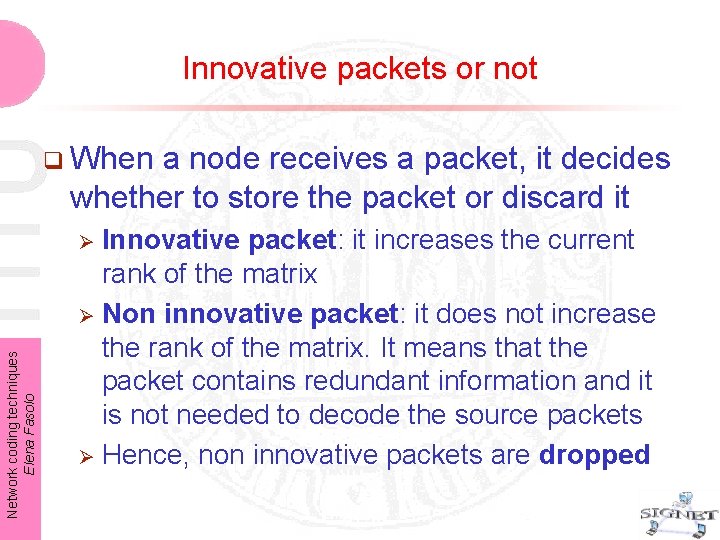
Innovative packets or not q When a node receives a packet, it decides whether to store the packet or discard it Innovative packet: it increases the current rank of the matrix Ø Non innovative packet: it does not increase the rank of the matrix. It means that the packet contains redundant information and it is not needed to decode the source packets Ø Hence, non innovative packets are dropped Network coding techniques Elena Fasolo Ø
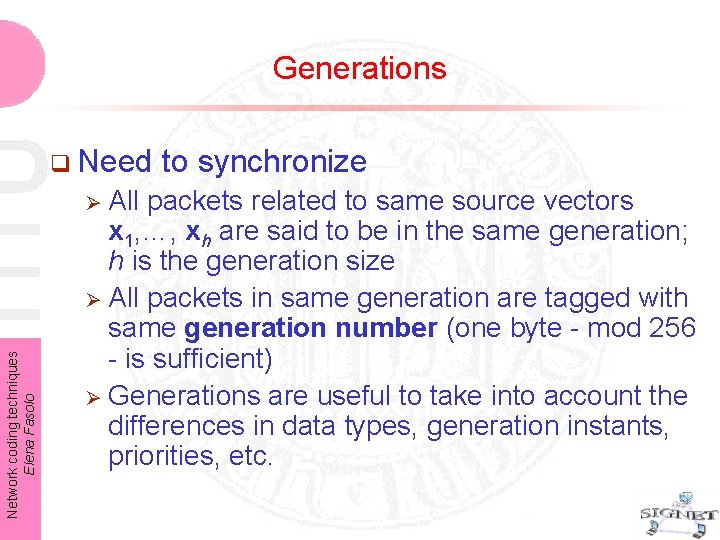
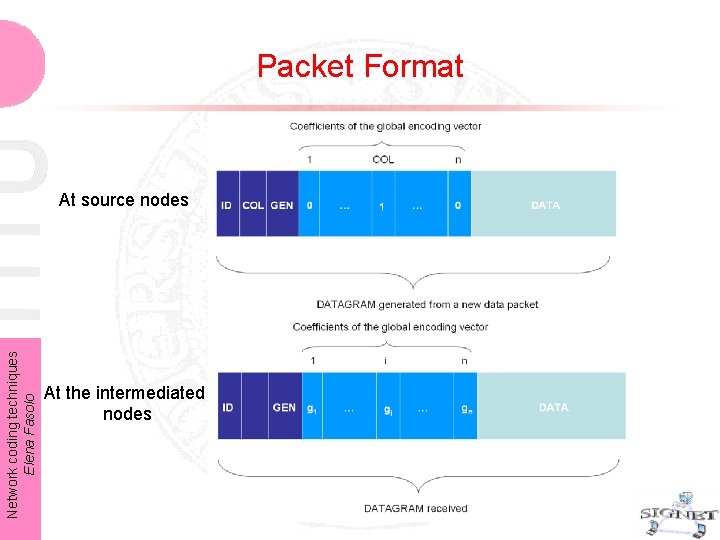
Generations q Need All packets related to same source vectors x 1, …, xh are said to be in the same generation; h is the generation size Ø All packets in same generation are tagged with same generation number (one byte - mod 256 - is sufficient) Ø Generations are useful to take into account the differences in data types, generation instants, priorities, etc. Ø Network coding techniques Elena Fasolo to synchronize
Packet Format Network coding techniques Elena Fasolo At source nodes At the intermediated nodes
Summarizing ed ge Network coding techniques Elena Fasolo edge Arriving packets (jitter, loss, variable rate) Transmission opportunity: generate packet Random Combination edge Buffer e g ed NODE Asynchronous transmission
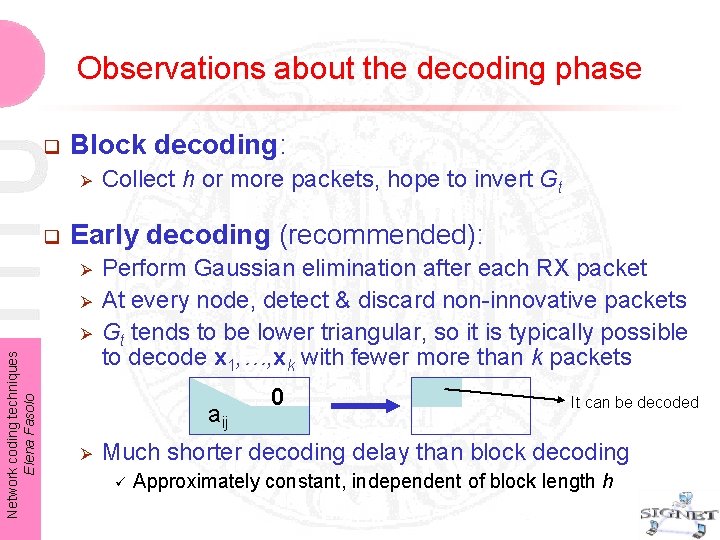
Observations about the decoding phase q Block decoding: Ø q Early decoding (recommended): Ø Ø Ø Network coding techniques Elena Fasolo Collect h or more packets, hope to invert Gt Perform Gaussian elimination after each RX packet At every node, detect & discard non-innovative packets Gt tends to be lower triangular, so it is typically possible to decode x 1, …, xk with fewer more than k packets aij Ø 0 It can be decoded Much shorter decoding delay than block decoding ü Approximately constant, independent of block length h
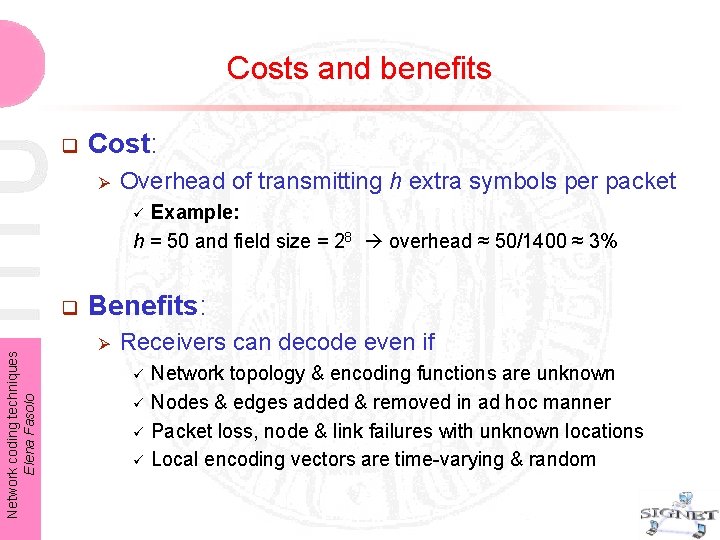
Costs and benefits q Cost: Ø Overhead of transmitting h extra symbols per packet Example: h = 50 and field size = 28 overhead ≈ 50/1400 ≈ 3% ü Network coding techniques Elena Fasolo q Benefits: Ø Receivers can decode even if ü ü Network topology & encoding functions are unknown Nodes & edges added & removed in ad hoc manner Packet loss, node & link failures with unknown locations Local encoding vectors are time-varying & random
Energy efficient broadcasting with NC [5] RING NETWORK q q All nodes are senders; all nodes are receivers Tnc = # transmissions needed to broadcast with network coding Tw = # transmissions without network coding Lemma: Tnc/Tw ≥ ½ Network coding techniques Elena Fasolo Ø Ø q Without NC = 6 transmissions (Tw ≥ n - 2 ) With NC = Tnc ≥ (n – 1)/ 2 Achievable by physical piggybacking [5] J. Widmer, C. Fragouli, and J. -Y. L. Boudec, “Low–complexity energy–efficient broadcasting in wireless ad–hoc networks usign network coding”, in Proc. IEEE Information Theory Workshop, Oct. 2004.
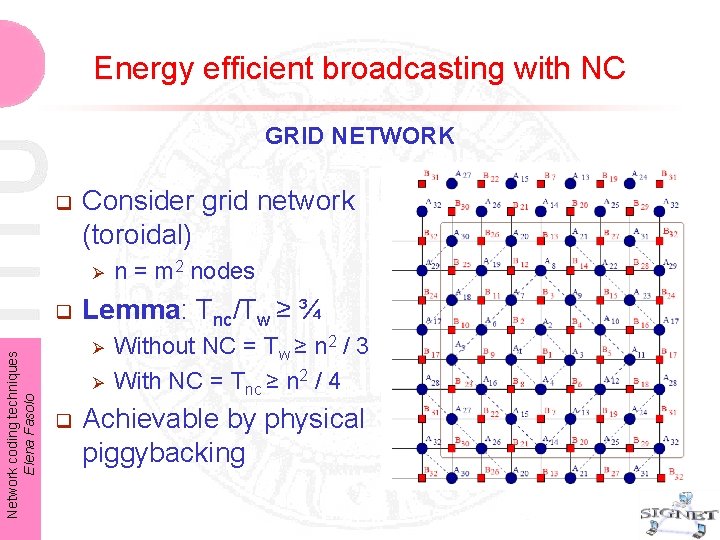
Energy efficient broadcasting with NC GRID NETWORK q Consider grid network (toroidal) Ø Network coding techniques Elena Fasolo q Lemma: Tnc/Tw ≥ ¾ Ø Ø q n = m 2 nodes Without NC = Tw ≥ n 2 / 3 With NC = Tnc ≥ n 2 / 4 Achievable by physical piggybacking
Broadcasting in random networks [6] q q At each node v in the graph is associated a forwarding factor, dv. Source node v transmits source symbols (or packets) Ø Ø Network coding techniques Elena Fasolo q When a node receives an innovative symbol (packet), it broadcasts a linear combination over the span of the received coding vectors Ø Ø q max{ 1, | dv | } times. An additional time with probability p = dv - max{ 1, | dv | } if p > 0. int(dv) times And TX a further copy with probability p = dv – int(dv) if p > 0 Two heuristics: Ø Ø dv = k / |N(v)| dv = k / min |N 2(v)| where N 2(v) are the number of 2 -hops neighbors [6] C. Fragouli, J. Widmer, and J. -Y. L. Boudec, “A network coding approach to energy efficient broadcasting”, Proceedings of INFOCOM 06, April 2006.
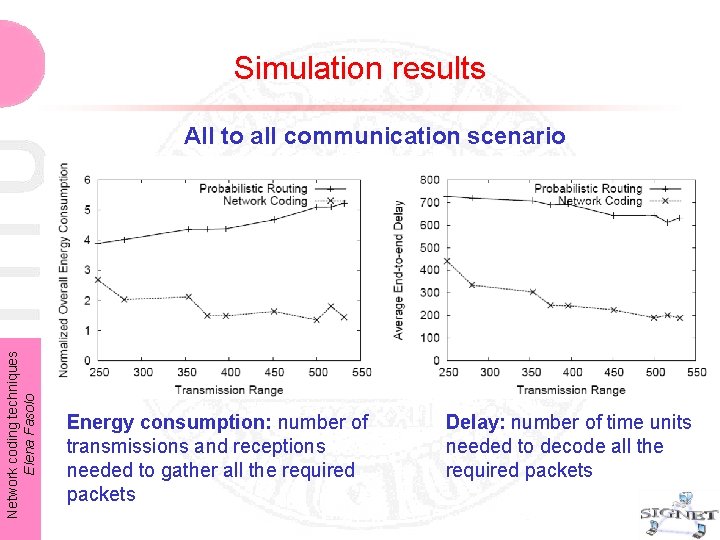
Simulation results Network coding techniques Elena Fasolo All to all communication scenario Energy consumption: number of transmissions and receptions needed to gather all the required packets Delay: number of time units needed to decode all the required packets
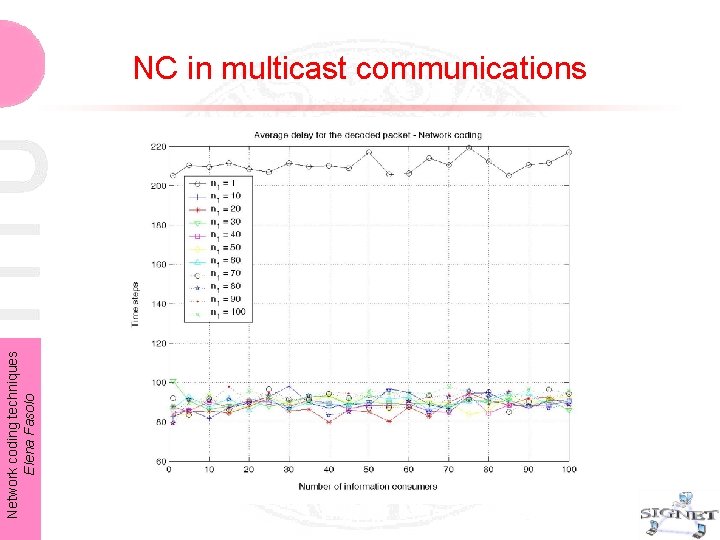
Network coding techniques Elena Fasolo NC in multicast communications
Summary q Network Coding can be used in practice Ø Ø Ø q Network Coding is being applied to Network coding techniques Elena Fasolo Ø q Packetization Buffering Generation Internet, Live broadcast, storage, messaging, peer 2 peer file sharing (“e. MULE of the future”), … Wireless ad hoc, mobile, and sensor networks Ø Many open issues
Network coding techniques Elena Fasolo Wireless Systems - Lecture Thank you!