
Wireless Sensor Networks Wakeup Receivers Amir Bannoura Department
Wireless Sensor Networks Wake-up Receivers Amir Bannoura Department of Computer Networks and Telematics 27. June 2016 Albert-Ludwigs-Universität Freiburg
Sensor Networks § Energy is the main concern for WSN § Potential energy waste sources: - Idle Listening Overhearing Retransmission Overmitting § Reduce power consumption: Duty-cycling
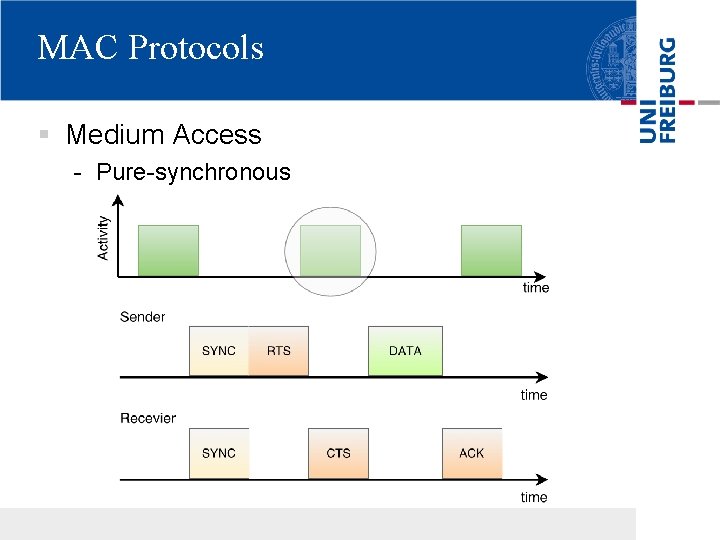
MAC Protocols § Medium Access - Pure-synchronous
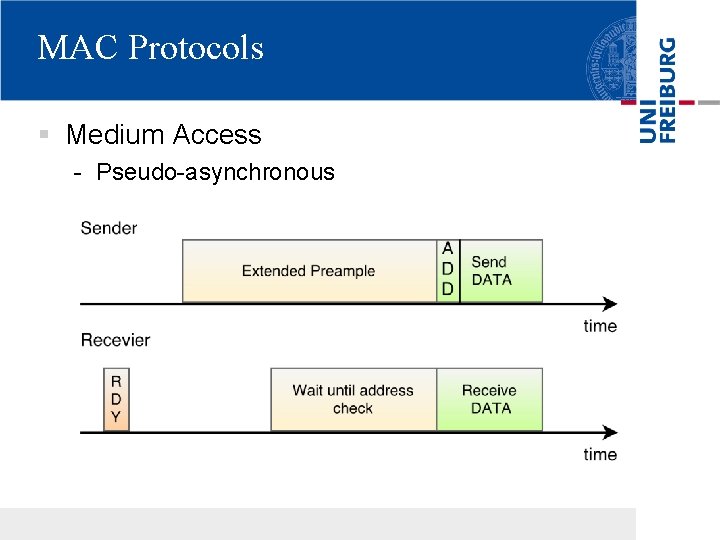
MAC Protocols § Medium Access - Pseudo-asynchronous
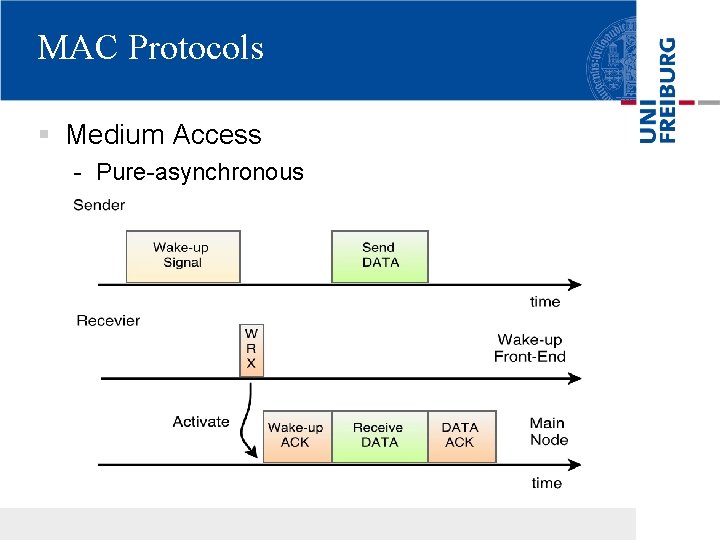
MAC Protocols § Medium Access - Pure-asynchronous
Wake-up on Demand Radio § Communication occurs only when required § Benefits: - Nodes always in a sleep phase - Avoid the energy waste sources - Ultra low power energy consumption § Challenges: - Hardware cost and Complexity Wake-up signals energy Wake-up distance Network topology
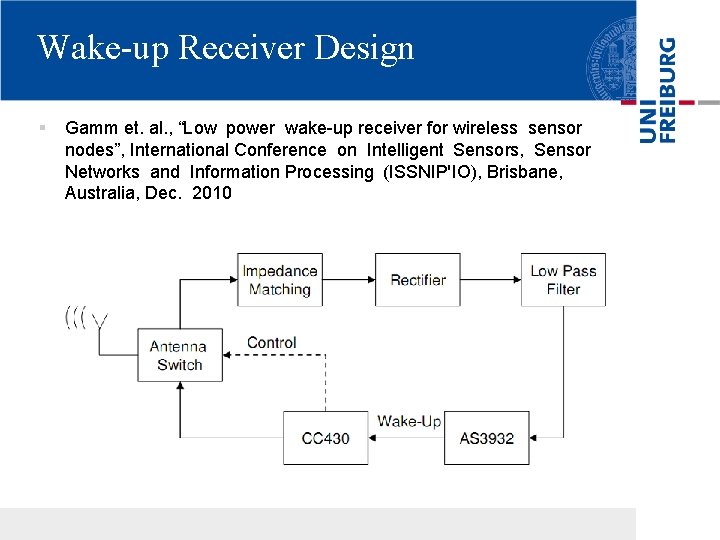
Wake-up Receiver Design § Gamm et. al. , “Low power wake-up receiver for wireless sensor nodes”, International Conference on Intelligent Sensors, Sensor Networks and Information Processing (ISSNIP'IO), Brisbane, Australia, Dec. 2010
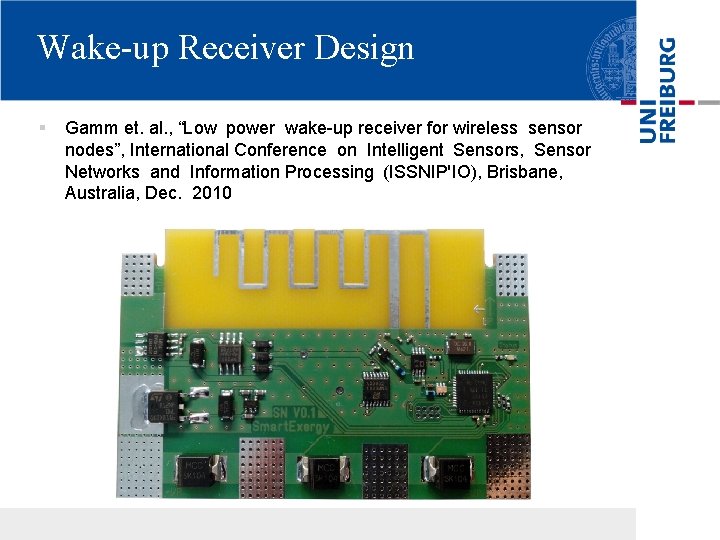
Wake-up Receiver Design § Gamm et. al. , “Low power wake-up receiver for wireless sensor nodes”, International Conference on Intelligent Sensors, Sensor Networks and Information Processing (ISSNIP'IO), Brisbane, Australia, Dec. 2010
Wake-up Receiver Design § Gamm’s Design: - Operating frequency 868 MHz - ASK Modulation • Wake-up chip operates on 125 KHz • Transform 868 MHz to 125 KHz - Power consumption < 8. 2 µW - Receiver sensitivity -53 d. Bm - Wake-up distance up to 100 m

Wake-up Receiver Design § Wake-up Signal Construction: - Switch the transceiver on/off (ASK) - Generate 125 KHz periods - Data rate affects the signal length and distance
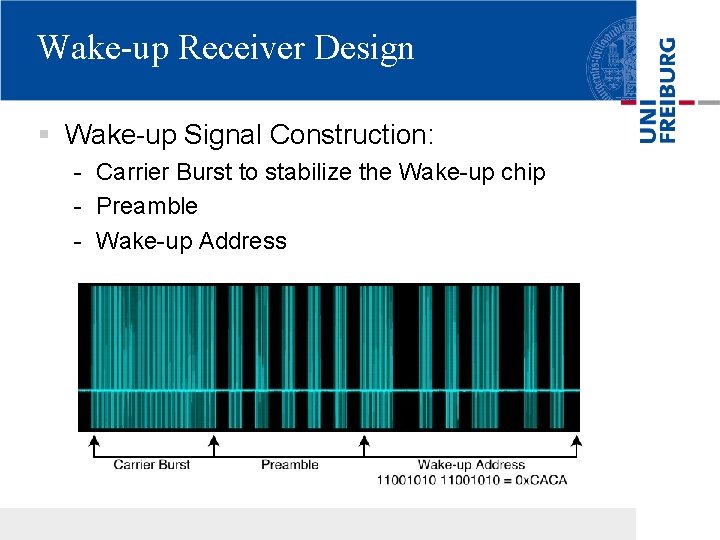
Wake-up Receiver Design § Wake-up Signal Construction: - Carrier Burst to stabilize the Wake-up chip - Preamble - Wake-up Address
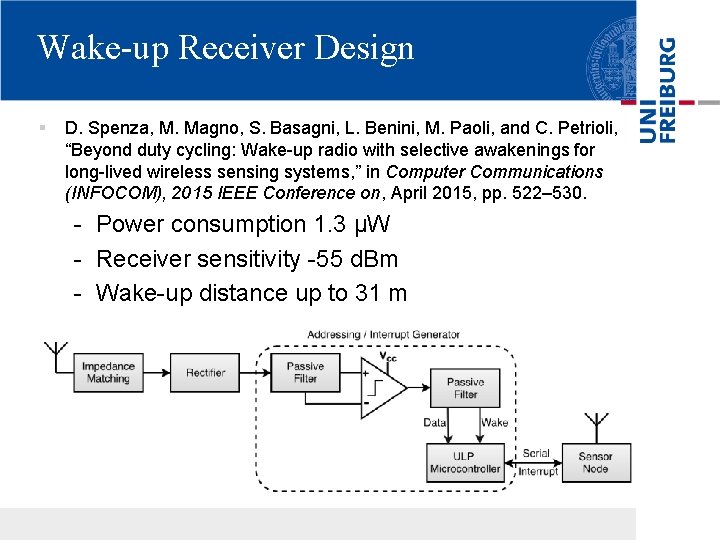
Wake-up Receiver Design § D. Spenza, M. Magno, S. Basagni, L. Benini, M. Paoli, and C. Petrioli, “Beyond duty cycling: Wake-up radio with selective awakenings for long-lived wireless sensing systems, ” in Computer Communications (INFOCOM), 2015 IEEE Conference on, April 2015, pp. 522– 530. - Power consumption 1. 3 µW - Receiver sensitivity -55 d. Bm - Wake-up distance up to 31 m
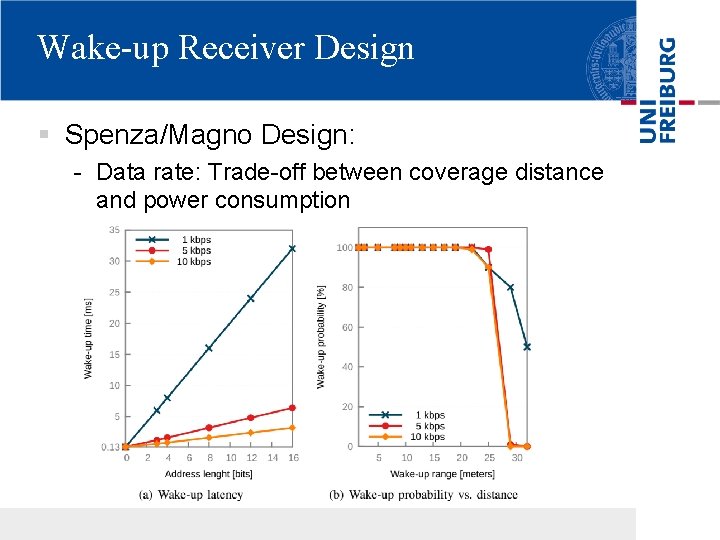
Wake-up Receiver Design § Spenza/Magno Design: - Data rate: Trade-off between coverage distance and power consumption
Wake-up Receiver Algorithms § Motivation to design new protocols: - New protocols to adequate the new hardware - Wake-up receivers Problems • Short wake-up ranges • Higher wake-up signal energy compared to data messages - Minimize the wake-up signal transmission - Maximize the wake-up range - Unknown nodes’ locations
Wake-up Receiver Algorithms § Requirement: - Nodes’ density guarantee coverage and connectivity of Wake-up graphs § How can we reach every single node? - Establish a Minimum Connected Dominating Set - The wake-up problem is an Online-variant of the MCDS
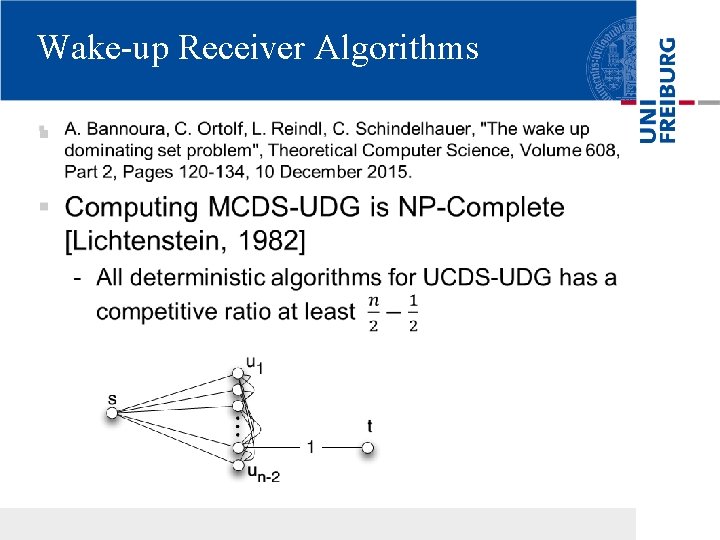
Wake-up Receiver Algorithms §
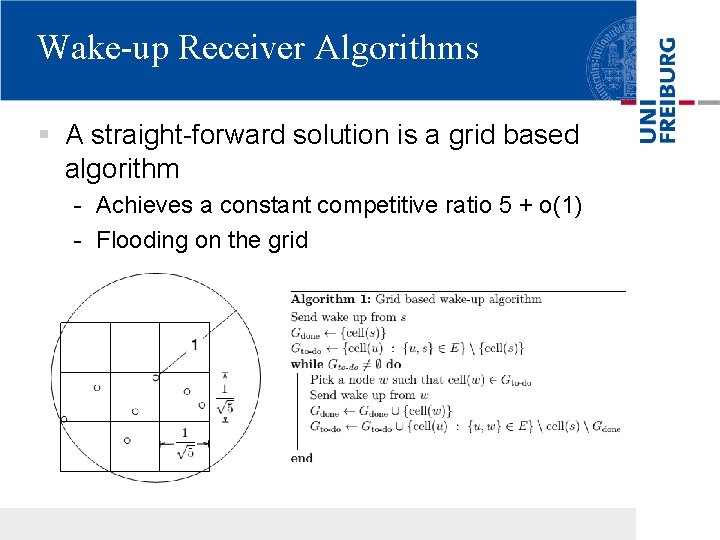
Wake-up Receiver Algorithms § A straight-forward solution is a grid based algorithm - Achieves a constant competitive ratio 5 + o(1) - Flooding on the grid
Wake-up Receiver Algorithms § A position oblivious wake-up algorithm - Flooding - Random Walk - Epidemic approach • Distinguish between covered and uncovered nodes • Use simple counter to stop wake-up transmission - Random k-covered wake-up • Nodes either transmit or be woken k-times • Computes CDS with O(log n) • Does the algorithm always succeed?
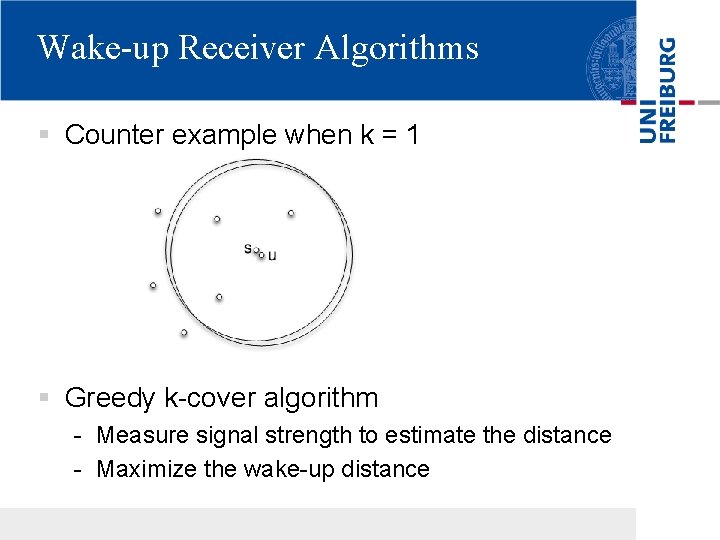
Wake-up Receiver Algorithms § Counter example when k = 1 § Greedy k-cover algorithm - Measure signal strength to estimate the distance - Maximize the wake-up distance
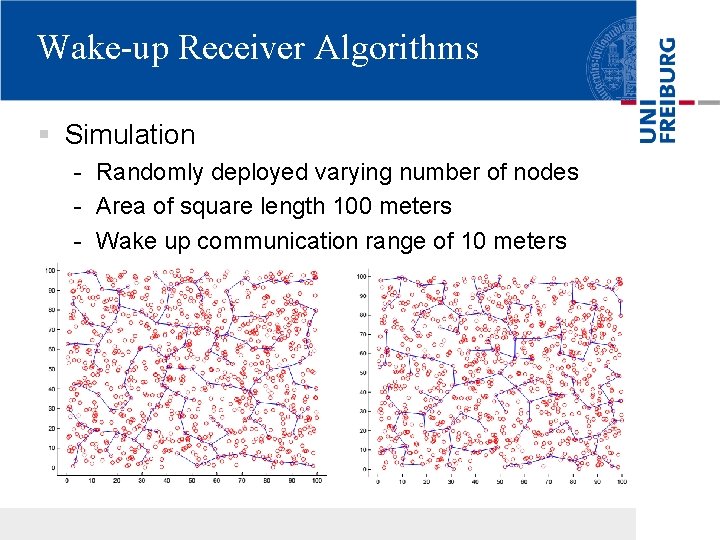
Wake-up Receiver Algorithms § Simulation - Randomly deployed varying number of nodes - Area of square length 100 meters - Wake up communication range of 10 meters
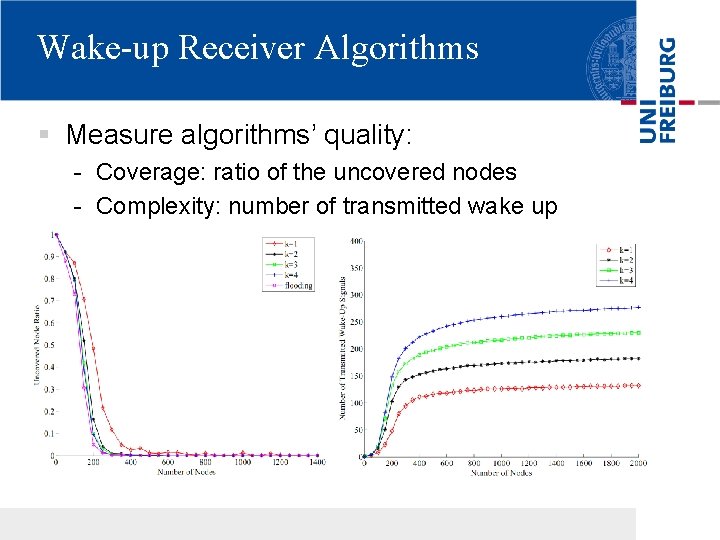
Wake-up Receiver Algorithms § Measure algorithms’ quality: - Coverage: ratio of the uncovered nodes - Complexity: number of transmitted wake up

Wake-up Receiver Algorithms § Greedy 1 -coverage delivers a good combination of message complexity and coverage
Wake-up Receiver Algorithms § Expensive to construct trees from scratch § Hybrid algorithms to combine: - Duty cycle - Wake-up receivers § A. Bannoura, L. Reindl, C. Schindelhauer, "Convergecast Algorithms for Wake-up Transceivers", Sensor. Nets 2016: 5 th International Conference on Sensor Networks, Rome, Italy, February 19 -21, 2016.
- Slides: 23