
Wireless Sensor Networks SMART DUST from vision to






- Slides: 50
Wireless Sensor Networks SMART DUST from vision to products Kris Pister Prof. EECS, UC Berkeley Founder & CTO, Dust Networks
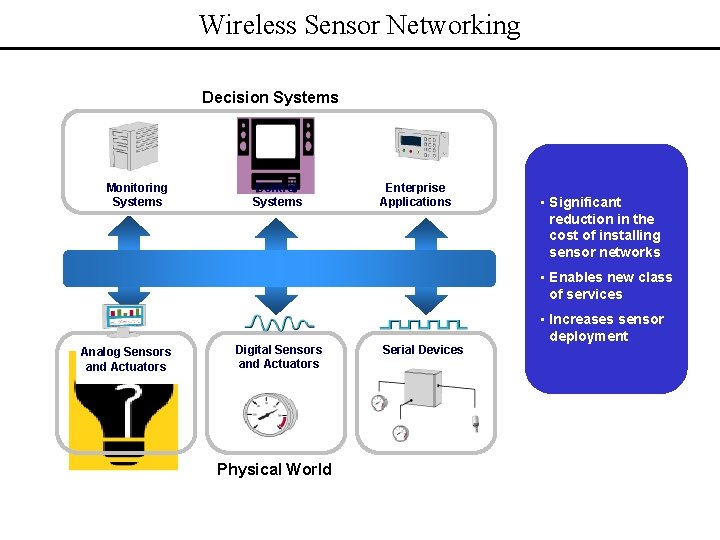
Wireless Sensor Networking Decision Systems Monitoring Systems Control Systems Enterprise Applications • Significant reduction in the cost of installing sensor networks • Enables new class of services Analog Sensors and Actuators Digital Sensors and Actuators Physical World Serial Devices • Increases sensor deployment
Outline • • History Technology Markets & Standards Future
Smart Dust History • 1992 Rand workshop – Future Technology Driven Revolutions in Military Operations – “Military Applications of MEMS”, K. Brendley, R. Steeb • 1994— 1997? DARPA ISATs • 1995 coined “Smart Dust” • 1997 wrote Smart Dust proposal to DARPA/MTO – Goal: sensing and comm. from 1 cubic millimeter • 2002 Founded Dust Inc (now Dust Networks) • Jan 2003 – Dec 2004 on leave as CEO then CTO of Dust Networks
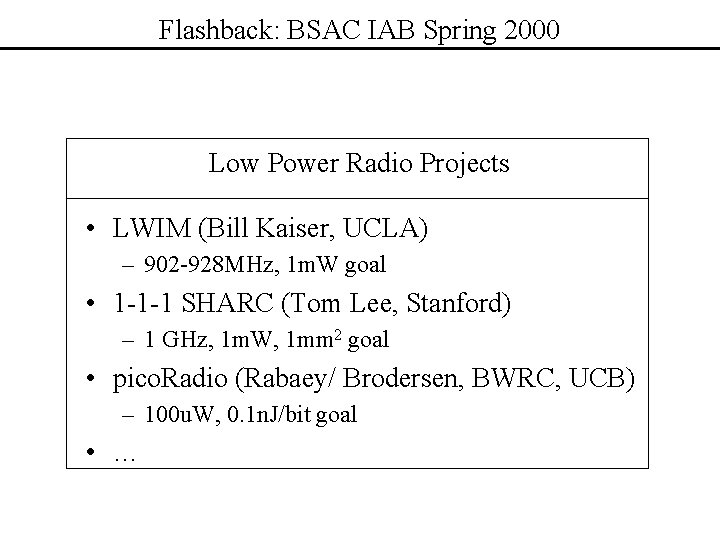
Flashback: BSAC IAB Spring 2000 Low Power Radio Projects • LWIM (Bill Kaiser, UCLA) – 902 -928 MHz, 1 m. W goal • 1 -1 -1 SHARC (Tom Lee, Stanford) – 1 GHz, 1 m. W, 1 mm 2 goal • pico. Radio (Rabaey/ Brodersen, BWRC, UCB) – 100 u. W, 0. 1 n. J/bit goal • …
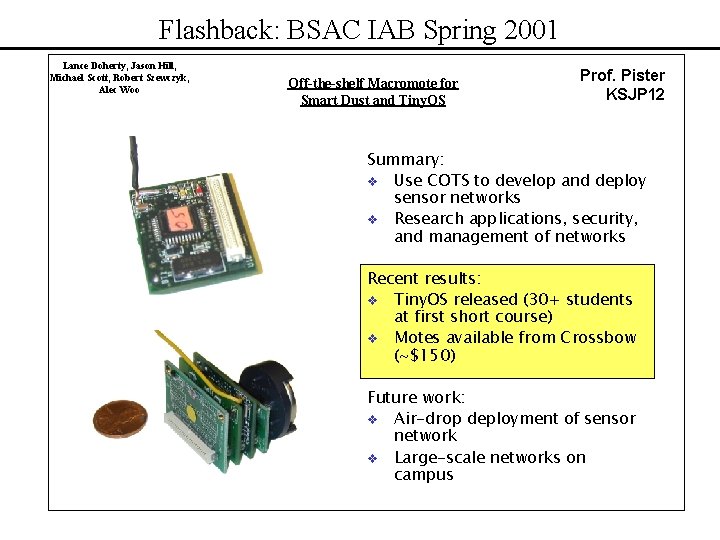
Flashback: BSAC IAB Spring 2001 Lance Doherty, Jason Hill, Michael Scott, Robert Szewczyk, Alec Woo Off-the-shelf Macromote for Smart Dust and Tiny. OS Prof. Pister KSJP 12 Summary: v Use COTS to develop and deploy sensor networks v Research applications, security, and management of networks Needle piercing pig skin Recent results: v Tiny. OS released (30+ students at first short course) v Motes available from Crossbow (~$150) Future work: v Air-drop deployment of sensor network v Large-scale networks on campus
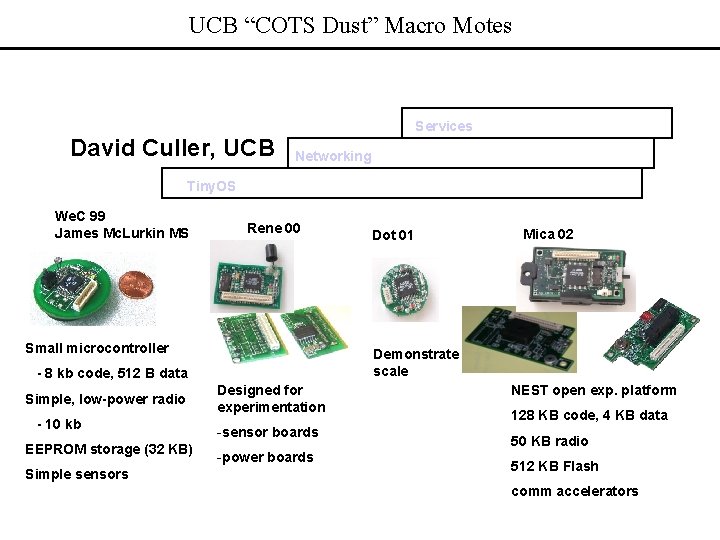
UCB “COTS Dust” Macro Motes Services David Culler, UCB Networking Tiny. OS We. C 99 James Mc. Lurkin MS Rene 00 Small microcontroller - 10 kb EEPROM storage (32 KB) Simple sensors Mica 02 Demonstrate scale - 8 kb code, 512 B data Simple, low-power radio Dot 01 Designed for experimentation -sensor boards -power boards NEST open exp. platform 128 KB code, 4 KB data 50 KB radio 512 KB Flash comm accelerators
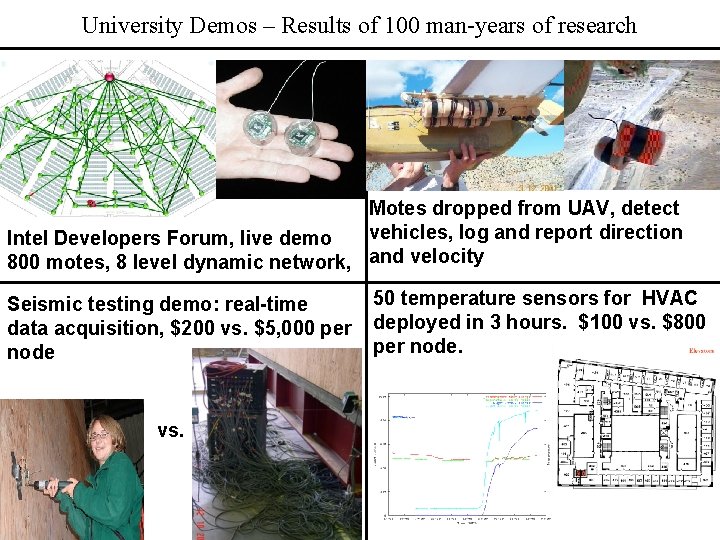
University Demos – Results of 100 man-years of research Motes dropped from UAV, detect vehicles, log and report direction Intel Developers Forum, live demo 800 motes, 8 level dynamic network, and velocity Seismic testing demo: real-time data acquisition, $200 vs. $5, 000 per node vs. 50 temperature sensors for HVAC deployed in 3 hours. $100 vs. $800 per node.
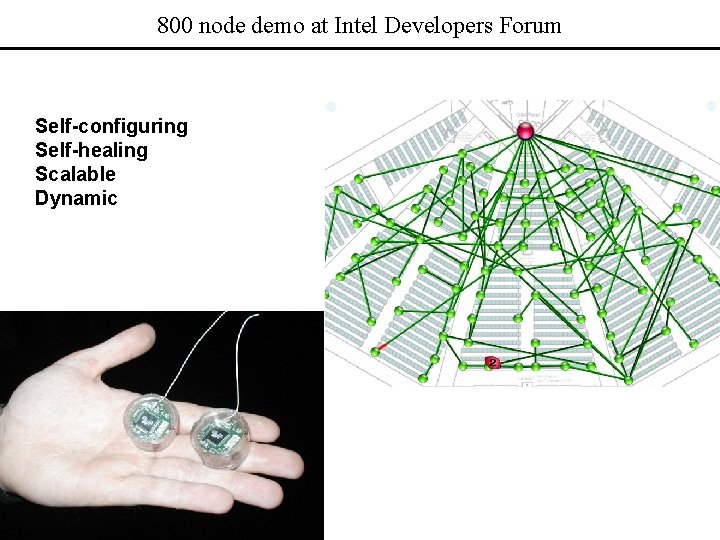
800 node demo at Intel Developers Forum Self-configuring Self-healing Scalable Dynamic
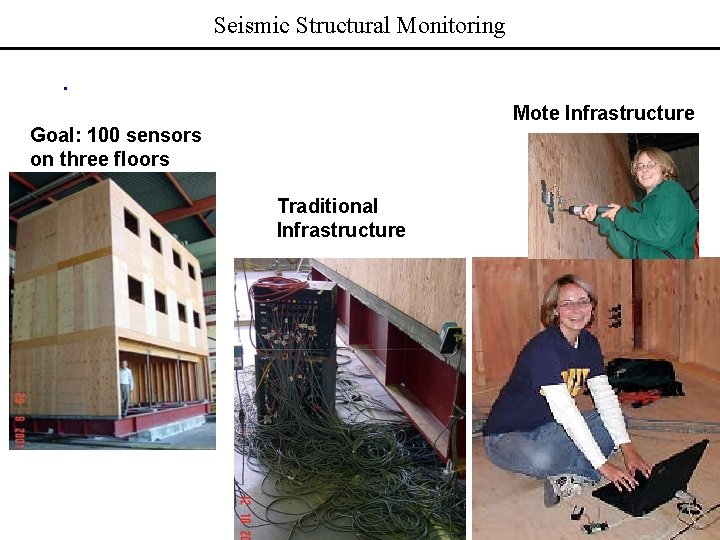
Seismic Structural Monitoring. Mote Infrastructure Goal: 100 sensors on three floors Traditional Infrastructure
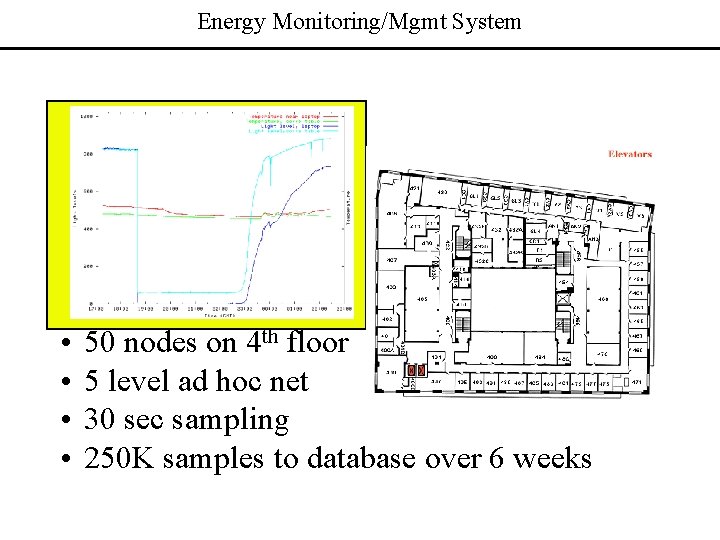
Energy Monitoring/Mgmt System • • 50 nodes on 4 th floor 5 level ad hoc net 30 sec sampling 250 K samples to database over 6 weeks
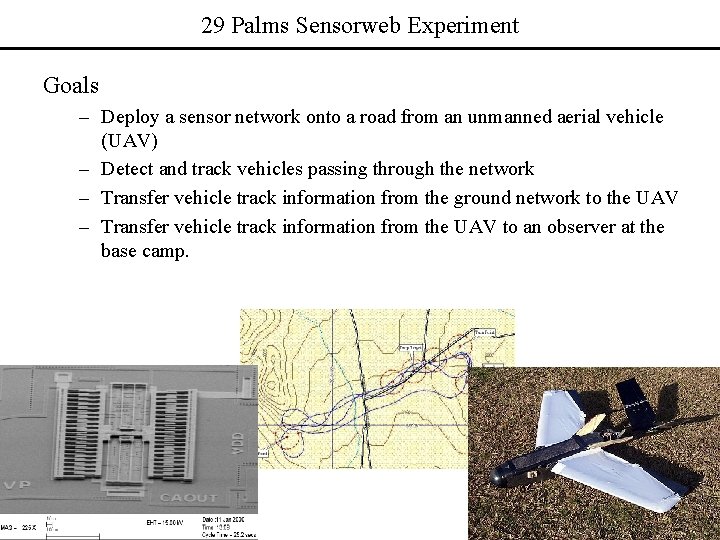
29 Palms Sensorweb Experiment Goals – Deploy a sensor network onto a road from an unmanned aerial vehicle (UAV) – Detect and track vehicles passing through the network – Transfer vehicle track information from the ground network to the UAV – Transfer vehicle track information from the UAV to an observer at the base camp.
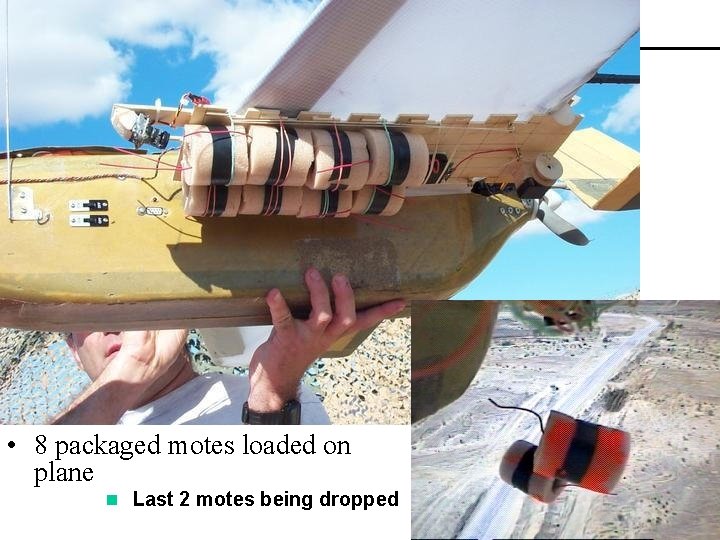
• 8 packaged motes loaded on plane n Last 2 motes being dropped
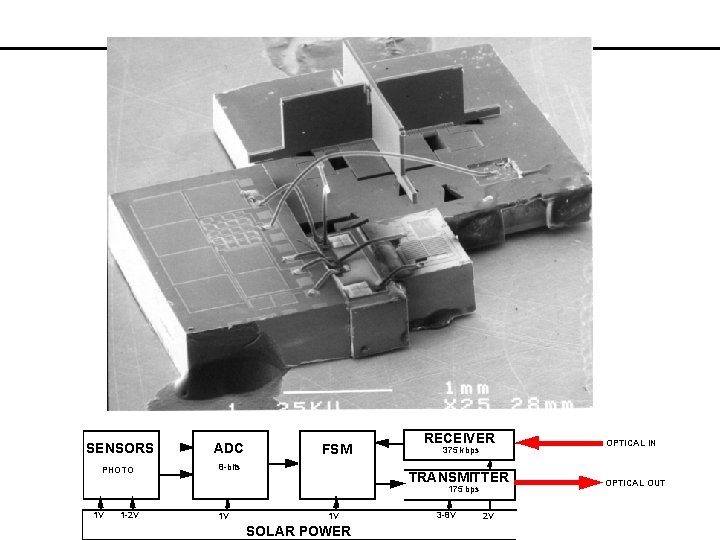
Smart Dust - Integration SENSORS ADC PHOTO 8 -bits 1 V 1 -2 V FSM RECEIVER 375 kbps 16 mm 3 total circumscribed volume TRANSMITTER 175 bps ~4. 8 mm 3 total displaced volume 1 V 1 V SOLAR POWER 3 -8 V 2 V OPTICAL IN OPTICAL OUT
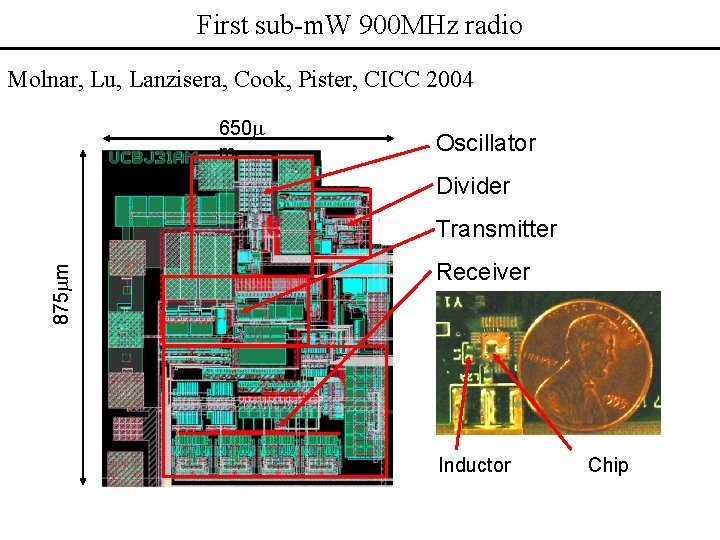
First sub-m. W 900 MHz radio Molnar, Lu, Lanzisera, Cook, Pister, CICC 2004 650 m m Oscillator Divider 875 mm Transmitter Receiver Inductor Chip
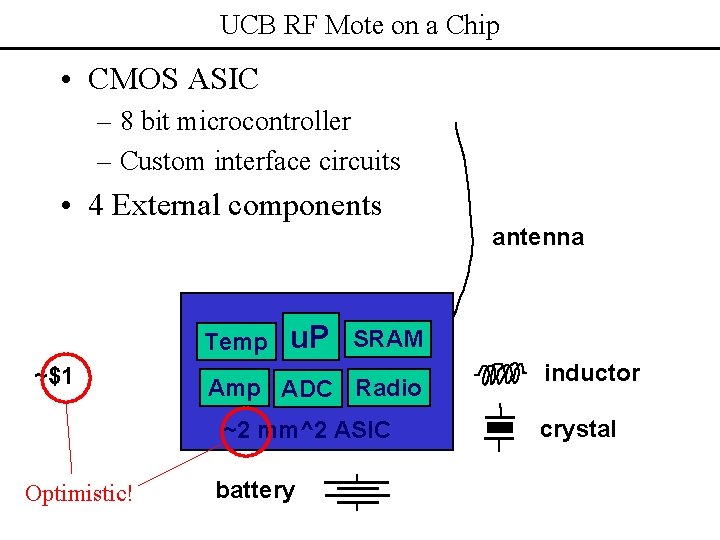
UCB RF Mote on a Chip • CMOS ASIC – 8 bit microcontroller – Custom interface circuits • 4 External components antenna Temp ~$1 u. P SRAM Amp ADC Radio ~2 mm^2 ASIC Optimistic! battery inductor crystal
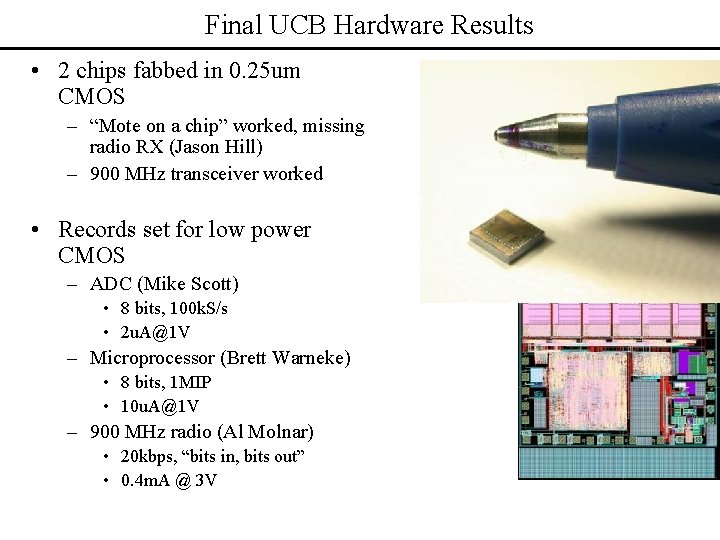
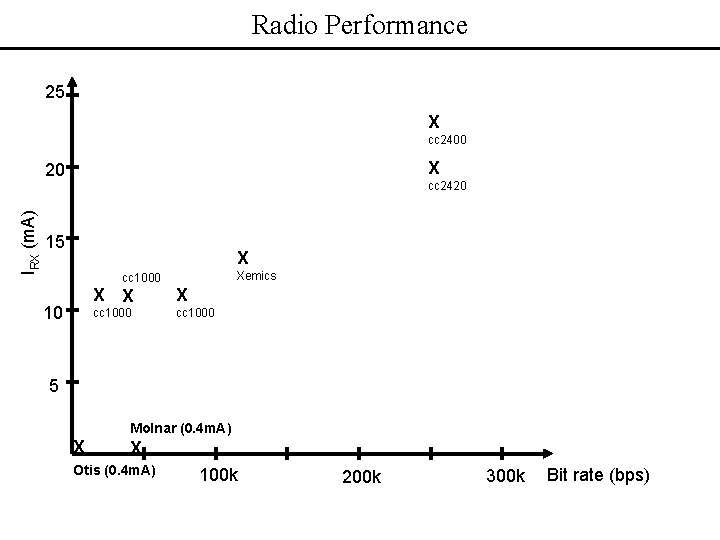
Final UCB Hardware Results • 2 chips fabbed in 0. 25 um CMOS – “Mote on a chip” worked, missing radio RX (Jason Hill) – 900 MHz transceiver worked • Records set for low power CMOS – ADC (Mike Scott) • 8 bits, 100 k. S/s • 2 u. A@1 V – Microprocessor (Brett Warneke) • 8 bits, 1 MIP • 10 u. A@1 V – 900 MHz radio (Al Molnar) • 20 kbps, “bits in, bits out” • 0. 4 m. A @ 3 V
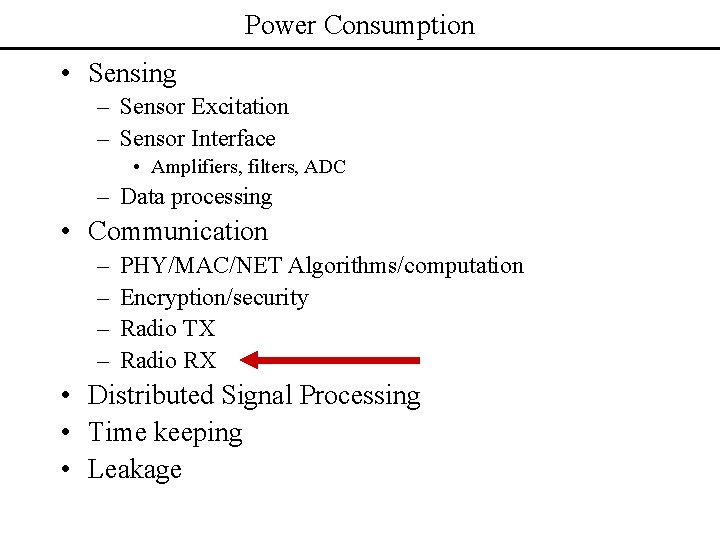
Power Consumption • Sensing – Sensor Excitation – Sensor Interface • Amplifiers, filters, ADC – Data processing • Communication – – PHY/MAC/NET Algorithms/computation Encryption/security Radio TX Radio RX • Distributed Signal Processing • Time keeping • Leakage
Radio Performance 25 X cc 2400 X IRX (m. A) 20 cc 2420 15 X Xemics cc 1000 10 X X X cc 1000 5 Molnar (0. 4 m. A) X X Otis (0. 4 m. A) 100 k 200 k 300 k Bit rate (bps)
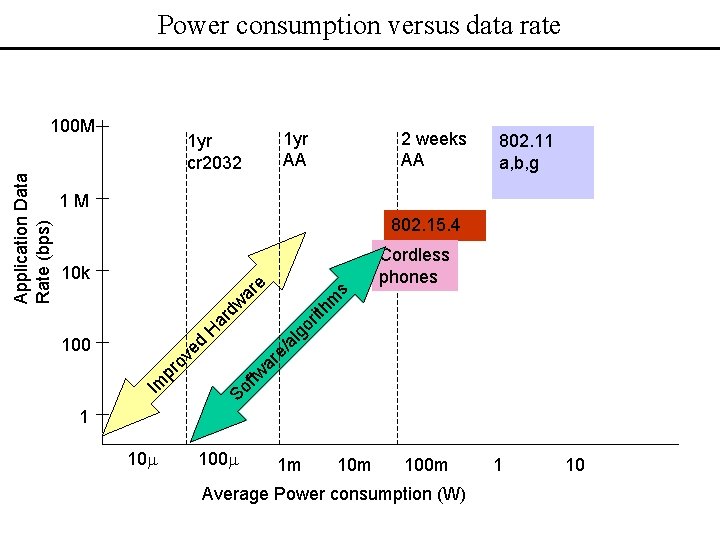
Power consumption versus data rate 1 yr AA 1 yr cr 2032 2 weeks AA 802. 11 a, b, g 1 M 802. 15. 4 Cordless phones s m ith So ftw pr ov e d 100 ar e/ al go r H ar dw ar e 10 k Im Application Data Rate (bps) 100 M 1 10 m 100 m 1 m 100 m Average Power consumption (W) 1 10
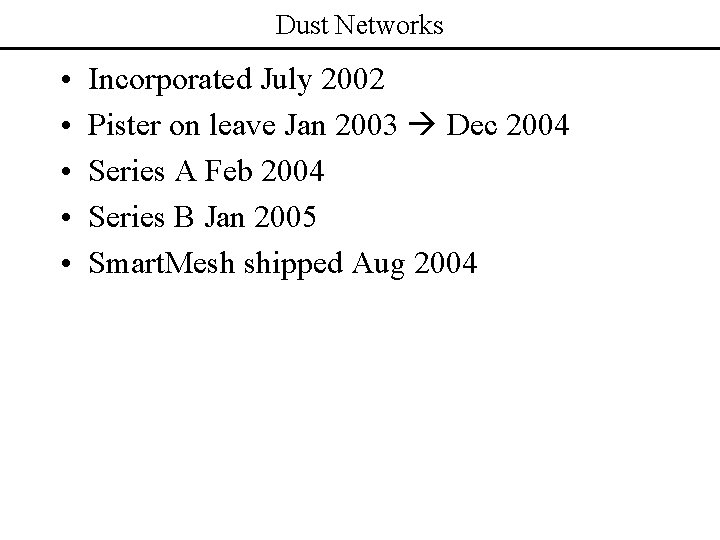
Dust Networks • • • Incorporated July 2002 Pister on leave Jan 2003 Dec 2004 Series A Feb 2004 Series B Jan 2005 Smart. Mesh shipped Aug 2004
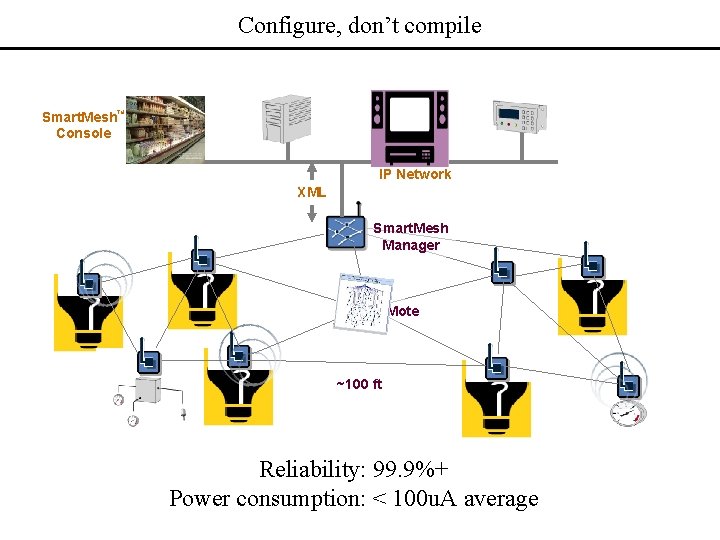
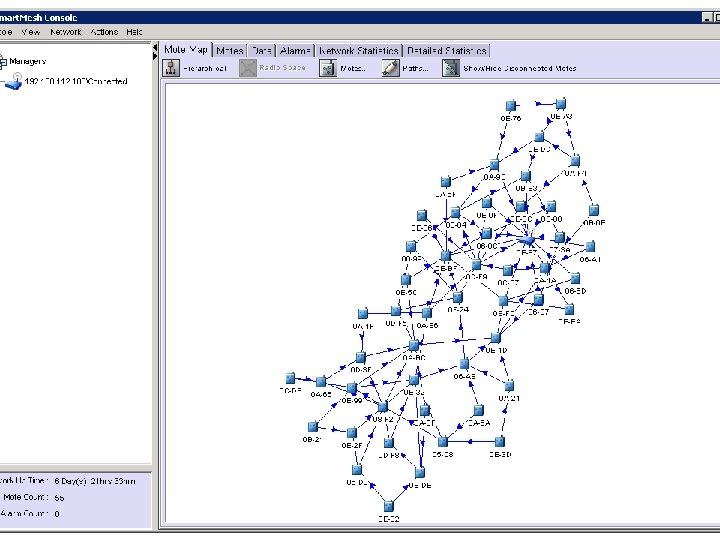
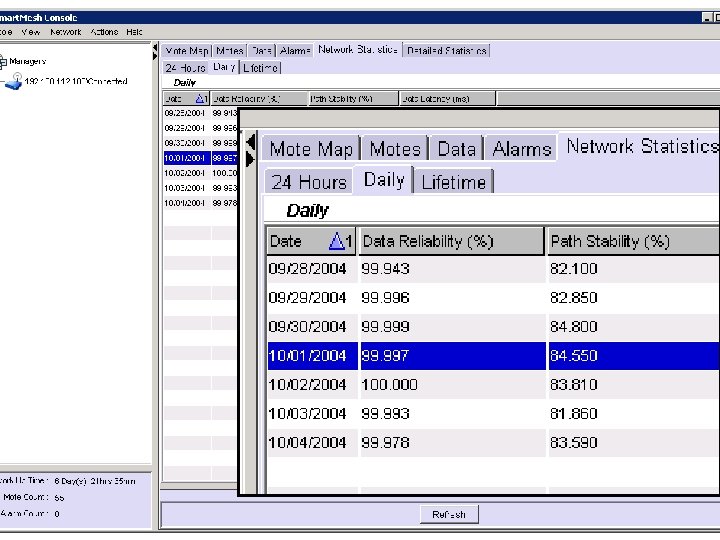
Configure, don’t compile Smart. Mesh Console TM IP Network XML Smart. Mesh Manager Mote ~100 ft Reliability: 99. 9%+ Power consumption: < 100 u. A average
Energy Monitoring Pilot • Honeywell Service: monitor, analyze and reduce power consumption • Problem: ~$500/sensor wiring cost • Solution: Dust Smart. Mesh TM – Entire Smart. Mesh network installed in 3 hours (vs. 3 -4 days) – 9 min/sensor
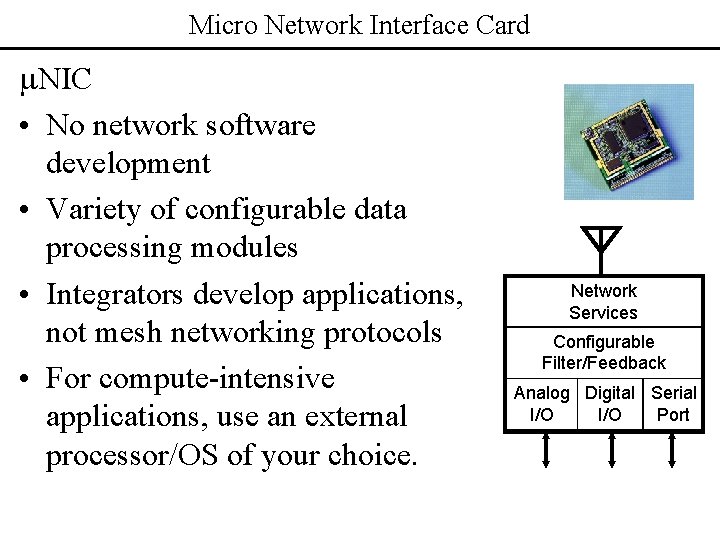
Micro Network Interface Card m. NIC • No network software development • Variety of configurable data processing modules • Integrators develop applications, not mesh networking protocols • For compute-intensive applications, use an external processor/OS of your choice. Network Services Configurable Filter/Feedback Analog Digital Serial I/O Port
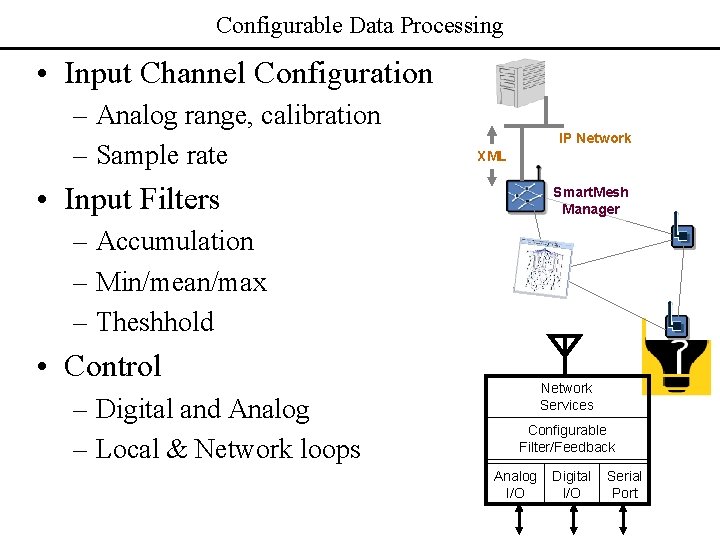
Configurable Data Processing • Input Channel Configuration – Analog range, calibration – Sample rate IP Network XML • Input Filters Smart. Mesh Manager – Accumulation – Min/mean/max – Theshhold • Control – Digital and Analog – Local & Network loops Network Services Configurable Filter/Feedback Analog I/O Digital I/O Serial Port
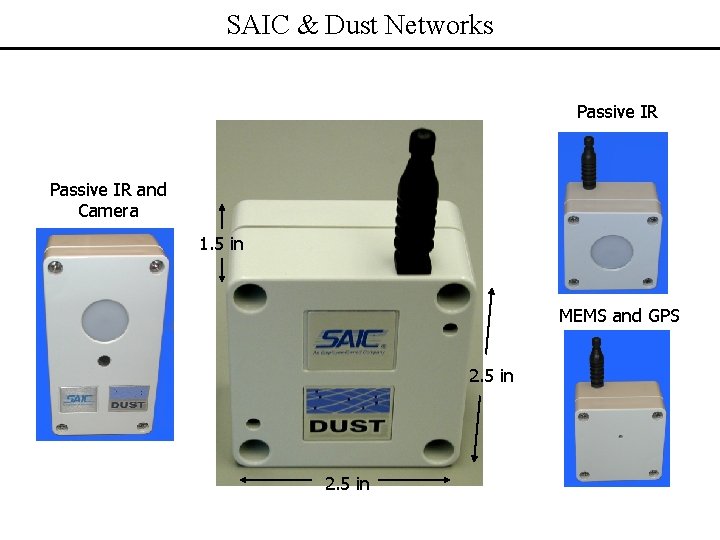
SAIC & Dust Networks Passive IR and Camera 1. 5 in MEMS and GPS 2. 5 in
Markets & Standards
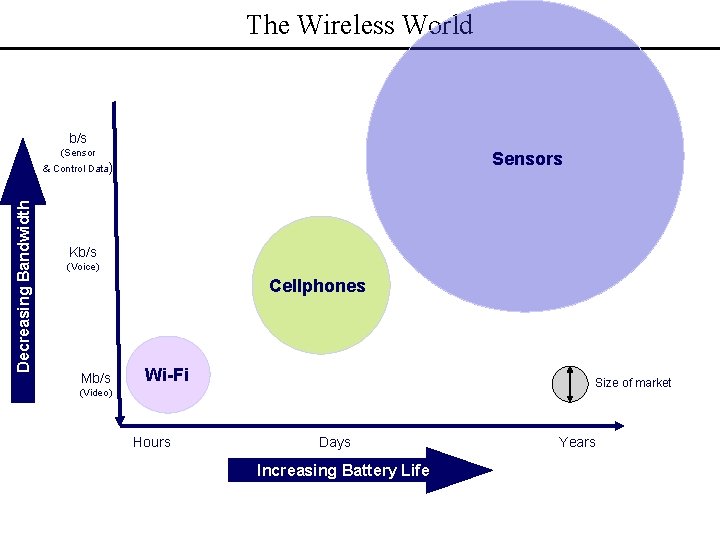
The Wireless World b/s (Sensors Decreasing Bandwidth & Control Data) Kb/s (Voice) Cellphones Mb/s Wi-Fi Size of market (Video) Hours Days Increasing Battery Life Years
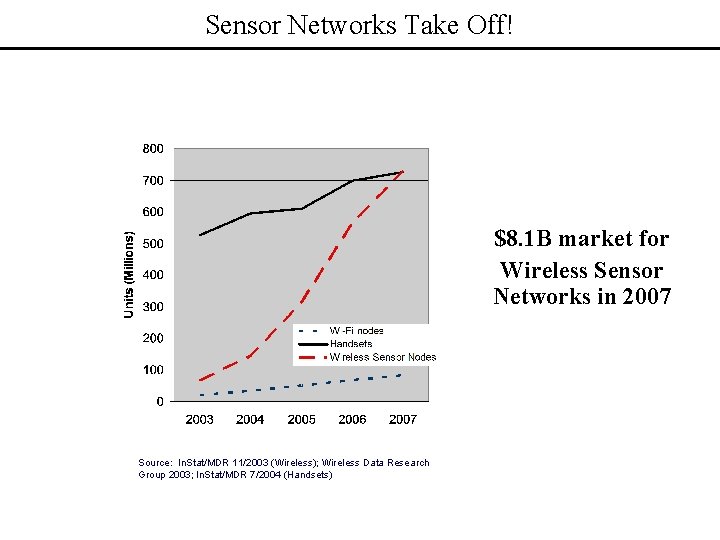
Sensor Networks Take Off! $8. 1 B market for Wireless Sensor Networks in 2007 Source: In. Stat/MDR 11/2003 (Wireless); Wireless Data Research Group 2003; In. Stat/MDR 7/2004 (Handsets)
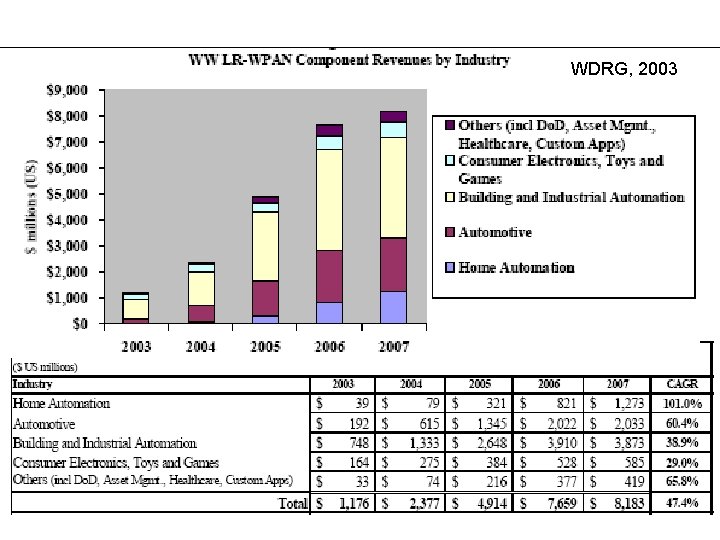
WDRG, 2003
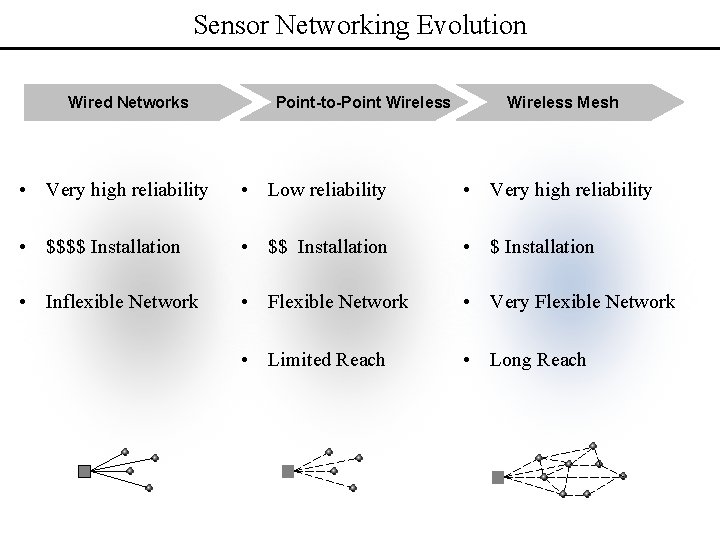
Sensor Networking Evolution Wired Networks Point-to-Point Wireless Mesh • Very high reliability • Low reliability • Very high reliability • $$$$ Installation • Inflexible Network • Flexible Network • Very Flexible Network • Limited Reach • Long Reach
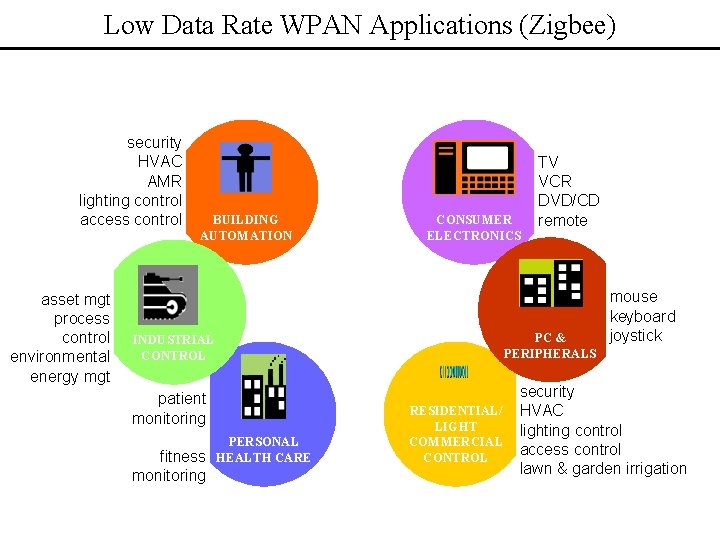
Low Data Rate WPAN Applications (Zigbee) security HVAC AMR lighting control access control asset mgt process control environmental energy mgt BUILDING AUTOMATION CONSUMER ELECTRONICS PC & PERIPHERALS INDUSTRIAL CONTROL patient monitoring fitness monitoring TV VCR DVD/CD remote PERSONAL HEALTH CARE RESIDENTIAL/ LIGHT COMMERCIAL CONTROL mouse keyboard joystick security HVAC lighting control access control lawn & garden irrigation
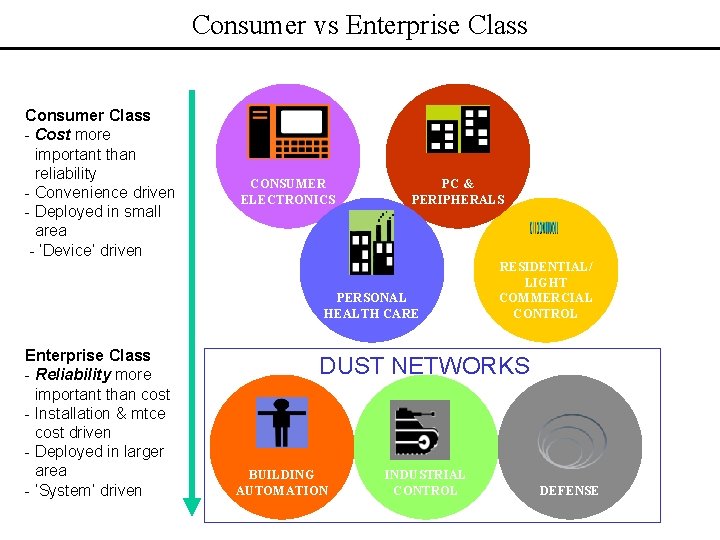
Consumer vs Enterprise Class Consumer Class - Cost more important than reliability - Convenience driven - Deployed in small area - ‘Device’ driven CONSUMER ELECTRONICS PC & PERIPHERALS PERSONAL HEALTH CARE Enterprise Class - Reliability more important than cost - Installation & mtce cost driven - Deployed in larger area - ‘System’ driven RESIDENTIAL/ LIGHT COMMERCIAL CONTROL DUST NETWORKS BUILDING AUTOMATION INDUSTRIAL CONTROL DEFENSE
802. 15. 4, Zigbee • Zigbee is an industry consortium created to apply 802. 15. 4 to commercial applications • “Toolkit” functionality of PHY and low-level MAC in 15. 4 • Device/application profiles defined in Zigbee
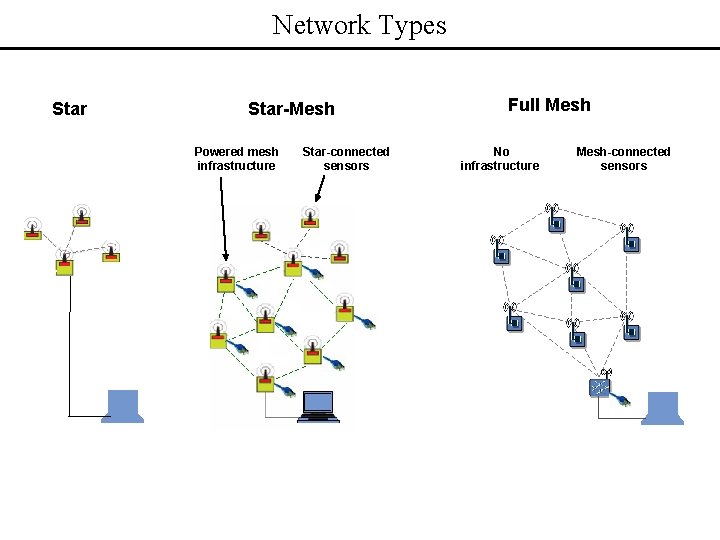
Network Types Star-Mesh Powered mesh infrastructure Star-connected sensors Full Mesh No infrastructure Mesh-connected sensors
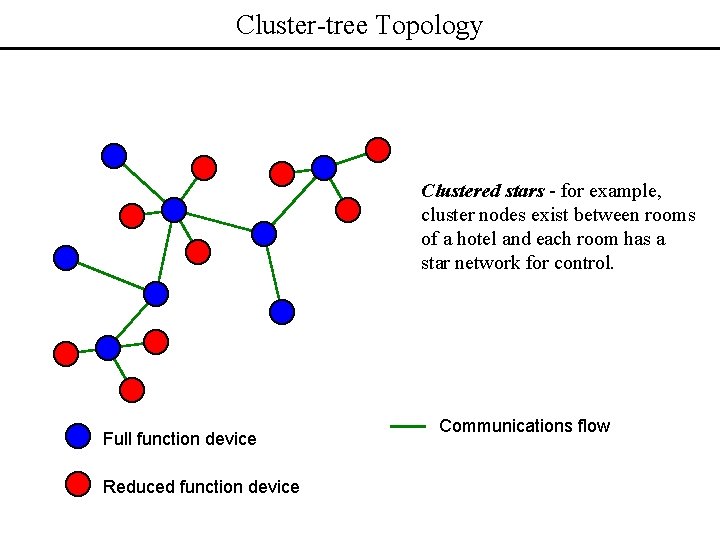
Cluster-tree Topology Clustered stars - for example, cluster nodes exist between rooms of a hotel and each room has a star network for control. Full function device Reduced function device Communications flow
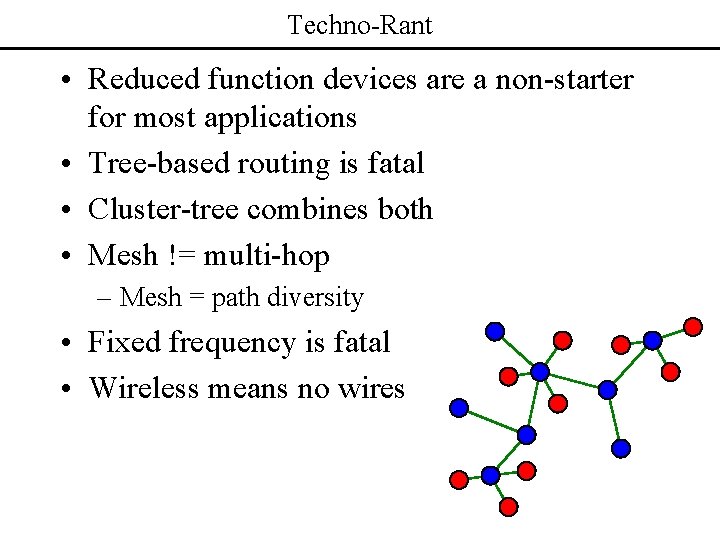
Techno-Rant • Reduced function devices are a non-starter for most applications • Tree-based routing is fatal • Cluster-tree combines both • Mesh != multi-hop – Mesh = path diversity • Fixed frequency is fatal • Wireless means no wires
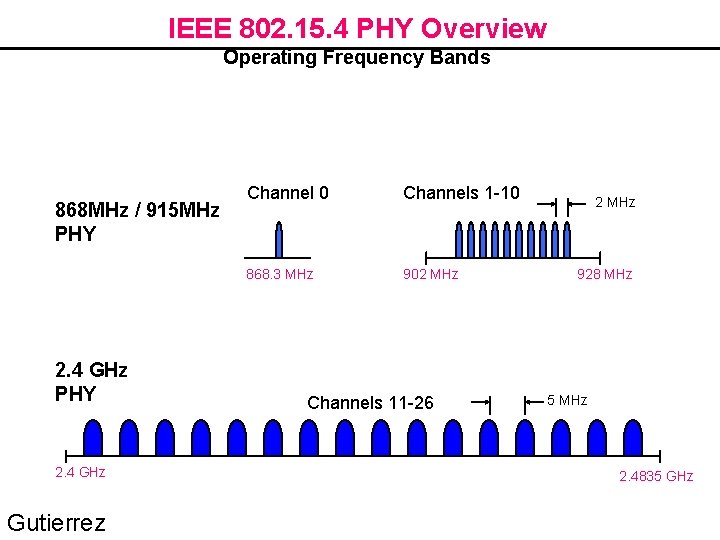
IEEE 802. 15. 4 PHY Overview Operating Frequency Bands 868 MHz / 915 MHz PHY 2. 4 GHz Gutierrez Channel 0 Channels 1 -10 868. 3 MHz 902 MHz Channels 11 -26 2 MHz 928 MHz 5 MHz 2. 4835 GHz
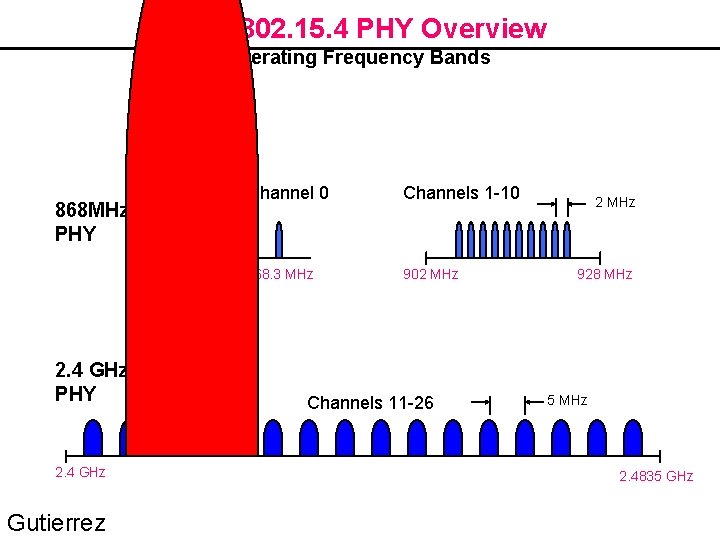
IEEE 802. 15. 4 PHY Overview Operating Frequency Bands 868 MHz / 915 MHz PHY 2. 4 GHz Gutierrez Channel 0 Channels 1 -10 868. 3 MHz 902 MHz Channels 11 -26 2 MHz 928 MHz 5 MHz 2. 4835 GHz
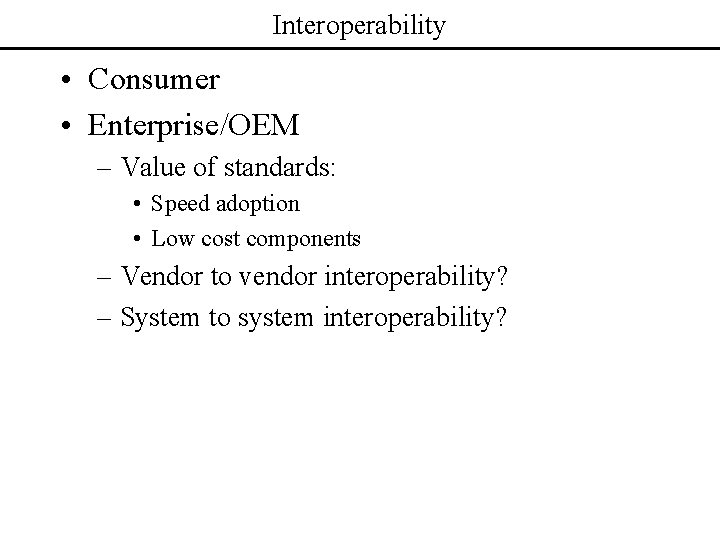
Interoperability • Consumer • Enterprise/OEM – Value of standards: • Speed adoption • Low cost components – Vendor to vendor interoperability? – System to system interoperability?
So what should I use? • Networking Research – Crossbow and/or Moteiv + Tiny. OS • New Networking product – Buy chips and stacks, write software – 802. 15. 4 – Zigbee? • Home automation – Chipcon/Figure 8 – “Ember University”? • Application/Solution – Buy a reliable network, develop your product (not embedded software) – Dust Networks
Important Players • Universities – Tiny. OS (UC Berkeley, UCLA, UW, Vanderbilt, …) – Network Theory • Startup Companies – – – Chipcon/Figure 8 Crossbow Dust Networks Ember Millennial Net • Major Corporate Research Groups – – Intel Microsoft IT: Agilent, Cisco, HP, IBM, France. Telecom, Nortel Automation: GE, Honeywell, Johnson Controls, Siemens • Zigbee Alliance
Future
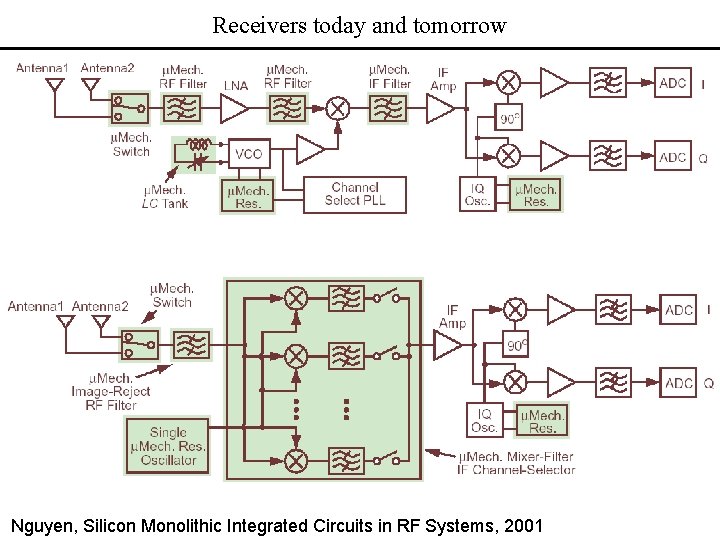
Receivers today and tomorrow Nguyen, Silicon Monolithic Integrated Circuits in RF Systems, 2001
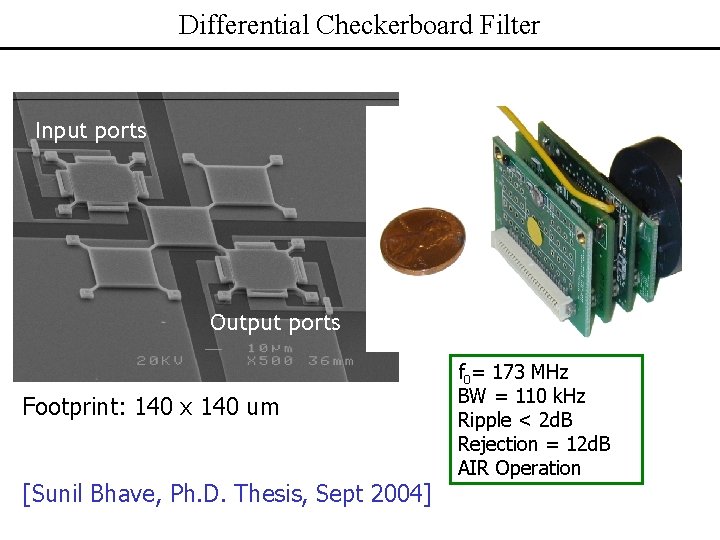
Differential Checkerboard Filter Input ports Output ports Footprint: 140 x 140 um [Sunil Bhave, Ph. D. Thesis, Sept 2004] f 0= 173 MHz BW = 110 k. Hz Ripple < 2 d. B Rejection = 12 d. B AIR Operation
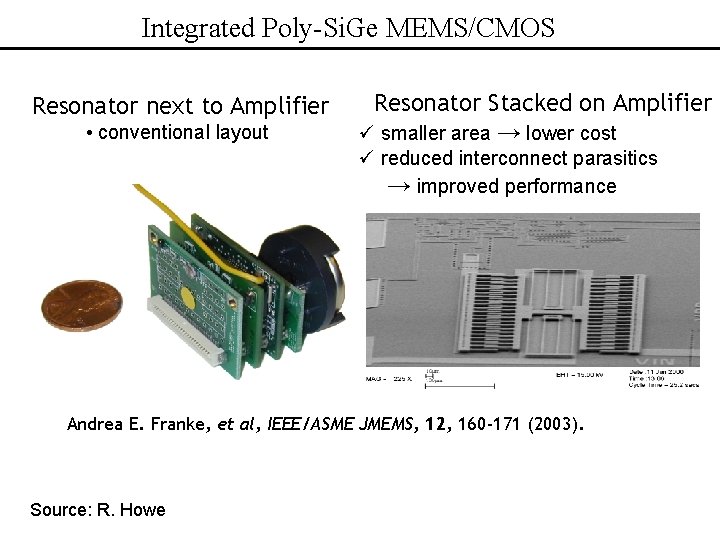
Integrated Poly-Si. Ge MEMS/CMOS Resonator next to Amplifier • conventional layout Resonator Stacked on Amplifier ü smaller area → lower cost ü reduced interconnect parasitics → improved performance Andrea E. Franke, et al, IEEE/ASME JMEMS, 12, 160 -171 (2003). Source: R. Howe
Nano Dust? • • Nanotube sensors Nanotube computation Nanotube hydrogen storage Nanomechanical filters for low-power RF
Conclusion • Sensor networks are everywhere today • Installation is dominated by wiring costs • Wireless sensor networks are now – Reliable – Easy to integrate & install – Low cost • Projected to be a multi-billion $ industry • MEMS &Nano will reduce cost and improve capabilities moving forward