
Wireless Sensor Networks for Habitat Monitoring Alan Mainwaring
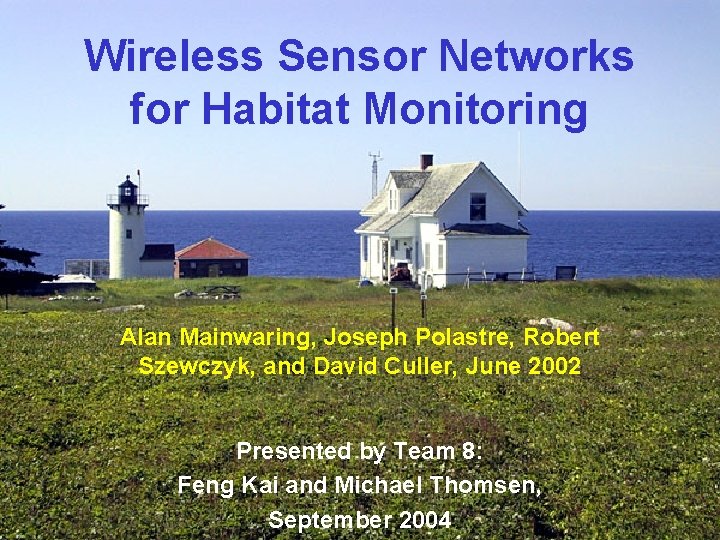
Wireless Sensor Networks for Habitat Monitoring Alan Mainwaring, Joseph Polastre, Robert Szewczyk, and David Culler, June 2002 02202, September 7 th Presented by Team 8: Feng Kai and Michael Thomsen, September 2004 , lecture 2 Team 8 – Feng Kai and Michael Thomsen
Outline • • • Habitat monitoring Network Requirements System Architecture Hardware and Design Results 02202, September 7 th, lecture 2 Team 8 – Feng Kai and Michael Thomsen
Why? Why are we interested in Habitat Monitoring? • Focus attention on a REAL network • Some problems have simple concrete solutions, while others remain open research areas • Application driven approach separates actual problems from potential ones, and relevant issues from irrelevant ones • Collaboration with scientists in other fields helps define broader application space as well as scientific requirements 02202, September 7 th, lecture 2 Team 8 – Feng Kai and Michael Thomsen
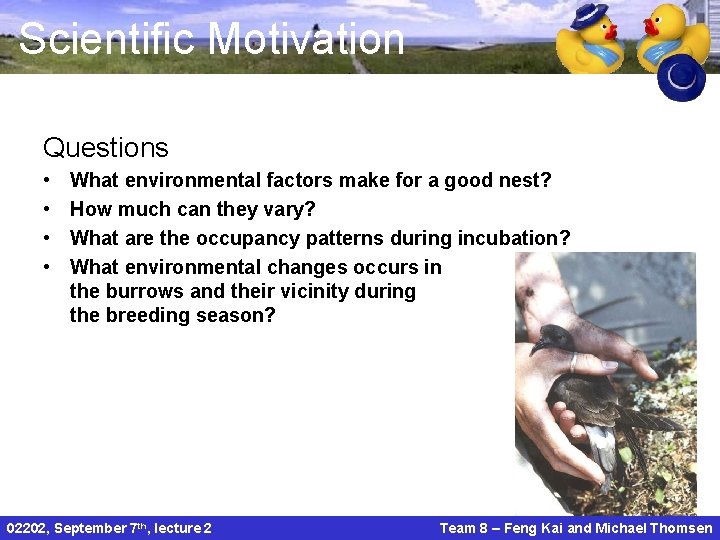
Scientific Motivation Questions • • What environmental factors make for a good nest? How much can they vary? What are the occupancy patterns during incubation? What environmental changes occurs in the burrows and their vicinity during the breeding season? 02202, September 7 th, lecture 2 Team 8 – Feng Kai and Michael Thomsen
Scientific Motivation Methodology • Characterize the climate inside and outside the burrow • Collect detailed occupancy data from a number of occupied and empty nests • Validate a sample of sensor data with a different sensing modality • Augment the sensor data with deployment notes (e. g. burrow depth, soil consistency, vegetation data) • Try to answer the questions based on analysis of the entire data set 02202, September 7 th, lecture 2 Team 8 – Feng Kai and Michael Thomsen
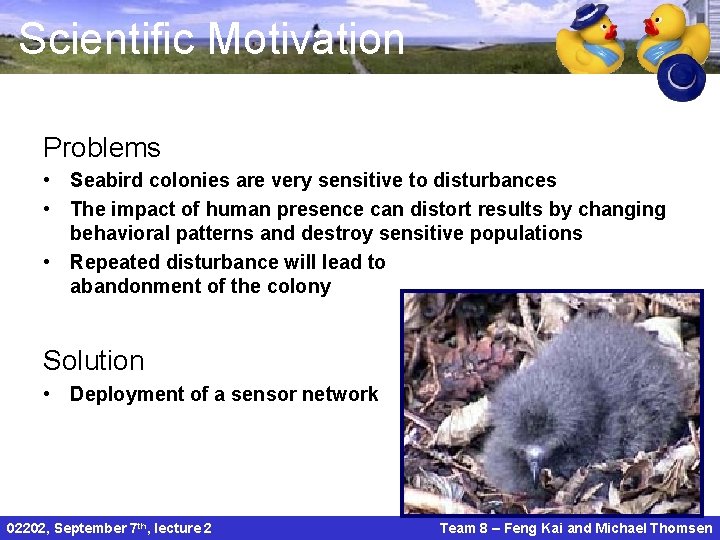
Scientific Motivation Problems • Seabird colonies are very sensitive to disturbances • The impact of human presence can distort results by changing behavioral patterns and destroy sensitive populations • Repeated disturbance will lead to abandonment of the colony Solution • Deployment of a sensor network 02202, September 7 th, lecture 2 Team 8 – Feng Kai and Michael Thomsen
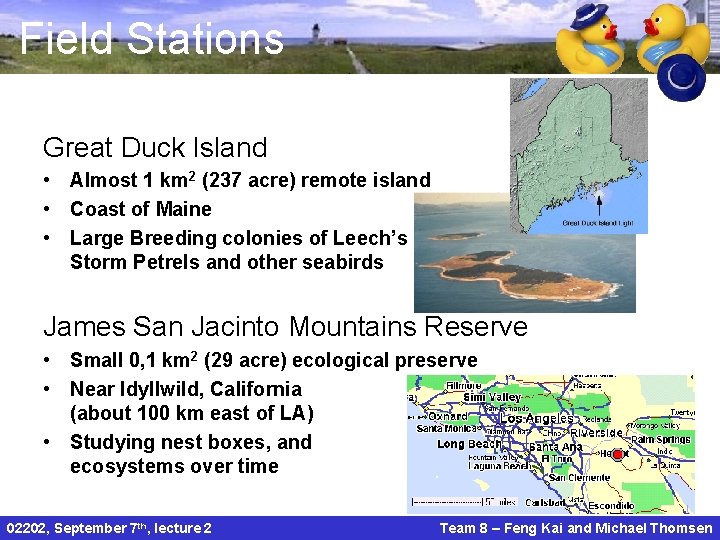
Field Stations Great Duck Island • Almost 1 km 2 (237 acre) remote island • Coast of Maine • Large Breeding colonies of Leech’s Storm Petrels and other seabirds James San Jacinto Mountains Reserve • Small 0, 1 km 2 (29 acre) ecological preserve • Near Idyllwild, California (about 100 km east of LA) • Studying nest boxes, and ecosystems over time 02202, September 7 th, lecture 2 Team 8 – Feng Kai and Michael Thomsen
Application Requirements General Requirements • • • Internet access Hierarchical network (local networks over longer distances) Sensor network longevity (at least 9 months) Operating off-the-grid (battery or solar cells) Remote management (personnel just available 2 -3 months) Inconspicuous operation (should not disrupt natural processes or behaviors under study) • System behavior (stable, predictable and repeatable behavior) • In-situ interactions (during deployment and maintenance) • Sensors and sampling (light, temperature, IR, humidity, pressure) 02202, September 7 th, lecture 2 Team 8 – Feng Kai and Michael Thomsen
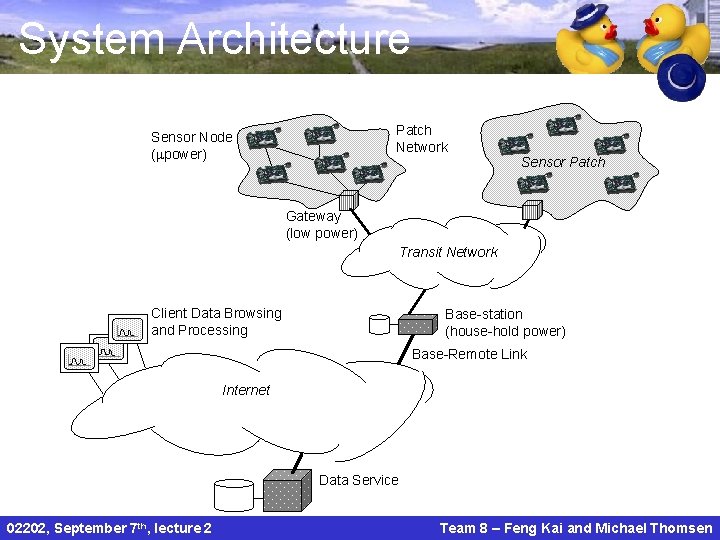
System Architecture Patch Network Sensor Node ( power) Sensor Patch Gateway (low power) Transit Network Client Data Browsing and Processing Base-station (house-hold power) Base-Remote Link Internet Data Service 02202, September 7 th, lecture 2 Team 8 – Feng Kai and Michael Thomsen
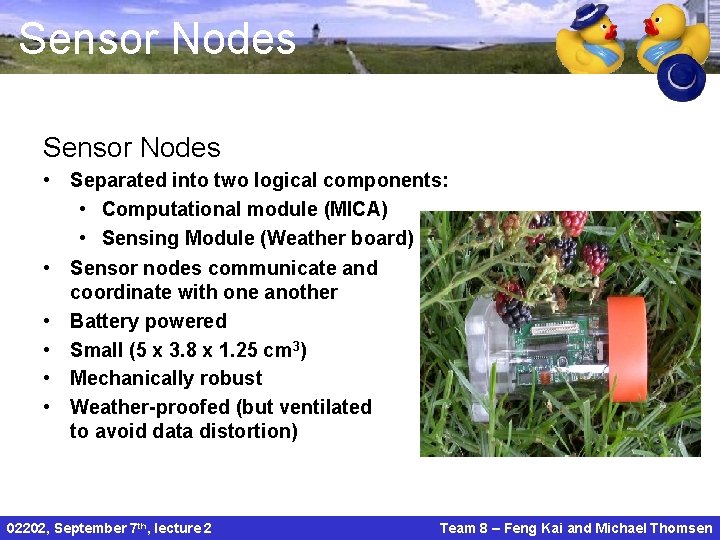
Sensor Nodes • Separated into two logical components: • Computational module (MICA) • Sensing Module (Weather board) • Sensor nodes communicate and coordinate with one another • Battery powered • Small (5 x 3. 8 x 1. 25 cm 3) • Mechanically robust • Weather-proofed (but ventilated to avoid data distortion) 02202, September 7 th, lecture 2 Team 8 – Feng Kai and Michael Thomsen
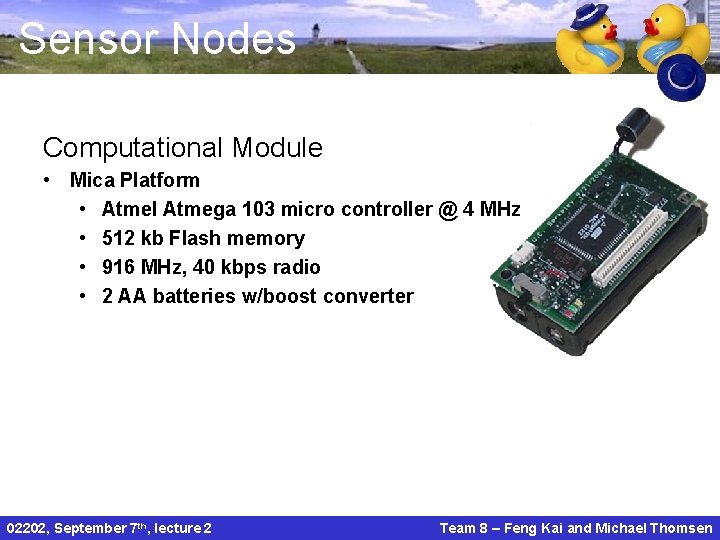
Sensor Nodes Computational Module • Mica Platform • Atmel Atmega 103 micro controller @ 4 MHz • 512 kb Flash memory • 916 MHz, 40 kbps radio • 2 AA batteries w/boost converter 02202, September 7 th, lecture 2 Team 8 – Feng Kai and Michael Thomsen
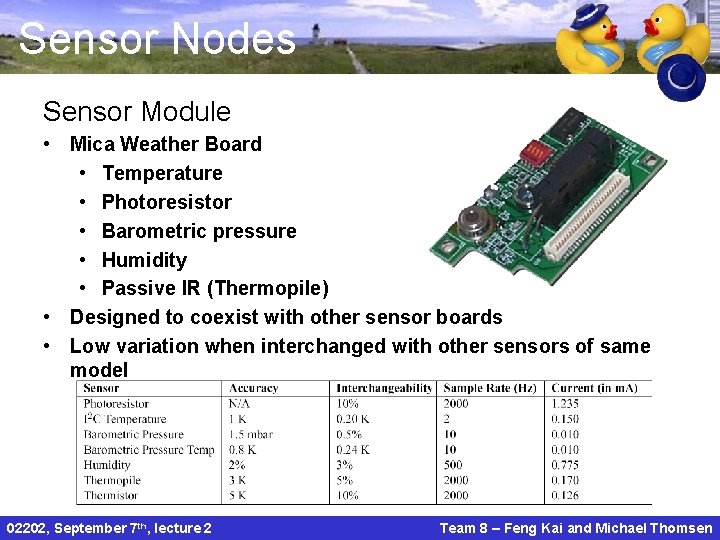
Sensor Nodes Sensor Module • Mica Weather Board • Temperature • Photoresistor • Barometric pressure • Humidity • Passive IR (Thermopile) • Designed to coexist with other sensor boards • Low variation when interchanged with other sensors of same model 02202, September 7 th, lecture 2 Team 8 – Feng Kai and Michael Thomsen
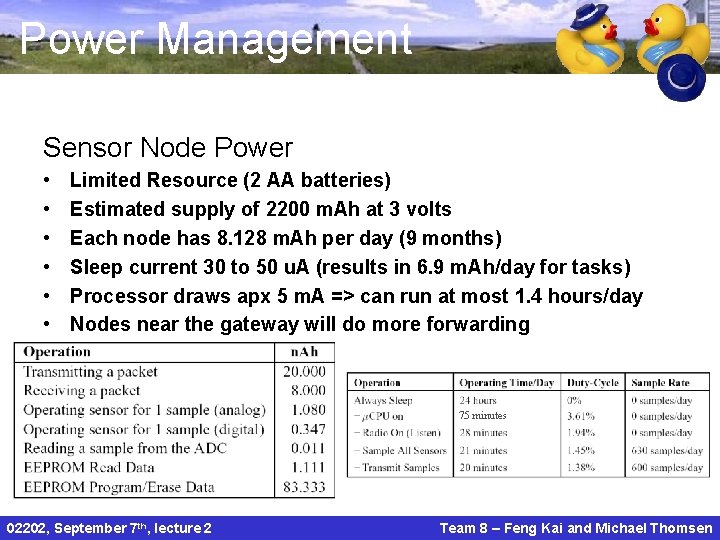
Power Management Sensor Node Power • • • Limited Resource (2 AA batteries) Estimated supply of 2200 m. Ah at 3 volts Each node has 8. 128 m. Ah per day (9 months) Sleep current 30 to 50 u. A (results in 6. 9 m. Ah/day for tasks) Processor draws apx 5 m. A => can run at most 1. 4 hours/day Nodes near the gateway will do more forwarding 75 minutes 02202, September 7 th, lecture 2 Team 8 – Feng Kai and Michael Thomsen
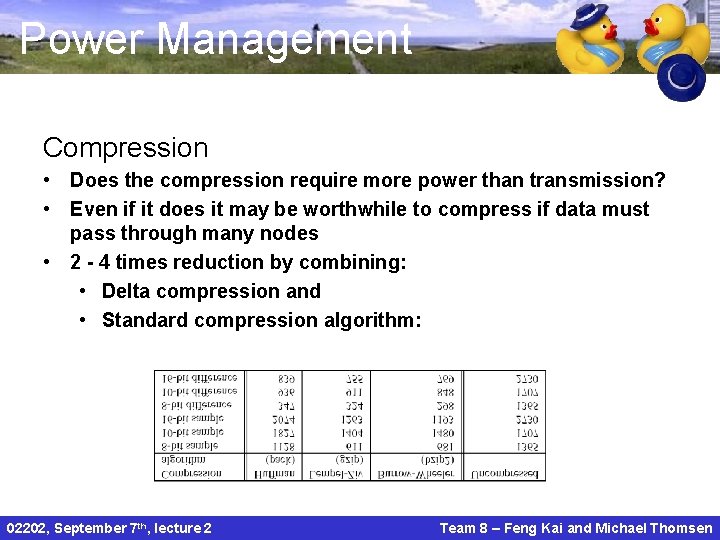
Power Management Compression • Does the compression require more power than transmission? • Even if it does it may be worthwhile to compress if data must pass through many nodes • 2 - 4 times reduction by combining: • Delta compression and • Standard compression algorithm: 02202, September 7 th, lecture 2 Team 8 – Feng Kai and Michael Thomsen
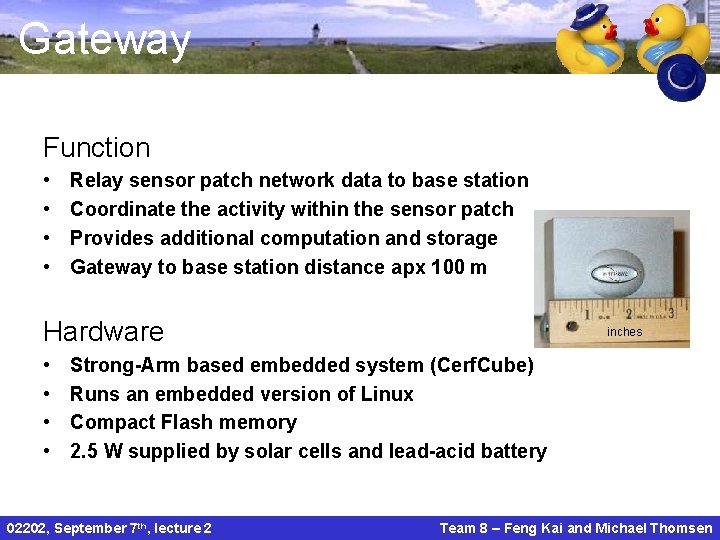
Gateway Function • • Relay sensor patch network data to base station Coordinate the activity within the sensor patch Provides additional computation and storage Gateway to base station distance apx 100 m Hardware • • inches Strong-Arm based embedded system (Cerf. Cube) Runs an embedded version of Linux Compact Flash memory 2. 5 W supplied by solar cells and lead-acid battery 02202, September 7 th, lecture 2 Team 8 – Feng Kai and Michael Thomsen
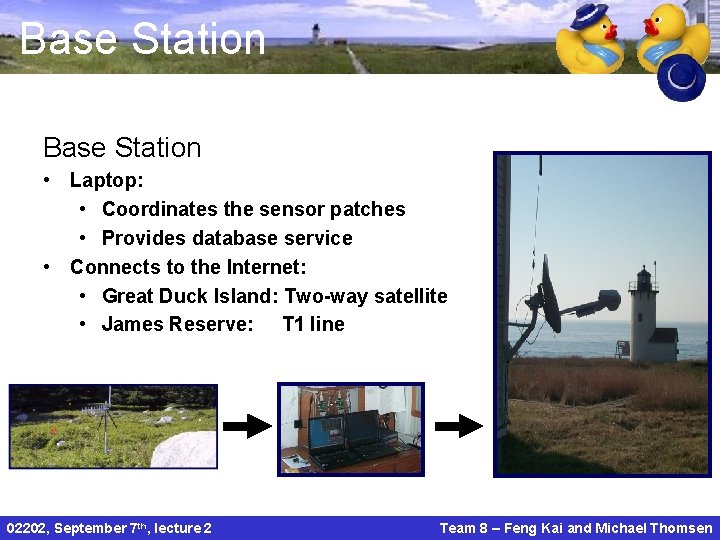
Base Station • Laptop: • Coordinates the sensor patches • Provides database service • Connects to the Internet: • Great Duck Island: Two-way satellite • James Reserve: T 1 line 02202, September 7 th, lecture 2 Team 8 – Feng Kai and Michael Thomsen
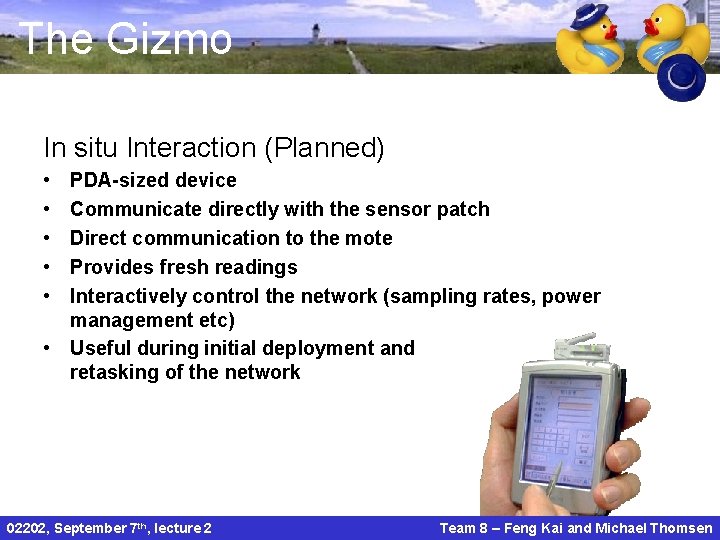
The Gizmo In situ Interaction (Planned) • • • PDA-sized device Communicate directly with the sensor patch Direct communication to the mote Provides fresh readings Interactively control the network (sampling rates, power management etc) • Useful during initial deployment and retasking of the network 02202, September 7 th, lecture 2 Team 8 – Feng Kai and Michael Thomsen
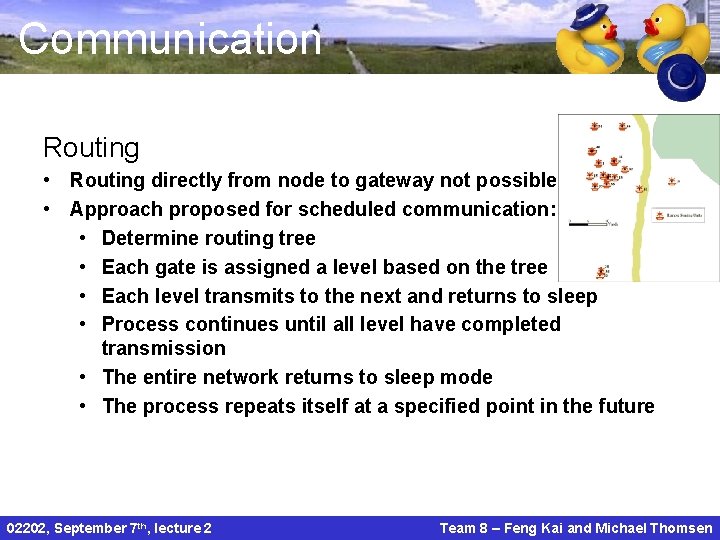
Communication Routing • Routing directly from node to gateway not possible • Approach proposed for scheduled communication: • Determine routing tree • Each gate is assigned a level based on the tree • Each level transmits to the next and returns to sleep • Process continues until all level have completed transmission • The entire network returns to sleep mode • The process repeats itself at a specified point in the future 02202, September 7 th, lecture 2 Team 8 – Feng Kai and Michael Thomsen
Network Retasking • Initially collect absolute temperature readings • After initial interpretation, could be realized that information of interest is contained in significant temperature changes • Full reprogramming process is costly: • Transmission of 10 kbit of data • Reprogramming application: 2 minutes @ 10 m. A • Equals one complete days energy • Virtual Machine based retasking: • Only small parts of the code needs to be changed 02202, September 7 th, lecture 2 Team 8 – Feng Kai and Michael Thomsen
Conclusion Paper conclusion • Two small scale sensor networks deployed at Great Duck Island James Reserve (one patch each) • Results not evaluated • No calibration was done, development of auto-calibration procedure suggested Future • Develop a habitat monitoring kit 02202, September 7 th, lecture 2 Team 8 – Feng Kai and Michael Thomsen
Problems 2002 Deployed Network • No new science about petrel breeding behavior, many insights into how to build sensors that would yeild that science • Base Station laptop must run unattended (problem with unscheduled system reboots (mostly fixed)) • Temperature Sensors: • Measured temperature inside the enclosure, rather than ambient temperature • Good correlation with Cost Guard measurements on cloudy days • Batteries: • Only operational down to 2. 5 V (expected down to 1. 6 V) 02202, September 7 th, lecture 2 Team 8 – Feng Kai and Michael Thomsen
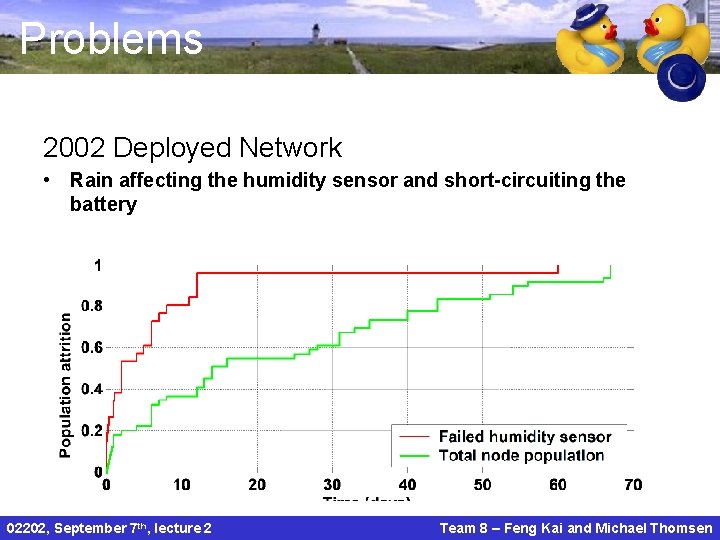
Problems 2002 Deployed Network • Rain affecting the humidity sensor and short-circuiting the battery 02202, September 7 th, lecture 2 Team 8 – Feng Kai and Michael Thomsen
Additional References • R. Szewczyk, J. Polastre, A. Mainwaring, D. Culler: ”Lessons from a Sensor Network Expedition”, UC Berkerly, Jan 2004 • J. Polastre: ”Design and Implementation of Wireless Sensor Networks for Habitat Monitoring”, Research Project, 2003 • www. greatduckisland. net 02202, September 7 th, lecture 2 Team 8 – Feng Kai and Michael Thomsen
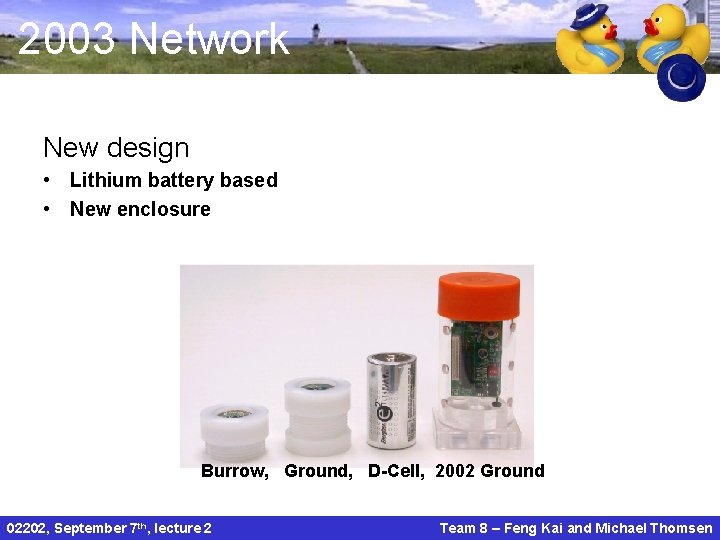
2003 Network New design • Lithium battery based • New enclosure Burrow, Ground, D-Cell, 2002 Ground 02202, September 7 th, lecture 2 Team 8 – Feng Kai and Michael Thomsen
- Slides: 24