
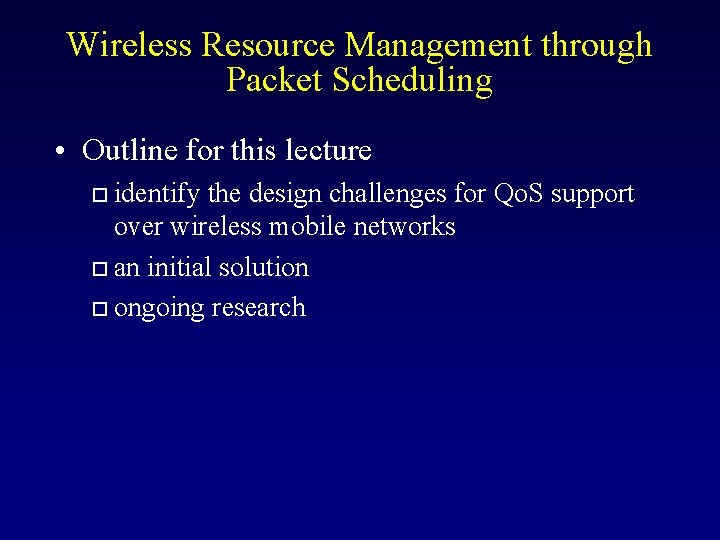
Wireless Resource Management through Packet Scheduling Outline for
![Why Wireline Fair Queueing Fails in Wireless Networks t [0, 1] t=0 1 F](https://slidetodoc.com/presentation_image_h/bec6f46a6ca9b338b7f6e1f4d27a1a8a/image-16.jpg "Why Wireline Fair Queueing Fails in Wireless Networks t [0, 1] t=0 1 F")
- Slides: 40
Wireless Resource Management through Packet Scheduling • Outline for this lecture identify the design challenges for Qo. S support over wireless mobile networks o an initial solution o ongoing research o
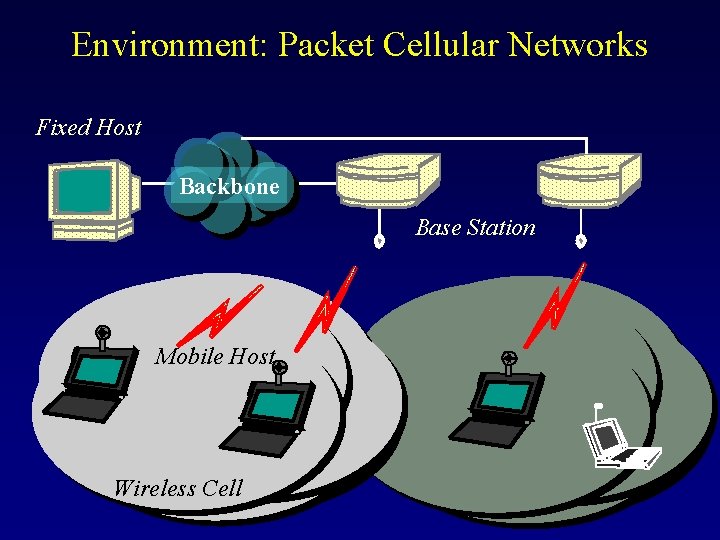
Environment: Packet Cellular Networks Fixed Host Backbone Base Station Mobile Host Wireless Cell
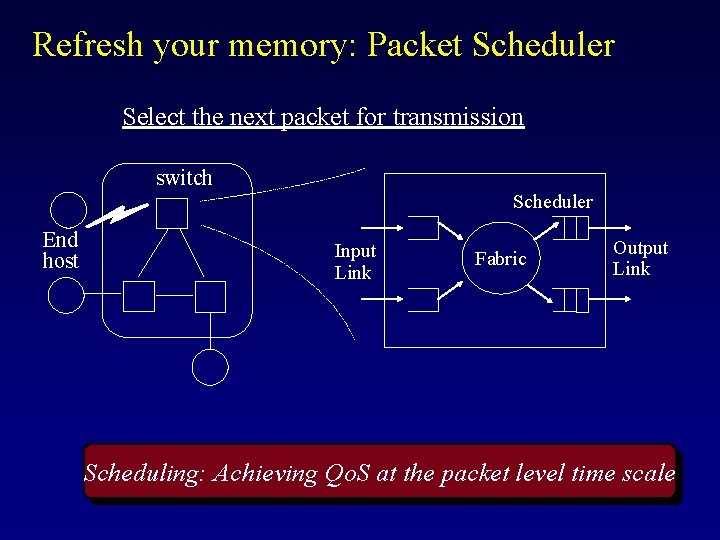
Refresh your memory: Packet Scheduler Select the next packet for transmission switch Scheduler End host Input Link Fabric Output Link Scheduling: Achieving Qo. S at the packet level time scale
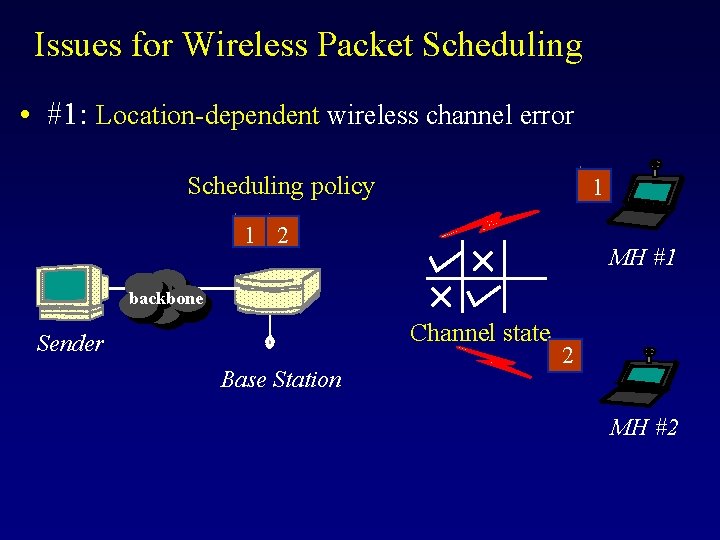
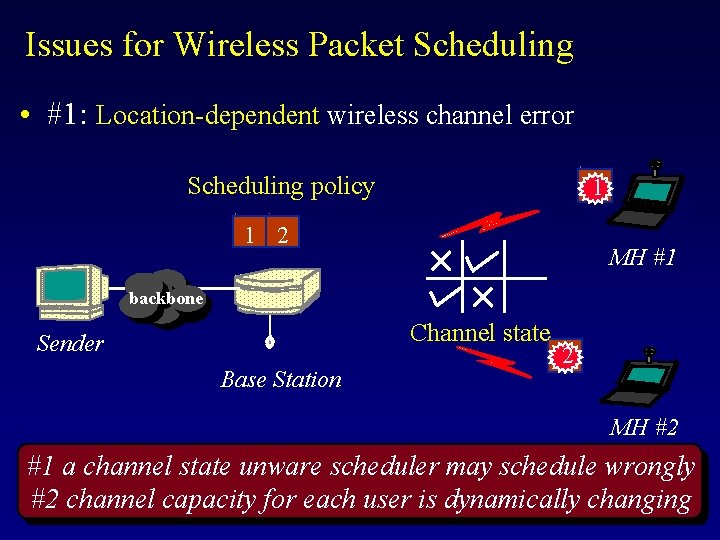
Issues for Wireless Packet Scheduling • #1: Location-dependent wireless channel error Scheduling policy 1 1 2 MH #1 backbone Channel state Sender Base Station 2 MH #2
Issues for Wireless Packet Scheduling • #1: Location-dependent wireless channel error Scheduling policy 1 1 2 MH #1 backbone Channel state Sender Base Station 2 MH #2 #1 a channel state unware scheduler may schedule wrongly #2 channel capacity for each user is dynamically changing
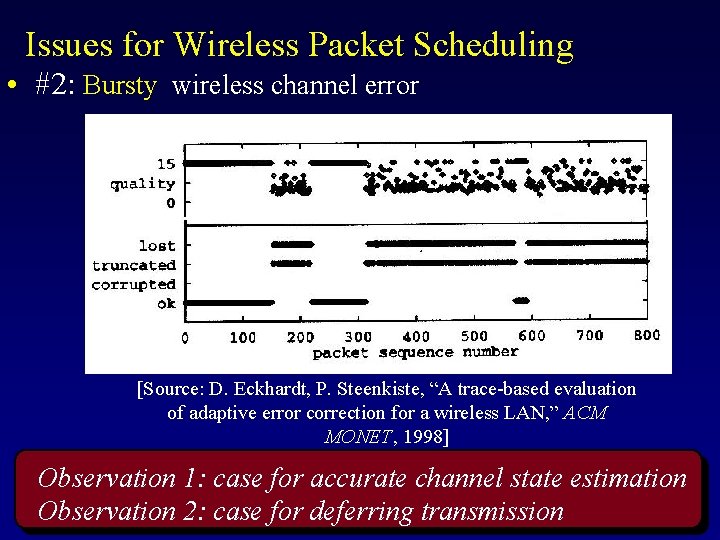
Issues for Wireless Packet Scheduling • #2: Bursty wireless channel error [Source: D. Eckhardt, P. Steenkiste, “A trace-based evaluation of adaptive error correction for a wireless LAN, ” ACM MONET, 1998] Observation 1: case for accurate channel state estimation Observation 2: case for deferring transmission
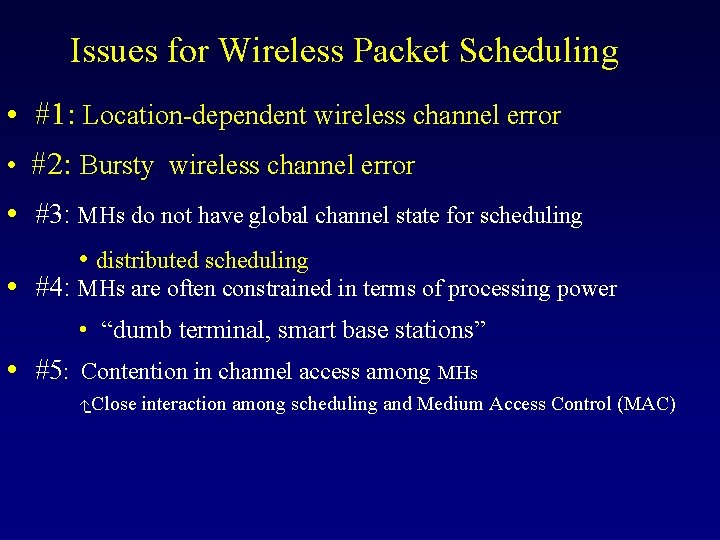
Issues for Wireless Packet Scheduling • #1: Location-dependent wireless channel error • #2: Bursty wireless channel error • #3: MHs do not have global channel state for scheduling • distributed scheduling • #4: MHs are often constrained in terms of processing power • “dumb terminal, smart base stations” • #5: Contention in channel access among MHs áClose interaction among scheduling and Medium Access Control (MAC)
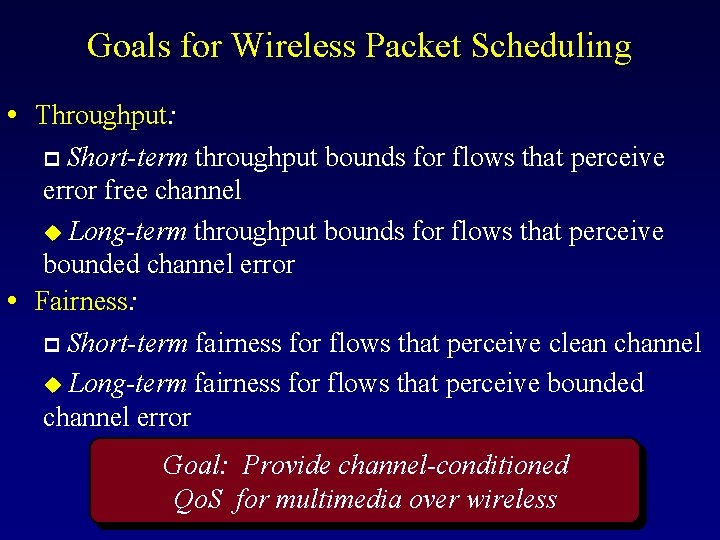
Goals for Wireless Packet Scheduling • Throughput: Short-term throughput bounds for flows that perceive error free channel u Long-term throughput bounds for flows that perceive bounded channel error • Fairness: p Short-term fairness for flows that perceive clean channel u Long-term fairness for flows that perceive bounded channel error p Goal: Provide channel-conditioned Qo. S for multimedia over wireless
A Comprehensive Quality of Service Model for Wireless Packet Scheduling cont’d. • Channel-conditioned delay bounds for packets • Support for diverse applications: Both delay-sensitive and loss-sensitive applications p Accept flows with different decoupled delay/bandwidth requirements áoptimization of the schedulable region p u Graceful service degradation and compensation Goal: Provide channel-conditioned Qo. S for multimedia over wireless
Conventional Approaches for Wireless Packet Scheduling • #1: FIFO, WRR, etc. : do NOT address wireless link issues Location dependent channel error p Bursty channel error á inefficient link utilization á users are exposed to all channel errors p • #2: address wireless link issues but NO Qo. S P. Bhagwat et. al. “Channel State Dependent Packet Scheduling (CSDPS)”, INFOCOM’ 96 á Not able to support multimedia and provide fair service p
Two Design Principles for Qo. S oriented Wireless Packet Scheduling • #1: Fair Queueing á providing Qo. S in the error-free case • #2: Adaptation to location dependent and bursty channel error via compensation á addressing wireless link issues
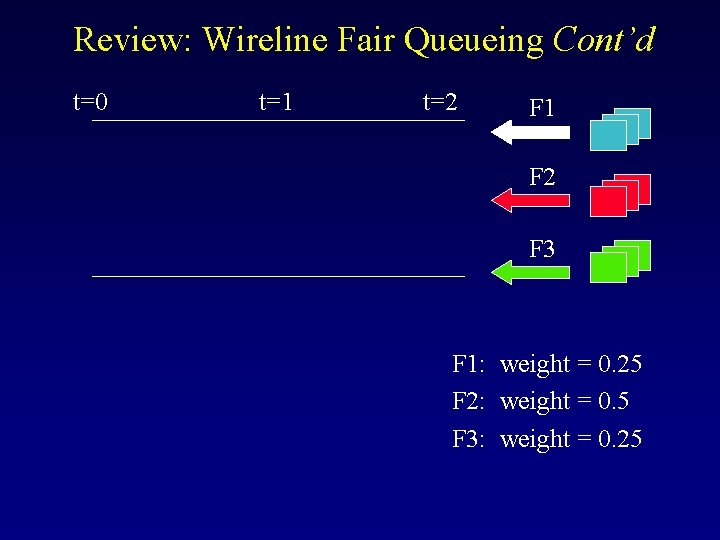
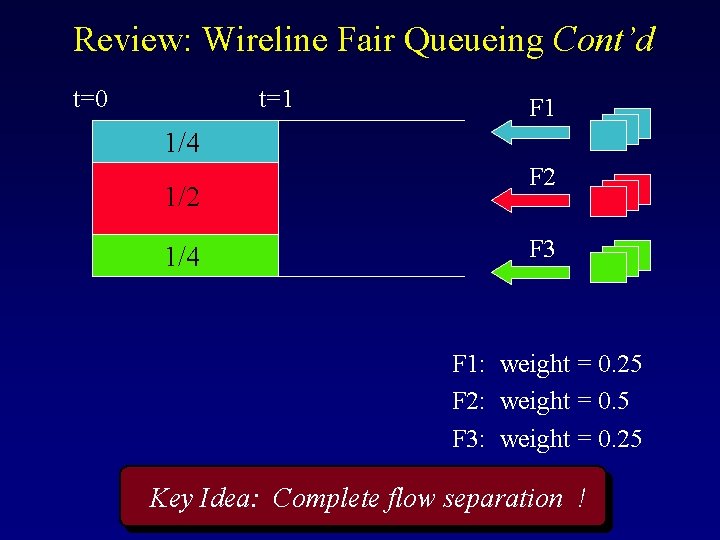
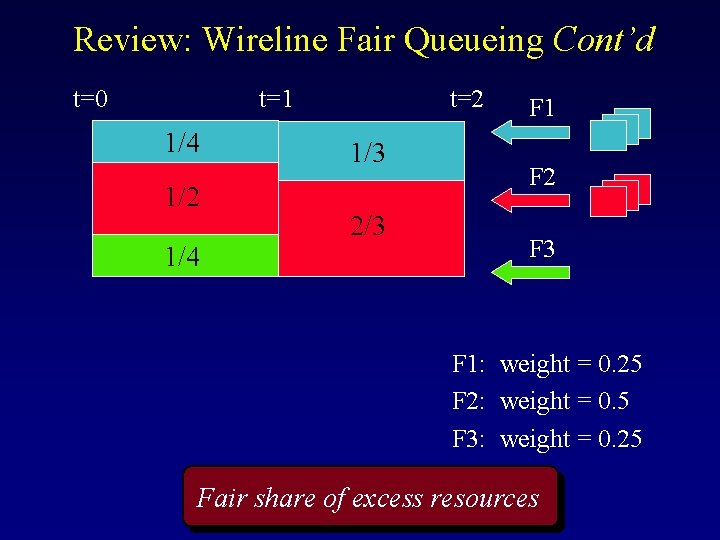
Introduction to Wireline Fair Queueing • A popular paradigm to achieve Qo. S at the packet level throughput guarantees p packet delay guarantees p fairness p various algorithms, WFQ, WF 2 Q, SCFQ, STFQ, . . . p • Key idea: flow separation a fluid fair queueing system p packetized approximation of the fluid model p works regardless of differences in packet size p
Review: Wireline Fair Queueing Cont’d t=0 t=1 t=2 F 1 F 2 F 3 F 1: weight = 0. 25 F 2: weight = 0. 5 F 3: weight = 0. 25
Review: Wireline Fair Queueing Cont’d t=1 t=0 F 1 1/4 1/2 1/4 F 2 F 3 F 1: weight = 0. 25 F 2: weight = 0. 5 F 3: weight = 0. 25 Key Idea: Complete flow separation !
Review: Wireline Fair Queueing Cont’d t=0 t=1 1/4 1/2 1/4 t=2 1/3 2/3 F 1 F 2 F 3 F 1: weight = 0. 25 F 2: weight = 0. 5 F 3: weight = 0. 25 Fair share of excess resources
Why Wireline Fair Queueing Fails in Wireless Networks t [0, 1] t=0 1 F 1 2/3 backbone Sender 1/3 Base Station F 2 Equal weights F 3: CBR
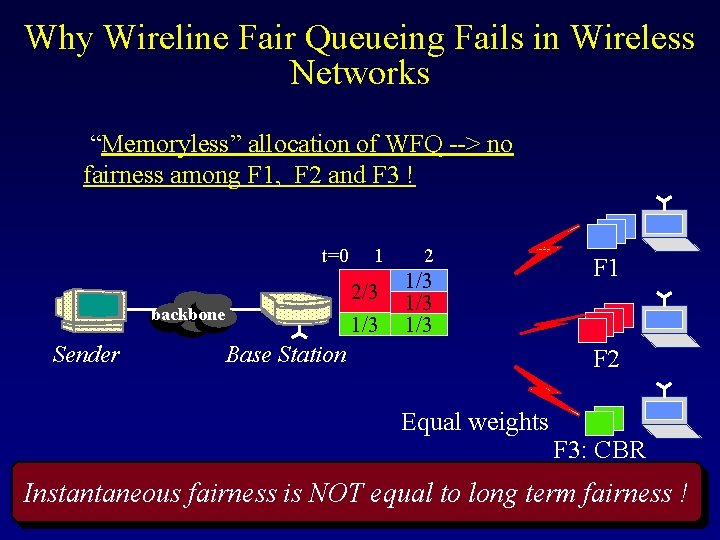
Why Wireline Fair Queueing Fails in Wireless Networks “Memoryless” allocation of WFQ --> no fairness among F 1, F 2 and F 3 ! t=0 1 2/3 backbone Sender 1/3 2 1/3 1/3 Base Station F 1 F 2 Equal weights F 3: CBR Instantaneous fairness is NOT equal to long term fairness !
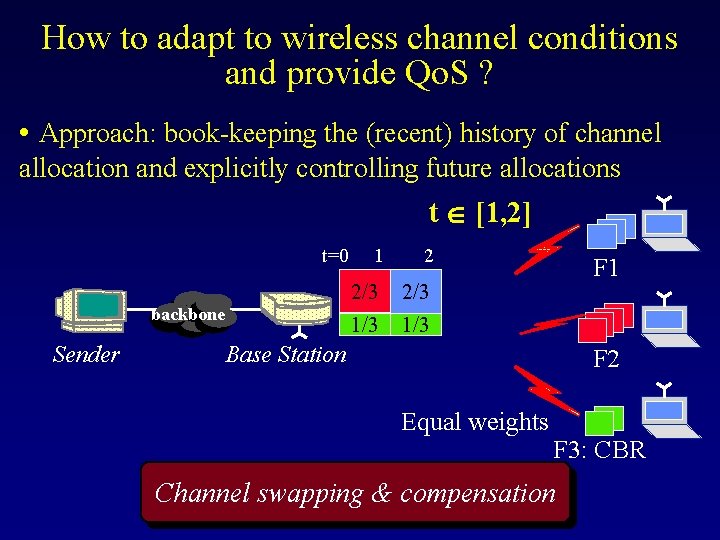
How to adapt to wireless channel conditions and provide Qo. S ? • Approach: book-keeping the (recent) history of channel allocation and explicitly controlling future allocations t [1, 2] t=0 backbone Sender 1 2 2/3 1/3 F 1 Base Station F 2 Equal weights F 3: CBR Channel swapping & compensation
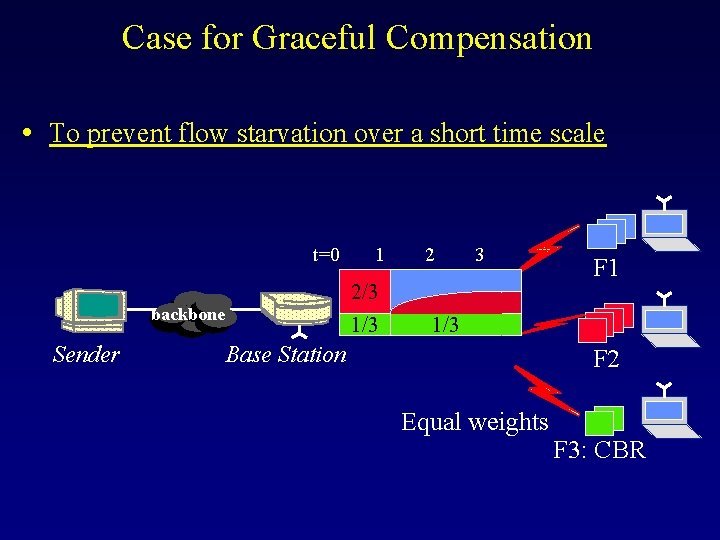
Case for Graceful Compensation • To prevent flow starvation over a short time scale t=0 1 2 3 2/3 backbone Sender 1/3 F 1 1/3 Base Station F 2 Equal weights F 3: CBR
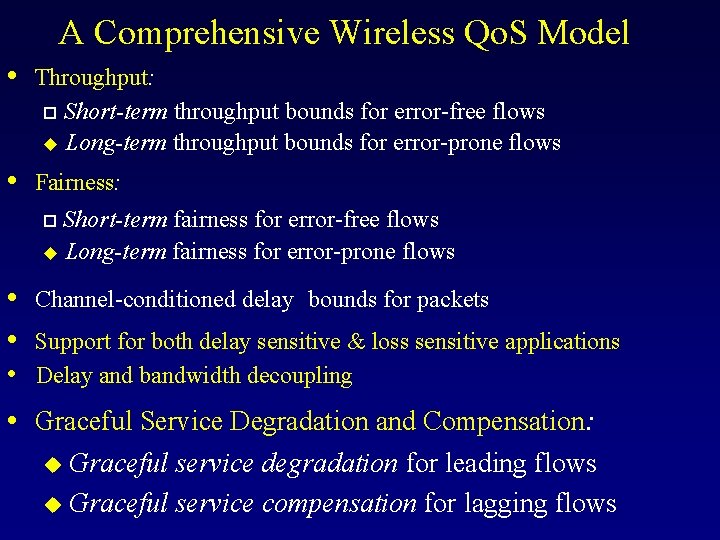
A Comprehensive Wireless Qo. S Model • Throughput: p Short-term throughput bounds for error-free flows u Long-term throughput bounds for error-prone flows • Fairness: Short-term fairness for error-free flows u Long-term fairness for error-prone flows p • • • Channel-conditioned delay bounds for packets Support for both delay sensitive & loss sensitive applications Delay and bandwidth decoupling • Graceful Service Degradation and Compensation: Graceful service degradation for leading flows u Graceful service compensation for lagging flows u
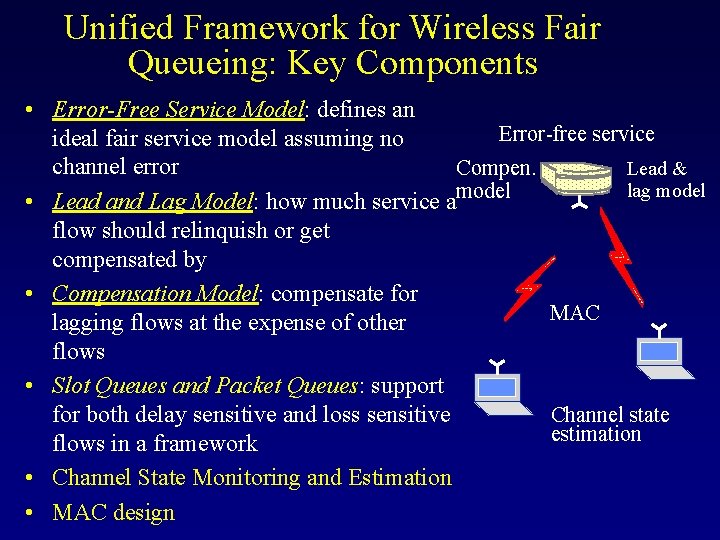
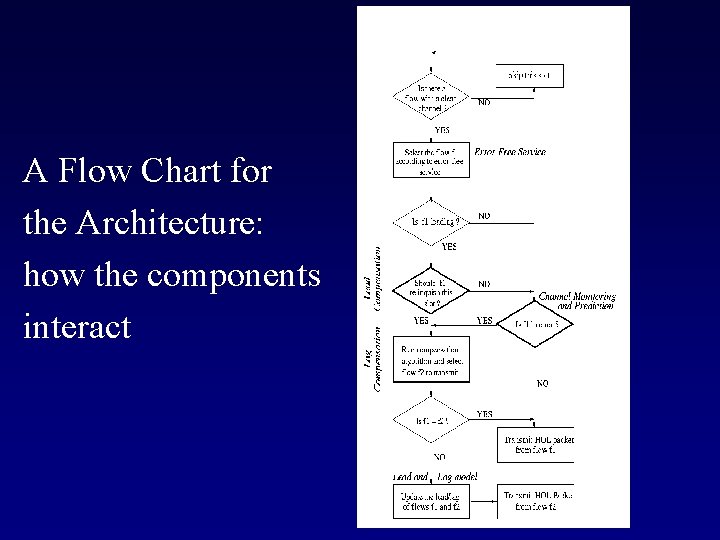
Unified Framework for Wireless Fair Queueing: Key Components • Error-Free Service Model: defines an Error-free service ideal fair service model assuming no channel error Compen. Lead & lag model • Lead and Lag Model: how much service amodel flow should relinquish or get compensated by • Compensation Model: compensate for MAC lagging flows at the expense of other flows • Slot Queues and Packet Queues: support Channel state for both delay sensitive and loss sensitive estimation flows in a framework • Channel State Monitoring and Estimation • MAC design
A Flow Chart for the Architecture: how the components interact
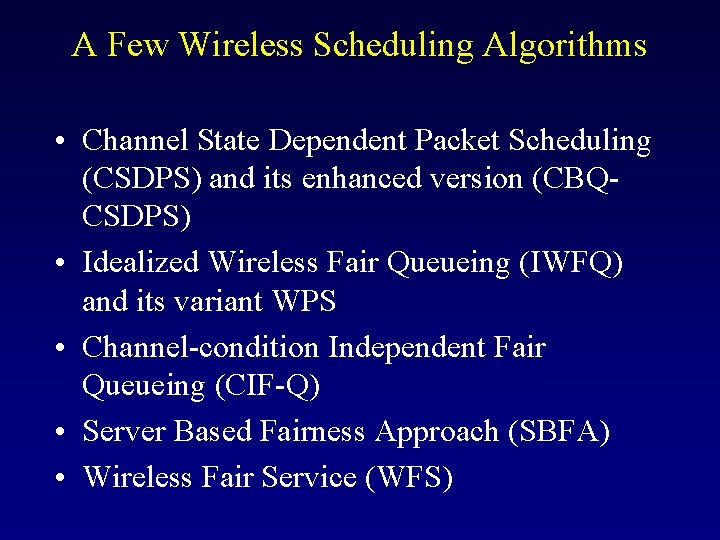
A Few Wireless Scheduling Algorithms • Channel State Dependent Packet Scheduling (CSDPS) and its enhanced version (CBQCSDPS) • Idealized Wireless Fair Queueing (IWFQ) and its variant WPS • Channel-condition Independent Fair Queueing (CIF-Q) • Server Based Fairness Approach (SBFA) • Wireless Fair Service (WFS)
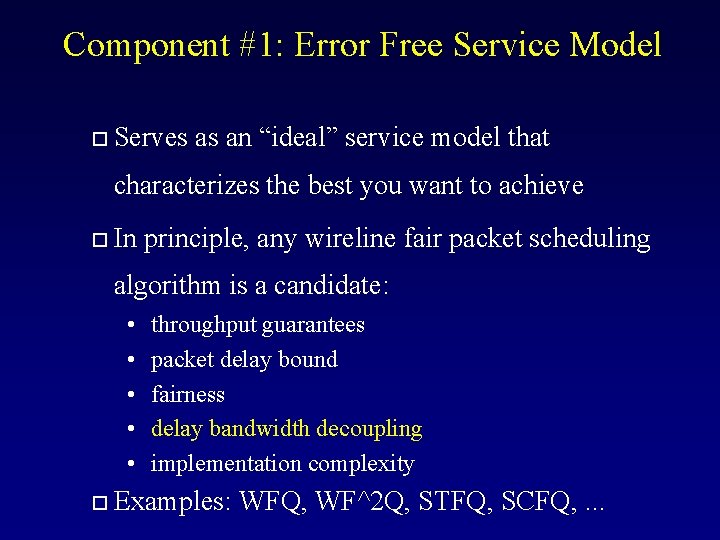
Component #1: Error Free Service Model o Serves as an “ideal” service model that characterizes the best you want to achieve o In principle, any wireline fair packet scheduling algorithm is a candidate: • • • o throughput guarantees packet delay bound fairness delay bandwidth decoupling implementation complexity Examples: WFQ, WF^2 Q, STFQ, SCFQ, . . .
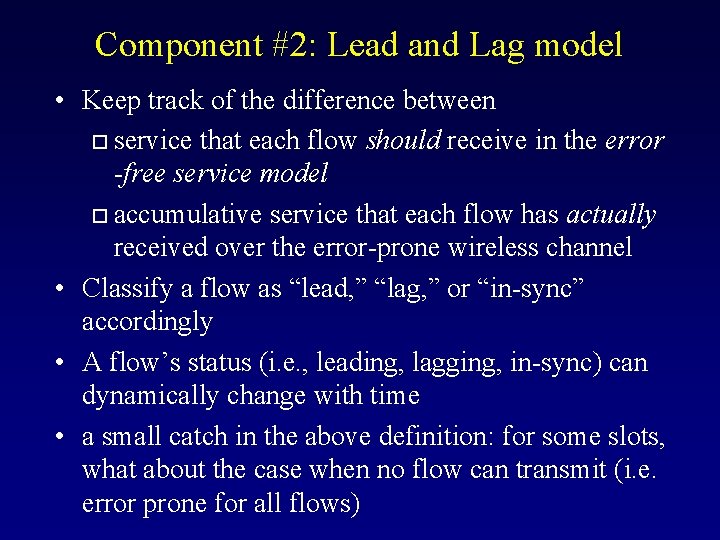
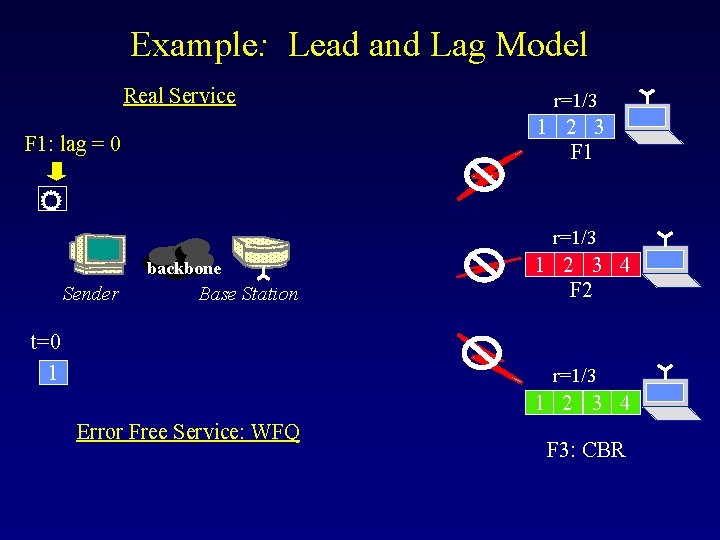
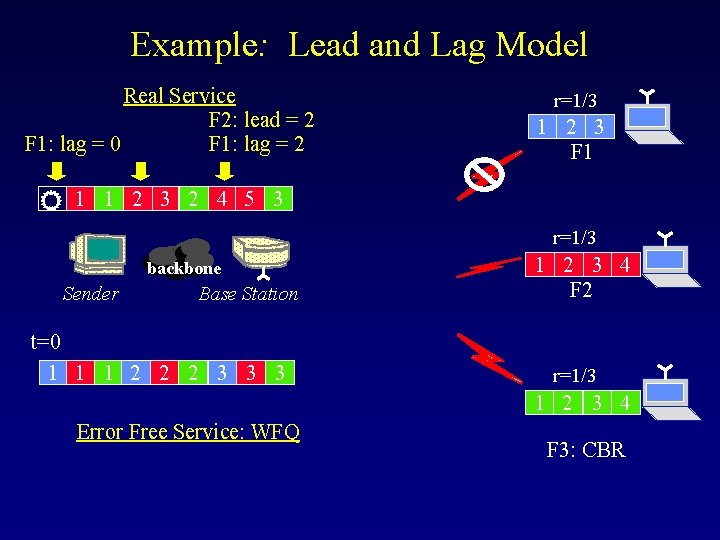
Component #2: Lead and Lag model • Keep track of the difference between o service that each flow should receive in the error -free service model o accumulative service that each flow has actually received over the error-prone wireless channel • Classify a flow as “lead, ” “lag, ” or “in-sync” accordingly • A flow’s status (i. e. , leading, lagging, in-sync) can dynamically change with time • a small catch in the above definition: for some slots, what about the case when no flow can transmit (i. e. error prone for all flows)
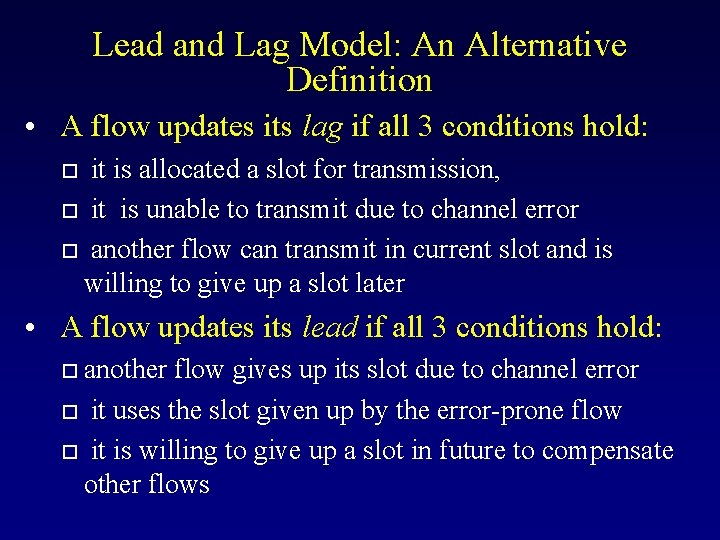
Lead and Lag Model: An Alternative Definition • A flow updates its lag if all 3 conditions hold: it is allocated a slot for transmission, o it is unable to transmit due to channel error o another flow can transmit in current slot and is willing to give up a slot later o • A flow updates its lead if all 3 conditions hold: another flow gives up its slot due to channel error o it uses the slot given up by the error-prone flow o it is willing to give up a slot in future to compensate other flows o
Example: Lead and Lag Model Real Service r=1/3 1 2 3 F 1: lag = 0 r=1/3 backbone Sender Base Station t=0 1 1 2 3 4 F 2 r=1/3 1 2 3 4 Error Free Service: WFQ F 3: CBR
Example: Lead and Lag Model Real Service F 2: lead = 2 F 1: lag = 0 F 1: lag = 2 r=1/3 1 2 3 F 1 1 1 2 3 2 4 5 3 r=1/3 backbone Sender Base Station t=0 1 1 1 2 2 2 3 3 3 1 2 3 4 F 2 r=1/3 1 2 3 4 Error Free Service: WFQ F 3: CBR
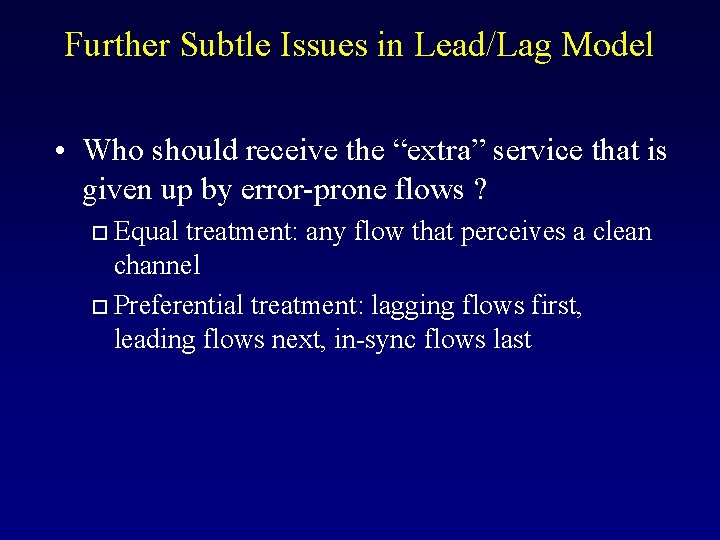
Further Subtle Issues in Lead/Lag Model • Who should receive the “extra” service that is given up by error-prone flows ? Equal treatment: any flow that perceives a clean channel o Preferential treatment: lagging flows first, leading flows next, in-sync flows last o
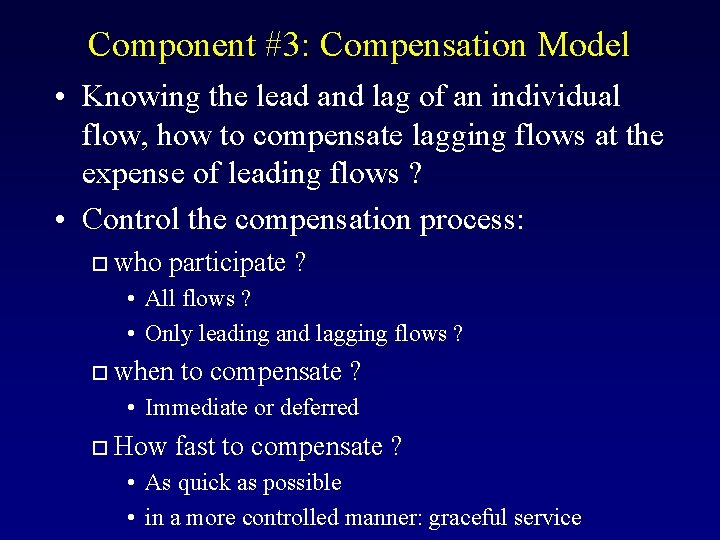
Component #3: Compensation Model • Knowing the lead and lag of an individual flow, how to compensate lagging flows at the expense of leading flows ? • Control the compensation process: o who participate ? • All flows ? • Only leading and lagging flows ? o when to compensate ? • Immediate or deferred o How fast to compensate ? • As quick as possible • in a more controlled manner: graceful service
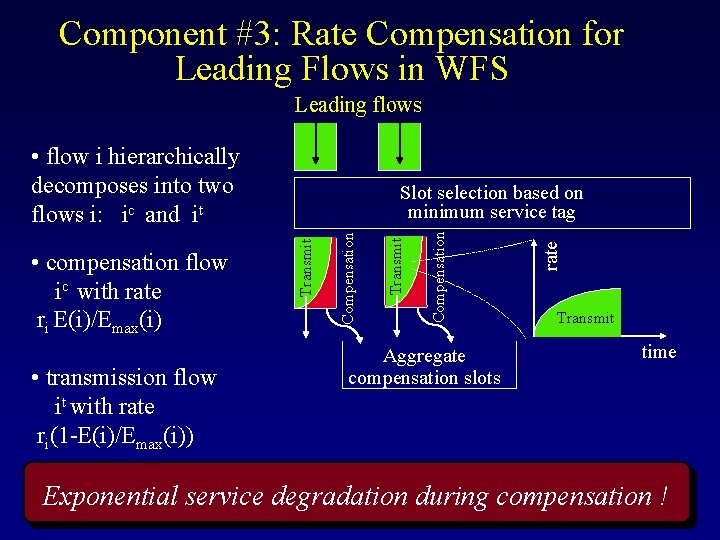
Component #3: Rate Compensation for Leading Flows in WFS Leading flows • flow i hierarchically decomposes into two flows i: ic and it • transmission flow it with rate ri(1 -E(i)/Emax(i)) Aggregate compensation slots rate Compensation Transmit • compensation flow ic with rate ri E(i)/Emax(i) Slot selection based on minimum service tag Transmit time Exponential service degradation during compensation !
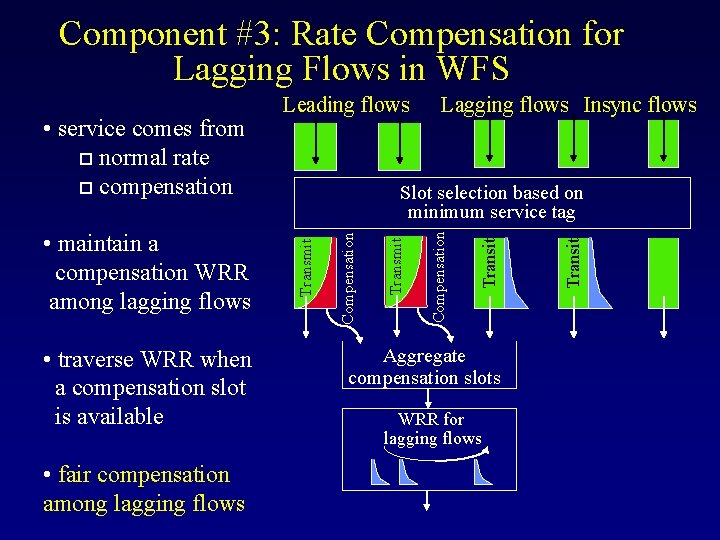
Component #3: Rate Compensation for Lagging Flows in WFS • traverse WRR when a compensation slot is available • fair compensation among lagging flows Aggregate compensation slots WRR for lagging flows Transit Compensation Transmit Compensation • maintain a compensation WRR among lagging flows Lagging flows Insync flows Slot selection based on minimum service tag Transmit • service comes from p normal rate p compensation Leading flows
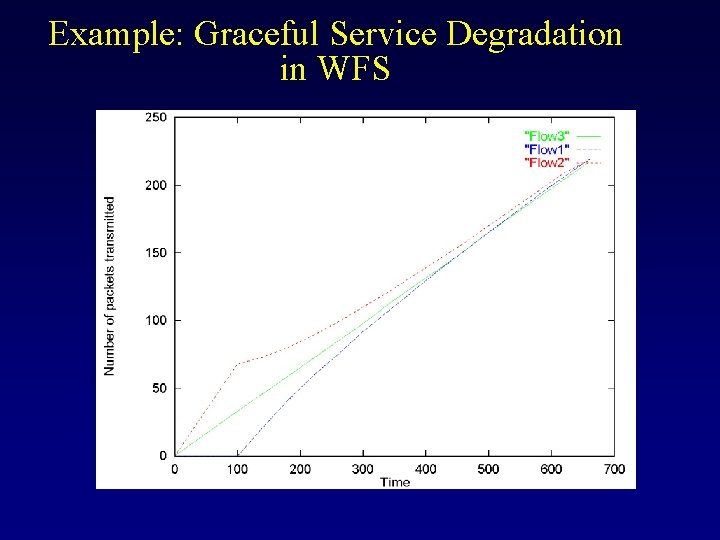
Example: Graceful Service Degradation in WFS
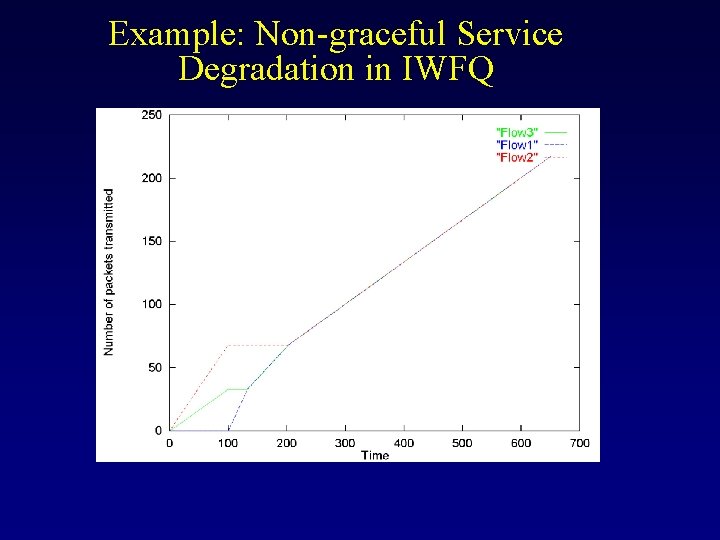
Example: Non-graceful Service Degradation in IWFQ
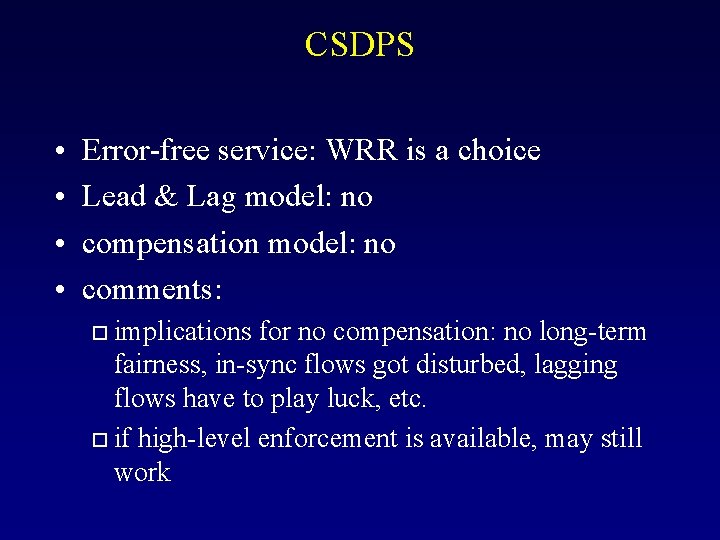
CSDPS • • Error-free service: WRR is a choice Lead & Lag model: no compensation model: no comments: implications for no compensation: no long-term fairness, in-sync flows got disturbed, lagging flows have to play luck, etc. o if high-level enforcement is available, may still work o
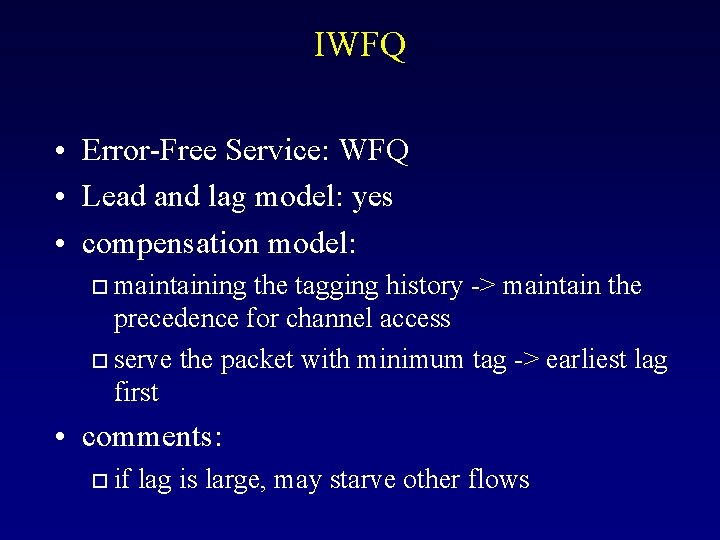
IWFQ • Error-Free Service: WFQ • Lead and lag model: yes • compensation model: maintaining the tagging history -> maintain the precedence for channel access o serve the packet with minimum tag -> earliest lag first o • comments: o if lag is large, may starve other flows
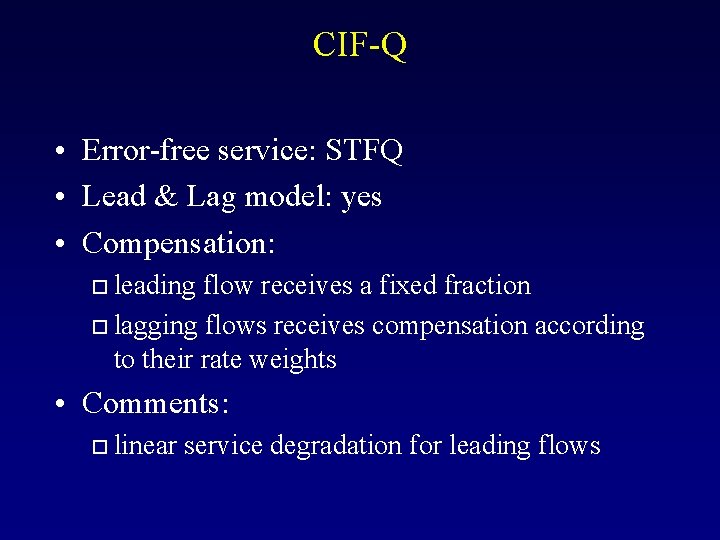
CIF-Q • Error-free service: STFQ • Lead & Lag model: yes • Compensation: leading flow receives a fixed fraction o lagging flows receives compensation according to their rate weights o • Comments: o linear service degradation for leading flows
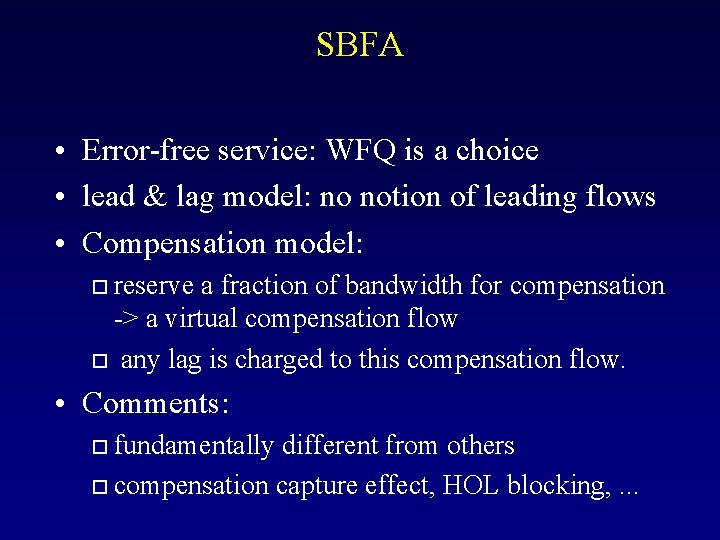
SBFA • Error-free service: WFQ is a choice • lead & lag model: no notion of leading flows • Compensation model: reserve a fraction of bandwidth for compensation -> a virtual compensation flow o any lag is charged to this compensation flow. o • Comments: fundamentally different from others o compensation capture effect, HOL blocking, . . . o
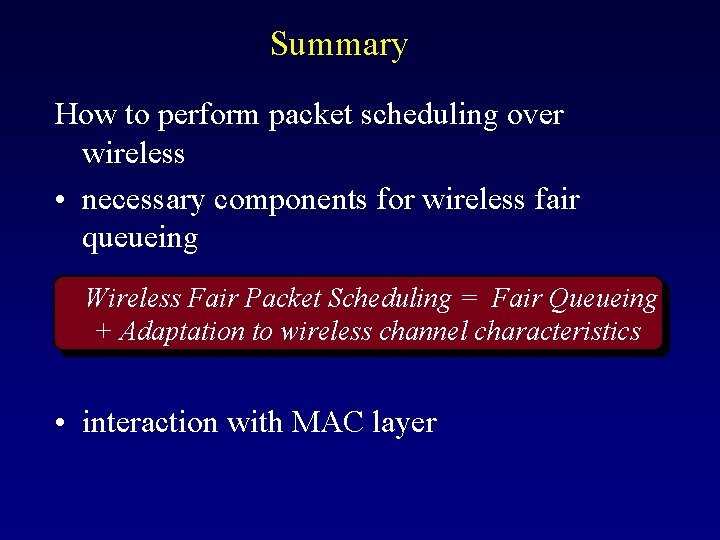
Summary How to perform packet scheduling over wireless • necessary components for wireless fair queueing Wireless Fair Packet Scheduling = Fair Queueing + Adaptation to wireless channel characteristics • interaction with MAC layer
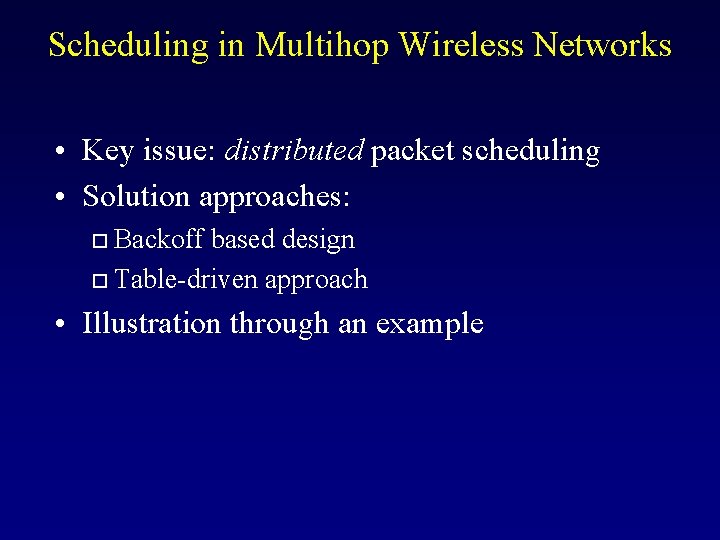
Scheduling in Multihop Wireless Networks • Key issue: distributed packet scheduling • Solution approaches: Backoff based design o Table-driven approach o • Illustration through an example