
Wireless Personal Communications Systems CSE 5807 Lecture 05

- Slides: 17
Wireless Personal Communications Systems – CSE 5807 Lecture: 05 Stephen Giles and Satha K. Sathananthan School of Computer Science and Software Engineering Monash University Australia These slides contain figures from Stallings, and are based on a set developed by Tom Fronckowiak. Lecture: 05 Wireless & Personal Communication Systems – CSE 5807
CDMA System • Multiple access: Direct sequence spread spectrum (DS-SS). • Uplink/Downlink: Frequency Division Duplexing. • Advantages: – Frequency diversity: • Frequency-dependent transmission impairments have less effect on signal. – Multipath resistance: • Chipping codes used for CDMA exhibit low cross correlation and low autocorrelation. – Privacy: • Privacy is inherent since spread spectrum is obtained by use of noiselike signals. – Graceful degradation: • System only gradually degrades as more users access the system Lecture: 05 Wireless & Personal Communication Systems – CSE 5807
CDMA System • Drawbacks: – Self-jamming: • Arriving transmissions from multiple users not aligned on chip boundaries unless users are perfectly synchronized. – Near-far problem: • Signals closer to the receiver are received with less attenuation than signals farther away. – Soft handoff: • Requires that the mobile acquires the new cell before it relinquishes the old. • This is more complex than hard handoff used in FDMA and TDMA schemes. Lecture: 05 Wireless & Personal Communication Systems – CSE 5807
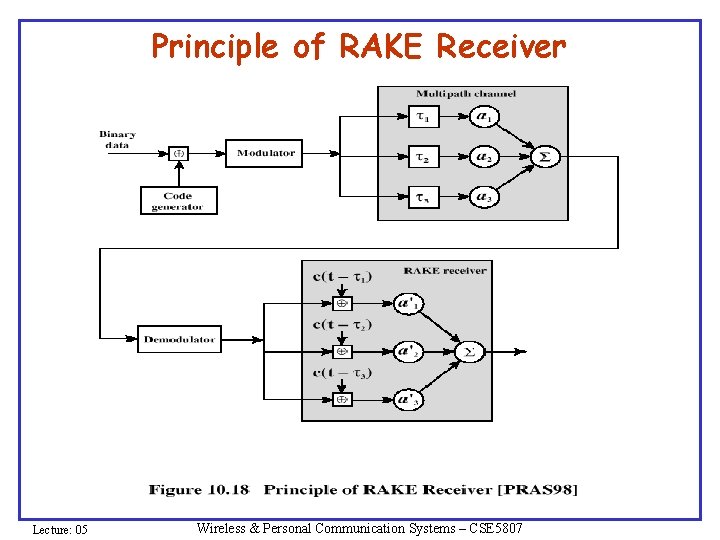
CDMA System • Design Consideration: – RAKE receiver: • When multiple versions of a signal arrive more than one chip interval apart, RAKE receiver attempts to recover signals from multiple paths and combine them. • This method achieves better performance than simply recovering dominant signal and treating remaining signals as noise – Soft Handoff: • Mobile station temporarily connected to more than one base station simultaneously. – Power control: • Multi-user interference is the major problem. Lecture: 05 Wireless & Personal Communication Systems – CSE 5807
Principle of RAKE Receiver Lecture: 05 Wireless & Personal Communication Systems – CSE 5807
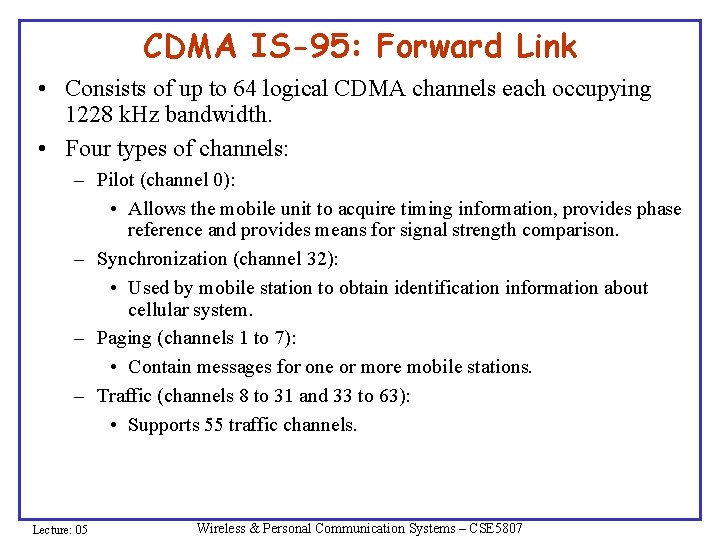
CDMA IS-95: Forward Link • Consists of up to 64 logical CDMA channels each occupying 1228 k. Hz bandwidth. • Four types of channels: – Pilot (channel 0): • Allows the mobile unit to acquire timing information, provides phase reference and provides means for signal strength comparison. – Synchronization (channel 32): • Used by mobile station to obtain identification information about cellular system. – Paging (channels 1 to 7): • Contain messages for one or more mobile stations. – Traffic (channels 8 to 31 and 33 to 63): • Supports 55 traffic channels. Lecture: 05 Wireless & Personal Communication Systems – CSE 5807
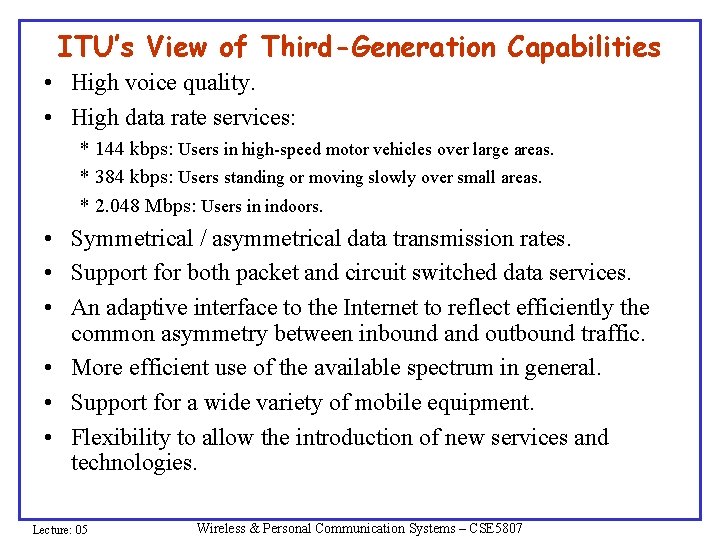
ITU’s View of Third-Generation Capabilities • High voice quality. • High data rate services: * 144 kbps: Users in high-speed motor vehicles over large areas. * 384 kbps: Users standing or moving slowly over small areas. * 2. 048 Mbps: Users in indoors. • Symmetrical / asymmetrical data transmission rates. • Support for both packet and circuit switched data services. • An adaptive interface to the Internet to reflect efficiently the common asymmetry between inbound and outbound traffic. • More efficient use of the available spectrum in general. • Support for a wide variety of mobile equipment. • Flexibility to allow the introduction of new services and technologies. Lecture: 05 Wireless & Personal Communication Systems – CSE 5807
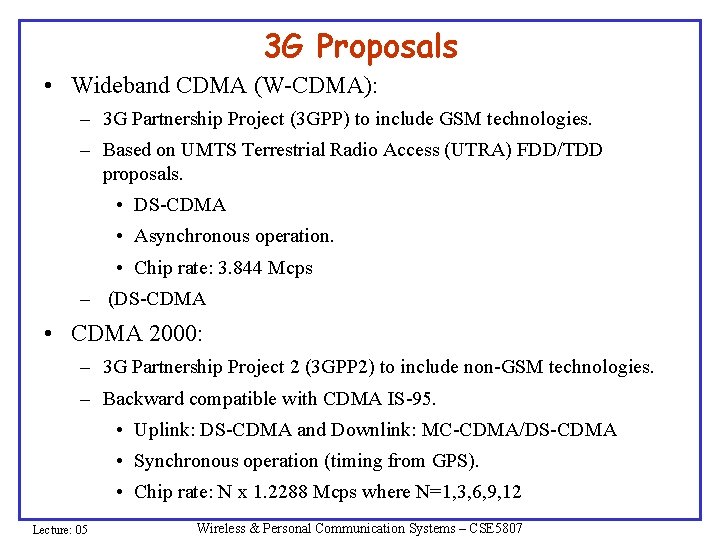
3 G Proposals • Wideband CDMA (W-CDMA): – 3 G Partnership Project (3 GPP) to include GSM technologies. – Based on UMTS Terrestrial Radio Access (UTRA) FDD/TDD proposals. • DS-CDMA • Asynchronous operation. • Chip rate: 3. 844 Mcps – (DS-CDMA • CDMA 2000: – 3 G Partnership Project 2 (3 GPP 2) to include non-GSM technologies. – Backward compatible with CDMA IS-95. • Uplink: DS-CDMA and Downlink: MC-CDMA/DS-CDMA • Synchronous operation (timing from GPS). • Chip rate: N x 1. 2288 Mcps where N=1, 3, 6, 9, 12 Lecture: 05 Wireless & Personal Communication Systems – CSE 5807
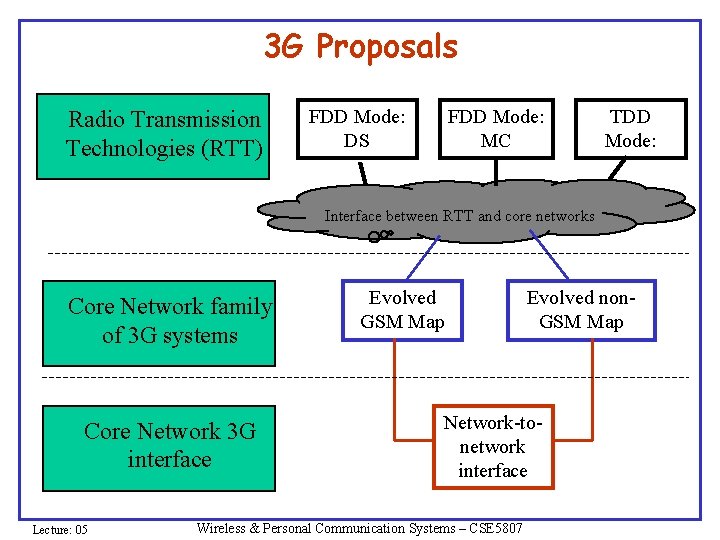
3 G Proposals Radio Transmission Technologies (RTT) FDD Mode: DS FDD Mode: MC TDD Mode: Interface between RTT and core networks Core Network family of 3 G systems Core Network 3 G interface Lecture: 05 Evolved GSM Map Evolved non. GSM Map Network-tonetwork interface Wireless & Personal Communication Systems – CSE 5807
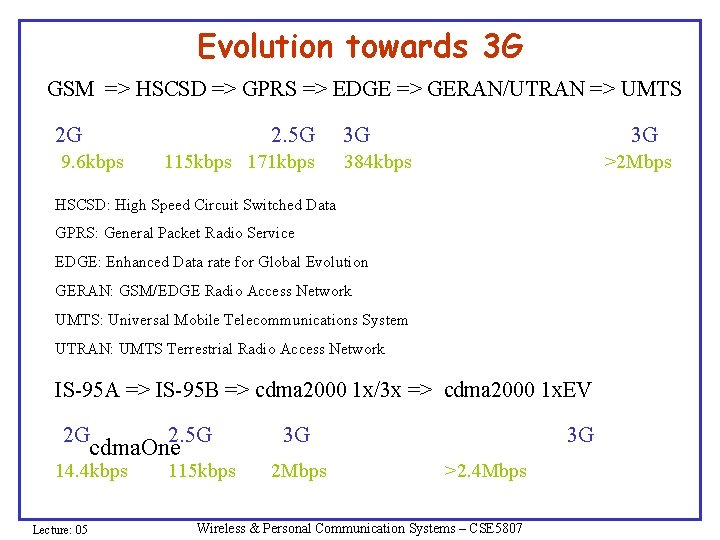
Evolution towards 3 G GSM => HSCSD => GPRS => EDGE => GERAN/UTRAN => UMTS 2 G 2. 5 G 9. 6 kbps 115 kbps 171 kbps 3 G 3 G 384 kbps >2 Mbps HSCSD: High Speed Circuit Switched Data GPRS: General Packet Radio Service EDGE: Enhanced Data rate for Global Evolution GERAN: GSM/EDGE Radio Access Network UMTS: Universal Mobile Telecommunications System UTRAN: UMTS Terrestrial Radio Access Network IS-95 A => IS-95 B => cdma 2000 1 x/3 x => cdma 2000 1 x. EV 2 G 2. 5 G cdma. One 14. 4 kbps Lecture: 05 115 kbps 3 G 2 Mbps 3 G >2. 4 Mbps Wireless & Personal Communication Systems – CSE 5807
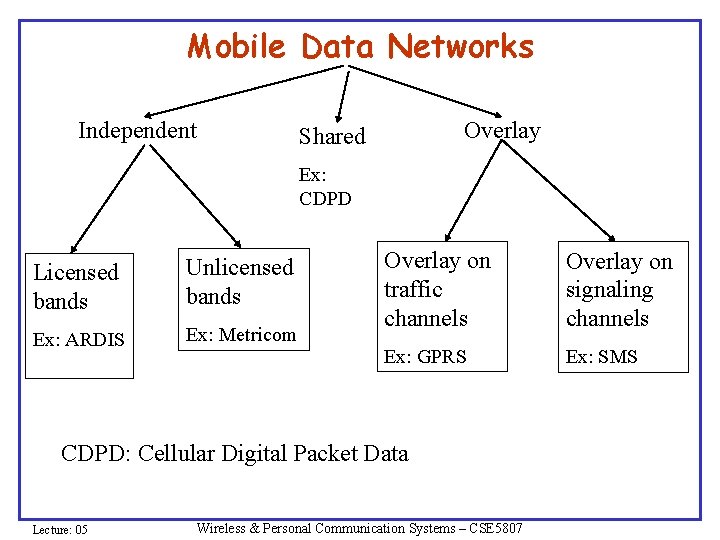
Mobile Data Networks Independent Overlay Shared Ex: CDPD Licensed bands Unlicensed bands Ex: ARDIS Ex: Metricom Overlay on traffic channels Overlay on signaling channels Ex: GPRS Ex: SMS CDPD: Cellular Digital Packet Data Lecture: 05 Wireless & Personal Communication Systems – CSE 5807
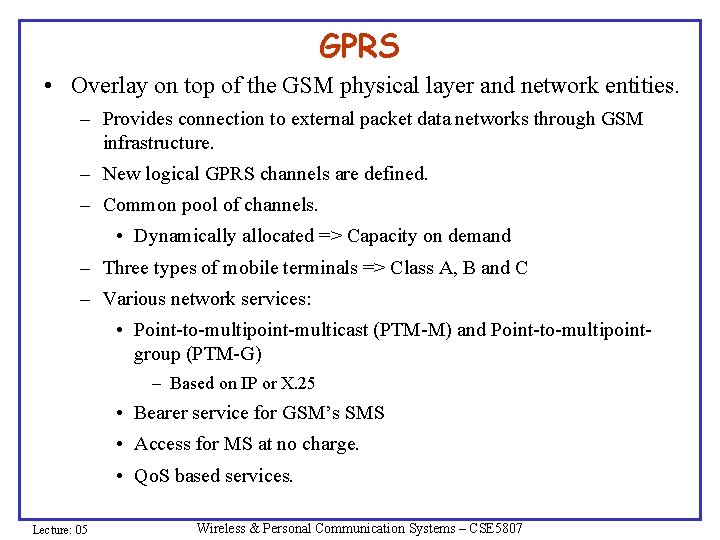
GPRS • Overlay on top of the GSM physical layer and network entities. – Provides connection to external packet data networks through GSM infrastructure. – New logical GPRS channels are defined. – Common pool of channels. • Dynamically allocated => Capacity on demand – Three types of mobile terminals => Class A, B and C – Various network services: • Point-to-multipoint-multicast (PTM-M) and Point-to-multipointgroup (PTM-G) – Based on IP or X. 25 • Bearer service for GSM’s SMS • Access for MS at no charge. • Qo. S based services. Lecture: 05 Wireless & Personal Communication Systems – CSE 5807
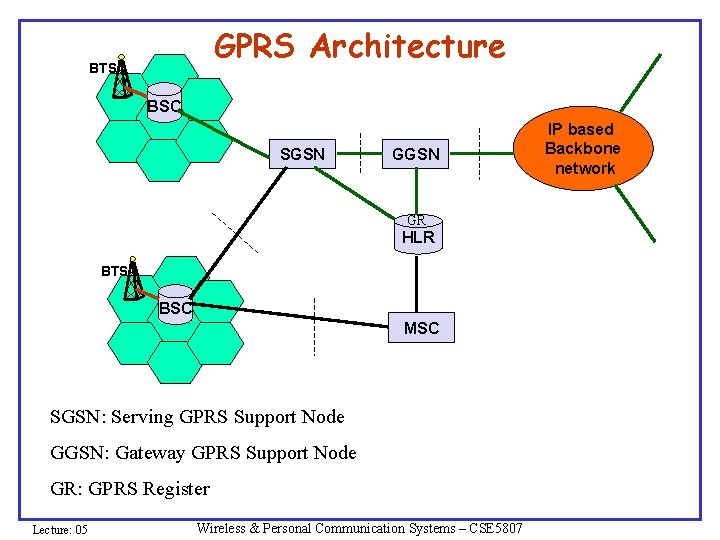
GPRS Architecture BTS BSC SGSN GR HLR BTS BSC MSC SGSN: Serving GPRS Support Node GGSN: Gateway GPRS Support Node GR: GPRS Register Lecture: 05 Wireless & Personal Communication Systems – CSE 5807 IP based Backbone network
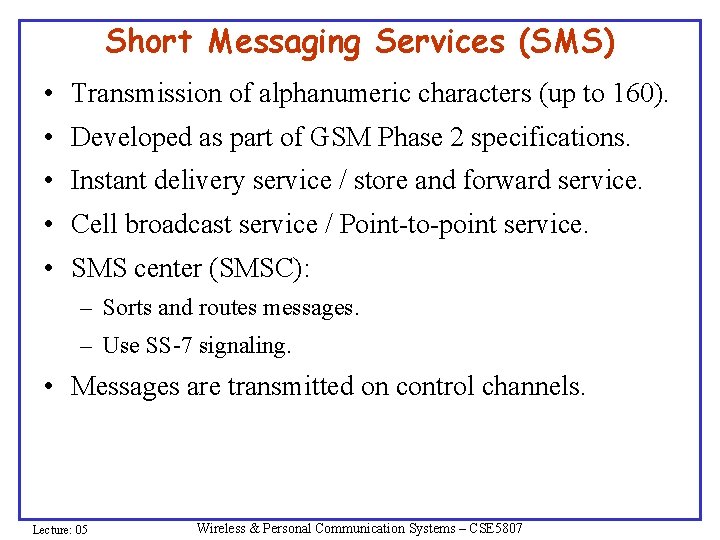
Short Messaging Services (SMS) • Transmission of alphanumeric characters (up to 160). • Developed as part of GSM Phase 2 specifications. • Instant delivery service / store and forward service. • Cell broadcast service / Point-to-point service. • SMS center (SMSC): – Sorts and routes messages. – Use SS-7 signaling. • Messages are transmitted on control channels. Lecture: 05 Wireless & Personal Communication Systems – CSE 5807
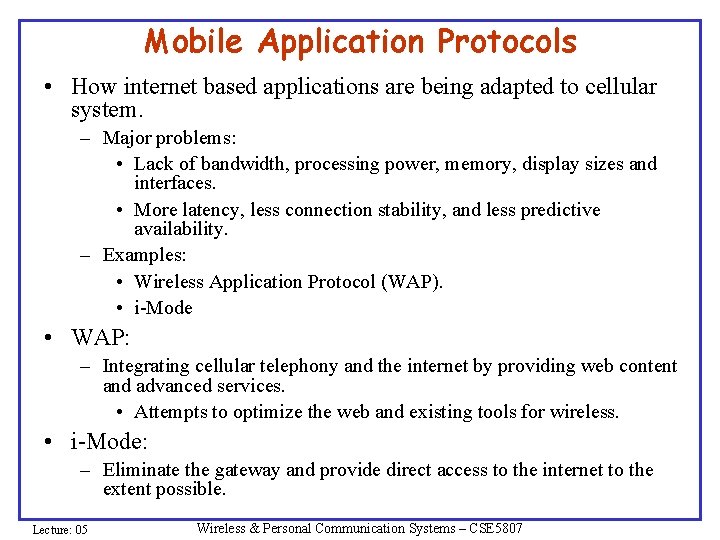
Mobile Application Protocols • How internet based applications are being adapted to cellular system. – Major problems: • Lack of bandwidth, processing power, memory, display sizes and interfaces. • More latency, less connection stability, and less predictive availability. – Examples: • Wireless Application Protocol (WAP). • i-Mode • WAP: – Integrating cellular telephony and the internet by providing web content and advanced services. • Attempts to optimize the web and existing tools for wireless. • i-Mode: – Eliminate the gateway and provide direct access to the internet to the extent possible. Lecture: 05 Wireless & Personal Communication Systems – CSE 5807
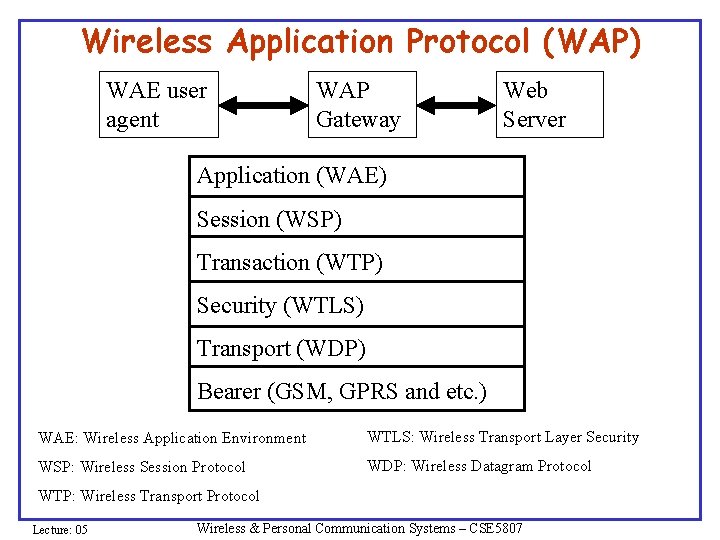
Wireless Application Protocol (WAP) WAE user agent WAP Gateway Web Server Application (WAE) Session (WSP) Transaction (WTP) Security (WTLS) Transport (WDP) Bearer (GSM, GPRS and etc. ) WAE: Wireless Application Environment WTLS: Wireless Transport Layer Security WSP: Wireless Session Protocol WDP: Wireless Datagram Protocol WTP: Wireless Transport Protocol Lecture: 05 Wireless & Personal Communication Systems – CSE 5807
Required Reading • W. Stallings, “Wireless Communications and Networks” Prentice-Hall, 2000. >> Chapter 10 Reference • K. Pahlavan and K. Krishnamurthy “Principles of Wireless Networks”, Prentice-Hall, 2002. Lecture: 05 Wireless & Personal Communication Systems – CSE 5807