
Wireless Networks 1 l Cellular and line telephone

- Slides: 27
Wireless Networks 1 l Cellular and line telephone systems are responsible for providing coverage throughout a coverage region or market l The interconnection of many such systems defines a wireless network over the world
Types of Networks 2 Fixed Networks(PSTN) Wireless Network • Highly static • High bandwidth possible (fiber Optic or coaxial) • Highly dynamic • Low RF bandwidth provided for each user
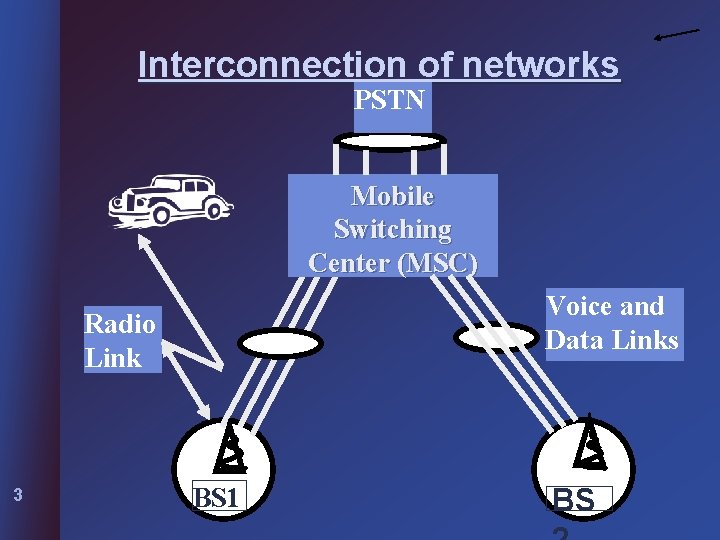
Interconnection of networks PSTN Mobile Switching Center (MSC) Voice and Data Links Radio Link 3 BS 1 BS
Functions of PSTN l l 4 Highly integrated communications network that connects the world’s population Each country is responsible for the regulation of PSTN within it’s borders. PSTN has a network of fixed telephone exchanges Over time, transition has occurred from manual to automatic exchanges
History of PSTN network 5 l Controlled by long distance companies like AT&T, Sprint, Verizon l 1984 – Supreme Court issued Modified Final Judgement (MFJ) l Break up of AT&T into 7 major Bell operating companies (BOCs) each with its own service region.
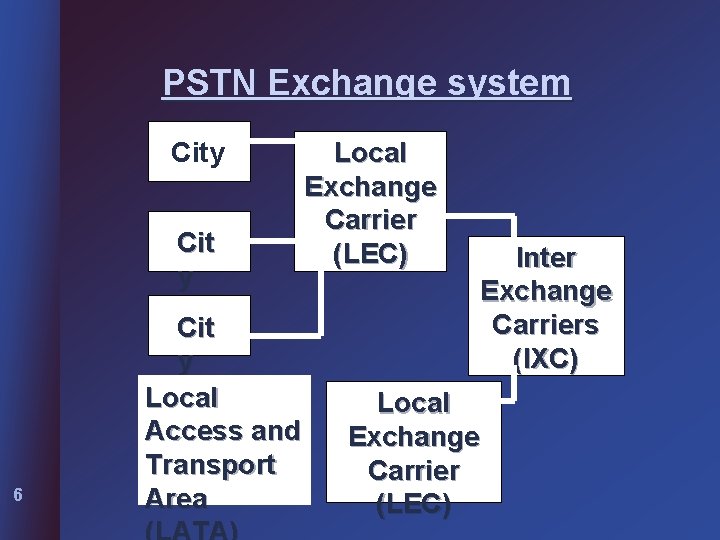
PSTN Exchange system City Cit y 6 Cit y Local Access and Transport Area Local Exchange Carrier (LEC) Inter Exchange Carriers (IXC) Local Exchange Carrier (LEC)
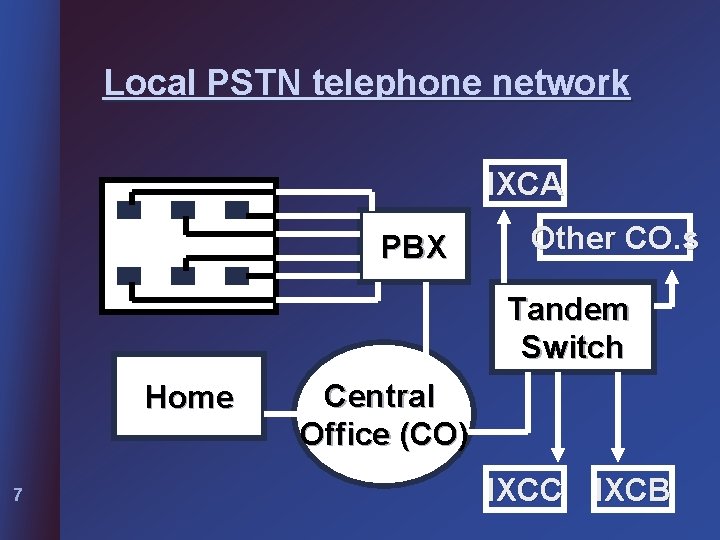
Local PSTN telephone network IXCA PBX Other CO. s Tandem Switch Home 7 Central Office (CO) IXCC IXCB
Wireless Networks l l 8 Wireless Networks are extremely complex, unlike static fixed telephone networks. Wireless networks requires air interface between base stations and randomly spaced subscribers Complex propagation media MSC provides connection to PSTN and other MSCs
Functions of MSC 9 l Provides overall System control for each region l Maintains mobile related information and handoff control l Performs all call processing; billing; fraud detection within the market
Wireless network comparison 10 First, second and third generations l Modulation techniques (Analog, Digital, Spread Spectrum) l Switching (channel) techniques (Circuit switching, packet switching) l Signaling (control) techniques (in-band, CCS) l Practical systems (USDC, GSM, CDMA) l Network capabilities
First Generation Networks l l l 11 Analog Technology -FM modulation AMPS (Advanced Mobile Phone Services) – in U. S. Mobile Terminals Base Stations MSCs PSTN is separate network from the signaling network (non CCS)
IS-41 Network Protocol l l 12 l Network protocol standard to allow automatic registration of roamers – inter-operator roaming Allow MSCs of different service providers to pass information about subscribers to other MSCs on demand HLR – Home Location Register – real time user list VLR – Visitor Location Register AUC – Authentication Center
Roaming process l l 13 l Mobile periodically keys up and transmits identity information which allows MSC to constantly update it’s customer list. The registration command is sent in over control channels at 5 -10 minute intervals MIN – Mobile Identification Number (Telephone No. ) ESN – Electronic Serial Number
Registration l l l 14 l By comparing MIN of roaming subscriber with HLR database, the MSC identifies roamers MSC sends registration request over landline signaling network to subscriber’s home MSC Home MSC validates roamer’s MIN and ESN and returns a customer profile to visited MSC Home and visitor MSC update their HLR and VLR
Switching in Networks 15 l First generation Circuit Switching l MSC dedicates a voice channel connection between base station and PSTN for duration of cell phone call l As calls are initiated and completed, different radio circuits and dedicated PSTN voice circuits are switched in and out to handle traffic
l l 16 Second Generation Wireless Networks Employ digital modulation and have advanced call processing capabilities. Examples: o Global system for Mobile (GSM) o DECT (Digital European Cordless Telephone) o Cordless Telephone (CT 2) -British system o JDC – Japanese Digital Cellular system
Packet Switching network l l 17 Second generation switching network Packet Switching implements connectionless services for large number of data users, who remain virtually connected Packet switching breaks each message into smaller units for transmission and recovery When a message is broken into packets, control information is added to each packet to provide source/
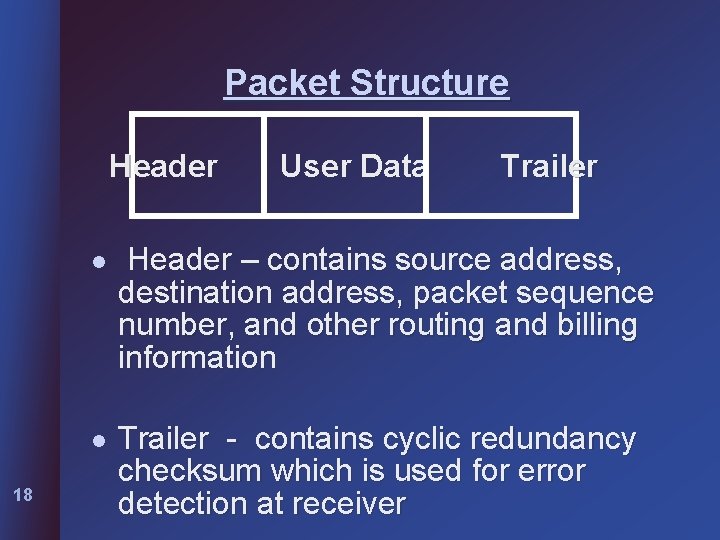
Packet Structure Header 18 User Data Trailer l Header – contains source address, destination address, packet sequence number, and other routing and billing information l Trailer - contains cyclic redundancy checksum which is used for error detection at receiver
Advances in Second Generation Networks l l l 19 While 1 st generation systems were primarily designed for voice, second generation networks provide paging, facsimile and high –data rate network access Handoff is mobile-controlled. MAHO(Mobile assisted Handoff) The mobile units in this generation perform functions like received power reporting, adjacent base station scanning, data encoding
Common Channel Signaling (CCS) l l 20 Second generation signaling network Digital Technique that provides simultaneous transmission of user data, signaling data and other related traffic through a network. Advantage – high speed signaling is not limited by low speed voice data Substantial increase in the number of users
Advantages of CCS 21 l Advantage – high speed signaling is not limited by low speed voice data l Substantial increase in the number of users
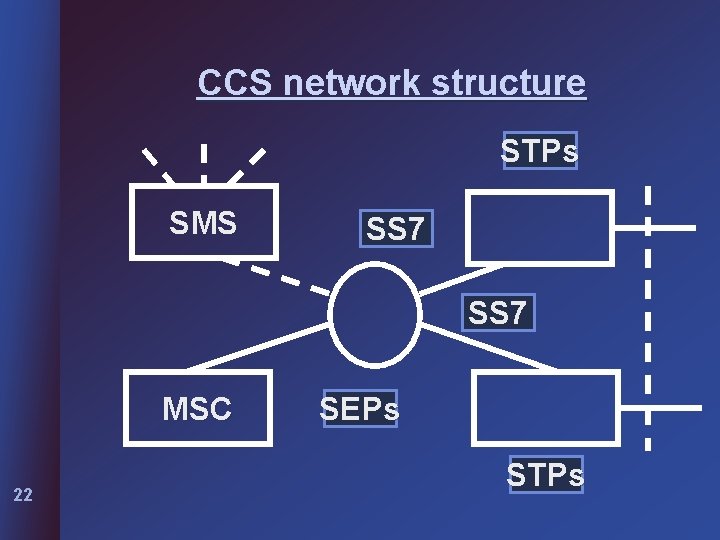
CCS network structure STPs SMS SS 7 MSC 22 SEPs STPs
CCS network components l l l 23 CCS network architecture is composed of geographically distributed central switching offices. Service Management system (SMS) Switching end points (SEPs) Signaling transfer points(STPs) Database service management system(DBAS)
Third Generation Wireless Networks l 24 Aim is to provide a single set of standards that can meet a wide range of wireless applications, and provide universal access around the globe => voice, data and video
Integrated Services Digital Network (ISDN) l l 25 Parallel worldwide network for CCS signaling traffic that can be used to either route traffic on PSTN or provide new services between network nodes and end users ISDN has 2 types of channels: o Information bearing channels called Bearer channels (B channels) o Out of band signaling channels, called data channels (D channels)
Broadband ISDN (B-ISDN) 26 l End user applications require greater bandwidth for computer systems and video imaging l Based on asynchronous transfer mode (ATM) technology which allows packet switching – 100 Gbps
Future Wireless Networks l l 27 Based on B-ISDN to provide access to information networks such as Internet and other public and private databases PCS - Personal Communication System PCN - Personal Communication Network International Mobile Telecommunication (IMT – 2000)