
Wireless Networking and Communications Group MIMO RECEIVER DESIGN

![References 14 RFI Modeling [1] D. Middleton, “Non-Gaussian noise models in signal processing for](https://slidetodoc.com/presentation_image_h/0001bd0bb92194bb86bd9589c048f7f3/image-14.jpg "References 14 RFI Modeling [1] D. Middleton, “Non-Gaussian noise models in signal processing for")
![References (cont…) 15 Filtering and Detection [8] A. Spaulding and D. Middleton, “Optimum Reception](https://slidetodoc.com/presentation_image_h/0001bd0bb92194bb86bd9589c048f7f3/image-15.jpg "References (cont…) 15 Filtering and Detection [8] A. Spaulding and D. Middleton, “Optimum Reception")
![Assumptions for RFI Modeling 22 Key Assumptions [Middleton, 1977][Furutsu & Ishida, 1961] Infinitely many](https://slidetodoc.com/presentation_image_h/0001bd0bb92194bb86bd9589c048f7f3/image-22.jpg "Assumptions for RFI Modeling 22 Key Assumptions [Middleton, 1977][Furutsu & Ishida, 1961] Infinitely many")
![Middleton Class A, B and C Models 23 Return [Middleton, 1999] Class A Class](https://slidetodoc.com/presentation_image_h/0001bd0bb92194bb86bd9589c048f7f3/image-23.jpg "Middleton Class A, B and C Models 23 Return [Middleton, 1999] Class A Class")
- Slides: 37
Wireless Networking and Communications Group MIMO RECEIVER DESIGN IN THE PRESENCE OF RADIO FREQUENCY INTERFERENCE Kapil Gulati†, Aditya Chopra†, Robert W. Heath Jr. †, Brian L. Evans†, Keith R. Tinsley ‡ and Xintian E. Lin‡ †The University of Texas at Austin ‡ Intel Corporation 2 DECEMBER 2008 IEEE Globecom 2008
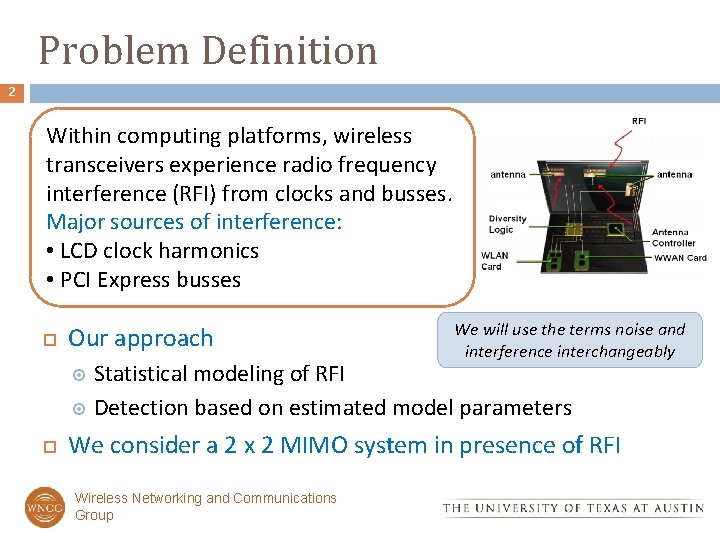
Problem Definition 2 Within computing platforms, wireless transceivers experience radio frequency interference (RFI) from clocks and busses. Major sources of interference: • LCD clock harmonics • PCI Express busses Our approach We will use the terms noise and interference interchangeably Statistical modeling of RFI Detection based on estimated model parameters We consider a 2 x 2 MIMO system in presence of RFI Wireless Networking and Communications Group
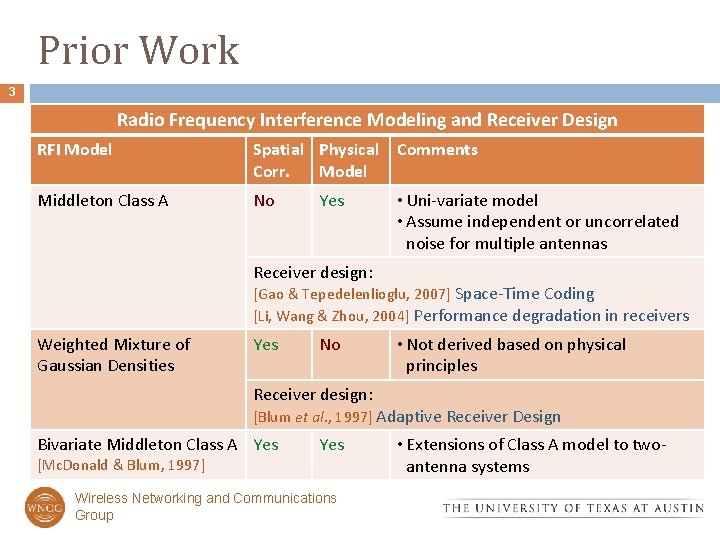
Prior Work 3 Radio Frequency Interference Modeling and Receiver Design RFI Model Spatial Physical Comments Corr. Model Middleton Class A No Yes • Uni-variate model • Assume independent or uncorrelated noise for multiple antennas Receiver design: [Gao & Tepedelenlioglu, 2007] Space-Time Coding [Li, Wang & Zhou, 2004] Performance degradation in receivers Weighted Mixture of Gaussian Densities Yes No • Not derived based on physical principles Receiver design: [Blum et al. , 1997] Adaptive Receiver Design Bivariate Middleton Class A Yes [Mc. Donald & Blum, 1997] Yes Wireless Networking and Communications Group • Extensions of Class A model to twoantenna systems
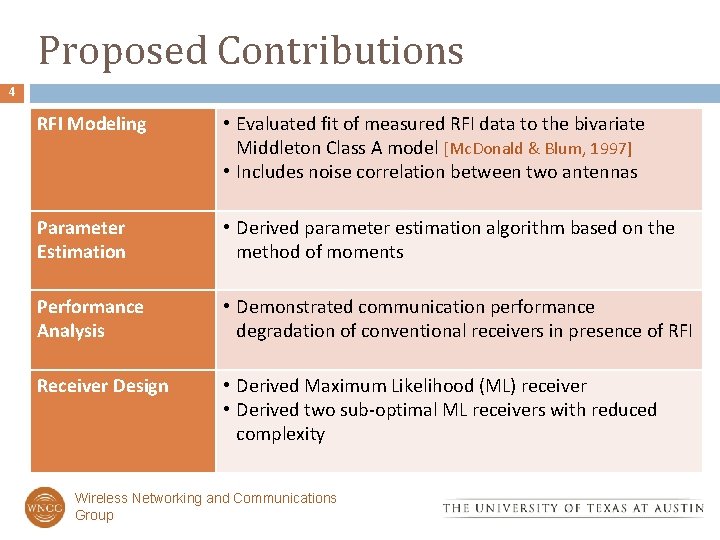
Proposed Contributions 4 RFI Modeling • Evaluated fit of measured RFI data to the bivariate Middleton Class A model [Mc. Donald & Blum, 1997] • Includes noise correlation between two antennas Parameter Estimation • Derived parameter estimation algorithm based on the method of moments Performance Analysis • Demonstrated communication performance degradation of conventional receivers in presence of RFI Receiver Design • Derived Maximum Likelihood (ML) receiver • Derived two sub-optimal ML receivers with reduced complexity Wireless Networking and Communications Group
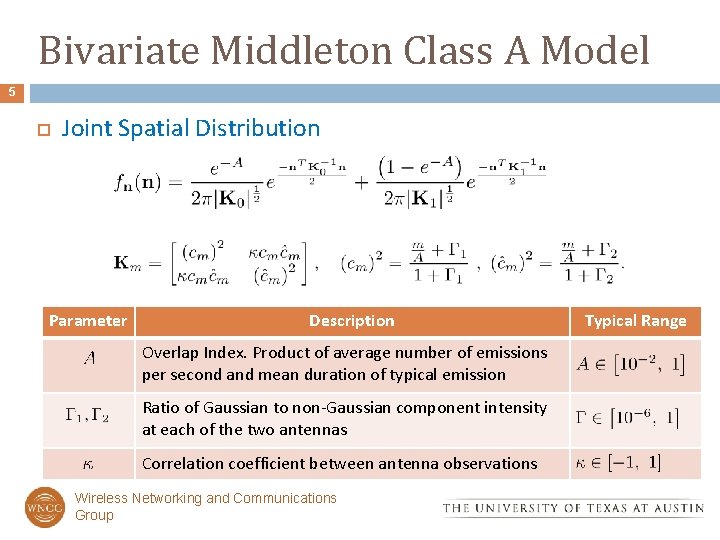
Bivariate Middleton Class A Model 5 Joint Spatial Distribution Parameter Description Overlap Index. Product of average number of emissions per second and mean duration of typical emission Ratio of Gaussian to non-Gaussian component intensity at each of the two antennas Correlation coefficient between antenna observations Wireless Networking and Communications Group Typical Range
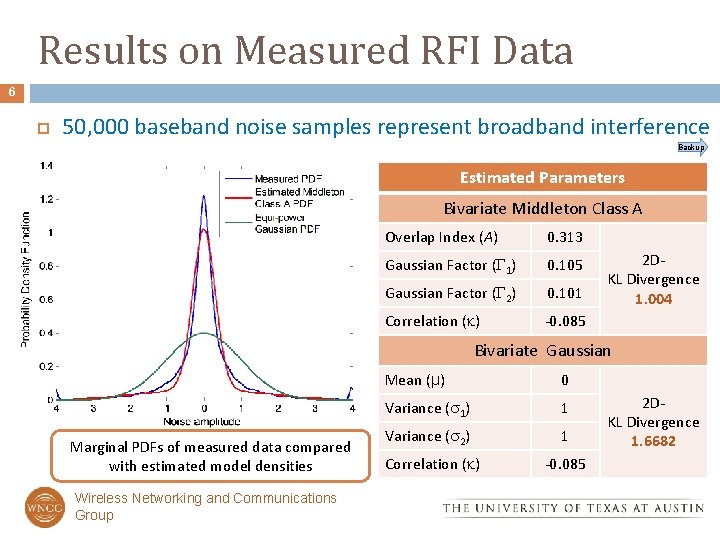
Results on Measured RFI Data 6 50, 000 baseband noise samples represent broadband interference Backup Estimated Parameters Bivariate Middleton Class A Overlap Index (A) 0. 313 Gaussian Factor ( 1) 0. 105 Gaussian Factor ( 2) 0. 101 Correlation (k) -0. 085 2 DKL Divergence 1. 004 Bivariate Gaussian Marginal PDFs of measured data compared with estimated model densities Wireless Networking and Communications Group Mean (µ) 0 Variance (s 1) 1 Variance (s 2) 1 Correlation (k) -0. 085 2 DKL Divergence 1. 6682
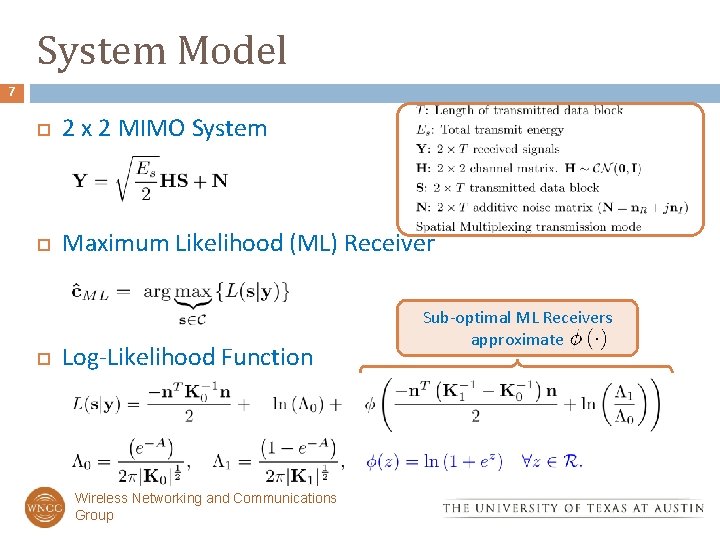
System Model 7 2 x 2 MIMO System Maximum Likelihood (ML) Receiver Log-Likelihood Function Wireless Networking and Communications Group Sub-optimal ML Receivers approximate
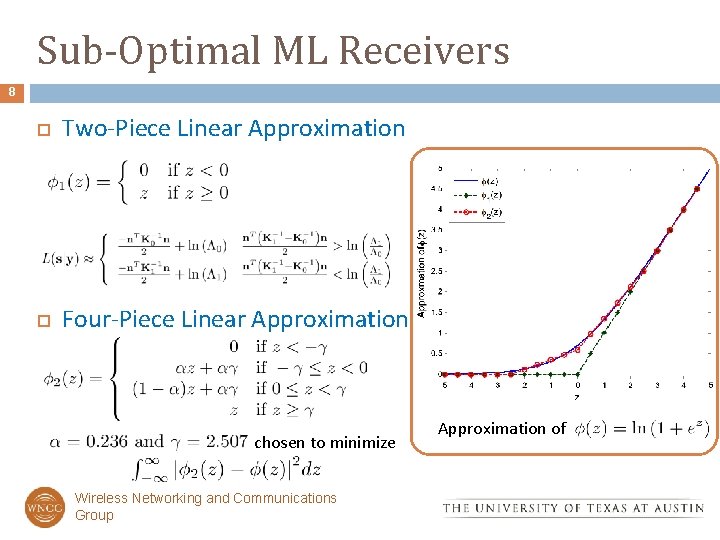
Sub-Optimal ML Receivers 8 Two-Piece Linear Approximation Four-Piece Linear Approximation chosen to minimize Wireless Networking and Communications Group Approximation of
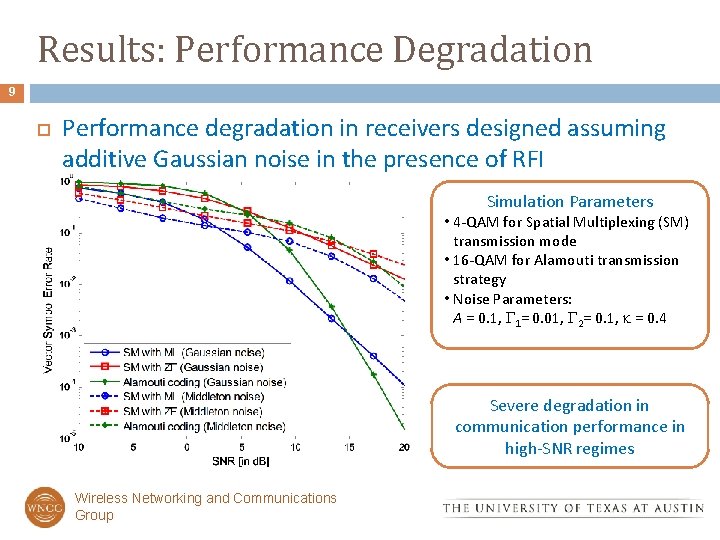
Results: Performance Degradation 9 Performance degradation in receivers designed assuming additive Gaussian noise in the presence of RFI Simulation Parameters • 4 -QAM for Spatial Multiplexing (SM) transmission mode • 16 -QAM for Alamouti transmission strategy • Noise Parameters: A = 0. 1, 1= 0. 01, 2= 0. 1, k = 0. 4 Severe degradation in communication performance in high-SNR regimes Wireless Networking and Communications Group
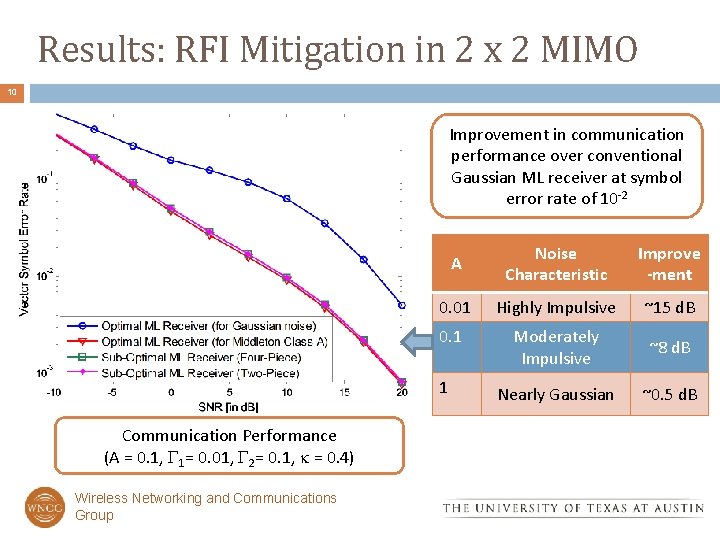
Results: RFI Mitigation in 2 x 2 MIMO 10 Improvement in communication performance over conventional Gaussian ML receiver at symbol error rate of 10 -2 A Noise Characteristic Improve -ment 0. 01 Highly Impulsive ~15 d. B 0. 1 Moderately Impulsive ~8 d. B Nearly Gaussian ~0. 5 d. B 1 Communication Performance (A = 0. 1, 1= 0. 01, 2= 0. 1, k = 0. 4) Wireless Networking and Communications Group
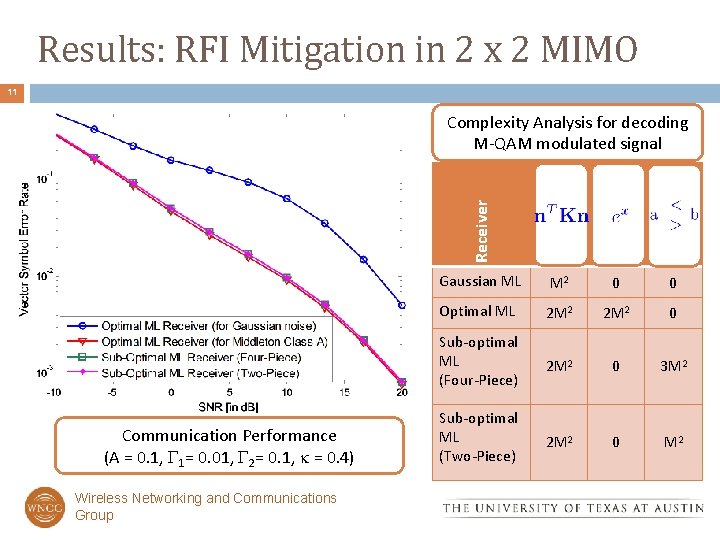
Results: RFI Mitigation in 2 x 2 MIMO 11 Receiver Quadratic Forms Exponential Comparisons Complexity Analysis for decoding M-QAM modulated signal Gaussian ML M 2 0 0 Optimal ML 2 M 2 0 Sub-optimal ML (Four-Piece) 2 M 2 0 3 M 2 Sub-optimal ML (Two-Piece) 2 M 2 0 M 2 Complexity Analysis Communication Performance (A = 0. 1, 1= 0. 01, 2= 0. 1, k = 0. 4) Wireless Networking and Communications Group
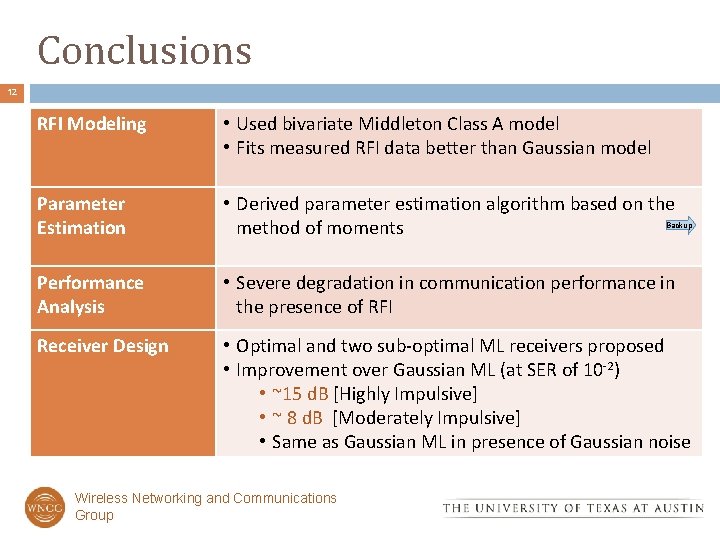
Conclusions 12 RFI Modeling • Used bivariate Middleton Class A model • Fits measured RFI data better than Gaussian model Parameter Estimation • Derived parameter estimation algorithm based on the method of moments Performance Analysis • Severe degradation in communication performance in the presence of RFI Receiver Design • Optimal and two sub-optimal ML receivers proposed • Improvement over Gaussian ML (at SER of 10 -2) • ~15 d. B [Highly Impulsive] • ~ 8 d. B [Moderately Impulsive] • Same as Gaussian ML in presence of Gaussian noise Backup Wireless Networking and Communications Group
13 Thank You, Questions ? Wireless Networking and Communications Group
References 14 RFI Modeling [1] D. Middleton, “Non-Gaussian noise models in signal processing for telecommunications: New methods and results for Class A and Class B noise models”, IEEE Trans. Info. Theory, vol. 45, no. 4, pp. 1129 -1149, May 1999. [2] K. F. Mc. Donald and R. S. Blum. “A physically-based impulsive noise model for array observations”, Proc. IEEE Asilomar Conference on Signals, Systems& Computers, vol 1, 2 -5 Nov. 1997. [3] K. Furutsu and T. Ishida, “On theory of amplitude distributions of impulsive random noise, ” J. Appl. Phys. , vol. 32, no. 7, pp. 1206– 1221, 1961. [4] J. Ilow and D. Hatzinakos, “Analytic alpha-stable noise modeling in a Poisson field of interferers or scatterers”, IEEE transactions on signal processing, vol. 46, no. 6, pp. 1601 -1611, 1998. Parameter Estimation [5] S. M. Zabin and H. V. Poor, “Efficient estimation of Class A noise parameters via the EM [Expectation-Maximization] algorithms”, IEEE Trans. Info. Theory, vol. 37, no. 1, pp. 60 -72, Jan. 1991 [6] G. A. Tsihrintzis and C. L. Nikias, "Fast estimation of the parameters of alpha-stable impulsive interference", IEEE Trans. Signal Proc. , vol. 44, Issue 6, pp. 1492 -1503, Jun. 1996 RFI Measurements and Impact [7] J. Shi, A. Bettner, G. Chinn, K. Slattery and X. Dong, "A study of platform EMI from LCD panels - impact on wireless, root causes and mitigation methods, “ IEEE International Symposium on Electromagnetic Compatibility, vol. 3, no. , pp. 626 -631, 14 -18 Aug. 2006 Wireless Networking and Communications Group
References (cont…) 15 Filtering and Detection [8] A. Spaulding and D. Middleton, “Optimum Reception in an Impulsive Interference Environment. Part I: Coherent Detection”, IEEE Trans. Comm. , vol. 25, no. 9, Sep. 1977 [9] A. Spaulding and D. Middleton, “Optimum Reception in an Impulsive Interference Environment Part II: Incoherent Detection”, IEEE Trans. Comm. , vol. 25, no. 9, Sep. 1977 [10] J. G. Gonzalez and G. R. Arce, “Optimality of the Myriad Filter in Practical Impulsive-Noise Environments”, IEEE Trans. on Signal Processing, vol 49, no. 2, Feb 2001 [11] S. Ambike, J. Ilow, and D. Hatzinakos, “Detection for binary transmission in a mixture of Gaussian noise and impulsive noise modelled as an alpha-stable process, ” IEEE Signal Processing Letters, vol. 1, pp. 55– 57, Mar. 1994. [12] J. G. Gonzalez and G. R. Arce, “Optimality of the myriad filter in practical impulsive-noise environments, ” IEEE Trans. on Signal Proc, vol. 49, no. 2, pp. 438– 441, Feb 2001. [13] E. Kuruoglu, “Signal Processing In Alpha Stable Environments: A Least Lp Approach, ” Ph. D. dissertation, University of Cambridge, 1998. [14] J. Haring and A. J. Han Vick, “Iterative Decoding of Codes Over Complex Numbers for Impulsive Noise Channels”, IEEE Trans. On Info. Theory, vol 49, no. 5, May 2003 [15] Ping Gao and C. Tepedelenlioglu. “Space-time coding over mimo channels with impulsive noise”, IEEE Trans. on Wireless Comm. , 6(1): 220– 229, January 2007. Wireless Networking and Communications Group
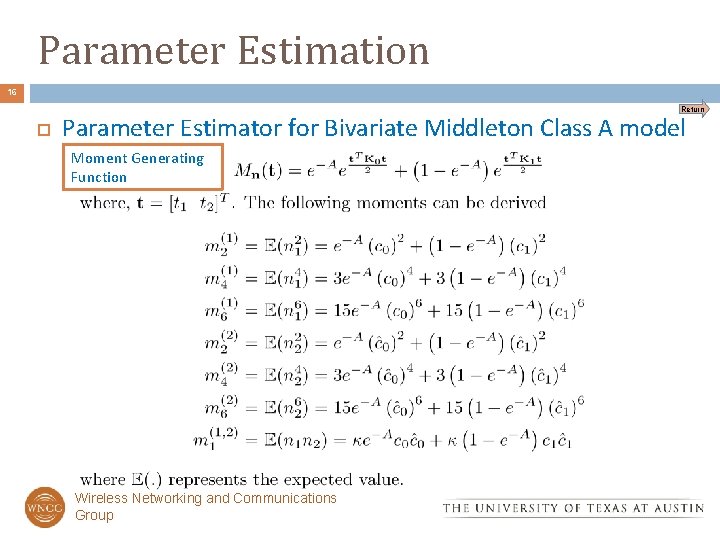
Parameter Estimation 16 Return Parameter Estimator for Bivariate Middleton Class A model Moment Generating Function Wireless Networking and Communications Group
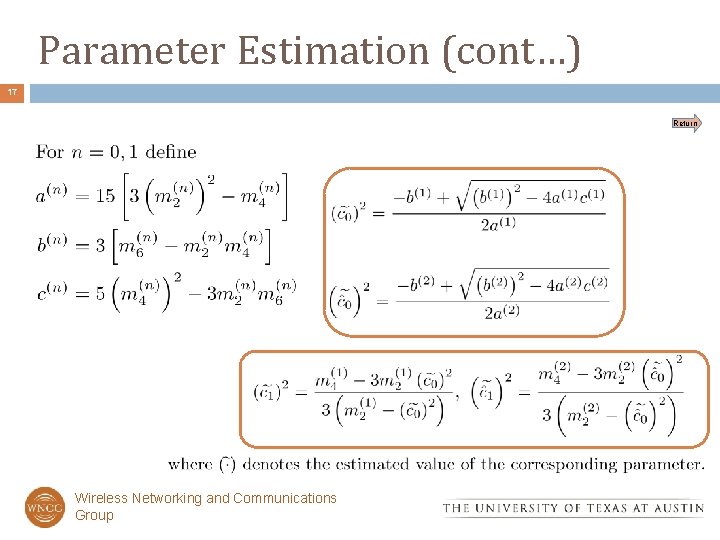
Parameter Estimation (cont…) 17 Return Wireless Networking and Communications Group
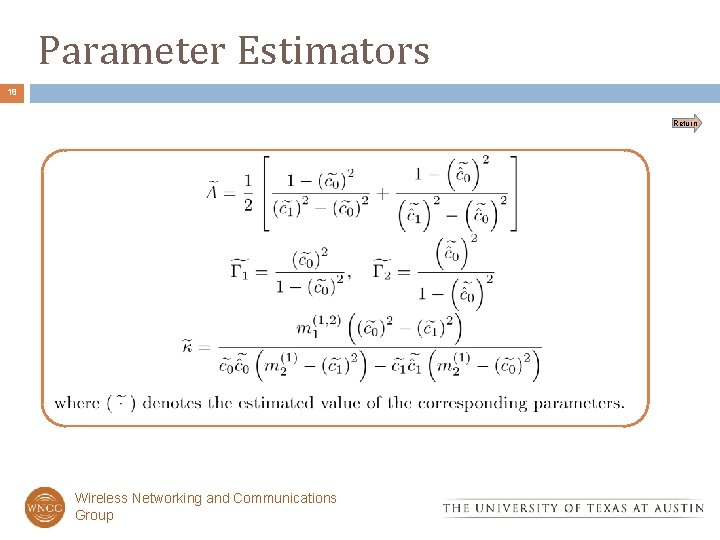
Parameter Estimators 18 Return Wireless Networking and Communications Group
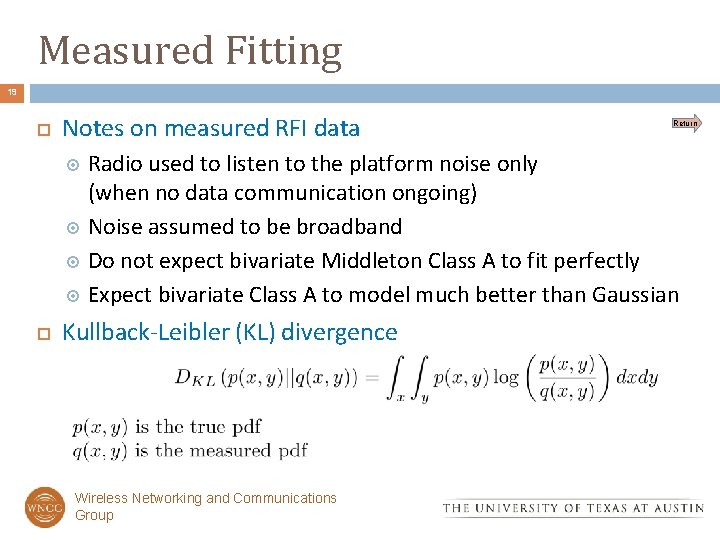
Measured Fitting 19 Notes on measured RFI data Return Radio used to listen to the platform noise only (when no data communication ongoing) Noise assumed to be broadband Do not expect bivariate Middleton Class A to fit perfectly Expect bivariate Class A to model much better than Gaussian Kullback-Leibler (KL) divergence Wireless Networking and Communications Group
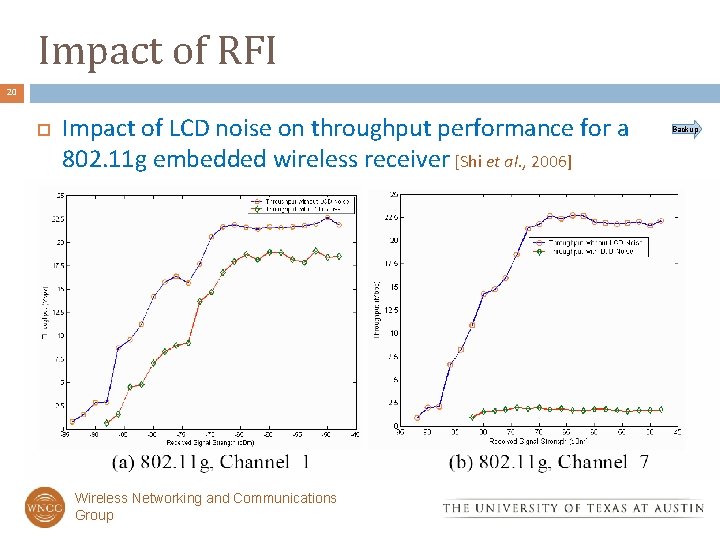
Impact of RFI 20 Impact of LCD noise on throughput performance for a 802. 11 g embedded wireless receiver [Shi et al. , 2006] Wireless Networking and Communications Group Backup
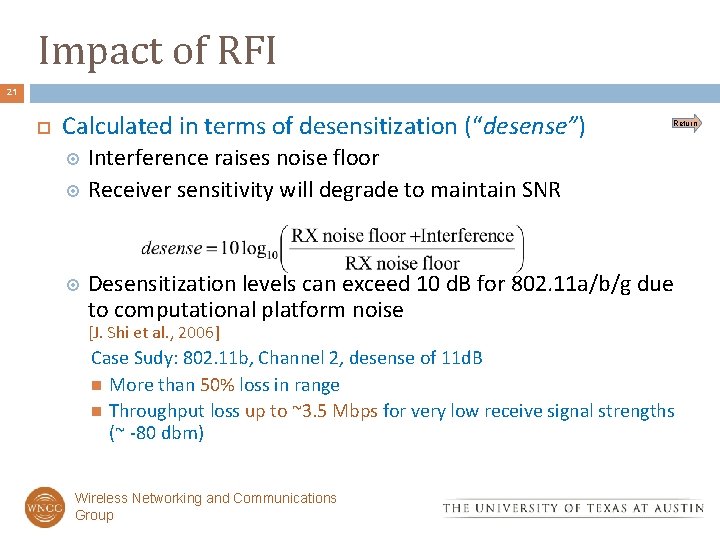
Impact of RFI 21 Calculated in terms of desensitization (“desense”) Return Interference raises noise floor Receiver sensitivity will degrade to maintain SNR Desensitization levels can exceed 10 d. B for 802. 11 a/b/g due to computational platform noise [J. Shi et al. , 2006] Case Sudy: 802. 11 b, Channel 2, desense of 11 d. B More than 50% loss in range Throughput loss up to ~3. 5 Mbps for very low receive signal strengths (~ -80 dbm) Wireless Networking and Communications Group
Assumptions for RFI Modeling 22 Key Assumptions [Middleton, 1977][Furutsu & Ishida, 1961] Infinitely many potential interfering sources with same effective radiation power Power law propagation loss Poisson field of interferers Pr(number of interferers = M |area R) ~ Poisson distributed emission times Temporally independent (at each sample time) Limitations [Alpha Stable]: Does not include thermal noise Temporal dependence may exist Wireless Networking and Communications Group
Middleton Class A, B and C Models 23 Return [Middleton, 1999] Class A Class B Class C Narrowband interference (“coherent” reception) Uniquely represented by 2 parameters Broadband interference (“incoherent” reception) Uniquely represented by six parameters Sum of Class A and Class B (approx. Class B) Wireless Networking and Communications Group Backup
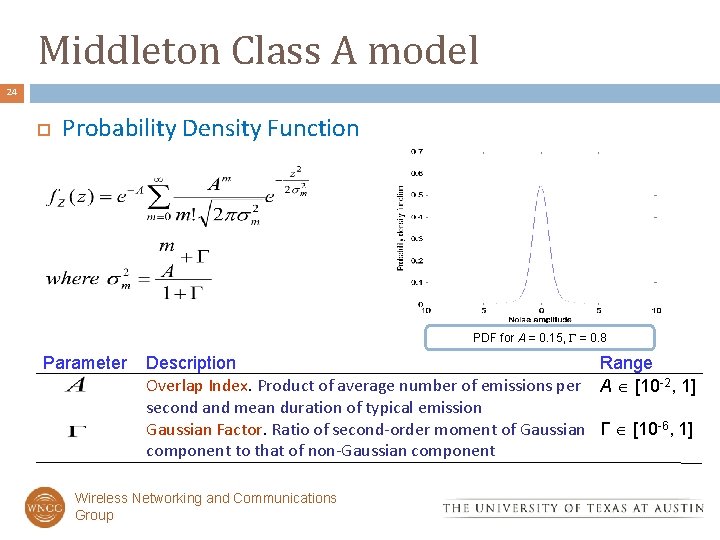
Middleton Class A model 24 Probability Density Function PDF for A = 0. 15, = 0. 8 Parameter Description Range Overlap Index. Product of average number of emissions per A [10 -2, 1] second and mean duration of typical emission Gaussian Factor. Ratio of second-order moment of Gaussian Γ [10 -6, 1] component to that of non-Gaussian component Wireless Networking and Communications Group
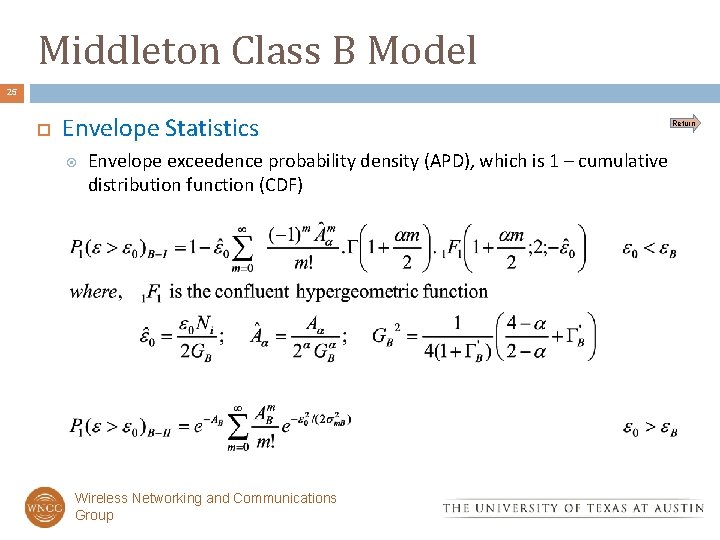
Middleton Class B Model 25 Envelope Statistics Return Envelope exceedence probability density (APD), which is 1 – cumulative distribution function (CDF) Wireless Networking and Communications Group
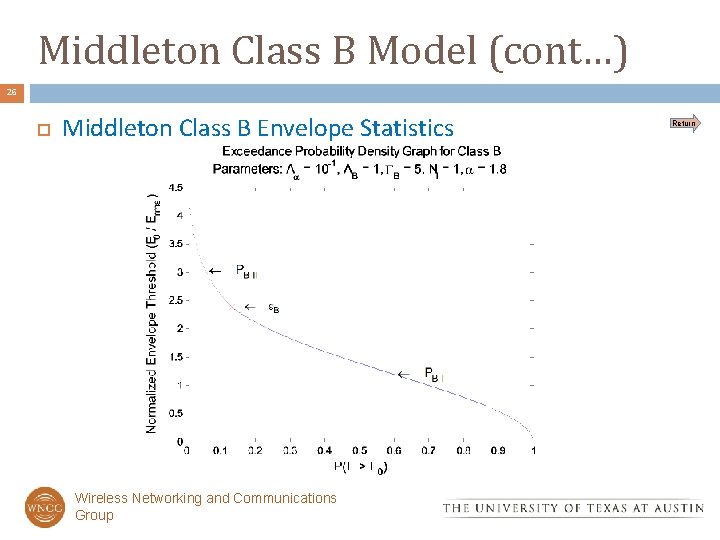
Middleton Class B Model (cont…) 26 Middleton Class B Envelope Statistics Wireless Networking and Communications Group Return
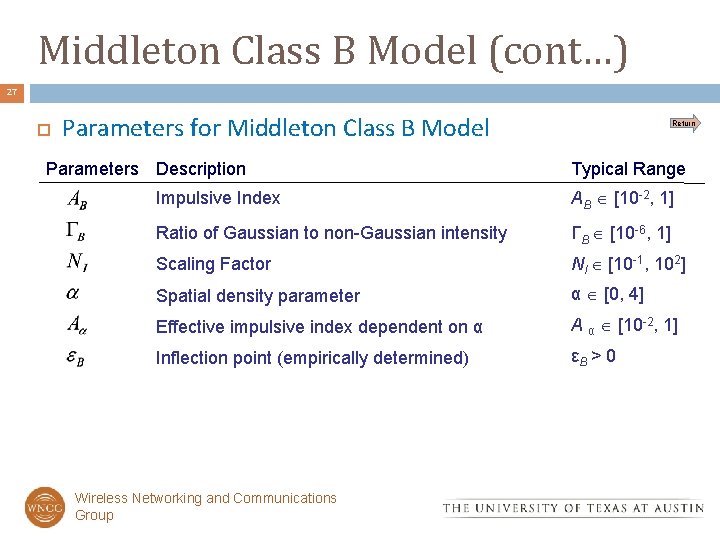
Middleton Class B Model (cont…) 27 Parameters for Middleton Class B Model Parameters Description Return Typical Range Impulsive Index AB [10 -2, 1] Ratio of Gaussian to non-Gaussian intensity ΓB [10 -6, 1] Scaling Factor NI [10 -1, 102] Spatial density parameter α [0, 4] Effective impulsive index dependent on α A α [10 -2, 1] Inflection point (empirically determined) εB > 0 Wireless Networking and Communications Group
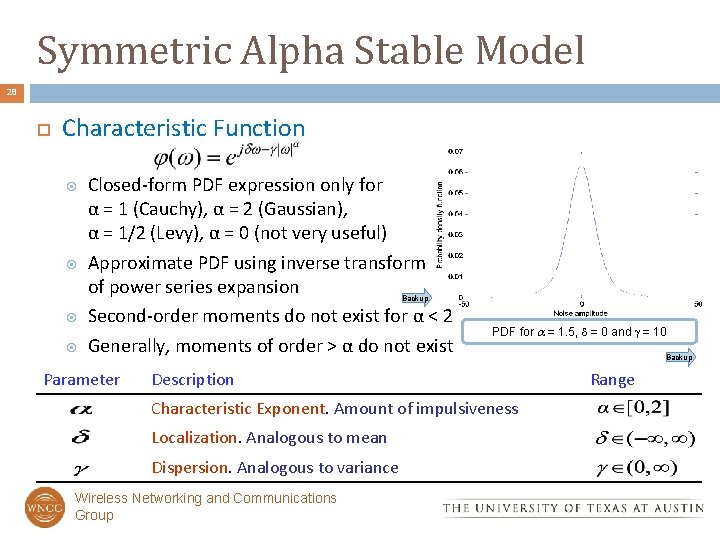
Symmetric Alpha Stable Model 28 Characteristic Function Closed-form PDF expression only for α = 1 (Cauchy), α = 2 (Gaussian), α = 1/2 (Levy), α = 0 (not very useful) Approximate PDF using inverse transform of power series expansion Second-order moments do not exist for α < 2 Generally, moments of order > α do not exist Backup Parameter PDF for = 1. 5, = 0 and = 10 Description Characteristic Exponent. Amount of impulsiveness Localization. Analogous to mean Dispersion. Analogous to variance Wireless Networking and Communications Group Backup Range
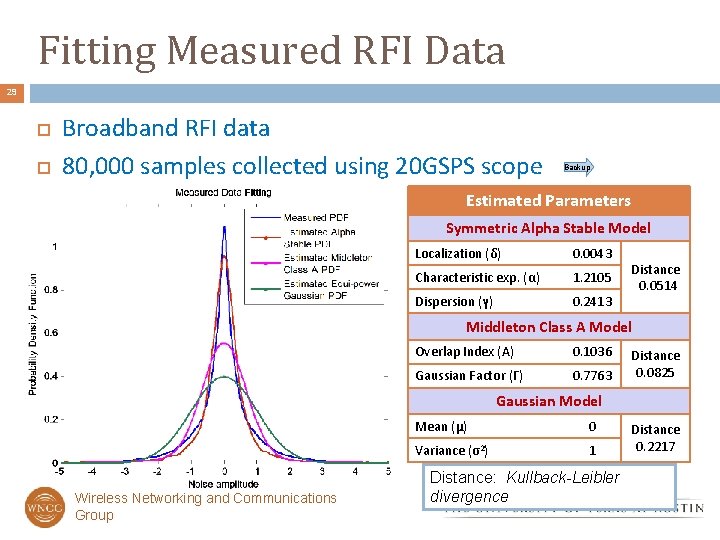
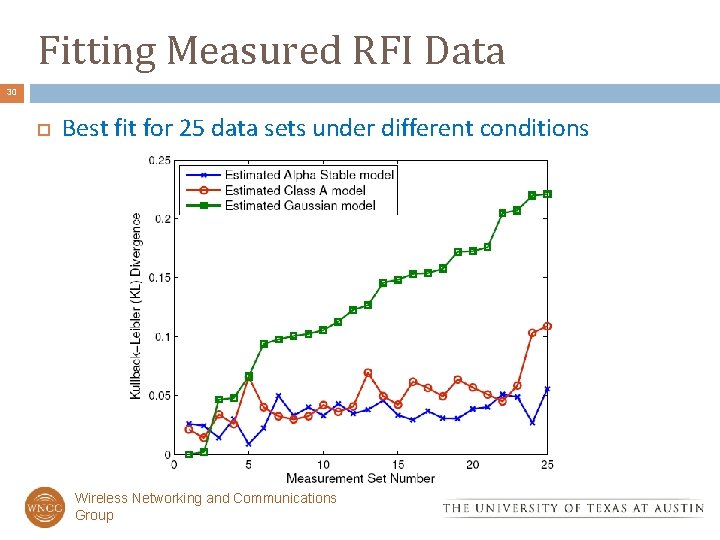
Fitting Measured RFI Data 29 Broadband RFI data 80, 000 samples collected using 20 GSPS scope Backup Estimated Parameters Symmetric Alpha Stable Model Localization (δ) 0. 0043 Characteristic exp. (α) 1. 2105 Dispersion (γ) 0. 2413 Distance 0. 0514 Middleton Class A Model Overlap Index (A) 0. 1036 Gaussian Factor (Γ) 0. 7763 Distance 0. 0825 Gaussian Model Wireless Networking and Communications Group Mean (µ) 0 Variance (σ2) 1 Distance: Kullback-Leibler divergence Distance 0. 2217
Fitting Measured RFI Data 30 Best fit for 25 data sets under different conditions Wireless Networking and Communications Group
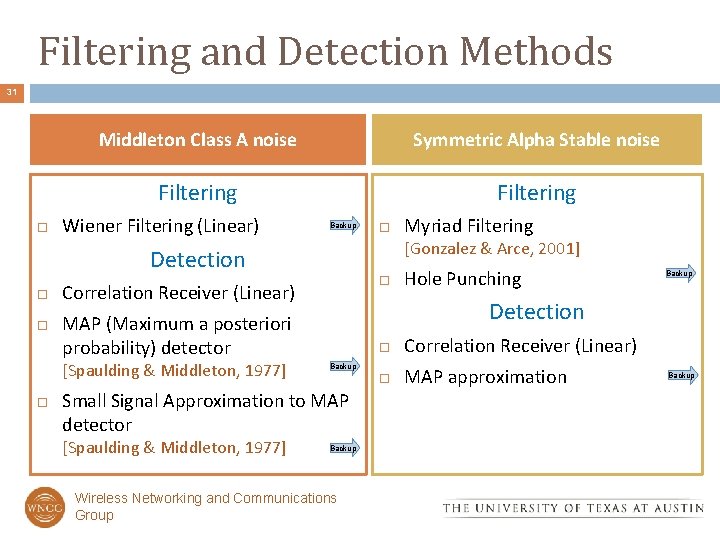
Filtering and Detection Methods 31 Middleton Class A noise Symmetric Alpha Stable noise Filtering Wiener Filtering (Linear) Backup [Gonzalez & Arce, 2001] Detection Correlation Receiver (Linear) MAP approximation Backup Small Signal Approximation to MAP detector [Spaulding & Middleton, 1977] Hole Punching Backup Detection MAP (Maximum a posteriori probability) detector [Spaulding & Middleton, 1977] Myriad Filtering Backup Wireless Networking and Communications Group Backup
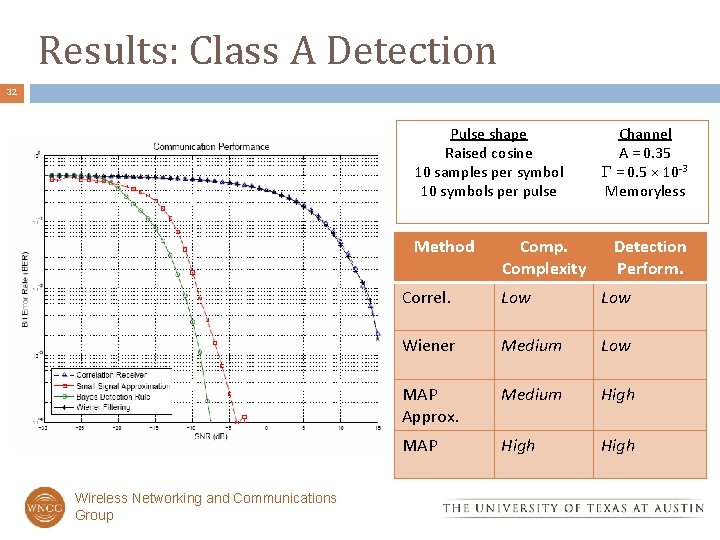
Results: Class A Detection 32 Pulse shape Raised cosine 10 samples per symbol 10 symbols per pulse Method Wireless Networking and Communications Group Complexity Channel A = 0. 35 = 0. 5 × 10 -3 Memoryless Detection Perform. Correl. Low Wiener Medium Low MAP Approx. Medium High MAP High
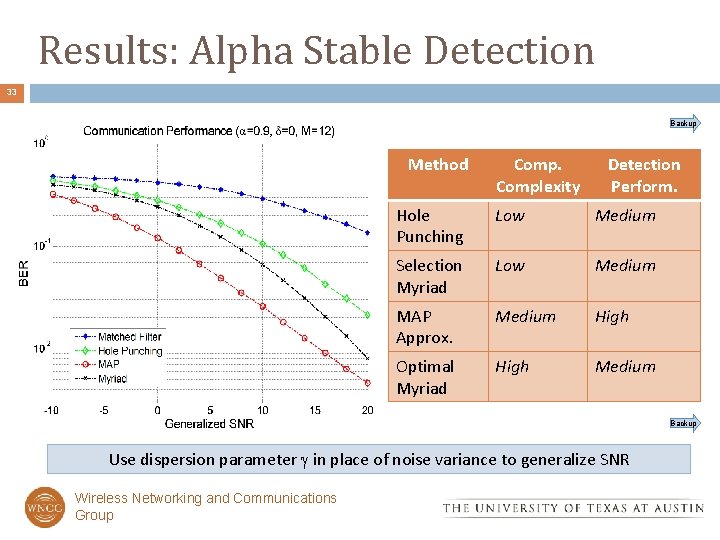
Results: Alpha Stable Detection 33 Backup Method Complexity Detection Perform. Hole Punching Low Medium Selection Myriad Low Medium MAP Approx. Medium High Optimal Myriad High Medium Backup Use dispersion parameter in place of noise variance to generalize SNR Wireless Networking and Communications Group
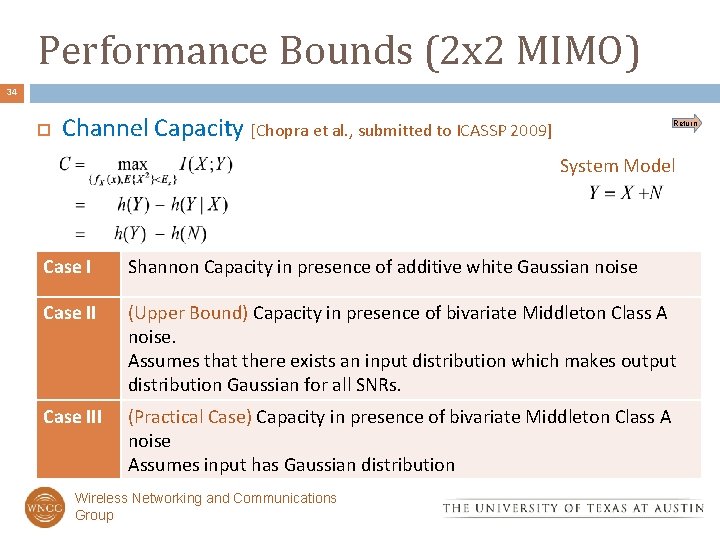
Performance Bounds (2 x 2 MIMO) 34 Channel Capacity [Chopra et al. , submitted to ICASSP 2009] Return System Model Case I Shannon Capacity in presence of additive white Gaussian noise Case II (Upper Bound) Capacity in presence of bivariate Middleton Class A noise. Assumes that there exists an input distribution which makes output distribution Gaussian for all SNRs. Case III (Practical Case) Capacity in presence of bivariate Middleton Class A noise Assumes input has Gaussian distribution Wireless Networking and Communications Group
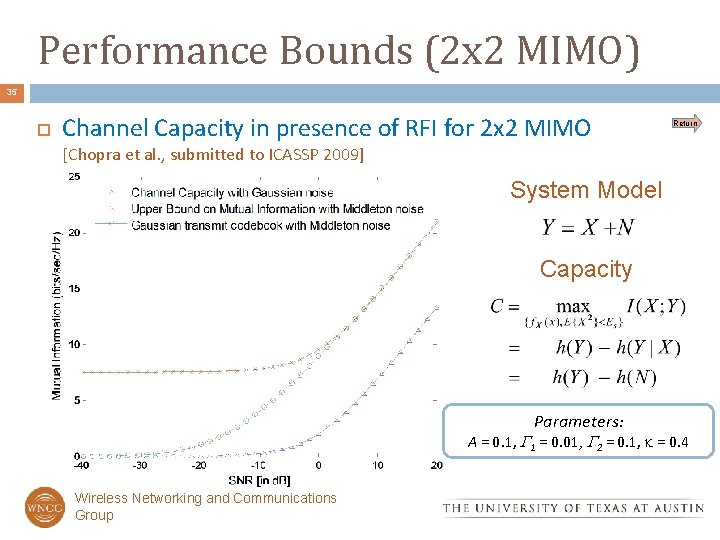
Performance Bounds (2 x 2 MIMO) 35 Channel Capacity in presence of RFI for 2 x 2 MIMO Return [Chopra et al. , submitted to ICASSP 2009] System Model Capacity Parameters: A = 0. 1, G 1 = 0. 01, G 2 = 0. 1, k = 0. 4 Wireless Networking and Communications Group
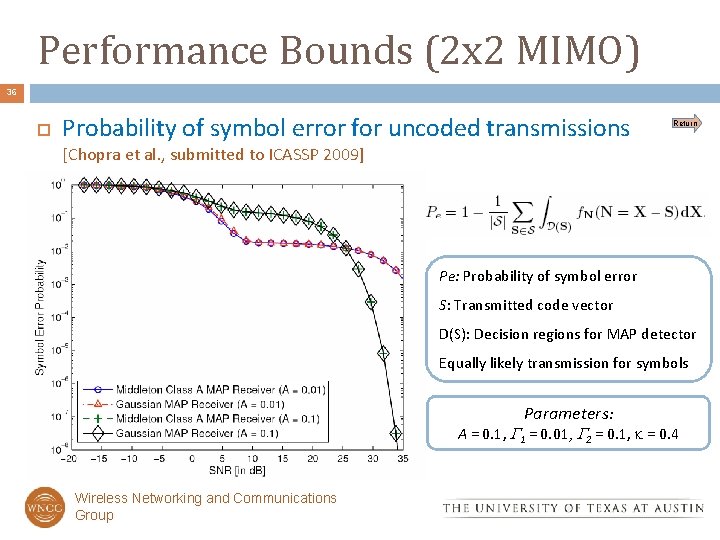
Performance Bounds (2 x 2 MIMO) 36 Probability of symbol error for uncoded transmissions Return [Chopra et al. , submitted to ICASSP 2009] Pe: Probability of symbol error S: Transmitted code vector D(S): Decision regions for MAP detector Equally likely transmission for symbols Parameters: A = 0. 1, G 1 = 0. 01, G 2 = 0. 1, k = 0. 4 Wireless Networking and Communications Group
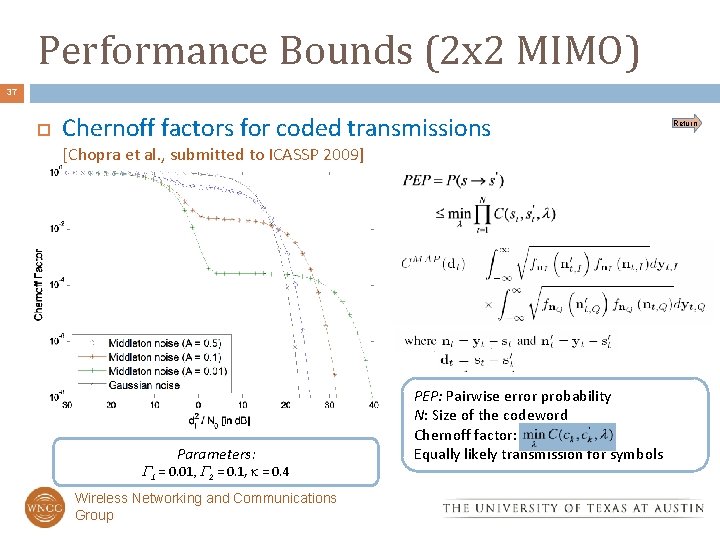
Performance Bounds (2 x 2 MIMO) 37 Chernoff factors for coded transmissions [Chopra et al. , submitted to ICASSP 2009] Parameters: G 1 = 0. 01, G 2 = 0. 1, k = 0. 4 Wireless Networking and Communications Group PEP: Pairwise error probability N: Size of the codeword Chernoff factor: Equally likely transmission for symbols Return