
Wireless Networking 04 September 2004 Quintin Krisp Overview
Wireless Networking 04 September 2004 Quintin Krisp
Overview Wireless LAN Applications Wireless LAN Technology IEEE 802. 11 Standard IEEE 802. 11 Protocol Architecture IEEE 802. 11 Relatives Wi-Fi Security
Wireless LAN Applications LAN Extension: Ø Ø Ø Buildings with large open areas (e. g. Manufacturing plants, Warehouses) Historical buildings: may not damage building Small offices: wired LANs not economical May be mixed with fixed wiring system (hence LAN extension) Either a single-cell or multiple-cell wireless LAN Cross-building interconnection: Ø Ø Ø Point-to-point wireless link between buildings (e. g. Rural Monash Campuses) Typically connecting bridges or routers Used where cable connection not possible (e. g. across a street)
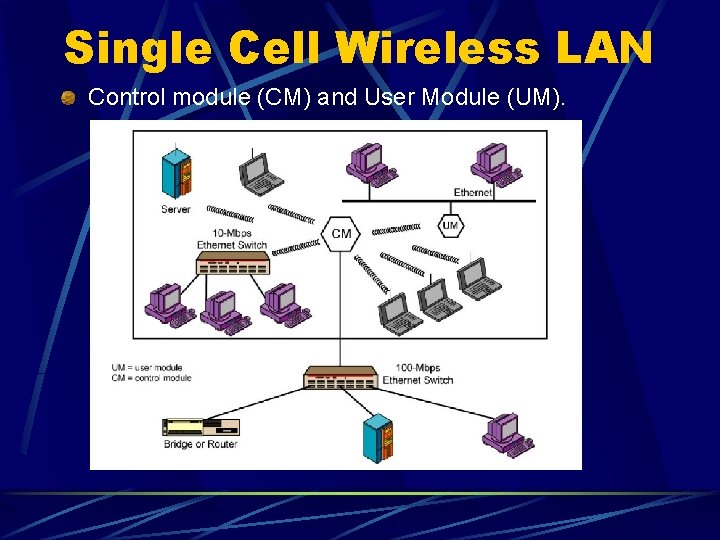
Single Cell Wireless LAN Control module (CM) and User Module (UM).
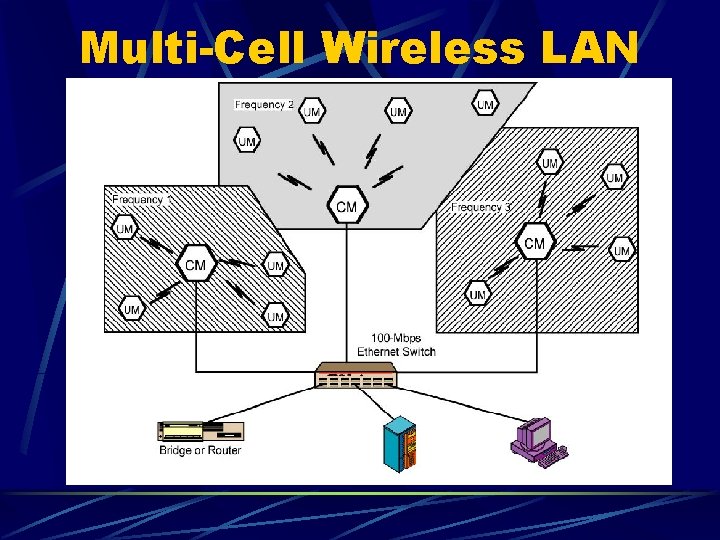
Multi-Cell Wireless LAN
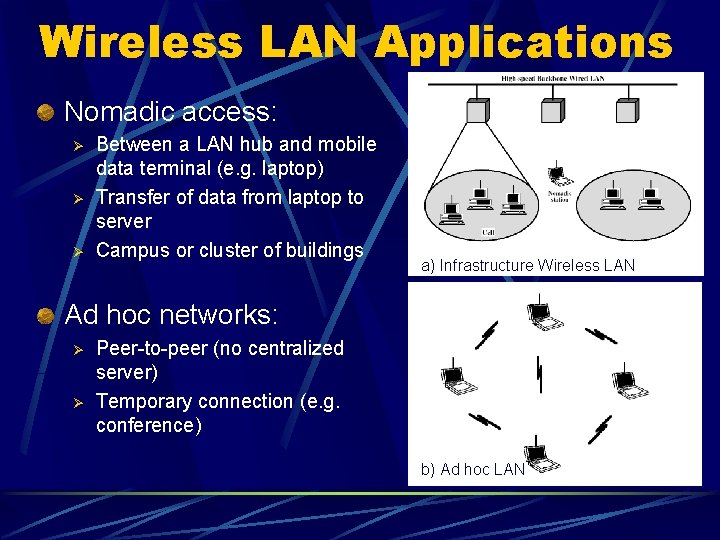
Wireless LAN Applications Nomadic access: Ø Ø Ø Between a LAN hub and mobile data terminal (e. g. laptop) Transfer of data from laptop to server Campus or cluster of buildings a) Infrastructure Wireless LAN Ad hoc networks: Ø Ø Peer-to-peer (no centralized server) Temporary connection (e. g. conference) b) Ad hoc LAN

Wireless LAN Technology Infrared (IR) LANs: Ø Ø Individual cell of IR LAN limited to single room IR light does not penetrate opaque walls More immune to electromagnetic interference (radio transmission or microwave ovens) No licenses required Spread spectrum LANs: Ø Ø Mostly operate in ISM (industrial, scientific, and medical) bands No Federal Communications Commission (FCC) licensing is required in USA Narrowband microwave: Ø Ø Microwave frequencies but not use spread spectrum Some require FCC licensing
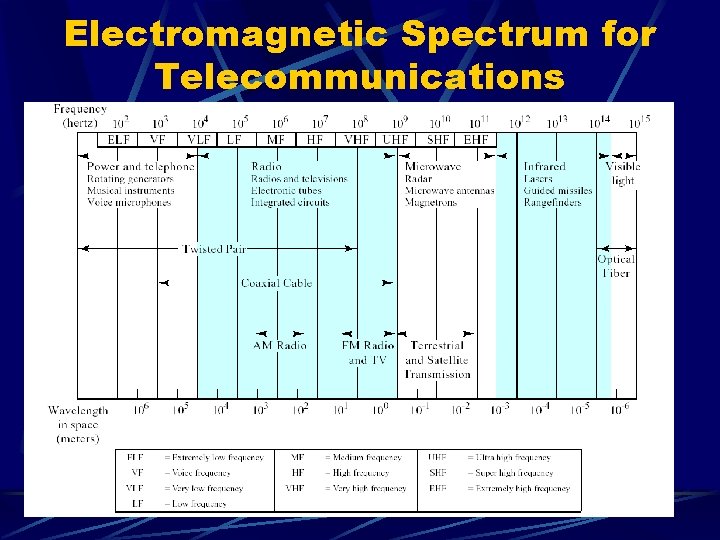
Electromagnetic Spectrum for Telecommunications
802. 11 Standard IEEE 802 committee began in 1987 within the IEEE 802. 4 group Initial interest developing ISM-based wireless LAN using equivalent of token-passing bus MAC protocol Token bus not suitable for radio medium, caused inefficient use of the radio frequency spectrum IEEE 802. 11 formed in 1990 as new working group devoted specifically to wireless LANs
802. 11 Protocol Architecture Distributed Coordination Function DFC Ø Lower MAC sublayer, uses Ethernet contention algorithm to provide access to all traffic Ø Contention protocol designed to handle two or more stations accessing network traffic simultaneously Point Coordination Function (PCF) Ø Centralized MAC algorithm to provide contentionfree service Ø AP polls according to list, no collisions occur Logical Link Control (LLC) Ø Provide an interface to higher layers Ø Performs basic link-layer functions such as error control
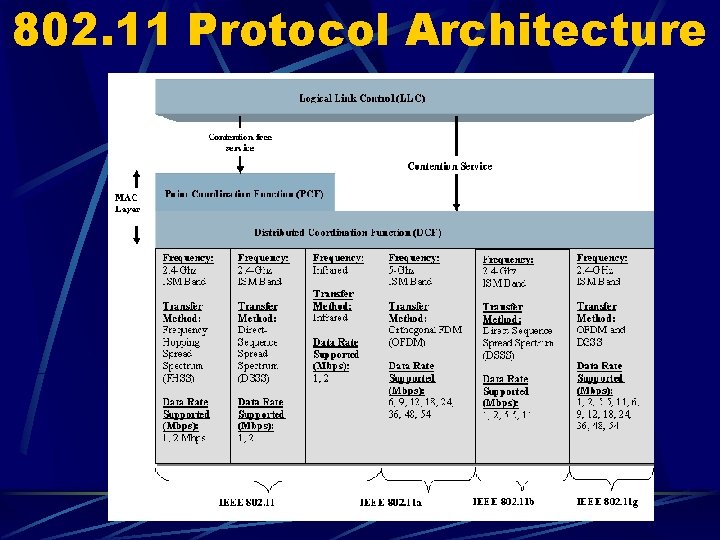
802. 11 Protocol Architecture

802. 11 Relatives 802. 11 d: Modification to comply with other countries 802. 11 e: Add Quality of Service (QOS) 802. 11 f: Improve communication between APs for authentication 802. 11 h: Modification to comply with Europe 802. 11 i: Improve WLAN security 802. 11 j: Modification to comply with Japan 802. 11 k: Provide measurement info of APs 802. 11 m: Minor Mods to previous Pubs
802. 11 Relatives 802. 11 n: Increase WLAN raw throughput 802. 11 p: Utilize 5. 9 GHz band for Intelligent Transportation System 802. 11 o: Faster handoff, prioritize voice traffic over data 802. 11 q: Frame tagging for VLAN segregation 802. 11 r: Standardize fast-hand-off 802. 11 s: Self-healing/self-configuring Mesh networks 802. 11 t: Performance prediction
802. 11 Relatives 802. 11 d: New Countries Ø Ø Where 802. 11 family not allowed to operate Specification similar to 802. 11 b Main difference, configuration fine-tuned at MAC level to comply with rules of country or district network to operate Rules subject to variation include allowed: frequencies, power levels, and signal bandwidth
802. 11 Relatives 802. 11 e: Quality of Service (QOS) Ø Ø Ø Goal: Develop QOS technology to help Wi-Fi networks avoid problems when transmitting time-sensitive data like voice and video One 802. 11 e innovation starting to be used: frame bursting or packet burning Improves ratio of data-to-network overhead by sending larger amounts of data in individual frames Can only speed up mixed 802. 11 b/802. 11 g networks Initial improvement better if all equipment from same manufacturer
802. 11 Relatives 802. 11 f: Inter-Access Point Communication Ø Ø Communication between Wi-Fi APs a problem depending on manufacture APs will be able to offer fast handoff Eliminates break in service when roaming Some features tie with 802. 11 i security standard 802. 11 h: Compatibility with European Regs Ø Ø Ø Supplementary to MAC layer, comply w/5 Ghz WLANs Require transmission power control (TPC), limits minimum power required to reach furthest user Require dynamic frequency selection (DFS), selects radio channel at AP to minimize interference with other systems
802. 11 Relatives 802. 11 i: Security Specifications Ø Ø Replaces wired equivalent privacy (WEP) encryption with temporal key integrity protocol (TKIP) Supplement TKIP with advanced encryption system (AES) Adds pre-authentication, enables user logged into a corporate-style network connected roaming capability while maintaining connection Relies on inter-access point communication provided by 802. 11 f
802. 11 Relatives 802. 11 j: 5 GHz Operations in Japan Ø Ø Ø Main intent, add channels in the RF band of 4. 9 GHz to 5 GHz Implement changes to satisfy Japanese legal requirements concerning: transmitter output power, operational modes, channel arrangements, and spurious emission levels Like 802. 11 a networks Provide speeds up to 54 Mbps Employ OFDM Transfer Method
802. 11 Relatives 802. 11 k: Radio Resource Management Ø Ø Ø Address lack of standard for managing WLANs Focuses on two key elements: AP and PC cards Goal: make measurements from physical and data link layers available to upper layers Allow upper layers to make decisions about the radio environment and what can be accomplished in that environment One feature allow better traffic distribution, produce higher speed for the original AP and redirected users
802. 11 Relatives 802. 11 m: 802. 11 Housekeeping Ø Perform editorial maintenance, corrections, improvements, clarifications, and interpretations, relative to 802. 11 family specification documentation 802. 11 n: Inter-access Point Communications Ø Ø Ø Objective: increase overall and throughput speed of future 802. 11 protocols Real speed 100 Mbps 250 Mbps in PHY level 4 -5 times faster than 802. 11 g 50 times faster than 802. 11 b Better operating distance
802. 11 Relatives 802. 11 o: Vo Wi-Fi Faster Handoff Ø Ø Ø A proposed IEEE group to be. Spun out of the 802. 11 i group Focus for standard for a fast handoff that is fully secure and compatible with 802. 11 i and Wi-Fi Protected Access (WPA) Current supported roaming causes brief break in data stream 802. 11 i implementation will exacerbate the situation Handover time (70 milliseconds) make voice calls impossible
802. 11 Relatives 802. 11 p: Intelligent Transportation System Ø Ø Ø Ø Established for wireless access in vehicular environments (WAVE) Dedicated short range communications (DRC) is a general purpose communications link between the vehicle and roadside (or between vehicles) using 802. 11 p protocol Protocols just months old Improves on dedicated 5. 9 GHz range (1, 000 ft. ) and transmission speed (6 Mbps) Protocol aimed at vehicles: toll collection, vehicle safety, commerce transactions via cars Government pushing forward to cover highways with APs that support this new type of extra-secure hotspots that ride over 5. 9 GHz Manufactures expect to install chips, initially in high-end vehicles, in 2007 or 2008 time frame
802. 11 Relatives 802. 11 q: VLAN Management Ø Ø Ø Defines mechanisms for tagging frames, allow them to be segregated into separate VLANs extend into WLAN by adding 802. 11 q awareness to the AP Frames destined for different VLANs are transmitted by the AP wirelessly on different SSIDs with different WEP keys Only the client associated with the VLAN receives those packets Conversely, packets coming from a client associated with a certain VLAN are tagged with 802. 11 q before they are forwarded into the wired network
802. 11 Relatives 802. 11 r: Fast BSS – Transition Ø Ø Ø Recently founded to address fast roaming among APs Some experts think technology emerging from 802. 11 i and 802. 11 k will render 802. 11 r group unnecessary Group still defining scope and does not have a draft yet
802. 11 Relatives 802. 11 s: ESS Mesh Networking Ø Ø Ø Aims to define a MAC and PHY for mesh networks Improve coverage with no single point of failure APs relay information hop-by-hop, router like fashion Adding nodes, scalable and redunant Can serve as indoor or outdoor networks Example: Municipalities extend fiber networks or all outdoor enterprises such as construction sites 802. 11 t: Wireless Performance Prediction Ø Ø Enable testing, comparison, and deployment planning of 802. 11 WLAN devices Based on common accepted set of performance metrics, measurement methodologies and test conditions
Wi-Fi Security Robust Security Network (RSN) Ø Ø Ø Defined by 802. 11 i specification Replaces wired equivalent privacy (WEP) Backward compatible support of Wi-Fi protected access (WPA) based on temporal key integrity protocol (TKIP) Uses advanced encryption system (AES) in addition to TKIP AES method combines a key and a 128 -bit block of unencrypted data to produce a block of different encrypted data. WEP only uses 40 -bit key
Wi-Fi Security 802. 11 i Standard Acceptance Impact Ø Ø Business community interest expected to skyrocket in next year or two Vendors already rolling out firmware enabling 802. 11 compliant security protocols Immediate impact by eliminating VPN infrastructure except when connected remotely, such as a hotel Performance penalty for 802. 11 i functionality unknown
Summary Wireless LAN Applications Wireless LAN Technology IEEE 802. 11 Standard IEEE 802. 11 Protocol Architecture IEEE 802. 11 Relatives Wi-Fi Security
- Slides: 28