
Wireless Network Coding Some Lessons Learned in ITMANET
![Dealing with Interference • [Avestimehr et al. ‘ 07]“Deterministic model” (ADT model) – –](https://slidetodoc.com/presentation_image_h2/0221692bb03414d9607fa7f97cbb8805/image-4.jpg "Dealing with Interference • [Avestimehr et al. ‘ 07]“Deterministic model” (ADT model) – –")
![Different Types of SNR • Diamond network [Schein] • As a increases: the gap](https://slidetodoc.com/presentation_image_h2/0221692bb03414d9607fa7f97cbb8805/image-10.jpg "Different Types of SNR • Diamond network [Schein] • As a increases: the gap")
- Slides: 27
Wireless Network Coding: Some Lessons Learned in ITMANET Muriel Médard RLE MIT
Collaborators • Nadia Fawaz, Andrea Goldsmith, Minji Kim, Ivana Maric, Asuman Ozdaglar, Ali Parandeh. Gheibi, Srinivas Shakkottai, Jay-Kumar Sundararajan, Mohit Thakur 2
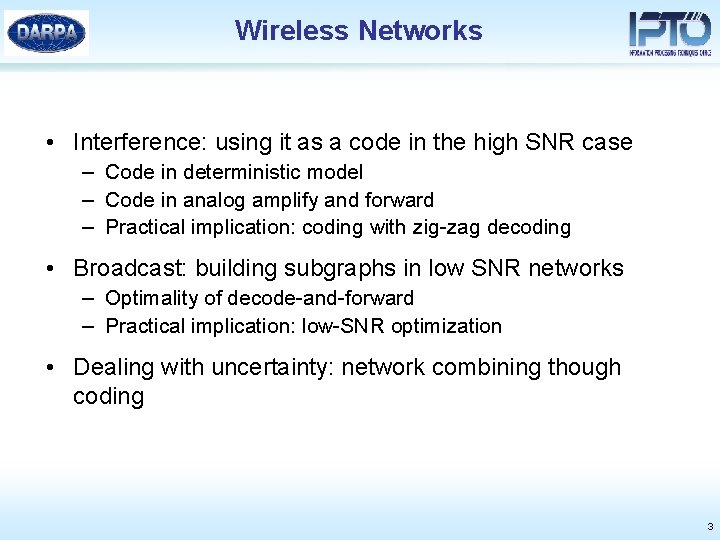
Wireless Networks • Interference: using it as a code in the high SNR case – Code in deterministic model – Code in analog amplify and forward – Practical implication: coding with zig-zag decoding • Broadcast: building subgraphs in low SNR networks – Optimality of decode-and-forward – Practical implication: low-SNR optimization • Dealing with uncertainty: network combining though coding 3
Dealing with Interference • [Avestimehr et al. ‘ 07]“Deterministic model” (ADT model) – – – Interference Does not take into account channel noise In essence, high SNR regime Requires optimization over a large set of matrices Code construction algorithms [Amaudruz et al. ‘ 09][Erez et al. ’ 10] Matroidal [Goemans ‘ 09] • High SNR: interference is the main issue – – Noise → 0 Large gain Large transmit power Interference as a code R 1 Model as error free links Y(e 1) Y(e 2) R 2 e 1 e 2 e 3 Y(e 3) = β 1 Y(e 1) + β 2 Y(e 2)
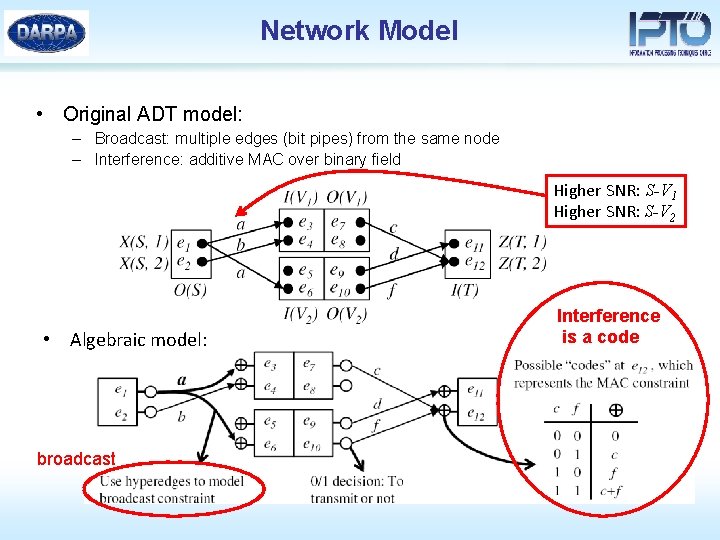
Network Model • Original ADT model: – Broadcast: multiple edges (bit pipes) from the same node – Interference: additive MAC over binary field Higher SNR: S-V 1 Higher SNR: S-V 2 • Algebraic model: broadcast Interference is a code
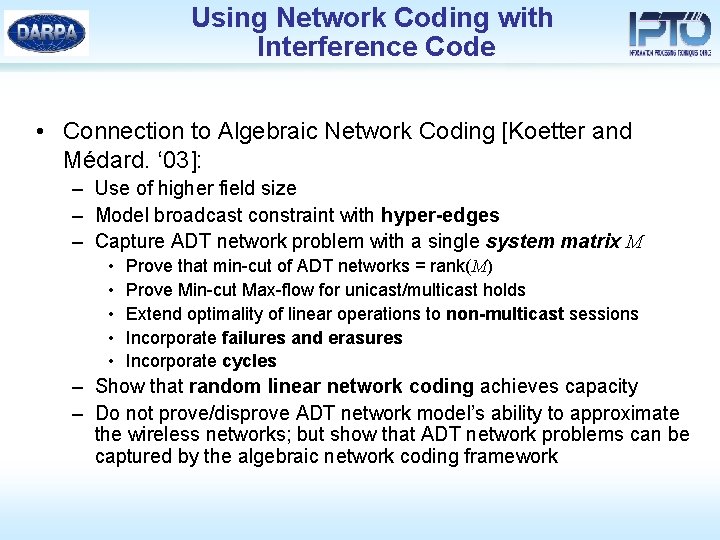
Using Network Coding with Interference Code • Connection to Algebraic Network Coding [Koetter and Médard. ‘ 03]: – Use of higher field size – Model broadcast constraint with hyper-edges – Capture ADT network problem with a single system matrix M • • • Prove that min-cut of ADT networks = rank(M) Prove Min-cut Max-flow for unicast/multicast holds Extend optimality of linear operations to non-multicast sessions Incorporate failures and erasures Incorporate cycles – Show that random linear network coding achieves capacity – Do not prove/disprove ADT network model’s ability to approximate the wireless networks; but show that ADT network problems can be captured by the algebraic network coding framework
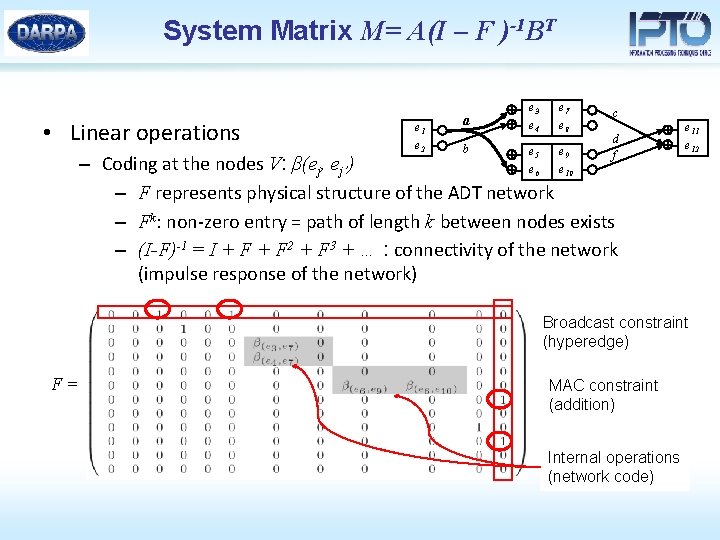
System Matrix M= A(I – F )-1 BT • Linear operations e 1 e 2 a b e 3 e 4 e 7 e 8 e 5 e 6 e 9 e 10 c d f – Coding at the nodes V: β(ej, ej’) – F represents physical structure of the ADT network – Fk: non-zero entry = path of length k between nodes exists – (I-F)-1 = I + F 2 + F 3 + … : connectivity of the network (impulse response of the network) e 11 e 12 Broadcast constraint (hyperedge) F= MAC constraint (addition) Internal operations (network code)
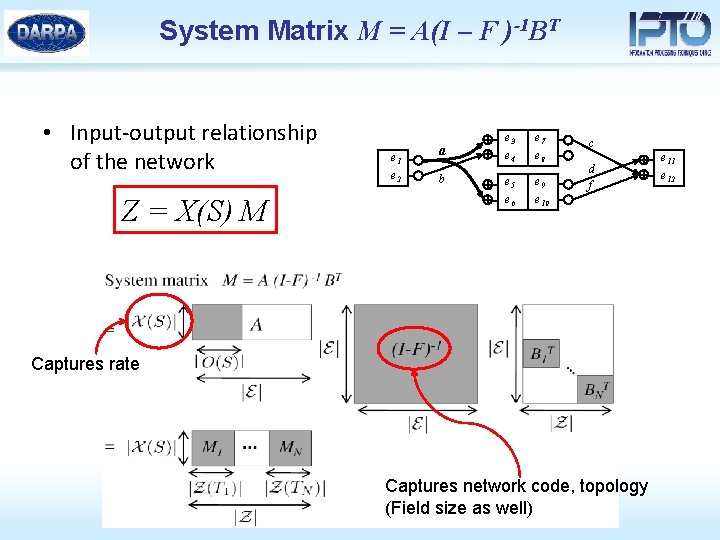
System Matrix M = A(I – F )-1 BT • Input-output relationship of the network Z = X(S) M e 1 e 2 a b e 3 e 4 e 7 e 8 e 5 e 6 e 9 e 10 c d f Captures rate Captures network code, topology (Field size as well) e 11 e 12
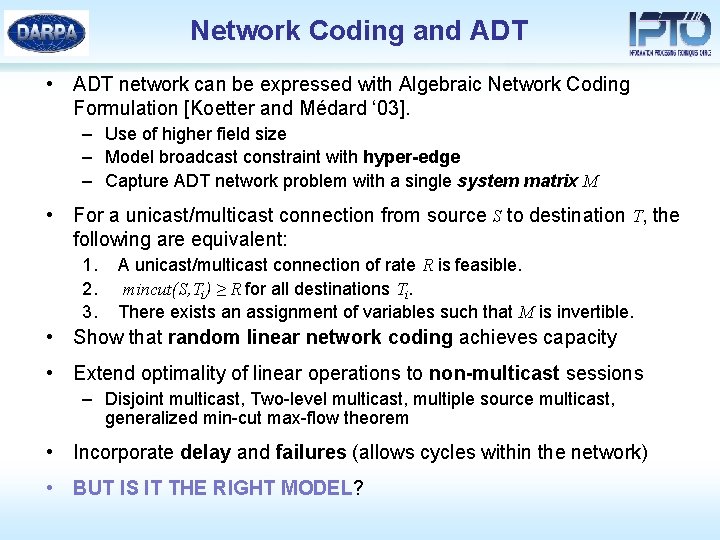
Network Coding and ADT • ADT network can be expressed with Algebraic Network Coding Formulation [Koetter and Médard ‘ 03]. – Use of higher field size – Model broadcast constraint with hyper-edge – Capture ADT network problem with a single system matrix M • For a unicast/multicast connection from source S to destination T, the following are equivalent: 1. 2. 3. A unicast/multicast connection of rate R is feasible. mincut(S, Ti) ≥ R for all destinations Ti. There exists an assignment of variables such that M is invertible. • Show that random linear network coding achieves capacity • Extend optimality of linear operations to non-multicast sessions – Disjoint multicast, Two-level multicast, multiple source multicast, generalized min-cut max-flow theorem • Incorporate delay and failures (allows cycles within the network) • BUT IS IT THE RIGHT MODEL?
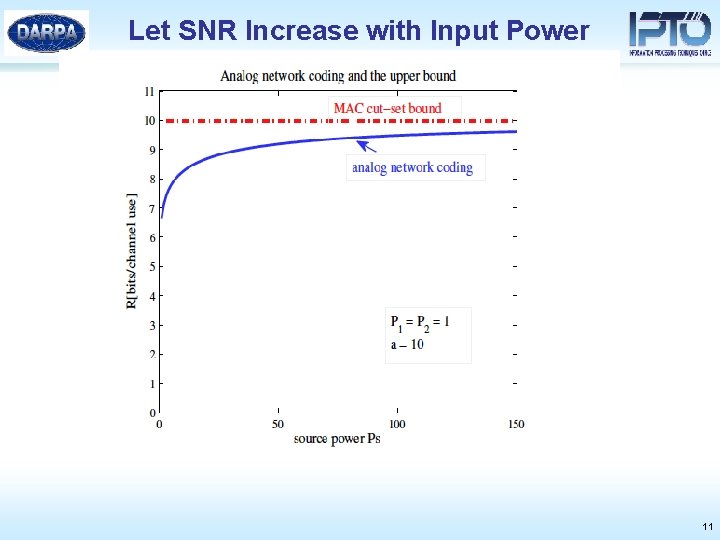
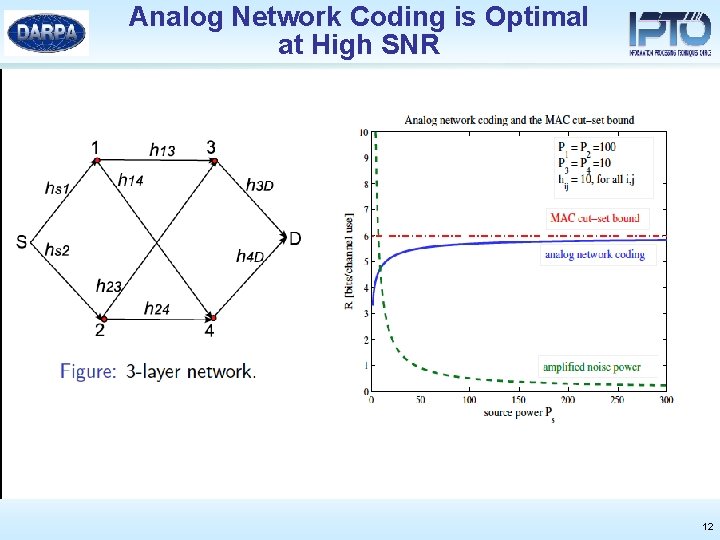
Different Types of SNR • Diamond network [Schein] • As a increases: the gap between analog network coding and cut set increases • In networks, increasing the gain and the transmit power are not equivalent, unlike in point-to-point links 10
Let SNR Increase with Input Power 11
Analog Network Coding is Optimal at High SNR 12
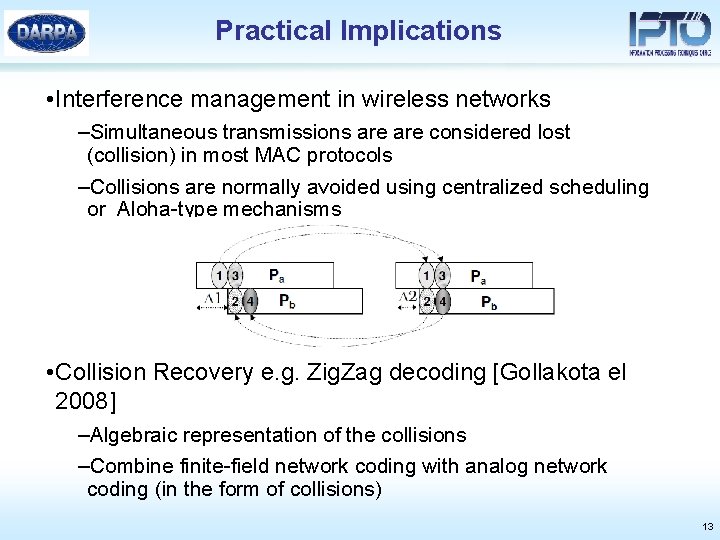
Practical Implications • Interference management in wireless networks –Simultaneous transmissions are considered lost (collision) in most MAC protocols –Collisions are normally avoided using centralized scheduling or Aloha-type mechanisms • Collision Recovery e. g. Zig. Zag decoding [Gollakota el 2008] –Algebraic representation of the collisions –Combine finite-field network coding with analog network coding (in the form of collisions) 13
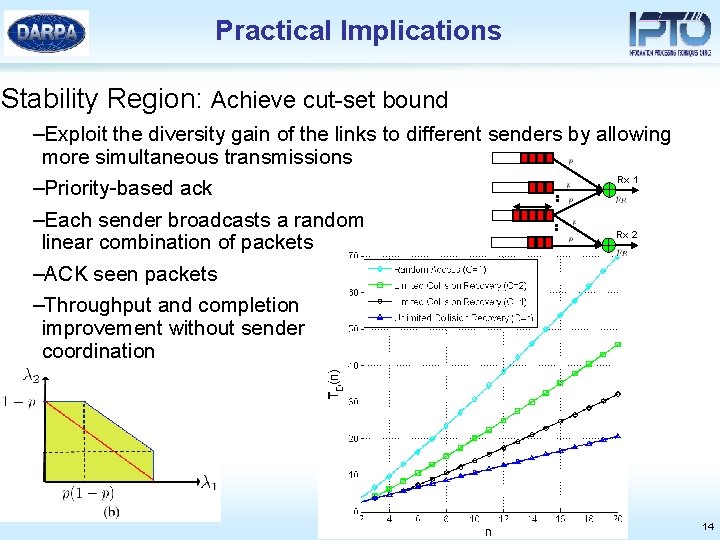
Practical Implications Stability Region: Achieve cut-set bound –Exploit the diversity gain of the links to different senders by allowing more simultaneous transmissions Rx 1 –Priority-based ack –Each sender broadcasts a random Rx 2 linear combination of packets –ACK seen packets –Throughput and completion improvement without sender coordination 14
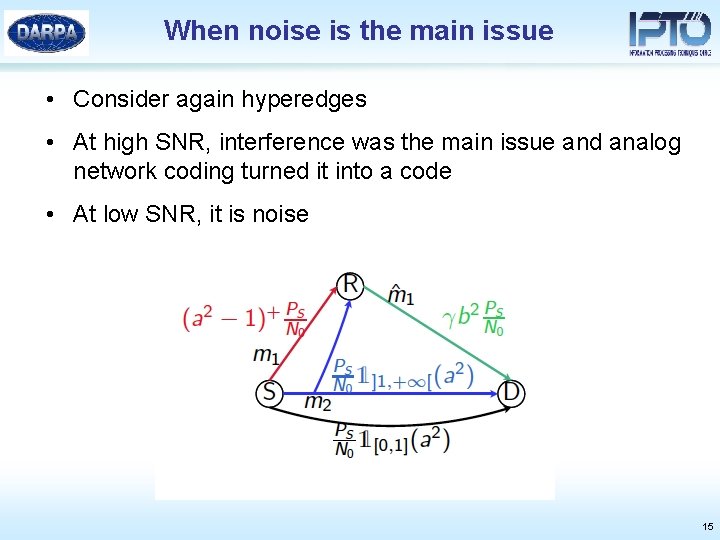
When noise is the main issue • Consider again hyperedges • At high SNR, interference was the main issue and analog network coding turned it into a code • At low SNR, it is noise 15
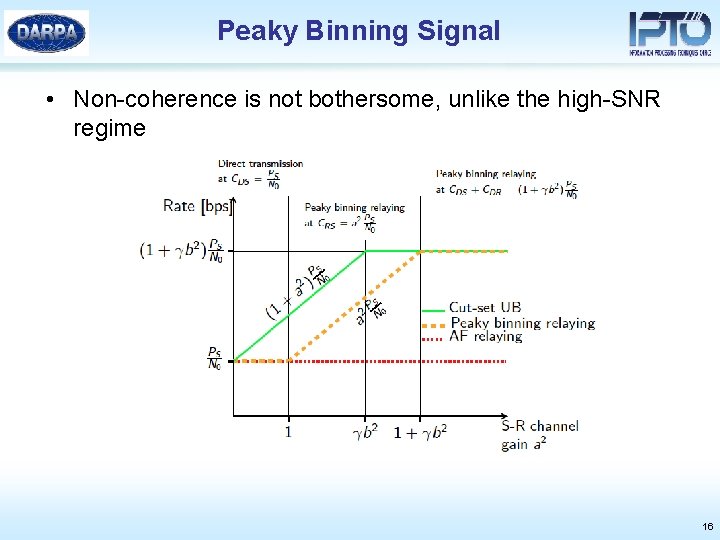
Peaky Binning Signal • Non-coherence is not bothersome, unlike the high-SNR regime 16
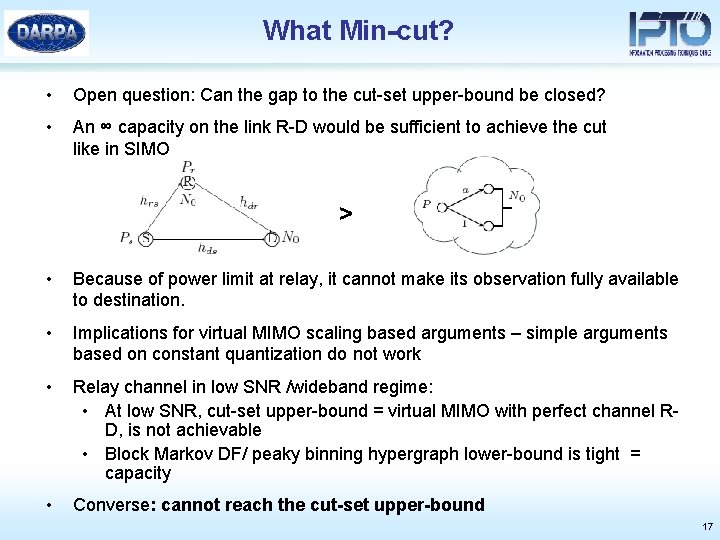
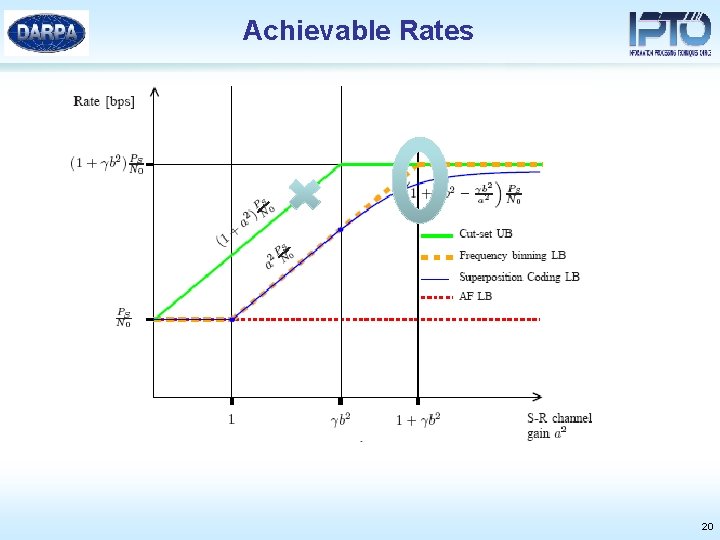
What Min-cut? • Open question: Can the gap to the cut-set upper-bound be closed? • An ∞ capacity on the link R-D would be sufficient to achieve the cut like in SIMO > • Because of power limit at relay, it cannot make its observation fully available to destination. • Implications for virtual MIMO scaling based arguments – simple arguments based on constant quantization do not work • Relay channel in low SNR /wideband regime: • At low SNR, cut-set upper-bound = virtual MIMO with perfect channel RD, is not achievable • Block Markov DF/ peaky binning hypergraph lower-bound is tight = capacity • Converse: cannot reach the cut-set upper-bound 17
Converse • Sketch of proof: • Assuming that the relay cannot decode: • Split total mutual information into two parts • • • contribution from relay remaining contribution from source after deducting contribution from relay Bound contributions using equivalence theory and rate distortion theory, in particular to justify • • • Gaussian input at source Estimation with distortion at relay Error-free R-D link with finite capacity • Analyze the limit of these contributions in the low SNR regime and show that the total converges to the direct link capacity • Conclusion: the relay should decode in the low SNR and we do Network Coding in the digital domain at low SNR 18
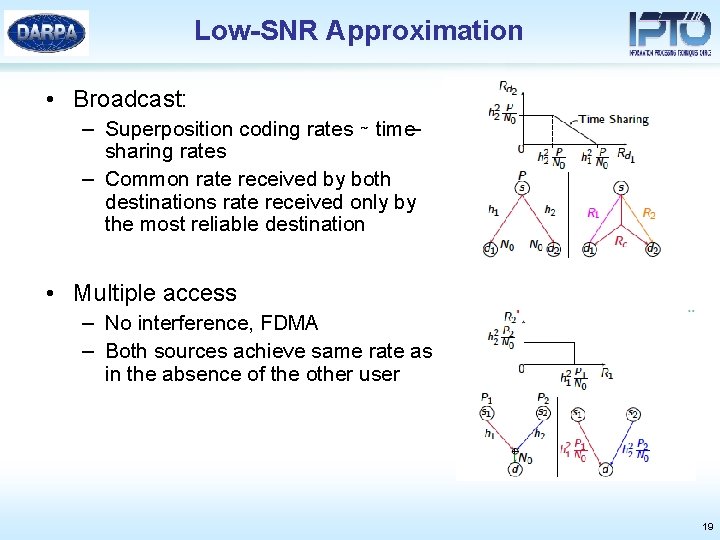
Low-SNR Approximation • Broadcast: – Superposition coding rates ∼ timesharing rates – Common rate received by both destinations rate received only by the most reliable destination • Multiple access – No interference, FDMA – Both sources achieve same rate as in the absence of the other user 19
Achievable Rates 20
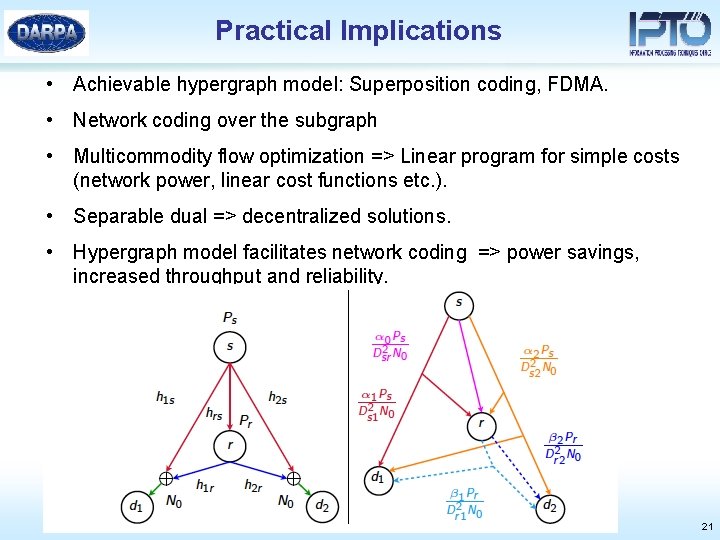
Practical Implications • Achievable hypergraph model: Superposition coding, FDMA. • Network coding over the subgraph • Multicommodity flow optimization => Linear program for simple costs (network power, linear cost functions etc. ). • Separable dual => decentralized solutions. • Hypergraph model facilitates network coding => power savings, increased throughput and reliability. 21
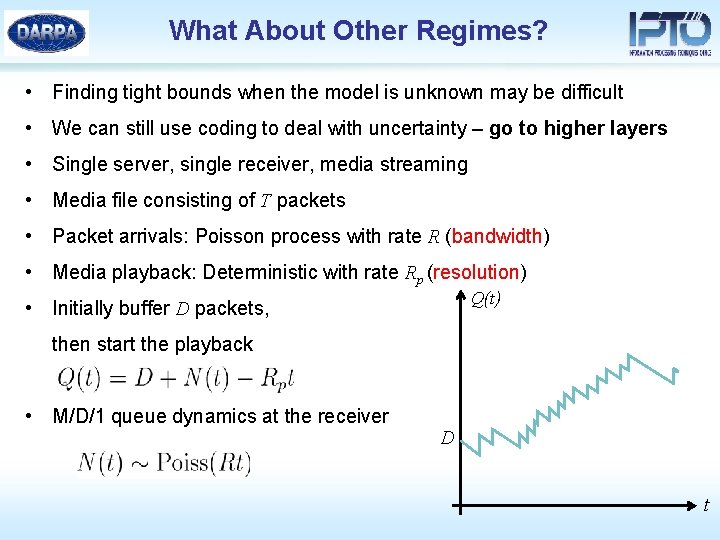
What About Other Regimes? • Finding tight bounds when the model is unknown may be difficult • We can still use coding to deal with uncertainty – go to higher layers • Single server, single receiver, media streaming • Media file consisting of T packets • Packet arrivals: Poisson process with rate R (bandwidth) • Media playback: Deterministic with rate Rp (resolution) Q(t) • Initially buffer D packets, then start the playback • M/D/1 queue dynamics at the receiver D t
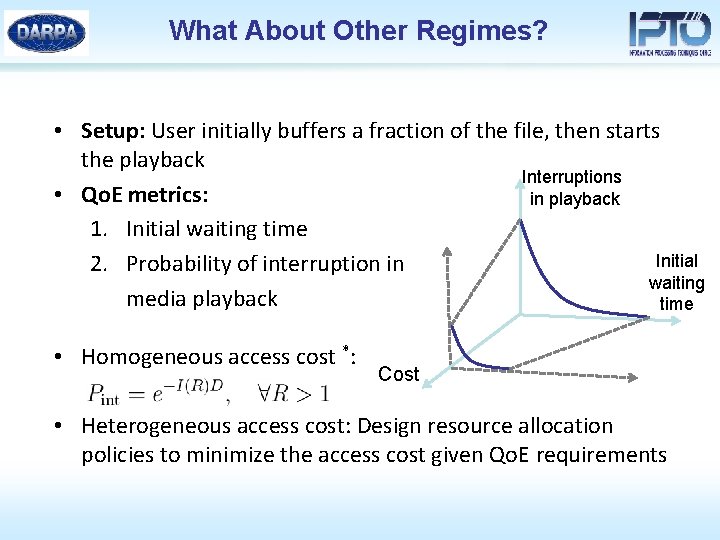
What About Other Regimes? • Setup: User initially buffers a fraction of the file, then starts the playback Interruptions • Qo. E metrics: in playback 1. Initial waiting time Initial 2. Probability of interruption in waiting media playback time • Homogeneous access cost *: Cost • Heterogeneous access cost: Design resource allocation policies to minimize the access cost given Qo. E requirements
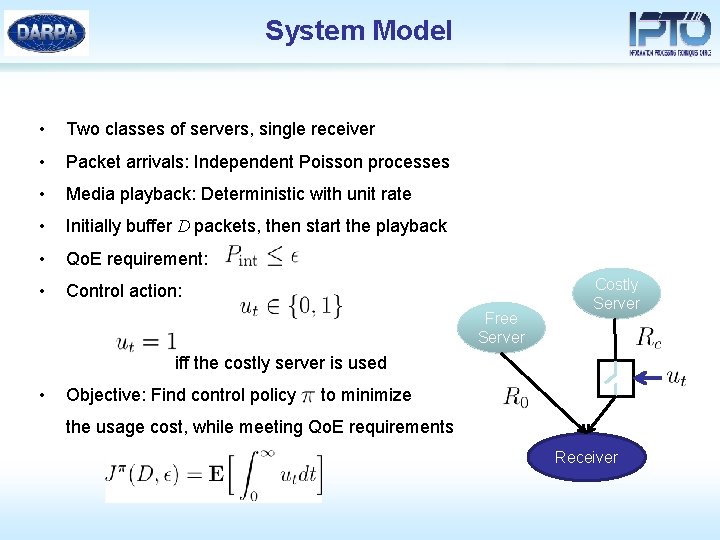
System Model • Two classes of servers, single receiver • Packet arrivals: Independent Poisson processes • Media playback: Deterministic with unit rate • Initially buffer D packets, then start the playback • Qo. E requirement: • Control action: Free Server Costly Server iff the costly server is used • Objective: Find control policy to minimize the usage cost, while meeting Qo. E requirements Receiver
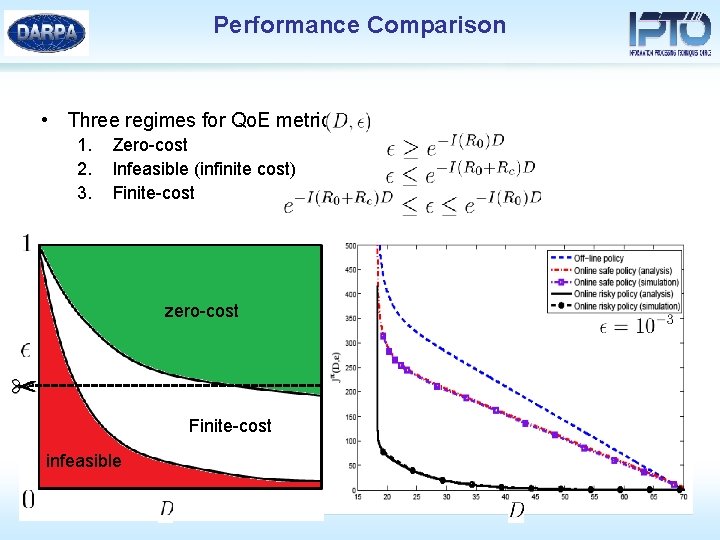
Performance Comparison • Three regimes for Qo. E metrics 1. 2. 3. Zero-cost Infeasible (infinite cost) Finite-cost zero-cost Finite-cost infeasible
Conclusions • Interference: using it as a code in the high SNR case – Code in deterministic model – Code in analog amplify and forward – Practical implication: coding with zig-zag decoding • Broadcast: building subgraphs in low SNR networks – Optimality of decode-and-forward – Practical implication: low-SNR optimization in node placement • When physical channel models do not suffice: – We can still apply information theory and optimization to the higher layers effectively 26
27